Pennsylvania Green

IMG_1540 smCrayola needs a new colour—Pennsylvania Green.

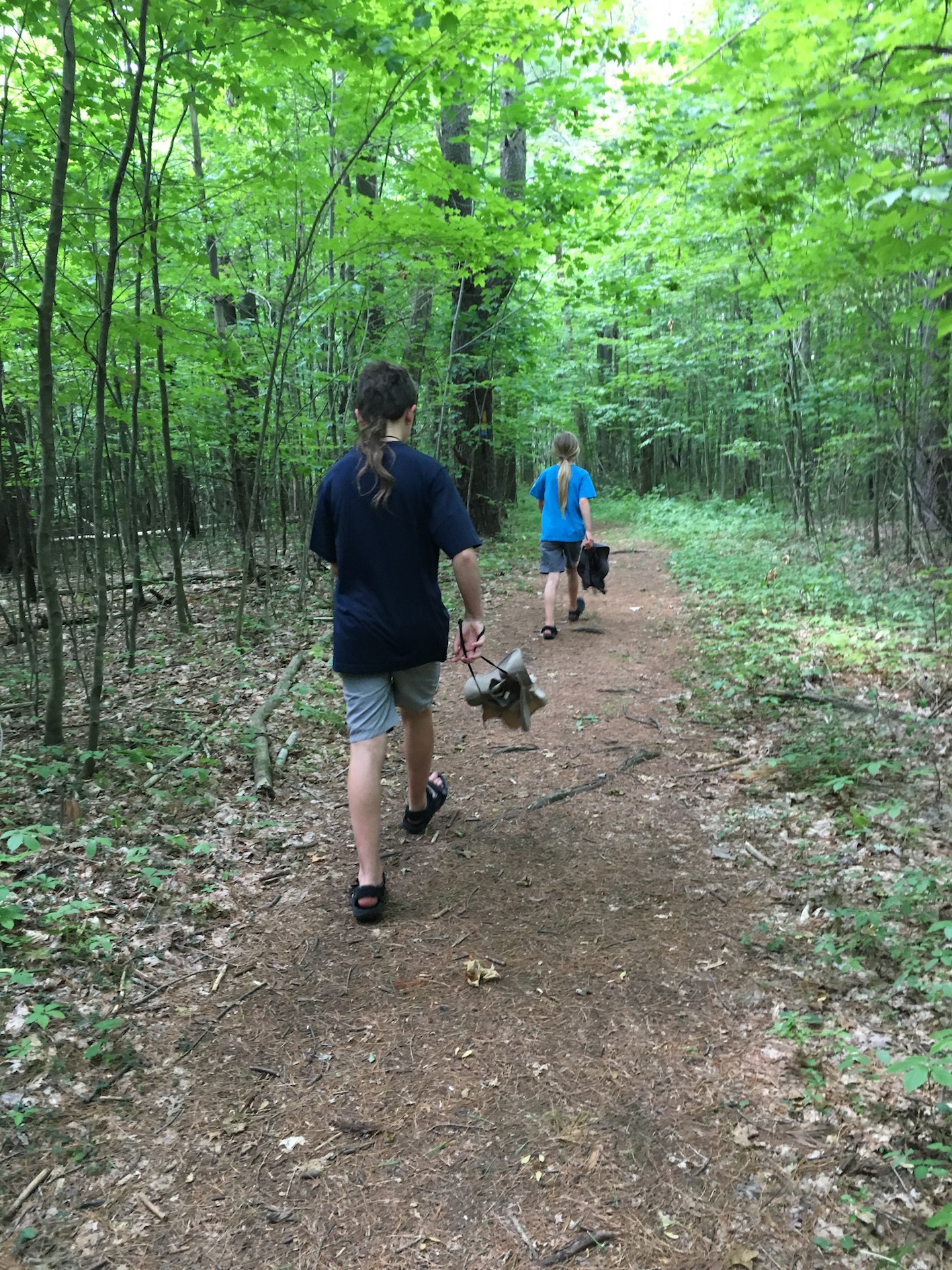
There is something about the shade of Pennsylvania forests that’s different from every other place.

I know, I know. It’s not actually possible. The forests don’t follow state boundaries. New York, West Virginia, Ohio, and Maryland have similar greens. But for me there’s nothing like Pennsylvania Green.

We spent a delightful weekend enjoying that green with friends in the middle of the state. A soothing and cool colour for a hot summer weekend.

Hooray for North American Wildlife!

IMG_1551New Zealand may have some of the more unique and awesome animals on the planet, but for sheer variety, North America is the winner.

For my kids, squirrels, chipmunks, and turtles are amazing sights. Bright cardinals, drumming woodpeckers, and colourful butterflies are exotic treasures.

To come across a deer in the woods is the event of a lifetime.

Even the forest floor is teeming with exotic creatures.

Here is one of my favourites—Apheloria virginiensis. Sometimes called the almond bug, this large bright millipede uses cyanide compounds to protect itself from predators, giving it an almond smell. Most millipedes use chemical defenses, so it’s nothing out of the ordinary in the millipede world, but who could resist the charm of this lovely creature?

Of course, spraying cyanide at your enemies isn’t particularly charming. Though they are harmless to handle, do wash your hands afterwards, because the poison can be quite irritating if you get it in your eyes.


Wolves

IMG_1524 smToday’s vacation outings included a trip to the Wolf Sanctuary of Pennsylvania. Though wolves and humans alike were wilting in the 94-degree heat, it was an interesting tour.

The animals’ individual stories were sometimes heartbreaking—most of them had been removed from owners who kept them illegally, often in poor conditions.

The wolves, kept in small to medium-sized ‘packs’ throughout the 80 acres of the sanctuary, ranged from the friendly young one who begged the keeper for a scratch through the fence, to the wary animal (kept for nine years on a chain in someone’s back yard) who wouldn’t come near the fence, even for a venison snack.

The wolf pictured here was happy to approach the fence and display his remarkable sense of smell. As you can see in the photo, he is blind—cataracts. In the wild, a blind wolf would be driven from his pack—there’s no room for disability in the wild (at the sanctuary, he is kept in a pack of two to avoid this). In captivity, he clearly thrives, making his way by smell and hearing. While we watched, he sniffed out a chunk of meat thrown into the undergrowth, and our guide related how he had once caught a rabbit that wandered into his enclosure.

Seeing these wolves in captivity was nothing like hearing wild wolves howl at night in northern Minnesota. And the stories of how they cam to be at the sanctuary are a terrible symptom of humans’ desire for mastery over wild animals. But I was glad for the opportunity to see these marvelous animals up close, an to know that in spite of their sad pasts, they are now being cared for with compassion and respect for their physical and social needs.

Some Things Never Change

001C

Photo: Peter Weiss

Summer. The beach. Sisters.

These photos were taken forty years apart. My sister and I at Barnegat in 1976, and my nieces at the same beach in 2016.

They could practically be the same girls.

Photo: Peter Weiss

Photo: Peter Weiss

Playing in the waves with your sister. Perhaps you didn’t spend much time together at other times. Perhaps your sister was the younger, irritating type. Or perhaps she was the older, bossy type. But you went to the beach, and there, with the waves rolling in, and the sand stretching on forever, you were kindred spirits. You laughed and played stupid games with the waves and sand. You collected shells together. You built sand castles.

And maybe you went back home and ignored one another, or maybe you yelled at each other, or maybe you enjoyed each other’s company at home, too. But the beach was a special bond. A place where your irritations with one another were set aside, and you were sisters—real sisters—braving the ocean together.


Cicada Killers

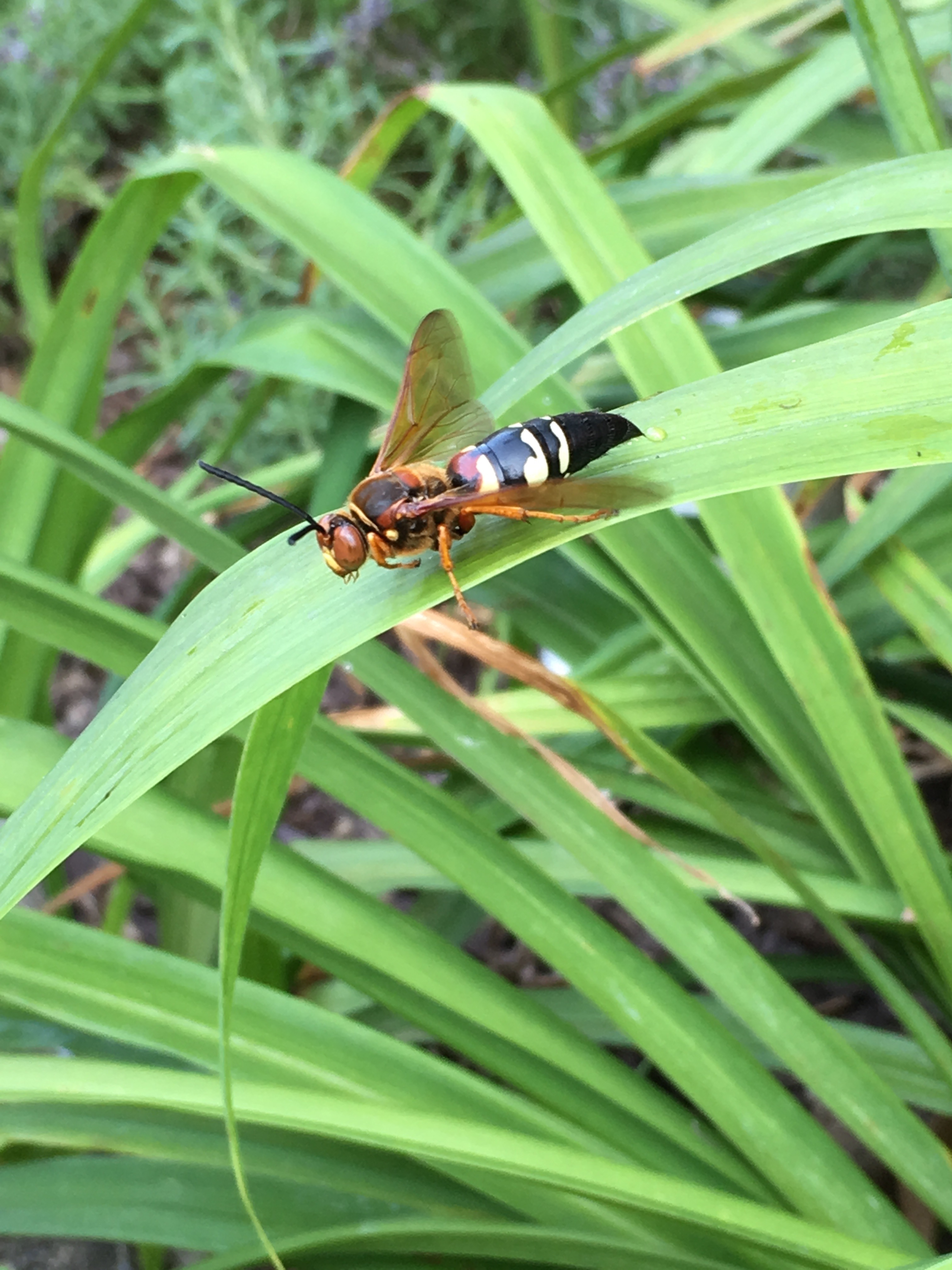
IMG_1470How can you not love an insect called a cicada killer?

The eastern cicada killer (Sphecius speciosus) is a solitary burrowing wasp. One of the largest wasps in eastern North America, the females top out at about 5 cm (2 inches) in length. These beautiful, large wasps are harmless to humans, but deadly to cicadas.

The female catches and stings adult cicadas. The sting paralyses, but doesn’t kill the cicada. The wasp then takes her immobilized prey to her underground burrow where she lays eggs on them. Male eggs get one cicada each, and female eggs get two or three cicadas (because females are bigger and need more food to reach adulthood). The eggs hatch out, and the wasp larvae eat the cicadas.

Cicada killers, looking a lot like giant hornets, strike fear into most people’s hearts. Their behaviour can be frightening, too. Males defend territories from other males, and can be seen fighting one another, grappling in midair. But males have no stinger, so they’re completely harmless to humans. Female cicada killers can theoretically sting, but unlike the social wasps, they don’t sting to defend their nests. You’re only likely to be stung by a cicada killer if you pick it up and squeeze it.

The cicada killer in this photo is a male. His territory is in my mother’s garden, and he is reliably found on a particular plant in the morning sun, sallying forth to challenge other males who get too close.

Garden of Colour

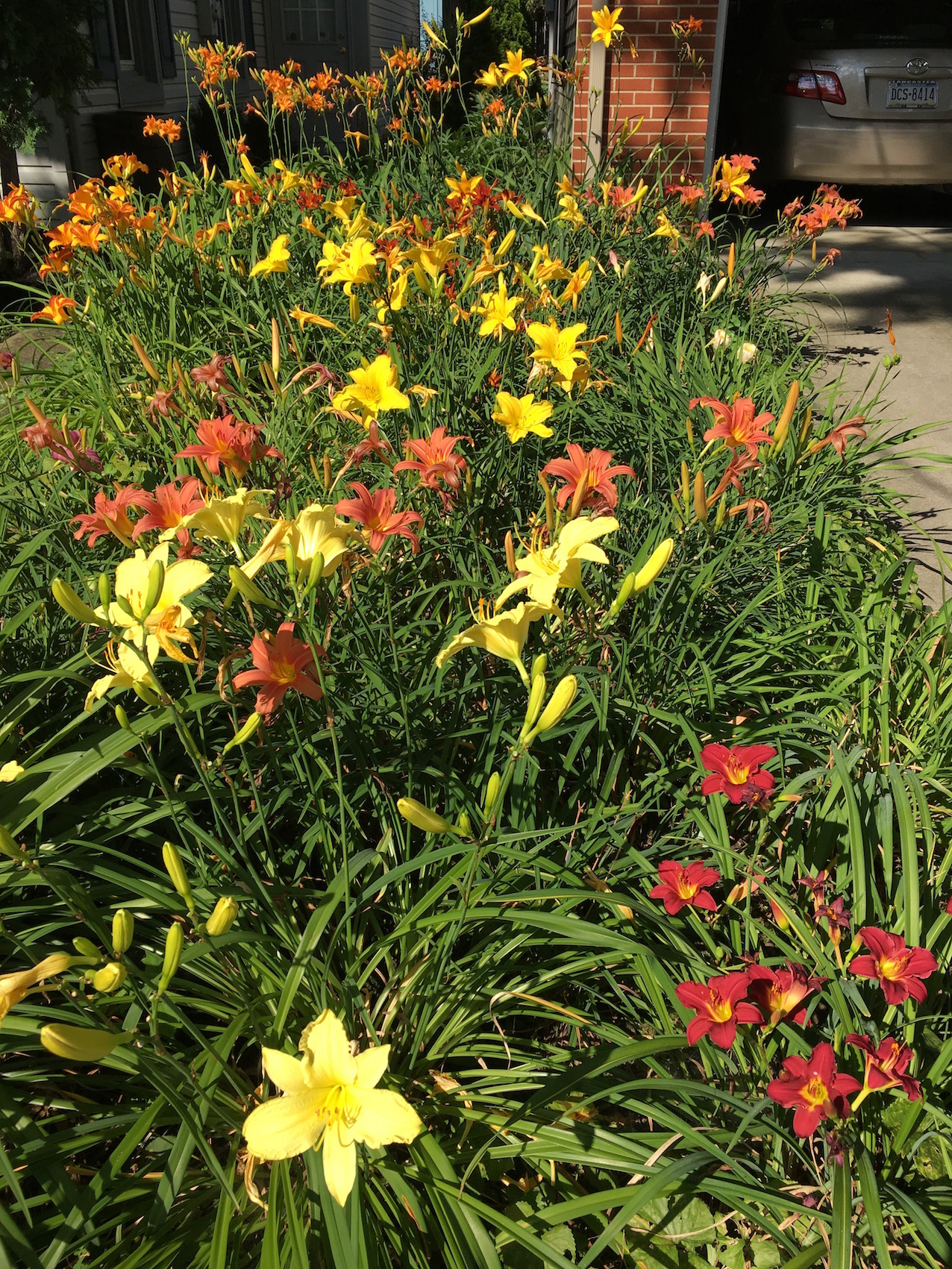
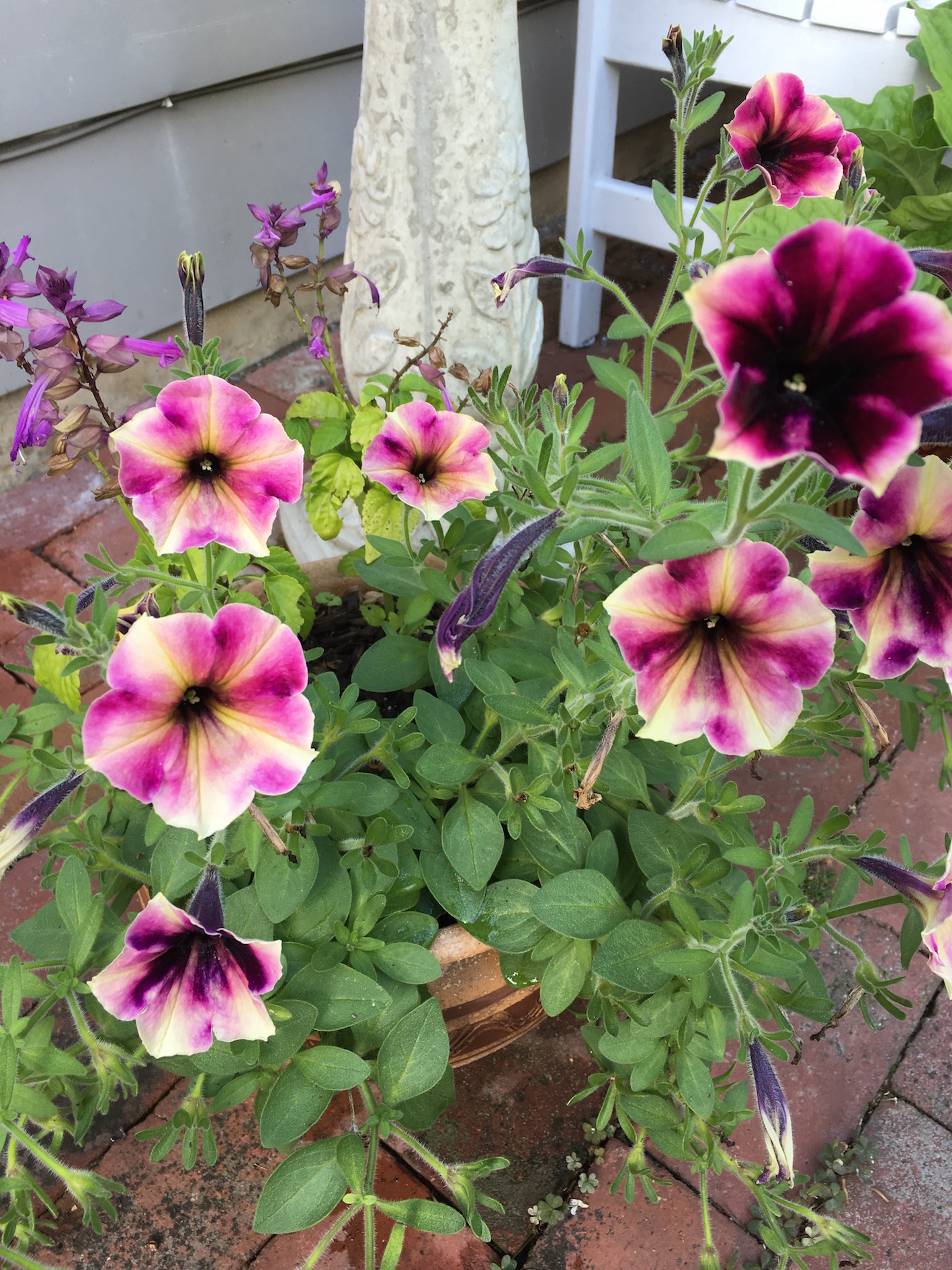
IMG_1454I don’t get to visit my parents very often, as they live on the other side of the planet. When I do, I am always struck by my mother’s garden.

For me, flowers are a second-thought. I like them, but I’m so focused on the vegetable garden, I don’t have the energy leftover for the effort of growing flowers. Nor do I really have the water to keep them growing through summer.

IMG_1453 (1)My mother, however, focuses on flowers, and her garden is a stunning show of colour. It’s amazing to me the wide variety of plants she packs into such a small space!


IMG_1448


Like Those Lichens

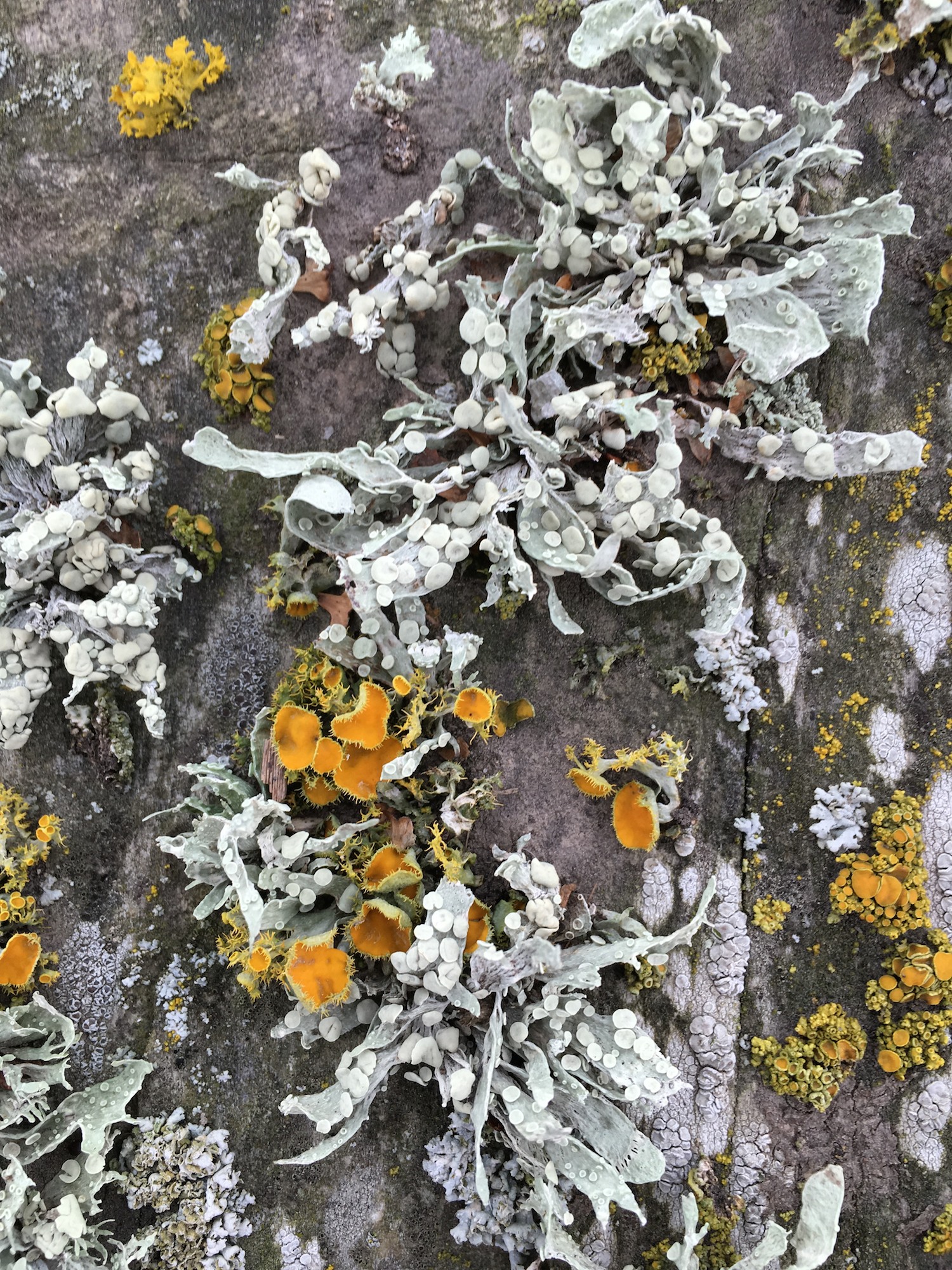
2016-07-04 10.32.44 smLichens are one of those groups of organisms that defies categorisation. A lichen is a symbiosis between a fungus and either a green alga or cyanobacteria. As such, they are neither strictly fungus, nor plant, nor bacteria.

Nor are all lichens the same. The relationships between fungi and their photosynthesising partners did not all evolve from a common ancestor, so each relationship is unique. In all cases, the fungus has the upper hand—capturing and enveloping its algal partner, and drawing carbohydrates from it. In some relationships, the fungus is only mildly parasitic, and in others it better resembles a disease on the alga.

The algae, however, do reap some benefit from the relationship. The fungal hyphae protect the alga from excess sunlight and keep it moist, allowing it to thrive in places it would otherwise be unable to survive.

Then there are the lichens that are parasitic on other lichens, stealing their algae, and those that begin as a lichen, but then become independently living fungi—there seems no upper limit on the complexity of lichen relationships.

Separate a lichen into its component organisms, and each will take on a form quite different from their joint lichen form–the lichen is more than the sum of its parts.

Together, lichens can colonise some of the most inhospitable places on the planet—bare rock, polar regions, mountain peaks, intertidal zones, and even the backs of living insects.

They certainly like to colonise my yard—benches, tree trunks, my office deck, even the roofs of house and shed are home to lichens. Many of the lichens in our yard are leaflike or shrubby in form, which is a good indication that our air quality is high. Shrubby and leaflike lichens don’t like air pollution, and tend to vanish in more industrial areas.

Biology and ecology aside, lichens are simply beautiful, with their intricate shapes and sometimes vivid colours. There’s a lot to like about lichens.
Be a Plantain

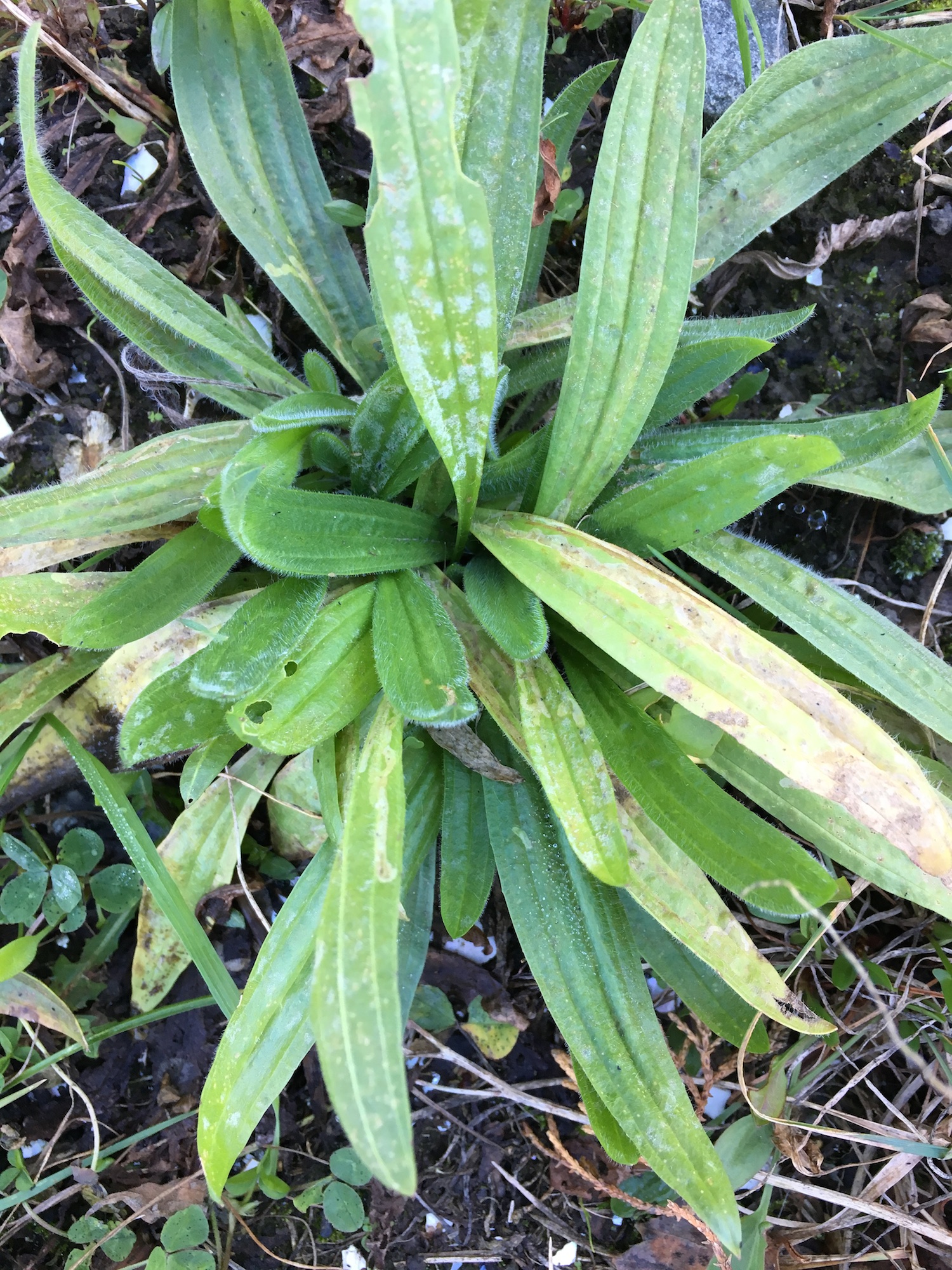
2016-06-29 14.01.15 smWeeds are survivors—that’s part of what makes them weeds—and none more so than the lowly plantain. This plant, carried throughout the world by European colonists for its medicinal uses, thrives in even the most inhospitable places.

It is common along roadsides and paths, in lawns, and even in the tiniest of cracks in pavement. It withstands trampling and mowing, and can resprout from pieces of root left in the soil.

It was known by the Anglo-Saxons as waybread or waybroad, for its habit of colonising roadsides, and it was revered for its tenacity.

And thou, Waybroad,
Mother of Worts,
Open from eastward,
Mighty within;
Over thee carts creaked,
Over thee Queens rode,
Over thee brides bridalled,
Over thee bulls breathed,
All these thou withstoodest
Venom and vile things
And all the loathly ones,
That through the land rove.

Anglo-Saxon poem about plantain, as reproduced in A City Herbal, by Maida Silverman.

As a gardener, I should despise plantain’s tenacity, it’s ability to invade and overtake my garden. Instead, I side with the Anglo-Saxons—I admire it. I might even say I aspire to be as tenacious myself.

Be tough. Be strong. Thrive in spite of the tramplings of life (or the bridalling of brides). Be a plantain.

Creative Combinations

2016-07-08 13.14.04 smOne of the cool things about having teenaged children is their increasing ability to combine ideas and skills in new and exciting ways.

Last weekend, my daughter was weaving flax fronds. I noted she had the Fun with Flax book out, and assumed she was making one of the projects in that book.

Some time later, I saw her with a wide cylinder of woven flax and a stick. She was using the stick to spin and toss the flax cylinder into the air.

I thought the idea must have come from the book, but no–she’d used weaving techniques in the book to create a unique shape, then used new skills in plate spinning (learned in PE in their circus arts unit) to manipulate the woven shape at the end of a stick.

How awesome is that?

Tūrangawaewae

DSC_0095 smIt’s Maori language week, so I thought I’d share one of my favourite Maori words—tūrangawaewae.

Tūrangawaewae is a place to stand, where a person feels strong and at home. It doesn’t really have an English equivalent. Homeland comes sort of close, but one’s homeland is not always one’s tūrangawaewae.

Though I am not a religious person, I am a spiritual one, and the word tūrangawaewae speaks to me in a spiritual way. I know where my tūrangawaewae is. It’s not so much an actual place, but a biome–the forests of the north eastern US. I am an organic part of that biome. It is wired into my nerves and muscles. Every leaf, animal and rock feels familiar.

I have little use for American culture, and no affinity with the cities and interstate highways that encroach upon my tūrangawaewae. I have honestly tried to find a new tūrangawaewae here in my adopted home. There are many places here I love. Many places to which I feel drawn. But none matches my tūrangawaewae for that deep sense of belonging.

Where is your tūrangawaewae?