Love your Library

I’ve blogged in the past about how much I appreciate libraries, but it bears repeating. I can’t deny I prefer writing in my lovely office, but modern libraries are beautifully set up for those who need to work away from the office, with power points, standing desks, and quiet spaces. I’ve spent the past two days in the public library. My word count is down, compared to working at home, but I’ve enjoyed the people watching.

One of my key observations from the past two days is how the library is a safe space in the middle of the city. A fellow at the table next to me spent an hour working on a jigsaw puzzle while his computer and phone sat unattended and unobserved on the other side of the room. Parents of toddlers calmly browse the shelves while their little ones scamper around happily out of sight. Those same toddlers swagger through the library to visit their favourite books, posters, and egg chairs as though they’re in their own living room. When their parents eventually look up and find their children gone, they don’t panic, but casually stroll after them, stopping now and again to check out an interesting book on the way. After three o’clock, kids of all ages descend upon the library to read, hang out, and play games until their parents are able to pick them up. The implicit assumption is that everyone in the library is kind, helpful, and honest. I’m sure that’s not entirely true, but the expectation is so high, I think anyone who tried to behave in a socially unacceptable way would be instantly frog-marched out of the library by all the other visitors.

It’s good to have these spaces. It’s a reminder that we can create safe spaces, where strangers from all walks of life can mix and mingle over a shared love of books.

In Praise of Parsnip

The rangy rosette of a parsnip plant.

A bit like carrots, but sweeter and starchier, parsnips are wonderful winter vegetables.

I’m not certain when I first ate parsnip, but I know I’ve eaten a lot of it. When I was breastfeeding my son, nearly everything I ate gave him colic (It took eight weeks of 24-hour-a-day screaming for me to work this out … longest eight weeks of my life). Parsnips were one of the few safe vegetables, so I ate parsnips. Lots and lots of parsnips. But I never got sick of them. Their comforting, earthy flavour only grew on me the more I ate.

I try to grow parsnips every year, but I’m not always successful. Parsnip seed has a short shelf-life, and germination can be poor, even with seed that isn’t officially past it’s ‘plant by’ date. I buy a new packet of seed every year, whether I’ve used all of the old seeds or not. Even so, I don’t always have luck germinating it, because parsnip doesn’t like to be transplanted, and needs to be seeded directly into the garden beds. In my garden, that means the seeds tend to dry out, in spite of my best efforts. It also leaves tender seedlings at the mercy of birds and slugs, which seem to enjoy parsnip as much as I do.

But this past summer the parsnips did well, like many other crops that appreciated the unusually warm, wet weather. The parsnip I picked for dinner yesterday was 15 cm in diameter at the crown, but still tender and delicious. And there are plenty more out there to harvest.

Parsnips are sweeter after the first frost, so they’re a great autumn and winter food. They store well in the ground, so there’s no need to fill your fridge with them at harvest time. When we lived in Minnesota, I used to use a pickaxe to chip them out of the frozen ground through the winter.

Parsnips make wonderful additions to stews and casseroles. Their flavours meld well with potato, carrot, and celeriac. They compliment beans and pulses. They’re great vehicles for butter and cheese. Back when I was subsisting on little beyond parsnips, we used to mash them (like mashed potatoes), braise them, and roast them, in addition to using them in stew and soup.

It’s no wonder these versatile vegetables have been cultivated since long before Roman times. They’re a great winter staple—a vegetable you can eat again and again and still enjoy.

Gluten Culture

“I’m allergic to gluten-free.”

That’s my son’s line when people ask.

In part, it’s true; he’s allergic to buckwheat, which is often used in gluten-free products. But what he’s really saying is that gluten-containing foods are a staple at our house. Our diet and our family culture would break down without gluten.

It’s been a while since I blogged about a bread day, but they still happen. Every two or three weeks my husband fires up the bread oven and bakes two dozen loaves of bread. I follow with a couple of cakes, cookies, or whatever sweets I feel like baking. On the tail-end heat, my husband might throw in some bac-un or seitan—gluten-based meat substitutes.

Between the bi-weekly gluten fests, we make pastries, muffins, scones, crackers, and all manner of other gluten-containing food.

If we took gluten out of our diet, we’d lose a protein source and a suite of family activities.

And, yes, you can bake gluten-free bread, cakes and cookies.

But they’re not the same.

There is something fundamental, something visceral about the feel of gluten—under your hands as you knead bread, in your mouth as you chew it—something that is integral to my family’s enjoyment of food.

Yes, I think we’re all allergic to gluten-free.

Slashing the Stash

It rained all weekend, so what was I to do but bake and sew for two days? It felt decadent, indulgent (though I did get my weekend chores done; I wasn’t a total slacker).

It was a rewarding weekend, too. My fabric stash has been getting out of control lately. I only buy fabric when I have a project in mind, but there’s always a little left over from any project, and it builds up. Not enough to make clothing for me or my now adult-sized kids, but enough for clothes for little kids and babies.

So this winter I’m on a mission to reduce the stash by making clothing to give to charity. On this chilly, wet weekend, I started in on my scraps of polar fleece. I made a whole raft of warm hats, and cut out the pieces for five little jackets (I need to get zips for the jackets before I can sew them). It was great fun turning all that ‘waste’ fabric into useful items.

Next weekend, I hope to start in on the knit fabric—I have patterns for baby t-shirts that’ll be perfect for using up those scraps. And then there’s the denim, cotton broadcloth, corduroy … so many fabrics, and so many creative possibilities, once you think small.

I managed to cut my polar fleece volume down by half—my stash reduced to pieces useful for my own clothes. If I can do the same with all my other fabrics, I’ll be thrilled. I get more space in my cupboard, I get to indulge in sewing I enjoy doing, and someone in need gets new clothes. It’s a win for everyone.

Hiking Under the Influence of Parenthood

My daughter and I went hiking for two days this week, taking advantage of the school holidays to get out. On our first day, we summited Little Mount Peel. Several years ago the whole family hiked the same track, though not to the top. In those days, my husband and I pulled the kids along behind us. Encouraging them on, waiting for them while they took breaks.

These days, it’s the other way around. I determined we would go at my pace, not the 14 year-old rock climber’s pace. She pulled me up the mountain, stopping occasionally to let me catch up. (Where did she learn that bland, patient smile, calculated to hide her boredom?)

I wish I could be as oblivious as the children I used to pull up the mountain.

Though I hiked behind her, I was still out in front, assessing risk, calculating her need for food and rest, figuring hiking times and return times, keeping an eye on her warmth. I was still the worrier, still the responsible parent.

When the kids were young, I dreamed of the day they could keep up. Now I fear the kids’ ability to get into trouble has outstripped their ability to manage risk. Not surprising. That’s what teens do.

But now I dream of a day when I can simply hike, without worrying about anyone’s safety but my own. I will go at my own pace, stop when I am tired, sit on rocky outcrops for hours contemplating the patterns of ridge lines in the distance. Perhaps once again I will experience a place fully, and not through the fog of parental responsibility.

Home Fires Burning

Cat enjoying a good book by the fire.

I woke yesterday morning shivering under the summer quilt on the bed after a restless night listening to icy rain on the roof.

Time to switch to winter mode, I suppose.

I lit the first fire of the season.

It wasn’t long before the cat joined me by the fire. Then my daughter, then my husband, then my son…Nothing like a hearth to draw everyone together.

I think about the angst over today’s youth, separated from face-to-face interactions by their devices, and I think that perhaps what we all need are small, poorly insulated houses heated by inefficient wood burners. In a big, centrally heated house, it’s easy for everyone to retreat to their own rooms—shut the door, pull out the phone and troll the internet. But in our house, the only comfortable room in the winter is the 3×4 m living room. A teen who retreats to their room and shuts the door pretty quickly returns to warm up by the fire.

Yes, we may all sit here doing our own thing, but by gathering around the fire together, we share what we’re doing with each other. Someone might share a good line from the book they’re reading, or show a dumb cat video they thought was funny, or ask for help on a maths problem. Simply by virtue of proximity, we connect in other ways.

I will admit that on winter mornings, crawling out of a warm bed into the freezing air to light the fire, I dream of luxuries like heat pumps. And sometimes it would be really nice to have some space to myself, rather than do my knitting cheek-by-jowl with a teenager practicing a new juggling trick. But on the whole, I suspect the benefits outweigh the drawbacks. We humans are hardwired to sit around the fire talking to one another. Our ways of relating to one another, passing on wisdom and culture, and finding our place in a community evolved around the fire.

So, again this winter, I will keep the home fires burning.

Summer Soup 2018

I feel like a broken record sometimes (those of you under the age of 45, ask your parents what I mean by that). The garden season repeats itself each year in a pretty predictable fashion, and I find myself blogging about the same events every year.

Saturday was Summer Soup day, which I’ve blogged about more than once before (in 2015 and again in 2016). This year’s production was 25 quarts of soup and 6 quarts of vegetable stock, bottled and ready for quick meals throughout the year. Production time, just over 14 hours.

It always feels good to fill every pot in the kitchen with delicious vegetable soup…at least for the first hour or so. But by the end of the day, I’m sick of being in the kitchen and ready to collapse. I need to remember the feeling later in the year when I’m feeling guilty about just pulling a jar of soup out of the cupboard for dinner. I’ve put in the time. We all have, because even the kids help pick and chop vegetables for summer soup. We’ve earned every ‘free’ meal we get from it.

Crazy Cake Season 2018—#2

My son left it wide open for me this year. He wanted his usual spice cake (the one I’ve marked with his name in the cookbook), but he left it up to me how I decorated it.

I swear that was more difficult than being told what he wanted.

After many hours scouring the cupboards and looking at cake photos online for inspiration, I came up with a large geode.

Most geode cakes online are, frankly, weird—an ordinary tiered cake covered smoothy in fondant, with a slash down the side filled with geode crystals. They don’t look like a geode at all, and some look disturbingly like vaginas. I didn’t think my son would appreciate that. I strove for a more natural geode look.

I also hoped for a tastier geode material. I was inspired to do a geode by a bag of crystalised ginger in the cupboard. Most geode cakes, though, are made with rock candy, which isn’t the nicest accompaniment to cake. On a spice cake, I thought crystalised ginger would be a much more appropriate flavour (and texture). Unfortunately, my experiments with colouring ginger were uninspiring—the ginger had a beautiful sparkling appearance, but light colours looked grey on the yellowish ginger, and dark colours looked black. I couldn’t manage a nice geode-like lavender.

So I made purple hard candy and broke it into shards for the crystals.

The result was reasonably geode-like, and easy to make. And better than a crystal vagina.

Downsizing?!

I realised a shocking thing the other day. My son will finish high school in December this year. We all hope he’ll be leaving home for university shortly thereafter.

Next year, my teenage boy won’t be here all summer to eat vegetables.

Next year, I’ll need to plant a smaller garden, or be completely overwhelmed with food we can’t eat.

This is the last summer I will ever have a garden this big.

I’m having a harder time adjusting to that thought than I am the thought one of my kids will leave home in a year. Oh, I always knew that someday I’d scale back the garden, but ‘someday’ in my mind was always when I grew too old to manage so much garden.

But ‘someday’ is next year.

How am I going to cut back? Which varieties will I not plant? How will I curb my zucchini problem? What am I going to do with my time, if I’m not forced to spend every daylight hour in the garden from September to December?

It’s a good thing I have several months to prepare. This is going to take some getting used to.

Crazy Cake Season 2018–Cake #1

It’s that time of year again, when I get to indulge in all things cakey.

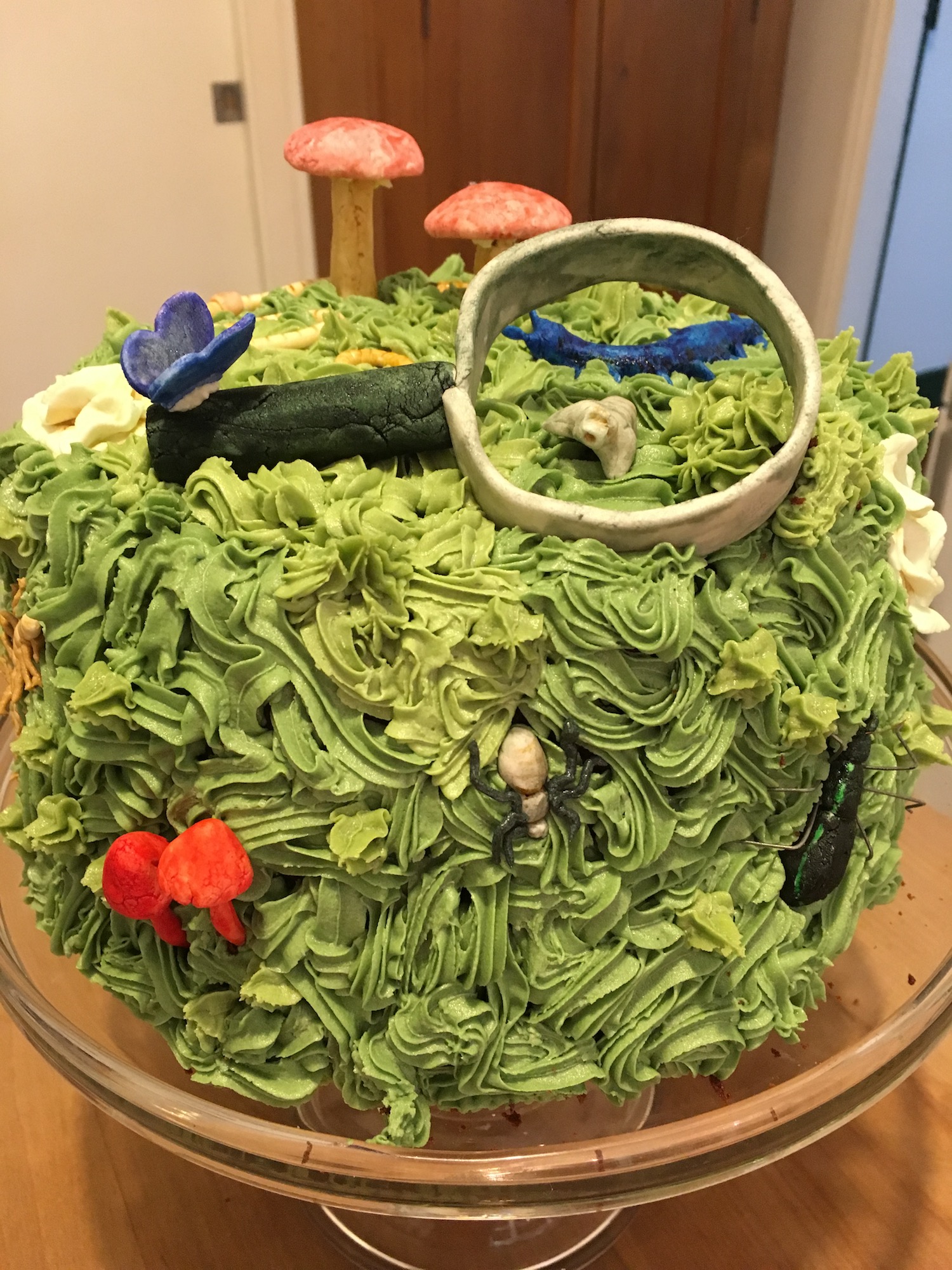
The girl asked for ‘a mossy hummock with life’ this year. I had fun creating invertebrates and fungi from Mexican paste. In hindsight, I should have made more critters—when it came time to place them on the cake, it felt sparsely populated. But the final effect was fun, and the overly decadent chocolate cake underneath was spectacular.