Preparing for Gita

Just some of the weekend’s harvest.

I have been AWOL from the blog for longer than usual. I have good reasons, one of which is whirling toward New Zealand as I type. Cyclone Gita is bearing down on us, and though we aren’t likely to bear the full brunt of her damage at our place, we will get heavy rain and gale-force winds.

So I’ve spent the last two days bringing in the crops that might be damaged by her—wheelbarrow loads of corn, soy, black beans, borlotto beans, tomatoes, and apples. This summer’s intense heat and sufficient rainfall have not only encouraged excess cucurbits, but also increased my bean harvest—picking took far longer than I expected, and I will spend the next week shelling them all.

But when the rain starts later tonight, I’ll be able to relax, knowing I’ve done as much as I can to protect the crops. And the rush to bring them in means the job isn’t still hanging over me, lingering on the to-do list.

So I may not have posted the blogs I’d hoped to, but I’m ready for whatever Gita throws at us.

Little Beach Poems

Spent some time at ‘our’ beach today, watching waves, birds, dolphins. Here are a few little poems I wrote there:

Terns wheel and bob
Above each dolphin
Like balloons on a string.

****

Wave rises, crests
Wind blows foam back

Like errant strands of hair.

****

The hiss-swoosh of wave
And rolling pebbles
Rounds all edges.

****

Shag arcs and dips its head.
The body follows
And is gone.

Summer Soup 2018

I feel like a broken record sometimes (those of you under the age of 45, ask your parents what I mean by that). The garden season repeats itself each year in a pretty predictable fashion, and I find myself blogging about the same events every year.

Saturday was Summer Soup day, which I’ve blogged about more than once before (in 2015 and again in 2016). This year’s production was 25 quarts of soup and 6 quarts of vegetable stock, bottled and ready for quick meals throughout the year. Production time, just over 14 hours.

It always feels good to fill every pot in the kitchen with delicious vegetable soup…at least for the first hour or so. But by the end of the day, I’m sick of being in the kitchen and ready to collapse. I need to remember the feeling later in the year when I’m feeling guilty about just pulling a jar of soup out of the cupboard for dinner. I’ve put in the time. We all have, because even the kids help pick and chop vegetables for summer soup. We’ve earned every ‘free’ meal we get from it.

Downsizing?!

I realised a shocking thing the other day. My son will finish high school in December this year. We all hope he’ll be leaving home for university shortly thereafter.

Next year, my teenage boy won’t be here all summer to eat vegetables.

Next year, I’ll need to plant a smaller garden, or be completely overwhelmed with food we can’t eat.

This is the last summer I will ever have a garden this big.

I’m having a harder time adjusting to that thought than I am the thought one of my kids will leave home in a year. Oh, I always knew that someday I’d scale back the garden, but ‘someday’ in my mind was always when I grew too old to manage so much garden.

But ‘someday’ is next year.

How am I going to cut back? Which varieties will I not plant? How will I curb my zucchini problem? What am I going to do with my time, if I’m not forced to spend every daylight hour in the garden from September to December?

It’s a good thing I have several months to prepare. This is going to take some getting used to.

Aftermath

The courgettes (zucchini) will recover, in spite of all the broken leaves.

The remnants of cyclone Fehi hit New Zealand yesterday. We didn’t receive the brunt of the storm, and I am thankful for that. But we didn’t escape damage.

After Fehi’s wind dumped rain on the West Coast, it swooped over the Southern Alps and raced down the other side, heating up as it went. We were blasted by the hot, dry wind—gusts at least 130 kph (and higher, by the damage inflicted), and a temperature that reached 35ºC by early afternoon.

Parts of the garden will not recover. I’m glad we ate our first sweet corn earlier in the week, because it might be our last—the corn lies flat on the ground today.

The greenhouse plastic was shredded, and the stakes holding the greenhouse in place were pulled from the ground. Only my paranoia about the greenhouse taking flight in the wind saved the structure—years ago, I’d tethered it to y-posts driven deep into the soil. They were the only things left holding the structure in place.

Today is cool and rainy. The change will help the garden recover from yesterday’s thrashing, but it can’t bring back the stripped fruit, broken branches, and fatally flattened vegetables. It won’t fix the greenhouse.

We pick up the mess and get on with it. The damage is discouraging, but I am not discouraged. If gardening (and life in general) were not laced with setbacks and disaster, we could take no pride in our accomplishments. I will be extra-pleased with every tomato and cucumber we eat for the remainder of the summer.

And, by the way, if cyclone Fehi did nothing else, it reminded me where the name Debbie’s chutney came from—cyclone Debbie stripped the apples from the trees before they were ripe. We made chutney from those apples, and named it Debbie’s. Perhaps we will be making Fehi’s chutney this weekend.

Market Smells

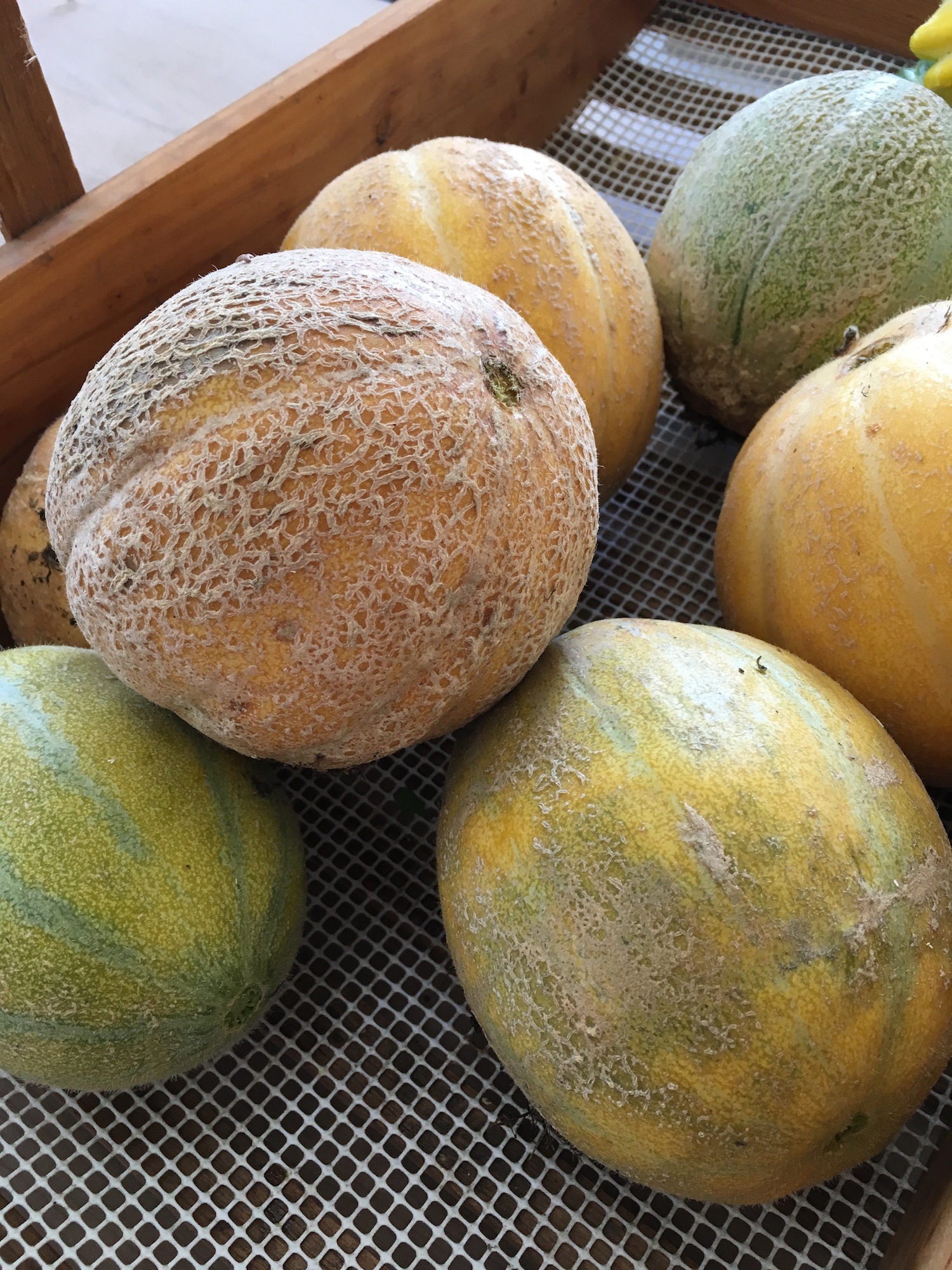
I brought seven dead-ripe rock melons in from the garden yesterday afternoon. The smell in the kitchen was overpowering, and took me directly to Roots Market, a large farmers’ market in Lancaster County PA, on a hot July day.

For me, the smell of ripe melons = Roots. I’m not entirely certain why—there are many competing smells at the market. Perhaps because in the mid-1980s a melon grower had a stall at the entrance where my family always arrived, so it was the first smell I experienced every time. Whatever the reason, that smell will forever be associated with that market in my mind.

I’ve been to many farmers’ markets since the mid-80s. Memorable smells accompany many of them.

In Ann Arbor, Michigan, it was basil, which my housemates and I bought by the grocery-bag for pesto.

In Panama, the market in Penonome was where my husband and I shopped every week or two. The meat-sellers’ area was screened from the flies, but the screen didn’t stop the smell of beef, pork, chicken and fish on display in the tropical heat from wafting through the market.

In St. Paul, Minnesota, I remember the smell of flowers and sweet corn.

I haven’t been to many farmers’ markets here in New Zealand, because I grow all our vegetables, but as a seller in Leeston, I remember the smell of my friend Cris’s homemade bagels.

Pretty cool how smell can act as a teleportation device, spanning distance and time in an instant.

50 Ways to Eat Zucchini

I’ve been humming the Paul Simon tune, Fifty Ways to Leave Your Lover, but changing the words a little…

There must be fifty ways to eat zucchini.

Just fry it in ghee, Lee, make a stir fry, Guy
Don’t need to be fancy, Nancy, just listen to me
Pop it in lasagne, Yolanda, don’t need to be fond of it
Just put it in tea, Lee, and eat your zucchini.

Wondering how many ways we do eat zucchini, I started a list.

I got to 42 before I had to think too hard. So here we go…

  1. Raw sticks dipped in skordalia or your favourite veggie dip.
  2. As crostini: thinly sliced and topped with cheese, tapanade or olivade.
  3. With peas, carrots and pesto over pasta.
  4. In burgers.
  5. In enchiladas.
  6. Grated in a tomatoey spaghetti sauce (adds wonderful texture).
  7. Grated, raw, in burritos.
  8. In vegetable pakoras.
  9. In calzones.
  10. In cheese pasties.
  11. On pizza.
  12. Herb and parmesan-crusted.
  13. Zucchini bread.
  14. Zucchini cake.
  15. Chocolate zucchini cake.
  16. Zucchini sorbet (trust me, this is amazing!).
  17. Frittata.
  18. In stir-fry.
  19. In fried rice.
  20. In Not Yo Mama’s Mac and Cheese.
  21. Stuffed with mushrooms and cheese.
  22. In vegetable soup.
  23. Zucchini and tomato tart.
  24. In quiche.
  25. Zucchini and cheese madeleines.
  26. Zucchini and cheese muffins.
  27. In roast vegetables.
  28. Grilled.
  29. Zucchini souffle (not the best souffle–zucchini releases too much water).
  30. Coleslaw with zucchini.
  31. Kebabs.
  32. Oven-baked Zucchini tomato risotto.
  33. Ratatouille.
  34. Sauteed with garlic and herbs.
  35. In summer vegetable stew.
  36. Panir Louki Tarkari–Paneer, zucchini and red bell peppers.
  37. Zucchini pickles (meh. I wouldn’t do these again).
  38. Mixed vegetable curry.
  39. Braised.
  40. Zucchini fritters.
  41. Zucchini cheese tart.
  42. In Uplifted Polenta Lasagne.

There are our 42 ways. There must be (at least) 50 ways to eat zucchini.

Year of the Cucurbit

A portion of one day’s cucurbit harvest…and the melons and pumpkins haven’t even begun.

The Chinese New Year is coming up in less than a month. It will be the year of the dog.

I beg to differ. At least at Crazy Corner Farm, it will be the year of the cucurbit.

Extremely high temperatures combined with an unusual amount of rain seem to have encouraged growth of the pumpkins, zucchinis, melons, and cucumbers this year. I have never, in over 30 years of gardening on three continents, seen cucurbits grow like this.

I accept responsibility for the zucchini. I know I always plant too many. But the others aren’t my fault.

Melons are usually incredibly difficult to grow here. They barely grow, and give very few, tiny fruits. I’ve tried them in the greenhouse, and they seem to do even worse there than in the garden. Too cool and dry, I suspect. Not this year! They have outgrown their bed and are invading the beans on either side of them. There are dozens of fruit set, and those fruits (still quite immature) are already larger than most of the mature fruits I’ve gotten in previous years.

The pumpkins have simply devoured half the garden. They’ve invaded the corn, overtopping it in some places. I’ve had to push them back into the garden when they’ve escaped, growing over five metres from where I planted them. I planted just a few plants each of pickling cucumbers and  table cucumbers, and spaced the two varieties well apart from one another. I am now hacking them back to keep them separate and avoid them spreading over the shade house. My plan with the pickling cucumbers was to have just a handful for making fresh pickles (because I only ‘make pickles’ every two years to avoid becoming the crazy pickle lady), but I’m harvesting as many pickling cucumbers as I do on most pickle years.

I have lost all paths in half the garden to cucurbits, and many of the paths in the more clear half are overgrown, too. It is truly out of control. I have never seen this sort of cucurbit exuberance before.

So, I declare 2018 Year of the Cucurbit. Care for a pickle, anyone?

A new species!

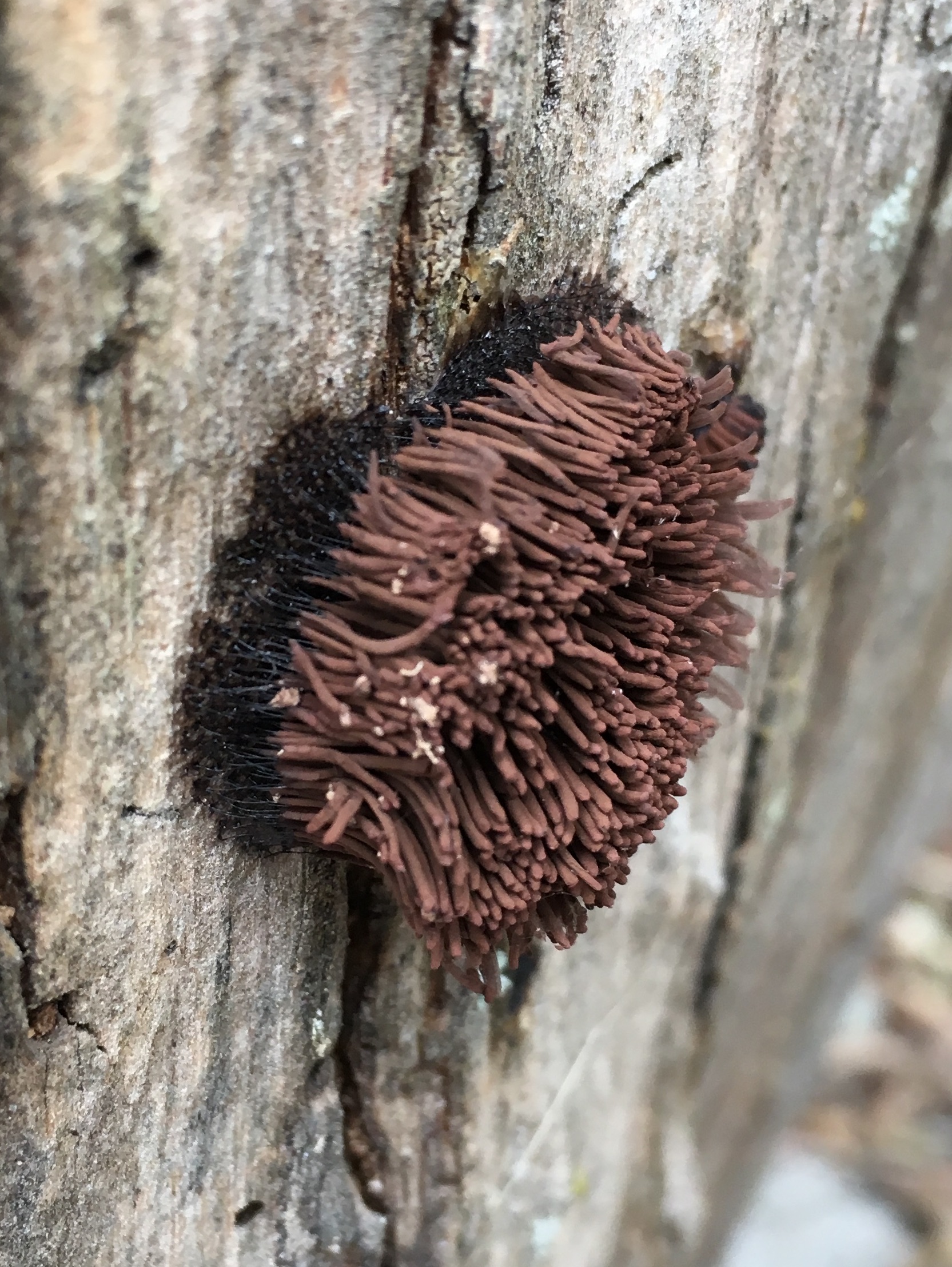
It’s always exciting to discover a new species in the yard. Yesterday we found a chocolate tube slime mould (in the genus Stemonitis). A beautiful creature, and aptly named.

If you Google chocolate tube slime mould, you get lots of websites calling it a fungus. Let’s just get this straight right now. Slime moulds are not fungi. Not even close. They’re not even in the same Kingdom of life. Saying a slime mould is a fungus is about as accurate as saying you are a fungus.

We’re a bit nutty about slime moulds here at Crazy Corner Farm … Okay, we’re a little more than a bit nutty about slime moulds. My daughter and husband have been working for months on a slime mould bridge modelled after Physarum polycephalum.

Slime moulds are some of the strangest organisms you’ll find in your back yard. Many are named for their looks, and one of the most common species goes by the name ‘dog vomit slime mould’.

The two groups of slime moulds, plasmodial and cellular, are quite different from one another, and both types are weird and wonderful creatures. Plasmodial slime moulds can cover several square metres, but are made of just one cell filled with thousands of nuclei. They creep across the ground like a giant amoeba with pulsing waves of cytoplasm, engulfing and eating bacteria.

But they’re more than just quivering bags of goo; they can solve mazes, even choosing the most efficient pathway if there is more than one. Cellular slime moulds (which don’t form enormous multi-nucleus cells) can join together to create a multi-cellular organism when the need arises for a larger, more mobile body.

Slime moulds may even save us from the growing problem of antibiotic-resistant bacteria—researchers are working on ‘training’ cellular slime moulds to sense and destroy resistant bacteria.

So you can see why we were excited to find another species of slime mould living on our property! Who wouldn’t be excited by it?

How To Eat a Whale

Melinda Mae took eighty-nine years to eat a whale, according to Shel Silverstein. How’d she do it? “…she started in right at the tail.” and “She took little bites and she chewed very slow, / Just like a good girl should…”

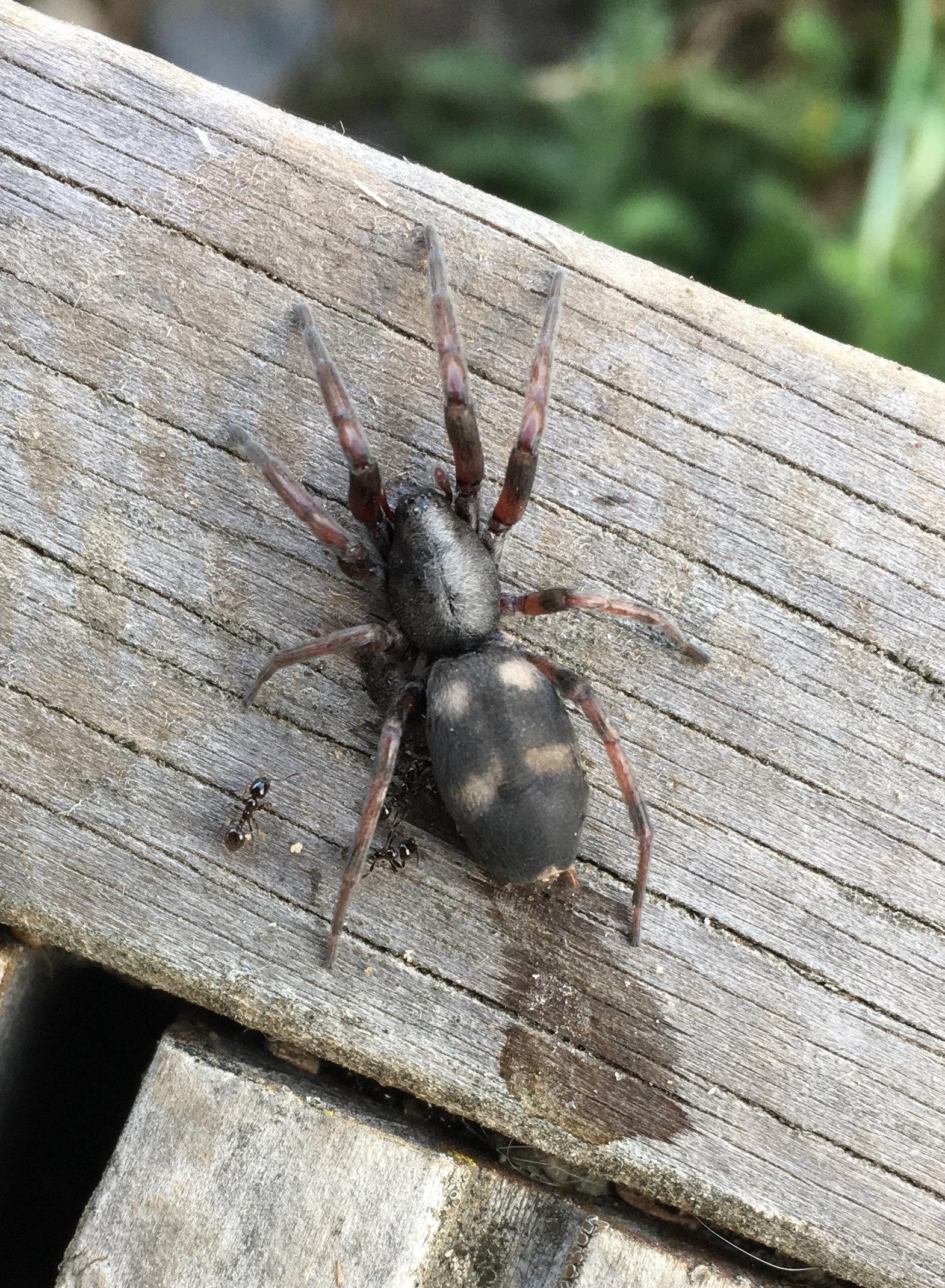
This morning I found this adult female white-tailed spider on my office deck. I don’t know what killed her—she’d dragged herself about 20 cm across the deck oozing hemolymph before succumbing to whatever it was—but by the time I saw her, the ants had found her.

At first, they swarmed over her body, biting at her legs, tugging at hairs. I looked closely with a hand lens—they’d made not a mark on her exoskeleton. Melinda Mae was lucky whales’ skeletons are on the inside.

Eventually, the ants stopped swarming, and I assumed they’d given up eating their ‘whale’.

But a few hours later, I checked again and noticed an ant slip underneath the spider’s body. Another photograph revealed the spider was shrivelling.

Some of the shrivelling would be from dehydration, for sure. But as I watched, I saw a steady stream of ants slipping in under the spider, then slipping out again. Something had punctured her, killing her. The ants had found the hole and were using it to access the soft bits inside.

I expect these ants will accomplish their task much more quickly than Melinda Mae did, but then, they’re working as a team.

So how do you eat a whale?

Well, if it’s got an exoskeleton, the answer is, from the inside out. And if you want to finish before you grow old, get some friends to help.