A new species!

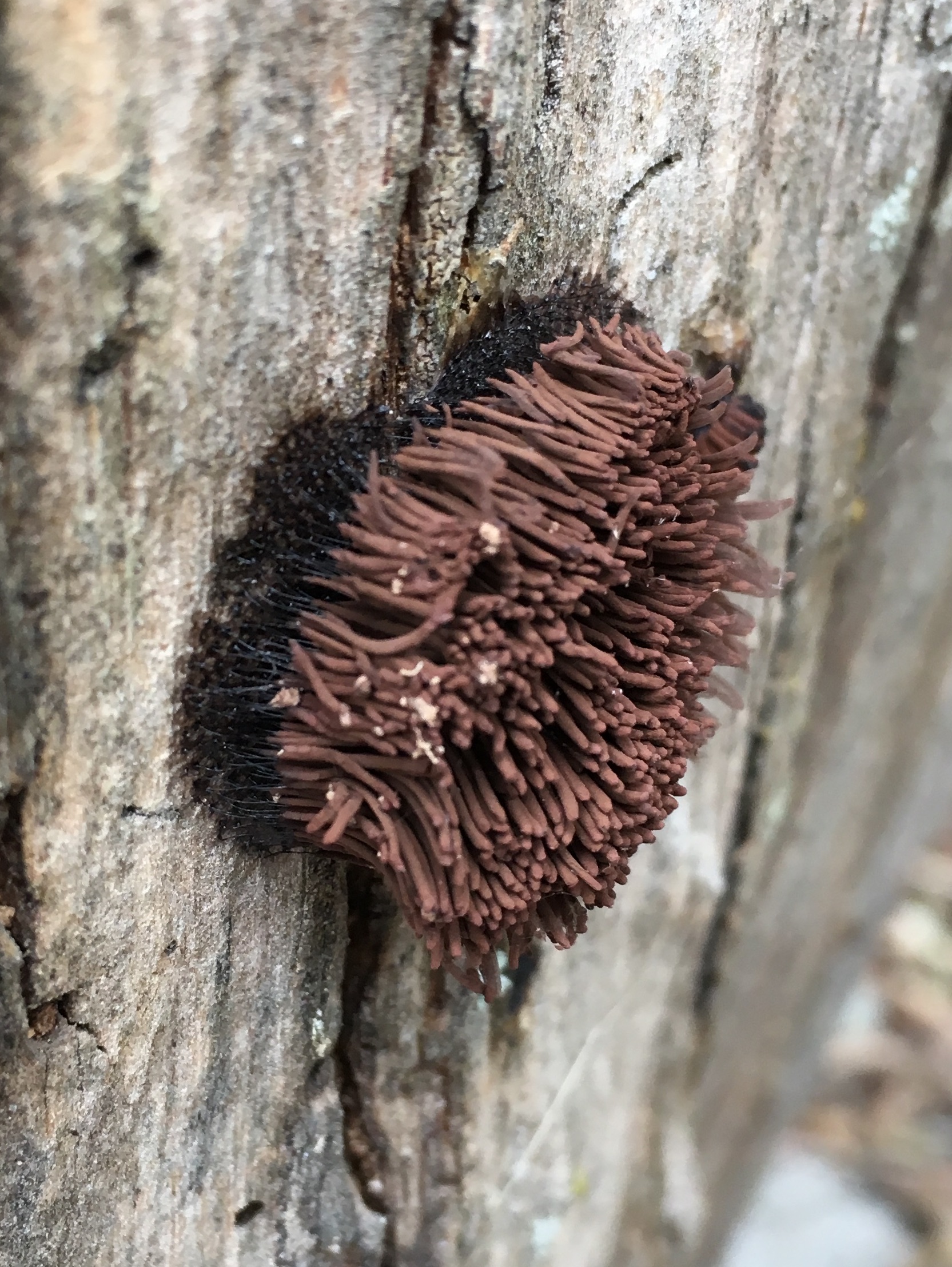
It’s always exciting to discover a new species in the yard. Yesterday we found a chocolate tube slime mould (in the genus Stemonitis). A beautiful creature, and aptly named.

If you Google chocolate tube slime mould, you get lots of websites calling it a fungus. Let’s just get this straight right now. Slime moulds are not fungi. Not even close. They’re not even in the same Kingdom of life. Saying a slime mould is a fungus is about as accurate as saying you are a fungus.

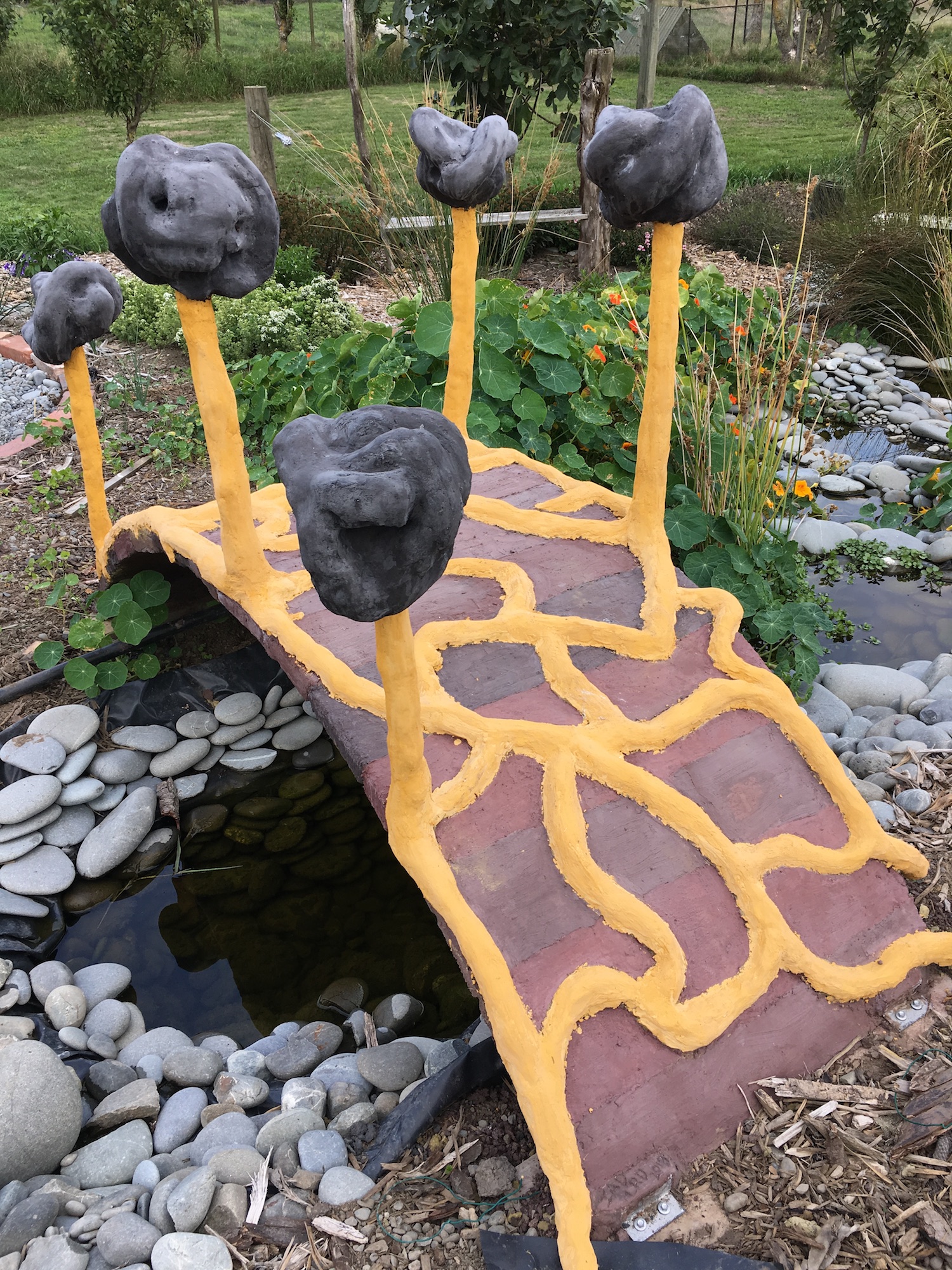
We’re a bit nutty about slime moulds here at Crazy Corner Farm … Okay, we’re a little more than a bit nutty about slime moulds. My daughter and husband have been working for months on a slime mould bridge modelled after Physarum polycephalum.

Slime moulds are some of the strangest organisms you’ll find in your back yard. Many are named for their looks, and one of the most common species goes by the name ‘dog vomit slime mould’.

The two groups of slime moulds, plasmodial and cellular, are quite different from one another, and both types are weird and wonderful creatures. Plasmodial slime moulds can cover several square metres, but are made of just one cell filled with thousands of nuclei. They creep across the ground like a giant amoeba with pulsing waves of cytoplasm, engulfing and eating bacteria.

But they’re more than just quivering bags of goo; they can solve mazes, even choosing the most efficient pathway if there is more than one. Cellular slime moulds (which don’t form enormous multi-nucleus cells) can join together to create a multi-cellular organism when the need arises for a larger, more mobile body.

Slime moulds may even save us from the growing problem of antibiotic-resistant bacteria—researchers are working on ‘training’ cellular slime moulds to sense and destroy resistant bacteria.

So you can see why we were excited to find another species of slime mould living on our property! Who wouldn’t be excited by it?

How To Eat a Whale

Melinda Mae took eighty-nine years to eat a whale, according to Shel Silverstein. How’d she do it? “…she started in right at the tail.” and “She took little bites and she chewed very slow, / Just like a good girl should…”

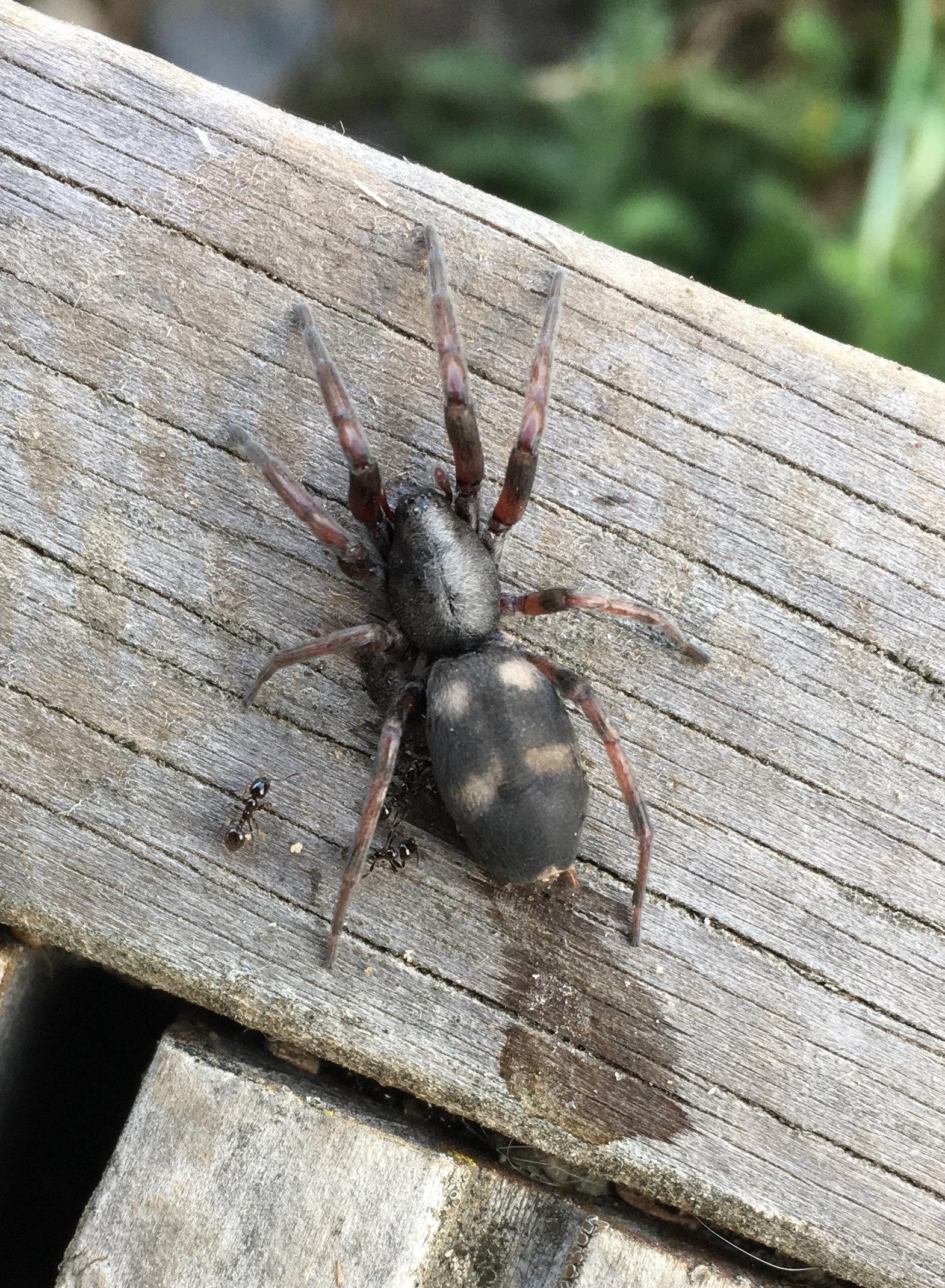
This morning I found this adult female white-tailed spider on my office deck. I don’t know what killed her—she’d dragged herself about 20 cm across the deck oozing hemolymph before succumbing to whatever it was—but by the time I saw her, the ants had found her.

At first, they swarmed over her body, biting at her legs, tugging at hairs. I looked closely with a hand lens—they’d made not a mark on her exoskeleton. Melinda Mae was lucky whales’ skeletons are on the inside.

Eventually, the ants stopped swarming, and I assumed they’d given up eating their ‘whale’.

But a few hours later, I checked again and noticed an ant slip underneath the spider’s body. Another photograph revealed the spider was shrivelling.

Some of the shrivelling would be from dehydration, for sure. But as I watched, I saw a steady stream of ants slipping in under the spider, then slipping out again. Something had punctured her, killing her. The ants had found the hole and were using it to access the soft bits inside.

I expect these ants will accomplish their task much more quickly than Melinda Mae did, but then, they’re working as a team.

So how do you eat a whale?

Well, if it’s got an exoskeleton, the answer is, from the inside out. And if you want to finish before you grow old, get some friends to help.

Infidelity

It’s time to come clean. This will be hard for some of you to hear, but it needs to be said. I never thought this would happen. I never thought I’d be saying this, but I can’t deny it anymore.

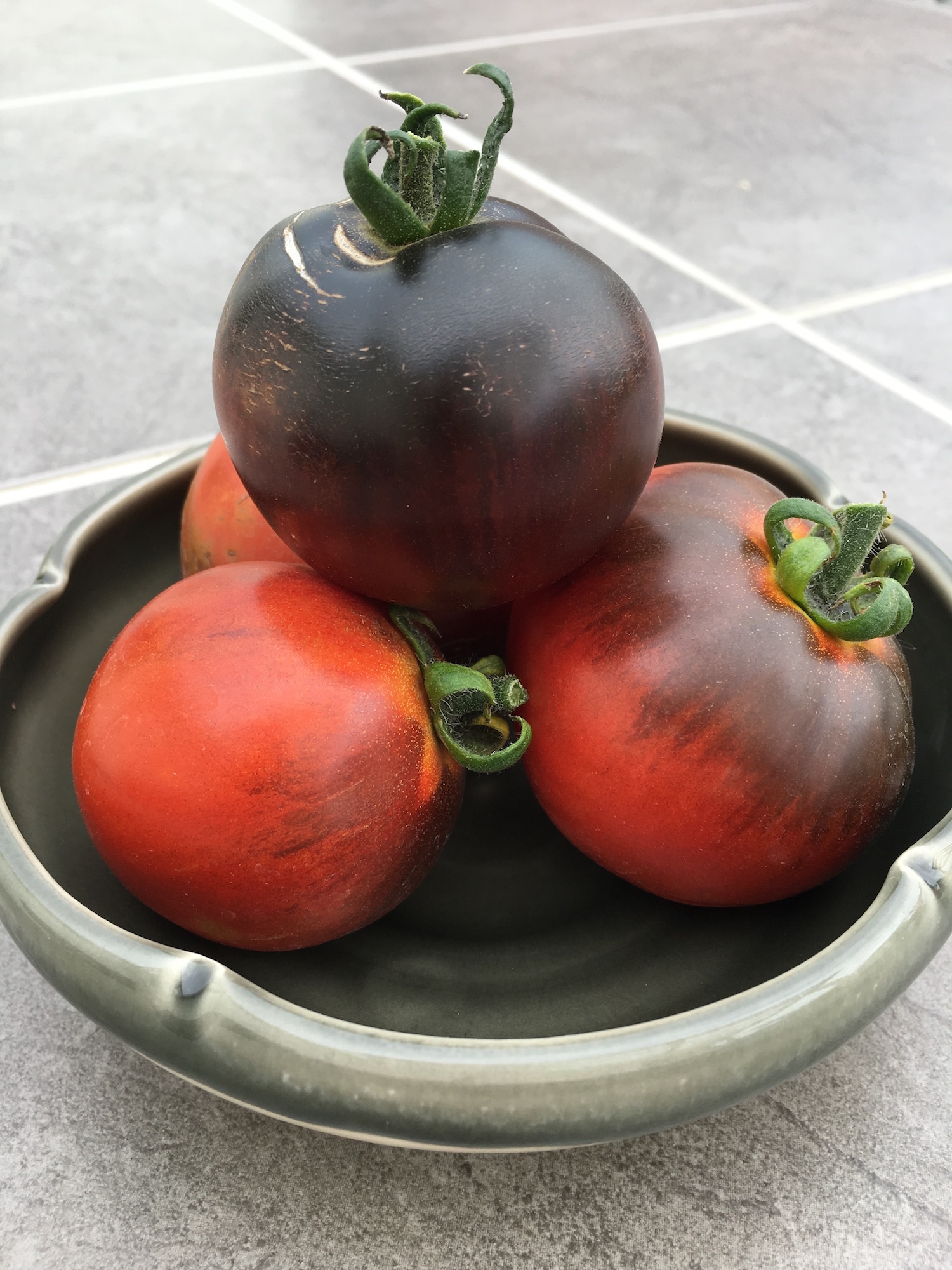
I’ve found a tomato as good as Brandywine.

I know, I know, you can’t believe I would do something like that. Can’t believe I’d be so unfaithful after decades of tomatoey bliss.

But there you have it. Indigo Apple is my new love. She’s a black tomato—a beautiful medium-sized fruit on an indeterminate plant. Her flavour is complex and rich, like Brandywine’s and, in contrast to Brandywine’s long maturation time, she ripens early. What can I say? I’m in love.

Hawksbeard: a Cheerful Weed

We’ve had recent, much-appreciated rain, and the grass is unusually green for January. But even with the grass growth, summer is weed season in the lawn.

More specifically, summer is weed flowering season.

Some of the weed flowers are uninspiring, and merely annoying—the dull greenish flowers of plantain, for example.

Others bring a splash of colour to what is normally a bleak time in the lawn.

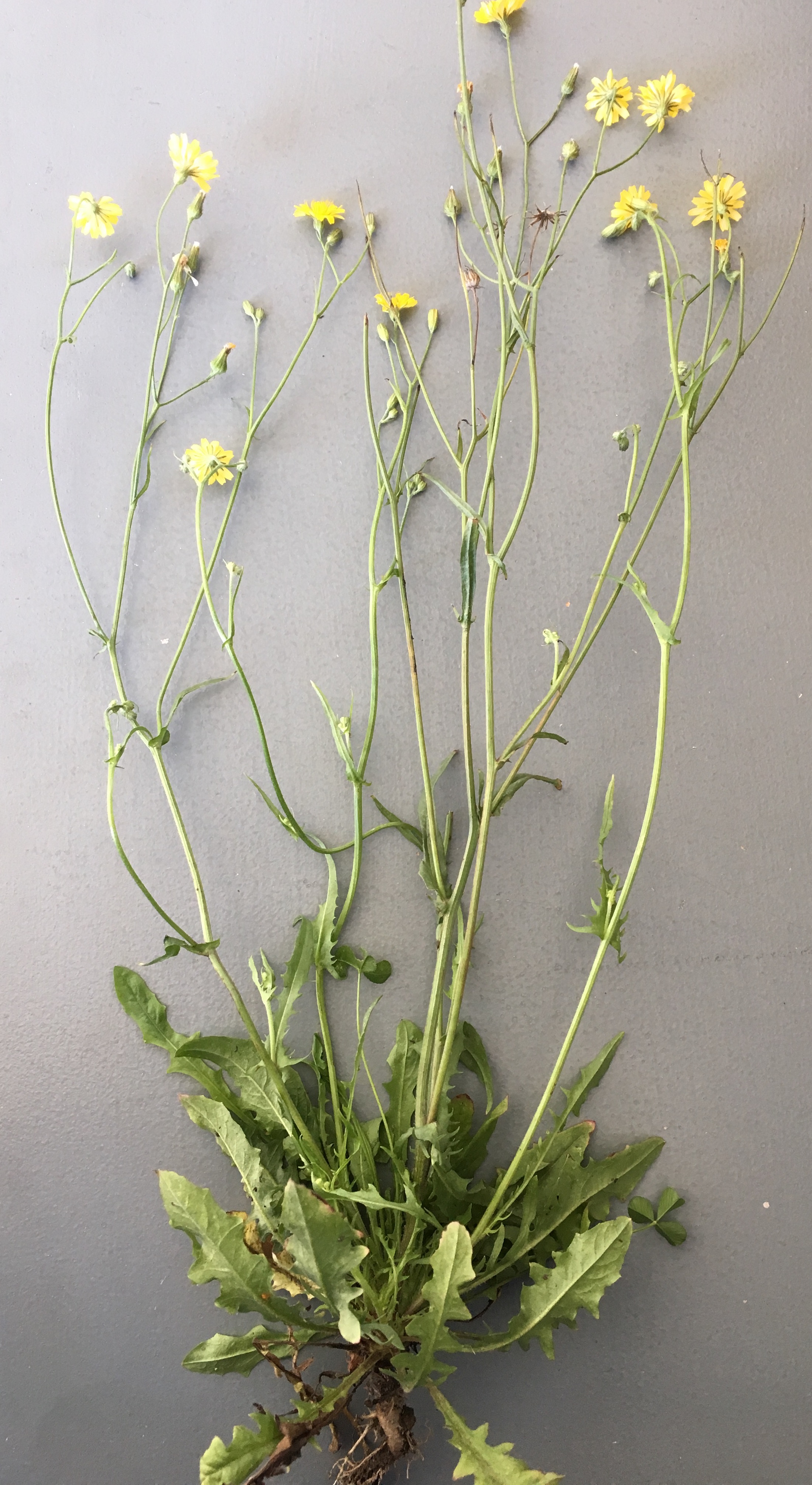
Hawksbeard (Crepis capillaris) is one of the more prolific colourful weeds in the lawn in summer. An annual or biennial member of the dandelion family, this plant bears small, cheery yellow blooms on tall, branched stems.

The NZ Plant Conservation Network shows hawksbeard as being naturalised in 1867 from Europe. Like its cousin dandelion, it was most likely brought to New Zealand on purpose as a food plant—it’s young leaves are edible. Like the dandelion, it is no longer valued as a food, but is considered a weed.

I will admit, the tall flower heads of hawskbeard can be annoying in the lawn. They seem to spring up overnight between mowings, and they slap against your legs as you walk through the yard. But I do appreciate their yellow blooms at a time of year when most other plants give up from the heat and drought. I have been known to use hawksbeard in flower arrangements, and their green rosettes are sometimes the only green to be found around the yard.

Rolling out the Welcome Mat

When we first moved to our house, most of the landscaping, at our place and at the neighbour’s, was non-native. Gorse, photinia, oaks, birch, macrocarpa…plants of little interest to native wildlife. We’ve slowly been replacing much of the non-native vegetation with natives. When the property next door changed hands, the new owner replaced the gorse hedges with natives. Our plantings are all maturing, and I’ve got my fingers crossed we’ll soon attract some native residents.

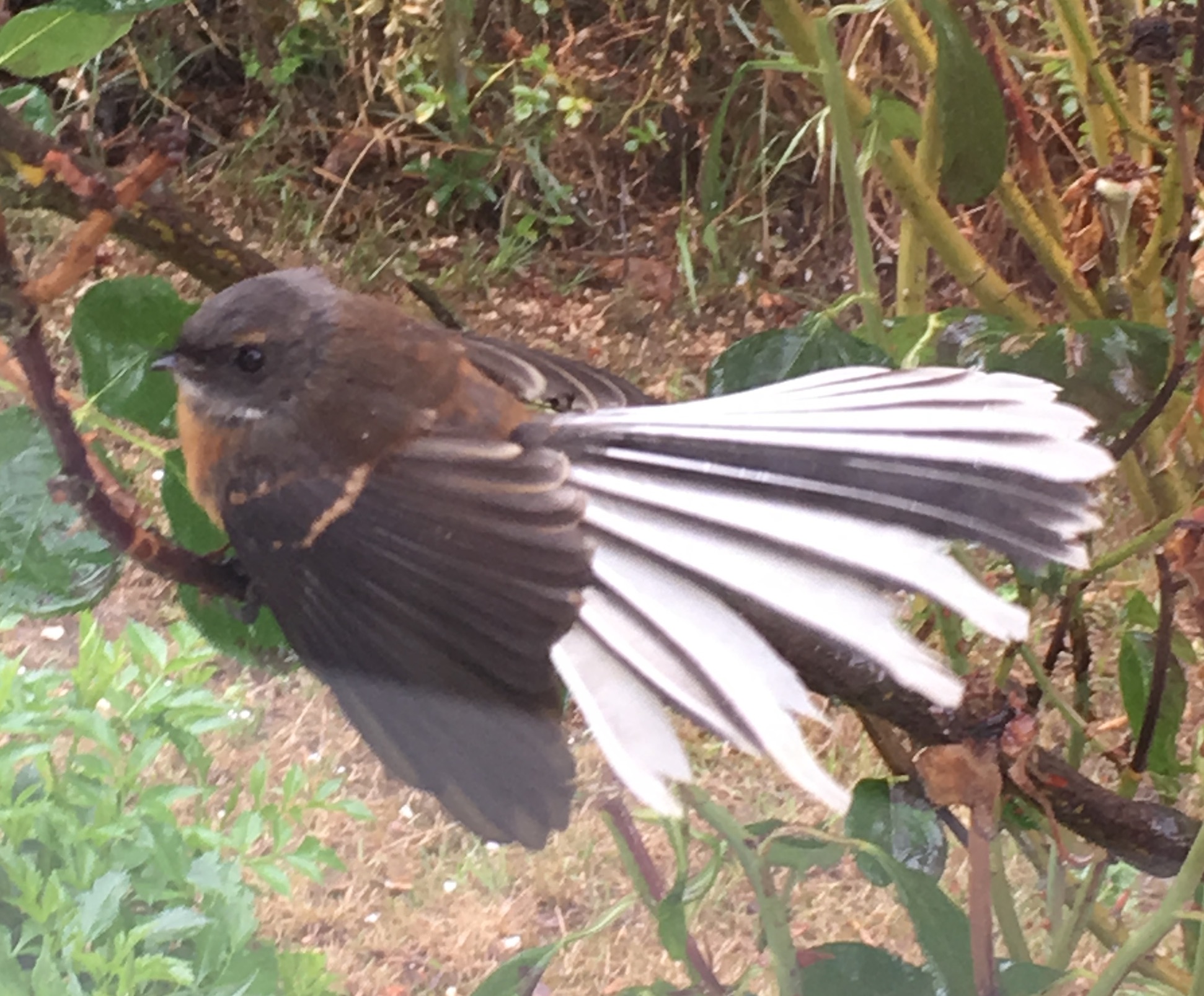
Over the years, piwakawaka (fantails) have shown up occasionally, usually in autumn, and only for a week or so before moving on. But this year, one has arrived in summer. He’s been flitting around for over a week now, chattering and declaring ownership of the place. I’m crossing my fingers, hoping he’ll stay.

Piwakawaka don’t stay still for photos, but he was talking to me through the kitchen window yesterday and, with the window as a bird blind, I was able to snap a couple of photos that weren’t just a blur of feathers. He’s a cute wee guy. I hope our welcome mat is acceptable to him.

A Zucchini Problem

Hi. My name is Robinne and I have a zucchini problem.

They say the first step is to acknowledge you have a problem. I did that years ago with my zucchini addiction, but it doesn’t seem to have helped. Every year, I say I’m going to plant fewer zucchini. But in early July, with icy rain lashing the windows, the pictures in the seed catalogue are so alluring…

When it comes to planting time in October, I find I have four or five varieties of zucchini seed—how did that happen? Well, since I have the seed…

I plant only six of each variety—I use those little six-pack seedling trays, so it’s really the minimum reasonable number of any one variety.

Let’s see…six times four or five…hmmm…

At plant-out, I swear I’ll cull some. I’ll only plant the best-looking individuals of each variety. Two of each kind, just in case one plant dies (which, by the way, has never happened to me, but it’s always a risk).

But I’ve earmarked an entire bed for zucchini on my garden plan. I couldn’t leave part of a bed empty. That would be a waste of space. And there are plenty of plants to fill the bed…

As I say, I have a zucchini problem.

A-Z of Thankfulness–#3

Here’s the final instalment, posted on Christmas day, I hope you all find much to be thankful for today and every day.

Sunshine—The counterpoint to rain, and just as necessary for the garden. It’s also critical for my mental health, and I try to make the most of our sunny days.

Teeth—Where would we be without them? I wish I had appreciated them earlier in life and taken better care of them when I was a teen.

Ukuleles—Who can resist smiling while listening to ukulele music?

Vision—Not just my eyesight, though I appreciate that a great deal, but also the ability to look ahead at what could be. I’ve relied on vision the past twelve years, building a business, and then closing it to become a writer. Many days, that vision has been the only thing getting me out of bed in the morning.

Water—I have not truly experienced a lack of water—not as many people in the world have—but after losing our well in the 2010 earthquake, and experiencing a few years of drought, I have an appreciation for the ease with which I obtain water. I am thankful to have access to clean, safe water.

Xenophilia—The love of the unknown. I love the fact we humans don’t understand everything. I love the fact that in my backyard, there may be insects that have yet to be described by science. I love the fact there are discoveries to be made every day. I love that our world is populated by weird and wonderful life.

Yellow admirals—These butterflies, and all the native insects and spiders in my yard are a source of great pleasure to me. They help me tolerate the weeds, because they rely upon many of them for food and shelter.

Zucchini—How many ways can you eat zucchini? I don’t know, but I love them all. I always plant too many zucchini, and I end up wondering what on earth I’m going to do with them, but they are a wonderful summer staple in our kitchen.

A-Z of Thankfulness–#2

Jumper cables—They bring out the best in everyone. How many times have I stood by my car, cables in hand, and had strangers happy to help? How many times have I had the pleasure of pulling out my cables to help someone else? Wonderful things, those jumper cables.

Knitting needles—My nemesis. I hate them, and I have conquered them. How rewarding is that?

L2—The collective term I use for my children, both of whom have names beginning with L. They have grown into fine young people who I am proud to own up to. I take no responsibility for that—they’ve always been the best kids ever.

Mountains—They make New Zealand what it is. Every time I look west to see their changing faces, I smile.

Nettles—Okay, I’m weird, but nettles growing lush in the garden over winter tell me my soil is rich and fertile. They harbour the caterpillars of beautiful butterflies, and they remind me that things can be useful and irritating at the same time.

Ocean—A critical part of the Earth’s life support system, a source of food, moderator of our weather, a wild and mysterious frontier…and a wonderful place to play on a hot summer day.

Peas, Pumpkins, and Potatoes—Of all the vegetables I grow, these are perhaps the most important. Productive, tasty, and easy to store, they are year-round ingredients in our dinners.

Quiet—There is beauty in silence. I appreciate that every morning when I head out to tend to the animals at 5.30. It’s such a peaceful silent time of day, that even when I don’t really have to get up that early, I’m eager to do so.

Rain—We never get enough of it here, and I’m always thankful when it arrives to water my thirsty garden.

A-Z of Thankfulness–#1

I saw another blogger doing this a few weeks ago and liked the idea. I thought it would be a good set of posts for the holiday season.

Here’s the first instalment—A to I.

Apples—It seems a silly thing to be thankful for, but I eat at least one apple a day. They are my go-to snack. Having lived in the tropics for two years, where apples don’t grow, I am thankful to live in a place where excellent apples are produced and available year-round.

Bees—I’d have no garden if it weren’t for the bees pollinating all my fruit and vegetables. I try to show my thanks by planting flowers they like and managing the garden to maximise nectar throughout the year.

Cat—He’s a real pain in the rear a lot of the time, waking me at four in the morning, getting fur on everything, using furniture as scratching posts. But I appreciate his hunting abilities. This spring was looking bad for rabbits—they seemed to be everywhere, and I was worried they’d cause havoc in the garden and paddocks—but the cat seems to have a particular fondness for rabbit. He seems to have dealt handily with the rabbit problem, saving me a great deal of trouble.

Desk—A space of my own to work. I appreciate this most when I have to spend a few days working in the library, elbow to elbow with strangers, and without my reference books, my porch, and my view.

Earthquakes—I know, it’s a weird thing to be thankful for, but the devastating 2010/2011 earthquakes set into motion a series of events that led to my kids being enrolled in an incredibly supportive school, and to a friendship I value a great deal.

Friends and Family are the obvious answers here, and for the obvious reasons.

Gardening—I am thankful to be able to produce most of our food for the year. I get great pleasure out of gardening, watching the plants grow, and eating the excellent produce I’m able to grow.

Home—Not just a house, but a home. A community in which I feel comfortable. A place I feel I belong. I am blessed to have been welcomed so warmly into this country and this community.

Ian—My best friend, who has stuck by me for over 25 years and is father to my children. If I had nothing but him, it would be enough.

Garden Shift

From one day to the next it happened.

The garden went from newly planted to bursting and full.

It will get much more crowded before summer is over—I usually lose most of my paths by mid-February—but it has lost the widely-spaced springtime look.

It is always such a surprise and a pleasure when it takes on the summer look. It’s like the moment when you look at your teenager and you can see the adult s/he is becoming. It’s a phase shift, and though it comes on gradually, there is a magical moment when you suddenly see it.

I walked through the garden today for no reason, just for the pleasure of walking among those wonderful, full rows of plants.