Wild Wind

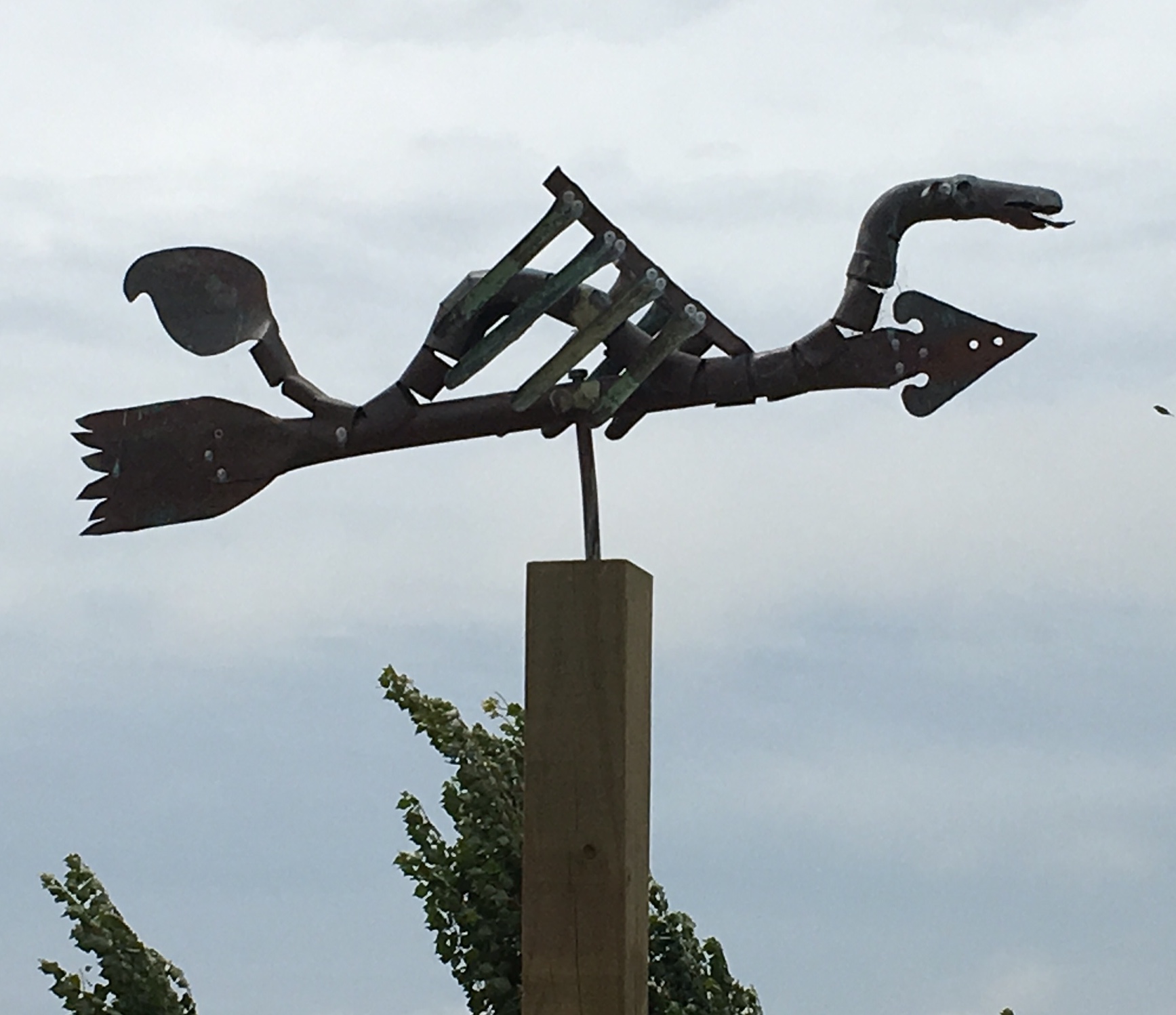
"Fred" the weather vane braving the wind.

“Fred” the weather vane braving the wind.

The satellite images showed a band of clouds stretching diagonally across the Tasman Sea, from Australia to New Zealand and out into the Pacific.

All morning, we felt that front, as it pushed the wind ahead of it.

An empty rain barrel tipped and rolled away. Hay bales set up for archery toppled. Bird nests flew out of the oak trees like cannonballs, spilling eggs and chicks across the yard. Plums, apricots, apples and figs rained from branches heavy with fruit. The office shook as 100 kph gusts hit it. I watched as the windows flexed. The air was hot and gritty, filled with dust and flying debris.

Then I smelled the sea.

The wind shifted 180 degrees in a moment. The air cooled, became moist. The plants, bowed all day to the south, tipped to bow northward, limp and compliant. The dust that had finally settled on the south side of every rock and building, lifted again to find new harbourage on the north side of something.

That band of clouds sits over top of us now. If we are lucky, it will deliver a few drops of rain.

Colours in the Garden

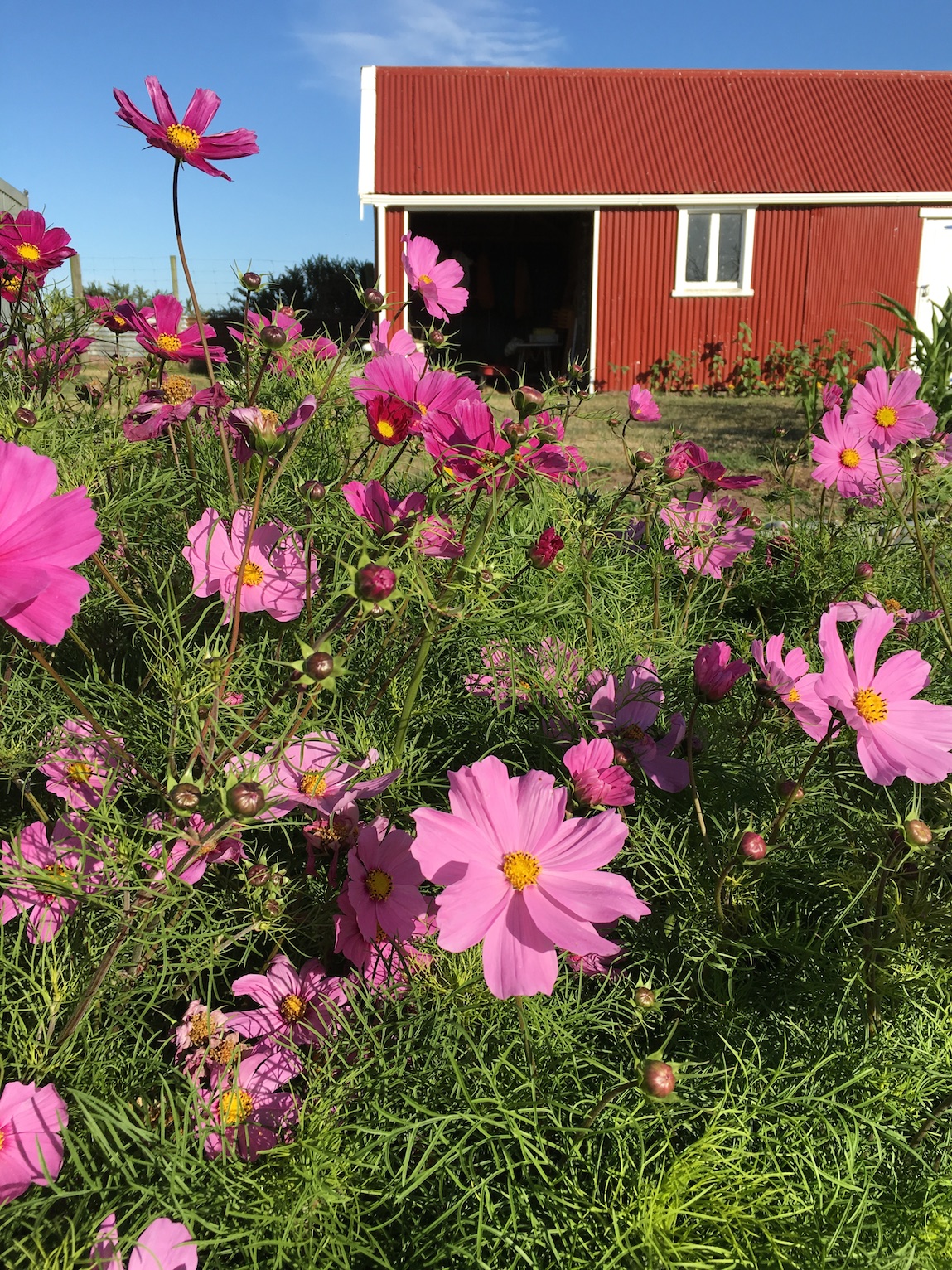
2016-01-12 08.31.38 smJanuary can be a pretty brown month, and it is especially brown this year, with the El Niño induced drought. So I’ve been appreciating the flowers in the garden even more than usual.

When I wandered through the garden this morning and saw this view, I had to capture it.

But why do I enjoy these bright colours? Why not appreciate the brown?

There is a great deal of speculation about our colour preferences. Some people believe that our colour preferences are evolutionarily based. The most popular colours are blue and green. These would have been important colours for our ancestors to focus on—the blue of clean water and clear skies, the green of plants.

But as far as I can tell, there’s no good data to support that theory.

And many of us like colours other than blue and green, too.

A research paper published in 2010 by psychologists Stephen Palmer and Karen Schloss at UC Berkeley found that people’s attitudes toward colours were based on their experiences with objects that were normally associated with those colours. Basically, if you like sunny days, you’ll like the colour blue. If you like tomatoes, you’ll like the colour red. (But if you like sunny days, you won’t necessarily like blue tomatoes, because you don’t expect blue to be associated with tomatoes.)

And, as you would expect, they also found that those preferences were culturally influenced, and people from different cultures had different colour preferences.

So there’s probably no evolutionary advantage to me loving this garish juxtaposition of pink, green, red and blue. I just love it because I love the garden.

Look for the Good

100_3873I’m not always successful at it, but I do try to find pleasure and beauty in everything, even the day-to-day chores.

It’s not necessarily easy. The laundry doesn’t present a perfect rainbow every day.

But knowing that it can…well, that goes a long way.

2016-01-10 15.59.26 HDR smIn the garden, there is a weed (okay, there are many hundreds of weeds, but there’s one in particular…). I know I need to pull it—it will soon set seed and cause me grief. But it is a lovely English daisy—a perfect mound of spoon-shaped leaves with dainty white and yellow flowers dancing above it. I smile as I carefully weed around it. I will get rid of it…eventually.

The drag of getting up at 5am to milk is a small payment for the peace and silence of a sunrise.

The ache in my back in the morning reminds me that I did something yesterday.

The brown film I scrub off the bathtub means we all spent the week outdoors.

The failed project teaches me.


I still grumble sometimes.

I still sometimes wish for a day off.

But it helps, to look for the good. It’s usually there, if only I look.

When the cat is away, the mice will…

Kids or no, I'll be here...

Kids or no, I’ll be here…

The kids are at summer camp. An entire week with just my husband and me in the house. No children lingering at my office door with the “Mum, I’m bored” look. No teenager hiding in his cave with his earphones on, to be prodded into activity.

We’re free to do whatever we want!

So, um, I’m cleaning the house, my husband is making the week’s bread. Later I’ll milk the goats and do some weeding…

We tried to go out for lunch and a stroll on the beach after dropping them off at camp, but…well…there was work to be done at home, and the weather wasn’t great, and we weren’t really hungry for lunch…

I reckon it’s a sign we’ve managed parenthood reasonably well so far that when we’re free of the children, we don’t rush out and party. We pretty much carry on as usual, because we pretty much do what we want when the kids are here, too.

Oh, we’ll do a few things differently. Tonight’s dinner will be bread and cheese with a glass of wine on the porch instead of some healthy cooked affair. But we’re unlikely to go out at all, and the week will proceed pretty much the same as if the kids were here.

Perhaps we’ve been selfish parents—the kids have always known that mum and dad need their space. Bedtime has always been strictly enforced, so that the adults have ‘their’ time at the end of the day. And from the beginning, the kids have gone to art museums, historic sites, etc, with us. We’ve included them in our adult lives, and they’ve happily come along for the ride.

Yes, we spent many hours bored, watching them at playgrounds when they were younger, but we made sure that they also spent time bored at ‘adult’ things, too.

It wasn’t long before they became interested in those adult outings—the art museums, the historic sites, the tramping trips. Just as we learned to appreciate the subtleties of playground design, they learned to appreciate the play of light on a sculpture, or the patterns of wear on an artefact.

And so, when the kids are away, we feel no need to get our fill of ‘adult’ things or to make up for lost ‘us’ time. We will certainly enjoy our week of relative quiet, and fewer articles of clothing to pick up off the floor. But we enjoy spending time with the kids, doing the things we all like to do.

In Praise of Thistles

2016-01-09 16.58.01 smI hate thistles.

California thistles infest my garden. Their underground runners are impossible to remove, and every time I pull one, two spring up in its place.

Leave them laying on the ground once you’ve pulled them and they either re-root and have to be pulled again, or they dry into vicious prickly brown masses, ready to stab any exposed flesh in the garden.

But thistles have another side.

Artichokes (a thistle) provide us delicious food in early spring, when little else is available in the garden.

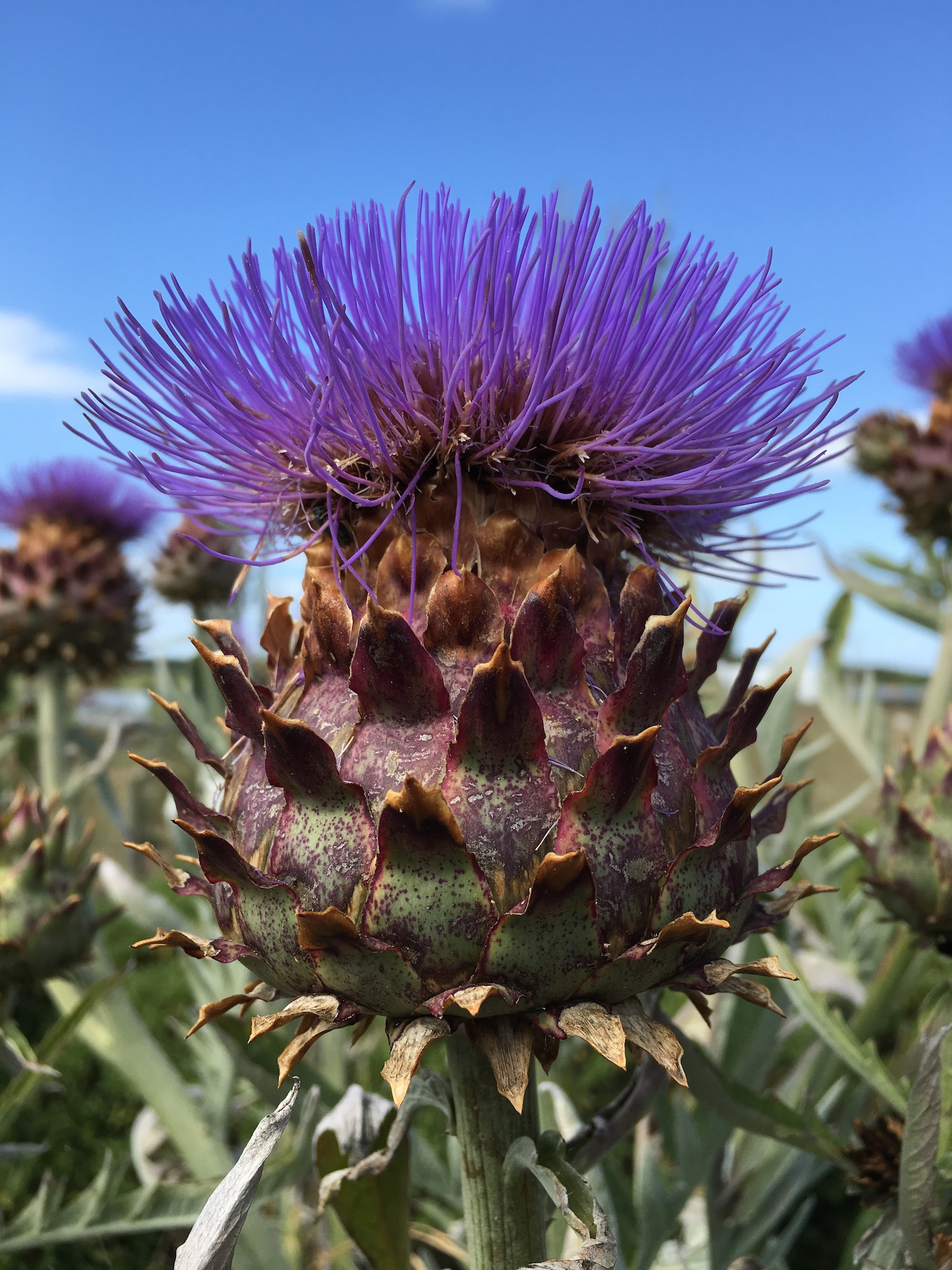
Cardoons (the artichoke’s poor wild cousin) produce stunning fist-sized purple blooms. Even the @!#!*&$*!%# California thistles have beautiful flowers if I don’t manage to pull them quickly enough. Those flowers attract bees by the dozen, and I love to watch the bees tumbling around in the giant flowers.

At this time of year, I’ve usually managed to get on top of the California thistles and prevented them from flowering, but the cardoon—a centrepiece of the flower garden—puts on a gorgeous display. Standing two metres tall and topped with dozens of giant purple flowers, you can be forgiven for forgetting that the plant is a thistle.

Just don’t make me try to pull that thing out…

The Evil of Summer Vacation

Who can resist when summer calls?

Who can resist when summer calls?

I know that many of my readers are in the Northern Hemisphere, and they’ll play their little finger-violins for me as they muddle through another dreary January day, but I’m facing the problem I face every year during summer vacation—I can’t go inside.

There is so much to do outdoors—weeding, unending DIY on this wreck of a house, mowing, animal care, harvesting—that I neglect indoor things. The weather doesn’t help—blue skies and warm breezes—because I think I need to take advantage of the good weather while it lasts.

And if by some miracle I feel like I’ve caught up on the outdoor tasks, well, that’s just an excuse to go to the beach!

So the house gets messier, the bathroom remains uncleaned, I forget to pay the bills, I ignore the shopping.

I blog mostly after dark (which is difficult, because the days are so long), and only read the news or check social media at times when I have no choice but to be indoors (like when I’m pasteurizing the day’s milk).

I actually look forward to days when the weather is poor so I can catch up on the indoor chores.

And so I was secretly pleased when the wind shifted this afternoon, and the hot sun turned to chilly drizzle. I retreated to my office to deal with paperwork, get the day’s blog finished, check my e-mail, and maybe (if the clouds remain) eve do a little sewing.

The house cleaning?

Well, I doubt I’ll get to that…it is still summer vacation, after all!

These Are a Few of My Favourite Things: Preying Mantids

DSC_0025 sm

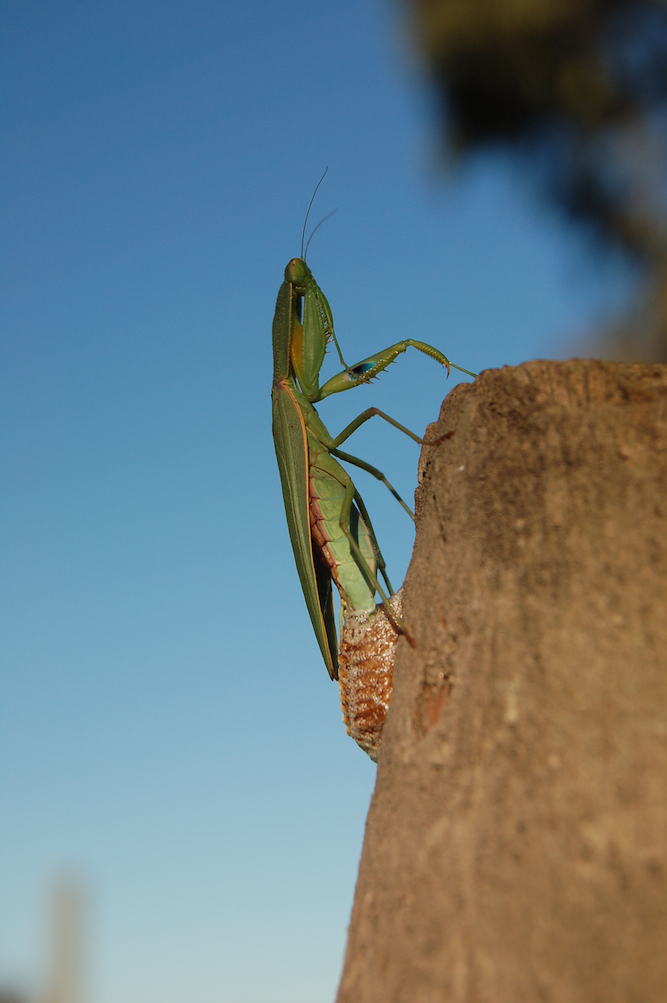
NZ mantis laying eggs

There’s no question why I’ve been known as The Bug Lady most of my life. I have a weakness for anything with more than four legs.

Preying mantids are some of my favourites. Not just because they eat pests in the garden, but because they are simply fun to watch.

How often can you watch a cheetah bring down an antelope in real life? Um…never. But it’s easy to watch a mantis snatch a fly—all the drama of the Discovery Channel, right in your back yard.

Sometimes the drama is a little too close for comfort.

When we lived in Panama, a beautiful 10 cm long green mantid with bright pink hind wings often came to our light at night. It would sit on our table and snatch moths attracted to the oil lamp. It was a cheeky insect, and had no compunctions about perching on our faces or arms to get a better vantage point for its nightly hunting. We laughed that it would follow us to bed some night.

We weren’t quite right, but one morning I slipped on my jeans, only to feel something enormous crawling up my thigh. With a yelp of surprise (and visions of scorpions, which were common in our house) I tore the jeans back off and peered down the leg to find our cheeky mantid scrambling out. It looked distinctly ruffled by the experience, but that didn’t stop it from returning to our light.

But from then on, we trapped it in a jar every night before we went to bed.

We are blessed with a healthy population of New Zealand mantids here at Crazy Corner Farm. Like most mantids, they enjoy hanging out on flowering plants, particularly herbs which attract huge numbers of flies and bees. Sometimes, I sit in the middle of the herb garden with my morning coffee, just to watch the mantids. I’m always surprised and impressed by the size of prey they can take down. I’ve even seen them snatch more than one fly at a time—one in each “hand”. Indeed, they will keep snatching prey as long as it keeps coming—even once they are fully sated and can’t possibly eat any more—their predatory instinct is so strong, they can’t stop themselves.

Of course, everyone has heard that female preying mantids eat their mates, and in species in which the female is much larger than the male, I’m sure it happens. But male preying mantids are just as fierce as the females, and they don’t go without a fight. The female New Zealand mantid is only slightly larger than the male, and I have kept males and females together in captivity. Only once did I see a female try to eat her mate. It was an epic struggle, worthy of the best wildlife documentary. It went on for at least fifteen minutes, and in the end, the male got away.

So turn off the TV. Get outside and watch the drama unfold!

Secret Garden

Years ago, my husband installed a mirror in our hedge. I still catch myself wondering about the garden on the other side.


hedgemirrorsmThere is an arch in the hedge,

Dark and green,

And a gate.

It beckons.

Calls me to step through

To the secret garden

Beyond.


At work over here,

I glance up.

The far side is green,

Lush,

With clipped shrubs

And well-weeded flowers.


I wonder at the gardener

Who can maintain such beauty.

I struggle so on this side!


A bird flashes by,

Glimpsed through the arch,

I am sure it was red,

With a long tail.

What exotic creatures live over there

On the other side?


I stand, stretching my aching back.

I step closer to the arch.

Was there movement?

There is someone on the other side.

The gardener?

I would like to meet her.

Would she show me around her garden?

Boldly I approach the gap.

I see she, too, walks to greet me.

When I catch her eye,

I draw up short.

A slow smile spreads across our faces

As we recognise one another.


The hills are alive with the sound of music

I was in the garden, weeding as usual, when I heard the Star Wars theme wafting across the yard. It was my daughter, testing the new low register she was making for the flip-flop-o-phone.

What’s a flip-flop-o-phone, you ask?

It’s one of a number of musical instruments scattered around our yard. My husband believes in tantalizing all the senses in the garden. Music is an important part of that, so he builds instruments everywhere.
tubophone smIn the herb garden is the tubophone—galvanized electrical conduit cut to a C-major scale and played with a mallet—a DIY glockenspiel.

musicalbench sm


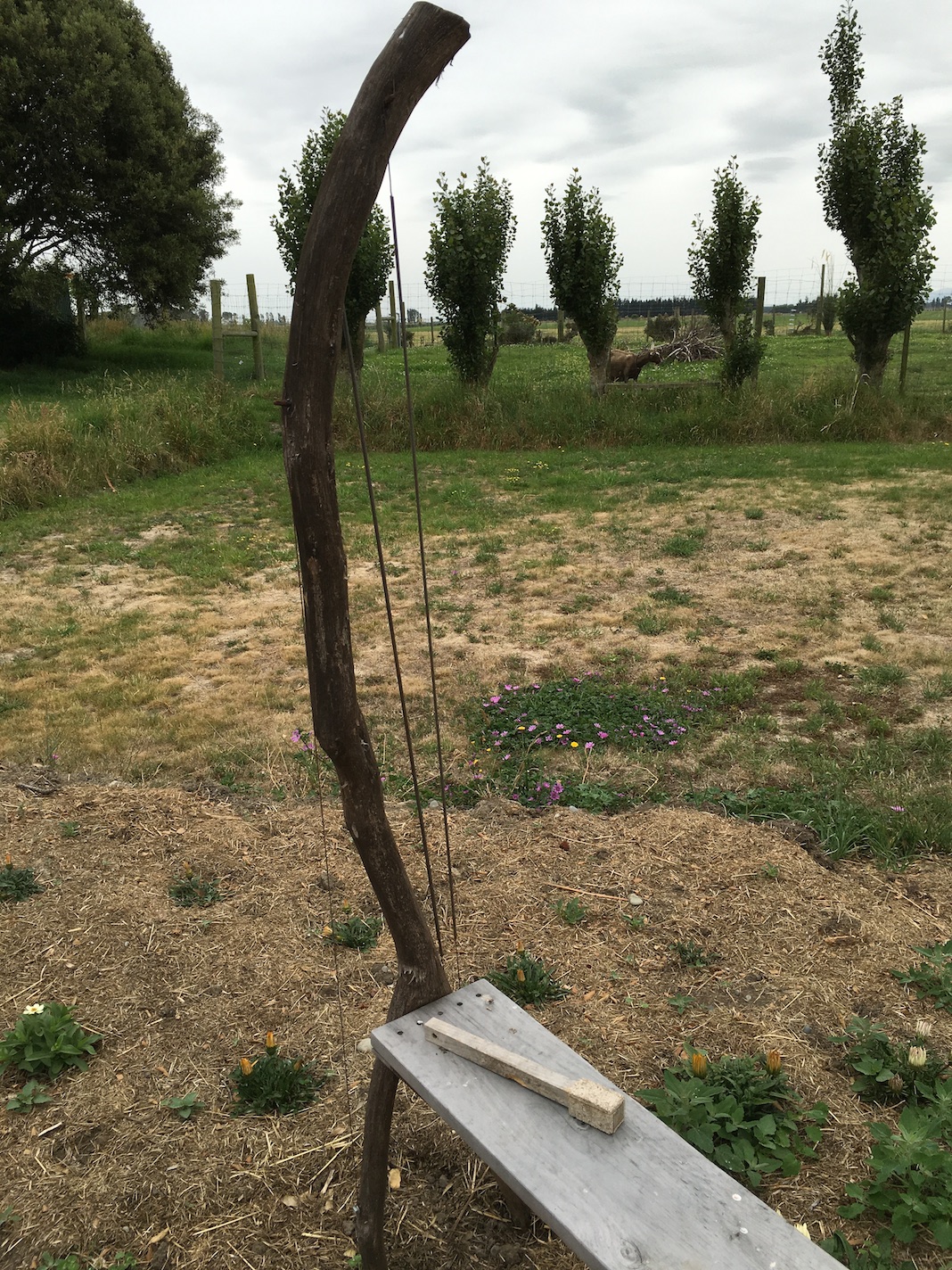
In the pond garden is a bench strung with strikable and pluckable piano strings—sort of a jug band sound.


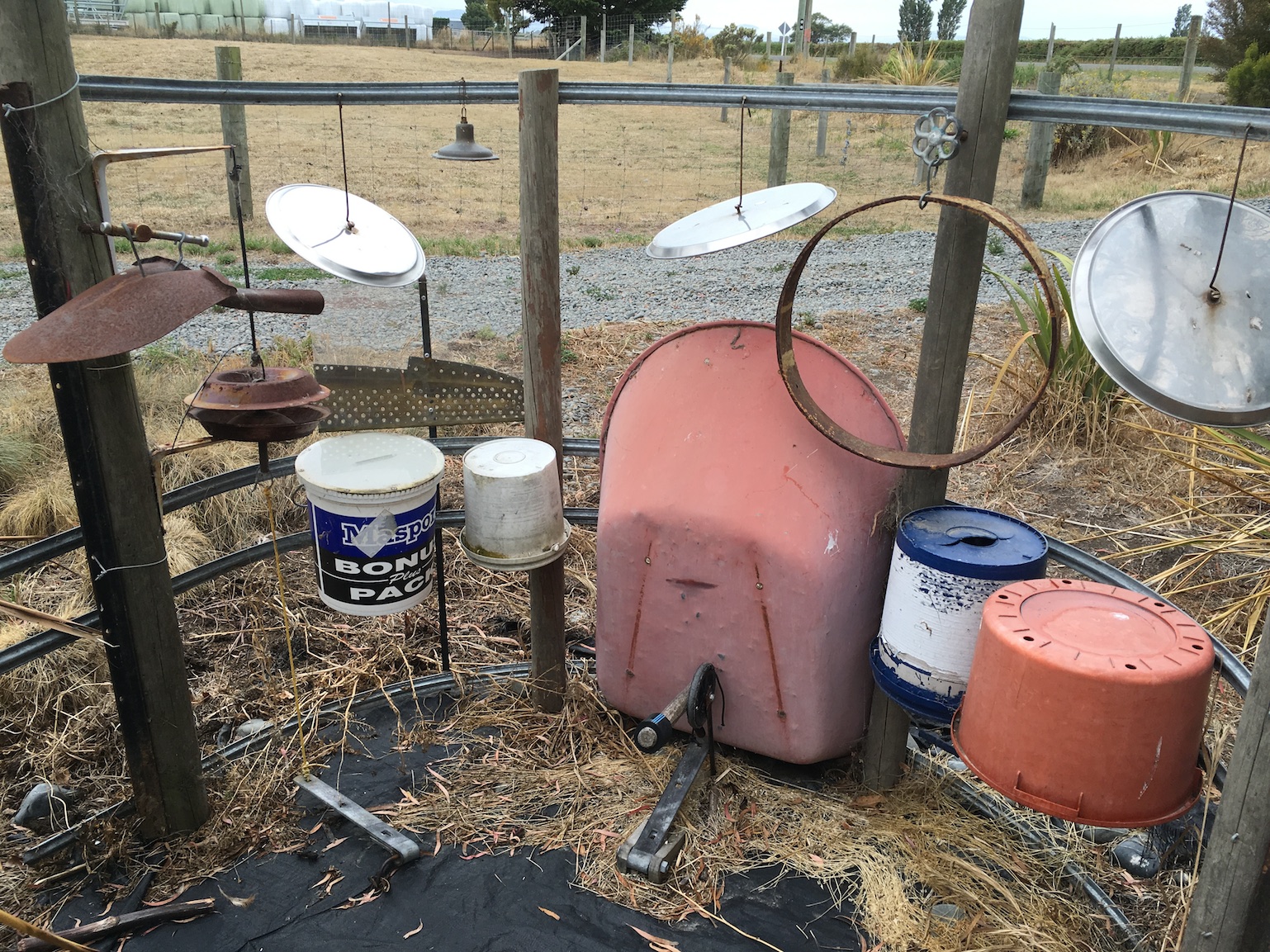
drumkit1 smAnd nestled among the plants in the native garden are the garden drum kit (complete with wheelbarrow bass drum, bucket snare, and tyre hub high hat), and the flip-flop-o-phone.
flipflopophone1 sm


The flip-flop-o-phone is a set of pvc pipes (salvaged plumbing) that are struck on the end with an old flip-flop to make a (sort of) musical note.

The outdoor instruments are fun, interactive garden elements we all enjoy—one of the many elements of whimsy my husband adds to the landscaping.