Equinox Accounting

Happy Equinox!

It is the autumnal equinox, and fittingly, our weather today has started out pure summer heat, and is predicted to turn to wintery wind and rain later on. I can see the clouds piling up to the south as the front approaches.

There are still plenty of summer crops coming out of the garden, but the equinox is a good time to evaluate what worked and what didn’t this past summer.

It was an extreme summer, so there’s no saying this year’s performance will hold in future years, but new varieties that did well include:

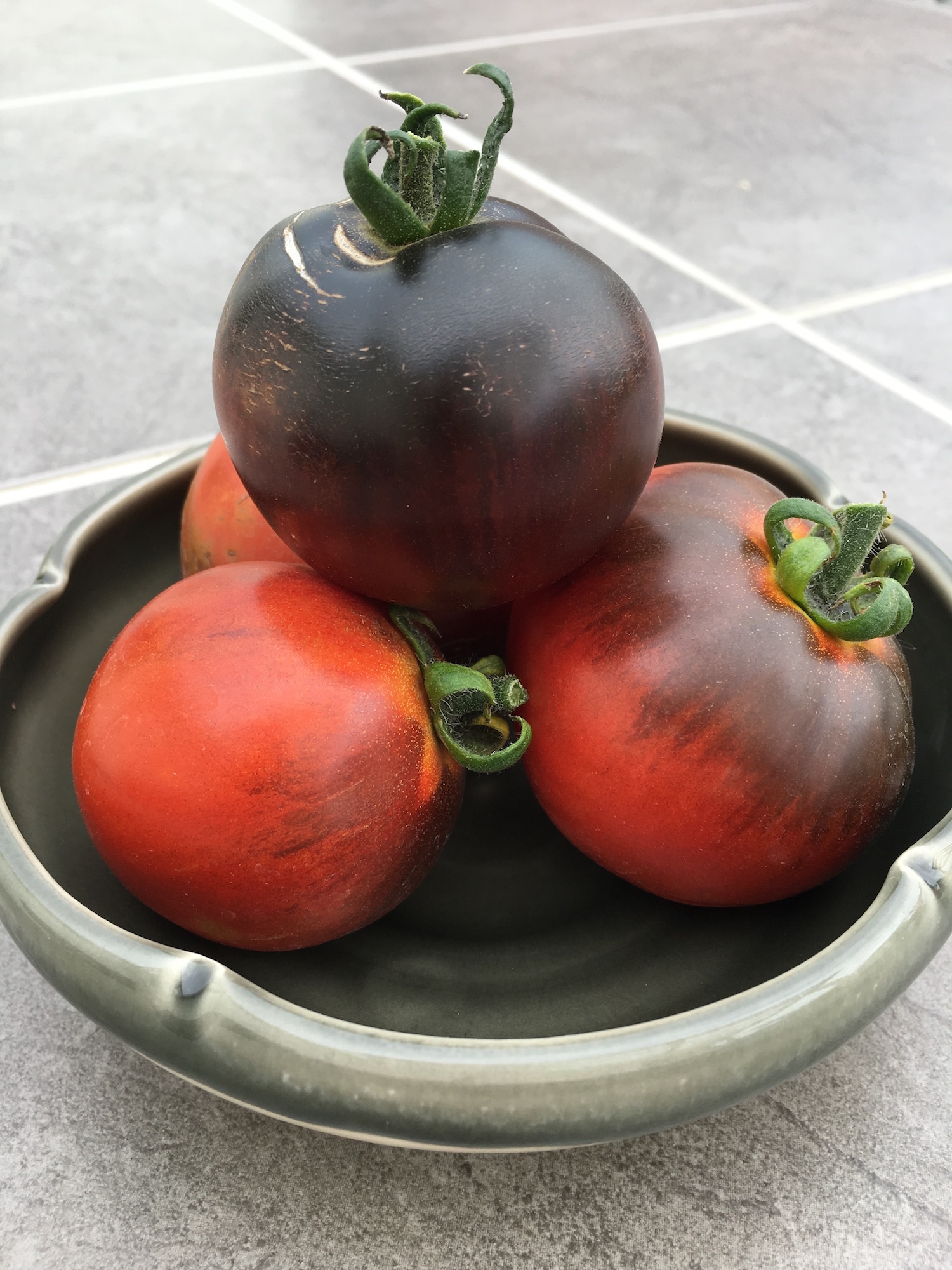
Tomato Indigo Apple—I blogged about this beauty when it first began to ripen. It has proven itself over the season, producing plentiful, delicious and attractive fruits that ripened early and continue to ripen as other varieties are giving up for the year.

Tomato Oxheart—This variety was also new to me this year, and it did well enough to deserve another go. The almost disturbingly heart-shaped (as in ox heart, not love heart) fruits were flavourful and plentiful.

Onion Pearl Drop—Cute and fast-growing. I’ll plant these again.

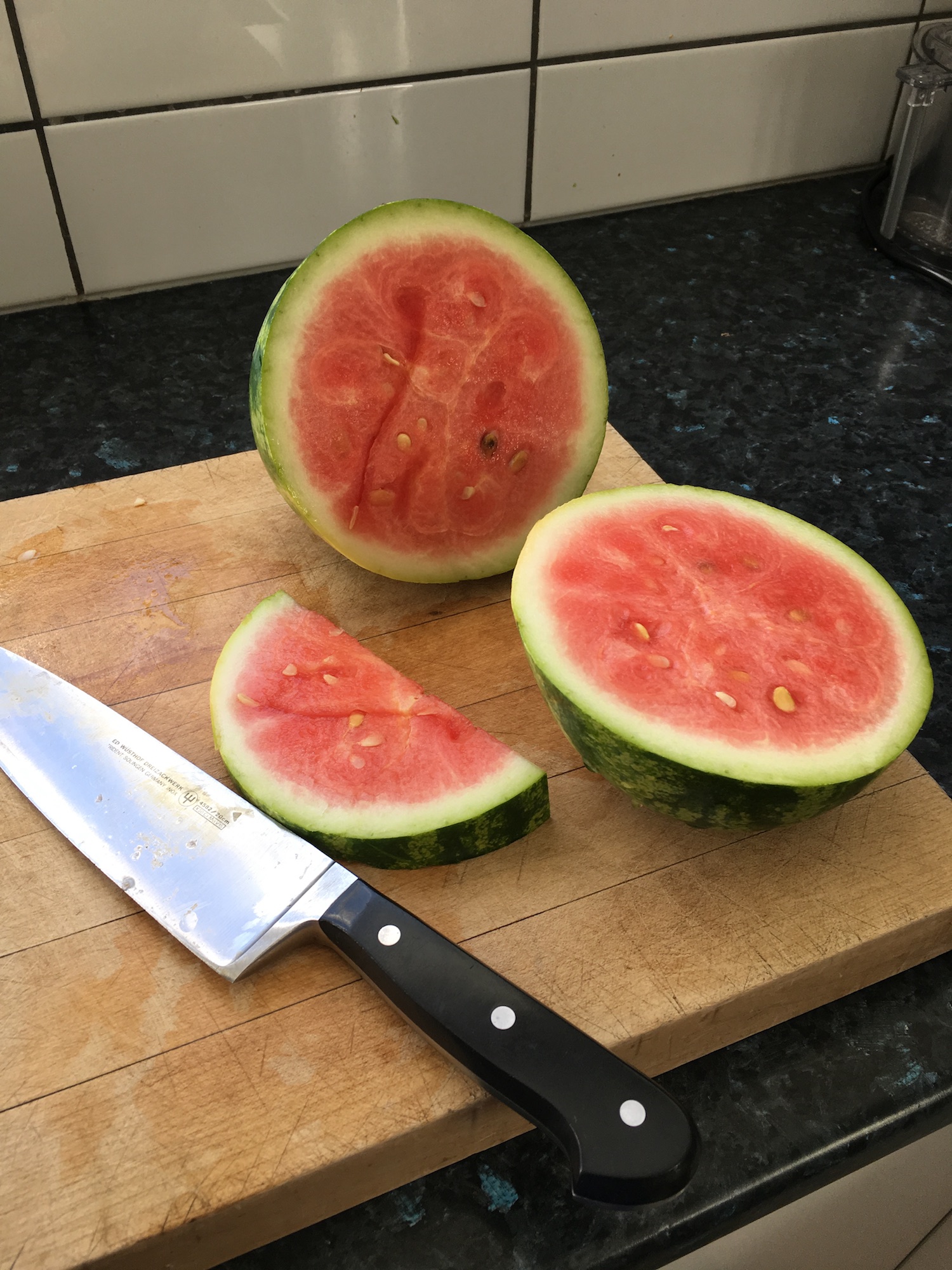
Watermelon Sweet Red—It might have simply been the weather this summer, but Sweet red matured more quickly and produced more fruit than Rapid Red, which I’ve planted in past years. I’ll be curious to see how it does in a cooler summer.

Varieties that didn’t grow so well:

Eggplant Container Pick—I was excited by this smaller variety of eggplant, as mine always end up pressed against the top of the low tunnel I grow them in, but these seeds didn’t even germinate.

Tomato Russian Red—This isn’t a new variety for me. Usually Russian Red, bred for its ability to withstand and produce well in cool temperatures, is my best producer. This year, the plants spent most of their energy on vegetative production, growing to massive leafy plants without actually producing much fruit. And the fruit they did produce was so hidden in all the greenery that I missed half of it. It won’t stop me from planting Russian Red in the future, but it emphasises to me the need to plant a mix of varieties, as year-to-year differences in weather can make a big difference in production.

Pole Bean Jackson Wonder—The jury is still out on this bean, but poor germination and slow growth mean I still haven’t harvested any of these lima beans. There are plenty of pods on the plants, but whether they will fill out properly before frost kills them is debatable. My guess is that in a normal summer here, they wouldn’t have a chance—they appear to need too long a growing season.

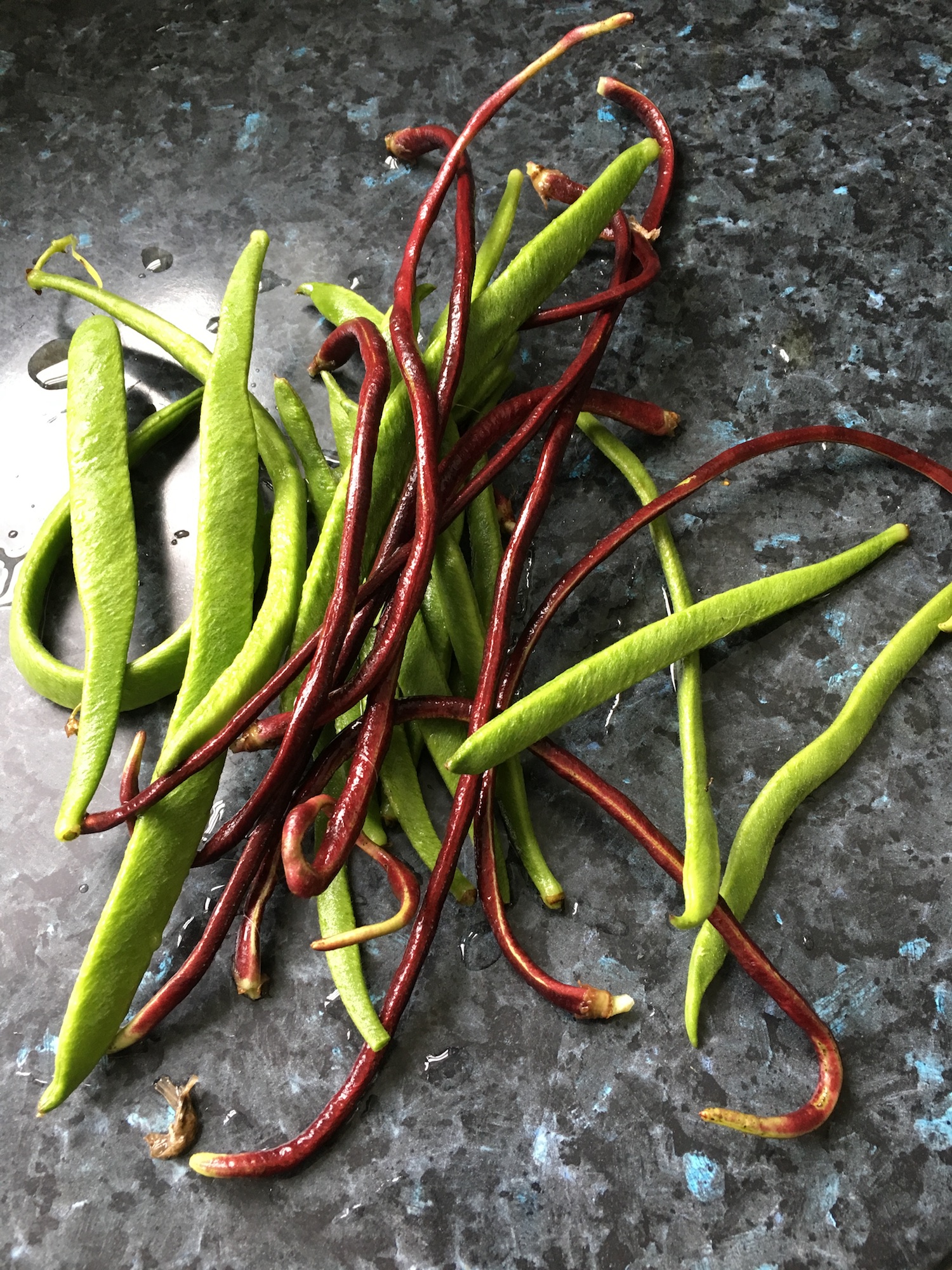
Yard Long Red Noodle

Yard Long Red Noodle alongside scarlet runner beans.

Along with all the other heat-loving plants that did well in this summer’s garden is the bean Yard Long Red Noodle (Vigna unguiculata—the same species as cowpeas). I have never had luck with these beans here in New Zealand—they are particularly sensitive to herbicide overspray, and also prefer it hotter than our summers normally are (ideal temperature for them is 30ºC). But this year, the plants germinated slowly, which spared them the springtime overspray, and the summer was hot and wet. I can’t say they’ve thrived (we grew yard long beans in Panama, and so I know what they’re supposed to grow like), but they have managed to produce a small crop of ridiculous-looking beans. The beans aren’t exactly a yard (90 cm) long, but they’re 30 cm (12 inches) or more, and are the sort of silly crop to make everyone smile.

Their red colour is pretty in the garden, and unlike many other red or purple vegetables, they retain their colour when cooked. Good enough reasons for me to plant them, in spite of their poor performance here—a few go a long way.

Watermelons Rule

Nothing says summer like watermelon—a seasonal fruit that matures during the hottest days of the year, and doesn’t keep.

Watermelon is an unreliable crop here. Twelve years ago, when we first arrived, I was told watermelon doesn’t grow in Canterbury. I’ve planted it every year, regardless, because I can’t imagine a summer without it.

Some years we get nothing. The plants don’t grow at all, or they grow too slowly to produce mature fruit before the first frost, or they’re nailed by herbicide overspray. Some years we get a few smallish fruits that we savour as rare delicacies.

This year we are awash in watermelon. The fruits aren’t big—even the largest hasn’t reached the weight the seed catalogue says this variety should—but they’re the largest watermelons we’ve managed to grow here. And most importantly, they’re sweet, crisp and delicious. And there are lots of them!

As I sit on my office deck spitting seeds, I am reminded of the magical poem by John Tobias—Reflections on a Gift of Watermelon Pickle Received from a Friend Called Felicity.

I wonder if my kids will remember this year of watermelon as Tobias wrote…

“…During that summer—
Which may never have been at all;
But which has become more real
Than the one that was—
Watermelons ruled…”

Summer Soup 2018

I feel like a broken record sometimes (those of you under the age of 45, ask your parents what I mean by that). The garden season repeats itself each year in a pretty predictable fashion, and I find myself blogging about the same events every year.

Saturday was Summer Soup day, which I’ve blogged about more than once before (in 2015 and again in 2016). This year’s production was 25 quarts of soup and 6 quarts of vegetable stock, bottled and ready for quick meals throughout the year. Production time, just over 14 hours.

It always feels good to fill every pot in the kitchen with delicious vegetable soup…at least for the first hour or so. But by the end of the day, I’m sick of being in the kitchen and ready to collapse. I need to remember the feeling later in the year when I’m feeling guilty about just pulling a jar of soup out of the cupboard for dinner. I’ve put in the time. We all have, because even the kids help pick and chop vegetables for summer soup. We’ve earned every ‘free’ meal we get from it.

Crazy Cake Season 2018—#2

My son left it wide open for me this year. He wanted his usual spice cake (the one I’ve marked with his name in the cookbook), but he left it up to me how I decorated it.

I swear that was more difficult than being told what he wanted.

After many hours scouring the cupboards and looking at cake photos online for inspiration, I came up with a large geode.

Most geode cakes online are, frankly, weird—an ordinary tiered cake covered smoothy in fondant, with a slash down the side filled with geode crystals. They don’t look like a geode at all, and some look disturbingly like vaginas. I didn’t think my son would appreciate that. I strove for a more natural geode look.

I also hoped for a tastier geode material. I was inspired to do a geode by a bag of crystalised ginger in the cupboard. Most geode cakes, though, are made with rock candy, which isn’t the nicest accompaniment to cake. On a spice cake, I thought crystalised ginger would be a much more appropriate flavour (and texture). Unfortunately, my experiments with colouring ginger were uninspiring—the ginger had a beautiful sparkling appearance, but light colours looked grey on the yellowish ginger, and dark colours looked black. I couldn’t manage a nice geode-like lavender.

So I made purple hard candy and broke it into shards for the crystals.

The result was reasonably geode-like, and easy to make. And better than a crystal vagina.

Market Smells

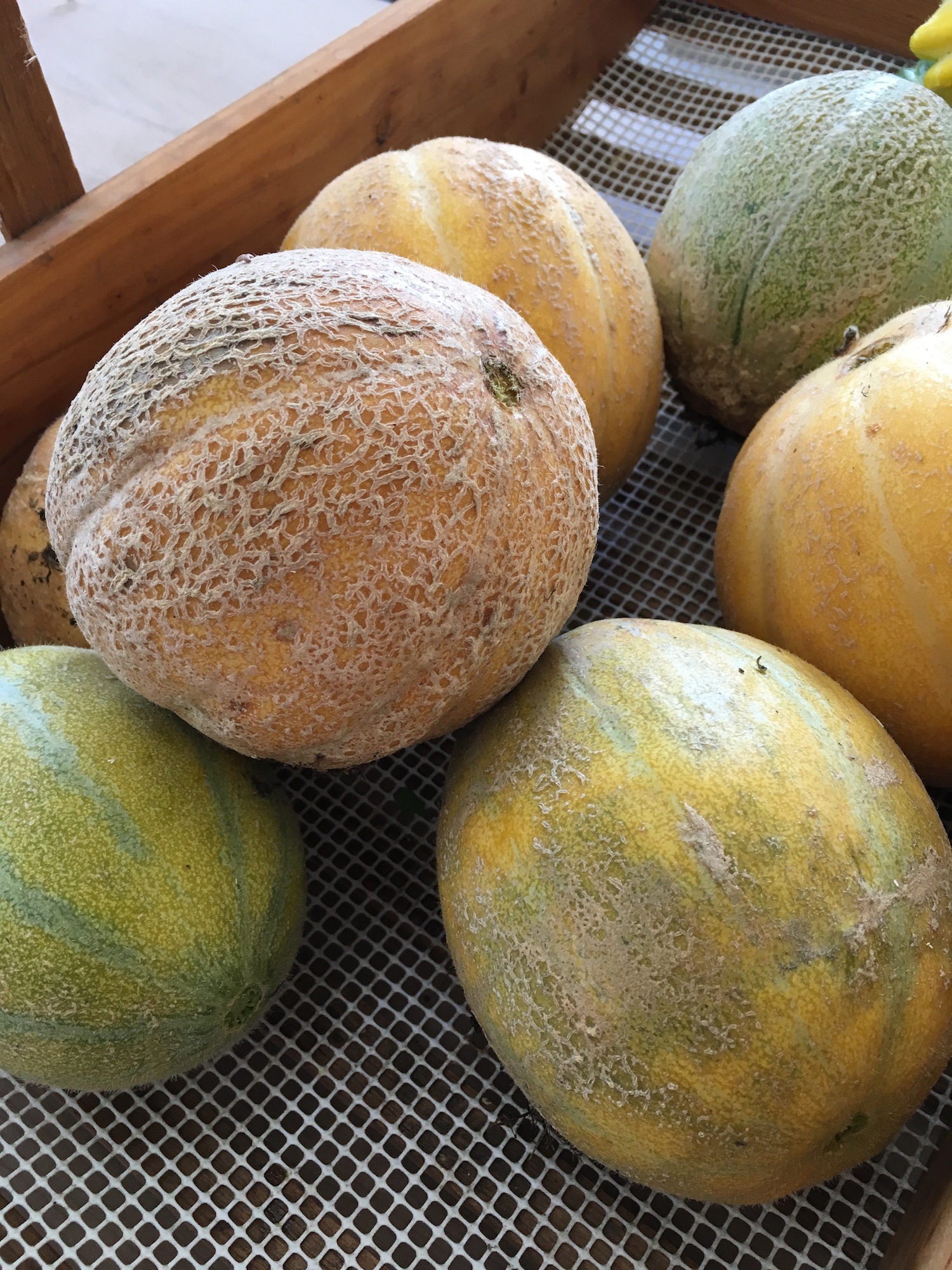
I brought seven dead-ripe rock melons in from the garden yesterday afternoon. The smell in the kitchen was overpowering, and took me directly to Roots Market, a large farmers’ market in Lancaster County PA, on a hot July day.

For me, the smell of ripe melons = Roots. I’m not entirely certain why—there are many competing smells at the market. Perhaps because in the mid-1980s a melon grower had a stall at the entrance where my family always arrived, so it was the first smell I experienced every time. Whatever the reason, that smell will forever be associated with that market in my mind.

I’ve been to many farmers’ markets since the mid-80s. Memorable smells accompany many of them.

In Ann Arbor, Michigan, it was basil, which my housemates and I bought by the grocery-bag for pesto.

In Panama, the market in Penonome was where my husband and I shopped every week or two. The meat-sellers’ area was screened from the flies, but the screen didn’t stop the smell of beef, pork, chicken and fish on display in the tropical heat from wafting through the market.

In St. Paul, Minnesota, I remember the smell of flowers and sweet corn.

I haven’t been to many farmers’ markets here in New Zealand, because I grow all our vegetables, but as a seller in Leeston, I remember the smell of my friend Cris’s homemade bagels.

Pretty cool how smell can act as a teleportation device, spanning distance and time in an instant.

50 Ways to Eat Zucchini

I’ve been humming the Paul Simon tune, Fifty Ways to Leave Your Lover, but changing the words a little…

There must be fifty ways to eat zucchini.

Just fry it in ghee, Lee, make a stir fry, Guy
Don’t need to be fancy, Nancy, just listen to me
Pop it in lasagne, Yolanda, don’t need to be fond of it
Just put it in tea, Lee, and eat your zucchini.

Wondering how many ways we do eat zucchini, I started a list.

I got to 42 before I had to think too hard. So here we go…

  1. Raw sticks dipped in skordalia or your favourite veggie dip.
  2. As crostini: thinly sliced and topped with cheese, tapanade or olivade.
  3. With peas, carrots and pesto over pasta.
  4. In burgers.
  5. In enchiladas.
  6. Grated in a tomatoey spaghetti sauce (adds wonderful texture).
  7. Grated, raw, in burritos.
  8. In vegetable pakoras.
  9. In calzones.
  10. In cheese pasties.
  11. On pizza.
  12. Herb and parmesan-crusted.
  13. Zucchini bread.
  14. Zucchini cake.
  15. Chocolate zucchini cake.
  16. Zucchini sorbet (trust me, this is amazing!).
  17. Frittata.
  18. In stir-fry.
  19. In fried rice.
  20. In Not Yo Mama’s Mac and Cheese.
  21. Stuffed with mushrooms and cheese.
  22. In vegetable soup.
  23. Zucchini and tomato tart.
  24. In quiche.
  25. Zucchini and cheese madeleines.
  26. Zucchini and cheese muffins.
  27. In roast vegetables.
  28. Grilled.
  29. Zucchini souffle (not the best souffle–zucchini releases too much water).
  30. Coleslaw with zucchini.
  31. Kebabs.
  32. Oven-baked Zucchini tomato risotto.
  33. Ratatouille.
  34. Sauteed with garlic and herbs.
  35. In summer vegetable stew.
  36. Panir Louki Tarkari–Paneer, zucchini and red bell peppers.
  37. Zucchini pickles (meh. I wouldn’t do these again).
  38. Mixed vegetable curry.
  39. Braised.
  40. Zucchini fritters.
  41. Zucchini cheese tart.
  42. In Uplifted Polenta Lasagne.

There are our 42 ways. There must be (at least) 50 ways to eat zucchini.

Year of the Cucurbit

A portion of one day’s cucurbit harvest…and the melons and pumpkins haven’t even begun.

The Chinese New Year is coming up in less than a month. It will be the year of the dog.

I beg to differ. At least at Crazy Corner Farm, it will be the year of the cucurbit.

Extremely high temperatures combined with an unusual amount of rain seem to have encouraged growth of the pumpkins, zucchinis, melons, and cucumbers this year. I have never, in over 30 years of gardening on three continents, seen cucurbits grow like this.

I accept responsibility for the zucchini. I know I always plant too many. But the others aren’t my fault.

Melons are usually incredibly difficult to grow here. They barely grow, and give very few, tiny fruits. I’ve tried them in the greenhouse, and they seem to do even worse there than in the garden. Too cool and dry, I suspect. Not this year! They have outgrown their bed and are invading the beans on either side of them. There are dozens of fruit set, and those fruits (still quite immature) are already larger than most of the mature fruits I’ve gotten in previous years.

The pumpkins have simply devoured half the garden. They’ve invaded the corn, overtopping it in some places. I’ve had to push them back into the garden when they’ve escaped, growing over five metres from where I planted them. I planted just a few plants each of pickling cucumbers and  table cucumbers, and spaced the two varieties well apart from one another. I am now hacking them back to keep them separate and avoid them spreading over the shade house. My plan with the pickling cucumbers was to have just a handful for making fresh pickles (because I only ‘make pickles’ every two years to avoid becoming the crazy pickle lady), but I’m harvesting as many pickling cucumbers as I do on most pickle years.

I have lost all paths in half the garden to cucurbits, and many of the paths in the more clear half are overgrown, too. It is truly out of control. I have never seen this sort of cucurbit exuberance before.

So, I declare 2018 Year of the Cucurbit. Care for a pickle, anyone?

Infidelity

It’s time to come clean. This will be hard for some of you to hear, but it needs to be said. I never thought this would happen. I never thought I’d be saying this, but I can’t deny it anymore.

I’ve found a tomato as good as Brandywine.

I know, I know, you can’t believe I would do something like that. Can’t believe I’d be so unfaithful after decades of tomatoey bliss.

But there you have it. Indigo Apple is my new love. She’s a black tomato—a beautiful medium-sized fruit on an indeterminate plant. Her flavour is complex and rich, like Brandywine’s and, in contrast to Brandywine’s long maturation time, she ripens early. What can I say? I’m in love.

Hawksbeard: a Cheerful Weed

We’ve had recent, much-appreciated rain, and the grass is unusually green for January. But even with the grass growth, summer is weed season in the lawn.

More specifically, summer is weed flowering season.

Some of the weed flowers are uninspiring, and merely annoying—the dull greenish flowers of plantain, for example.

Others bring a splash of colour to what is normally a bleak time in the lawn.

Hawksbeard (Crepis capillaris) is one of the more prolific colourful weeds in the lawn in summer. An annual or biennial member of the dandelion family, this plant bears small, cheery yellow blooms on tall, branched stems.

The NZ Plant Conservation Network shows hawksbeard as being naturalised in 1867 from Europe. Like its cousin dandelion, it was most likely brought to New Zealand on purpose as a food plant—it’s young leaves are edible. Like the dandelion, it is no longer valued as a food, but is considered a weed.

I will admit, the tall flower heads of hawskbeard can be annoying in the lawn. They seem to spring up overnight between mowings, and they slap against your legs as you walk through the yard. But I do appreciate their yellow blooms at a time of year when most other plants give up from the heat and drought. I have been known to use hawksbeard in flower arrangements, and their green rosettes are sometimes the only green to be found around the yard.