Damselflies

2016-01-31 13.44.27 cropTwo years ago, my husband did what he’d been threatening to do for years—he dug a pond. At some point, I’ll write a blog post on the pond itself, but today I want to talk about the damselflies that live there.

I took a break from my work this morning and spent a few minutes sitting beside the pond. It was swarming with red damselflies (Xanthocnemis zealandica). They were mostly males jockeying for the best territories—chasing and dive bombing each other, all short jabs of snapping wings.
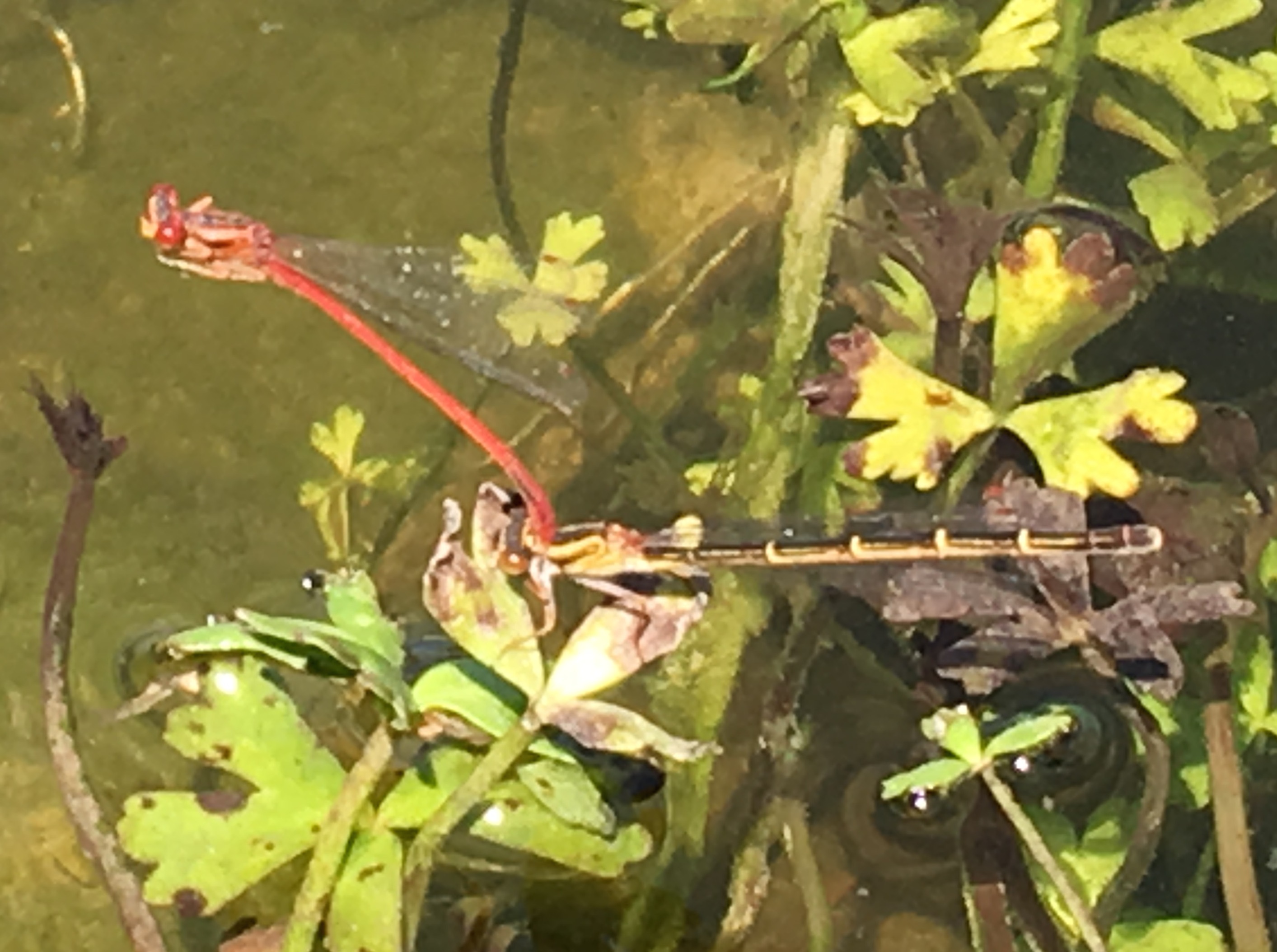
2016-01-31 13.44.40 cropThe females were there, too. Every one I saw was being guarded by a male as she flitted from plant to plant, dipping her abdomen into the water to lay her eggs in the plant’s submerged stem. Damselfly mate guarding is awkward at best—the male grasps the female behind the head with claspers on the end of his abdomen and discourages other males from mating with “his” female. Both insects must beat their wings to keep the pair aloft, and as I watched them, it wasn’t at all clear to me who chooses the spots to stop and lay eggs.

When a pair stops, the male often supports himself entirely with his claspers, tucking in wings and legs and forming a bizarre appendage to the female as she gets down to business. She appears completely oblivious of her escort, resting after laying each egg, as if to say, “If you want to cling there in that ridiculous pose, that’s fine by me, but you’re not going to rush me.”

The eggs these girls lay will hatch in a week or two, and the nymphs will spend nearly a year living in the pond, eating other aquatic invertebrates with a hinged, extrusible mouth that is the stuff of horror movies, before emerging from the water as adults.

I sat and watched the spectacle for a while, and just as I was about to leave, I was treated to the sight of the other damselfly resident in this part of New Zealand—the blue damselfly (Austrolestes colensonis)—a large neon-blue insect that makes the red damselfly look dull.

Unfortunately, he didn’t stick around for a photograph, but I’ll be looking for his nymphs in the water later in the year.

Hedgehogs

2016-01-26 18.07.41 smThey’re adorable and unafraid of humans. They eat snails, slugs and grass grubs. What’s not to like about hedgehogs?

Unfortunately, a fair bit, here in New Zealand. In addition to eating pests, they also feast on ground nesting bird eggs and chicks, skinks, and many native and endangered invertebrates.

And they’re more common in New Zealand than they are anywhere in their native habitat.

And I think they’re more common in our yard than anywhere else in New Zealand.

Now that the days are getting shorter, I regularly step on them in the dark when I’m out milking and feeding the animals. I certainly wouldn’t walk barefoot through the yard at night here.

They snuffle around the flower beds, snorting and grunting, oblivious to anything non-edible. They spread compost all over the yard.

They also apparently love cucumbers—last year I had to trap one out of the garden after it managed to squeeze in through a hole in the rabbit fencing. It took a bite out of each cucumber—obviously trying to find the perfect one.

They like the apples and peanut butter I bait the possum traps with, and though I don’t aim to kill them, I will admit that I’m not upset when I catch a hedgehog instead of a possum (my trapping seems to have no effect whatsoever on the population of either pest, anyway…). They snatch the eggs of the spur-winged plovers that nest unsuccessfully every year in our paddock, and I’d much prefer plover chicks to hedgehogs in the yard.

It still doesn’t stop me from smiling when I see one trundling along through the grass.

They are adorable after all…

Sunrise, Sunset

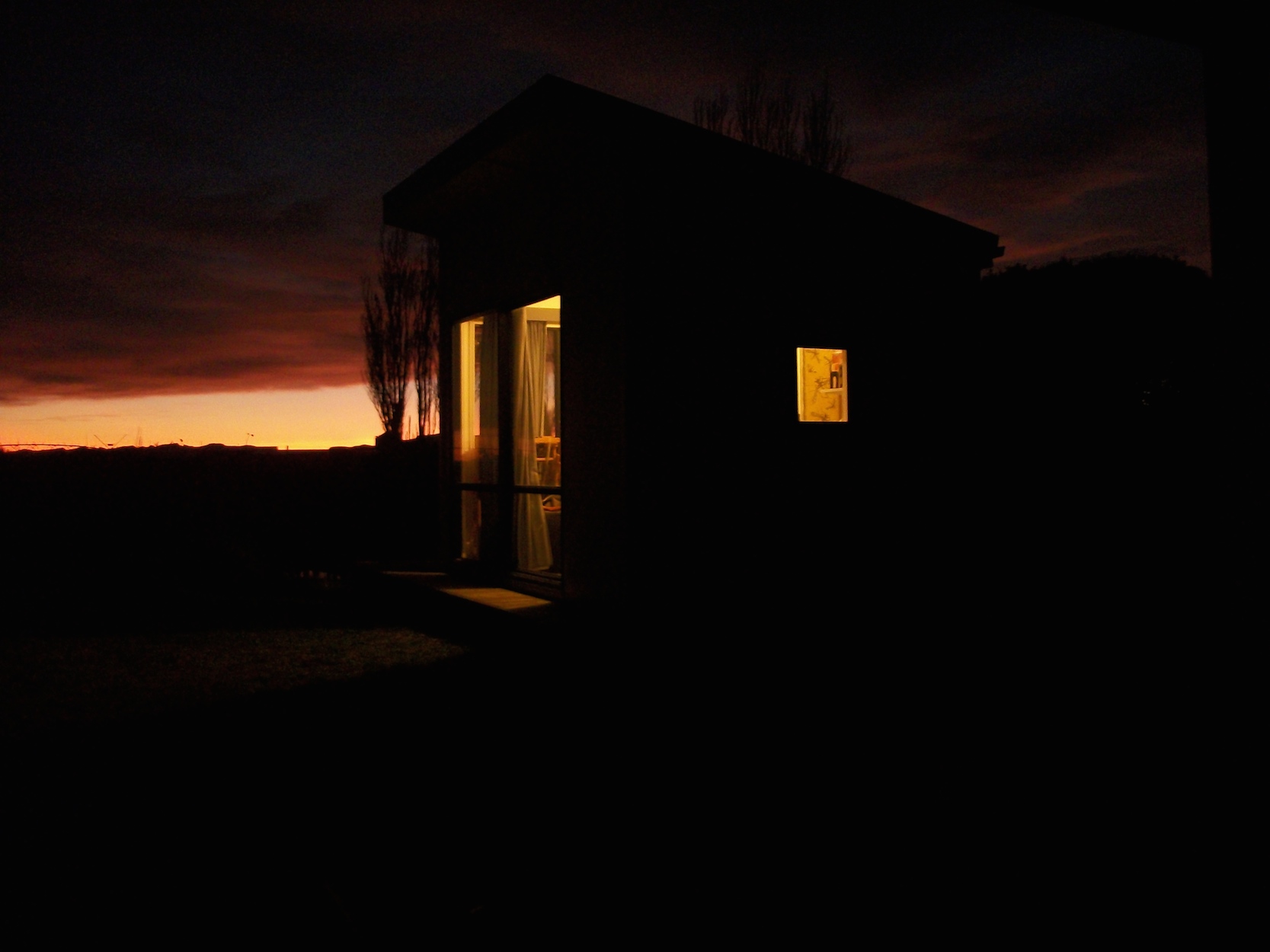
100_3310 smThe days are getting shorter.

You might not notice unless you push the daylight as hard as I do. Because I get up so early, I can feel the shrinking days by early January.

It starts with me oversleeping. I don’t use an alarm, so as the days get shorter, I find myself sleeping longer. Just by a few minutes at first, but by now I don’t open my eyes until 5.15 am, and don’t bother getting up until 5.30—the animals tell time by the sun and won’t look for me until then anyway.

At some point, I’ll have to switch to getting up in the dark. At some point, the days won’t be long enough.

But for now, I’ll enjoy the extra sleep.

Homemade and Home grown

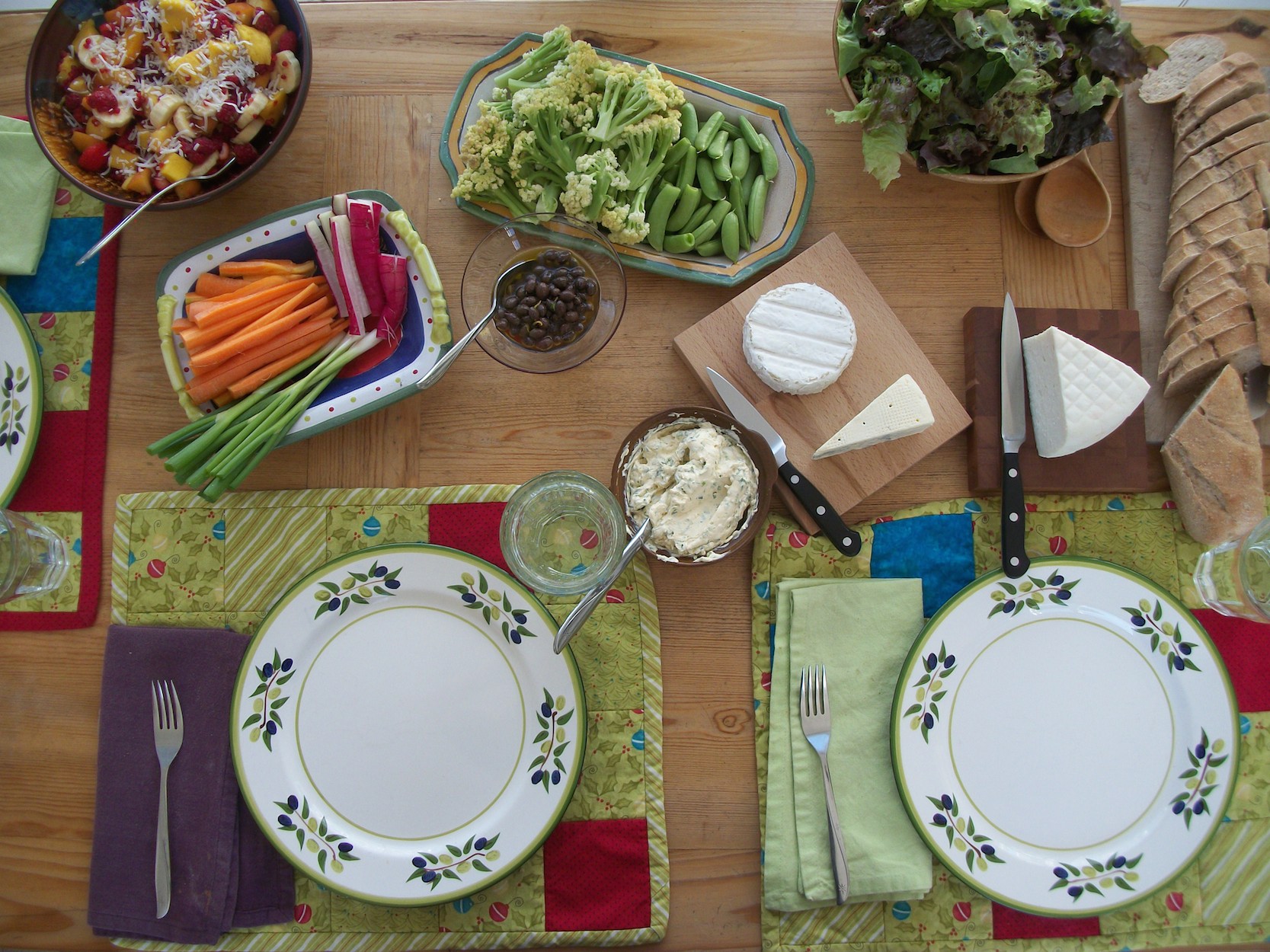
100_4265 smMy family loves food. We eat well. We eat a lot. But what I’ve come to realise is that we don’t just love food for its own sake. We don’t go out to restaurants, and we don’t wax lyrical about our favourite products from the grocery store.

For us, food is as much about how it gets to our table as it is about what it tastes like there. Food is a labour of love, a creative endeavour, a team effort. Food is inseparable from its origin.

Years ago, my son asked, “If we didn’t grow the ingredients ourselves, is it really homemade?” That is how deep our relationship to our food is.

I sometimes wonder if this is healthy—this obsession with food. But it really isn’t so much about the food as it is about the process and all the corollary benefits.

Producing our own food, we stay fit without paying for gym memberships, we have food security in the face of natural disasters, we learn to work together as a family, the children gain a sense of worth from helping to feed us all, we eat better, we reduce our impact on the earth…the list goes on and on.

Producing our own food is a way to nurture the family, a way to acknowledge our place in the natural world, a way to celebrate each day of the year and the gifts it brings.

Harvest time, Time to harvest

100_4237 smI picked peas today.

That was all.

Well, yes, I did a few other things, like laundry and cooking dinner and whatnot, but my day was pretty much given over to picking and processing peas.

Tomorrow I will do the same with currants and raspberries.

The next day we will pick cabbages and make saurkraut.

And it will be time to pick peas again.

When George Gershwin wrote the lyric, “Summertime, and the livin’ is easy,” he obviously wasn’t thinking like a gardener. Oh, food is plentiful—more than plentiful—but getting that food to the table or stored away for leaner times doesn’t make for easy living.

Summer

100_4218 smWhen the question is not, “What is there to eat?”

But, “What needs to be eaten?”


When bringing in the day’s vegetables takes all morning.

And doing something with them takes the rest of the day.


When you worry, not about what to eat,

But how to eat it all.


When you begin to think that life is nothing

But picking and processing vegetables.


When you know

You will appreciate all this work

In the dead of winter

When you are still eating

Peas, corn, cherries, strawberries, green beans…

But today

All you want

Is to sit

For five minutes

And not

think

about

food.

Currently Jammin’

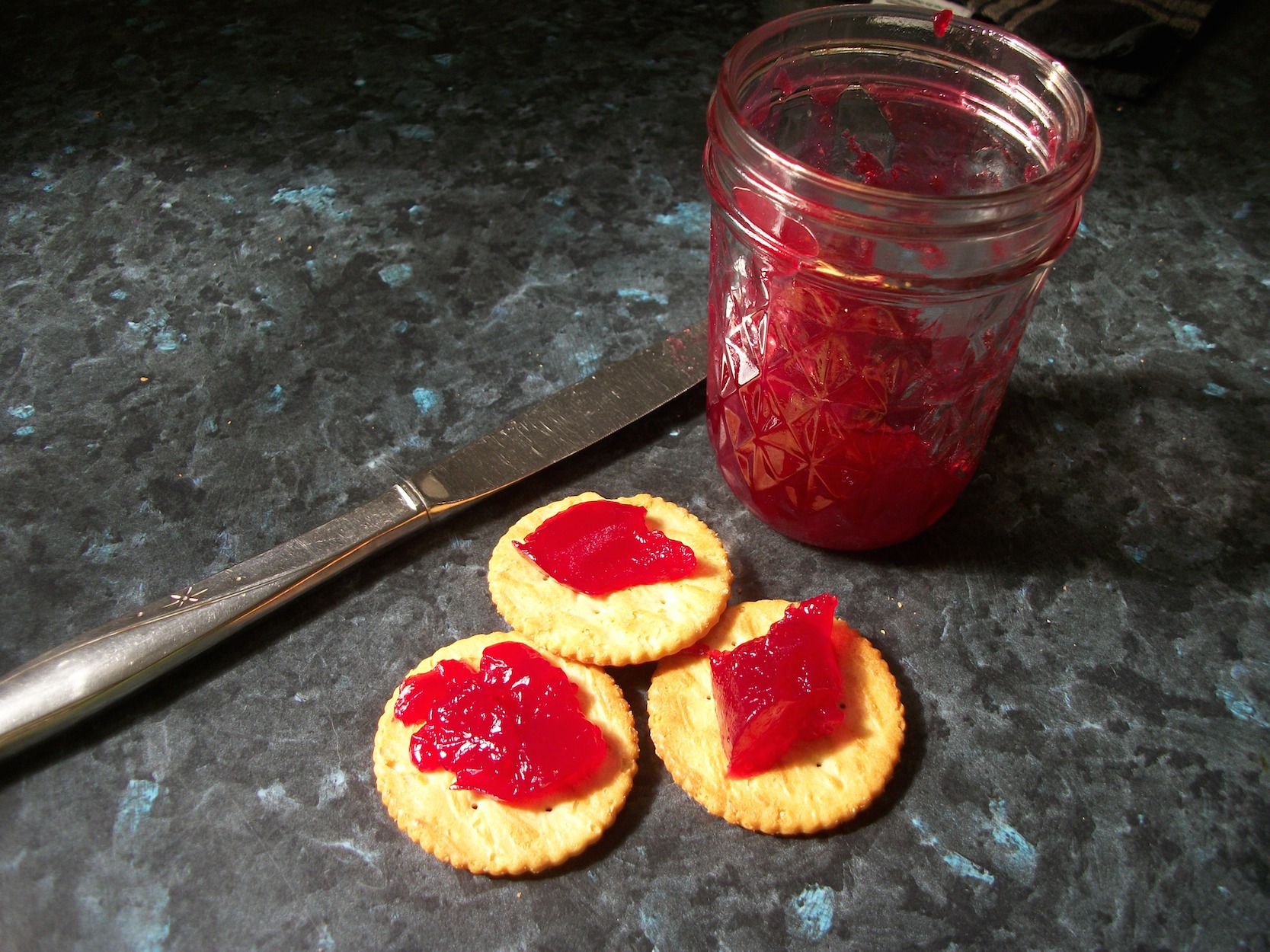
100_4220 smIt was a fruity day today—picked and processed cherries, blackcurrants, and red currants.

We enjoy mixed berry jams, but this is the first year we have enough red currants to make straight red currant jam. Naturally, I had to try it.

I am in love.

The jam is incredibly tart and hits you with waves of flavours.

And it is impossibly red!

I tried some on a cracker, then had another and another…

I can tell that it’s main problem is that it won’t keep well 😉


The Cherry Mystery

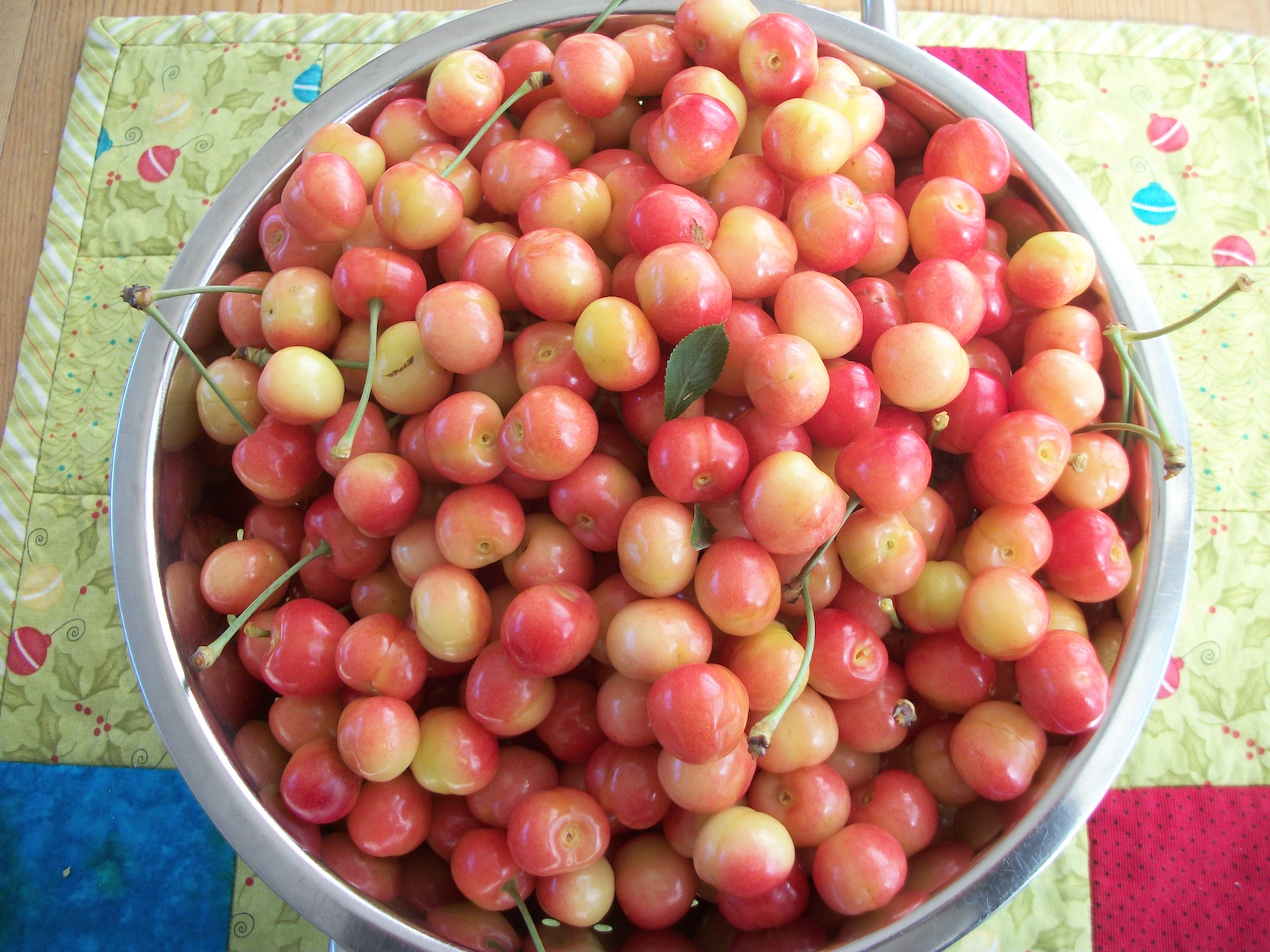
100_4169 smWhen you move onto an old property, it takes a while to become familiar with all the plants previous owners planted. Our property was blessed with a variety of fruit trees. There are a few apples—three varieties, from what we’ve seen, though we can only identify one of them. There’s a late-season peach. And there is a cherry tree. The cherry tree is old and had been damaged repeatedly over the years.

In the spring, the first years on the property, we would watch as the tree put out a few flowers, but we never saw a ripe fruit. The birds seemed to eat them all before they ripened.

Then one year the tree flowered profusely. It was loaded with cherries. But still, they didn’t seem to ripen before they were eaten by the birds.

That’s when it finally dawned on us—it was a yellow cherry! The fruits were ripening. The birds knew that—they can see the change in reflected UV light when a berry is ripe—but we didn’t.

Once we knew what the cherries were, we were able to get a harvest most years, in spite of the birds. It’s still difficult for me to tell when one is ripe by look, but I pick by feel—a ripe cherry is subtly softer than a nearly ripe one.

We still don’t know the variety. The fruits are relatively small. They’re sweet, but very heavy in cyanide flavour, and we can’t decide if they’re better for eating fresh or baking.

This year is a bumper year for cherries, so we’ll be able to have them both ways. This morning’s harvest was more than enough for a pie, so you can guess what we’re having for dessert tonight!

Reality check

syringesPeople who don’t keep livestock think that having dairy goats is like some sort of fairytale honeymoon. You go out to the paddock, fill a pail with fresh milk, and life is all strawberries and cream.

Reality…is a bit different.

You wake at 5 am to the sound of the goats whining at you. You stumble out of bed wishing that you could sleep in, just one day, but you know you can’t—the milking has to be done, whether you feel like it or not. You go out to the paddock and open the gate. You wrestle desperately with four goats who all want out the gate at once, trying to tease out the one you want. While you heave the gate shut behind her, the loose goat decides to eat those lovely ornamentals you just planted.

You pull her away from your flower beds and head her to the milking stand. She baulks at stepping up, because yesterday the neighbour’s irrigator was hitting the stand while you milked, and she was spooked by it. You cajole, then threaten her up onto the stand. You start to milk her, and she kicks. When you pull back to let her calm down, you discover why she doesn’t want to be milked this morning—she has a cut on one teat, and milking is reopening it. Your hand is covered in blood, but you can’t stop—she’s got to be milked.

You manage to milk her out while she dances around, trying to upset the pail. You get her back into the paddock and repeat the circus with another goat. When you get back inside, you strain the milk, and realise that one of the goats has developed mastitis.

You spend another couple of milkings trying to isolate who is infected, and whether one or both sides is infected.

When you finally know only one side of one goat has mastitis, you go to the vet, who decides that this time, she’s going to give you a systemic antibiotic for it, not the local udder injection like you expected. All that work figuring out exactly where the infection is was a waste of time.

For the next three days, you inject the goat with antibiotics. An intramuscular injection that’s as painful for you as it is for the goat. She hates the injections, and by day three absolutely refuses to get on the milking stand where you give them to her.

Now, for thirty-five days, you need to continue to milk, morning and evening. But instead of making cheese and ice cream, you have to throw the milk away because it’s laced with antibiotics.

So, yeah, it’s all strawberries…hold the cream.

Favourite Garden Tool–Machete

100_4045 smI learned to use a machete in Panama, where it became an extension of my arm. I learned my macheteing technique from greats such as Julián Valdéz and Onofre Gonzales. Not having been born with a machete in my hand as they were, I could never match their skill, but by the end of my two years, I could at least keep pace with a crew clearing brush for a new crop. Of course I could only do this because I’m ambidextrous, and when my left arm gave out, I could switch to the right. But, hey, that meant I was at least half as good as the farmers around me!

In rural Panama, a machete may be the only tool a farmer owns. It’s used for everything from taking down trees three feet in diameter to paring one’s toenails. Machetes are kept razor sharp, and if a farmer isn’t using her machete, she’s probably sharpening it. All that use wears them down. As a machete grows smaller and smaller, its use changes—from land clearing, to weeding tool, to kitchen knife. The smallest ones are given to little children, who proudly toddle around with machete in hand—able to help around the farm now they have a tool.

When I left Peace Corps, I sadly had to leave my “Collins”* behind—it was Peace Corps issued, and went to the next volunteer in my village. But I couldn’t live long without a machete, and soon had another upon my return to the United States. Actually, we had three…size is critical, and you have to get just the right one, so my husband has a long one, and I have a shorter one, and we have an even shorter one that fits neither of us well, but is useful for edge-destroying activities.

Those machetes came to New Zealand with us when we moved, and they are as useful here as they were every other place we’ve lived, though they get odd looks from the neighbours.

Here in the developed world, the machete is an anachronism of sorts. Its jobs are done by petrol-powered weed whips, chainsaws, saws and secateurs.

But there is something satisfying about a tool that can do just about anything. A tool that never breaks down, doesn’t need fuel, and requires only simple maintenance—sharpening—easily done with a file or even a chunk of concrete.

And of course, as the forerunner of the sword, a machete comes in handy if you happen to come across a dragon in the garden…

*Collins is a favoured brand of machete in Panama.