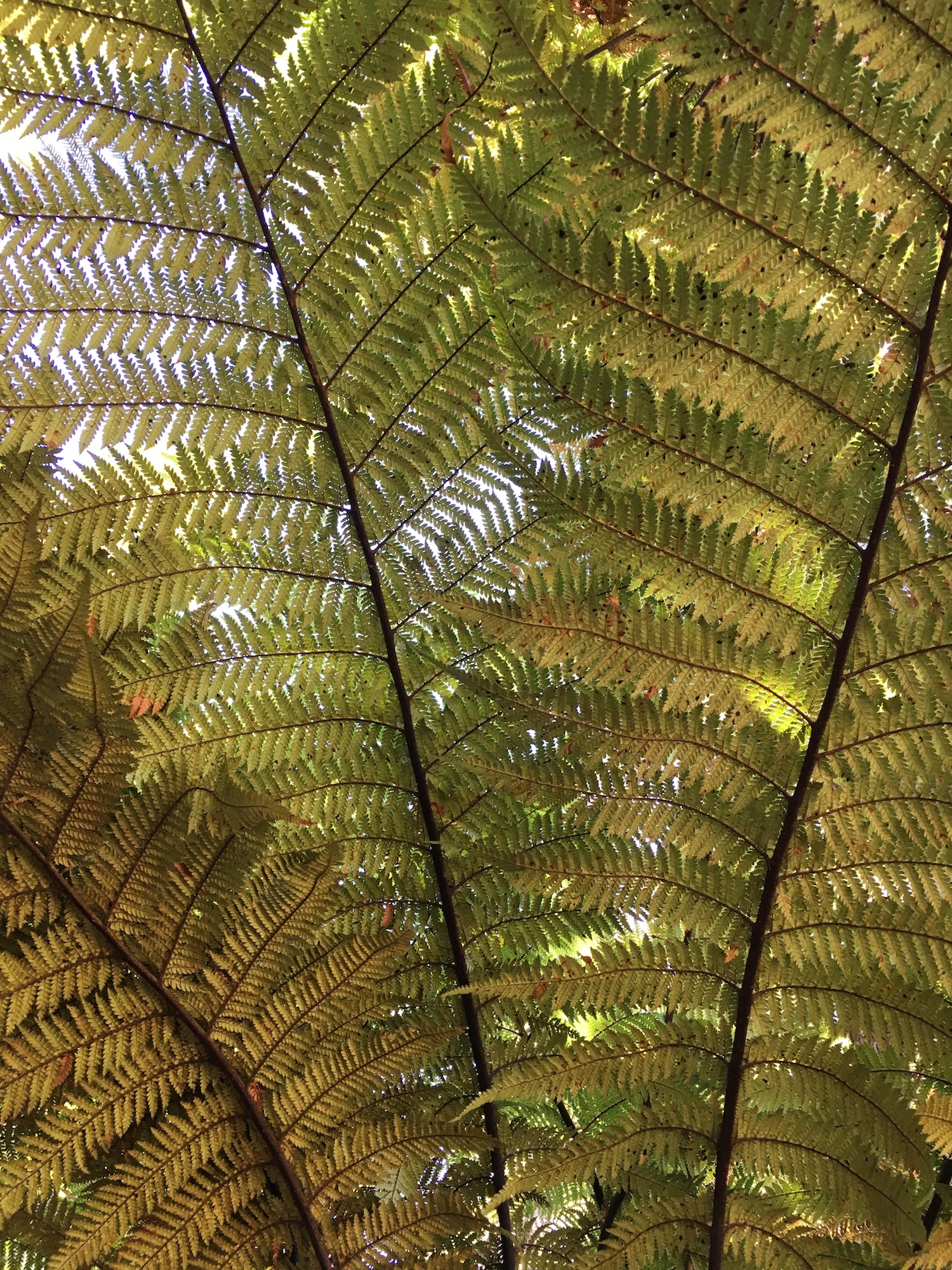
 Tree fern laced sky;
Feathered frond umbrella
Sheds no rain.

Pohutukawa–
Pollen-tipped pompom brings
Holiday cheer.
Tree fern laced sky;
Feathered frond umbrella
Sheds no rain.
Pohutukawa–
Pollen-tipped pompom brings
Holiday cheer.
 From one day to the next it happened.
The garden went from newly planted to bursting and full.
It will get much more crowded before summer is over—I usually lose most of my paths by mid-February—but it has lost the widely-spaced springtime look.
It is always such a surprise and a pleasure when it takes on the summer look. It’s like the moment when you look at your teenager and you can see the adult s/he is becoming. It’s a phase shift, and though it comes on gradually, there is a magical moment when you suddenly see it.
I walked through the garden today for no reason, just for the pleasure of walking among those wonderful, full rows of plants.
 It’s the silly season, with end-of-the-school-year stuff piling up with Christmas, summer vacation, and garden stuff.
Once again, lists take centre stage for me. The general to-do list gave way to a ‘before Christmas’ to-do list. That list has now been refined into a day-by-day list, a sort of sadistic Advent calendar counting the days to Christmas.
I’m afraid ‘write blog’ didn’t make it onto today’s list. It was bumped off when I failed to complete ‘pick and process peas’ on yesterday’s list, due to the unexpectedly large harvest.
So, I’m off to blanch and freeze peas. Hope you’ve all had a lovely day and completed everything on you to-do list. Just two more weeks, and we’ll get a day off!
 In a nod to Thanksgiving, I made orange cranberry scones for Sunday breakfast. Another wonderful use of barley flour. I’ve grown quite fond of barley flour in cakes and pastries–it lends a softness to the texture that is delightful. It also seems to delay baked goods going stale. The remaining scone, pictured here, was just as tender and moist on Monday morning as it had been fresh out of the oven on Sunday.
2 cups barley flour
1 1/4 cup all-purpose flour
1/2 cup lightly packed brown sugar
1 tsp baking soda
1 tsp baking powder
1/4 tsp salt
125 g (1/2 cup) cold butter
1 egg
1/2 cup buttermilk
1/2 cup orange juice
grated rind of 1 orange
Combine the flours sugar, baking soda, baking powder and salt in a large bowl. Cut the butter into the flour mixture until it resembles coarse crumbs.
Whisk together the egg, buttermilk, orange juice and orange rind in a separate bowl. Add to the flour mixture, stirring until evenly moistened.
Turn the dough onto a floured surface and knead two or three times. Divide dough in half. Pat each half into a circle about 2 cm (3/4-inch) thick, and cut each circle into eight wedges.
Place on an ungreased baking sheet and bake at 190°C (375°F) for 20-25 minutes.
 Twelve years ago, I was facing my first Christmas in the Southern Hemisphere. Everything felt wrong. I tried to carry on the traditions my husband and I had established in the States; I made truffles and cookies, I decorated with fresh greenery, we strung Christmas lights, we planned a big Christmas dinner, we played Christmas music.
The truffles melted, the greenery turned brown, the Christmas lights were invisible in the long summer evenings, the heavy dinner sat like lead on a hot summer day.
I longed for snow, and all the indoor family time of the northern holiday. I wanted long nights, candles and a roaring fire. I wanted hygge. But it was summer—time to be outdoors, on the beach, enjoying the sun.
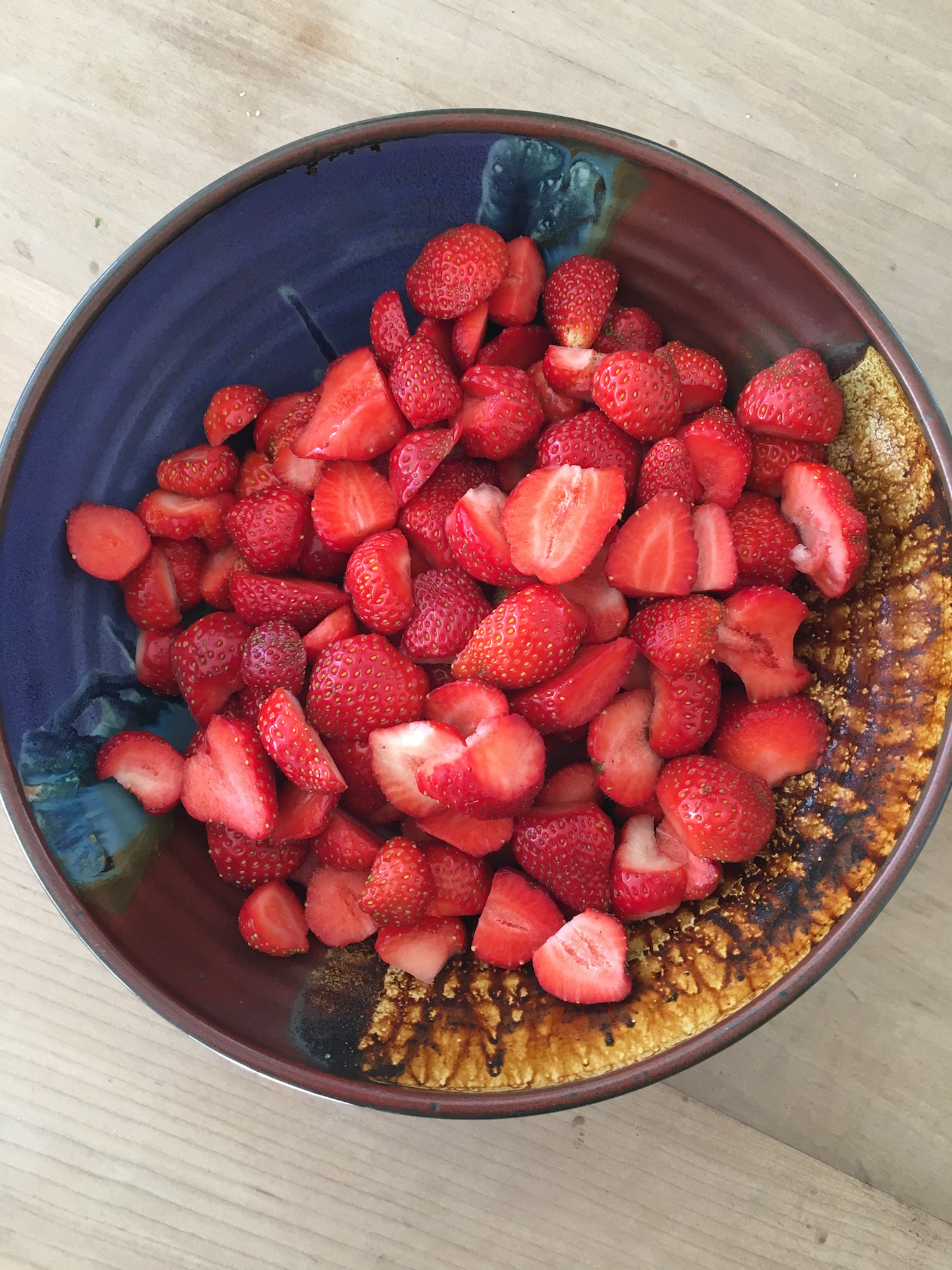
Slowly our traditions have adapted to this southern holiday. I realised how far I’d come on Sunday morning. Slicing strawberries for breakfast, the smell of berries made it feel so Christmassy, I started humming carols. Then I laughed at the idea that strawberries equal Christmas.
I thought about all the things my kids have grown up associating with Christmas—long days at the beach, gardening, strawberries, cherries, making jam, making sauerkraut (which usually happens about Christmas eve every year), the ‘traditional’ Christmas salad, the first new potatoes, broad beans, backpacking.
We rarely play Christmas carols anymore (who wants to be indoors?). We bake fruit pies, and not many cookies. We use red carnations from the garden for Christmas decorations. Rather than being a time for focusing inward, Christmas is a time for adventuring—traveling, hiking, exploring.
And so, as we start into this Christmas season, I am looking forward to our travel plans. I’m looking forward to many days at the beach. I’m looking forward to the summer bounty from the garden. I’m looking forward to ice cream, roadside stands selling Otago cherries, outdoor dinners, and warm sun.
And that, I think, is the key of the season—to celebrate what is good about the here and now. To celebrate the bounty we’ve been given, whatever form it comes in—love, friendship, snow or strawberries. To be mindful. To be present in the moment.
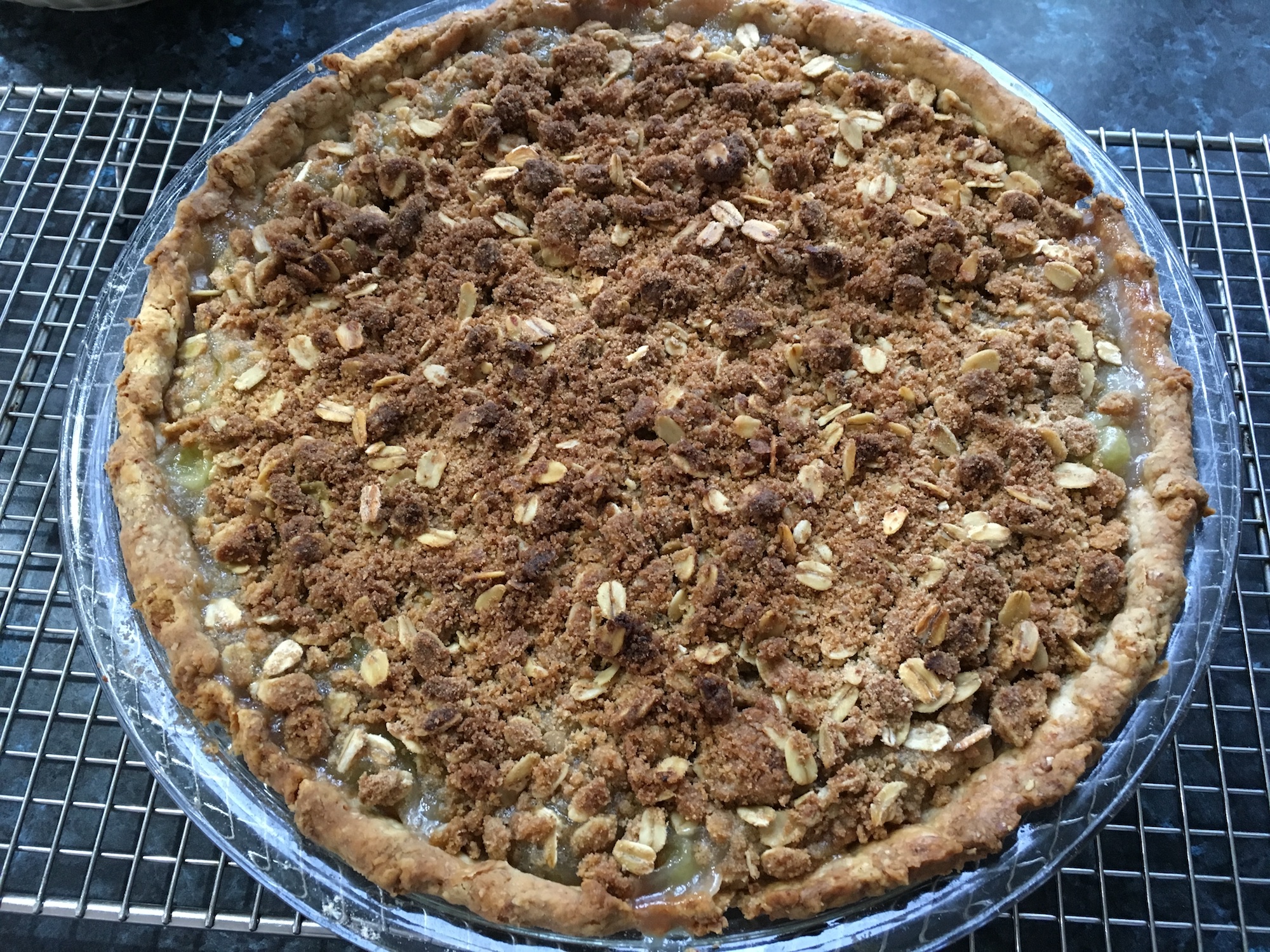 It’s a good year for gooseberries. Our supply of them seems to be limited only by our tolerance for the spines. Gooseberry jam, gooseberry ice cream, and the tartest, most gorgeous pie…
4 cups fresh gooseberries, stemmed and tailed
1 1/4 cups sugar
1/4 cup all-purpose flour
1/4 tsp nutmeg
pastry for 1 pie crust
Speedy Streusel:
2/3 cup wholemeal flour
1/2 cup brown sugar
2/3 cup old-fashioned rolled oats
1 tsp cinnamon
5 Tbsp melted butter
Roll out the dough and line a pie plate. Refrigerate until ready to use.
Mix all ingredients for the streusel, stirring until crumbly. Set aside.
Put gooseberries in a medium saucepan and add a few tablespoons of water. Heat over medium heat until the berries ‘pop’. Combine sugar, flour and nutmeg. Add these to the gooseberries and cook until thickened.
Pour gooseberries into the pie dough. Sprinkle streusel on top. Bake at 190ºC (375ºF) for 30 minutes. Cool completely before cutting.
This pie is very tart. Serve small slices, accompanied by whipped cream or vanilla ice cream.
 And So It Begins…
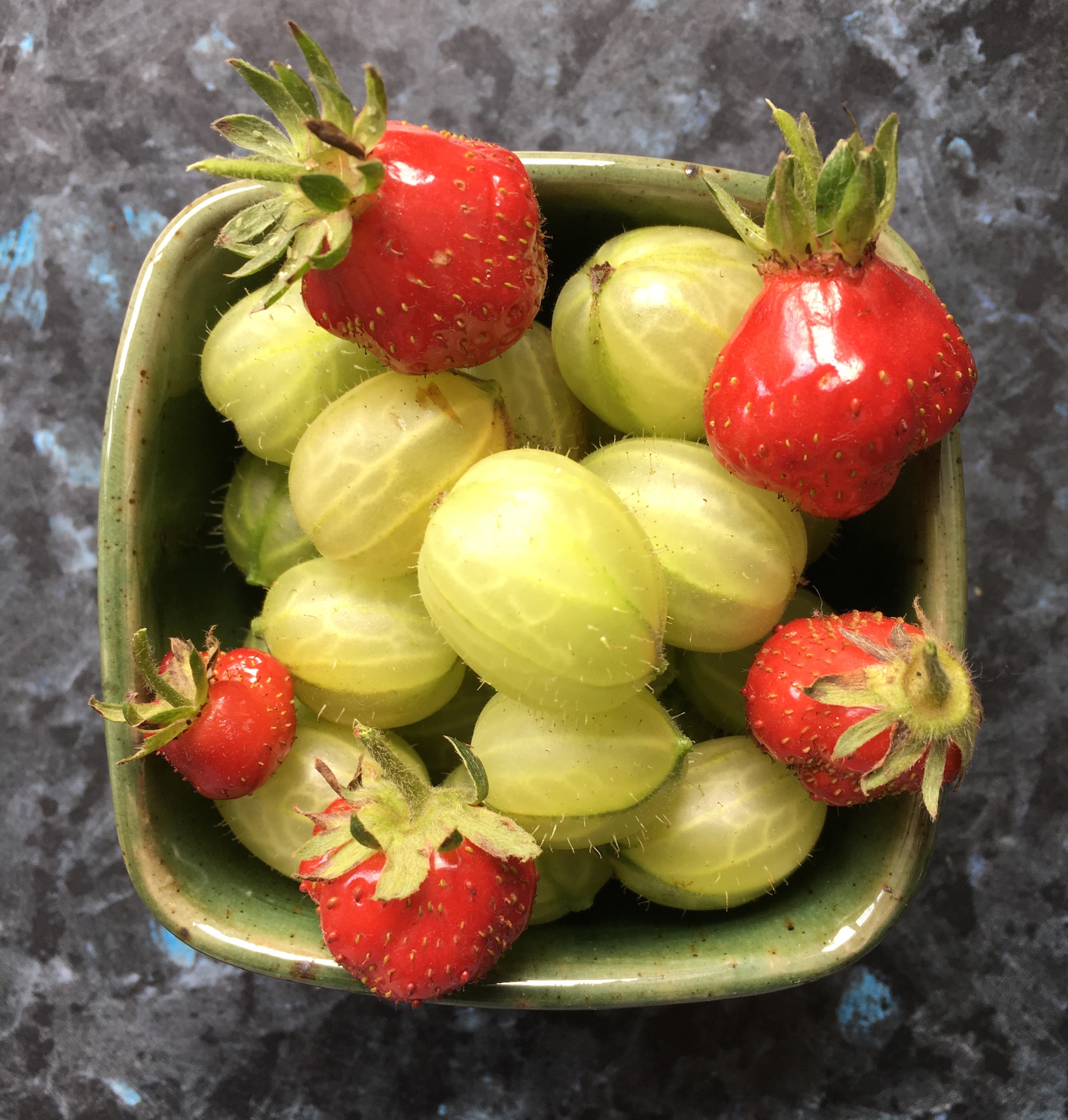
We’ve been watching the berries for weeks, and the signs have been promising. The gooseberry bushes are dripping with fruit. The currants, too, promise a good harvest. In spite of a viral infection, even the strawberries are managing a crop. The raspberries are humming with bees, attracted to a plethora of flowers.
The first harvest was tiny—a handful of berries—but it marks the beginning of my favourite season on the property. The season of fresh fruit. It begins with strawberries and gooseberries, moves on to currants, cherries and raspberries, and ends with apricots and plums. Watermelons, apples, and peaches come late in the year, and they’re lovely, but nothing compares to the early summer fruits. Their season is short, but bountiful. It’s the season of jams, fruit pies, and fruit ice cream. The season of gooseberry fool, strawberry-smothered waffles, and apricot upside down cake. It is the season of plenty.
In festive red and green, ’tis the season, indeed.
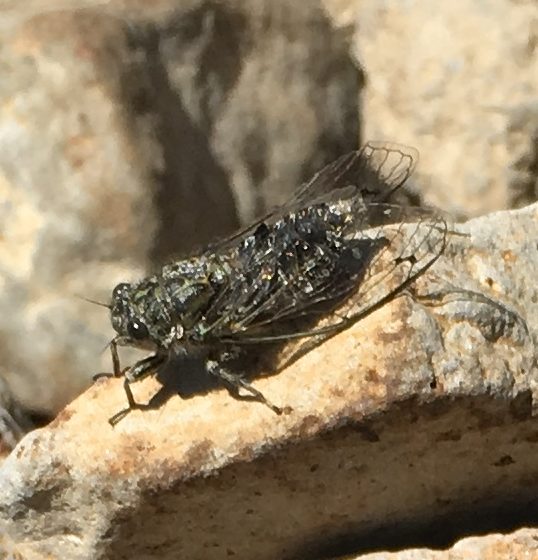 It’s a cicada; it must be summer.
The main cicada season doesn’t really start until the chorus cicadas (Amphisalta zealandica) come out after Christmas, but two weeks ago, we found a few chirping cicadas (Amphisalta strepitans) on the rocks around Okains Bay.
Cicadas are largish, as insects go, but they’re well camouflaged. Usually, you find them by sound. As with most insects, it’s the males that do the singing. The main part of a cicada’s song is made by flexing plates (tymbals) on top of the body. Built-in amplifiers (opercula) pump up the volume to an astonishing level. Cicadas are noisy. I don’t know if any of the New Zealand species have been tested, but the calls of some North American cicadas are over 105 decibels at a distance of 50 cm. That’s nearly as loud as a rock concert (115 decibels). When the chorus cicadas here in New Zealand come out in large numbers, they can be so loud in some places that it’s impossible to carry on a conversation.
Some New Zealand cicadas add an extra feature to their song—a bit of drumming called clapping. The cicada snaps the leading edge of its wings against a branch to make a sharp click. Females also clap, and I’ve read (though I’ve never tried it) that you can call the males to you by snapping your fingers.
There are about 2500 species of cicada worldwide. Because of their size and volume, they seem to be culturally important wherever they live. They are eaten as food in many areas, and sometimes used as fish bait. Growing up, my siblings and I used to collect the shed exoskeletons of cicadas and attach them to our clothing like jewellery. When I lived in Panama, the children would catch cicadas and tie strings to their feet, then carry them like helium balloons, flying on the end of the string.
Wherever they live, they mark the seasons. Here in New Zealand, and in America where I grew up, summer hasn’t really started until the cicadas sing.
Loud singing? Drumming? Must be a summer rock concert!
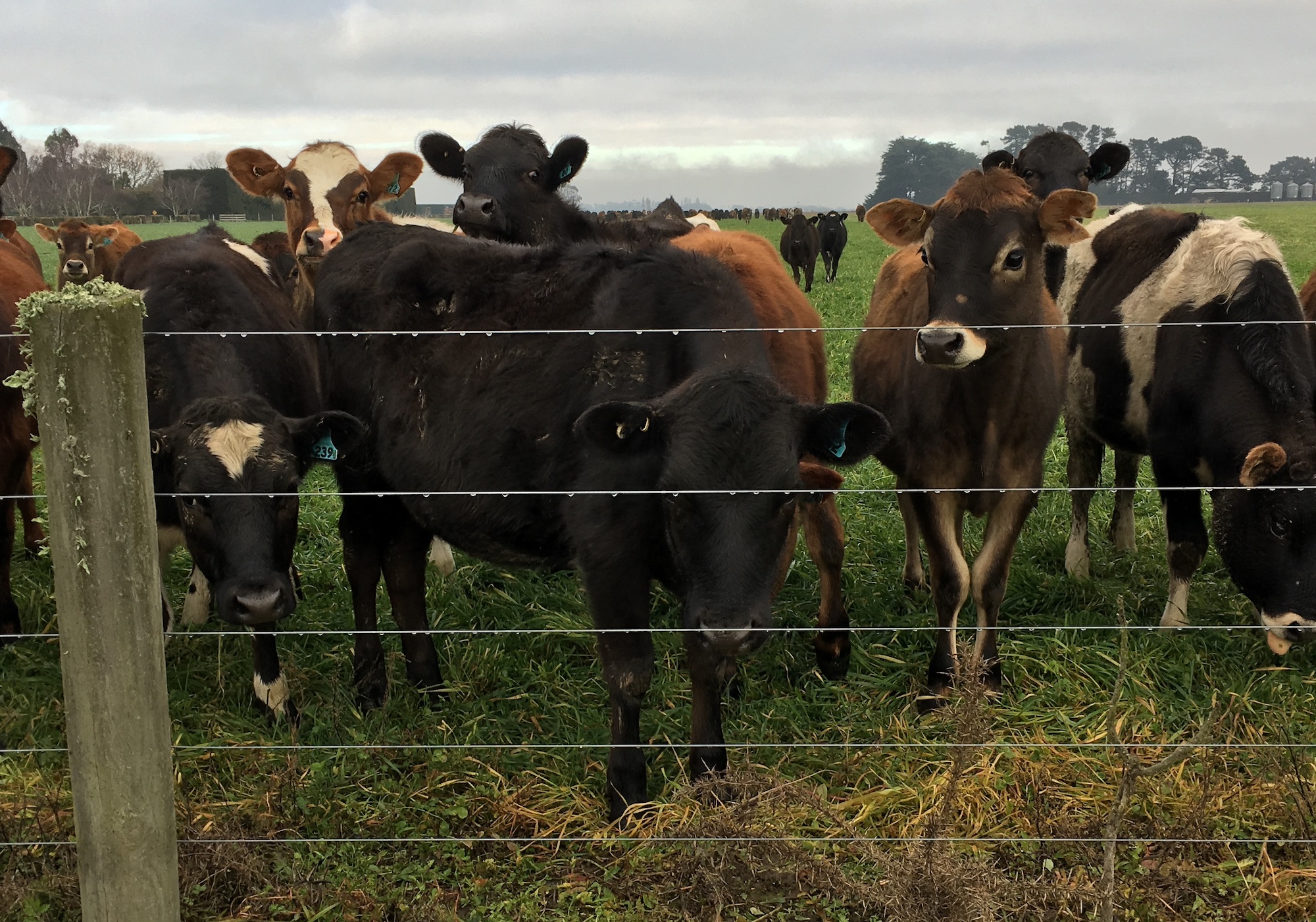 The smell of cattle and rank pasture grasses.
Most of you are saying, “Ew! Disgusting!”
But a few, I’m sure, are thinking, “Yep! Nothing else says summer like that smell.”
And I can guess that, if you’re in the second group, you grew up running barefoot through yours or the neighbours paddocks as a kid. You hopped the fence, dodged the cows (or if you were unlucky, the bull), and swished through tall grass to the creek where you’d wade in the ankle-deep water for hours in the hot sun, catching crayfish, water striders, and dragonfly nymphs. You’d follow the trickle upstream to ‘the dam’, made by countless ten-year-old hands over decades of summers. The pool behind the dam always teemed with minnows, and you’d stand still, hands outstretched in the water hoping to catch one.
The whirligig beetles loved the pool behind the dam, too, and their jiggling, twirling dance on the water’s surface sent ripples across the water, bouncing and refracting into mesmerising patterns.
All the while, the sun heated grass and cow pies, and the perfume of the paddock hung in the hot air and clung to the back of your neck like your sweaty hair.
And when the sun finally began to sink in the west, and you knew dinner was waiting for you at home, you’d climb up from the stream and swish through the paddock again, the cows further off now, in the lengthening shade of the trees. You’d climb back over the fence and take one last, deep breath, storing the summer day, and saving it for tomorrow.
And now, forty years later, you drive past a paddock on a hot day, and in a single breath, you are suddenly ten again, ankle-deep in a creek catching crayfish.
 Spring is spittlebug season. Just about the time I want to start picking and dehydrating the perennial herbs, the spittlebugs descend upon them. In bad years, it makes harvesting herbs a slimy task.
Spittlebugs are also known as frog hoppers. As adults, they are cute, squat, dun coloured insects with spectacular leaping abilities. They really do resemble frogs (with a little imagination).
It’s the nymphs that have the disgusting habit of spitting. Well, it’s actually not spit at all. The foamy slimy ‘spittle’ is a combination of fluid from the insect’s anus, and slimy gunk from glands on the insect’s abdomen. The insect sits head downward on the stem of a plant and exudes the ‘spittle’, letting it pour over its body and cover it completely. The resulting mass keeps the young insect protected from enemies and from drying wind and sun. Gross, but effective.
Like humans, who usually stop blowing bubbles in their milk as adults, spittlebugs leave off spittle production when they grow up. As adults, they use their hopping ability to avoid predators.
Some species of spittlebug can become significant agricultural pests, stunting the growth of herbaceous plants and some forestry trees, but in the home garden, they’re usually not much more than a minor nuisance.
 Robinne Weiss