Currently Jammin’

100_4220 smIt was a fruity day today—picked and processed cherries, blackcurrants, and red currants.

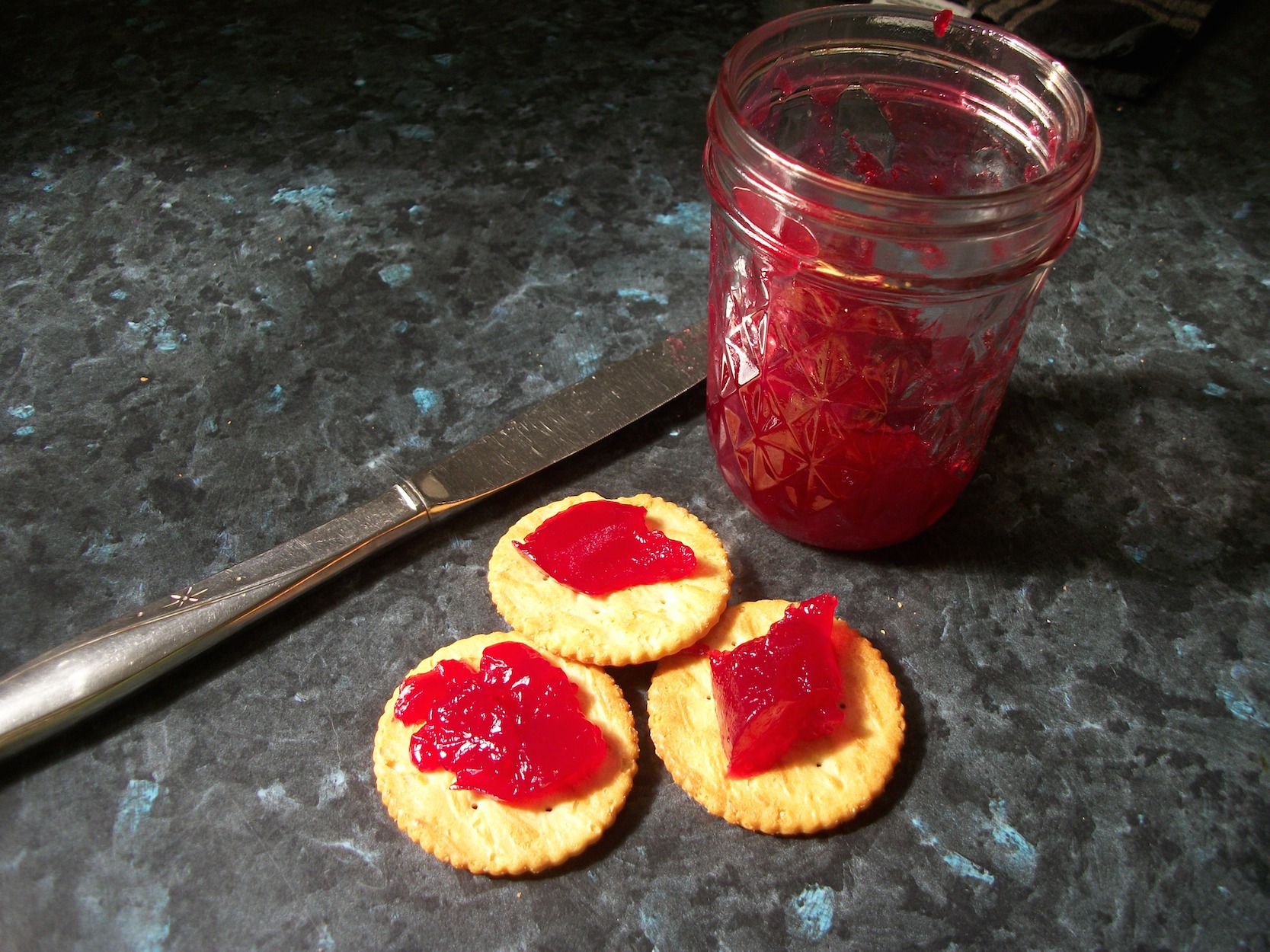
We enjoy mixed berry jams, but this is the first year we have enough red currants to make straight red currant jam. Naturally, I had to try it.

I am in love.

The jam is incredibly tart and hits you with waves of flavours.

And it is impossibly red!

I tried some on a cracker, then had another and another…

I can tell that it’s main problem is that it won’t keep well 😉


Rain!

100_4212I didn’t dare believe it until it happened, but we got over a centimetre of rain today. Squally thunderstorms rolled in at lunchtime, curtailing my gardening and cutting power, but I don’t mind. A centimetre of rain will do lovely things for the garden and paddocks.

Dinner switched from the planned ricotta and pea tart to risi e bisi, which could be made on the gas stove without electricity.

This blog was written the old-fashioned way—on paper with one of my favourite pencils (and uploaded when the power came back on).

Now there’s nothing left to do by sit down with a glass of wine and a book to read by the light of the solar powered Christmas tree lights.

The Cherry Mystery

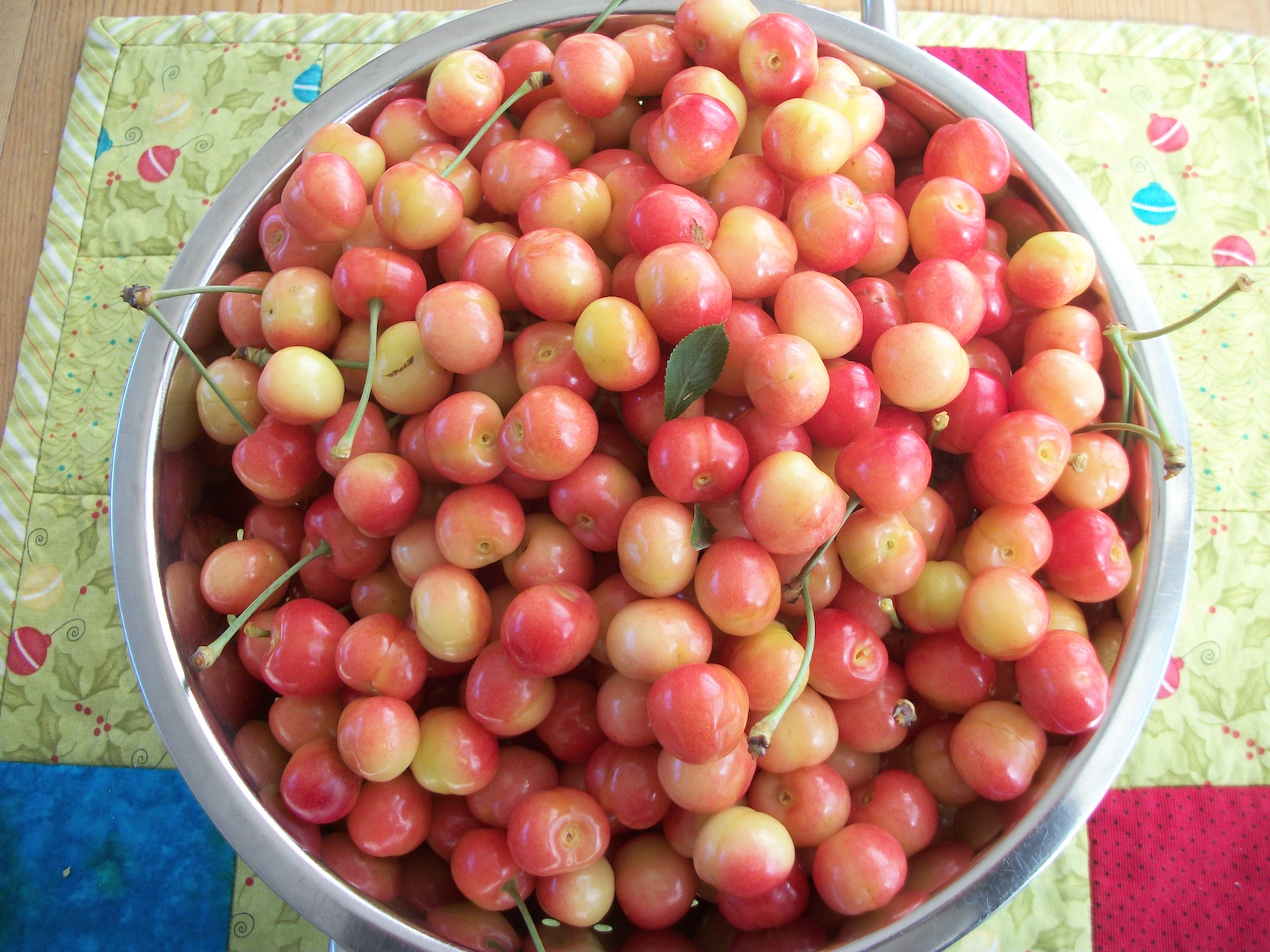
100_4169 smWhen you move onto an old property, it takes a while to become familiar with all the plants previous owners planted. Our property was blessed with a variety of fruit trees. There are a few apples—three varieties, from what we’ve seen, though we can only identify one of them. There’s a late-season peach. And there is a cherry tree. The cherry tree is old and had been damaged repeatedly over the years.

In the spring, the first years on the property, we would watch as the tree put out a few flowers, but we never saw a ripe fruit. The birds seemed to eat them all before they ripened.

Then one year the tree flowered profusely. It was loaded with cherries. But still, they didn’t seem to ripen before they were eaten by the birds.

That’s when it finally dawned on us—it was a yellow cherry! The fruits were ripening. The birds knew that—they can see the change in reflected UV light when a berry is ripe—but we didn’t.

Once we knew what the cherries were, we were able to get a harvest most years, in spite of the birds. It’s still difficult for me to tell when one is ripe by look, but I pick by feel—a ripe cherry is subtly softer than a nearly ripe one.

We still don’t know the variety. The fruits are relatively small. They’re sweet, but very heavy in cyanide flavour, and we can’t decide if they’re better for eating fresh or baking.

This year is a bumper year for cherries, so we’ll be able to have them both ways. This morning’s harvest was more than enough for a pie, so you can guess what we’re having for dessert tonight!

Watch Out—She’s Packing Secateurs!

Among my favourite garden tools is a pair of small, straight-bladed secateurs. In addition to the secateur function, the tool also acts as a knife—the “back” edge of each blade is sharpened.

It took me a few very deep, nasty cuts to my fingers before I quite got the hang of this tool. When I use it to trim goat hooves, I have to wear heavy gloves, because the goats always kick and send the blade into my hand.

Thankfully, the tool comes with a sheath. The sheath clips to a belt or pocket, and I’ve found it quite handy to always have a knife and secateurs with me in the garden. So I’ve taken to automatically clipping it on when I go to the garden.

With my secateurs at my hip, I feel like I’m packing heat.

**Apologies—I spent most of my day away from internet access, only got home at 10.30 pm, and didn’t get a photo for today’s post. At least I got it posted…just an hour to go in the day!

Reality check

syringesPeople who don’t keep livestock think that having dairy goats is like some sort of fairytale honeymoon. You go out to the paddock, fill a pail with fresh milk, and life is all strawberries and cream.

Reality…is a bit different.

You wake at 5 am to the sound of the goats whining at you. You stumble out of bed wishing that you could sleep in, just one day, but you know you can’t—the milking has to be done, whether you feel like it or not. You go out to the paddock and open the gate. You wrestle desperately with four goats who all want out the gate at once, trying to tease out the one you want. While you heave the gate shut behind her, the loose goat decides to eat those lovely ornamentals you just planted.

You pull her away from your flower beds and head her to the milking stand. She baulks at stepping up, because yesterday the neighbour’s irrigator was hitting the stand while you milked, and she was spooked by it. You cajole, then threaten her up onto the stand. You start to milk her, and she kicks. When you pull back to let her calm down, you discover why she doesn’t want to be milked this morning—she has a cut on one teat, and milking is reopening it. Your hand is covered in blood, but you can’t stop—she’s got to be milked.

You manage to milk her out while she dances around, trying to upset the pail. You get her back into the paddock and repeat the circus with another goat. When you get back inside, you strain the milk, and realise that one of the goats has developed mastitis.

You spend another couple of milkings trying to isolate who is infected, and whether one or both sides is infected.

When you finally know only one side of one goat has mastitis, you go to the vet, who decides that this time, she’s going to give you a systemic antibiotic for it, not the local udder injection like you expected. All that work figuring out exactly where the infection is was a waste of time.

For the next three days, you inject the goat with antibiotics. An intramuscular injection that’s as painful for you as it is for the goat. She hates the injections, and by day three absolutely refuses to get on the milking stand where you give them to her.

Now, for thirty-five days, you need to continue to milk, morning and evening. But instead of making cheese and ice cream, you have to throw the milk away because it’s laced with antibiotics.

So, yeah, it’s all strawberries…hold the cream.
Aphids

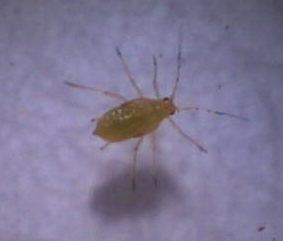
20151127_125023710It’s aphid season here. Lettuce, strawberries, dill, parsley, and roses are covered in the little green girls.

I used to fret about aphids—they can certainly cause a great deal of damage, particularly to young plants. But I’ve learned to live with them. Here are a few of my aphid strategies:

  1. When I plant out, I check every plant carefully, and squish any aphids—knocking back these early individuals goes a long way to limiting damage.
  2. If a plant is heavily infested, I turn my hose on jet and blast the aphids off. This technique doesn’t get them all, but it does knock the population back to manageable levels.
  3. I allow some plants to get covered. In my garden, my early dill always gets nailed by aphids. I accept this. I don’t kill the aphids, either. The aphids on the dill attract ladybugs, lacewings, and parasitic wasps that eat aphids. Lots of aphids on the dill means lots of predators later in the season.
  4. I plant purple varieties of crops, which are usually less attractive to aphids.
  5. I accept aphids as a source of extra protein and vitamin B in our diets. We eat aphids. They’re good for us.
  6. I have patience. By midsummer, the aphids have all but vanished, decimated by the predators I cultivated in springtime.
  7. I admire aphids’ abilities and beauty—parthenogenic reproduction (that is, the females clone themselves—no need for males), dainty legs and antennae, and a remarkable ability to survive.

Favourite Garden Tool–Machete

100_4045 smI learned to use a machete in Panama, where it became an extension of my arm. I learned my macheteing technique from greats such as Julián Valdéz and Onofre Gonzales. Not having been born with a machete in my hand as they were, I could never match their skill, but by the end of my two years, I could at least keep pace with a crew clearing brush for a new crop. Of course I could only do this because I’m ambidextrous, and when my left arm gave out, I could switch to the right. But, hey, that meant I was at least half as good as the farmers around me!

In rural Panama, a machete may be the only tool a farmer owns. It’s used for everything from taking down trees three feet in diameter to paring one’s toenails. Machetes are kept razor sharp, and if a farmer isn’t using her machete, she’s probably sharpening it. All that use wears them down. As a machete grows smaller and smaller, its use changes—from land clearing, to weeding tool, to kitchen knife. The smallest ones are given to little children, who proudly toddle around with machete in hand—able to help around the farm now they have a tool.

When I left Peace Corps, I sadly had to leave my “Collins”* behind—it was Peace Corps issued, and went to the next volunteer in my village. But I couldn’t live long without a machete, and soon had another upon my return to the United States. Actually, we had three…size is critical, and you have to get just the right one, so my husband has a long one, and I have a shorter one, and we have an even shorter one that fits neither of us well, but is useful for edge-destroying activities.

Those machetes came to New Zealand with us when we moved, and they are as useful here as they were every other place we’ve lived, though they get odd looks from the neighbours.

Here in the developed world, the machete is an anachronism of sorts. Its jobs are done by petrol-powered weed whips, chainsaws, saws and secateurs.

But there is something satisfying about a tool that can do just about anything. A tool that never breaks down, doesn’t need fuel, and requires only simple maintenance—sharpening—easily done with a file or even a chunk of concrete.

And of course, as the forerunner of the sword, a machete comes in handy if you happen to come across a dragon in the garden…

*Collins is a favoured brand of machete in Panama.

Gather Ye Rosebuds…

100_3978 smRunning late

After a hard day,

Back aching,

Dinner to be made,

Laundry to be folded.


I stood at the kitchen sink

Washing the dishes that I didn’t have time to wash

After lunch.


Outside the window

A bloom danced in the breeze.

A rose

Frothy pink.

Another

Burgundy

Like wine I wished I had time to enjoy.

There were more, I knew

Out of sight.


I left the dishes,

Dried my hands.


Dinner would have to wait.


Scissors in hand, I abandoned my work

To gather roses.


An Apartment in Town

100_4017Some days make me want to live in an apartment in the city.

Today was one of them.

As I mentioned in a previous post, I planted out all the frost-tender plants last weekend.

Earlier this week, it frosted. In spite of my efforts to save them, I lost nearly 200 plants. I saved hundreds more, so I tried to make the best of it. I replanted what I could.

When it looked like it was going to frost again last night, I covered everything I could.

But it didn’t just frost last night. It froze.

When I tried to spray the plants down in the morning to save what was left, my hoses were frozen. I managed to get a sprinkler going eventually, but when I came back half an hour later, the water it had sprayed had frozen solid.

I won’t know until tomorrow, but I expect I have now lost all of my frost-tender crops, except the few plants that fit in the greenhouse.

After the plant disaster, I headed to the goat paddock to do the milking and noticed that one of my yearlings was scouring badly. The result of worms, no doubt (she was the one goat I didn’t manage to dose the last time I drenched them). Treatable, but in a goat so small, I worry—they can go down fast once they start scouring. I gave her an injection of Dectomax, but like the plants, I won’t know until tomorrow what the outcome is.

So I rushed around trying to save lives this morning before driving an hour into the city to take the kids to school…makes that apartment in town look really attractive.

Overspray

100_4002Planting out, I scrutinise each plant for health. I discard damaged or poorly growing plants. I pick off pests.

But there are some problems I can’t do anything about.

The neighbour’s 2,4-D overspray is one of those.

2,4-D is a broadleaf herbicide that has become increasingly popular with our neighbours over the past five years. Unfortunately, it is extremely volatile, so if the wind is blowing our direction when they spray, we are enveloped in a cloud of herbicide.

It usually doesn’t kill our plants outright, but it has long-lasting effects on them. Grapes are particularly susceptible, but we’ve had damage to nearly every vegetable crop in some years. Some plants, like the green beans, seem to be able to ‘grow out’ of the damage. Others never do, and the effects of an early spring spray can still be seen at harvest time in late summer.

This year, the first overspray hit us in mid-October. Though the frost-tender crops weren’t in the garden yet, they were in the greenhouse, and didn’t escape damage.

I’d surveyed the damage in general as the plants were massed in the greenhouse, but as I inspected each plant at plant out time, I saw the full extent of the damage.

The most obvious early sign of 2,4-D damage is deformation of the leaves—they elongate and curl, and develop odd-looking venation. They can also bleach, sometimes looking nearly white. This year, the tomatoes were particularly hard-hit, with almost all the young leaves deformed. Eggplants, too. Thankfully, the peppers seem to have escaped, and many plants weren’t even up yet, so they made it, too.

I accept that my neighbours aren’t organic farmers, and that they have little control over when the contractor comes to do their spraying, but still it is discouraging to face the same overspray problems year after year.