Throwback Thursday: A Journey with Sammy Sandoval

Home sweet home

I started writing a post about the winter weather we’re experiencing this week, but it was as grey and dull as the sky.

Then my husband played a song by Sammy and Sandra Sandoval, and I was transported back 25 years and 11,000 kilometres to the tropical heat and sun of Panama in 1993, where we served in the Peace Corps.

Like all our neighbours in the province of Coclé, my husband and I loved Sammy and Sandra Sandoval. They would play in the little villages sometimes, and we’d go see them whenever we could. Their music was loud and joyful, and we’d walk hours to pack into a crowded room and dance to it.

But what I remember most is the silent walk home from the first of those dances. Leaving the noise and sweat of the dance hall, we stepped into the dark night of the campo. No lights, no roads, just a packed clay footpath and the sound of music receding behind us.

That walk was magical. I don’t know if the buzz was from the music, the beer (Cold beer! What a luxury!), or the faint glint of moonlight off the palm trees. Most likely, it was from the blessed silence and the recognition that, in walking an hour and a half to dance Panamanian tipico, we’d stepped irrevocably out of our previous lives.

Navigating our way home on a familiar path lit only by moonlight, we traveled much further than the few kilometres of hilly mountain terrain between the dance hall and our house. In that short space, we traversed a one-way path that left our past lives behind. Yes, we’d already made many steps along that path before, but that night was the moment I knew we could never go back. The magic of that moment is that I never heard the door click shut behind us; I only saw the landscape open out in front.
Peace Corps

2016-10-15-20-10-59Fifty-six years ago today, John F. Kennedy introduced a new public service challenge to the American people. That challenge would become known as the Peace Corps. While it is considered a foreign aid programme, Peace Corps’ value (and, in fact, it’s stated goal) is far more than the aid it provides to people in developing countries.

Peace Corps is about connecting people and cultures, one volunteer at a time. It is about cultural exchange, friendship, and understanding. It is about breaking down the ideas of ‘us’ and ‘them’. It is about promoting peace and understanding.

We need the Peace Corps as much today as we did fifty-six years ago. Perhaps more.

Twenty-four years ago, my husband and I, newly married, took up Kennedy’s challenge, becoming Peace Corps Volunteers in the Republic of Panama.

Those two years of service remain a defining time of our lives.

We left our homes and families in order to serve—to give of ourselves. In the end, we received far more than we could ever have given.

Nothing about Peace Corps service was easy. There were cultural misunderstandings, dangerous situations, language barriers, frustration, boredom, discomfort, failure, homesickness, and loneliness. But there were also laughter, friendship, curiosity, wonder, success, music, and dancing.

We watched our actions empower young farmers to become leaders, and they in turn empowered us. Together, we made a difference in our little corner of the world. Together, we learned that the colour of our skin, the language of our birth, our education, and the luxuries we either have or have not don’t matter. We are all alike inside, and it is the qualities of our hearts that matter.

If we give ourselves to the world, the world will give back and make us better. I entered Peace Corps as an American citizen, I left as a citizen of the world.

Throwback Thursday—visiting friends, Panama style

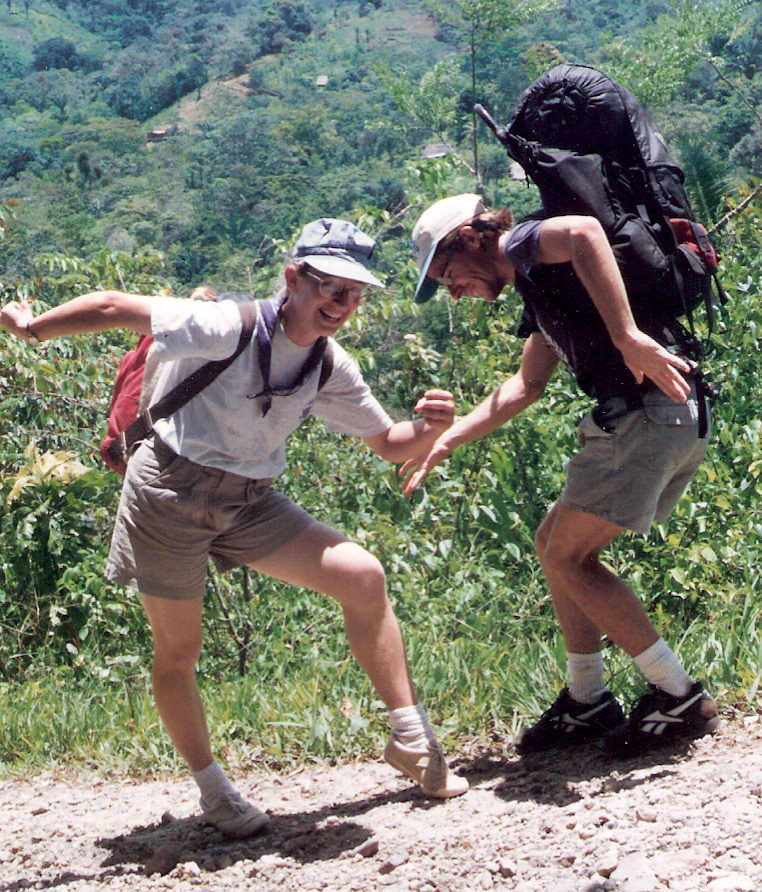
Paul and me, hamming it up for the camera on our trek.

Paul and me, hamming it up for the camera on our trek.

In Peace Corps in Panama, we lived in a village that was on the edge of what was accessible by vehicle. The lower part of our village was reliably accessible, but the upper part, where we lived, was only accessible in the dry season, and even then it was rough.

Walking was the main mode of travel there.

We walked everywhere. To all the farmers we worked with, to all the forestry groups we worked with. To the tienda, to the bus stop. Up and down (because there was no flat land in our village, or anywhere nearby, for that matter). We grew what we called “campo calves”—massive calf muscles that would have made an Elizabethan swoon.

Walking was such a natural mode of transport, that when we decided to visit a friend, Gareth, who lived on the other side of the mountains (hills, really, the continental divide is very low in Panama), we decided to walk.

First stop was our friend, Paul’s house, an hour up the mountain from our place. Paul went with us. Paul, Gareth, my husband, and I regularly met up for late-night Dungeons and Dragons sessions—a modified version that used only the two ordinary dice we had with us. This was to be an epic journey to play D&D.

After picking up Paul, we climbed further, to El Valle, where we spent the night with one of Paul’s friends there. We found ourselves without breakfast in the morning, so we shouldered our packs and set off with nothing but a cup of coffee in our stomachs.

Not to worry, we soon came across a campesino willing to sell us some bananas, and we ate as we walked.

We had only a vague notion of how to get where we were going, but all paths lead somewhere in the Panamanian countryside, and with regular stops along the way to ask directions, we managed a good pace.

Along the way we talked and laughed, we met campesinos, we enjoyed beautiful views. When we finally trudged into Gareth’s yard late in the afternoon, we felt we’d seen the world.

I have visited many friends since then, but that trip stands out as the best journey ever.

Throwback Thursday—Amas de Casa

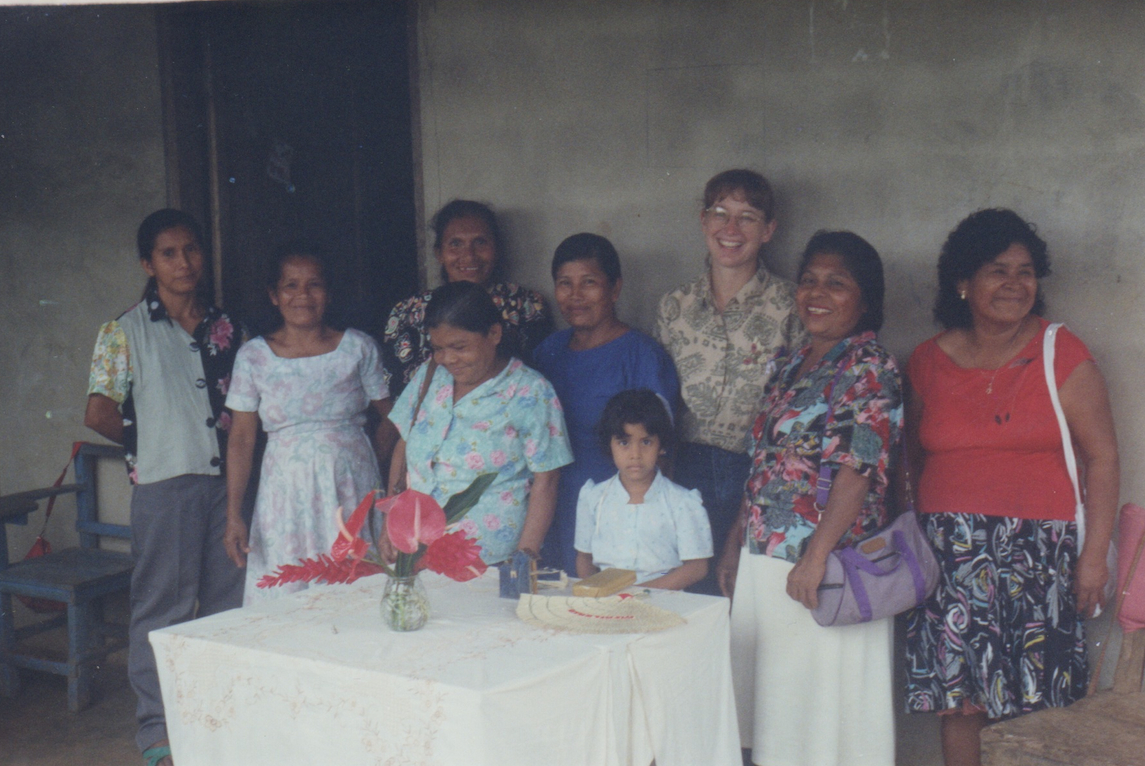
AmasdeCasasmI thought I’d take a trip down memory lane today and share this photo of some of the women I worked with as a Peace Corps Volunteer in Panama.

I regularly joke that this is my favourite photo ever, because it’s the only one in which I look tall (at 5-foot 2, I towered over most everyone in my village). But that isn’t really why I love this photo. I love it because of who is in it.

These women were all part of the Membrillo Amas de Casa (housewives) group. These women welcomed me into their group, and taught me so much. Together we created a tree and medicinal plant nursery. We created a demonstration garden using soil conservation techniques. We made bollo for Carnival. We laughed, we drank coffee, we shared our lives.

Two of the women were particularly special to me.

Onofre Gonzalez, the woman to my right, taught me that when it comes to using a machete, it’s attitude that matters, not size. Onofre could take down a tree in seconds with her little, wickedly sharp blade. She once snicked a palm viper’s head off right in front of me with her machete before I even saw the snake. She carried loads on her head, feeling the path with her bare feet like a cat.

To my left is Francisca Chirú. She and her husband, Cándido, adopted me and my husband into their family, though we did not live with them. They embraced us as though we were long lost friends, and we became a regular fixture at their house. They taught us to weed, included us in their family celebrations, and shared their lives with us.

All these women were incredibly strong, creative, and loving. Even 22 years later, I am still honoured and humbled by their acceptance of the tall white stranger among them.


Favourite Garden Tool–Machete

100_4045 smI learned to use a machete in Panama, where it became an extension of my arm. I learned my macheteing technique from greats such as Julián Valdéz and Onofre Gonzales. Not having been born with a machete in my hand as they were, I could never match their skill, but by the end of my two years, I could at least keep pace with a crew clearing brush for a new crop. Of course I could only do this because I’m ambidextrous, and when my left arm gave out, I could switch to the right. But, hey, that meant I was at least half as good as the farmers around me!

In rural Panama, a machete may be the only tool a farmer owns. It’s used for everything from taking down trees three feet in diameter to paring one’s toenails. Machetes are kept razor sharp, and if a farmer isn’t using her machete, she’s probably sharpening it. All that use wears them down. As a machete grows smaller and smaller, its use changes—from land clearing, to weeding tool, to kitchen knife. The smallest ones are given to little children, who proudly toddle around with machete in hand—able to help around the farm now they have a tool.

When I left Peace Corps, I sadly had to leave my “Collins”* behind—it was Peace Corps issued, and went to the next volunteer in my village. But I couldn’t live long without a machete, and soon had another upon my return to the United States. Actually, we had three…size is critical, and you have to get just the right one, so my husband has a long one, and I have a shorter one, and we have an even shorter one that fits neither of us well, but is useful for edge-destroying activities.

Those machetes came to New Zealand with us when we moved, and they are as useful here as they were every other place we’ve lived, though they get odd looks from the neighbours.

Here in the developed world, the machete is an anachronism of sorts. Its jobs are done by petrol-powered weed whips, chainsaws, saws and secateurs.

But there is something satisfying about a tool that can do just about anything. A tool that never breaks down, doesn’t need fuel, and requires only simple maintenance—sharpening—easily done with a file or even a chunk of concrete.

And of course, as the forerunner of the sword, a machete comes in handy if you happen to come across a dragon in the garden…

*Collins is a favoured brand of machete in Panama.

Klim Diplomacy

Kitchensm

All the kitchen you need for making ricotta!

I ran across this lovely article about unofficial Peace Corps cookbooks, and it brought a smile to my face.

There was no Panama Peace Corps cookbook when my husband and I were there, but there were plenty of recipes shared in the Peace Corps newsletter. I still have a few of them—ragged pieces of paper torn from the newsletter, smelling ever so faintly of mould.

The best Peace Corps recipe ever was for ricotta cheese made with powdered milk.

Fresh milk was impossible to come by in our village, as there was no electricity, and hence no refrigeration. Dairy of any sort just wasn’t part of the diet. But you could buy cans of powdered milk (marketed by Borden as Klim…the most uncreative name ever).

Today, with my goat milk, I am quite precise with temperature when I make ricotta, but the Peace Corps recipe was written for the Volunteer cooking over a three-rock fire with nothing more than a pot and a spoon.

The recipe went something like this:

Mix up two litres of milk from powder.

Heat to just below a boil.

Add ¼ cup of vinegar.

Skim off the cheese curds as they form.

This little recipe made surprisingly good ricotta, even from powdered milk. With it, we managed lasagne, pizza, and all manner of other cheesy treats over our little fire. It was a delightful break from unending days of rice and yuca.

Excited by our ability to make foods from home, we shared our pizza with the neighbours.

They thought it was disgusting.

But we all laughed and enjoyed the chance to talk about and compare our different cultures and cuisines.

One of the goals of Peace Corps is to foster understanding and exchange between cultures. Food is an important part of that exchange for all Peace Corps Volunteers. Even when the various parties can’t agree on what tastes good, food opens dialogue, it makes people smile, it is a common language.

Perhaps the world would be a more peaceful place if we all tried a little Klim diplomacy.