Random acts of poetry

Random Acts of Poetry Day was apparently the 3rd of October. I didn’t know about it until the following day, but it seems to me that it’s even more fitting to celebrate Random Acts of Poetry Day on some other, random, day. And since I’m feeling random today, here is a poem for you all. 

Chaos Theory:
Sammy Sandoval meets Sargent Shriver and Edward Lorenz in a young brain on a narrow footpath after dark.

The base beat
of Sammy’s accordion
faded into the night
like a heartbeat
after a long run.

Silence
save for the tap of rubber sole on packed earth,
the trill of the tropical screech owl,
the whisper of moth wings.

Those tiny wingbeats,
creating a tornado,
not on the other side of the world,
But here.
Inside.
Peeling back the roof to expose the beams,
rearranging the furniture,
toppling trees across the path,
hurling the neighbour’s car into my kitchen,
shattering mirrors,
slamming the door to the past.

And the folded bellows
of the future
breathed in and out,
humming in my ears,
masking the click
of the lock behind.

Kaitorete Spit: An Overlooked Gem

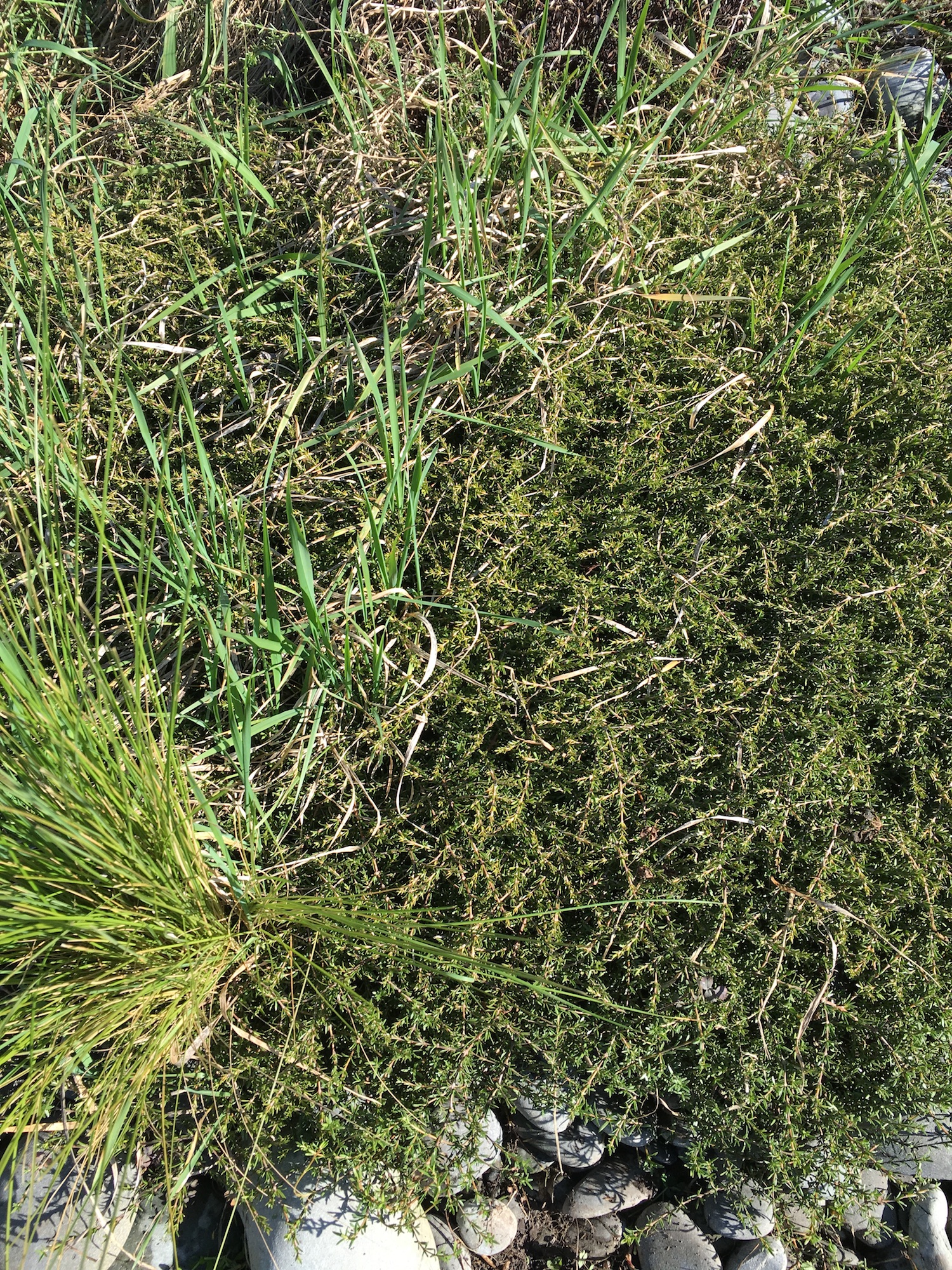
Earlier this week, my daughter and I hiked onto the Banks Peninsula from Birdlings Flat. The walk afforded us gorgeous views of Kaitorete Spit.

Kaitorete Spit is only about 6000 years old, but is an important natural and cultural resource. Te Waihora / Lake Ellesmere, formed by the spit, is home to or visited by 166 species of birds and 43 species of fish which support commercial fisheries, recreational fishing and hunting, and traditional food gathering. In spite of its harsh, exposed environment, Kaitorete Spit is home to a remarkable number of threatened plants and animals, including pīngao (a native sand sedge prized for weaving), a flightless moth, and the katipo spider. A variety of lizards also flourish on the spit. The lake and spit have been important sources of food and fibre for Māori since they arrived in the area. Fragments of the oldest known Māori cloak were uncovered on the spit, dating to around 1500 AD, and many other signs of early Maori use of the spit have also been found there.

In pre-European times, Māori used the spit as a convenient highway as they travelled up and down the island. Unfortunately, the shifting gravel of the spit and the regular opening of the lake to the sea mean the spit isn’t passable in anything but the most capable of four-wheel drive vehicles. Today, travellers make the long trek all around the lake, so our home near the pointy end of the spit is a 40-minute drive from Birdlings Flat, just 25 km away on the fat end of the spit. But I’m happy to leave the spit to foot traffic—it helps protect the unique plants and animals that live there.

On a windy, wet day, Kaitorete Spit is a miserable, exposed place to be, but visit it on a warm sunny day, and you’ll see why it is an overlooked gem.

Spring Babies

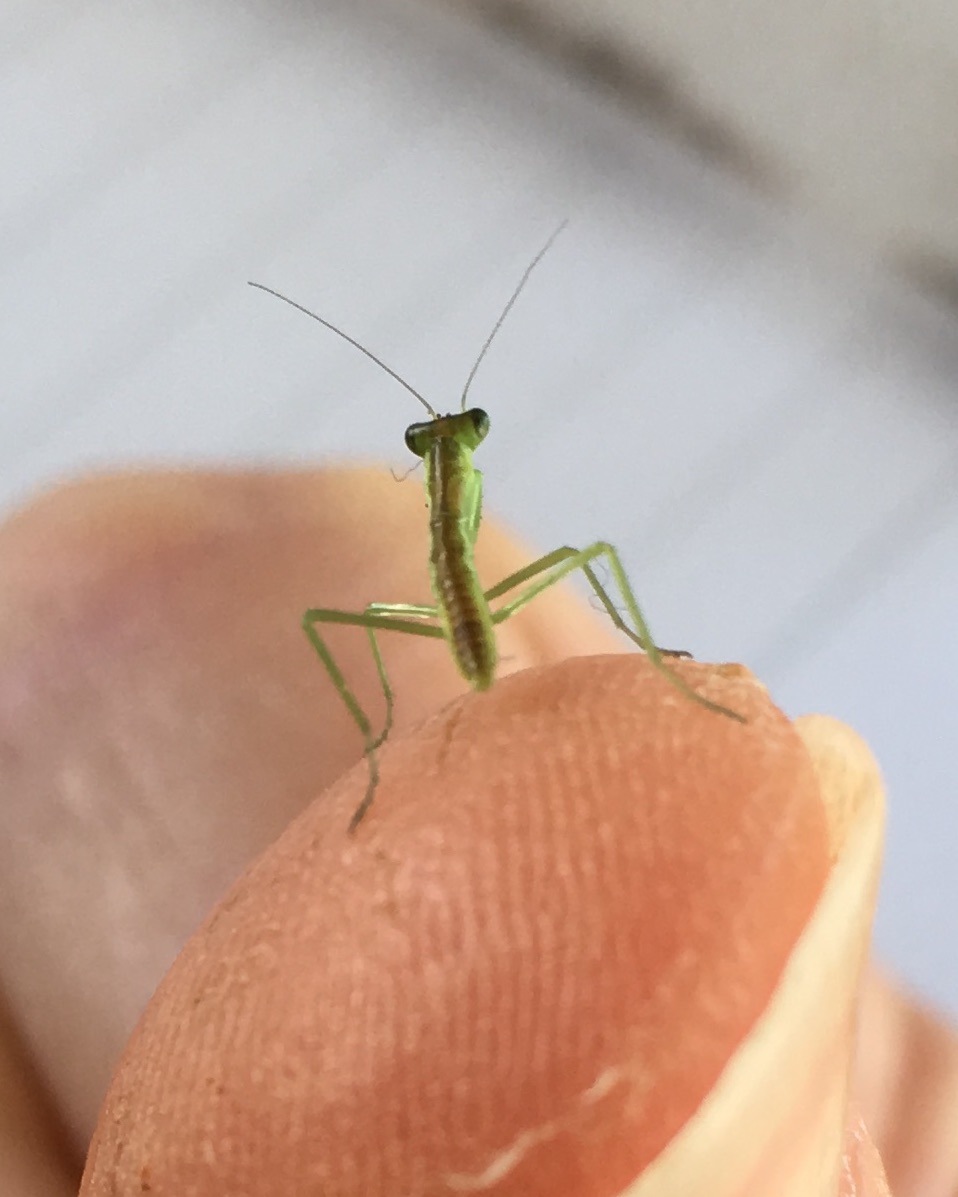
It’s that time of year again! The preying mantis egg case I collected in the autumn is hatching.

Because these mantids were in the warm office for half the winter, they’re early. Mantids in the egg cases outdoors haven’t yet emerged. So they need a little extra care. As the babies emerge, I transfer them to a large tank where they’ll be warm and well-fed for a few weeks while the weather improves. Eventually, I will release most, keeping only a few for use in educational programmes.

I never tire of this annual event. I love watching the newborn mantids stretch their legs and catch their first meal. And I’m always amazed that so many insects can emerge from such a small egg case. The current one, just 15 mm long, has disgorged 35 mantids so far, and only half the case has hatched. The mantids don’t all hatch at once—hatching seems to progress from one end of the egg case to the other over the course of a few days. In the wild, I suspect most of the later hatchlings are eaten by the early ones—it’s a mantid-eat-mantid world out there. It happens in my tanks, too, though I try to minimise cannibalism by spreading them out as much as possible and giving them plenty of hiding spots. I used to raise each individual in its own peanut butter jar, but that gets to be pretty time and space-consuming when there can be 70 mantids in each egg case.

Everyone’s heard the sensational ‘fact’ that female preying mantids eat the males after mating. It does happen, sometimes, in some species, but not as often as you might think. Mantids are creatures of instinct, and one of their most powerful instincts is to capture prey. In fact, this urge is so strong that, even when their digestive system is completely full, and they can’t actually eat anything else, they will continue to capture prey.

So it’s no surprise that a female mantid might snack on her mate, especially since she’s bigger than he is. In species where the females are significantly larger than the males, there’s a higher incidence of cannibalism after mating. Among New Zealand mantids, cannibalism at mating is rare—females are only slightly larger than males, and so the males have a good chance of fighting off the females. I’ve seen this in action in captivity—one of my females had a go at her mate, but he was every bit as feisty as she, and their tussle ended with both alive and unharmed.

My little babies won’t have to worry about mating cannibalism for a while yet, but there are plenty of other dangers out there—other predators, parasites, pathogenic fungi, freezing weather, and careless gardeners all take their toll. Of the maybe 70 mantids that will hatch from my egg case, only one or two are likely to survive to adulthood.

I’ll give my babies the best start I can, and then they’ll be on their own. Watching them now, catching gnats like pros, I think they’re well-equipped.

5 Simple Things You Can Do to Help Conserve Species

It’s Conservation Week here in New Zealand. Fittingly, one of the kōwhai trees we planted years ago has chosen this week to flower for the first time.

Conservation week is a good time to talk about backyard biodiversity. I’ve blogged more than once about biodiversity issues. It’s a topic near to my family’s heart, and something we strive to improve all the time.

Our yard is, unfortunately, home to a wide variety of non-native weeds, but it also sports native plantings (and even a fair number of native ‘weeds’). Here are just a few of the simple things we’ve done to improve the habitat value of our back yard for native organisms. You could do these, too.

  1. Plant natives instead of non-natives. Here in New Zealand this is especially important, but it’s a good rule of thumb wherever you live. Native vegetation will best support native wildlife, because they evolved together. Choose plants that provide food and shelter for local wildlife—shrubs with berries for birds and lizards to eat, dense grasses that provide hiding spots for invertebrates, and flowers that provide food for insects.
  2. Create lizard refuges. A pile of rocks or a stack of broken terracotta pot shards makes a nice refuge for lizards—the rocks and terracotta warm up in the sun, making a convenient basking spot for the lizards, and the little cracks between ensure a quick, safe get-away when predators appear.
  3. Just add water. Birds, insects, and other animals all need water to survive. Provide a bird bath, a small pond, or an attractive water feature, and you’ll find many more animals drawn to your yard.
  4. Kill non-native predators. Less important in some places, but here in New Zealand, protecting native birds and lizards requires controlling invasive predators. Trap out possums, stoats, and rats to give native birds a chance to nest successfully. Put a bell on your cat and keep it indoors around dusk and dawn when the birds are most vulnerable.
  5. Learn what you’ve got. No matter how small, your yard teems with species. Look closely, and you may be surprised at the diversity. Though our yard tends to be quite dry, we’ve discovered half a dozen species of moisture-loving slime moulds on the property. Once you know you an organism is present, you can tweak your planting and maintenance to protect and encourage it.

And that brings me back to the kōwhai tree, finally blooming. It’s not enough, yet, to attract bellbirds or tūī, across the vast stretches of agricultural land between us and the nearest populations, but someday, our kōwhai and flaxes, along with the neighbours’, may very well support a healthy population of native birds. All it takes is for each of us to care for our own backyards, and collectively we can improve the habitat for all our native species.

Sticky Feet! The Eucalyptus Tortoise Beetle

Hanging up the laundry this morning, I found this lovely beetle making its way along the washing line. It’s a eucalyptus tortoise beetle (Paropsis charybdis). I see them occasionally, but with only one eucalyptus tree in the yard, they’re not common.

I’m quite fond of tortoise beetles. This one isn’t much to look at, but many species are sparkling gold, and my first glimpse of them, as a kid, was a truly magical experience that I’ve never forgotten. What tortoise beetles have in common is their domed tortoise-like shape.

Their shape, combined with some pretty awesome feet is what keeps them safe.

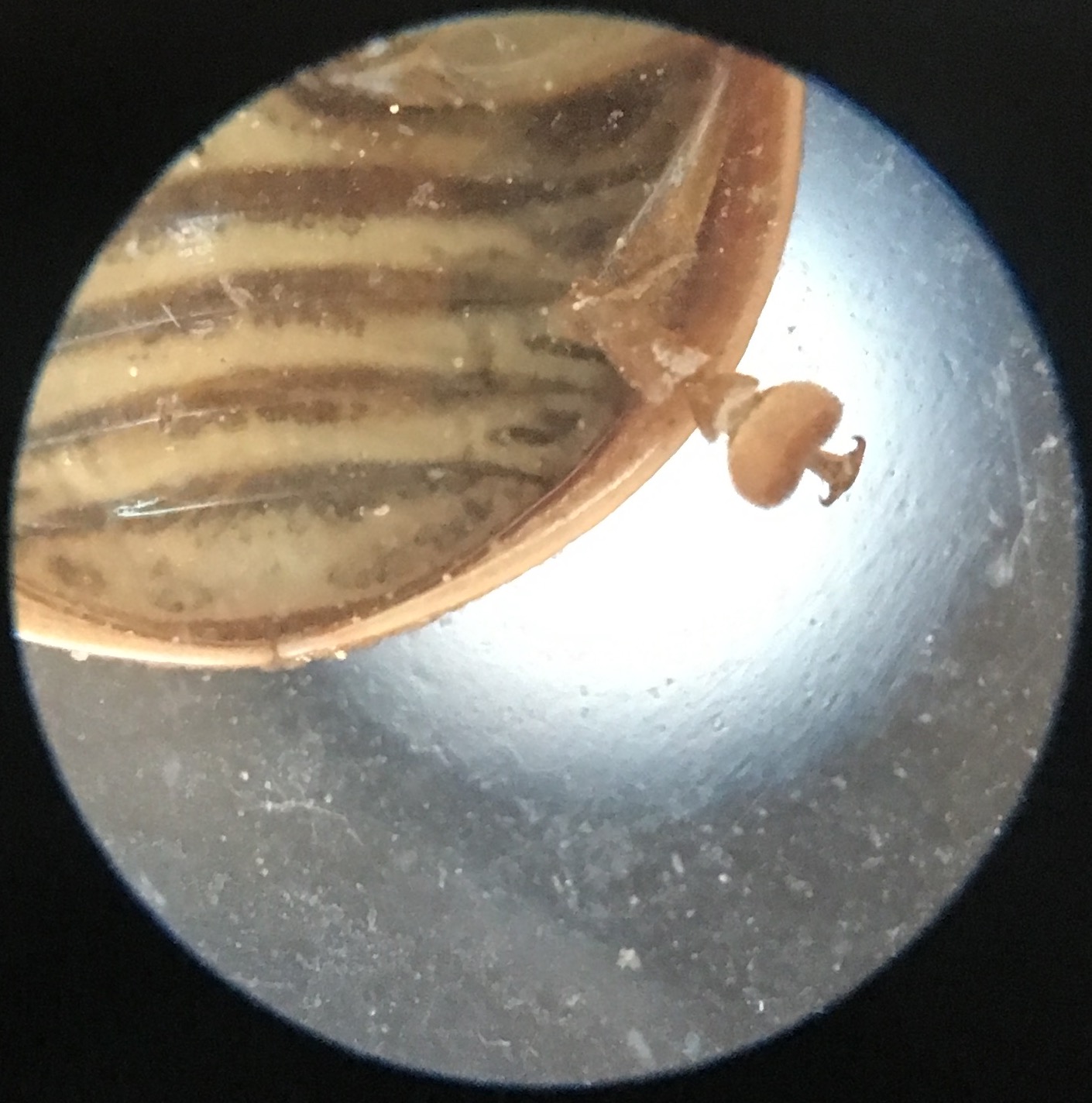
Tortoise beetles have wide pads on their feet (this one obligingly sat on a clear surface and showed its feet under the microscope). The pads are covered densely in short hairs, like the bristles of a toothbrush. Each hair is moistened by oil, which helps it stick to the waxy surfaces of leaves in the same way two wet drinking glasses stick together if they’re nested. The oil bonds to both surfaces and acts as glue. When disturbed, the tortoise beetle presses its feet against the surface, employing as many as 60,000 sticky bristles (about 10 times more than other beetles have) to keep it attached. These sticky feet, combined with the dome-like shape make it difficult for predators to dislodge the beetle.

Entomologist Tom Eisner performed a series of elegant experiments with the palmetto tortoise beetle, attaching weights to the beetles to see how much force they could withstand before being pulled off a leaf. He found they could hold up to 240 times their body mass. Those are some seriously sticky feet!

So if their feet are so sticky, how do they walk? Eisner showed, by looking at palmetto beetle footprints on glass, that when they walk, they don’t let all the bristles on their feet touch the surface. Their full adhesive power is only deployed for defence.

I don’t think anyone has tested eucalyptus tortoise beetle grip strength, but it’s definitely impressive. I popped this one into a narrow jar, and it never hit the bottom—it reached out with one leg, like some movie superhero, and grabbed the smooth wall of the jar, arresting its fall. Then, when I tried to get it out of the jar, it stuck like glue to the side. I had to slide a stiff piece of paper under its feet, prying them up one by one. It was obliging for the photo shoot, but when I tried to let it go, it stuck itself to the paper. It took a few determined nudges, but eventually I got it to the edge of the paper and it dropped off.

The eucalyptus tortoise beetle is not native to New Zealand, and is considered a pest in the forest industry here. Still, I have to admire the beetles’ sheer tenacity, and am willing to share my eucalyptus tree with them for the opportunity to see those sticky feet in action.

Ice and Fire

One of the things I like best about springtime here is the juxtaposition of hot and cold, especially in the high country. The sunshine is warm, but winter lingers in the shade. I’ve gone hiking in shorts and t-shirt through 15 cm of snow in past years.

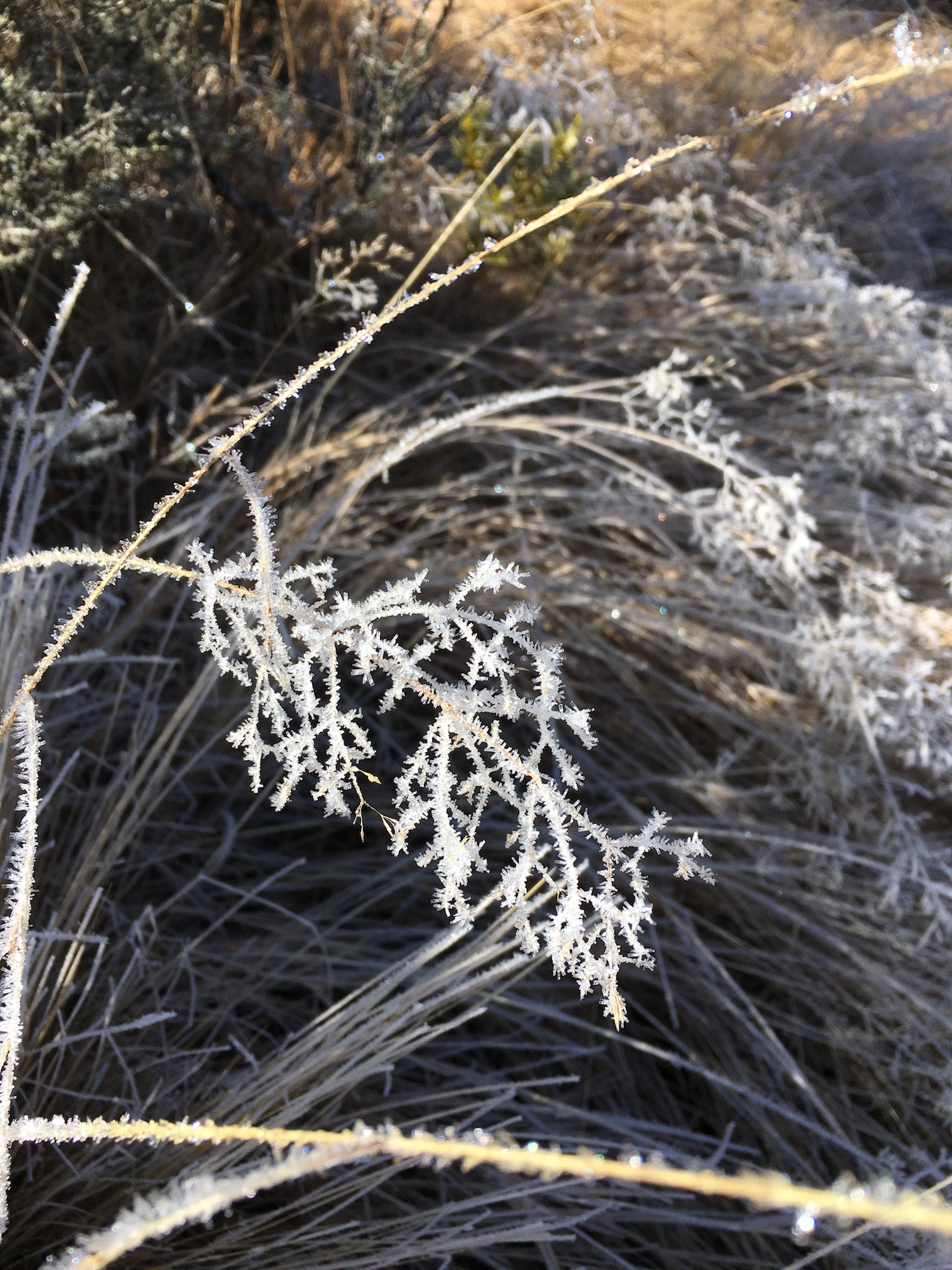
This weekend, we didn’t make it up to snow, but there was spectacular frost on our little Saturday jaunt. Hiking up the shaded side of a hill, we were treated to glistening plants as the first rays of the sun hit thick frost.

In addition to the frost, we crunched over a lot of needle ice. Needle ice can occur when the soil temperature is above freezing, but the air temperature is below freezing. Liquid water rises through the soil via capillary action and freezes on contact with the air. As more water is drawn upward, the ice needles grow in length. They’re common in the high country in springtime, when warm sun heats the ground during the day, but the temperature drops quickly after dark.

Ice needles are more than just a curiosity. They’re a significant factor in soil erosion, because they often push soil upward along with the ice. This loosens the top layer of soil, making it prone to erosion by wind and water.

The air was cold on Saturday morning, and as we started up the hill, we were well-bundled. But like all good tracks in New Zealand, this one started off by going straight up. Between the climb and the sun, we were soon stripped to our t-shirts, enjoying the crunch of ice underfoot and the warmth of the sun overhead.

Shining in the Dark

Not much to look at in the light, but spectacular in the dark.

I’m a morning person. I’m rarely in bed past six o’clock, and am often up long before that. But I will admit that even I get tired of getting up in the cold and dark at this time of year.

Of course, sometimes the most amazing things happen before the sun is up.

Yesterday morning, I stepped into the chicken paddock feed ‘the girls’. It was still dark, with just enough starlight to see my way. I bent to tip a scoop of feed into their dish and froze.

Something glowed on the ground—the eerie glow of bioluminescence.

I’ve seen bioluminescence while feeding the chickens before—a tiny sea creature whipped up and blown in with a violent snowstorm—but this was different.

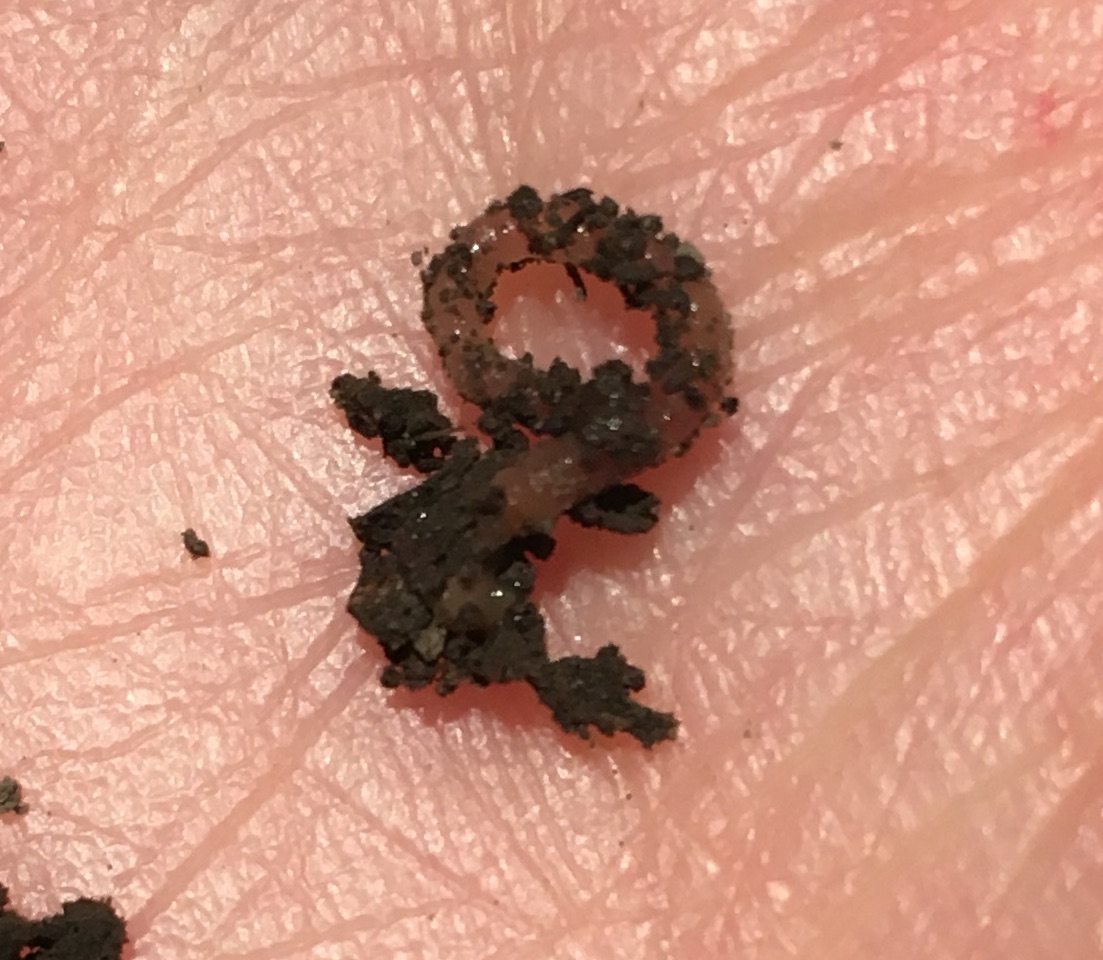
I flicked my light on and saw something pink glistening on the ground. When I tried to pick it up, I discovered it was the head of an earthworm.

A brightly glowing earthworm.

I couldn’t get it out of the ground in order to bring it in and identify it yesterday, but I took the spading fork with me this morning when I went to feed the chickens, and I collected a little glowing earthworm from where I’d seen one yesterday.

I already knew that at least one of our native earthworms is bioluminescent—Octochaetus multiporus, which I’ve blogged about before. But O. multiporus grows to enormous size, and I’ve never found any worms in the garden that match its description. Doing a little research, I found that bioluminescence is quite widely employed by earthworms, presumably as a deterrent to predators.

Most earthworms produce light in much the same way that fireflies do, with a chemical known as luciferin that reacts with oxygen-containing compounds in the presence of luciferase to create light.

So, what species is my little glowing worm? There are about thirty New Zealand species within the genera where bioluminescence has been recorded. I’ve found record of only two of those species being bioluminescent: O. mulitporus and Microscolex phosphoreus, a small worm considered native here, but widely distributed around the globe. My best guess is that it’s M. phosphoreus, but data on that worm’s distribution in New Zealand is almost nonexistent (it’s been recorded from only one location), and data about any earthworm in New Zealand is scanty. Perhaps my worm is M. phosphoreus, but it might also be a worm in which bioluminescence hasn’t been recorded. After all, most people aren’t out in the garden at night to notice glowing worms.

Hopefully, I’ll be able to have the worm identified by an expert. If not, well, I still think it’s the coolest thing I’ve seen in a long while! And I won’t be grumbling about getting up in the dark and cold tomorrow.

Nifty Nematodes

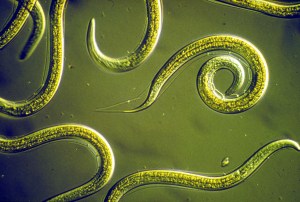
Nematodes under the microscope. Image: CSIRO

A week or so ago, during a writing break, I spent some time peering through the microscope in my ongoing quest to find tardigrades in our yard. I had no luck on the tardigrades, but as usual I came across lots of fabulous little invertebrates.

Perhaps the most common creatures under the microscope were nematodes. No surprise, really. Nematodes are the most common multicellular organisms on earth; there are several million in every square metre of soil here in New Zealand. Most are tiny (less than 3 mm). But not all are so minuscule; the largest, a parasite of sperm whales, can grow to 8 to 9 metres in length.

Nematodes can be free-living or parasitic on animals and plants. In fact, most animals (vertebrate and invertebrate) and plants are host to at least one specialist nematode parasite. Free-living nematodes eat bacteria, fungi, or small invertebrates (including other nematodes).

As you can imagine, nematodes are of huge importance ecologically, economically, and from a human health perspective.

Humans are host to about 60 species of nematode. Diseases caused by nematode parasites in humans include: ascariasis (an intestinal infection that can cause growth retardation and a variety of intestinal and other problems), hookworm (causing anaemia and developmental problems),filariasis (a lymph infection, causing swelling in many body parts, including elephantiasis of the legs), trichinosis (an intestinal infection causing diarrhoea, fever, and other symptoms). Many nematode infections are asymptomatic, and it’s likely most of us play host to nematodes for most of our lives.

The control of nematodes is important in agricultural systems. Worldwide crop loss to nematodes is estimated to be 12.3 percent of production (US$157 billion). Livestock and domestic pets are also susceptible to nematode infection, and millions of dollars annually are spent to control nematode infections including lungworm, hookworm, trichinella, heartworm, and many others.

But nematodes aren’t just doom and gloom. They’re integral parts of natural ecosystems, and critical components in nutrient cycling (especially nitrogen) and food webs. They regulate the bacterial population in the soil, and provide food for many organisms (including some fungi, which catch nematodes with lassos, like tiny cowhands). They can be useful, too. Some insect parasitic species are bred to help control insect pests—a highly species-specific, organic control method.

And like the tardigrade, nematodes are tough. A culture of live nematodes aboard the Space Shuttle Columbia were the only organisms to survive the re-entry breakup of the shuttle, making them the only organism known to survive unprotected atmospheric descent.

Fabulous Flatworms

Australian flatworm

One of the common animals in my yard and garden is the flatworm. Strictly speaking, “the” flatworm here in New Zealand is actually multiple species—possibly up to a hundred—but they have been poorly studied, so it’s unclear just how many species there are.

Flatworms are some of the most impressive predators in the garden, able to consume prey up to 55 times their own size. That’s the equivalent of your house cat taking down a female elk. They eat snails, slugs, and earthworms, digesting them externally before sucking them up with one or more mouths located midway along their bodies.

I love to find flatworms around the yard. They come in striking colours, and some have lovely brown stripes—the orange Australian flatworm (Australoplana sanguinea) is most common in my garden, followed by the relatively nondescript brown New Zealand flatworm (Arthurdendyus triangulatus). Like the slugs they eat, they prefer damp places, and they protect themselves with a layer of mucous. Flatworm mucus is stickier than slug mucous, and they use it to attach themselves to their prey during feeding.

New Zealand is full of non-native invasive organisms, but New Zealand flatworms are one of the few organisms that have turned the tables and become pests overseas. They are easily transported in potted plants, and have successfully invaded Ireland and Scotland. Though there was widespread panic at first about their potential to threaten the local ecology, they appear to have caused little damage to earthworm populations in the UK. Like most cold-blooded animals, their appetites are small. Far from being a devouring hoard, each flatworm can manage, on average, just one earthworm per week. And if they don’t manage to find an earthworm every week, it’s not a problem—they can go a year without eating.

Weeding Therapy

You know it’s been a good therapy session when it leaves a clear weeding front.

I make no secret of the fact I have a weeding problem. I’ll ignore hunger, thirst and bodily pain to pull just a few more weeds—fill the wheelbarrow, finish the garden bed, never mind the cost.

But in spite of my obsession, I believe there is a place for weeding therapy, even for me.

Today, when the temperature hit a sweltering (for mid-winter, at least) 18 degrees (64ºF), I had no interest in my usual lunchtime walk. No. Today, after weeks of inactivity in the garden, I needed to weed.

I grabbed my gloves, and hove to. A sweaty half-hour later, I was refreshed and ready to get back to work.

The key to good weeding therapy (to avoid it becoming a weeding marathon) is setting limits—I give myself half an hour, and set a timer so I’ve no excuse for running over time. It helps to choose the therapy weeding job well; I go for places that have been irritating me, places that are desperate, or places where the weeds are big and easy to pull. It gives me a greater sense of accomplishment in a short amount of time, so I feel I can quit when my time is up.

And if I do quit before exhaustion, pain or hunger set in, I can return to other work in a focused state of mind, ready to bang out the next chapter or tackle the next editing job.

And the best part is that, with so much garden area here, there will always be more weeds, so therapy is always available when I need it.