And They’re Off!

100_3569 smHurrah! The gardening season has begun!

Though it was cold and rainy today, I began planting the early (onions, peas, spinach, lettuce, brassicas) and the slow-growing (peppers and eggplants) crops in trays today.

Now, my office/craft room also becomes a greenhouse. For the next three months it will house a growing array of seedlings that need a little extra warmth overnight.

For several years I started my seeds on top of an old electric blanket in the shed. It worked fine at keeping the seeds warm, but I had difficulty keeping the rats and birds from digging up the seeds and eating them.

Then I discovered that the blanket was getting wet in spite of the plastic I employed to protect it. I decided that, rather than risk burning down the shed or electrocuting myself with a decidedly off-label use of an electric blanket, I should move my plants.

The office has proven a wonderful greenhouse. The seedlings sprout quickly and without fail, and the large sliding glass doors let in plenty of sunlight. And there are no rats or birds to contend with.

The only downside is the humid atmosphere in the office for the spring months. What is good for plants isn’t exactly the best for people or office supplies!

Maybe someday I’ll have a heated greenhouse. Until then, I’ll have to make do with an office full of plants.

Klim Diplomacy

Kitchensm

All the kitchen you need for making ricotta!

I ran across this lovely article about unofficial Peace Corps cookbooks, and it brought a smile to my face.

There was no Panama Peace Corps cookbook when my husband and I were there, but there were plenty of recipes shared in the Peace Corps newsletter. I still have a few of them—ragged pieces of paper torn from the newsletter, smelling ever so faintly of mould.

The best Peace Corps recipe ever was for ricotta cheese made with powdered milk.

Fresh milk was impossible to come by in our village, as there was no electricity, and hence no refrigeration. Dairy of any sort just wasn’t part of the diet. But you could buy cans of powdered milk (marketed by Borden as Klim…the most uncreative name ever).

Today, with my goat milk, I am quite precise with temperature when I make ricotta, but the Peace Corps recipe was written for the Volunteer cooking over a three-rock fire with nothing more than a pot and a spoon.

The recipe went something like this:

Mix up two litres of milk from powder.

Heat to just below a boil.

Add ¼ cup of vinegar.

Skim off the cheese curds as they form.

This little recipe made surprisingly good ricotta, even from powdered milk. With it, we managed lasagne, pizza, and all manner of other cheesy treats over our little fire. It was a delightful break from unending days of rice and yuca.

Excited by our ability to make foods from home, we shared our pizza with the neighbours.

They thought it was disgusting.

But we all laughed and enjoyed the chance to talk about and compare our different cultures and cuisines.

One of the goals of Peace Corps is to foster understanding and exchange between cultures. Food is an important part of that exchange for all Peace Corps Volunteers. Even when the various parties can’t agree on what tastes good, food opens dialogue, it makes people smile, it is a common language.

Perhaps the world would be a more peaceful place if we all tried a little Klim diplomacy.

Fridge Magnets

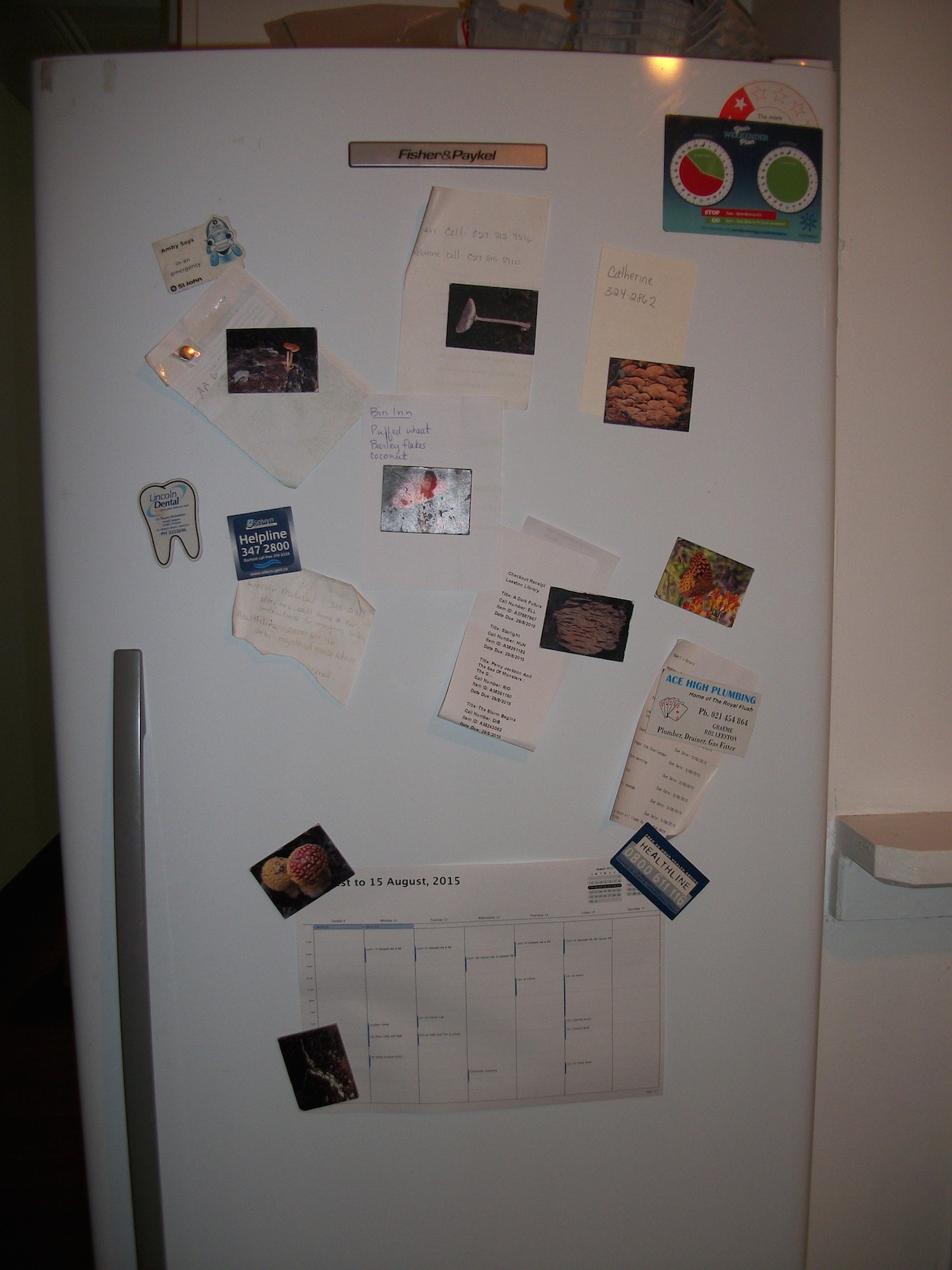
100_3570 sm“Amby the Ambulance says dial 111 in an emergency!”

“Lincoln Dental—Where great smiles are made!”

“Healthline—24 hour free health advice!”

“Ace High Plumbing—Home of the royal flush!”

The front of the refrigerator is plastered with magnets from various businesses and organisations. The magnets hold up the critical documents that form the command centre of the house:

  • This week’s calendar, showing who is taking which bus to and from school, who has band practice when, and who is out of town or needs extra money for a school field trip.
  • Library check-out receipts so we know when we have to return the latest clutch of books.
  • A running grocery list which I add to as I finish off things in the kitchen.
  • Emergency phone numbers.

Move to the side of the fridge, and you leave the rational, logical command centre and enter the twilight zone of fridge magnet poetry. With two whole sets of fridge magnet words, and a house full of…um…creative people…you never know what you might see there.


“Together they must beat the monkeys

Who eat their friends

These windy sunny days

Still my head aches from the blow”


“Want

Quick

Are

You

Juice

Girl

Man”


“Want

Drive

Need

Lust

Or

Reveal”


If I had to analyse the family on the basis of our fridge magnets, I would say we are a well-organised bunch of lunatics!

Seasons of Garlic

15 heads of garlic, all in one pint jar!

15 heads of garlic, all in one pint jar!

The garlic I planted on the winter solstice has taken advantage of the recent rain. It is now 5cm above ground, and looking great!

Of course, when the garlic in the garden starts sprouting, so does the garlic stored in the shed. And once it starts sprouting, its flavour goes off. The goats will still eat it (they seem to love garlic, and the local breeders feed it to them to help fend off intestinal parasites), but it’s not very tasty to the human palate.

So it’s about this time of year when we switch to using the garlic we dried at harvest time. The thin slices grind well in a mortar and pestle, and are easy to use. Though they aren’t as good as fresh garlic, they’re much better than sprouted garlic, because they were dried at peak freshness.

We’ll use this dry garlic until we can start harvesting the first immature new heads around Christmas. But as spring comes on, and the winter-planted leeks and the spring onions begin to be harvested, we naturally start using more of these fresh members of the onion family and less garlic. There will almost certainly be dry garlic left when the new heads start coming in. But that’s okay—the goats like dry garlic, too!

Space Salad

Simple to grow at home. Not so simple in space.

Simple to grow at home. Not so simple in space.

Astronauts on the International Space Station made history today—they were the first people to eat lettuce grown in space. Red romaine, I understand. With a little balsamic vinegar.

It took years to work out how to do it. Things gardeners take for granted like gravity, 24 hour day cycles, water, and air, are a challenge when growing vegetables in space.

So, why is it important that astronauts can eat fresh lettuce? As of yet, we’ve found nothing edible beyond our own planet. If humans are ever to spend significant time in space, we’ll need to know how to produce food wherever we are, not just for logistical reasons, but who would want to eat those nasty pre-packaged astronaut meals for years on end?

This is another example of people taking their crops with them wherever they go, as I discussed two months ago in Eating Native?

Which, of course, makes me think of how some of the foods introduced to New Zealand have become weeds and pests, damaging the native life forms. Will there someday be weeds in space? Let’s hope we’ve learned a thing or two about avoiding introducing pests before we get to that point.

Vandalizing the Cookbooks

100_3564I was taught never to write in books.

In high school when I was reading the classics for English class, the comments scribbled in the margins by previous students irritated me.

I even hesitated writing my name inside the front cover of books.

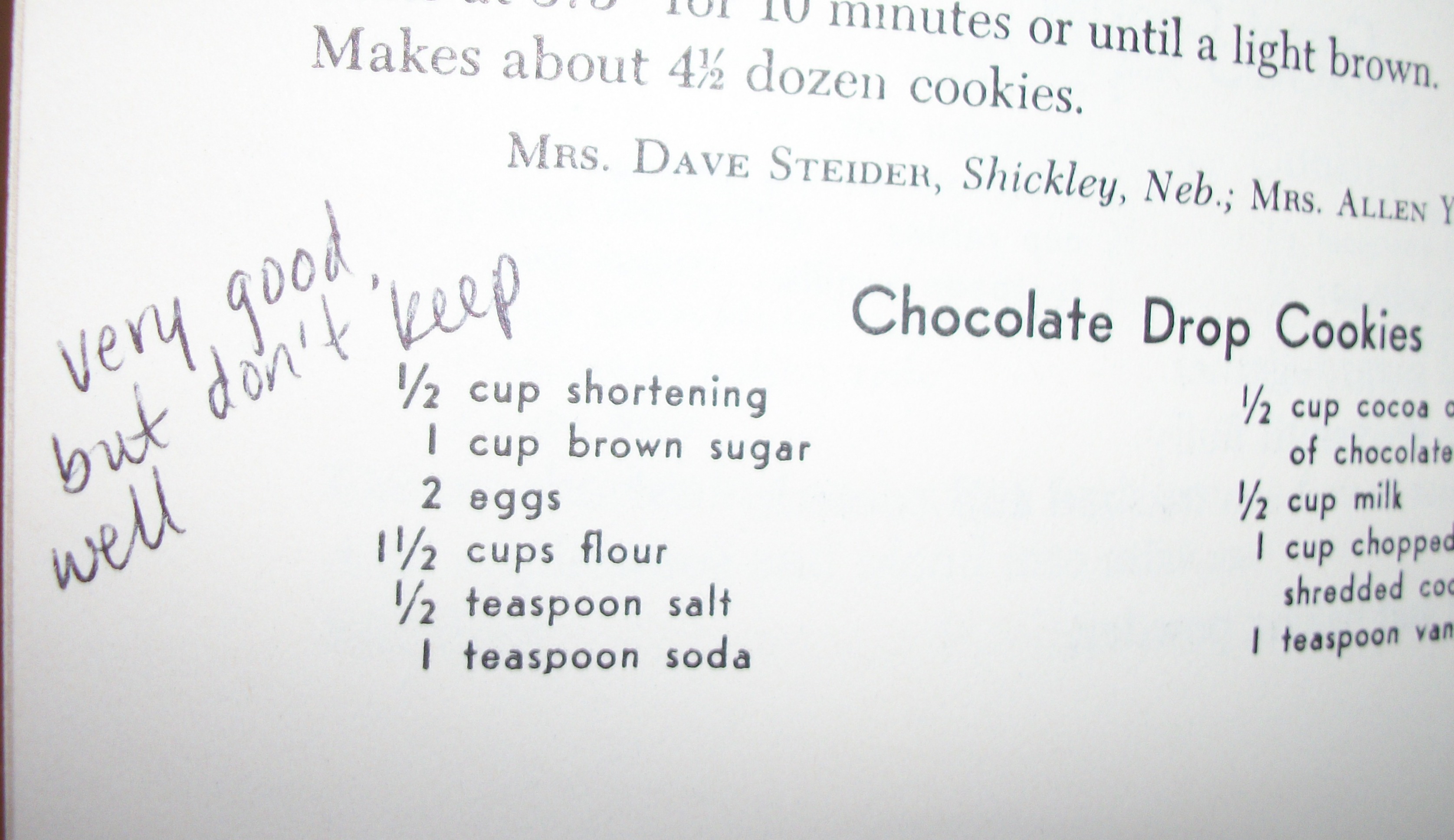
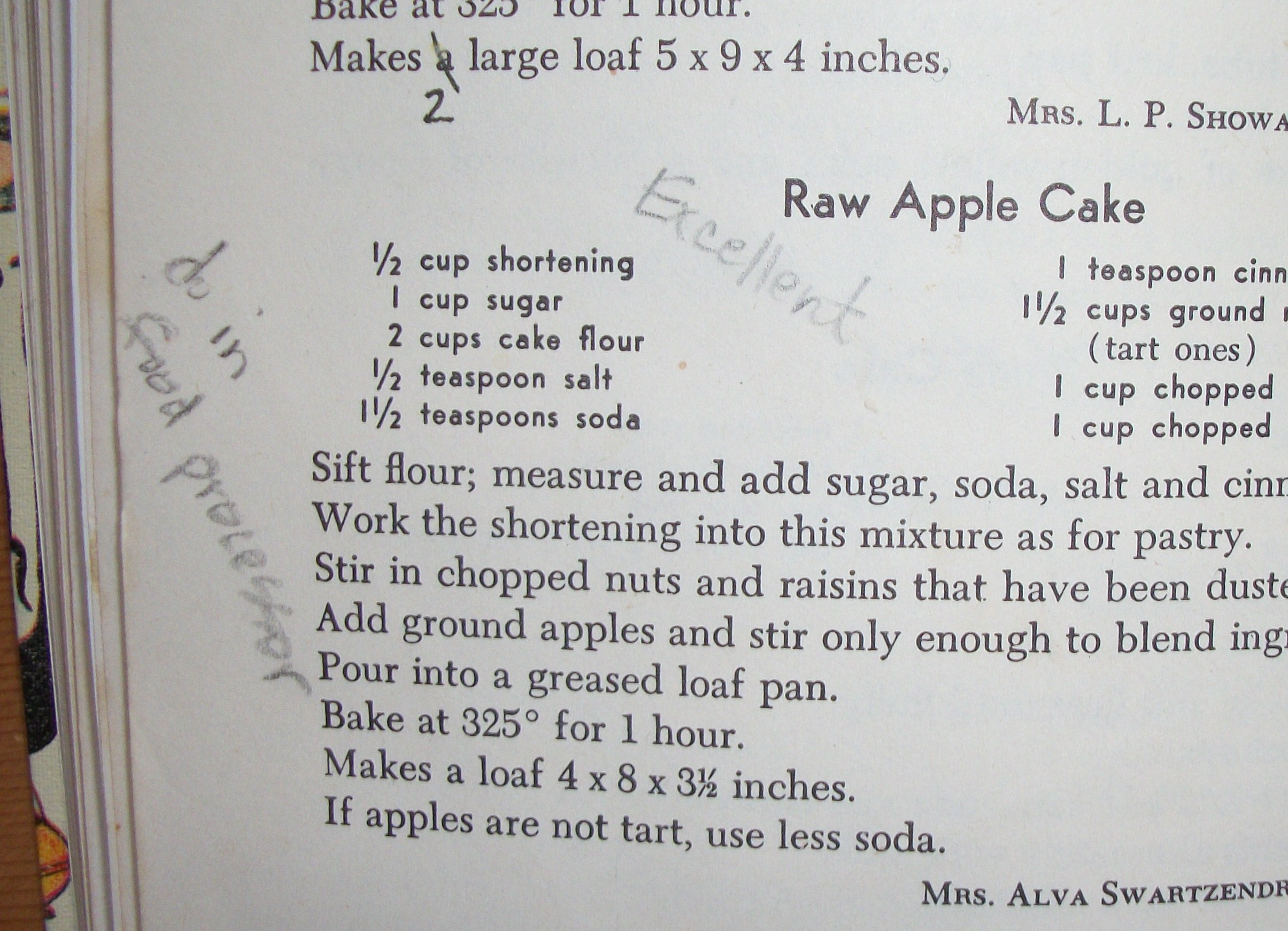
I still don’t generally write in books, but when it comes to cookbooks, I’ve realized that writing in them is necessary.

100_3566How else will I remember if a recipe is worth making again?

How else will I remember that this scone recipe is too wet, and requires an extra ¼ cup of flour, or that that cake recipe is better with half the sugar than called for? Or that the pumpkin pie recipe in the Mennonite Community Cookbook is much better than the one in Fanny Farmer?

100_3562My cookbooks are full of my scribbles in the margins, my temperature and weight conversions for American recipes that don’t provide the metric counterparts. The notes help me improve a recipe every time I make it, and remember what I’ve done when I’ve finally perfected a recipe.

Soft Pretzels

100_3556 smHaving grown up in central Pennsylvania, I consider pretzels their own food group.

So it was a great disappointment to discover that there are NO pretzels in New Zealand. Oh, you can get small bags of expensive, imported pretzels, but the variety and quality are very poor.

And soft pretzels—the pinnacle of pretzel evolution—are nonexistent.

Thankfully, soft pretzels are easy and fun to make!

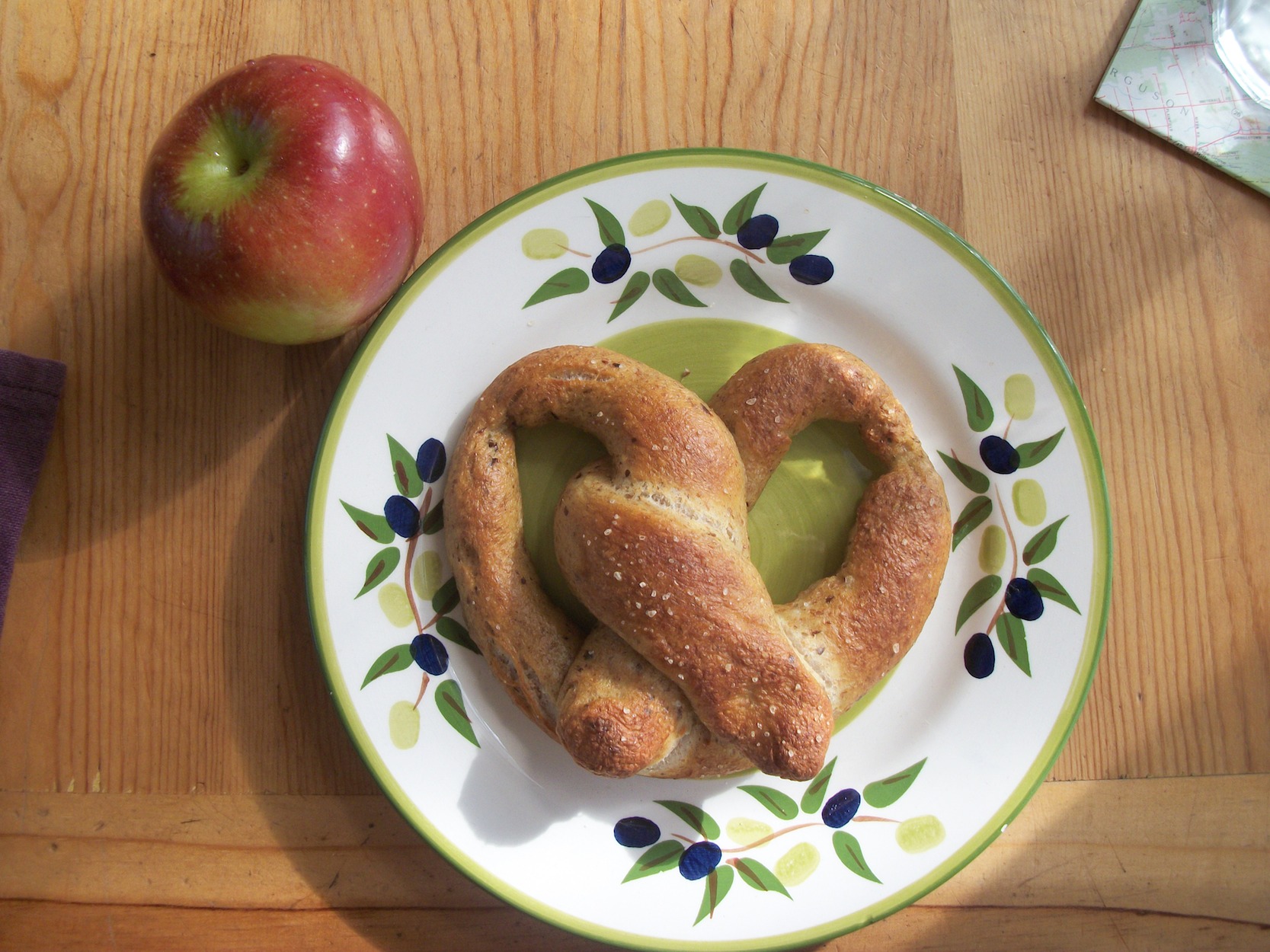
I make soft pretzels from a light whole wheat bread dough—any relatively light dough will work fine.

Once your dough has finished its first rise, divide it into 100g (3.5 oz) pieces. Roll each piece into a long snake, then twist into a pretzel shape and place on a well-greased baking sheet (You can make other shapes, but keep them compact or they will break apart when handled). Cover and let them rise until about doubled in bulk.

Now comes the part that turns them into pretzels.

Bring to a boil a mixture of 4 cups of water and 5 tsp baking soda (I use a large pot and need to double this amount to get a reasonable depth of water). Drop the pretzels carefully into the water (you may only be able to put 1 or 2 into the water at a time—my big pot fits 3) and allow them to boil for about 1 minute, until they float to the surface (I gently turn them over once they’ve reached the surface so that both sides boil relatively evenly). With a large slotted spoon, take them out and place them back on the greased baking sheets.

Sprinkle with coarse salt and bake at 230°C (450°F) for 12 minutes or until nicely browned.

Eat them hot, slathered in mild mustard!

Sunflowers

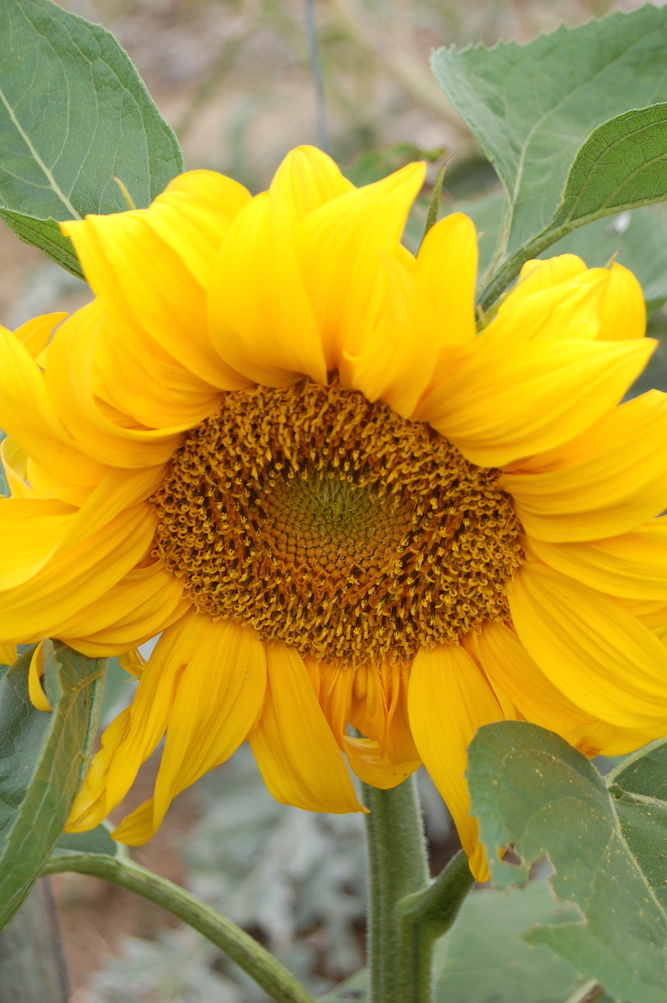
DSC_0009 smMany vegetable plants are attractive. Many have pretty flowers—okra (a hibiscus), scarlet runners, peas. None is more showy than the sunflower. Indeed, sunflowers are in the ornamentals section of the seed catalogue, not the vegetable section. There are plenty of sunflowers that don’t produce big meaty seeds for eating, but those that do are no less ornamental.

We eat sunflower seeds in a variety of ways. They are delicious sprinkled on top of a casserole or galette. They add nutty flavours to granola and veggie burgers. And they make a great snack!

We don’t grow nearly enough sunflowers to satisfy our appetite for sunflower seeds, but it’s always worth growing them, even if it’s only to enjoy the flowers!

Stomach bugs!

100_3544 smIt has been many years since a stomach bug has hit our family, but I’ll admit I expected this one, after we brought a very green friend home from school earlier in the week. He didn’t quite vomit in the car, but it was a close thing.

So when I got the text at 10 am that my son was vomiting in the sick bay at school, and could I come get him please, I was disappointed, but not surprised.

But of course, that begs the question, What do I serve for dinner? It’s no problem for the sick boy—he’ll get miso broth with plain crackers, if he eats at all. But I was planning on burgers slathered in ketchup and jalapeño peppers. The rest of us feel fine now, but we were just as exposed to this bug as my son, and at the same time. There’s a good chance we’re going to start vomiting in the next 12 hours, too. Do we really want burgers and hot peppers in our stomachs when we do?

I think not.

I’m thinking that something bland and easy to digest is probably the wiser choice for dinner. We’ll save those jalapeños for some other day.

5-minute Beets

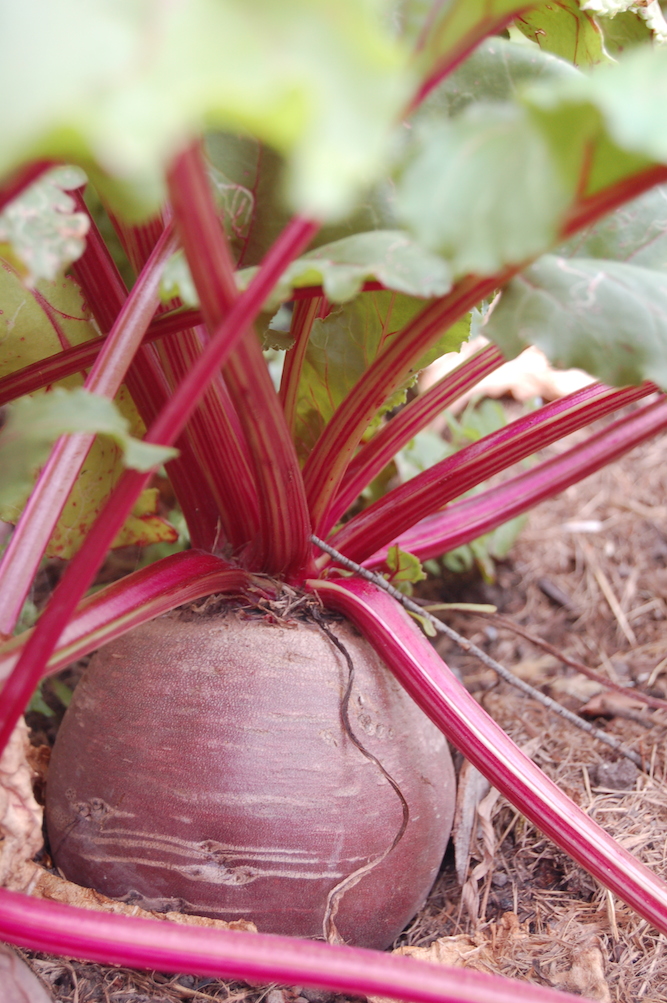
DSC_0036smIt took years to get our son to eat beets.

No. That’s not true.

He ate beets for years before he liked them.

Red beet eggs, nope.

Roasted beets, uh uh.

Grilled beets, no.

5-minute beets, OH YES!

This recipe comes straight from Vegetarian Cooking for Everyone, by Deborah Madison (one of my favourite cookbooks), and I’ve never been tempted to alter it in any way. It is absolutely perfect!

4 beets (about 500g/1lb)

1 Tbsp butter

Salt and pepper

Lemon juice or vinegar to taste

2 Tbsp chopped parsley, tarragon, dill or other herb

Grate the beets coarsely. Melt the butter in a skillet, add the beets, and toss them with ½ tsp salt and pepper to taste. Add ¼ cup water, then cover and cook over medium heat until the beets are tender. Remove the lid and raise the heat to boil off any excess water. Adjust salt, season with a splash of lemon juice or vinegar (I use balsamic), and toss with the herb.