Whoopie Pies

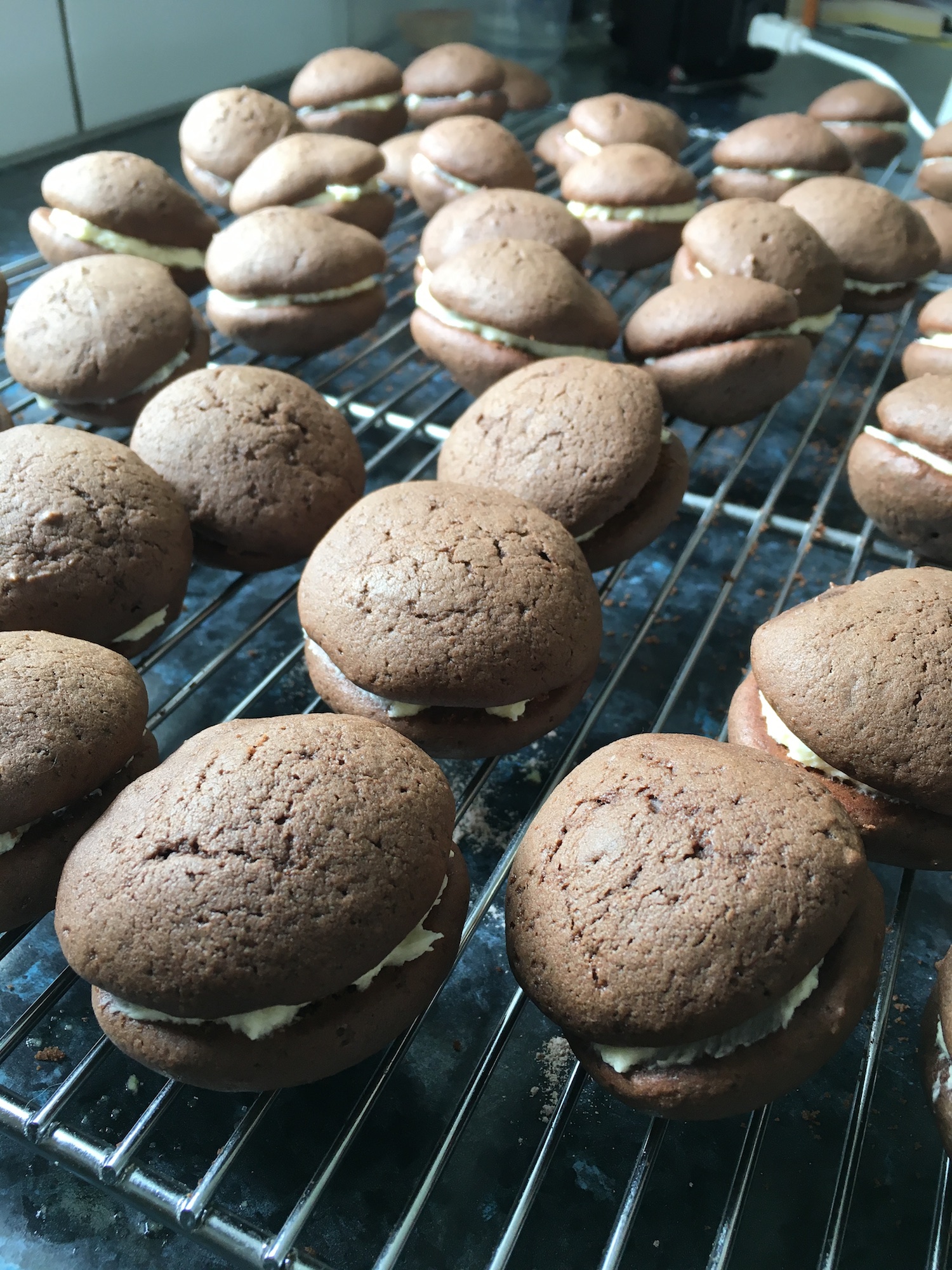
2016-09-27-16-01-18-smI can’t believe I did an entire year of food blogs last year and never mentioned whoopie pies, other than to note that I’d swim through crocodile-infested water to get one. So this is long-overdue.

I read an article once, claiming that whoopie pies came from some town in upstate New York. This is a lie. Whoopie pies are Pennsylvania Dutch from the top of their over-the-top chocolate cookie-cake to the bottom of their sweet fluffy filling. Only the Pennsylvania Dutch would make a cookie with this much chocolate and sugar, then decide it should be stuck to another cookie with more sugar, whipped into a roux, like some bizarre sweet gravy. Nobody else would then decide that this cookie should be made in vast quantities and provide a recipe that used six cups of flour.

New York…HAH!

Growing up, whoopie pies were the cookie for bake sales. They were a summer cookie. A cookie for farmers’ markets and family picnics. They were one of the things I missed when I left home and moved to the whoopie-pie-less Midwest.

And so, here, without further ado is the whoopie pie recipe my mother gave me when I left home. I admit that, these days, I make a half batch unless I’m making them for an event.

1 ½ cup shortening (I use butter)
3 cups granulated sugar
3 eggs
1 ½ cups sour milk (I use buttermilk if I have it)
3 tsp. vanilla
6 cups sifted flour
1 ½ cups cocoa
3 tsp. salt (use less if you use salted butter)
3 tsp. soda

Cream sugar and shortening. Add eggs and beat. Add sour milk and vanilla. Sift flour, cocoa and salt. Add to first mixture. Add water and soda. Drop by teaspoonful on [greased] cookie sheet and bake 8-10 minutes at 375°F. Cool and fill with filling.

Filling

5 Tbsp flour
1 cup milk
1 cup powdered sugar
½ cup margarine (I use butter)
½ cup butter
1 tsp. vanilla

Cook flour and milk together until thick. Cool thoroughly. Cream shortening and sugar. Add vanilla and flour mixture, beating until the consistency of whipped cream. Put two cookies together with filling.


Beetsteak

beetsteakI was clearing a garden bed today and pulled out a beet—forgotten in the masses of summer produce—left from last year’s garden. It was the size of an adult’s head, with dozens of sprouts coming from it.

I decided to take it to the goats, who love beetroot. On the way, I showed it to the family—it was impressive, after all.

My husband wouldn’t let me feed it to the goats. He was curious to know just how woody a beet that size would be.

So he made beetsteaks. He used our big pumpkin knife to slice it into giant slabs, then steamed them and grilled them with a spicy marinade.

The result…

Edible…mostly.

But I think I’ll feed any other beets this size to the goats next time.

North African Salted Lemons

Salty lemons and sweet lemon curd...mmmmm.

Salty lemons and sweet lemon curd…mmmmm.

My husband brought home a grocery bag full of lemons yesterday—a gift from a colleague with a prolific lemon tree.

When life gives you this many lemons, you have to be more creative than lemonade.

The first thing I did was make lemon curd, which is one of my favourite uses of lemon.

But when I was done with that, you couldn’t tell I’d taken any lemons out of the bag.

So I searched around and found a few recipes for salt-preserved lemons.

I was intrigued. We’ve been using more and more lemon in our savoury cooking, and salted lemons should be perfect for that.

It is perhaps the most bizarre recipe I’ve ever made.

Cut the lemons lengthwise into quarters, but not all the way through, so they fan out like a flower. Sprinkle salt on the fanned quarters, then juice them before stuffing the juiced lemon into a jar and pouring the salty lemon juice over it. Repeat with as many lemons as will fit in the jar. Let sit in a warm place for a month, then store in the fridge for up to a year, pulling out lemons as needed.

I’m very curious how they taste, and how we will end up using them.

And now I’m on to baking lemon cake and lemon scones, because I still have half a bag of lemons left…

Literary Peanut Butter

2016-09-20-07-22-52I don’t normally get into endorsing products, but I feel compelled to comment on this one.

Pic’s Peanut Butter has recently started showing up in our local supermarkets. Shopping for a family for whom peanut butter is a major food group, I was immediately attracted to the large jars Pic’s came in. Glancing at the label, I found it was made with Australian peanuts by a small company in Nelson. That appealed to my social and environmental conscience, and I thought I had to try it.

It wasn’t until we had the first jar sitting on the kitchen table that one of the kids noticed the nutrition information. After the usual list of energy, protein, fat, carbohydrates, fibre, and sodium was…

Poems: quantity per 100 g—1.

And, sure enough, on the inside of the label was a poem. It wasn’t about peanuts; it was just a poem. There purely for our enjoyment.

2016-09-20-07-21-25And not all jars have the same poem, we have discovered. It’s a mystery until you’ve used enough peanut butter to be able to read the inside of the label (because we’re not nearly patient enough to wait until the jar is empty and soak the label off).

The poem is reason enough to spend a little extra for this peanut butter (though it is delicious peanut butter, too, and worth the money).

It is the sort of creativity I like about small businesses—the sort of creativity that is all too rare in this day of giant multi-national corporations that stamp out cookie-cutter products for the lowest cost possible in order to maximise profit to shareholders. It recognises that peanut butter is not just peanut butter, and consumers aren’t just units sold. It recognises the humanity of those making the peanut butter, and those eating it. It recognises that whimsy and wonder are critical parts of what it means to be human.

Okay, maybe the folks at Pic’s didn’t think all that when they were trying to work out how to make their peanut butter stand out among the cheaper products on the shelf. Maybe they just wanted to sell more peanut butter. Maybe they just have a desperate poet on staff who can’t publish otherwise. Either way, they’ve created something joyful from an ordinary food, and I, for one, am happy to support that.

Sprouts

2016-09-18-09-18-09It had been years since I grew sprouts. There wasn’t really a reason for my neglect of these easy-to-grow vegetables. I just didn’t do it.

But I was inspired by a poor winter garden and a glossy seed catalogue to try sprouts again. I ordered alfalfa and radishes for sprouting.

The alfalfa is what I remembered—earthy, a bit grassy. Good on a sandwich.

The radishes? They are fabulous! In a salad, on a sandwich, or in a stir-fry they add a crunchy zing. Just like…well…radishes, except they’re ready to eat in a week, and require no cleaning or slicing.

I’m sold. I’m sure, when the spring vegetables start to come in, I’ll forget all about sprouts, but for the moment, I’m making sure we have a regular supply of them.

Experimental Pie

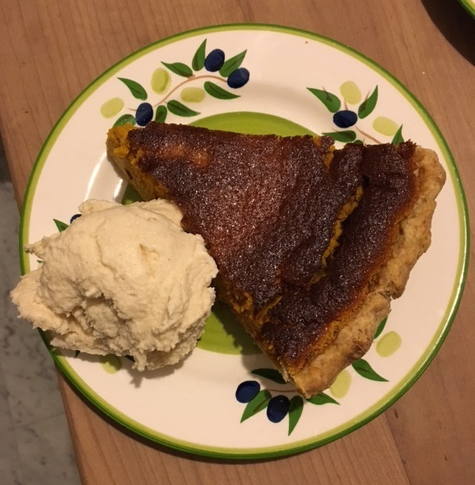
pie-icecreamI bought cream earlier this week, thinking I’d make pumpkin pie this weekend—you can’t possibly eat pumpkin pie without whipped cream, right?

But my husband wondered whether pumpkin pie would be even better with cinnamon ice cream, so he and my daughter used the cream to make cinnamon ice cream.

The ice cream is quite nice, and the pie is delicious.

But for my part, I still think plain old whipped cream is best.

A List of Garden Don’ts

2016-01-16 17.22.14 HDR smAs I head into spring, I always try to bear in mind my list of garden don’ts…

  1. Don’t put the compost pile next to the greenhouse. The rats and mice go straight from the compost to the greenhouse, where they devour everything in sight.
  2. Don’t plant so many zucchinis. No. I mean it. One zucchini plant can feed a small village. Just don’t do it.
  3. Don’t put the pumpkins near a path. You don’t need to do anything to them until long after all the other crops are finished, so tuck them away from heavy traffic areas. Otherwise, they’ll take over your paths. Same goes for potatoes, melons, and broad beans.
  4. Don’t take zucchini to every social function you attend. See point number 2. Even your friends can’t eat all that zucchini.
  5. Don’t plant corn where it will shade the tomatoes.
  6. Don’t freeze your extra zucchini. See point number 2. If you must freeze zucchini, grate it first, and don’t freeze more than what you can use in two batches of zucchini bread.
  7. Don’t plant horseradish. Anywhere. For any reason. It’s fine if you love horseradish. But don’t plant it. Get it from a friend who made the mistake of planting horseradish once ten years ago.
  8. Don’t save extra zucchini in the fridge. See point number 2. There will be more tomorrow, and you won’t eat the ones in the fridge. Get a pig or goat instead and feed the zucchini to it.
  9. Don’t water before you weed. It makes for unpleasant working conditions.
  10. Don’t worry. Your local food bank probably accepts zucchini.

Homemade Goat Parmesan

2016-09-05 17.16.17Today was the day—the day to finally crack open one of the parmesan cheeses from last October. Eleven months in the fridge, and they were every bit as disgusting as they always are. Covered in mould, in spite of my efforts to avoid it, and with a hard, dry rind.

And as usual, once the rind was cut off, the cheese underneath was the most divine, flavourful cheese ever.

My parmesan is drier than the standard commercial block, a bit less salty, and with twice the flavour punch. It takes at least ten months to reach full ripeness, but it’s worth the wait. We put commercial parmesan on pasta, in risotto, and in pesto. My parmesan, we also sneak onto our sandwiches for lunch, or onto crackers for an after school snack.

Of all the cheeses I’ve learned to make, it is one of the most rewarding for its sheer over-the-top gourmet decadence. I’d say we live like kings, but I wonder if even kings get cheese this good on a daily basis.

Hygge

Definitely hygge

Definitely hygge

It was way too warm this evening to need a fire, but I lit one anyway. After two brutal days in the garden, I just wanted warmth and comfort.

Apparently, it’s very trendy. Just two days ago, they were discussing this very thing on National Radio—hygge—a Danish term (pronounced hooga) that means comfort, well-being, cosiness, and contentment all wrapped up in one word.

Taking care of yourself. Doing those things that bring happiness and comfort—a picnic on the beach, curling up with a good book and a cup of tea, enjoying a glass of wine with friends.

For me, curling up with a good book by the fire is hygge, and that’s what I’ll be doing this evening.

But hygge for me is also an evening stroll in the garden, after the day’s work is done. It’s half an hour at the piano. Lunch outdoors in the sun. Scones on Sunday morning. Milking in the dark at 5am under a sky full of stars. Morning coffee among the tassling corn in mid-summer.

What is hygge for you?