Those of you who are interested, check out my latest guest blog post on Dan Kobolt’s Science in Science Fiction and Fantasy blog:
Gender Determination in Fantasy Creatures
(a topic I’m sure you’ve all been dying to learn about…;) )
Those of you who are interested, check out my latest guest blog post on Dan Kobolt’s Science in Science Fiction and Fantasy blog:
Gender Determination in Fantasy Creatures
(a topic I’m sure you’ve all been dying to learn about…;) )
 Back in the late 1980s, during the time when I was going to university, there was a great deal of controversy around the Northern Spotted Owl. Conservationists were trying to use the bird as a tool to limit logging of old growth forest in the Pacific Northwest by encouraging its listing as an endangered species (it was listed as threatened in 1990). It was a hot topic in conservation at the time.
Home for Christmas one year around that time, I was presented with a gift specifically from my grandfather.
That was odd. It was the women of the family—grandma and mom—who shopped for gifts. What could Grandpa have for me?
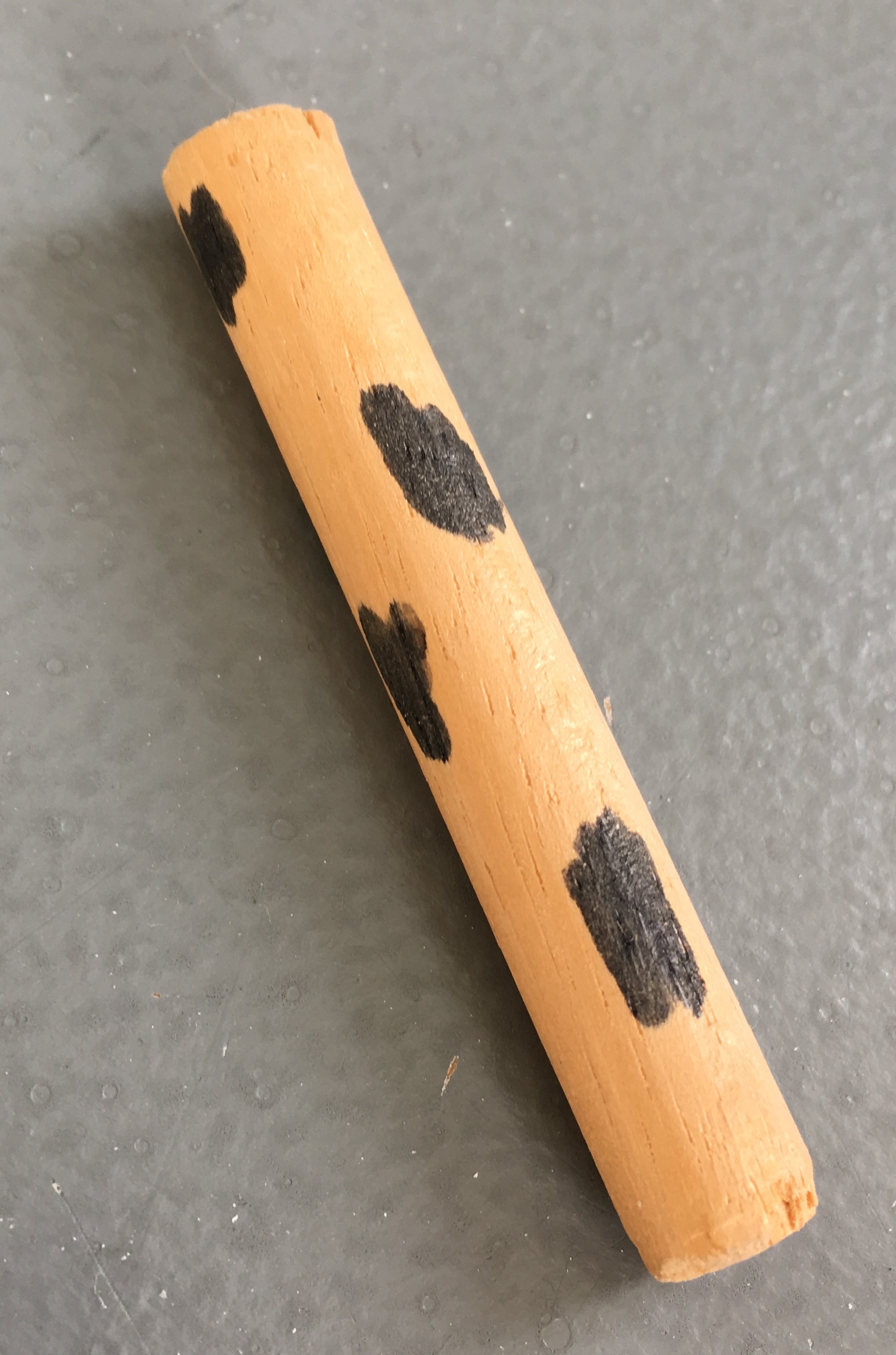
It was a small box. Inside, nestled in tissue paper was a small piece of wooden dowel with crude blotches drawn on it with a marker.
He watched me unwrap it, clearly struggling to hide a smile.
I pulled it out of the box and turned it around in my fingers. I was obviously supposed to figure out what it was. I wracked my brains. What was this spotted stick supposed to be?
It never occurred to me that it was a joke. I finally had to ask.
“It’s a spotted dowel!” Grandpa said, breaking into a grin.
I have no idea what other gifts I got that Christmas. No doubt, whatever they were, they’re long gone from my life.
But the spotted dowel has it’s own special place—its own little drawer in a small-parts organiser that holds all my buttons and beads and other odds and ends. I often run across it accidentally while looking for something else, and it still makes me smile.
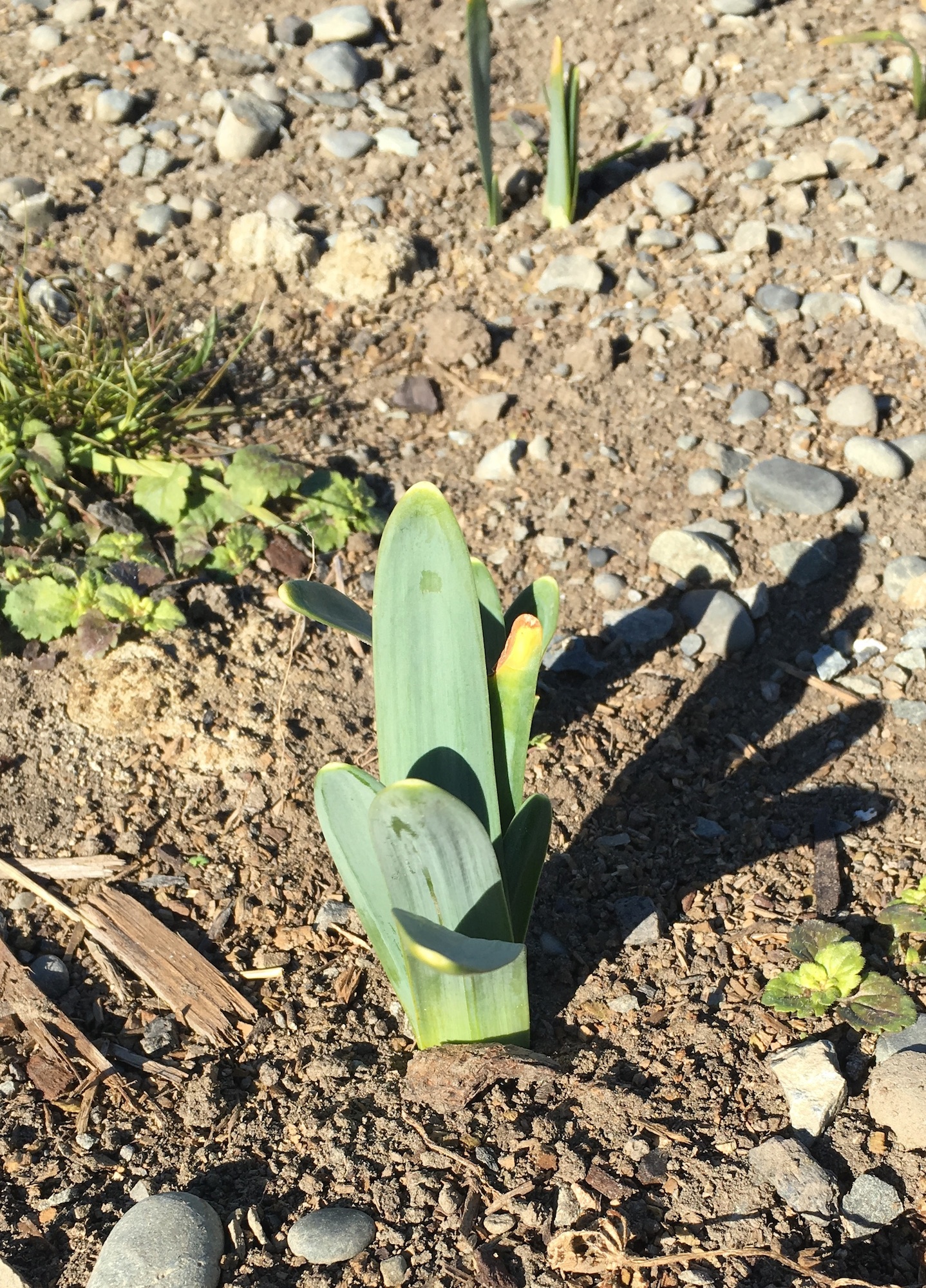 Remember last fall when I bought 200 daffodil bulbs and was thinking I’d made a huge mistake? Well, we got all those bulbs planted—they went in a lot faster than I expected them to, with all of us working together, and they didn’t fill nearly as much space as I thought they would.
And now, as we enter the final month of winter, we’re beginning to get a peek at what’s to come…
Daffodils coming up everywhere—even in places I don’t remember planting them.
Maybe buying all those bulbs wasn’t such a mistake after all…
My story, Mannequin, was published in Work Literary Magazine today. A small success, but it makes me smile. 🙂

Photo: Peter Weiss
Summer. The beach. Sisters.
These photos were taken forty years apart. My sister and I at Barnegat in 1976, and my nieces at the same beach in 2016.
They could practically be the same girls.

Photo: Peter Weiss
Playing in the waves with your sister. Perhaps you didn’t spend much time together at other times. Perhaps your sister was the younger, irritating type. Or perhaps she was the older, bossy type. But you went to the beach, and there, with the waves rolling in, and the sand stretching on forever, you were kindred spirits. You laughed and played stupid games with the waves and sand. You collected shells together. You built sand castles.
And maybe you went back home and ignored one another, or maybe you yelled at each other, or maybe you enjoyed each other’s company at home, too. But the beach was a special bond. A place where your irritations with one another were set aside, and you were sisters—real sisters—braving the ocean together.
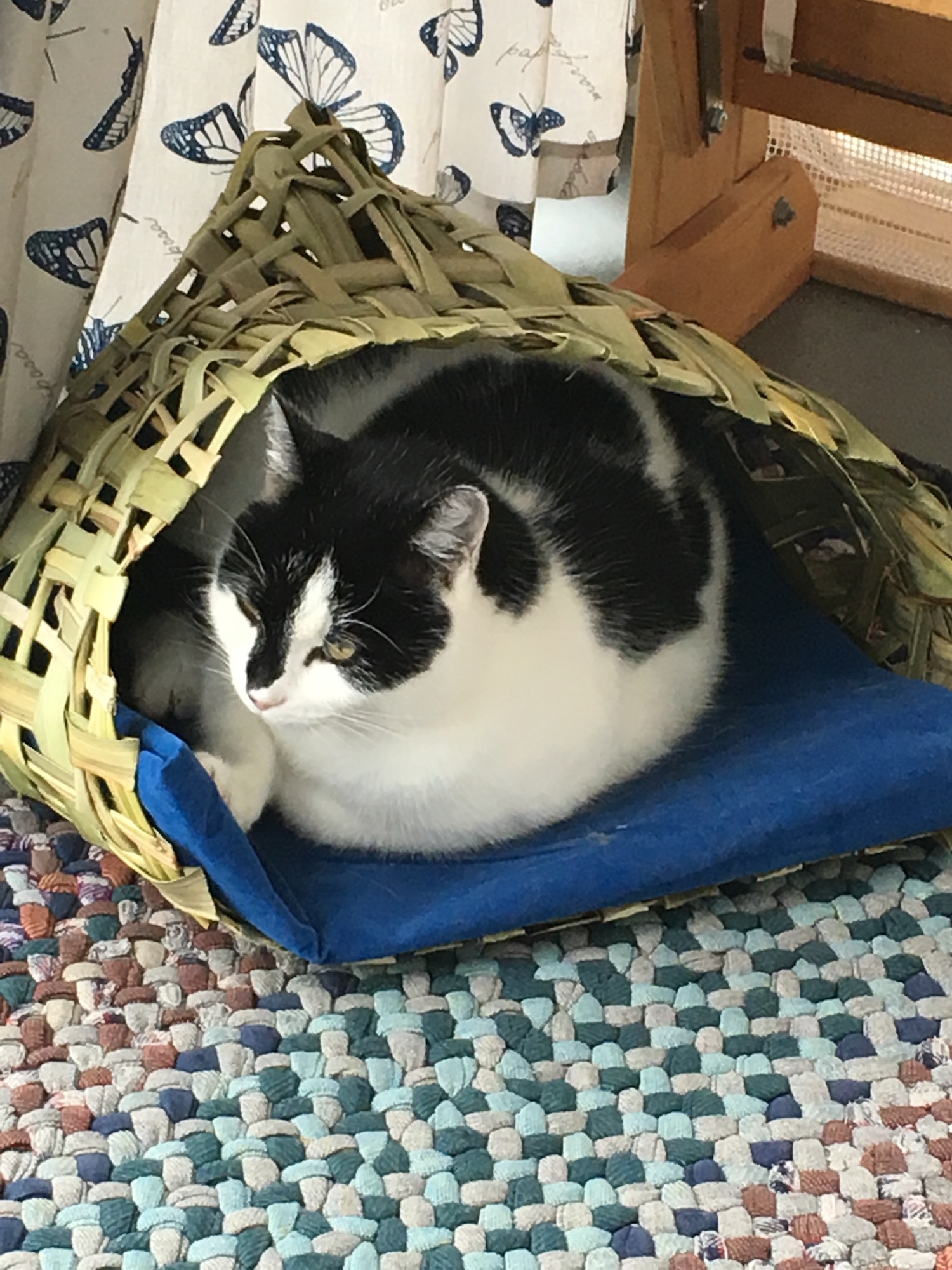
In the basket–that lasted about 10 minutes.
No one likes to have their routine disrupted. And no one hates it more than a cat.
I recently took the bean bag chair out of my office. The cat was the only one who sat on it there, and the build-up of cat hair on it was triggering my allergies.
I cleaned off the hair and put it in the living room, where we’ve been enjoying it.
Well, everyone except the cat.
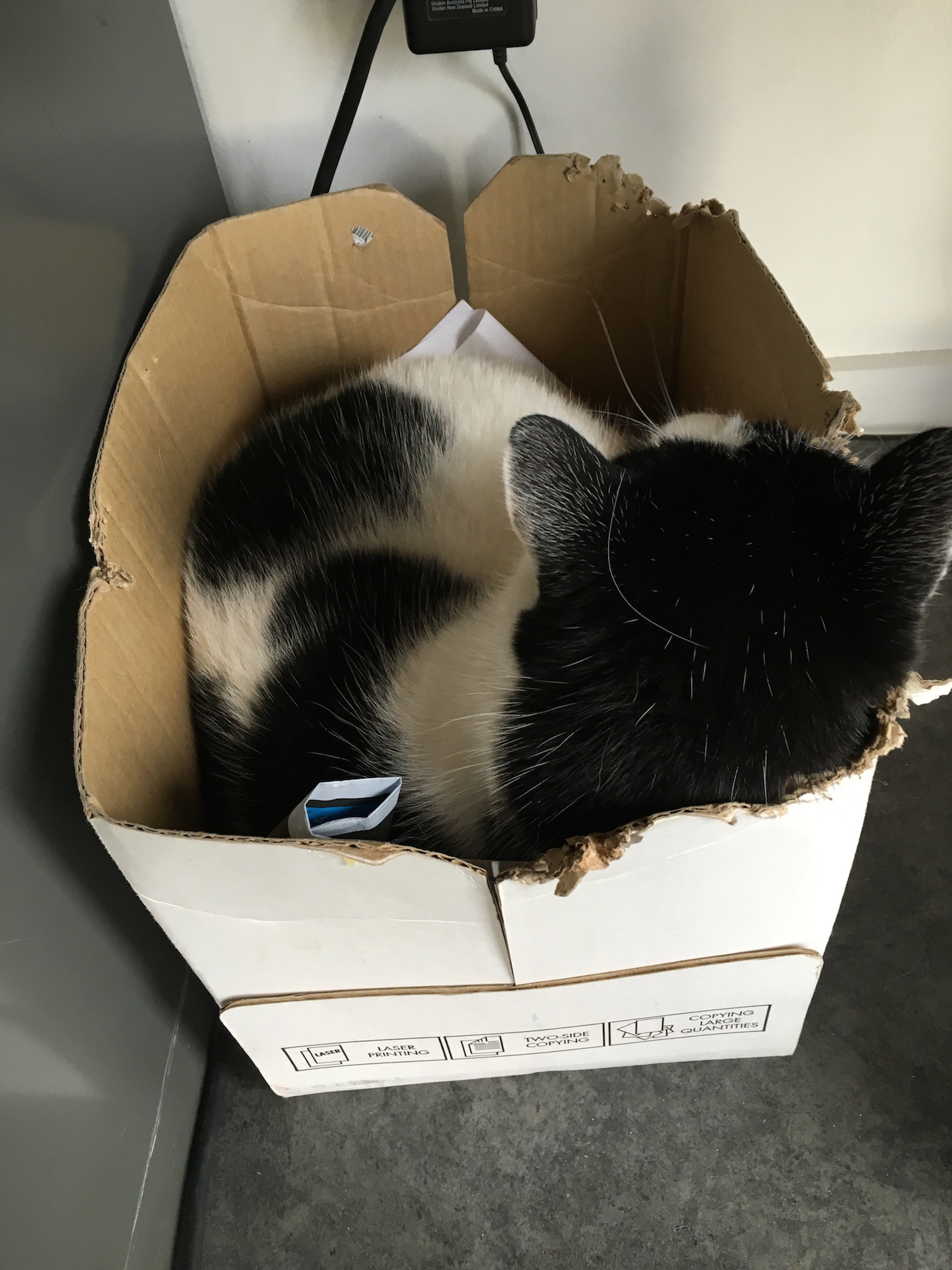
In the recycling box–a bit small for him.
He used to spend all day sleeping in the chair in my office. Now he doesn’t quite know what to do. I’ve provided him a basket in the office, but he doesn’t want anything to do with it. He also won’t sleep on the bean bag chair in the living room. Instead, he prowls from one spot to another, spending no more than a few minutes in each spot. In between naps, he sits at my feet and howls his indignation at me, punctuating his howls with vicious bites (it’s a good thing I wear jeans).
He’ll get over it, eventually, as we all do when change happens. At some point, we’ll get tired of the bean bag chair in the living room (it takes up an awful lot of space in there), and it will move back to my office. Then the cat will be pissed off at me for putting the bean bag chair into the office, and we’ll have to deal with his disruption all over again.
Change is tough.
 I always liked the early morning, before dawn. It was quiet. The kids weren’t clamoring for attention and hot chocolate. My husband wasn’t enlisting me in the frantic search for his car keys. The phone wasn’t ringing. Even the birds were quiet.
So it was natural, when we moved to the old farm out on Creamery Road, that I would tend to the livestock in the wee hours before daylight.
We kept a handful of dairy goats and a grumpy old steer named Bill, who came with the place. He’d run wild in the back forty, and only came down when winter set in, after we’d been there for six months. My daughter befriended him, and that’s how a family of vegetarians ended up with a beef cow.
But the cow wasn’t the only unusual thing that came with the property.
I saw the first ghost on an icy morning shortly after Bill arrived. We had made room for him in the barn alongside the goats. When I arrived in the barn that morning, I found Bill idly chewing an old wool blanket he had managed to reach from his stall.
“Are you taking lessons from the goats?” I asked him as I pulled the blanket away from him. I was about to toss it back into the corner when I saw the spinning wheel it had been covering.
The wheel was dusty. I wondered how many years it had sat in the barn, unused. I blew the dust off and tried turning the wheel with my hand.
“Use the foot pedal.”
I nearly jumped out of my skin at the sound of a woman’s voice. I looked up and there she was—a young woman in a long brown dress and white pinafore. She was clearly visible, but insubstantial, as though the dust had coalesced to make her form.
“Excuse me?”
“The foot pedal.” The woman pointed. “That’s what makes it go.”
I pressed the pedal and the wheel turned. I smiled.
“Was this yours?” I asked. The woman nodded, smiling.
“My husband ran two hundred sheep. I always kept back some of the fleeces—the best ones—for our own use. I had a loom, too, but it’s gone.”
“What did you make?”
“Dresses and trousers, jackets…and blankets and booties for the baby.” An insubstantial tear rolled down the woman’s ghostly face.
“The baby died?” I guessed.
The woman smiled.
“No. He lived, and grew up to be a fine man, but I never got to hold him or help him on his way. His first breath was my last.”
I took the spinning wheel into the house, cleaned and oiled it, and put a new drive band on it. I bought some wool and asked the neighbor to teach me to spin. The young ghost visited whenever I sat down to the wheel.
The next ghost appeared in springtime. The goats were out in the far paddock with their new kids, and I was coming back through the woods from an early morning visit to them .
She was an elderly Native American with deep laugh lines around her eyes. She beckoned me off the trail and showed me a patch of morels pushing through the leaf litter.
“I used to collect morels from this very spot. I taught my daughter how to find them, and she taught her daughter.” Her face clouded. “And then the White Man came. Before long, there was no one left to teach.”
“I’m sorry,” I said.
I picked the mushrooms, and have done so each spring since, savouring their earthy flavour in springtime meals.
Once I saw the first two, the other ghosts were easy to see. There was the boy floating sailboats on the farm pond—I taught my daughter to do the same. There was the doctor picking dandelion greens to nurse an invalid back to health—we began adding dandelions to our spring salads. There was the farmer building rock walls between fields—I added many stones to them over the years.
Everywhere I turned were the ghosts of those who had come before. My early mornings became a social time. I would greet the elderly man who milked his ghostly cow next to me as I milked my goats. I would share a joke with the girl who giggled in the oak tree. I would stop to hear a poem by the woman who sat writing on a mossy rock in the woods.
Bill is long gone. My kids have grown and moved away. My husband is buried in the churchyard in town. The ghosts stay with me all day now. They sit by my bedside when I wake in the night in pain.
I have claimed the milking stand as my own, when the time comes. The old man and his cow will have to make room for me.
 One of my favourite thing to do with students of all ages outdoors is to get them to be still and listen. It’s something we do surprisingly little of at any age.
This afternoon, waiting for the kids at piano lessons, I sat in the car and closed my eyes. I did it because I was tired and have a head cold, and it just felt good. But with my eyes closed, I naturally began to listen more.
Someone in the next block was mowing their lawn. House sparrows flitted and chattered in the tree across the street. Starlings warbled from the power lines. The leaves of the birch tree next to the car fluttered in the wind. A door opened somewhere, and whoever stepped outside lifted the lid of a metal rubbish bin, then set it down again and went indoors. A dog barked several streets away. An airplane flew overhead. A fly buzzed past the open car window. Someone walked down the sidewalk. Crickets chirped from the grass, and a lone cicada stuttered from a tree down the street.
I might have noticed some of these things without closing my eyes and sitting still, but would have missed many of them.
There is always so much to be done, I am rarely still. But it only takes a minute to close my eyes and listen to the world around me—I really should do it more often.
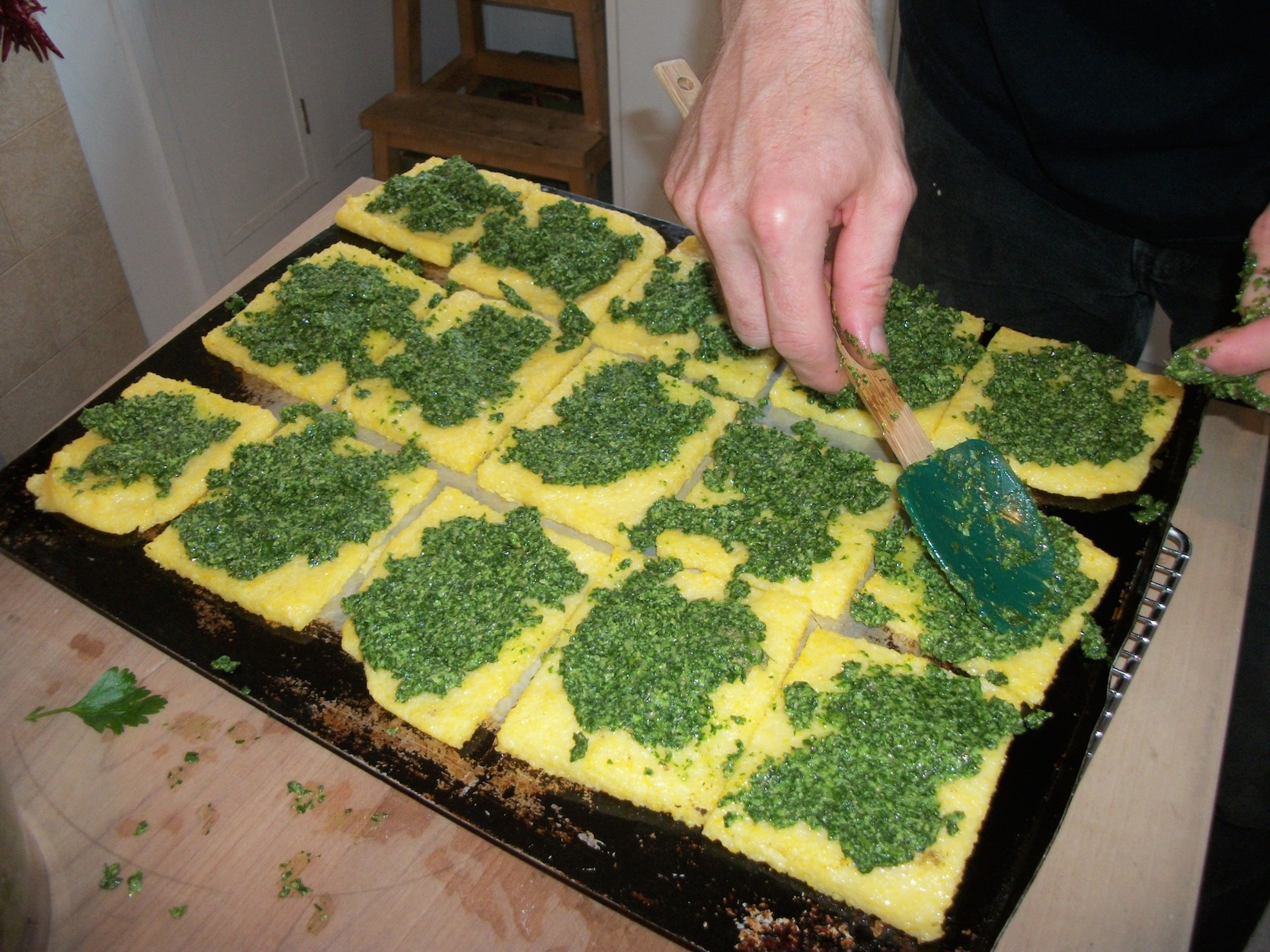 Today offered further proof (though I can’t imagine it was necessary) that my husband and I are nuts.
Weekday. We all come home from work and school.
I’ve scored a small handful of extremely expensive, first-of-the-season asparagus, and we start discussing what we’ll have with our asparagus for dinner.
Next thing I know, I’m making firm polenta, and Ian is picking the herbs for a fresh parsley pesto.
What arrives on the table an hour and a half later is nothing short of extraordinary—polenta crostini topped with pesto, sautéed mushrooms and cheese, with braised asparagus on the side.
I point out to Ian that most other people are heating up TV dinners on a Thursday night…
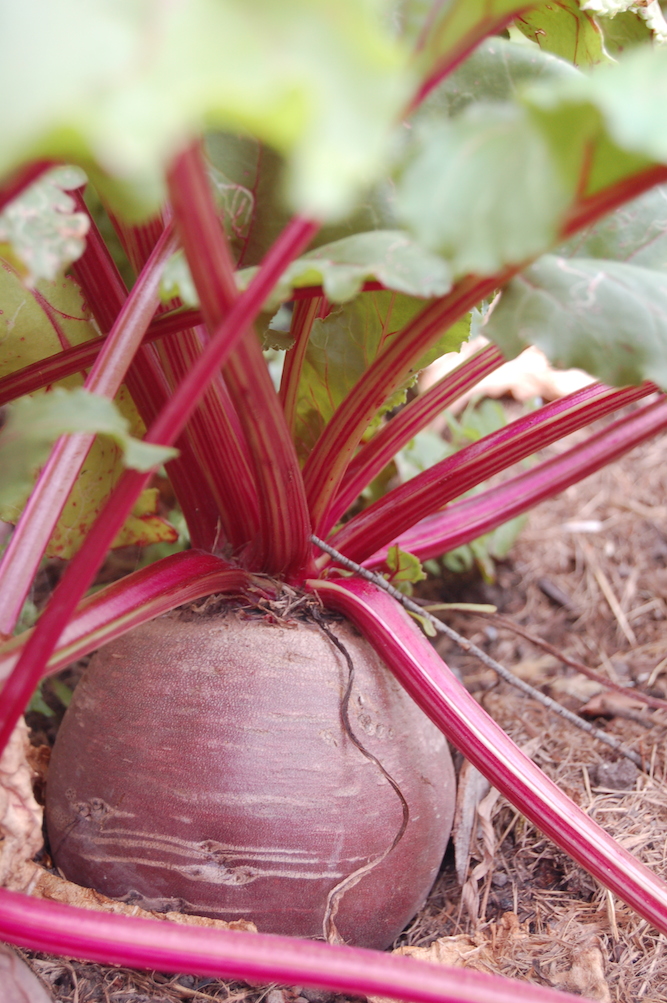 It took years to get our son to eat beets.
No. That’s not true.
He ate beets for years before he liked them.
Red beet eggs, nope.
Roasted beets, uh uh.
Grilled beets, no.
5-minute beets, OH YES!
This recipe comes straight from Vegetarian Cooking for Everyone, by Deborah Madison (one of my favourite cookbooks), and I’ve never been tempted to alter it in any way. It is absolutely perfect!
4 beets (about 500g/1lb)
1 Tbsp butter
Salt and pepper
Lemon juice or vinegar to taste
2 Tbsp chopped parsley, tarragon, dill or other herb
Grate the beets coarsely. Melt the butter in a skillet, add the beets, and toss them with ½ tsp salt and pepper to taste. Add ¼ cup water, then cover and cook over medium heat until the beets are tender. Remove the lid and raise the heat to boil off any excess water. Adjust salt, season with a splash of lemon juice or vinegar (I use balsamic), and toss with the herb.
 Robinne Weiss