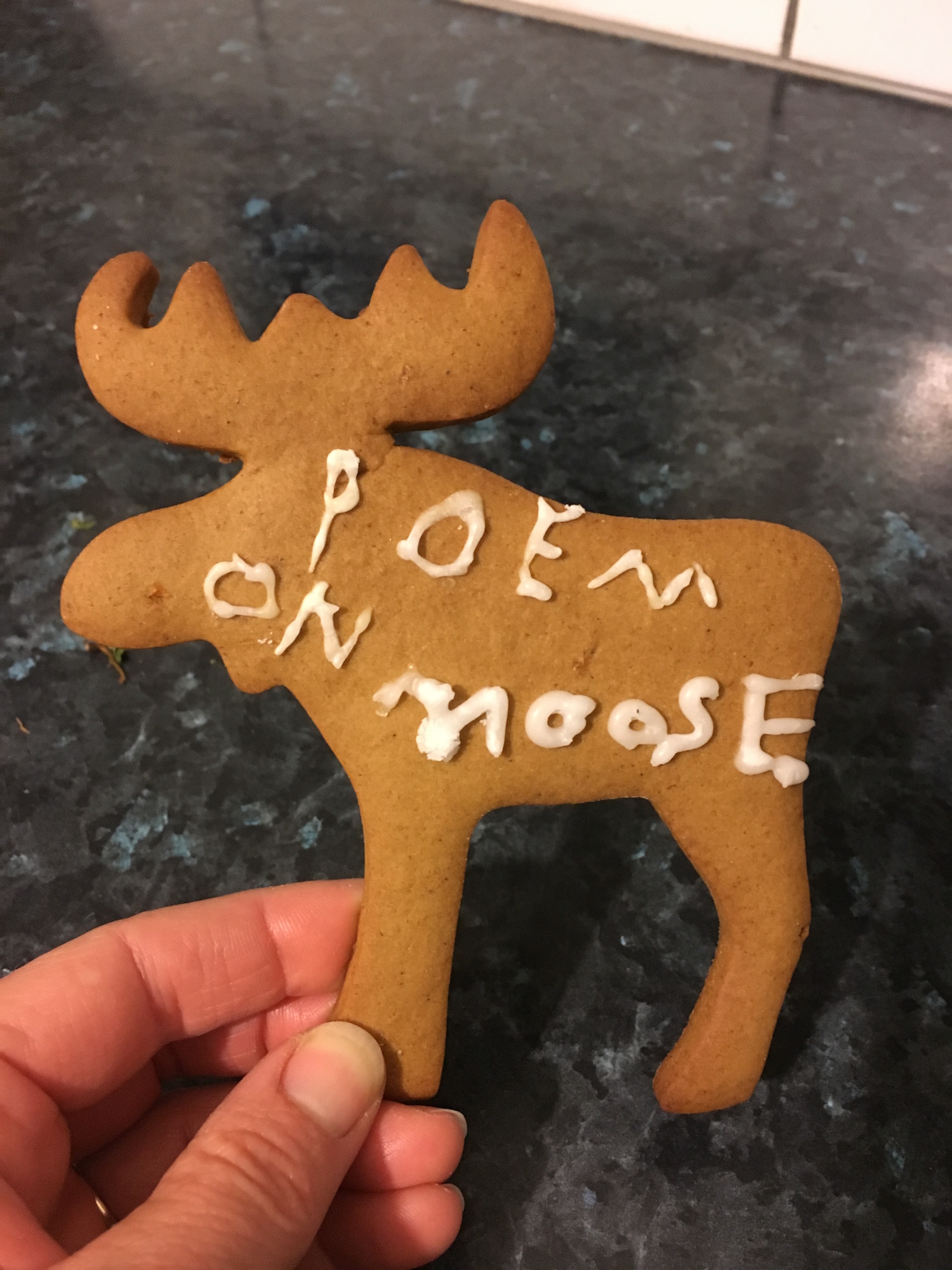
Poem on Moose

What happens when I let my daughter decorate Christmas cookies.

What happens when I let my daughter decorate Christmas cookies.

Literary ungulate
In gingerbread.

This poem is either
On a moose,
Or on moose,
Or both.

Your palmate antlers,
Distinctive,
Tell me you’re a bull.
They beg to be bitten off.

Then you would be a cow
Only your drooping nose
And your beard
Giving away your moosy nature.

But why a poem
On a moose
(Or on moose)?

I do not recommend
Writing poems on moose
(or is it mooses?)
Unless they are of the gingerbread variety.
The icing tickles
And moose (meece?) snort when they laugh.

But if you try,
I suggest a stepladder.

Penultimate

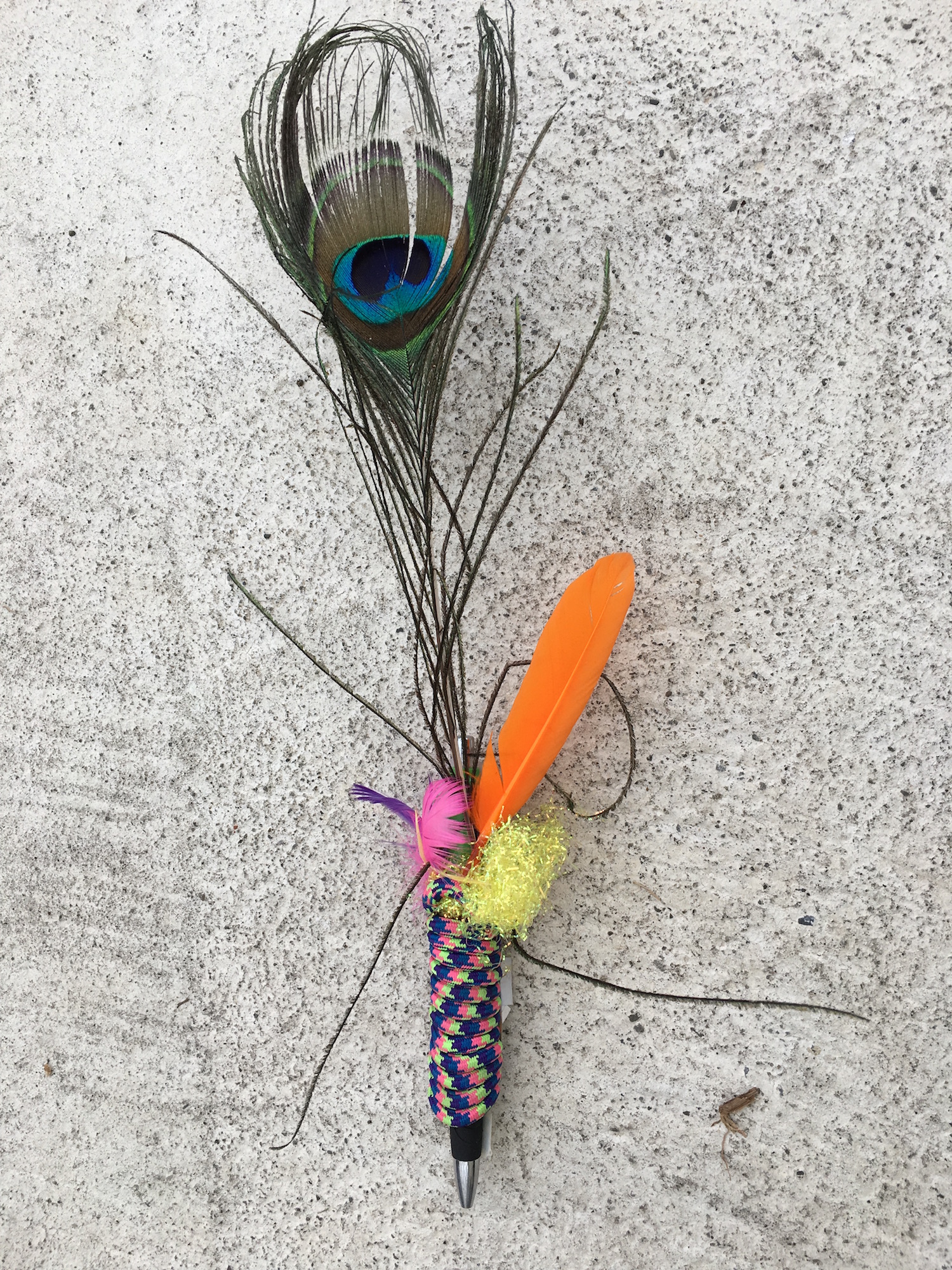
2016-12-07-07-53-28My daughter’s last day of school for the year was Thursday, so on Wednesday I wished her a happy penultimate last day of school.

We like words in our house, and penultimate is one of the best, in its own right. But, of course, it lends itself to so much fun…

So on the penultimate day of school, my daughter made and took the Pen-Ultimate.

We all thought it was awesome.

Unfortunately, she said her classmates didn’t really get it.

*sigh*

We’re raising complete geeks.

*grins madly*

What’s the price of a weed?

2016-11-08-16-14-49This is an important question at our house, with lots of weeds and two teens looking to make some extra money.

I decided to take a mathematical approach to this question.

Crop loss and control costs for weeds in New Zealand are estimated to be about $1.2 billion per year. Add another $1.3 billion for biodiversity losses, and the total bill for weeds comes to $2.5 billion per year.

So what should I be spending on weeds? Let’s do a few calculations.

New Zealand has a land area of 268,021 km2. That’s 26,802,100 hectares.

Our property is 0.6 hectares.

So our property is 0.00000002 of the land area of New Zealand.

Multiplying New Zealand’s total weed bill of $2.5 billion by 0.00000002, I should be paying about $50 a year to control weeds on my property.

My husband set the price of a 20 litre bucket of weeds at $2 (and I agreed to pay triple price for each bucket of pure thistles—hazard pay and all). That $50 is only going to pay for 25 buckets of weeds (or only 8 buckets of thistles).

Darn. I’m seriously being over-charged for weed control…

Spring Roller Coaster

rollercoaster_expedition_geforce_holiday_park_germany

Photo: Boris23; Wikimedia, public domain

The kids are back at school today after two weeks of school holidays. It’s the last term of the school year, and the start of what I always think of as a roller coaster ride.

For the past two weeks we’ve been slowly climbing the first hill. I could hear the tik-tik-tik of the chain winching us up, to perch at the top of the slope. Today we begin the descent to the end of the year. It will start slowly—I’ll be lulled into thinking I have plenty of time to do the gardening, get all the nagging spring DIY done, think about Christmas gifts, plan summer’s vacations. But before I know it, we’ll be hurtling along toward the end of the year, much faster than I anticipated. The garden will take longer that I’d hoped. The end-of-the-year school activities will start piling up. I’ll put off worrying about Christmas gifts until I’m frantic about it. Three DIY projects will balloon into ten. Late frost will keep me scrambling to protect plants. Livestock will get sick and require extra care. School will end much sooner than I’d like it to.

Time will compress. A month will be over in a week. A week will last a day. A day will be over in a blink of the eye.

Before I know it, we’ll be heading into the week before Christmas, and my Spring to-do list will be every bit as long as it is today.

I’ve learned to accept this state. I’ve almost learned to enjoy the frenetic insanity of the combination of the end of the school year, holidays, and spring gardening all at once.

But every year I sit here at the top of the roller coaster wondering if I really should have gotten on in the first place.

Making Music

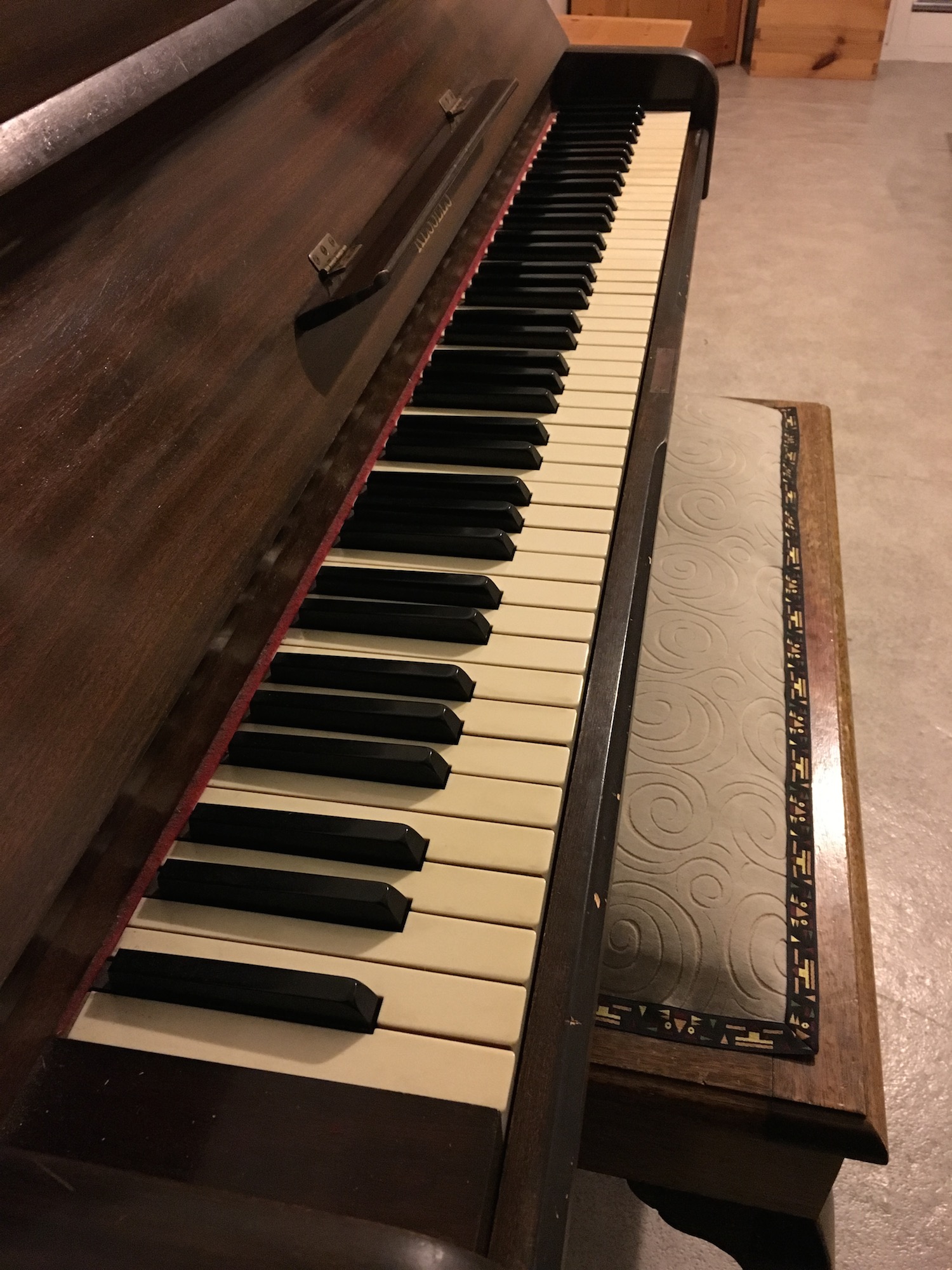
file-8-09-16-7-34-10-pmI attended another high school music programme this evening and was struck once again at how important making music is to human culture.

Not listening to music, though that is nice, too.

Making music.

I have always loved music—classical, rock, country, folk, hip-hop, jazz—doesn’t matter what it is. If I could live my life inside a musical, I would. In fact, some days you could be forgiven for thinking I do, the number of times my husband or I break out in song.

Young people seem to understand this need to make music—kids sing on the playground when they’re younger, and gather with friends and a few guitars when they’re teens.

They make up songs about their high school teachers. The one we heard tonight was loving; some of the ones I remember singing with my friends in high school were not so kind.

They beat drums, tap silverware on the table, clap their hands and do beat boxing. They write music, they play music, they make it their own. They use it to say the things they cannot speak. They use it to be the people they want to be.

And somewhere along the line, they stop making music.

Somewhere along the line, music becomes something that ‘professionals’ do.

They start to believe that making music is embarrassing, a waste of time.

They start to believe that music must be performed for an audience.

Gatherings no longer include the guitars. Beat boxing gets rolled eyes instead of an on-the-fly rap to go with it. Show tunes no longer feature in everyday conversation.

Oh, there are adults who still do this, for sure. But usually they have a reason for doing it—they’re in a band, or music is part of their work. The average adult with 2.5 kids, a mortgage, and a job doesn’t.

It is a loss.

A loss, not just to the individual, but to society as a whole. We lose our ability to express the things we cannot say. We forget to be the people we want to be. Celebrities become demi-gods, because we forget that we can all make music—we don’t need a recording contract, a gig, an audience, or even an ounce of musical ability. We can make music because we are human. We need to make music to remain so.
Risk

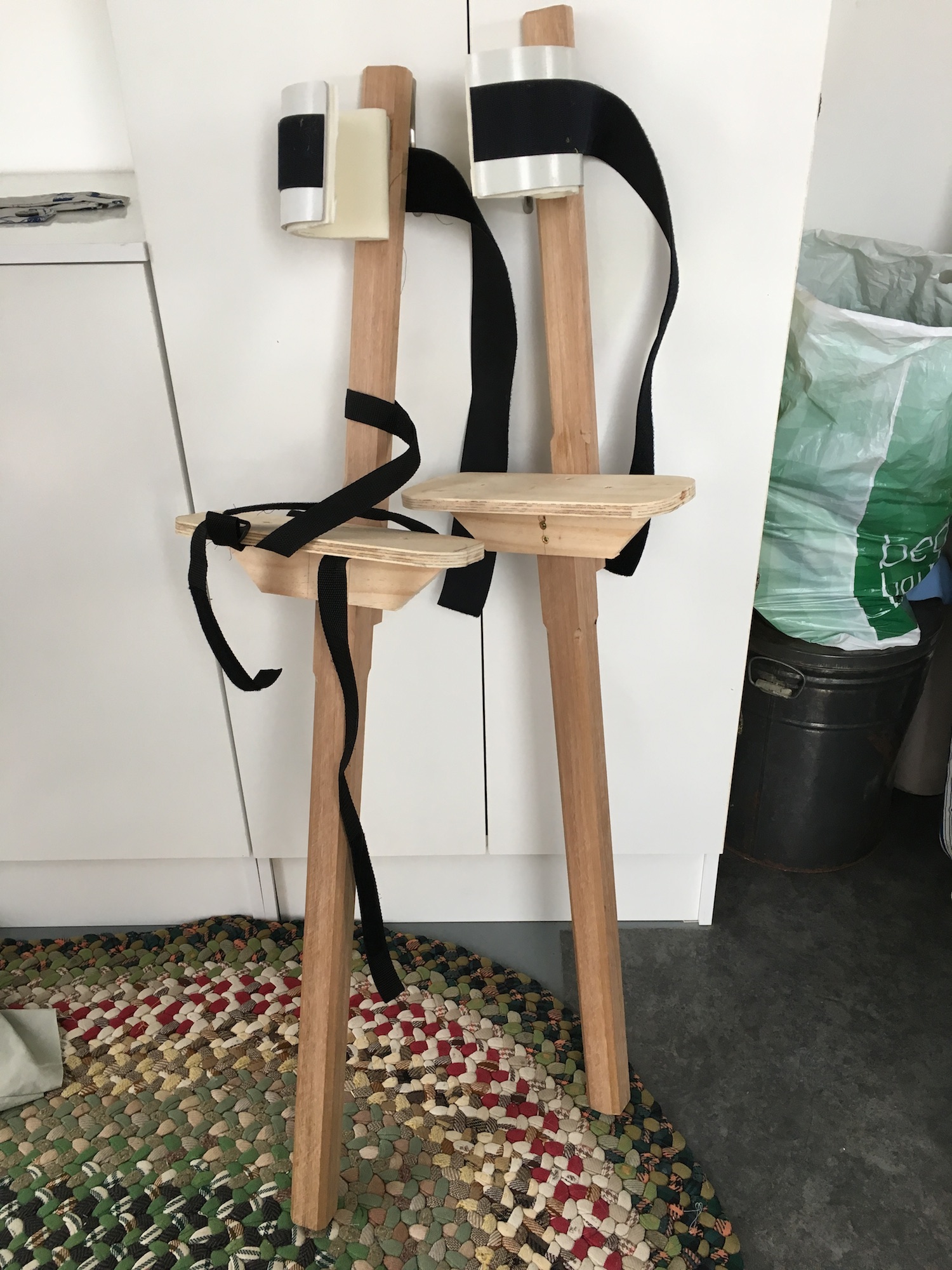
The stilts nearing completion.

The stilts nearing completion.

When I was about ten, my dad built me a high bar in the back yard so I could practice gymnastics at home.

My mom hated it. She refused to watch as I flipped and swung and tumbled through the air, with no crash mat below me. I used that bar a lot. Never once did I injure myself or even come close (the blisters don’t really count).

What mom didn’t know was that before the bar, I did my aerial work in the woods across the road—flipping and swinging around tree branches that bounced and swayed under me, with branches below to whack into if I should fall. I once found two branches that were the perfect distance apart to serve as uneven parallel bars. I couldn’t resist, though the branches were a little to big around for me to get a great grip on them. And they were at least twice as far off the ground as a real set of bars.

I stuck to moves I was comfortable with, but one involved being completely airborne and catching the upper bar.

But that upper branch was just too big. My hands slipped. I only just managed to dig the nails of one hand into the bark and hold on while I scrabbled around with my feet to find the lower branch (at this point, my mother, who reads my blog, is cringing and thinking she should have just locked me in my room instead). I admit that I clung to that branch for five minutes before I could bring myself to let go enough to climb down.

I write this as one who is now the mother of an equally adventurous daughter, not to scare other parents into locking their children away from trees, but to point out that children will find adventures. They will find ways to challenge themselves. By enabling our children’s adventures, we have an opportunity to manage those adventures.

Maybe mom didn’t like the high bar, but it was a heck of a lot safer than the tree branches.

My daughter is currently building herself a set of strap-on stilts, with the help and advice of both her parents. These stilts will replace the ordinary stilts we helped her make years ago, when she felt her first pair of (rather short) stilts weren’t challenging enough anymore. I was terrified by the tall stilts when she first got up on them. She fell again and again, but soon had them on their tallest setting and was playing soccer in them.

Now she wants to be able to juggle while walking on stilts. Her first idea was to tie her regular stilts to her legs. Not a good idea. Her father suggested she make purpose-built strap-on stilts.

I’m worried about the strap-on stilts—the only way to get off them is to fall—but because we are helping her address her need for more physical challenge, we are managing the risk. Elbow, wrist, and knee pads and a helmet will reduce the damage when she falls. Parental guidance on construction will ensure the stilts are strong enough to take the forces she’ll put on them.

It will be tempting to close my eyes the first time she gets up on them. But I owe it to the girl on the high bar to watch.

Playgrounds of the past


2016-07-14 20.33.37cropsmThough we are back from our visit to the US, there are a few blog posts inspired by the visit still to come over the next few days…

The playgrounds I enjoyed as a child are long gone.

The monkey bars over asphalt have given way to simpler structures over more forgiving surfaces. The high speed pop-your-partner-into-the-air seesaws have been replaced by almost immobile rockers on springs.

Much of this is probably good—I knew more than one kid who broke an arm falling off the monkey bars, and I remember the pain of a finger pinched in the seesaw’s fulcrum.

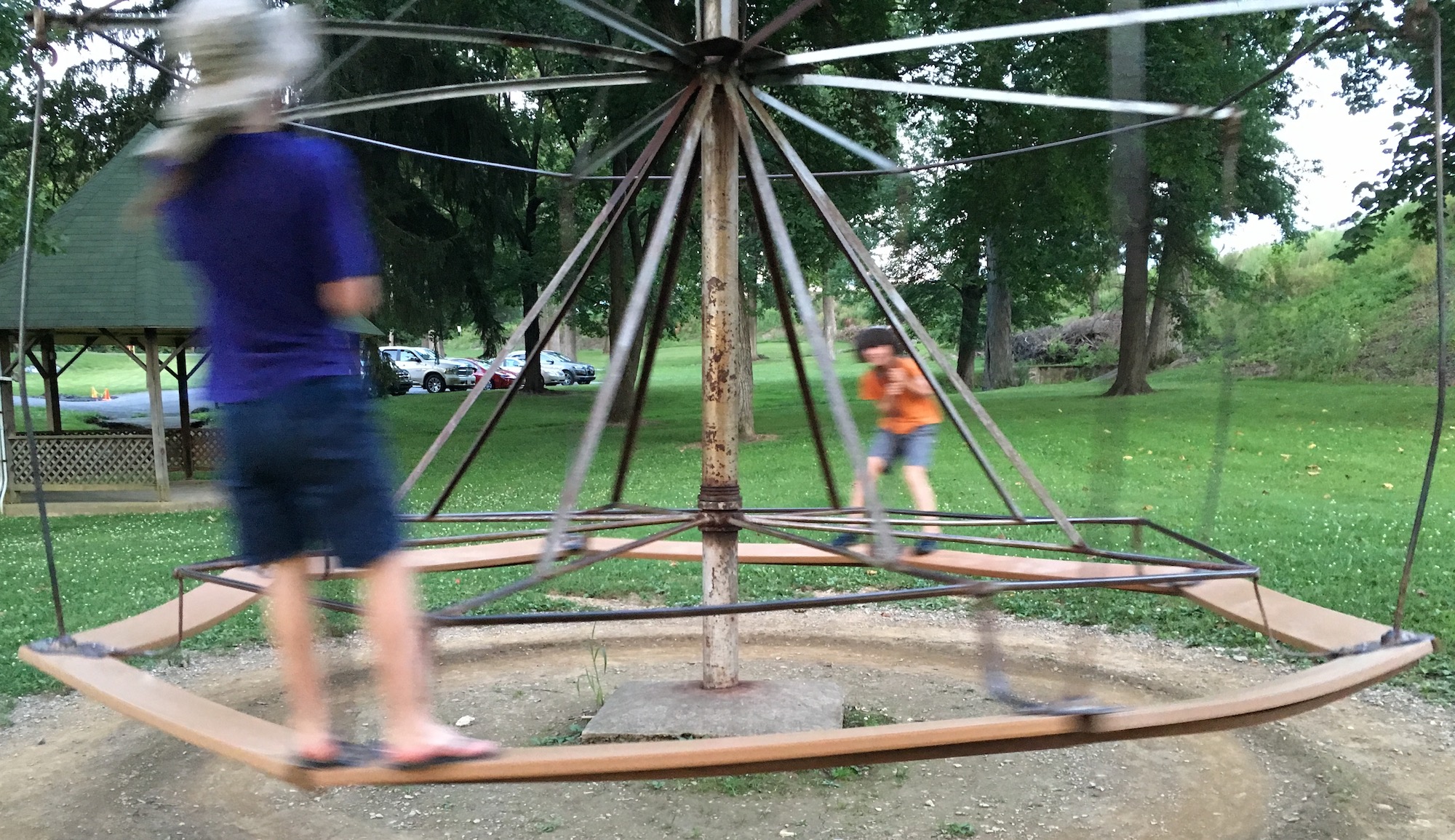
How this merry-go-round has escaped the fate of other aging playground equipment, I don’t know (I shall keep its location secret, lest the safety police go looking to remove it). I remember playing on it as a kid, and my mother does too. By that measure, it must be at least 70 years old.

It still spins, though the ride is rough and squeaky (it was rough and squeaky 40 years ago, too, as I recall). The wooden benches have been replaced…more than once, I’m sure.

But even after 70 years, it’s still fun, as proven by my own kids.

Fighting Over Firewood

2016-07-07 10.59.35 smI don’t know whether to count myself lucky, or to be disappointed.

My kids love to split firewood and kindling.

They’ve enjoyed this for several years, but now they’re actually old enough to do a decent job of it. And they jostle with one another to be the one to do it.

The problem is, I enjoy doing it, too. There’s something satisfying about swinging an axe and watching a log split in two under your blow. It warms you up on a cold day, and is appreciated by everyone as we sit by the fire in the evenings.

Now that the kids do the job most days, I have more time to do other things. That’s great, but it leaves me with no excuse to avoid the chores I don’t enjoy doing. It would be much better if the kids would start doing the really lousy chores like cleaning the bathroom, scrubbing the floors, and mucking out the animal sheds. Hmm…wonder how I can get them to do those…

Some Things Never Change

001C

Photo: Peter Weiss

Summer. The beach. Sisters.

These photos were taken forty years apart. My sister and I at Barnegat in 1976, and my nieces at the same beach in 2016.

They could practically be the same girls.

Photo: Peter Weiss

Photo: Peter Weiss

Playing in the waves with your sister. Perhaps you didn’t spend much time together at other times. Perhaps your sister was the younger, irritating type. Or perhaps she was the older, bossy type. But you went to the beach, and there, with the waves rolling in, and the sand stretching on forever, you were kindred spirits. You laughed and played stupid games with the waves and sand. You collected shells together. You built sand castles.

And maybe you went back home and ignored one another, or maybe you yelled at each other, or maybe you enjoyed each other’s company at home, too. But the beach was a special bond. A place where your irritations with one another were set aside, and you were sisters—real sisters—braving the ocean together.


Creative Combinations

2016-07-08 13.14.04 smOne of the cool things about having teenaged children is their increasing ability to combine ideas and skills in new and exciting ways.

Last weekend, my daughter was weaving flax fronds. I noted she had the Fun with Flax book out, and assumed she was making one of the projects in that book.

Some time later, I saw her with a wide cylinder of woven flax and a stick. She was using the stick to spin and toss the flax cylinder into the air.

I thought the idea must have come from the book, but no–she’d used weaving techniques in the book to create a unique shape, then used new skills in plate spinning (learned in PE in their circus arts unit) to manipulate the woven shape at the end of a stick.

How awesome is that?