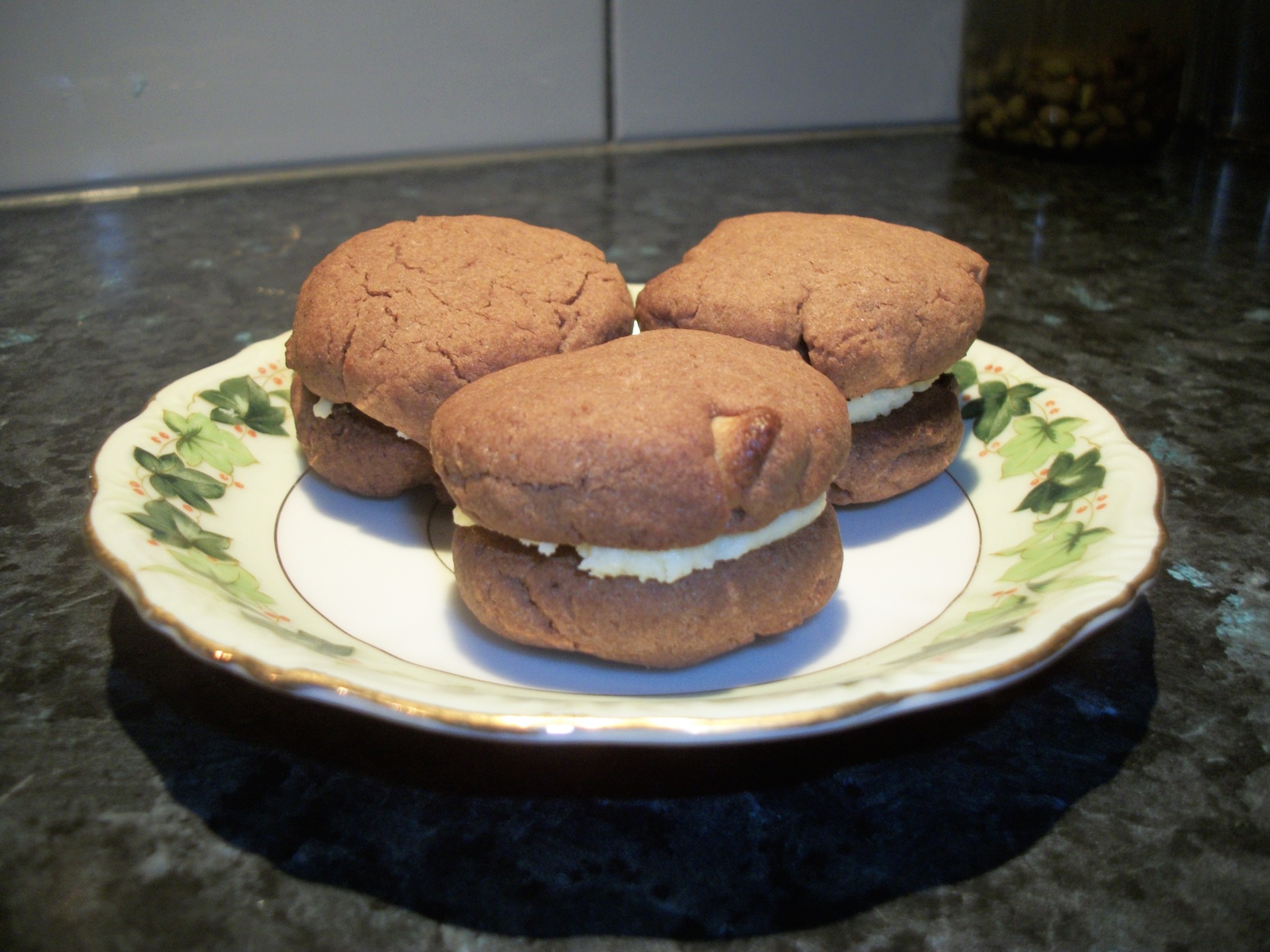
Lazy Woman’s Chocolate Yo-Yos

100_3645 smThese are perhaps the easiest cookies ever. They’re great if you just can’t bring yourself to beat butter, or you’ve forgotten to soften butter beforehand. They’re not the best cookies in the world, but they’re perfectly passable. They’re great cookies for young kids to make, because they don’t require a mixer. These were inspired by a sugar drop cookie recipe in Joy of Cooking.

2 ½ cups all purpose flour

3 Tbsp cocoa

1 ½ tsp baking powder

¾ tsp salt

¾ cup sugar

¾ cup vegetable oil

2 eggs

1 tsp vanilla

Sift together the flour, cocoa, baking powder and salt. In a separate bowl, combine the sugar and oil. Add the eggs and vanilla to the sugar and oil, and beat well. Add the flour mixture and mix thoroughly.

Roll the dough into 1.5 cm balls and flatten them slightly onto an ungreased baking sheet. Bake 8-10 minutes at 190°C.

When the cookies are cool, sandwich them together with frosting (I used cream cheese frosting left over from last week’s cupcakes).

I tried mixing in white chocolate chips this time, but the dough is so greasy, they just popped out. If you want to add chocolate chips, I suggest you do it by pressing them in as you roll the dough into balls, rather than trying to mix them in.
Biscuit Stars

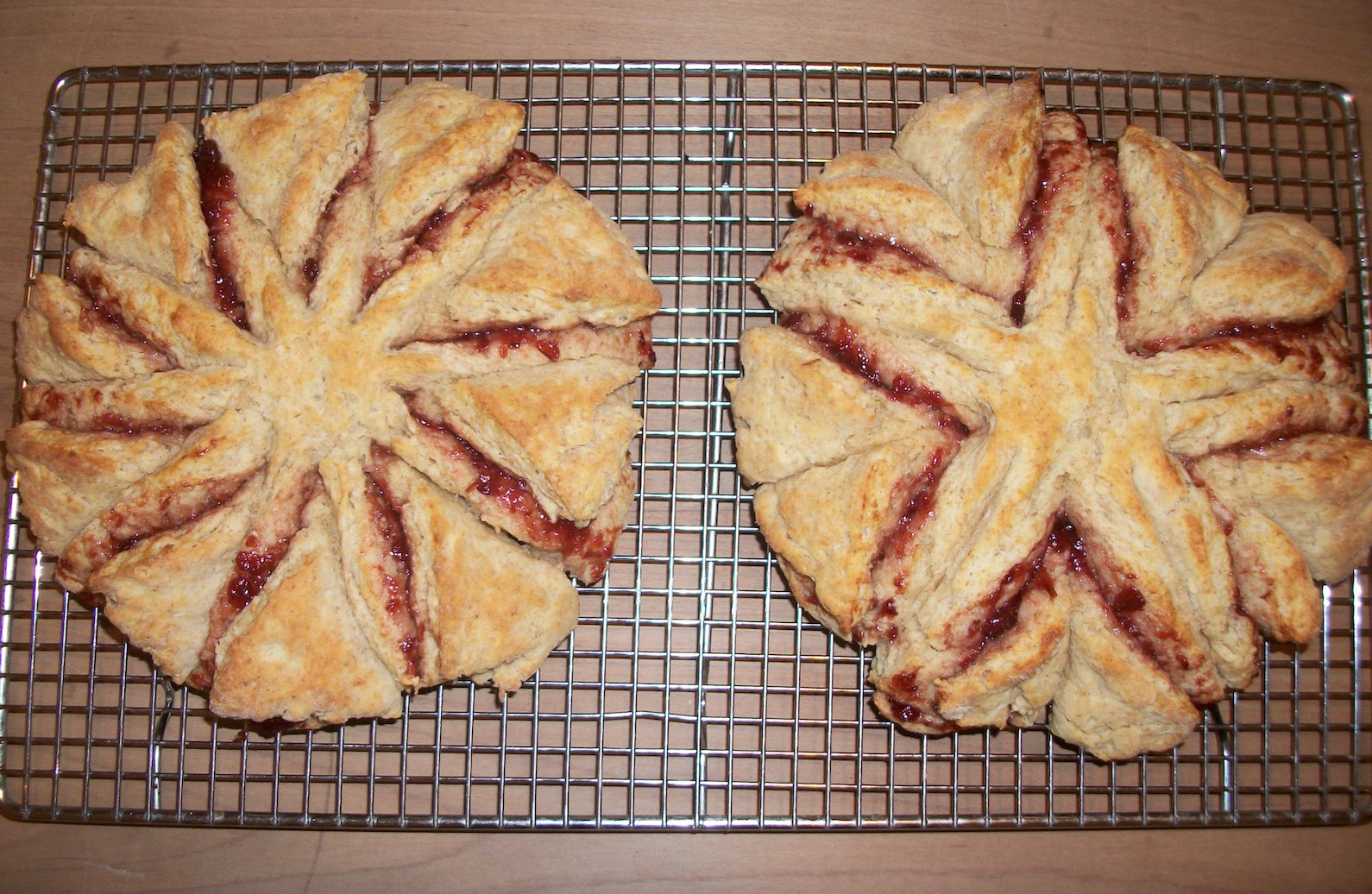
100_3639 smYesterday, I came across a lovely looking chocolate bread online that used the technique of cutting and twisting the dough to create pretty patterns.

I thought it would work in biscuit dough, too, so this morning I gave it a try.

I made my usual rolled biscuit dough, then divided the dough into quarters. I rolled out one quarter into a round about 20 cm (8 in) in diameter and 1 cm (1/2 in) thick and placed it on an ungreased baking sheet. Then I spread jam generously over the entire round, and topped it with another quarter of dough rolled out to the same size, pressing gently to bind them together. With a knife, I cut the stacked round into 10 wedges, leaving the centre uncut. Then I gently flipped each wedge over, to give it a twist.

Then I did the same with the other two quarters of dough. For the round on the left, I flipped each wedge in the same direction. For the round on the right, I flipped adjacent wedges toward each other.

I baked them at 190°C (375°F) for about 20 minutes.

The results were pretty and yummy, too!

Mushroom Leek Tart

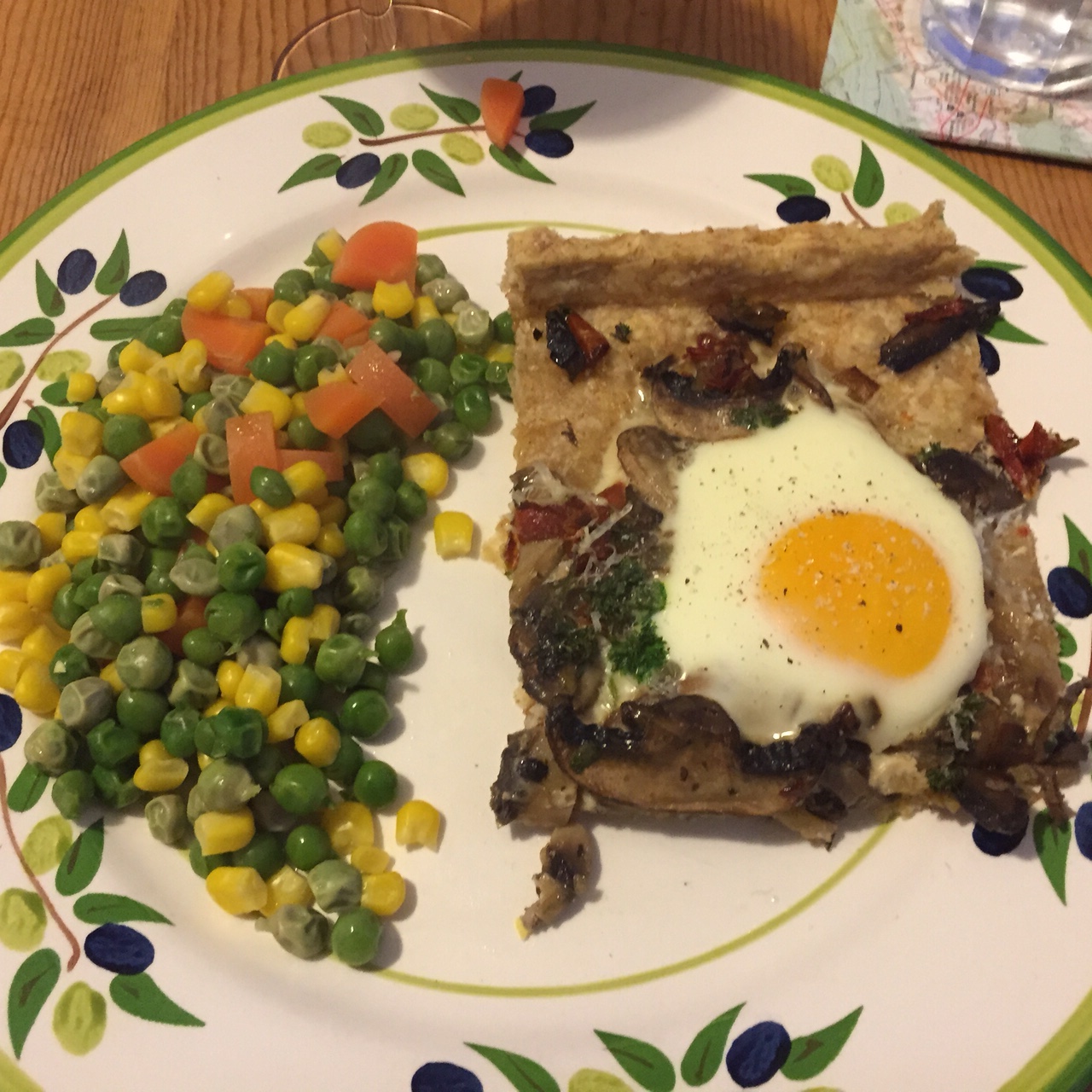
IMG_3455Driving home today with a kilo of mushrooms in the car, I devised the following mushroom and egg tart for dinner.

It was delicious!

Approx. 1 kg fresh mushrooms, sliced (I used buttons and portabellas)

10-15 g dried porcini, soaked 30 min in hot water

4 small leeks, sliced

small handful dried tomato, chopped roughly

Fresh thyme, rosemary, and parsley to taste

½ c. grated parmesan cheese

8 med eggs

salt and pepper to taste

Sauté leeks, mushrooms, tomatoes, rosemary and thyme over medium heat until well-cooked, and the mushroom liquid has evaporated. Add salt and pepper to taste.

Make pastry for a double crust pie. Roll it out in one large sheet and line a jelly roll pan with it.

Sprinkle half the cheese over the crust. Then spread the mushroom mixture evenly over the cheese. Top with the remaining cheese.

Crack the eggs onto the tart, one at a time, arranging them neatly across the tart.*

Bake 20 minutes at 190°C (375°F). Allow to cool for 5-10 minutes before serving.

*If I made this again, I’d bake the tart for 10 minutes, then add the eggs—20 minutes is a bit too long for the eggs.

Pastry for Science

Photo: Simon Pierre Barrette

Photo: Simon Pierre Barrette

Yes! The next time anyone questions my predilection for pastry, all I have to do is say I’m making it for science!

Researchers at Carleton University in Ontario made fake caterpillars from pastry in order to test the importance of the visual components of the tiger swallowtail caterpillar’s defence strategy (which is to look like a snake). The pastries were popular with birds, until they painted snake eyes on them. But young birds could learn that pastry with snake eyes was tasty, too, and then would only avoid pastry with eyes and the shape of a snake.

The researchers conclude that the combination of features the swallowtail caterpillar uses is a result of the selective pressure of smart birds, who aren’t fooled by imperfect disguises.

I might conclude that birds like pastry just as much as I do!

Upside Down Cake

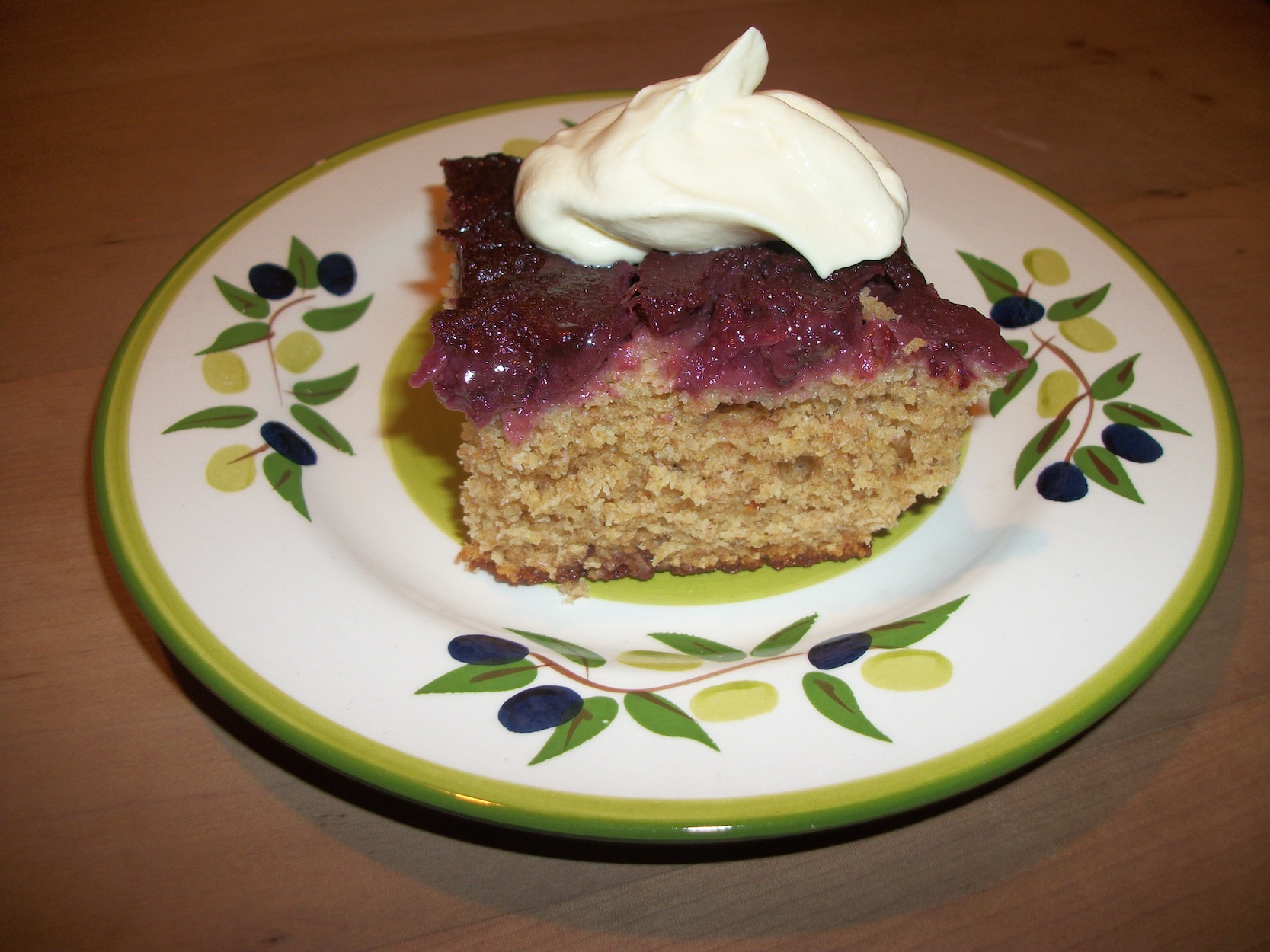
100_3609 smI don’t make it often, but I love upside down cake. Nectarines are possibly my favourite fruit in the topping, though pears and peaches are excellent, too. Really, how can you go wrong with butter and sugar-drenched fruit on top of cake?

At this time of year, the best I could do was a jar of black boy peaches that I put up over the summer, and that was just fine!

And with a bit of whipped cream left over from pumpkin pie the other night…hard to beat!

PV=nRT

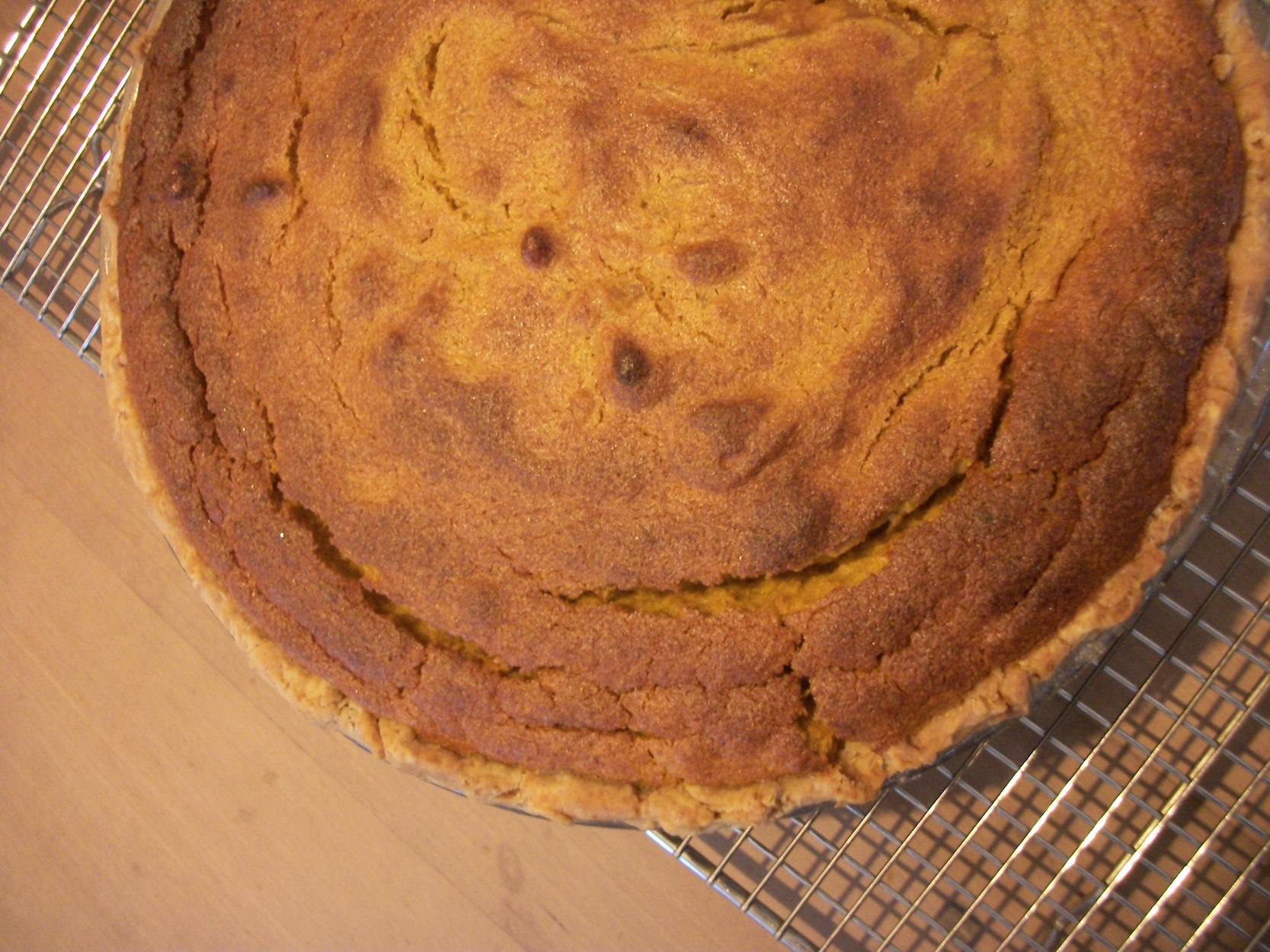
100_3593 smAnything can become an occasion for a science lesson in our house (much to our children’s dismay, I’m sure). Today it was pumpkin pie.

The pumpkin pie recipe I use has stiffly beaten egg whites in it. So, of course, it puffs up dramatically in the oven, coming out looking like a great big orange pillow. As it cools, it falls.

It’s the perfect physics lesson to explain the Ideal Gas Law! And my daughter fell right into it when she asked, “Why does it puff like that?”

If you’re not familiar with the Ideal Gas Law, here it is:

PV=nRT

Where P=pressure, V=volume, n=amount, R=ideal gas constant, and T=temperature of the gas.

From this equation, we can clearly see that, as the air in the bubbles of egg white heats up, the volume of the air will increase (assuming, of course that the bubbles themselves can expand and maintain a relatively constant pressure, which egg white does beautifully), causing the pie to puff. As it cools, the air decreases in volume, and the pie falls.

Proving that understanding thermodynamics is easy as pie!

Strawberry Banana Smoothies

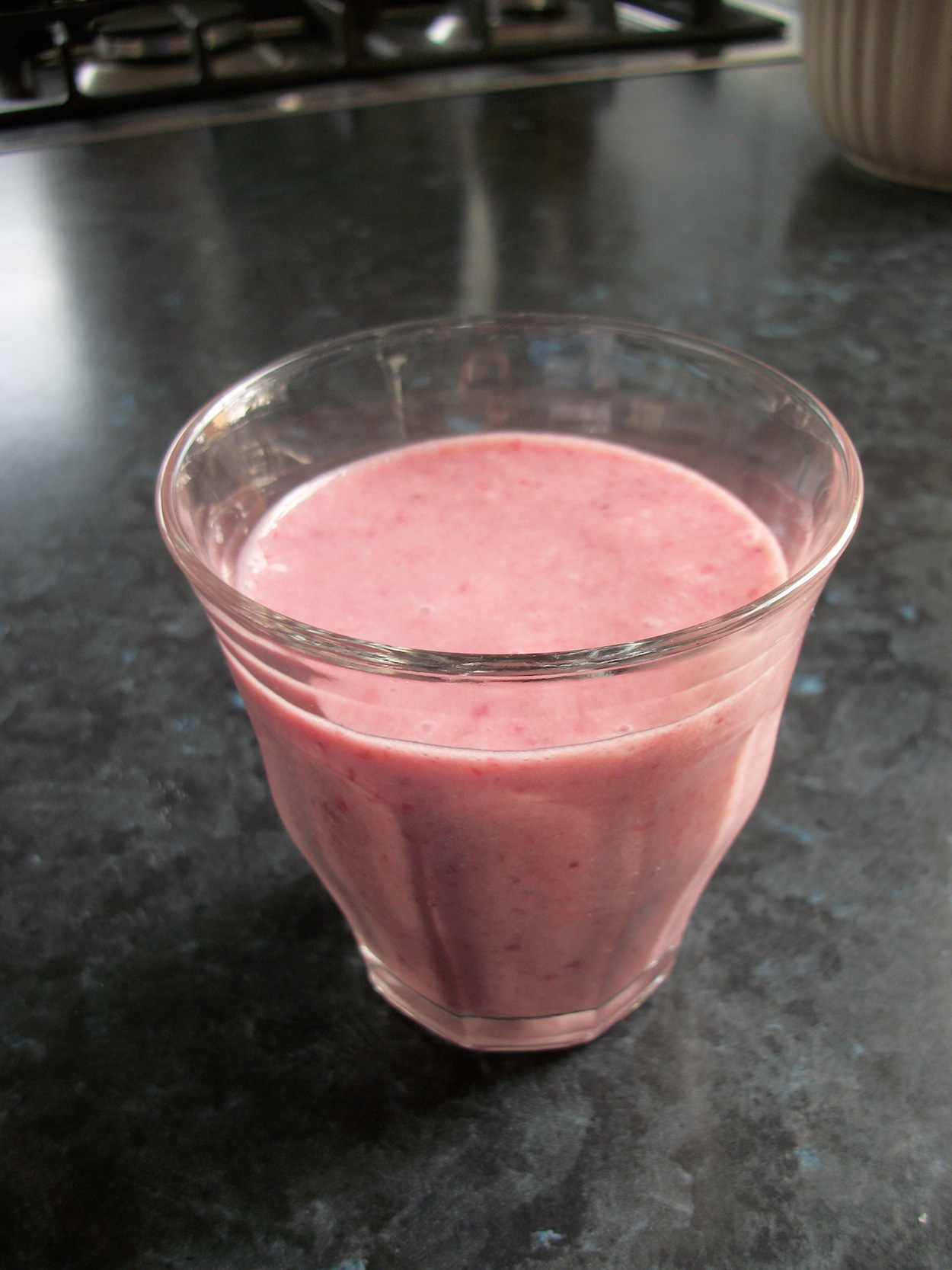
100_3588 smI found another excellent way to use my frozen strawberries today—smoothies!

I make a lot of strawberry smoothies during strawberry season—they are the after-school snack of choice at that time of year—but have never used frozen berries before. After trying it today, I’ll have to make sure I freeze more berries this year!

I had a couple of overripe bananas today, so I figured I’d throw them into the mix, too. The result was delicious! Here’s my recipe. The amounts are approximations—I never actually measure anything for smoothies.


For 4 servings (or 3 very generous ones), place in a blender:

3-4 cups strawberries (mostly thawed if frozen)

2 bananas (broken into pieces)

2 Tbsp honey

¼ tsp vanilla

Pour in milk until it covers about three-quarters of the fruit.

Blend until smooth and frothy.

Enjoy!


Cinnamon-filled Scones

Lucky I managed a photo before they were all eaten!

Lucky I managed a photo before they were all eaten!

These are arguably the family’s favourite breakfast scone. They take longer to make and to bake than my usual scones, so I make them up the night before and put them in the fridge. In the morning, all I have to do is toss them in the oven. Though I haven’t tried it, the oat/whole wheat dough would go great with a jam filling, too!

Filling:

1/3 cup brown sugar

1 ½ tsp cinnamon

1 Tbsp all-purpose flour

3 Tbsp (40 g) very soft butter (almost, but not quite melted)

Stir together the above ingredients until they form a spreadable paste. Set aside.

Dough:

1 cup oat flour *

1 cup whole wheat flour

1 cup all-purpose flour

¼ cup brown sugar

1 Tbsp baking powder

½ tsp salt

1 ½ tsp cinnamon

½ cup (125 g) cold butter

1 egg

1 cup milk **

1 tsp vanilla

Mix the flours, sugar, baking powder, salt and cinnamon in a large bowl. Cut in the butter with a pastry knife until it resembles coarse crumbs.

Whisk together the egg, milk, and vanilla. Add this mixture to the dry ingredients, and mix just until the dough comes together.

Divide the dough in half. Knead each half gently, then pat each into a 9-inch round. Place one round into a lightly greased 9-inch round baking pan. Spread the filling on top. Place the second round of dough on top of the filling and press gently to remove air pockets.

Cut the scones into 12 wedges, and bake at 375°F (190°C) for 40 minutes, until brown and firm in the centre. Allow to cool 5-10 minutes before removing from the pan.

Eat immediately…or someone else will beat you to them!

* You can make your own oat flour by grinding rolled oats in a food processor for about 30 seconds.

** For Cinnamon/Pumpkin scones, use ¾ cup of cooked, mashed pumpkin and ¼ cup milk. If the pumpkin is dry, you may need to add a little more milk.

Klim Diplomacy

Kitchensm

All the kitchen you need for making ricotta!

I ran across this lovely article about unofficial Peace Corps cookbooks, and it brought a smile to my face.

There was no Panama Peace Corps cookbook when my husband and I were there, but there were plenty of recipes shared in the Peace Corps newsletter. I still have a few of them—ragged pieces of paper torn from the newsletter, smelling ever so faintly of mould.

The best Peace Corps recipe ever was for ricotta cheese made with powdered milk.

Fresh milk was impossible to come by in our village, as there was no electricity, and hence no refrigeration. Dairy of any sort just wasn’t part of the diet. But you could buy cans of powdered milk (marketed by Borden as Klim…the most uncreative name ever).

Today, with my goat milk, I am quite precise with temperature when I make ricotta, but the Peace Corps recipe was written for the Volunteer cooking over a three-rock fire with nothing more than a pot and a spoon.

The recipe went something like this:

Mix up two litres of milk from powder.

Heat to just below a boil.

Add ¼ cup of vinegar.

Skim off the cheese curds as they form.

This little recipe made surprisingly good ricotta, even from powdered milk. With it, we managed lasagne, pizza, and all manner of other cheesy treats over our little fire. It was a delightful break from unending days of rice and yuca.

Excited by our ability to make foods from home, we shared our pizza with the neighbours.

They thought it was disgusting.

But we all laughed and enjoyed the chance to talk about and compare our different cultures and cuisines.

One of the goals of Peace Corps is to foster understanding and exchange between cultures. Food is an important part of that exchange for all Peace Corps Volunteers. Even when the various parties can’t agree on what tastes good, food opens dialogue, it makes people smile, it is a common language.

Perhaps the world would be a more peaceful place if we all tried a little Klim diplomacy.

Seasons of Garlic

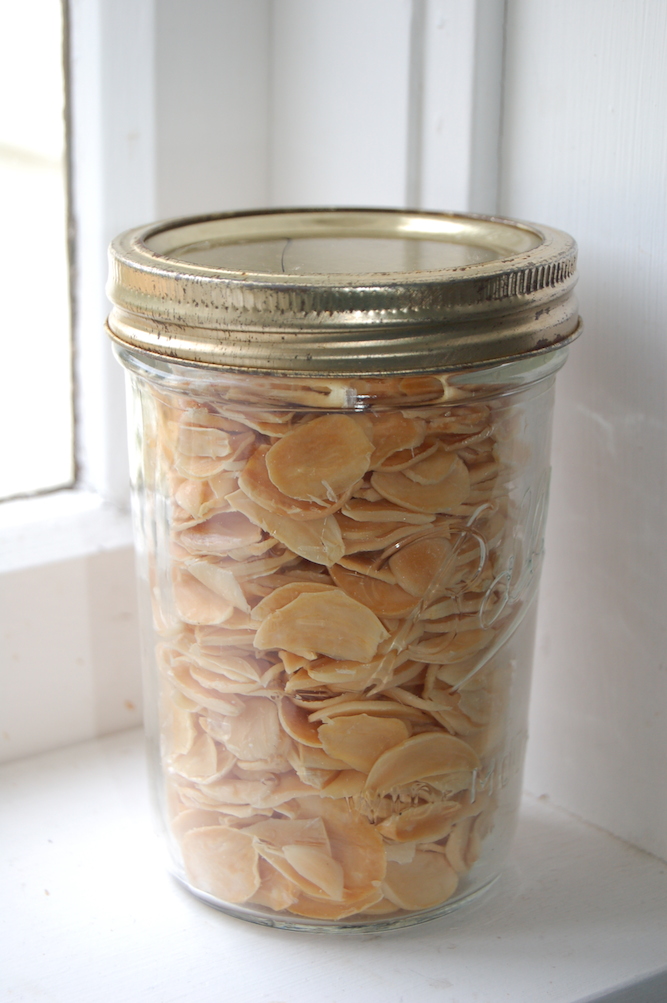
15 heads of garlic, all in one pint jar!

15 heads of garlic, all in one pint jar!

The garlic I planted on the winter solstice has taken advantage of the recent rain. It is now 5cm above ground, and looking great!

Of course, when the garlic in the garden starts sprouting, so does the garlic stored in the shed. And once it starts sprouting, its flavour goes off. The goats will still eat it (they seem to love garlic, and the local breeders feed it to them to help fend off intestinal parasites), but it’s not very tasty to the human palate.

So it’s about this time of year when we switch to using the garlic we dried at harvest time. The thin slices grind well in a mortar and pestle, and are easy to use. Though they aren’t as good as fresh garlic, they’re much better than sprouted garlic, because they were dried at peak freshness.

We’ll use this dry garlic until we can start harvesting the first immature new heads around Christmas. But as spring comes on, and the winter-planted leeks and the spring onions begin to be harvested, we naturally start using more of these fresh members of the onion family and less garlic. There will almost certainly be dry garlic left when the new heads start coming in. But that’s okay—the goats like dry garlic, too!