Mum’s Fluffy Buns

Mum's fluffy buns1smWe don’t ever buy bread; Ian bakes all the bread we eat…well almost all.

Most of the bread Ian bakes is sourdough. Wonderful, hearty, wholegrain stuff with dark, beautiful crusts. The kind of bread you want to eat, slathered with butter, for a late-night snack. Unfortunately, this toothsome bread makes lousy burger buns. It has too much body, doesn’t give enough under the teeth. The burger ends up squishing out the sides of a bun made of Ian’s sourdough.

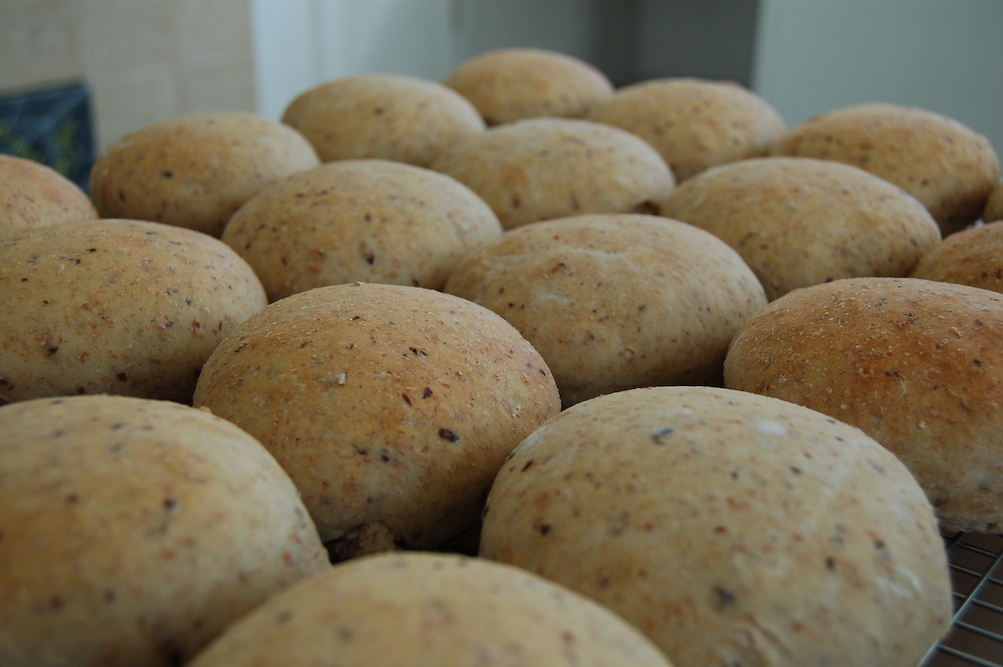
Which is where Mum’s Fluffy Buns come in. This is what the children call my light and soft burger buns. Still whole grain, but made with commercial yeast, and baked only until the centres are done. They are soft and yielding—perfect for burgers.

I wish I could give you a good recipe for them, but I don’t follow one, and I tend not to measure the ingredients I put in. Here’s a rough approximation. This yields enough buns for several meals—they freeze and reheat well. Of course, they don’t last long if they’re left out—the kids love snacking on them.

4 cups lukewarm water

scant tbsp yeast

scant tsp honey

1 ½ tsp salt

2 tbsp ground flax seed

2-3 tbsp (25-40 g) butter

bread flour (high grade)

whole wheat flour (wholemeal)

Dissolve yeast in the warm water and allow to proof. Add honey, salt, butter and flax and stir until the butter is mostly melted. Add equal quantities of whole wheat and bread flour to make a dough of the right consistency for bread. Turn the dough out onto a floured surface and knead about 10 minutes, until the surface springs back when touched. Work into a neat ball, and place in a greased or oiled bowl. Cover with a damp towel and allow to rise about 2 hours. Punch down and divide into pieces of about 100-110 grams (about 3 ½ oz). Work each piece into a neat ball and flatten onto a greased baking sheet. Cover with a damp towel and allow to rise as the oven heats. Bake at 210°C (400°F) until just barely beginning to brown (maybe 15 minutes).

The Harvest Hangover

The morning after

The morning after

I woke this morning with a headache. It was one I recognised—the Harvest Hangover. It’s a combination of fatigue and dehydration that comes after a day of picking and preserving vegetables.

Back in the years B.C. (Before Children), I used to lose 10 pounds during harvest season. I’d forget to eat and drink as I picked and processed mountains of tomatoes, zucchini, eggplant, beans, etc. Ironic, eh? After a night of canning, I’d wake with a Harvest Hangover. I’d stumble to work grumpy and groggy, as though I’d been out carousing all night.

As I age, I’m more moderate in my preserving. Instead of weeks of late-night canning sessions, I do two or three a year. It helps that I can’t grow the quantity of tomatoes I used to during the hot summers in Pennsylvania, but I’ve also rationalised my preserving. Here, where winters are mild, I can grow cool-weather crops year round, so winters aren’t the fresh vegetable desert they are in a harsher climate. If I don’t have 50 quarts of tomatoes in the cupboard for winter, it doesn’t matter—we can eat something else instead. I preserve only what I know we’ll eat, so I’m not throwing away old canned goods every summer. I’ve learned to better manage my planting so that I’m not completely overwhelmed with any one crop (usually). And I allow myself to simply give away extra produce when I am overwhelmed.

Perhaps it’s a sign of aging that I don’t wake with Harvest Hangovers very often any more, but I like to think of it as a sign of wisdom. As they say, know your limits!

Summer Soup

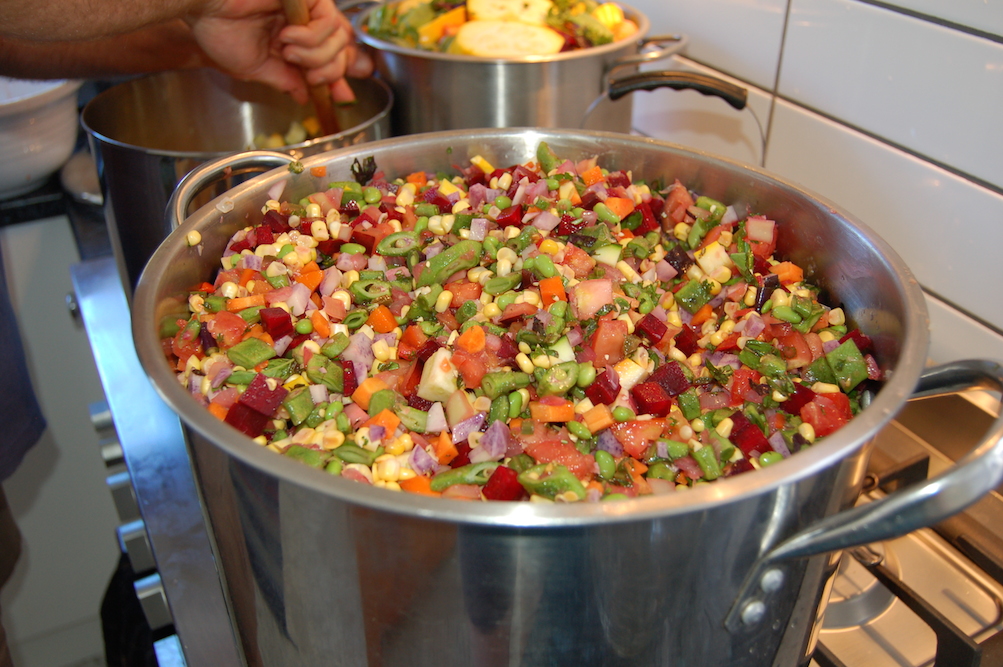
There’s no set recipe, but this year it went something like this…

After a hearty breakfast, assemble the family. Equip half with knives and cutting boards in the kitchen. Send the other half to the garden with buckets, colanders and knives to pick vegetables and ferry them in to the cutting crew. Pick and chop the following:

1 head garlicDSC_0027 copy

12 ears sweet corn

7 onions

8 sweet peppers

8 jalapeño peppers

5 Thai hot peppers

3 large beets

12 carrots

3 cups fresh shelled soy beans

8 stalks celery

8 quarts tomato

10 bay leaves

3 cups herbs (basil, parsley, rosemary)

8 cups green beans

12 small boiling potatoes

5 medium zucchini

5 oyster mushrooms

As you chop, put all the good stems, peels, and over mature vegetables into a pot. Top with water and put on a back burner to simmer for stock.

Take a break for lunch, then send the kids outside to play.

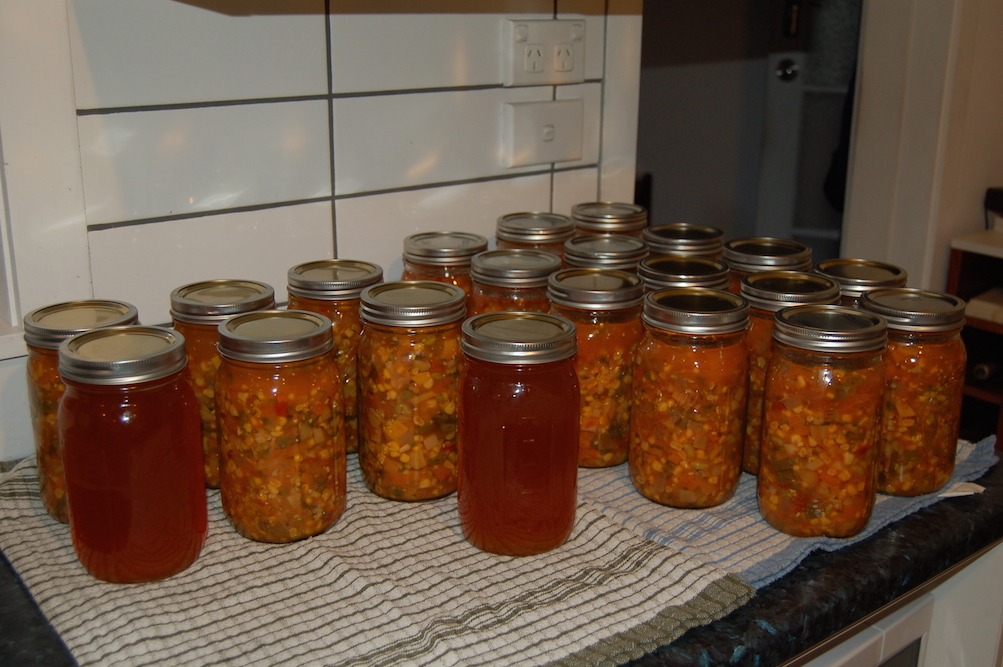
DSC_0035 copyIn an enormous pot, sauté onion, peppers and celery until onion is translucent. Add garlic and cook another couple of minutes. Add remaining ingredients and enough water to call it soup. Bring to a boil. Meanwhile, prepare 24 quart jars and the pressure canner.

Separate off enough soup for dinner. Boil the rest 5 minutes.

Send your husband outside to play.

Pressure can the remaining soup. Strain the stock and can it, alongside the soup. Plan on 4 canner loads. While the third batch is in the canner, reheat the soup for dinner.

Sit down to soup for dinner, but don’t forget to keep an eye on the canner.

While the last batch is processing, pour a glass of wine, and blog.

Almost done...just a few more jars in the canner.

Almost done…just a few more jars in the canner.

Pull the last batch out of the canner at 9.30 pm.

Go to bed and dream of all the wonderful canned summertime lined up in jars in the kitchen, waiting for those dark winter days when everyone comes home late and hungry.


Changing Perspectives

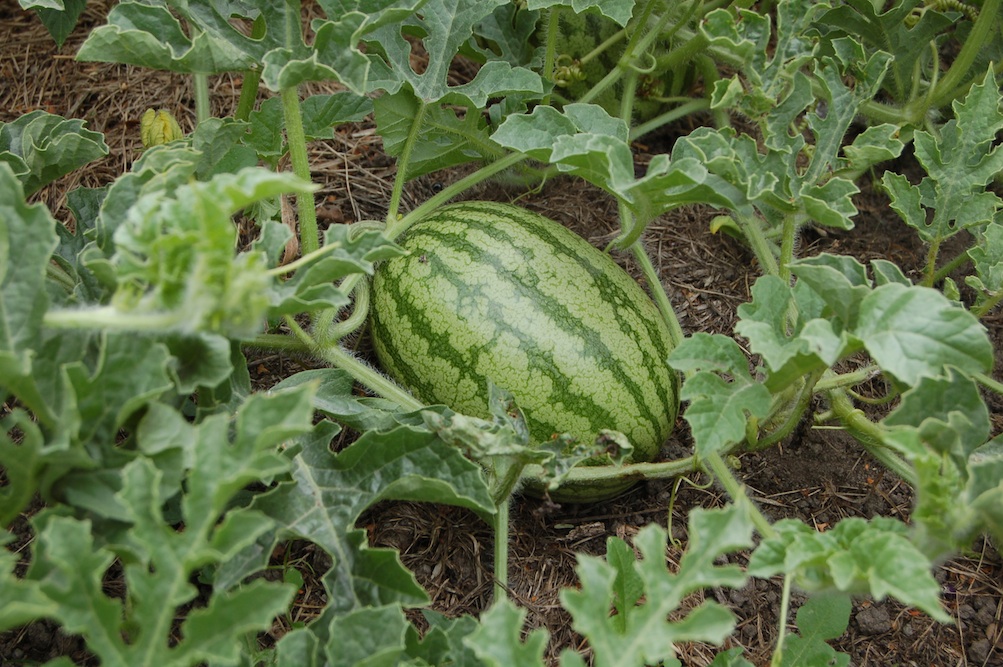
DSC_0019smWhen I first mentioned to a neighbour years ago that we were enjoying home grown watermelon, she was incredulous.

“Watermelon!? In Canterbury?!”

It’s true, melons are a hit-and-miss crop here. Summers are just too cold for these heat-loving plants. My first attempts were mediocre at best—we were lucky to get anything before frost killed the plants. Year after year, they failed. Since then, I’ve learned to start my seeds early in a heated room, and let the plants get nice and big before putting them out. They never go out into the garden until the end of November, and I try to tuck them into one of the more sheltered beds so they don’t have to deal with cold winds. With a bit of coddling, they do reasonably well.

Reasonably well for Canterbury, New Zealand, that is.

My standards for melons have changed dramatically in the last decade. If I were still gardening in North America, I would be sorely disappointed in my melon crop. The fruits are small and few—no giant rattlesnake watermelons or big fat cantaloupes here! Only the most rapidly maturing varieties give at all, and even on these varieties, most fruits don’t make it to maturity before the growing season ends.

But the few, small melons we do get are incredibly sweet and juicy. Even more so, because we shouldn’t be able to grow them at all here. Each one is a blessing and a marvel.

Milking in the Dark

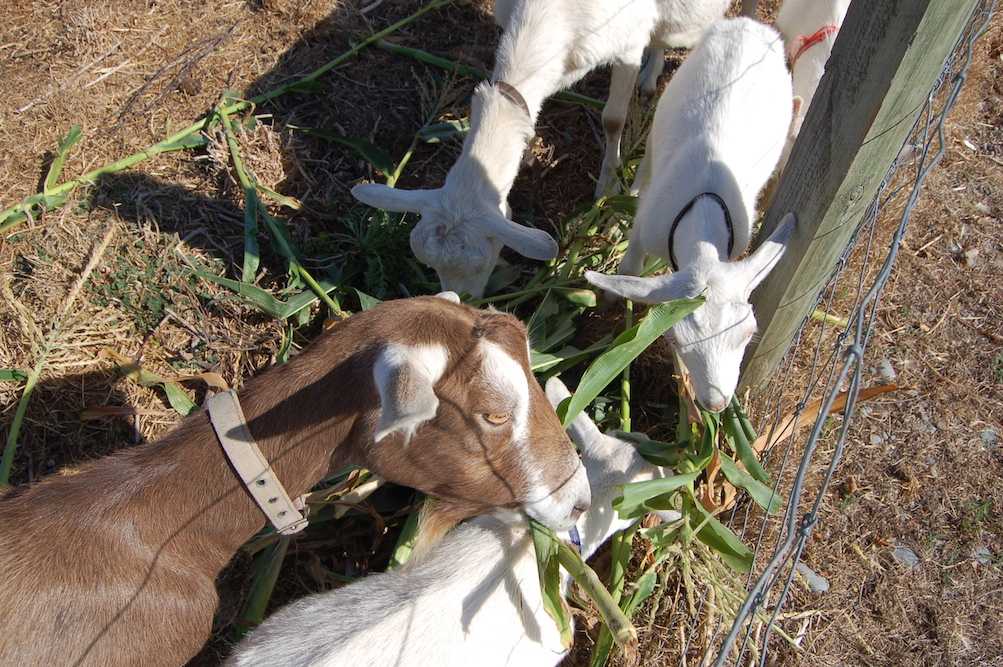
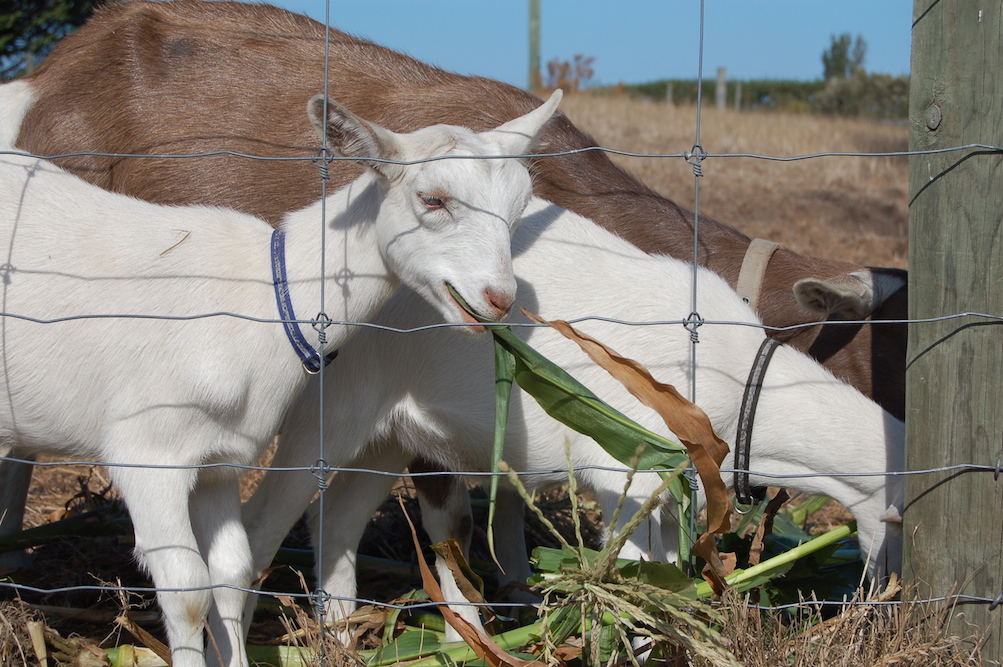
DSC_0012cropIt’s the time of year when milking gets difficult. The air is chilly, and it is still full night at 5:30 when I roll out of bed. I’ve already given up milking at 5—even I have trouble at that hour this time of year. If I start my day at 5.30, the sky is at least starting to lighten a bit by the time I finish milking and feeding the animals. In another week or two, I won’t even have that meagre consolation.

But there is something magical about stepping out the door in the pre-dawn darkness, the sky blazing with stars above, and no sound but the distant surf. Even the goats, who usually clamour for me every time they see me, are silent at that hour. They wait patiently for their turn on the milking stand, their turn to be fed. In the distance I can see the light from a neighbour’s milking shed, and I know I’m not the only one out in the darkness. While the neighbour works in the light and noise of a 60 cow rotary milking shed, though, I walk my goats one at a time to the solitary milking stand behind the shed. Weak light streams from the shed window—just enough to see the teats and the milking pail. I milk largely by Braille these mornings.

As I finish, and the eastern sky begins to lighten, a rooster crows in the distance, the neighbour’s peacocks mew. I stop for a moment on my way back into the house to admire the stars, listen to the sea. I won’t experience this stillness for the rest of the day; I need to savour it, store it up. When I step back into the warmth and light of the house, there will be a hundred frantic tasks waiting, and by the time I step back outside, the sun will be up, birds will be chattering in the trees, the goats will whine for attention, the neighbours will be passing back and forth on tractors, and the magic of the night will be gone.

And so I am thankful for this chore, the milking, that forces me out of bed and into the night, that I might have a moment or two of stillness in my day. Those brief moments are better than an extra hour of sleep any day.

Convergence of Chocolate

DSC_0001 smA few days ago, I made chocolate mint wafers—thin, heavily chocolaty refrigerator cookies with a hint of mint extract. Two days ago, Ian made chocolate ice cream. Yesterday, I discovered a small tub of leftover ganache from last week’s cake. What could we do but put them all together?

Gifts from the Soil

DSC_0001 smAccording to Wikipedia, the price of porcini mushrooms (Boletus edulis) ranges from $20-$80/kg in the U.S., though it’s been known to rise to over $200/kg (wholesale) in years when it is scarce.

Porcini is expensive because of its ecology. It is a mycorrhizal fungus, meaning it lives in association with the roots of plants. This is a mutualistic relationship—the plant provides sugar, and the fungus provides nutrients. Neither one can grow properly without the other. Porcini’s mycorrhizal partners are oak trees. In order to grow porcini, you have to grow oak trees, so it is difficult to cultivate. The result is that porcini is largely collected from the wild, and is subject to wide fluctuations in production.

Sitting down to a picnic lunch today (in a location that shall remain secret), Ian and I picked 730g of porcini. It’s very early in the mushroom season, and quite dry, so we were surprised to see it, though Ian regularly finds it nearby. Ian manages several hundred dollars worth of porcini foraging in the autumn, even calculated by the lowest prices. It’s a delicious and welcome gift that is overlooked by thousands of passersby.

Porcini is a firm and meaty mushroom. Strongly flavoured, a little can go a long way when it needs to. But in autumn when the porcini are fruiting, we need not skimp, and a meal can easily include half a kilo of mushrooms. I dry the excess for use over winter in soups and stews. It goes well with thyme and rosemary, and lends a deep earthy flavour to dishes.

So, thanks to whoever brought these two non-native organisms—oaks and Boletus edulis—to New Zealand. Their presence is a gift to our table.

Practice Makes Perfect

Tortilla1smIan shakes his head and rolls his eyes.

Nobody just whips out a batch of home made tortillas! Even Mexicans buy their tortillas.”

I shrug. It’s really not that big a deal, making tortillas. Although…thinking back to twelve years ago, when I was a novice tortilla maker, I’m inclined to agree. Back then, making tortillas always involved tears and curses. The dough ripped, stuck to the kitchen counter, and stuck to my rolling pin. The pan was always too hot or too cold, either burning or drying out the tortillas. Why I continued to try making them, I don’t know.

But I did. Again and again I tweaked my recipe, changed my rolling technique, adjusted the heat under my pan. Somewhere along the line, making tortillas changed from a once-in-a-while-when-I’m-feeling-particularly-brave sort of dish to a standard part of my repertoire. It changed so dramatically, that once I made over 100 tortillas for a party, and did so without breaking a sweat.

How many other foods once seemed unfathomably difficult or complex? I can think of dozens: risotto (stir constantly?), pizza (such advance planning needed!), anything Indian (all those spices?!), quiche (crust, and filling, and custard?!)…

It’s good to remember, sometimes, how difficult these “easy” things seemed long ago. It’s good to remember that how difficult something is to do is often simply a measure of how much you’ve practiced doing it. A few weeks ago, having endured yet another fondant icing disaster (see The Desolation of Smaug), I privately decided that fondant was too hard, and I would stick to my buttercream icing in future. But maybe I just haven’t made enough fondant. I don’t know if “practice makes perfect”, but it does make it easier.

Summertime Grilling

veggiesforgrilling2smThere’s nothing like a barbecue in summer. Now, you might think that vegetarians don’t have much use for a grill—you couldn’t be more wrong! Grilling is one of the best ways I know to celebrate summer vegetables. Add some corn on the cob or a fat slice of melon, and you’ve got a veritable feast.

One of the best things about grilling vegetables, is that they take very little preparation beforehand—big slabs of vegetable work best, so there’s no tedious chopping to do.

I’ll admit that grilling is Ian’s sphere, and what goes on after the vegetables are cut is his business. A few weeks ago, he wrote down the following recipe for the marinade he brushes on the vegetables before grilling:grillingveggies1 sm

Oil (~ 75% of volume)

Worcestershire sauce

Mustard (just a bit but essential)

Ketchup (not too much)

Vinegar (bit)

Cayenne

Soy sauce (fair whack)

crushed garlic

brown sugar (tiny bit to enhance flavour)

You can see by this recipe it’s an exact science…but never mind; whatever he does, works, and I’m happy to leave the grilling to him.

Bon appétit!

Sunday Morning Breakfast

DSC_0001 smI’m fond of breakfast. I usually wake ravenous in the morning, and by the time I get in from the daily animal care and milking, I’m more than ready to eat. My weekday breakfast is homemade muesli eaten standing up in the kitchen while I pasteurise the day’s milk. On Sundays, though, I take the time to make breakfast, and the whole family sits down together. I’ll admit right up front that I don’t do this out of some sort of altruistic love toward my family—I do it for purely selfish reasons. I love scones, biscuits, muffins, pancakes, and waffles. I would eat them every day for breakfast if it were at all practical or wise to do so. But it has also made for a wonderful family tradition that we all look forward to each week.

Today’s breakfast was peach oatmeal muffins. This recipe is a variation on Peach-Oatmeal Bread from King Arthur Flour’s Whole Grain Baking book. I’ve increased the spices and halved the sugar to create a muffin I consider healthy and yummy enough for a Sunday morning.


Peach oatmeal muffins


2 cups peaches, peeled and cut into small pieces (canned or frozen peaches work fine)

2 cups whole wheat flour

¾ cup all purpose flour

½ cup packed brown sugar

1 Tbsp baking powder

½ tsp baking soda

½ tsp salt

1 tsp ground cinnamon

¼ tsp ground nutmeg

¼ tsp ground cloves

1 cup old-fashioned rolled oats

2 large eggs

1 cup milk

¼ cup vegetable oil

¼ tsp almond extract

Place cut peaches into a strainer to drain. Stir together the flours, sugar, baking powder, baking soda, salt and spices in a large bowl. Add the oats and peaches, stirring to coat the peaches. In a separate bowl, beat together the eggs, milk, oil and almond extract. Add to the flour mixture and stir just until evenly moistened.

Scoop into greased muffin tins, and bake at 375°F (190°C) for 25-30 minutes, until a toothpick inserted into the centre of a muffin comes out clean, and the tops are lightly browned. Allow to cool in the pan for 5 minutes before turning out.

(makes about 18 muffins)