Planning the Next Novel

While I wait for my beta readers to read Fatemaker, I’ve been planning the sequel to Demonic Summoning for the Modern Woman. I’ve spent a lot of time the past two weeks staring off into space while I think, researching really weird things, and taking long walks while I sort out ideas.

I do my planning on paper, with a pencil, because it helps my creativity.

I’ve learned a lot about planning a novel since I made my first, aborted (and truly dreadful) attempt at one. 

I’m definitely a planner, rather than a pantser when it comes to writing novels. I find writing the first draft difficult, and have learned that the better I plan, the easier the first draft is to write. I thought I had a pretty good system in place, but when I sat down to write Fatemaker I found my planning completely inadequate, because there were so many threads to draw together in the final book of an epic fantasy series. So I wrote a chapter by chapter plan of the book, summarising what had to occur in each chapter in order to wrap up everything by the end of the book. It probably took a week to create that summary, but by the end of the week, I had a detailed guide for my story, and I could focus on it chapter by chapter as I wrote, without worrying that I was forgetting something. I wrote the first draft in three weeks, rather than my usual six to eight weeks.

So I’m following the same process for the second book of the Rifton Chronicles, even though this book is not overly complex. Hopefully it will make the first draft fly onto the page.

My current planning process looks like this:

  1. Develop the basic premise for a book.
  2. Establish the world in which the story will take place. This includes creating a timeline of any historical events that impact on the story and details of any magic systems I’ll use.
  3. Develop the characters who are best suited to be my protagonists and antagonists. This includes not only their personal background, but also their ancestry, relationships, strengths, weaknesses, and habits. I never concern myself with physical characteristics unless they have a direct bearing on the plot. If you asked me what my characters looks like, I couldn’t tell you.
  4. Create a 1-page outline of the major plot points. Usually I do this in the form of a story mountain—yeah, primary school stuff, but it works for me. This outline includes key events—inciting incident, try-fail cycles, climax and conclusion, and puts them all on a specific timeline, so I know details like what season it is when I am writing.
  5. Determine the story arcs of each of the main characters. Usually this is a couple of paragraphs per character, which I add to the character descriptions.
  6. Write the blurb. I know this seems counterintuitive—how can you write the blurb before you’ve written the story? I used to struggle writing blurbs, because there were so many story details in my head, I didn’t know what to highlight in the blurb. The blurb needs to convey the genre, conflict, and just enough detail to hook readers into picking up the book. I’ve found it is MUCH easier to write this when that’s all I know about the book. When I’m not sick of the bloody story after weeks of writing, months of editing. When the story is still as shiny and new to me as it will be for potential readers. It also gives me a touchstone as I’m writing and editing—am I delivering what I said I would in the blurb? Is my story still conveying the awesome ideas I started off with?
  7. Write a chapter by chapter summary of the story. I know my books tend to run about 30 chapters, so I divide the story into thirty chunks, then start placing the major plot points and filling in the details. When I did this for Fatemaker, I had a couple of blank chapters near the end, but also had the feeling some of the chapters were going to need to be split into two once I started writing. In the end, I had 34 chapters, so it deviated a bit from my plan, but only in volume, not substance. For the second Rifton Chronicles book, I know I will have six historical ‘interludes’, so I’ve spread these evenly through my chapters, and am building the modern part of the story between them.

Oh, yeah, and there’s the staring off into space, researching bizarre things, and taking walks—those are critical components of every step in the planning process.

Baking Disaster

A rainy weekend, an empty cookie jar … why not try out a new cookie recipe? 

In general, I love the recipes in King Arthur Flour’s Whole Grain Baking book. So I thought I’d try a new one—a cookie recipe called All Oats All the Time. 

It’s an intriguing recipe with ground oats and nuts instead of flour. It’s also pretty low in fat, for a cookie.

My first warning was the texture of the dough. It was quite wet. I re-read the recipe to make sure I hadn’t forgotten any ingredients—nope, everything was in there. Still I hesitated—should I add a little flour?

No. King Arthur recipes are good ones—this would be fine. I carried on, dropping teaspoons of dough onto my greased cookie sheets. 

Five minutes in the oven, and I knew I had a problem. The cookies had spread into one another. Not horribly, but creating the thin edge, thick centre combination characteristic of a dough that’s simply too wet.

Okay, fine. They wouldn’t look nice, but they’d be okay.

I pulled them out of the oven before those thin edges burned. The recipe said to let them cool five minutes on the pan before removing them. Once again I hesitated. Would those thin edges lift off after five minutes?

Once again, I went with the recipe. 

After five minutes, those cookies were virtually cemented to the pans, and they’d turned super crisp, so the moment you managed to wedge the spatula under one, it shattered.

I experienced a moment of despair, thinking I was going to spend an hour chipping inedible cookies off the pans, and then scrubbing the pans until all that baked-on gunk was gone. But then I thought of cheesecake crust, and how these crumbly cookies would make a lovely crust, or maybe a fruit crisp topping. And once I no longer cared if the cookies crumbled, it was a snap to scrape them off the pans. The pans came clean easily after a short soaking. 

On Monday, I picked up the ingredients for cheesecake and made little cheesecake cupcakes using my crumbled cookies in a crust, with a little sprinkling of crumbled cookie on top. The results are pretty darned good—certainly better than the original cookie alone.

I’ve still got a fair bit of crushed cookie left—it has gone into the freezer for use in some other interesting way.

So maybe the cookies weren’t such a disaster after all.

Matariki Lights

Photo by Klemen Vrankar on Unsplash

On the eve of Matariki, I woke to an empty house, which meant I didn’t have to tiptoe around being quiet until my husband woke. 

The morning being dark and cold, I decided to start the day with music, and because we’re so close to Matariki and the promise of longer days to come, I searched up music with the word light in the title.

So my day started with Phil Collins’ song, Dance Into the Light, Lorde singing Green Light, Light (My Time Has Come) by Madison Ryann Ward, Nu Aspect’s Light, and One More Light by Linkin Park.

What a great way to start the day, to start the new year, to celebrate all that has passed and all that is to come.

Whatever your plans for celebrating Matariki this weekend, I hope it is full of the light cast by people you love and things that make you happy. 

And as I look forward to the coming growing season, the challenges and opportunities that the coming year has in store, I’m going to try to inject more music into my mornings.

So come on, dance into the light with me. Here’s a little poem I scribbled down on the solstice—it’s equally pertinent for Matariki.

On the darkest day
We turn to the light,
Hope for a ray to warm our cheek.

On the darkest day
We look to the stars,
Imagine constellations
To guide our stumbling steps.

On the darkest day
We light a fire,
Praying the kindling
Is still dry.

On the darkest day
We gather our whānau,
Tell stories of sunlight.

On the darkest day
We find comfort in the night,
In the slow circle of the seasons,
The dance of faraway suns
Across a black sky.

On the darkest day
We recall deeds of light,
Sun-dappled paths,
And warm sand.

On the darkest day,
Even on the darkest day
There is light.

Butter, Butter … and more butter

I checked out a cookbook from the library last week called Butter, Butter, by Petra Galler. I was sold on it before I even opened the book—the subtitle is ‘Sometimes more is more.’ The photography is dark and sensual, with lots of dripping honey, and hands smeared with berries and icing. Who could resist?

Indeed, I’ll be looking for this book next time I’m in the bookstore—it’s one I’d like to have on hand permanently, not just for a few weeks.

I want to try everything in this book. Petra is a Jewish New Zealander, and her recipes combine traditional Jewish dishes with modern Kiwi flavours in a way I find intriguing.

Yesterday I tried her recipe for Mandelbrot, a twice-baked cookie similar to biscotti, but higher in fat, so it has a more delicate texture. 

As you would expect from a book titled Butter, Butter, these cookies are rich—full of butter, eggs, nuts, and chocolate. Although they take some time to make, they’re not difficult, and the end result is beautiful and delicious.

I haven’t had a chance to make anything else from this book yet, but next on my to-bake list is Tahini Shortbread with Salted Chocolate Ganache, then Almond Butter Brownies, then Miso and Roasted White Chocolate Cookies, and then … Seriously, I need to go purchase a copy of this book. You do too. Here’s the Mandelbrot recipe, but don’t stop there. Buy the book. And a few blocks of butter …

390 g plain flour
2 tsp baking powder
1 tsp flaky salt
1 1/4 tsp ground cinnamon
1/4 tsp ground nutmeg
245 g butter, melted and cooled
200 g caster sugar
2 tsp vanilla paste
1/4 tsp almond extract
zest of 1 lemon
zest of 1 orange
3 eggs
180 g dark chocolate, roughly chopped
100 g walnuts, roasted and roughly chopped

For dusting:
30 g caster sugar
1/4 tsp ground cinnamon

In a medium bowl, combine all the dry ingredients, mixing well.

Place the butter, sugar, vanilla, almond extract and zests in a large bowl and whisk with a mixer until combined. Add the eggs one at a time and mix until thick and pale; about 2-3 minutes.

Working by hand, gently fold the dry ingredients into the wet until just combined. Add the chocolate and walnuts, and mix well. Cover the bowl and refrigerate 1-2 hours until firm.

Preheat the oven to 175℃ fan-bake. Grease a large baking sheet.

Turn the dough out onto a lightly floured surface and divide into two pieces. Form each piece into a log about 33 cm long and 5 cm wide. Place on the prepared tray and bake for 25 minutes.

Allow to cool for 10-15 minutes. Reduce the oven temperature to 130℃ fan-bake. Then cut the logs diagonally into 2 cm thick slices. Sprinkle both cut sides with the cinnamon/sugar mix, and bake them, cut side up for 20 minutes. Flip the slices over, then bake another 20 minutes. 

Allow to cool completely on the pan.

Winter’s Gift

Here in the dark part of the year, the lack of daylight can be depressing. Rise in the dark, eat breakfast in the dark, have a few hours of light, then eat dinner in the dark, go to bed in the dark … And even during the day, shadows are long, and the frost lingers in every chilly pocket of the yard. The trees across the road cast shade on my office windows for much of the day, so even the sunny side of the house can feel dark.

But the low angle of the sun in winter comes with its own beauty. While my office is mostly shaded, the trees don’t provide complete shade. Shafts of sunlight track across my office as the sun moves. An antique chandelier crystal my husband bought me years ago catches the sun’s rays and fills my office with thousands of rainbows that appear and disappear throughout the day, shimmering on the white walls and ceiling and splashing across the floor. 

In summer, the sun is too high to hit the crystal—it’s shaded by the eaves. I could hang the crystal lower, so it made rainbows all year, but I like to think the rainbows are winter’s gift to me. They’re something to look forward to during these short days.

Tamariki Book Festival

I have started and not finished about a dozen blog posts in the past three weeks. The reason? I’ve been organising the Tamariki Book Festival, which is on tomorrow in the TSB Space at Tūranga in Christchurch.

A fabulous lineup of local authors who write everything from picture books to young adult novels will be running activities and selling books. It’s a great way to kick off the school holidays!

I hope to see you there, and I promise I’ll get back to regular blogging once I’ve had a good long sleep.

Tamariki Book Festival!

I’m thrilled to announce that the Tamariki Book Festival is back again this year after a 3-year Covid hiatus. This year, we’re running it in conjunction with KidsFest, and once again we’re holding the festival in lovely Tūranga, Christchurch’s central library.

Tamariki Book Festival brings children’s authors and illustrators together in a fun festival atmosphere. Kids of all ages can meet authors; do crafts, games and other fun activities; and discover new books.

We’ve got some fabulous authors and illustrators lined up. We’d love for you to join us:

Saturday 1 July, 11 am – 4 pm
TSB Space, Tūranga
Christchurch

Entrance is free and no registration is required. However, if you register, we’ll send you a reminder so you don’t miss the date.

Fruity Experiments

The freezer is packed with early summer fruits—raspberries, gooseberries, red currants, and black currants. Seriously, if we don’t make a good effort to eat it, we’ll still have fruit left when summer rolls around again.

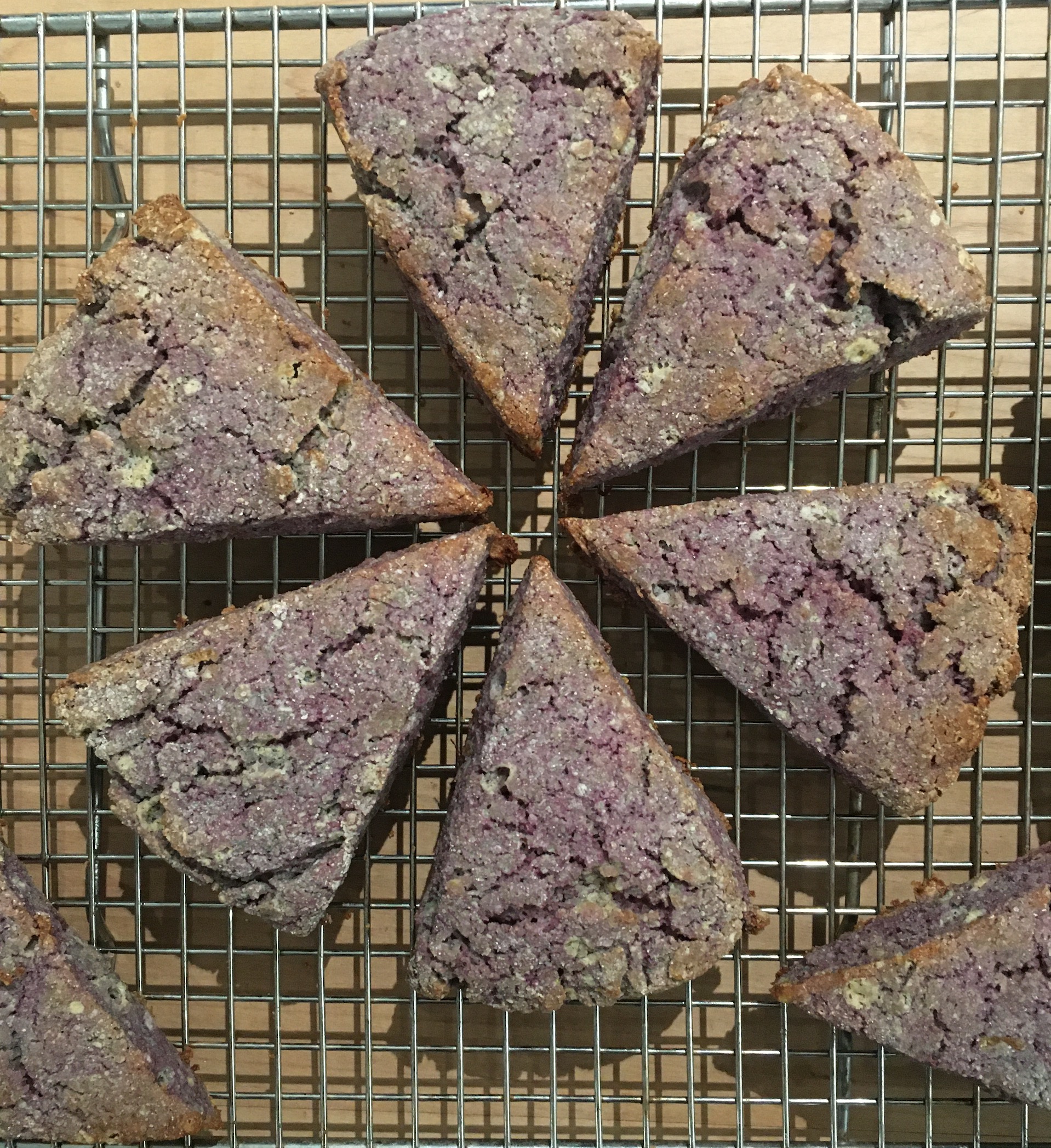
Black currant scones before baking–colour unusual, but okay…

So I’ve been experimenting with new and interesting ways to incorporate fruit into baked goods.

Two weeks ago I made a cookie bar that is supposed to be filled with chocolate fudge. I filled it with black currant puree instead, making a wonderful tart-sweet flavour bomb.

There was thawed black currant puree left over from the bars, so for Sunday breakfast I took my favourite lemon barley scone recipe (which I’ll have to blog about someday …) and substituted black currant puree for the liquid ingredients. The results were … mixed.

The flavour was good, but of course I love black currant, so I expected that. The colour, on the other hand, was more of a conversation piece than a bonus—dingy purple. The scones didn’t rise as well as they usually do either, and the texture was heavier than I would have liked.

So I’d say the scone experiment was inconclusive and needs more testing.

Black currant scones after baking–colour a bit disturbing…

I also made raspberry crisp and lemon pound cake studded with red currants over the past two weeks, and these were resounding successes. They, too, require replication.

And there’s plenty more fruit for additional studies! I don’t think it will be too much of a hardship to work our way through the frozen fruit.

Do I have to eat it?

Nance is a small yellow fruit popular in Panama. When my husband and I first arrived there, chicha de nance (a drink made from crushed nance fruit) was something we could barely choke down out of politeness to our hosts. The flesh of nance fruits is oily, gritty, acidic, and has a funky cheesy flavour. If you think too much about it, chicha de nance is reminiscent of watery vomit.

So you’ll understand why we didn’t like it.

But during nance season (and for several months afterwards, because people store it in bottles of water—yeah, don’t even think about what grows in those bottles) it’s impossible to avoid nance. Everyone you visit serves chicha de nance. Neighbours give you bottles filled with nance fruit.

You learn to drink it without grimacing. Before long you’re drinking it without even thinking about vomit. It’s a slippery slope from there, and next thing you know, you’re looking forward to nance season and wondering if you can trade some eggs for a bottle of nance from your neighbour.

I’m thinking about nance today as I contemplate the feijoas dripping from our tiny feijoa bushes. This is the plants’ first year producing fruit and I am amazed and a little terrified at their productivity.

I’m terrified because I hate feijoas. I don’t even like the smell. Simply walking past the fruit bowl when there are a few ripe feijoas in there makes me wrinkle my nose in disgust. I find it hard to breathe around them. Eating one makes me shudder—I swallow quickly to avoid tasting it too much.

Fortunately for me this year, my husband has been keeping up with the feijoas—he loves them. But those feijoa bushes are only going to get bigger. Next year I will have no excuses—I’ll have to eat them. 

So I’m thinking about nance. If I could learn to love a fruit that tastes and feels like vomit, surely I can learn to love feijoas, right?

They say a child needs to try a food up to 15 times before they’ll eat it. That’s a lot of feijoas …