One of the first things we did when we bought our new property, even before we built the house, was to establish native plantings. Those plantings have grown spectacularly well, and many of the trees are four metres tall already.
Invertebrate life on the property has increased with the growth of our gardens. Our lush akeake attract katydids, the herb garden is alive with butterflies, native bees, and hover flies. Preying mantids stalk the flowers, snatching up prey. Jumping spiders of several species prowl among the foliage and rocks. And web-building spiders festoon the branches of nearly every plant.
But there are some notable absences. Species that aren’t good at dispersal.
One of those absences is stick insects. Our common native species here in Canterbury are particularly fond of kānuka and mānuka. The kānuka we planted in our gardens has grown beautifully, but is completely devoid of stick insects.
But not for long …
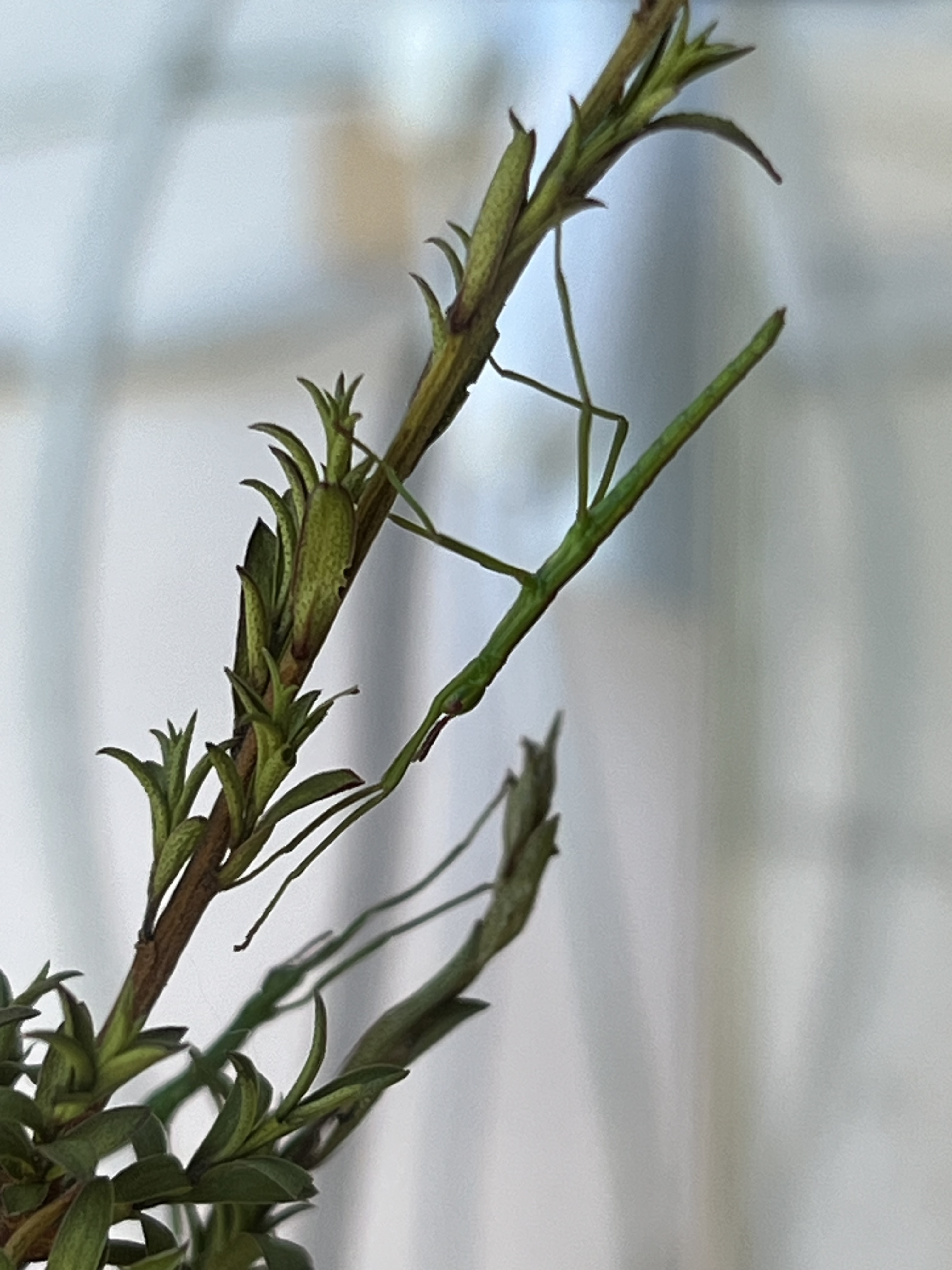
I was recently gifted some stick insect eggs from a researcher who is studying them. I set them up in an aquarium with some kānuka branches and eagerly awaited their hatching. The researcher warned the eggs were a bit old and might not hatch, but over the course of a few days, seven successfully emerged (a few more died in hatching).
The seven stick babies are now happily munching kānuka in captivity. I’ll release them into our garden when they’re a little older and I’m more confident they’ll survive. For now, I’m enjoying watching them in their tank on my desk.
Stick insects are some of my favourite bugs. I love their improbable shape. I love their crypsis-enhancing behaviours—sitting with their forelegs stretched out in front to make them look even more stick-like, and swaying in the ‘wind’ when disturbed.
I also love the fact that many species are parthenogenic—the females can lay fertile eggs without mating with a male. In fact, there are some species of stick insect for which we’ve never found males.
This parthenogenesis is the result of a strange relationship many insects have with the reproductive parasite Wolbachia. Wolbachia is a genus of bacteria that is passed from female insects to their offspring. Because Wolbachia’s spread is only through the females of its host species, it’s in the bacterium’s best interest to eliminate males. It does this by a variety of methods, depending upon the strain of bacteria and the host species. The result is insects in which males are rare or nonexistent and females can reproduce parthenogenically. Its a cool and complex relationship that I find fascinating.
I look forward to establishing stick insects on our native trees. Hopefully my seven lovely babies will grow into a thriving population.
Discover more from Robinne Weiss
Subscribe to get the latest posts sent to your email.
 Robinne Weiss