Being True to Yourself

My style of marketing.

I recently participated in ALLI’s SelfPubCon, which focused on the business side of writing. There were sessions on using social media, monetising YouTube, website design, using AI for marketing … I watched video after video that made my brain turn off. Video after video teaching me how to cash in on the advertising deluge we all suffer from online. How do you get those irritating ‘commercials’ into your YouTube videos (so you can make money on them)? How do you use Facebook Ads? How do you cash in on third-party advertising on your website?

Ugh!

I hate the constant bombardment of ads for crap no one needs. Do I really want to be a part of that, even if it can make my writing business profitable? Is that really why I write—so people’s interest in my writing can sell salad spinners, ‘miracle’ weight loss pills and erectile dysfunction products?

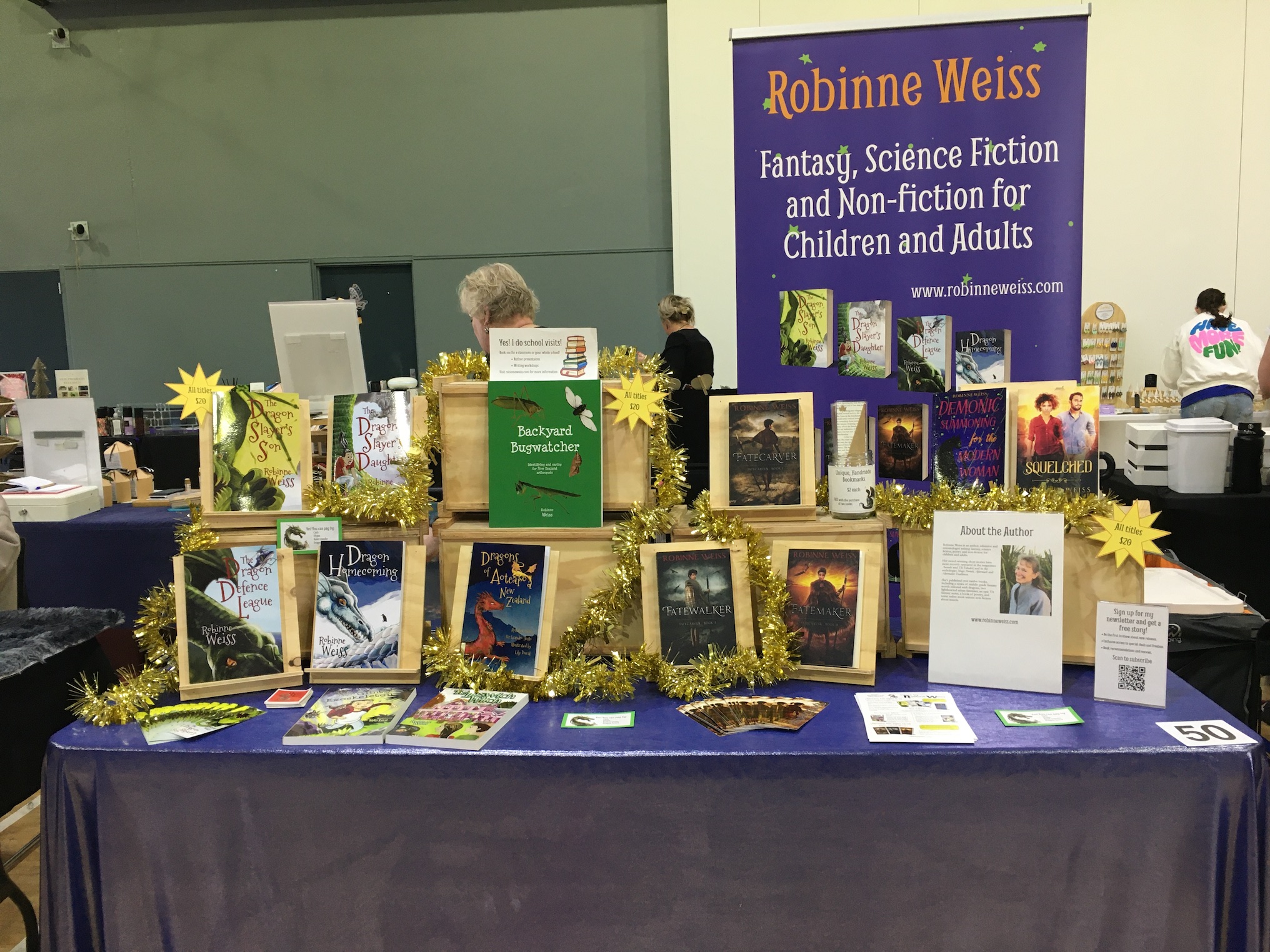
I despaired until I stumbled across a session on selling physical books. The panelists in this session talked about selling books at markets and fairs, doing school visits, exploring unusual sales outlets like tourist destinations, how to encourage people to buy your books face-to-face.

Yes! This was my kind of marketing. The kind of marketing I’ve been focusing on in the past year. Talking to people, talking about my books, being in the same physical space with potential readers, watching how people interact with my books. Getting that personal connection with readers in the real world.

Start talking to me about SEO, CTR, and ACOS, and my eyes glaze over. But throw me into a room with a bunch of potential readers, and I’m all over it. Watching the session on physical book marketing, I finally realised that it’s not that I can’t understand the online marketing game, it’s that I don’t want to.

Making money from random pop-up ads in my online content goes against my values. Putting my own random pop-up ads in someone else’s online content goes against my values. Bombarding potential readers online every day goes against my values.

And that’s okay.

I don’t have to participate in that madness.

And, yes, perhaps if I had to pay all my bills with my writing, I would feel differently, because god knows it’s hard to make a living selling books at markets. But I like my day job. And while I would love to write full-time, I know that I gain a lot of writing benefit from my day job. I would be a poorer writer without it.

And if making art is about expressing yourself and your values, then why wouldn’t your marketing reflect that as well?

Indeed, how could I, in good conscience, make money from plastic widgets advertised on my website when my books and stories contain so many environmental themes? 

So I will continue to trot out my books at local markets, beside other local artists. I’ll continue to work on the board of the Tamariki Book Festival to help other authors do the same. I’ll chat with readers, listen to grandparents talk about the sorts of books their grandkids like to read, discuss dragons and my favourite dragon books with kids, hand out stickers and bookmarks, visit schools and tell children how hard writing is even for me. And I will sell a few books, sign people up for my newsletter (people who actually want to hear from me), and probably end up spending half what I’ve earned buying art from others. 

Is that so bad?

Sounds perfect to me, because it is much more aligned with my values. It values personal connections and supporting others. It recognises the value in the art itself, rather than measuring the value of the art in terms of what else can be marketed alongside it.

And maybe I won’t ever be able to support myself with my writing. But I will be true to myself.

And … um … not to deluge you with marketing, but if you happen to be in the area, come say hello and pick up some Christmas gifts at these upcoming markets: 

  • Sunday 3 November—North Canterbury Creative Market, 11 am – 3 pm, Rangiora Showgrounds
  • Sunday 10 November—Goode Christmas Market, 10 am – 4 pm, Pioneer Stadium, Christchurch
  • Saturday 7 December—Rolleston Market, 10 am – 2 pm, Rolleston Community Centre
  • Sunday 15 December—North Canterbury Creative Market, 11 am – 3 pm, Kaiapoi Club

A New Way to Support Me

Like many writers, I’m often discouraged at how difficult it is to actually make a living by writing. And like many writers, I dream of the day when writing actually pays the mortgage and the power bill.

To hopefully take another step closer to that day, I’ve started a Ko-fi page, where readers can give a one-off donation, or buy a monthly subscription to get stories and behind-the-scenes peeks not available to anyone else.

For as little as $1 a month, you can get access to Two-minute Tales: weekly podcasts of micro-stories written just for you. Or purchase a $5 or $10 subscription for more stories, sneak previews, and early access to stories and books.

By subscribing, you’ll not only help me afford the editors and cover designers I need to produce more books, but you’ll also help me transform my books into audiobooks, which I’ve been wanting to do for years.

This is my first foray into offering a subscription service, so let me know if there are other things you’d like with your subscription. I’m sure I’ll be adding things as I go.

Head on over to my Ko-fi page to find out more about how you can join me on my writing journey!

Baking One for the Team

I’ve recently sent out my next book, Demonic Summoning for the Modern Gardener, to beta readers. It’s a more fleshed out tale than my husband read and commented on last month. A few weeks ago, I mentioned on the blog that my husband had requested more carrot cake in the story. In my rewrite after his comments, I made chasing the perfect carrot cake a sort of running gag/tiny subplot through the book.

Then I decided I should include the perfect carrot cake recipe in the back of the book.

I had already developed the perfect carrot cake recipe, so that was easy to include. But the frosting … I’ve made some very good carrot cake frostings, but I can’t say I’ve hit on the perfect frosting. Everyone agrees, of course, that carrot cake must be frosted with a cream cheese frosting, but there’s a lot of variation among cream cheese frostings. I’ve had them too sweet, too grainy, too dense …

No better excuse for baking!

So last night I whipped up a carrot cake and tested out a new variation on cream cheese frosting. This one has no butter—just cream cheese as the fat. It also contains lemon zest and lemon juice for a bit of added tartness. Lots of potential to be awesome!

Flavour-wise, it’s good … the texture, not so much. It’s too gummy. Not fluffy enough. Definitely not the perfect frosting.

But never fear, we’ll suffer through this almost perfect cake (have I mentioned that I’ve had two pieces of it already, and it’s been only 12 hours?), and then I’ll make another!

Because I couldn’t let my readers down with sub-standard carrot cake, now could I?

If you have a favourite cream cheese frosting, let me know—maybe I’ll try it out. How many cakes do you think it will take to reach peak frosting?

Cover Reveal: Dragons of Aotearoa New Zealand

I’m thrilled to be able to reveal the cover of my upcoming fictional non-fiction book, Dragons of Aotearoa New Zealand!

A world-first guide to dragons, written in consultation with the dragons themselves.

Hidden for centuries, Aotearoa New Zealand’s dragons step out of the shadows in this unique and informative guide. 

Here you will find information about:

  • All eight dragon species found in Aotearoa
  • Dragon biology and evolution
  • Dragons’ unique culture and customs
  • New Zealand Draconic language
  • The history of dragon slaying in New Zealand
  • Dragon conservation
  • How to stay safe in dragon country

With a foreword by the founding members of the Dragon Defence League, and special commentary by the dragons Rata and Foggy Bottom.

A must-read for dragon lovers! 

Coming 6 July!

Upcoming release: Dragons of Aotearoa New Zealand

Less than three months until Dragons of Aotearoa New Zealand is released! I’ve had so much fun working on this book, and I can’t wait to share it with you. I’m especially excited about the awesome illustrations created for me by the amazing Lily Duval. Look for a cover reveal in June, and the release of the book in July at the Tamariki Book Festival!

A world-first guide to dragons, written in consultation with the dragons themselves.

Hidden for centuries, Aotearoa New Zealand’s dragons step out of the shadows in this unique and informative guide. 

Here you will find information about:

  • All eight dragon species found in Aotearoa
  • Dragon biology and evolution
  • Dragons’ unique culture and customs
  • New Zealand Draconic language
  • The history of dragon slaying in New Zealand
  • Dragon conservation
  • How to stay safe in dragon country

With a foreword by the founding members of the Dragon Defence League, and special commentary by the dragons Rata and Foggy Bottom.

A must-read for dragon lovers! 

The Writing Life

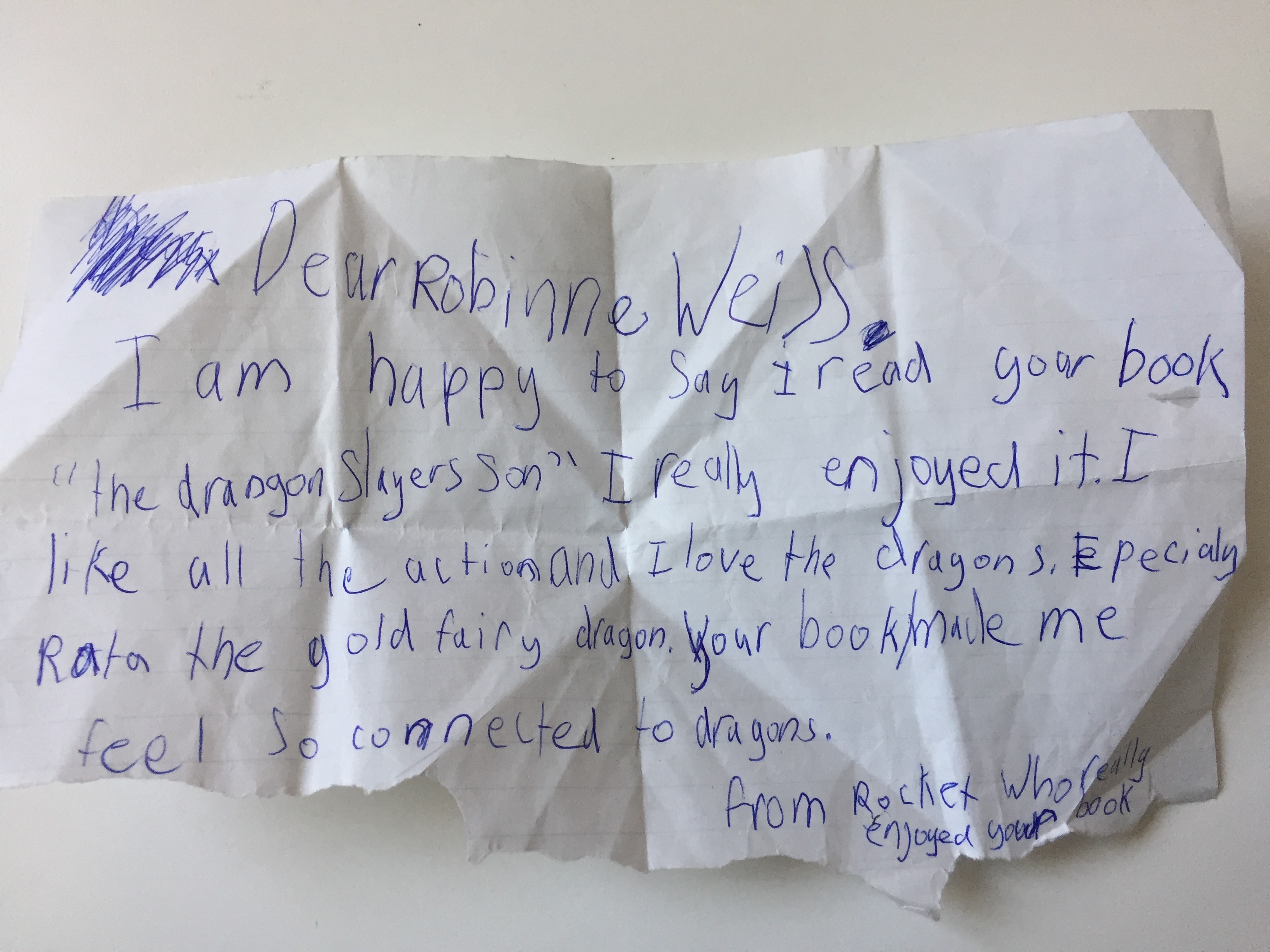
An oldie but a goodie–I love fan mail!

A couple days ago, I sat down at my desk, knowing I had a lot of ‘business’ to deal with. I was determined to complete these necessary but uninspiring tasks (cashbook marketing, etc.) quickly, so that I could get on to the writing I wanted to do.

First job was to check my email.

And this was the first message I opened:

Hi there Robinne
I bought your whole Dragon Defence League Series at the Spencer Park Market and you personalised one of the books for my son Mathew. I just wanted to write to let you know that he absolutely loves the first book and is over half way through and keeps telling us all about what is happening in the book. We have never seen him so glued to a book before and he never tells us what is happening so it has made a massive impression on him so thank you so much for writing them.

Well, there’s no better way to start your day than that! This is exactly the sort of thing I live for as a writer. To make an impression, to capture the imagination of a reader is the whole point of writing. And to have my book be the book that opens a child’s mind to the wonder of stories is something special, indeed.

It reminds me of the real reason I write. Oh, I would love to be able to make a living at this. The validation of a living wage would be amazing.

But it’s not why I write. I write to connect with others through words. There’s something magical about having an impact on a reader you have never met.

And I’m regularly reminded that I’m not the only writer who has to fund their passion with other endeavours. On a recent episode of Writing Excuses (a writing podcast I highly recommend), the topic of the week was how to fund the writing life. The whole point of the episode was that it’s okay, normal, and totally possible to purposely engage in money-making activities to support your writing habit, and that choosing activities that feed into your writing is the key to making the most of your time.

So, yeah, I teach three days a week in order to support the two days a week of writing. And because I teach students within my target audience, I know what my audience likes to read, know what sorts of life experiences they have, understand how current events resonate (or don’t) with them. I have an eager and ready population of beta readers at my fingertips, and a ready source of story inspiration.

It’s no different from when I was running the Bugmobile, my science outreach programme for schools. Bugmobile fees barely covered my costs, though I was charging schools as much as I possibly could. So I funded the Bugmobile by doing much more lucrative heritage interpretation consulting for various local and national agencies and organisations. The consulting work was interesting, but not my passion. But the skills to do both were similar, and it was a way to ensure I could continue to run the Bugmobile.

I will admit I ended 2023 feeling guilty for ‘wasting’ so much time, money and effort writing books and stories that don’t pay the bills. But I’m launching 2024 with a different attitude. And with a new realisation.

Back in 2005, when I first developed the idea for the Bugmobile, I wrote a mission statement. I don’t remember it exactly, but it was something along the lines of connecting people with the amazing nature found in their back yards and encouraging people to explore the world around them. I have realised that I’m still doing that as a writer. When I closed the Bugmobile and started writing, I felt like I’d cut off an arm. How could I stop interpreting the natural world?

The answer is I never did stop. I just don’t think I realised it. My Dragon Defence League books, which captivated Mathew, are a celebration of the landscapes and natural history of Aotearoa New Zealand. Yes, I’ve put dragons in there, but only to illuminate our relationship with the natural world and how it’s evolving over time. Only to give me a tool to envision a different way we might think of the natural world and our place in it. Digging deeply into all my stories—fantasy, science fiction, climate fiction, horror—they all contain elements of heritage interpretation.

The truth is, while I believed I was building a business, first with the Bugmobile and interpretation consultancy, and now with the writing, I’ve actually been building a life. A life with meaning and direction. 

I still have to make sure I’m paying the bills, and I still need to spend time worrying about marketing, but putting my writing in the larger context, and reminding myself of the larger goals I have for my life, helps me to let go of the feeling that net profit from the sales of my books and stories is the primary measure of success.

But that doesn’t mean you shouldn’t buy my books. They’re great! Fun reads, and full of environmental themes … Go on, you know you want to.

Planning the Next Novel

While I wait for my beta readers to read Fatemaker, I’ve been planning the sequel to Demonic Summoning for the Modern Woman. I’ve spent a lot of time the past two weeks staring off into space while I think, researching really weird things, and taking long walks while I sort out ideas.

I do my planning on paper, with a pencil, because it helps my creativity.

I’ve learned a lot about planning a novel since I made my first, aborted (and truly dreadful) attempt at one. 

I’m definitely a planner, rather than a pantser when it comes to writing novels. I find writing the first draft difficult, and have learned that the better I plan, the easier the first draft is to write. I thought I had a pretty good system in place, but when I sat down to write Fatemaker I found my planning completely inadequate, because there were so many threads to draw together in the final book of an epic fantasy series. So I wrote a chapter by chapter plan of the book, summarising what had to occur in each chapter in order to wrap up everything by the end of the book. It probably took a week to create that summary, but by the end of the week, I had a detailed guide for my story, and I could focus on it chapter by chapter as I wrote, without worrying that I was forgetting something. I wrote the first draft in three weeks, rather than my usual six to eight weeks.

So I’m following the same process for the second book of the Rifton Chronicles, even though this book is not overly complex. Hopefully it will make the first draft fly onto the page.

My current planning process looks like this:

  1. Develop the basic premise for a book.
  2. Establish the world in which the story will take place. This includes creating a timeline of any historical events that impact on the story and details of any magic systems I’ll use.
  3. Develop the characters who are best suited to be my protagonists and antagonists. This includes not only their personal background, but also their ancestry, relationships, strengths, weaknesses, and habits. I never concern myself with physical characteristics unless they have a direct bearing on the plot. If you asked me what my characters looks like, I couldn’t tell you.
  4. Create a 1-page outline of the major plot points. Usually I do this in the form of a story mountain—yeah, primary school stuff, but it works for me. This outline includes key events—inciting incident, try-fail cycles, climax and conclusion, and puts them all on a specific timeline, so I know details like what season it is when I am writing.
  5. Determine the story arcs of each of the main characters. Usually this is a couple of paragraphs per character, which I add to the character descriptions.
  6. Write the blurb. I know this seems counterintuitive—how can you write the blurb before you’ve written the story? I used to struggle writing blurbs, because there were so many story details in my head, I didn’t know what to highlight in the blurb. The blurb needs to convey the genre, conflict, and just enough detail to hook readers into picking up the book. I’ve found it is MUCH easier to write this when that’s all I know about the book. When I’m not sick of the bloody story after weeks of writing, months of editing. When the story is still as shiny and new to me as it will be for potential readers. It also gives me a touchstone as I’m writing and editing—am I delivering what I said I would in the blurb? Is my story still conveying the awesome ideas I started off with?
  7. Write a chapter by chapter summary of the story. I know my books tend to run about 30 chapters, so I divide the story into thirty chunks, then start placing the major plot points and filling in the details. When I did this for Fatemaker, I had a couple of blank chapters near the end, but also had the feeling some of the chapters were going to need to be split into two once I started writing. In the end, I had 34 chapters, so it deviated a bit from my plan, but only in volume, not substance. For the second Rifton Chronicles book, I know I will have six historical ‘interludes’, so I’ve spread these evenly through my chapters, and am building the modern part of the story between them.

Oh, yeah, and there’s the staring off into space, researching bizarre things, and taking walks—those are critical components of every step in the planning process.

Introduction to Poetry–published!

A couple of years ago, I wrote a poem for my students. It was an introduction to poetry that I used when I started a poetry unit, and was a response to the groans and moans I got whenever I introduced a poetry unit. The poem has been a hit–I slide smoothly into it when the kids start complaining, and when they realise I’m speaking in verse, their whole attitude changes.

I hadn’t really planned on publishing it, but when I found the perfect fit, I couldn’t resist.

It has just been published in the literary journal Teach. Write.

You can download the e-version here.

A Great Start to 2023!

January was a good writing month. I was blessed with three weeks of full-time writing—no kids, no day job, and even the garden was relatively low-maintenance.

Fatemaker, the third and final book of my Fatecarver series, had been hanging over my head for months. I’d meant to write it during the winter school holidays, but a different book jumped out and wrote itself down instead (more about that in a moment). In the lead-up to Christmas, I finally wrote out a detailed outline of Fatemaker, so when I hit January, the writing flowed at a rate of over 4000 words per day for weeks. On 25 January, I typed The End on the series, which felt amazing.

But I didn’t just write a novel in January. While banging out Fatemaker, I was also preparing for the publication of Demonic Summoning for the Modern Woman—a cosy urban fantasy I wrote when I meant to be writing Fatemaker during the winter. I sent a brief to the cover designer and the manuscript to the editor early in the month. Working with the cover designer was a nice distraction and break throughout the month, ending with a fun and bold cover I love. Then, on the last day of the month, I got the manuscript back from the editor, so Demonic Summoning for the Modern Woman is well on its way to a March publication date.

But that isn’t all. I wrote a new short story, almost finished a second short story, and fired off a bunch of magazine submissions, one of which resulted in an acceptance that squeaked into January on the 31st.

January was supposed to be focused on marketing—I’ve got a fun promotion project in the works—but I simply didn’t have the time or headspace to do it. I did, however, manage to make some progress, and at least get the ball rolling.

Weekly blog posts and my monthly newsletter rounded out the workload of January’s 10 to 12-hour workdays.

In fact, I accomplished so much in January, I’ve ticked off the majority of my 2023 first quarter goals. It was a great way to start the year!