Ephemera

So much of my life has gone undocumented.

The tree forts my siblings, neighbour kids and I built in the woods.

The winter days ice skating on the neighbour’s pond.

High school parties, where we danced and sang show tunes in our parents’ basements.

The entirety of my university years.

The day the bus my husband and I were in was shot at by guerrillas in Guatemala.

Cameras were not present at these events. They live on only in the memories of those who were there. Memories that grow increasingly spotty and selective over the years.

These days, when virtually everyone has a camera in their pocket, it’s hard to escape the incessant recording of events. Indeed, there are people who, I suspect, don’t actually experience the events in their lives, because they’re so busy recording them.

Which is one of the reasons I love my outdoor chalkboard. My daughter made it for me several years ago for Christmas, to give me a place to post poems, like I did during Covid lockdown.

A poem written in chalk outdoors is an ephemeral thing. I might write one on a Tuesday, and by Wednesday it is gone—washed away by a rainstorm. Or it might last for weeks before the board is wiped clean by the weather.

There is something pleasing about that impermanence. The poem exists for a brief time. A few people will read it. They may remember it or not. Then it is gone. Its temporary nature gives me permission to explore ideas, unusual thoughts, or weird images without fear. It gives me permission to write bad poetry for my own enjoyment—after all, it won’t last forever, and after it’s gone, no one’s memory of it will be perfect. They will take from it what they wish and discard the rest.

How much of the world’s creativity is stifled these days because everything is documented, posted online, and dissected by people who make it their job to criticise what they don’t understand?

Maybe I’m just old—a Luddite. Maybe our lives should be relentlessly documented and analysed by strangers. But I find an incredible richness in the variability of memory. Who remembers what, and why did those details stick in their minds? What can I learn about people based on what they remember about an event? I find freedom in creating things that virtually no one will see, and which do not last. Things that will be filtered by time until only the important parts are left.

So enjoy this half-erased poem. You will not see it again.

A New Non-fiction Project (and how you can help)

So, I’m doing a thing …

I know a lot of you read my blog for the recipes or the garden tips.

Over the past couple of months I’ve finally done what I’ve been threatening to do for years. I’ve collected 60 of my recipes (some of which have appeared on my blog, and many which haven’t) and put them together with growing tips to create a book I’ve tentatively titled Soup to Soil.

Soup to Soil is a seasonal guide to cooking and gardening. Recipes, arranged seasonally, feature fruits and vegetables from the garden. Each recipe is followed by a growing and preserving guide for one of the ingredients in the recipe.

The first draft of the manuscript is complete, and now the hard work starts. Over the next year, I’ll be cooking, gardening and photographing in order to refine and document all the recipes and gardening information in the book.

My goal is a hardcover full of delicious recipes, helpful gardening tips, and beautiful photographs.

If you’d like to test some of the recipes for me, I’d love to have you join my recipe testing crew! Send me a message through my contact page.

The Importance of Community

Western culture seems to lean more heavily into individualism all the time. We’re encouraged to look out for ourselves, celebrate our own uniqueness, prioritise our own needs, focus on increasing our own wealth, our own wellbeing.

It hasn’t made us happier.

In fact a 2015 study of happiness found that the pursuit of happiness in individualistic cultures left people feeling less well off than before. Conversely, they found that the pursuit of happiness within collectivistic cultures led to increased well being.

When we seek happiness as a group, we are better off. When we engage with others in a collective pursuit, we benefit.

The past week has been an excellent reminder of this for me. 

On Friday, I enjoyed a sailing excursion on the NZ Maritime Museum’s sailboat, Ted Ashby. The boat was manned by a crew of retired volunteers. Every one of the volunteers was having as much fun as the tourists on board. The fellow I chatted with gushed about how volunteering gave him the opportunity to hang out with other sailors, enjoy the water, sail on a historic boat (without the expense of owning it), and share his passion for sailing with others. He was happy because he was sharing his interests, his time, his energy.

On Saturday and Sunday, I attended the Storylines Children’s Writers and Illustrators’ National Hui. I enjoyed two days of talks and workshops, and chatted with dozens of other writers during breaks and meals. Although the weekend was exhausting for introverted me, I came away bursting with ideas, charged with purpose, and ready to tackle my own writing with renewed vigour, and with a feeling of support from countless others.

On Monday, the gardening group I’m a part of met for our bi-weekly catch-up. As always, our stroll through a member’s garden was accompanied by discussions of everyone’s successes and failures so far in this growing season. We discussed ideas, techniques, and frustrations. During the post-stroll cup of tea, conversation wandered freely to all aspects of rural life. People exchanged seeds, plants and produce, shared photos of recent projects, and commiserated about the weather. I know that whenever I’m in need of advice, plants, or anything, all I need do is reach out to the group. My glorious garden is a testament to the influence of the community. I could not have created it without them.

We cannot hope to succeed as individuals without a community of support around us. We cannot hope to thrive without others who thrive alongside us. We cannot hope for happiness without feeding the happiness of others.

Our leaders, our governments seem to have forgotten this. Collectively, we have forgotten this. We cannot simply take, we must give. We cannot expect support unless we provide it, too.

Life should not be about you. Life should not be about me. It should be about us. Together we are powerful, we are nurtured. We lift others up, and they pull us up with them.

I am blessed to be part of several communities of people who gather for mutual support around a particular passion. I’m also thankful to be part of a physical community made of the people who live in my town—a community that hosts a produce exchange and a little library, one that organises a trick-or-treat map of participating households, one that rallied with sidewalk messages and games, painted rocks, and window messages during Covid lockdown. 

What communities are you part of? What communities can you nurture? How can you chase happiness with others?

Ch-ch-ch-changes

I’ve been writing (and publishing my writing) since the 1970s. But, to be honest, I never considered myself a writer until 2015, when I closed my science outreach and interpretation consulting businesses in order to pursue writing full time.

my books on bookshelf

The change felt like losing an arm, even though I chose to do it.

Because I didn’t consider myself a writer. I was a heritage interpreter, and who was I really if I stopped being an interpreter?

It wasn’t until I ran into a fellow heritage interpreter at a writing conference the following year that I reconciled with the change. He said, “But you’re still telling stories, just in a different way.”

Because of course, heritage interpretation is all about telling the true stories of people, places, and the natural world. He was absolutely right. I had always been a storyteller. The shift from interpretation and science outreach wasn’t so much the removal of a body part, but the growing of a new one.

It made all the difference in my attitude towards the change.

So when the family’s financial situation changed and I needed a steady income, it wasn’t too difficult for me to switch to writing part time while working as a teaching assistant—I could see the connections between the two. I chose to view the change as growing a new limb, rather than cutting off the old one. And when that role evolved into a specialist teaching role focused on science and extension literacy and maths, it felt like the best of all worlds.

I began to think of myself as a communicator who used a variety of media to communicate. And that change in thinking has led to the next change.

This week I handed in my notice at my ‘day job’. Six weeks from now I will transition into full-time writing. It will be my second foray into this territory, but I am infinitely more prepared for it this time. With seventeen books under my belt, I have a base to work with. And with the understanding that I am doing the same thing, just in a different medium, losing the daily teaching from my schedule doesn’t feel as tragic.

And now that my plans are in motion, I’m allowing myself to explore all the possibilities this new phase will open up.

I will miss my students and the amazing people I’ve worked with for the past seven years. And I’m a little nervous—a bit overwhelmed by the sheer quantity of items on my growing to-do list. But I am more than excited to dive into my writing full time. I have heaps of plans for fiction and non-fiction, and I can’t wait to begin making them happen, and share the finished products with you all!

Pause

It’s a golden, autumnal day today. Just right for enjoying.

Pause here
On the edge of winter
Among dry stalks
Rattling in the breeze.

Pause here
While the sun
Glances off
Golden leaves.

Pause here
To inhale
The smell of
Fading roses,
Cut grass.

Pause here
To feel Earth’s
Smooth slide
Through space.

Pause here.

Market Month!

The Christmas season is heating up, and with it my market schedule. This month, I’ve got a stand at three markets, the first coming up this Sunday in Hokitika. My husband and I are taking the market as an excuse to spend the long weekend enjoying the West Coast, so my office floor is currently piled with books and market swag to be loaded in the car tomorrow morning. I’m very excited to be selling my latest book (set largely on the West Coast) in Hokitika!

Come on out to a market this month and say hello!

Halloween–a time to be batty

I’ve been folding origami bats this week in preparation for the trick-or-treaters who will be arriving at our door on the 31st. 

Although I can’t get into the Halloween spirit like I used to do in the northern hemisphere, I’ve decided Halloween in Kirwee is a chance to let my weird show.

Each year I write a poem on the driveway inviting trick-or-treaters to the door.

Of course I dress up. And I’m a stickler for the kids to be in costume too. If they show up at my door with no costume, I make them perform a trick for me.

I’ve had on-the-spot original rap performances, rugby moves, and songs. Some of my regulars now clearly prepare their trick in advance, whether they’re in costume or not.

I hand out candy, as is expected, but last year I gave one of my books for my favourite costume of the evening. The girl who got it was over the moon.

So this year I’ve leaned further into the weird. I wrote a special spooky story for kids, printed it (white on black) onto squares of paper, and folded the squares into bats to hand out along with the candy.

I hope the kids like my spooky story bats as much as I do!

Astrobiology Fun

Not long ago, I attended a workshop on Astrobiology for teachers. I’m not sure which of my two jobs it was more useful for—teaching or writing.

Cool swag from NASA and Blue Marble Space!

My day job, though ever changing, often involves teaching science across years 3-8. One of the strands of the New Zealand science curriculum is Planet Earth and Beyond, so I regularly teach about our solar system and various features within our galaxy. Last year, I did a fun unit with the year 7 and 8 students in which students had to design spacecraft, habitat modules, and promotional campaigns for a colonising trip to Mars. 

I’ve rarely touched much on astrobiology, and the questions about life elsewhere in the universe, but the workshop made me think about all the ways that questions about life on other planets reflects on life on Earth. How these questions reflect on our actions as human beings—our treatment of other humans, our treatment of the planet and other living things on it. The presenters made a great case for using astrobiology as a way to dive into big philosophical questions about what it means to be alive on Earth today. 

What are our responsibilities to planet Earth and the life on it? What if we are alone in the universe? What if we’re not? Does it change our perspective on our own actions as humans? 

Sanjoy Son, from Blue Marble Science, spoke eloquently about how the teaching of astrobiology can give students valuable perspective on life, and how they can approach questions of personal differences, values, and civic responsibility. The take home message I got from his talk was that we are either the caretakers of the only life in the universe, or we are part of a vast, interstellar network of life. Either way, we are all ambassadors of planet Earth. What a great message for kids. What a great way for them to think about their roles as human beings.

As an author of fantasy and science fiction, of course I soaked up the cool facts about the gazillions of planets there are just in our galaxy, the weird ways life might have to adapt to wildly different conditions on other planets, the surprises that even our own solar system has produced in terms of planets and moons on which life could potentially survive, the physics of travel and communication through space. So many story ideas!

You’ll definitely be seeing more astrobiology creeping into my writing and teaching in the future!

Market Season

Next weekend I’ll be selling books at my stall at the Ōtautahi Crafter’s Market. It’s the first market of what I consider my Christmas market season. I know, I know, Christmas is AGES away, and I won’t start thinking about my own Christmas shopping until at least late November. But thankfully, lots of people start turning their thoughts to gift buying as early as September. Especially, the aunties and grandmas who buy books for their nieces, nephews and grandkids.

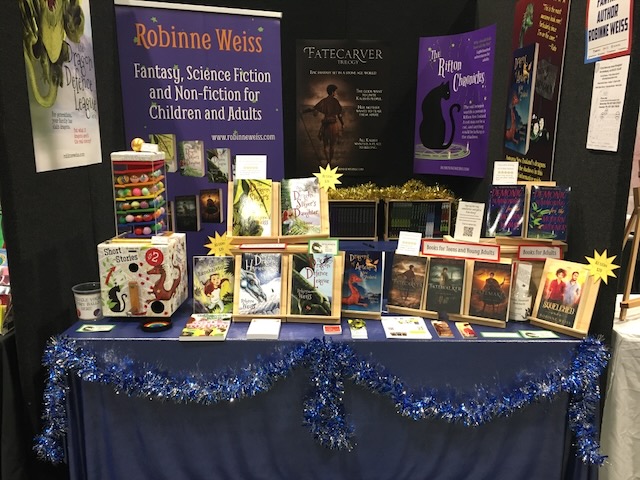
So I’ve booked in for a number of markets over the next few months, and I’ve come to realise that, in spite of being a socially awkward introvert who hates crowds and noise, I love selling at markets.

It’s EXHAUSTING, for sure. And it can be really depressing when you have a bad day and don’t even sell enough to cover the cost of your stall. But there’s so much to love about selling at markets.

  1. I love to meet my readers, or the parents/grandparents/aunties of my readers. Anyone who is browsing books at a market where they could instead spend their money on ice cream, hot chips, or cute garden gnomes is serious about books. They’re my kind of people. (Not that I don’t like ice cream, hot chips and garden gnomes, of course). I enjoy hearing what they like to read, who their favourite authors are, and why reading is important to them.
  2. Despite the crowds and noise, I appreciate the festival atmosphere of a market. Aside from the occasional spouse or young child who’s being dragged along against their will, people are there to have a good time. They’re happy. Shopping at a market isn’t like shopping for your groceries, that has to be done whether you want to or not. Market goers are willing victims—er, I mean—customers. And because they’re having fun, it’s easy for me to have fun.
  3. I love the excuse to browse other people’s stalls. I mostly frequent craft markets, and as an avid crafter myself, I love to see what other folks are creating. It’s a great way for me to get my Christmas shopping done, too.
  4. I enjoy the community of market goers. Go to enough markets, and you start to see the same vendors over and over. You say hello, ask how their day is going, whether they’ll be at the next market. For the vendors on either side of your stall, you practically become staff by the end of the day—looking after their stalls while they’re at the loo (and of course they do the same for you), and coming up with clever ways to hawk your own items and theirs together (Look! You can read my great books by the light of those beautiful handmade candles.)
  5. There’s nothing more satisfying than personally sending a copy of one of your books out into the world. Digital sales are fine, but there’s not the same feeling of success as when you actually hand your book to a reader yourself.
  6. I enjoy the creativity involved in creating my stall. Like many authors, I dabble in lots of other creative pursuits. A market stall gives me an opportunity to make use of my sewing, paper crafts, and other creative output to titivate my stall.

In spite of these positive things, I can’t deny that selling at markets can be exhausting and overwhelming. I’ve developed a few techniques to manage the stress that a day among so many people can induce.

The story ball vending machine adds to my market day fun.
  1. Bring a healthy lunch. It’s so easy to think, “Oh, I’ll treat myself to something from a vendor for lunch.” But sugary, salty, greasy food leads to feeling depleted and icky by the end of the day. I take carrot sticks, fruit, and a sandwich—all prepared in bite-sized pieces so I can snatch a bite between customers throughout the day.
  2. Get there early, but not too early. I know how long it takes me to set up. To avoid being stressed about not being ready, and to avoid awkward standing around before the market starts, I time my arrival with just enough time to set up and use the toilet.
  3. Rehearse my spiel. I know what I want to say about each of my books, making it short and snappy. By thinking in advance, I don’t flounder awkwardly for the right words with a customer.
  4. Remember, books don’t sell themselves. I use this truth to my advantage when I need a social break. When I’m overwhelmed and don’t want to engage with anyone, I simply take a step back and stop talking to people. I smile politely, but if I don’t attempt to engage, most people won’t engage with me, and I get to take a break. 

I’m looking forward to the coming months, hawking my books to readers. Come visit me at these upcoming markets!

Ōtautahi Crafters Market—20 September, 10am – 5pm at South City Mall

Hokitika Christmas Market—16 November, 10am – 2pm at Seaview Lodge

Lincoln Twilight Market—28 November, 5 – 9pm at Lincoln Event Centre

The Goode Christmas Market—30 November, 10am – 3-pm at Pioneer Stadium, Christchurch 

Ōtautahi Crafters Market—20 December, 10am – 4pm at the Air Force Museum of NZ, Wigram

Writing Jitters

Yesterday marked 15 years since the M7.3 earthquake here in Canterbury. I doubt there’s been a single day since then that I haven’t, at some point in the day, thought about earthquakes. I even sleep under a quilt inspired by the 2010 quake.

Working on the quake quilt. Wow! Look how little grey hair I had back then!

Earlier this year, I took a friend, who was visiting from overseas, to Quake City, the museum dedicated to our earthquakes in 2010-2011, which devastated Christchurch. I thought I would be okay visiting the museum, since the quakes were so long ago. But facing that exhibition, everything about those days, weeks, and months came rushing back. At one point, my friend turned to me and said, “You talk like this happened yesterday.”

It felt like it had happened yesterday.

The quakes changed me, changed everyone who was here at the time.

The quakes made me a New Zealander. In the aftermath, when communities were rallying together to help everyone, I realised that this was the place I wanted to be. When the world came crashing down, I wanted to be in a place where university students mobilised a massive volunteer force to dig liquefaction from people’s houses, where farmers airlifted food into the city, where ordinary people organised the collection and distribution of blankets and other homewares for people who had lost everything, where spaces left empty in the city by demolished buildings were turned into temporary parks and places of joy.

The Famous Grouse in Lincoln, post quake.

This week I got the beta reader comments back from my next book, Draconic Search and Rescue,  in which the Alpine Fault ruptures, so earthquakes have been on my mind a lot. None of my beta readers experienced the Canterbury quakes—most of them hadn’t even been born yet. Writing the book, I worried that I would frighten my readers (8-13 year-olds are my target market) with a book about the Alpine Fault rupture. When it happens (and it will), the consequences for the whole country will be huge, and some towns are likely to be entirely destroyed. Researching for this book kept me awake at night, inspired me to be even more particular about my own earthquake preparedness, and reminded me that I’m not entirely crazy to ensure that, wherever I go, I’m prepared to walk home (hi vis vest and water bottle in the car, check, comfortable shoes, check, jersey, check).

But my beta readers wanted more danger, more fear. For them, it isn’t real. The rumble of a large truck doesn’t have them pausing to listen, make sure it’s just a truck. They don’t look for the emergency exits every time they enter a room. They don’t mentally assess the construction date of every building and consider whether it will collapse in the next quake.

So this week, I’m ratcheting up the danger in my book. Shoving my characters closer the destruction, maybe breaking a limb or two. And if I’m a bit jumpy for the next week or so, you’ll know why.