Dolphin Stress Relief

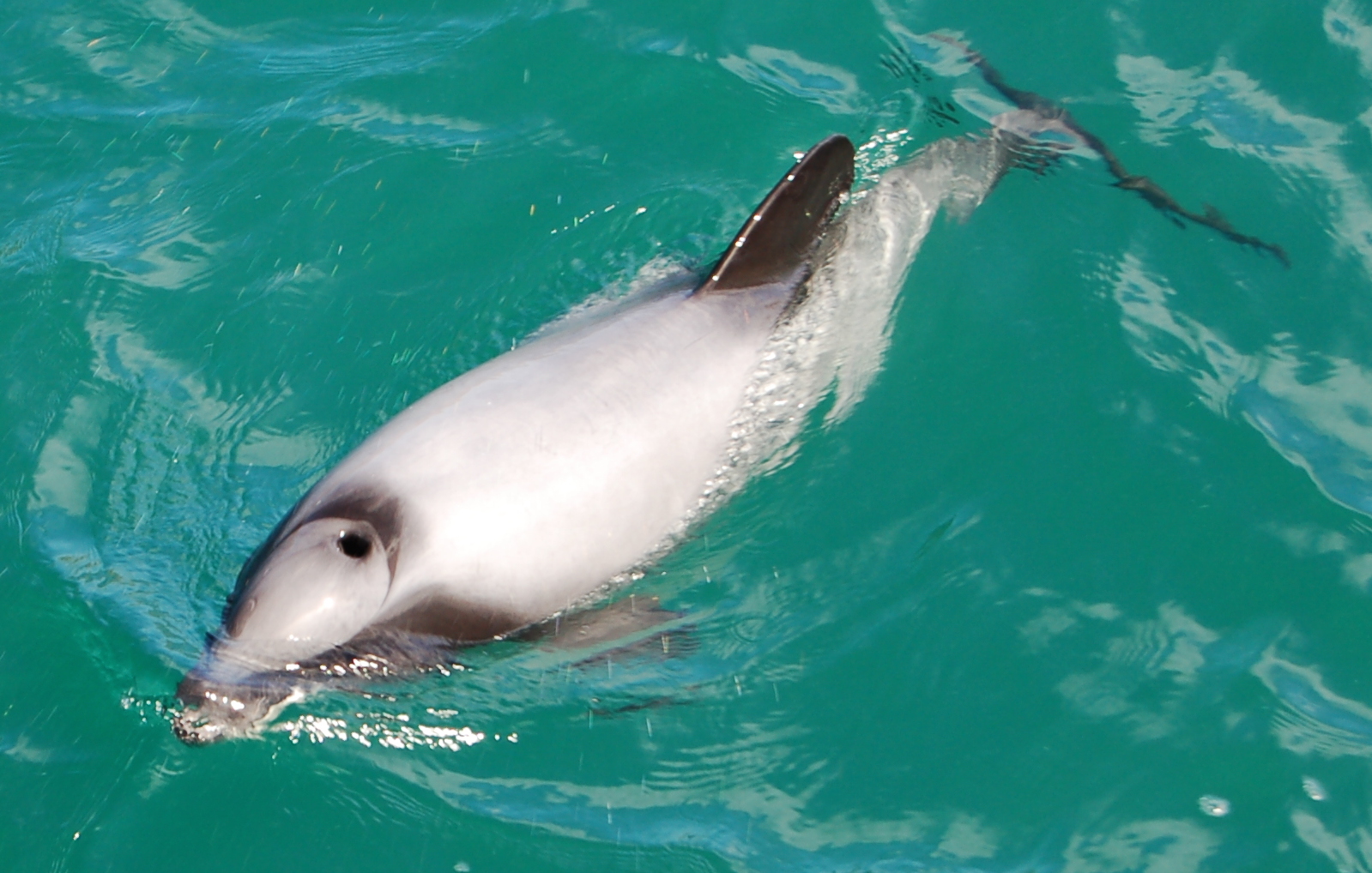
Hectors' dolphin (not today's) in Akaroa Harbour.

Hectors’ dolphin (not today’s) in Akaroa Harbour.

I had a long blog post for today mostly written. I just needed to polish it and find a photo to go with it…

Then we went down to the beach after dinner.

Before we had even crested the dunes, we saw the Hector’s dolphins—a pair of them cavorting just beyond the breakers of an unusually calm sea. By size it was a mother and calf.

What blog post can compete with dolphins?

“You realise this isn’t normal, right?” said my husband to the kids. “Most kids can’t see endangered dolphins on the beach five minutes from home.”

But it is normal for them.

And for that I am so thankful.

We walked the beach, watching the dolphins and picking up colourful stones. The stresses of the day vanished.

I forgot all about that other blog post…

At the Penguin Spa

2016-10-11-14-40-35-cropIt was a week of endangered species for me. After being bitten by a kea on Monday, I was lucky enough on Tuesday to have a chance to see a Fiordland crested penguin / tawaki at Haast School, where I’d spent the morning teaching.

After lunch that day, a trio of Department of Conservation rangers arrived with a juvenile female tawaki that had been rescued off a nearby beach where she had been found emaciated. She was being nursed back to health in preparation for re-release, and the rangers took the opportunity to share her with the local school.

Tawaki are not quite as rare as kea, but they’re shy and tend not to frequent tourist areas like the kea do. This was the first one I had ever seen. There are about 2500 to 3000 breeding pairs remaining, and they’re one of only three penguin species that nest on mainland New Zealand.

Like many of our native birds, they are threatened by stoats, which eat eggs and chicks, and dogs, which can wipe out entire breeding colonies.

The children at Haast School named this particular penguin Ellen, and they had great fun watching Ellen take a warm saltwater bath. The water needed to be warm because Ellen wasn’t preening and waterproofing her feathers properly (because she was too weak to do so). Without waterproof feathers, she got waterlogged in the bath, rather than staying nice and dry as penguins usually do underwater. After her bath, the DOC ranger wrapped her in a fluffy pink towel to dry off, and put a hot water bottle underneath her.

A full spa experience, I would say.

It wasn’t quite the same as seeing a tawaki in the wild would have been, but it was closer than I’m ever likely to get to one of these birds in the wild.

Ellen will spend about four weeks eating and taking spa baths before she’s ready to fend for herself again. I wish her luck.

Cheeky Parrots

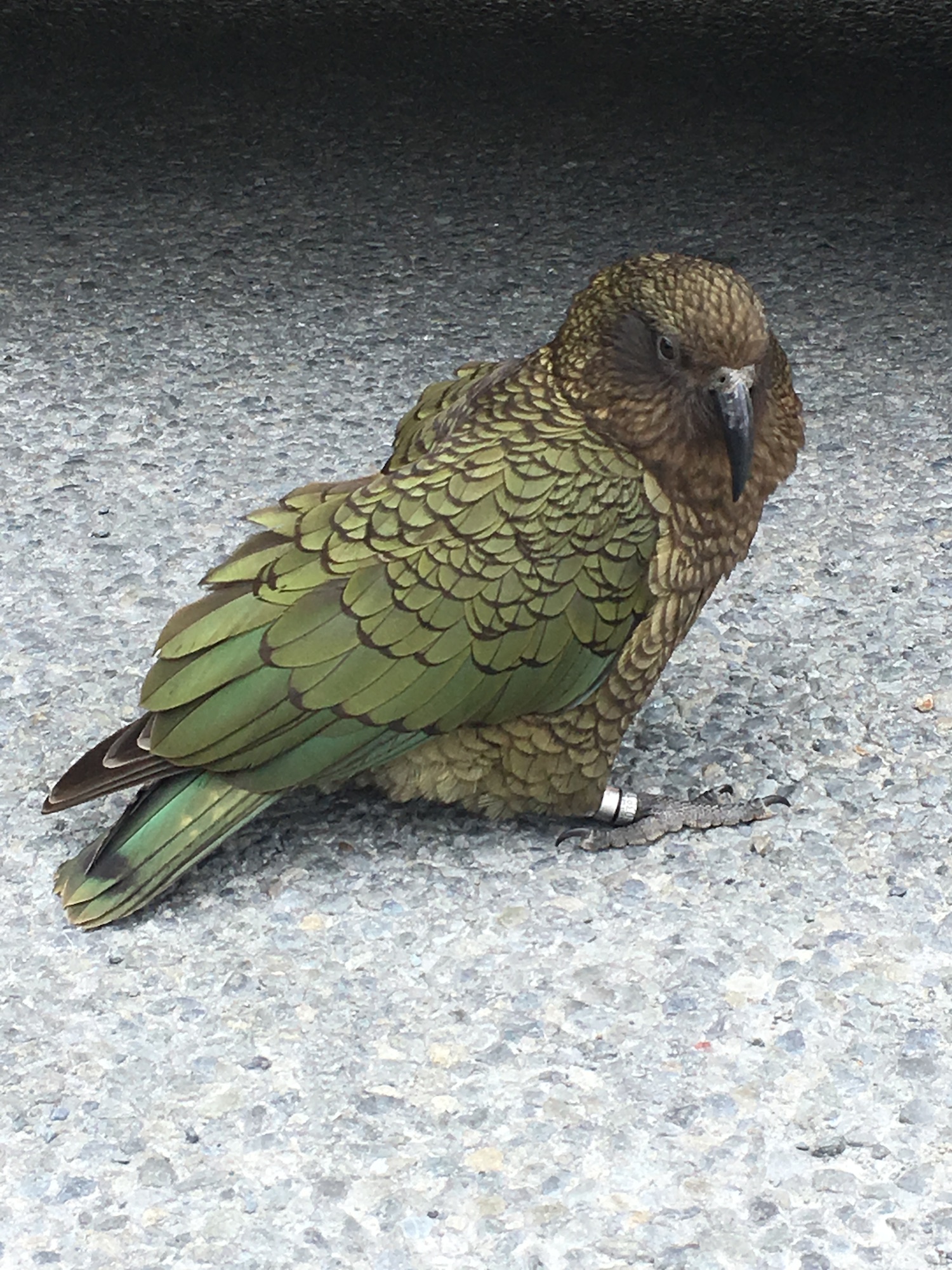
2016-10-10-13-11-37-smIt’s not every day you’re bitten on the bottom by an endangered species.

Yesterday was one of those auspicious days, however. I was travelling through Arthurs Pass, headed to Haast with two colleagues to do a programme at the school there. We stopped to pick up lunch at the Arthurs Pass store, and three kea descended on us.

For those who don’t know, kea are large alpine parrots. Though there are only 2,000 of them left, they are bold and curious animals, unafraid of people. And they’re smart. They understand tourists—how they get so absorbed in taking photos of the parrots that they forget to shut their car doors, or leave a sandwich lying beside them.

They work in gangs—one bird coming in close to pose for pictures, while the others circle in from behind to ransack the vehicle.

We knew this, and had taken appropriate precautions. There were three of us and three of them. We should have been safe.

But, of course, we wanted pictures—you simply can’t not take pictures of them, no matter how many times you’ve seen them. We all crouched down beside the van to snap our photos. That’s when it happened. I was focused on one kea, and another came up behind me and bit me on the bottom. Cheeky bastard!

But I got a photo.

There and Back Again

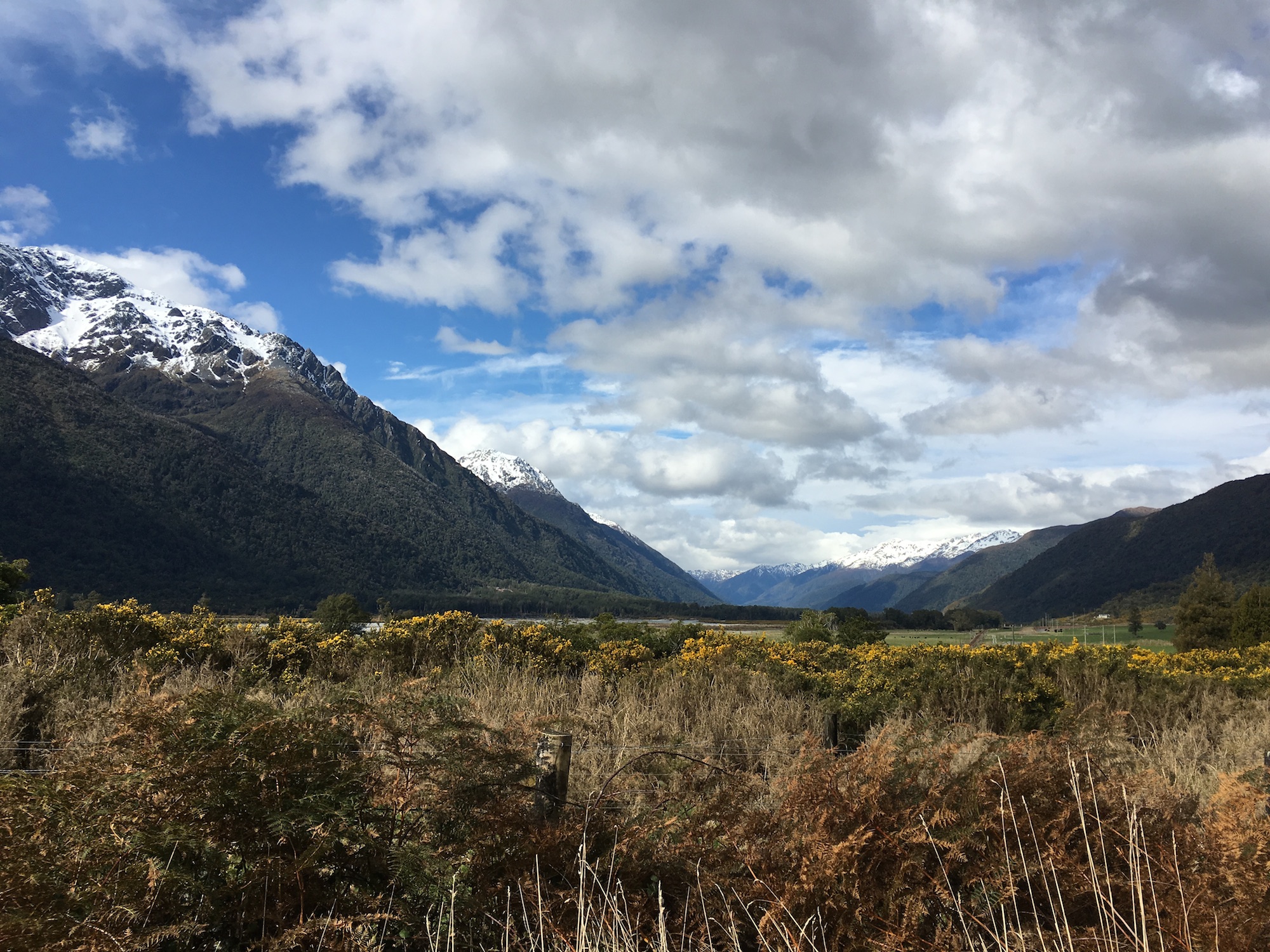
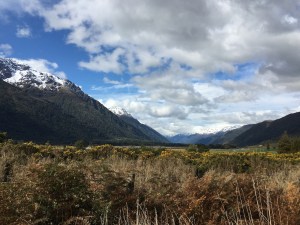
Looking up Otira Valley

Looking up Otira Valley

I slowed into the first curve and began to smile. Within a few short kilometres, the smile had widened to a grin that would remain for nearly two hours.

I will never tire of the drive up and over the Southern Alps. Especially the homeward drive, from Kumara on the West Coast to Springfield on the Canterbury Plains. The first time I made the trip was at night under a full moon that sparkled off the river below and made the snowy peaks shine. How could I not fall in love with it?

I love the first half of the drive, up Otira Valley—the belted galloways grazing in the paddocks on the lower slopes, the rainforest crowding in on the road, the long vistas up-valley to snowy peaks in the distance.

And then, when the road becomes steep and the valley closes in, the craggy peaks loom so close, you have to press your face to the window to see the tops.

And the water! Impossibly long falls coursing down forested slopes, spurting from every little dip and fissure along the roadside, and even soaring out over the road on a concrete sluice.

And then there is the road itself—steep, and as curvy as ribbon candy. There’s the cantilevered half-bridge, and the viaduct that soars out into space over an enormous landslide.

There is the lookout at Death’s Corner, where you can stop and be fleeced by a gang of endangered alpine parrots.

And when you reach the top and plunge down the other side, a whole new set of marvels awaits in the dry, brown, tussock-covered mountains of the eastern ranges.

There are the mountains of scree that look like they’ve been dumped by some enormous gravel truck. There are the limestone outcrops standing like a geologic Stonehenge. There are more snowy peaks, rising out of mounds of alpine tussock. There are lakes hemmed in by massive landslides.
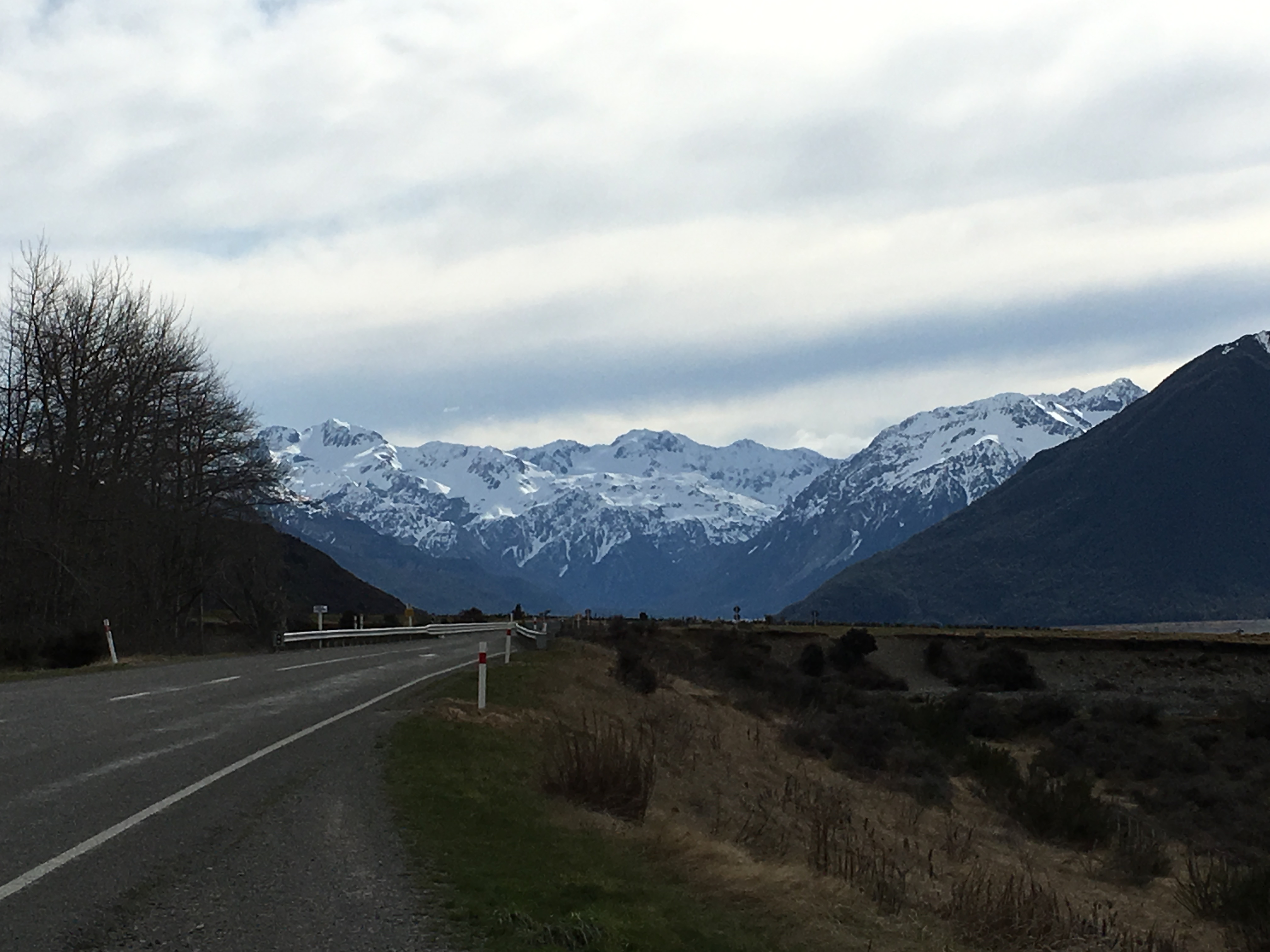
Rear view.

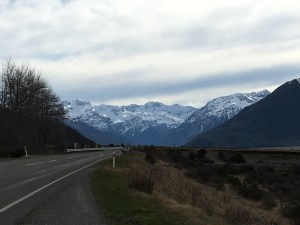
Rear view.

Coming home from the West Coast yesterday afternoon, I was still grinning as I drove through the last of the hills. When I glanced in the rear view mirror, I couldn’t help laughing out loud at the sun glinting off a rank of snow-laden peaks behind me.

Even after nearly twelve years here, I continue to live in wonder at my luck—that I am permitted to call this incredible land home.
Bealey Valley, Arthur’s Pass, New Zealand

2016-09-12-13-06-26-smStop.
Soak up the still silence.

Except that it is neither still
Nor silent.

Wind tumbles
The leaves of the trees.

Overhead in the branches, sounds
The pebble-in-a-still-pool languor
Of the bellbird,
The electric zit-zit
Of the rifleman.

Nearby, a small stream
Hisses over the rocks.
And from farther away
Comes the deep rumble
Of the river
Shaking the stone
As it crashes
Headlong
Down the mountain.


Humming Rosemary

There isn’t much in bloom at this time of year around our place. Daffodils, crocuses, a few early daisies and other weeds in the lawn.

And the rosemary.

Rosemary is perennial here, and grows into a large shrub unless regularly trimmed. The rosemary in the herb knot in the front yard is kept quite small, but two bushes by the side of the house are allowed to range more widely. They’re about two metres tall, and almost as wide. Right now they are in full bloom.

And they are absolutely filled with bees. I swear, there’s an entire hive there right now. The hum is audible from five metres away.

I love to watch bees on rosemary. Not only are they incredibly enthusiastic about the nectar, but they collect the purple pollen, which looks really cool in their pollen baskets.

We’ve been talking about re-envisioning the plantings at the side of the house. The new plan doesn’t have giant rosemary plants in it. Watching the bees enjoy the blooms in early spring, though, we might just have to rethink that.

Neptune’s Daughter

DSC_0009Rock and limpet,
Sea and shell,
Oh, what stories
You might tell!

Of mako shark and
Manatee,
Shipwrecked sailors
Lost at sea.

Love songs of
The humpbacked whale,
Farewells as a ship
Sets sail.

Jellyfish that sting
With grace,
Corals waving
Fronds of lace.

Sea slug, starfish,
Kelp and ray,
Eel and flounder
In the bay.

Squid and seahorse
Swimming by–
All the things
That you and I

Will never see.

Unless, one day
By unknown magic
Or perhaps by
Accident tragic.

We find ourselves
Beneath the water,
Swimming free
Like Neptune’s daughter.

Sedgemere Haiku–Spring

In honour of National Poetry Day this Friday, the remainder of my posts this week will be in verse.

2016-04-18 14.50.46 cropFog billows in wet.
Frosting hair, spider webs, grass
With silver gilding.

_______

Magpie warbles loud
In early morning darkness,
Waking up the sun.

_______

Bees hum in purple
Lavender blooms, blue pollen
Dusting hairy backs.

_______

Seedlings defy frost,
Growing tall in warm sunshine,
Sheltered under glass.

_______

Sparrows descend to
Old sheds, bringing straw, grass, noise
Leaving poo, feathers.

_______

Ploughs plough, seagulls wheel
Overhead seeking
The freshly turned worm.

There’s No Place Like Home

100_0785smThe best part of going away is coming back home.

The kids and I had a great time visiting friends and family in the US the past two weeks. We got a chance to do many things that aren’t possible here—picking wild blueberries; riding roller coasters; seeing deer, wolves and eagles; hearing whippoorwills pour their hearts out into the dark. We visited some of my favourite people in the whole world.

But as Dorothy so succinctly put it, there’s no place like home.

Returning home, the house feels small, the garden shabby. The car looks decrepit and filthy. Wind blows in through the windows and cracks in the floor.

But returning home, the wind also feels fresher. The fire is cosy. I know where everything belongs in the kitchen. The things around me are familiar and comforting.

At home I have responsibilities. Things to do. I am needed.

Though I didn’t feel uncomfortable away from home, now that I am back, I can feel the tension draining away. I feel like I am on vacation, moving through my daily chores with pleasure.

So, like Dorothy, I am glad to be home, regardless of how small and shabby that home might be.

There’s no place like home.

Hooray for North American Wildlife!

IMG_1551New Zealand may have some of the more unique and awesome animals on the planet, but for sheer variety, North America is the winner.

For my kids, squirrels, chipmunks, and turtles are amazing sights. Bright cardinals, drumming woodpeckers, and colourful butterflies are exotic treasures.

To come across a deer in the woods is the event of a lifetime.

Even the forest floor is teeming with exotic creatures.

Here is one of my favourites—Apheloria virginiensis. Sometimes called the almond bug, this large bright millipede uses cyanide compounds to protect itself from predators, giving it an almond smell. Most millipedes use chemical defenses, so it’s nothing out of the ordinary in the millipede world, but who could resist the charm of this lovely creature?

Of course, spraying cyanide at your enemies isn’t particularly charming. Though they are harmless to handle, do wash your hands afterwards, because the poison can be quite irritating if you get it in your eyes.