Sub-Alpine Idyll

We recently went on a lovely hike up Peak Hill, overlooking Lake Coleridge. The start of the track crosses paddocks, but once on the reserve land, the vegetation changes to a beautiful sub-alpine spread of daisies, Spaniard, matagouri, and tussocks. The daisies, in particular, were spectacular—so many were in bloom that the whole hillside looked frosted. The Spaniard was blooming, too, spiky flower heads rising above the daisies like something from a Dr. Seuss book. Native bees, mānuka beetles, and syrphid flies were all taking advantage of the abundance of nectar and pollen. The air hummed with insects.

You could be forgiven for thinking it was a beautiful, peaceful place. And it was, for us. But among the insects buzzing around were predators—pompillid wasps hunting for spider prey, robber flies snatching unwary insects out of the air, and birds snapping up bugs to feed to their young.

And then there were the plants themselves. At least one hapless beetle impaled itself on a Spaniard leaf. 

It may be pretty, but it’s a rough world out there when you’re insect-sized.

Alpine Delights

The family spent a delightful hour on the Dobson Nature Walk in Arthur’s Pass National Park on Wednesday. The track is an easy one, and hiking it quickly takes about 20 minutes. But it’s not a walk you want to do quickly, especially in summer. It winds through alpine and sub-alpine vegetation, including some beautiful tarns, and in summer, so many plants are blooming, it’s hard to take five steps without finding another lovely orchid, daisy, or hebe in bloom.

For me, the best part of the walk is the abundance of sundews in the tarns. As an entomologist, I’m naturally drawn to carnivorous plants like sundews. Sundews catch insects on the sticky hairs you can see glistening in this photo. The hairs are sensitive to both touch and taste, and when they sense a struggling insect, they fold inward to further entangle their prey. Enzymes exuded by the hairs then digest the insect, and the leaf takes up the nutrients in order to grow in the nutrient-poor alpine wetlands. 

These sundews were just beginning to flower—many plants had flower buds, but none had yet opened. The flowers sit above the leaves—an important adaptation, since the plant needs to be pollinated by the very insects it eats.

The alpine summer is short, so when these plants are done flowering, the leaves will slowly shrink into a structure called a hibernaculum that sits near the soil surface and protects the plant through the winter.

Catlin’s River Walk—a little bit of magic

My family and I were in the Catlins last week, in the southeast corner of the South Island. It’s a wild and remote area, home to more penguins and fur seals than humans. No urban adventures here—it’s a place for outdoor recreation.

One of the things we did was to hike part of the Catlins River Track (we didn’t have time to do the full track). It was unlike any other place I’ve been in New Zealand.

In fact, it reminded me most of eastern Pennsylvania, in spite of the fact that it shares not a single common species of plant or animal.

The track follows the Catlins River, a beautiful waterway that cuts through layers of limestone in one little cascade after another. Swing bridges cross the river several times, providing great aerial views of the water (and a little excitement for those who don’t like heights). The forest is old-growth beech which provides habitat for myriad native birds, carefully protected by intensive predator control. 

In addition to the beech, we were delighted to see two species of orchid on the forest floor, red-flowered mistletoes in the treetops, several species of slime mould, some lovely mushrooms, and a beautiful native harvestman. The birdlife was noisy and varied, but we weren’t lucky enough to see any endangered mohua. And, amazingly, there wasn’t a single sandfly! 

The whole effect was one of an enchanted forest. We were certainly enchanted.

The track is relatively flat—easy hiking for kids or those who can’t face the usual Kiwi hiking track going straight up a mountain, and because there’s no “goal” to reach, you can simply walk as far as you’d like, and then return. The entire length is 12 km one-way, with a return loop option through forestry land away from the river. 

I highly recommend this track. I’ll certainly be going back when I have enough time to do the whole thing.

A Bird in the Hand

I’ve had two funny encounters with birds recently. Two birds in-the-hand, so to speak.

A few weeks ago I was in town, doing some writing in Hagley Park, because it was a beautiful spring day. I sat down on the grass with my lunch and my laptop.

A few minutes later, I noticed a male European blackbird eyeing me up. He hopped closer, stopping when I met his gaze, but then, deciding I was no threat, sidling even closer. My lunchbox sat open between us, and I knew he was sizing it up.

Well, I don’t feed wildlife in general, and I certainly wasn’t going to feed a non-native invasive bird. Besides, I wanted to eat that lunch myself. I finished off my sandwich and started in on my apple.

The bird watched my every move. When I set the apple into the lunchbox to type, he rushed in. I clapped my hand over the box, and he backed off.

The bird was undeterred. When I brought the apple to my mouth again, he lunged for it. He flew up and took a bite out of it while I was biting the other side. His wingtips brushed my cheeks, he was so close.

Well, how could I refuse after that? I gave him the rest of the apple (which wasn’t much more than core at that point, anyway). 

But I made him work for it.

I put it back in the lunchbox, and set the box next to my leg. And that cheeky bird perched on the lunchbox and ate the rest of the apple. Other birds came to see what he had, but none were brave enough to come close, so he had it all to himself. He was terribly smug about it—quite pleased with himself, I’m sure.

My second recent bird encounter happened last weekend. My husband was mowing the lawn, and there was a fledgling magpie in the way. The magpie wouldn’t move out of the mower’s path, so I tried to shoo it away. It still wouldn’t budge, just cheeped at me, as if to say, “Yeah. What do you want?”

So I gently picked it up to pop it over the fence, out of the way. It gave one alarmed squawk, and suddenly its parents were arrowing straight for me from where they had been feeding in the neighbouring paddock. They swooped and screeched as I walked away, and I had to wave my arms over my head to avoid being pecked. The fledgeling, meanwhile, hopped away as though nothing had happened. I could almost hear him chuckling.

So, yeah, I’ve been had by two birds recently. A human in the beak is worth two in the bush, apparently.

A Weakness for Weevils

I was excited to find a new weevil on our property the other day. At least until I identified it.

Meet Otiorhynchus sulcatus—the black vine beetle—pest on a wide range of garden plants, including grapes, black currants and strawberries (all common in my garden).

I admit, I have a weakness for weevils—no matter how much of a pest they are, I think they’re cute. And this one is no exception. She’s lovely, in spite of her diet. And I’m certain she’s a ‘she’, because no males of this species have ever been found. The black vine beetle reproduces parthenogenetically, producing viable eggs without the need for fertilisation by males. 

This ability is the result of a bacterial symbiont in the genus Wolbachia. When researchers in California eliminated Wolbachia in black vine beetles (by giving the beetles antibiotics), the beetles’ unfertilised eggs were no longer viable. It’s a clever little ploy by the bacterium to ensure its own reproduction—only infected insects can reproduce, and they can do so without the trouble of finding a mate (I wrote more about this fascinating relationship in Putting the Science in Fiction and on Dan Koboldt’s Science in Fiction blog).

Another cool feature of the black vine beetle is that it is flightless. It’s not uncommon to find flightless insects and birds here in New Zealand, but it’s a little unusual to see it in invasive pests like the black vine beetle. Native to Europe, the black vine beetle is now distributed all around the world. Pretty impressive travelling for a 6 mm-long flightless insect.

Apparently black vine beetles can cause significant damage to plants. The larvae eat roots in the soil and do the most damage, particularly in potted plants, where root growth is limited. I’ve decided not to worry about them at the moment. I’ve got more damaging pests to worry about, and to be honest, I wouldn’t mind seeing them again. They are awfully cute.

Random acts of poetry

Random Acts of Poetry Day was apparently the 3rd of October. I didn’t know about it until the following day, but it seems to me that it’s even more fitting to celebrate Random Acts of Poetry Day on some other, random, day. And since I’m feeling random today, here is a poem for you all. 

Chaos Theory:
Sammy Sandoval meets Sargent Shriver and Edward Lorenz in a young brain on a narrow footpath after dark.

The base beat
of Sammy’s accordion
faded into the night
like a heartbeat
after a long run.

Silence
save for the tap of rubber sole on packed earth,
the trill of the tropical screech owl,
the whisper of moth wings.

Those tiny wingbeats,
creating a tornado,
not on the other side of the world,
But here.
Inside.
Peeling back the roof to expose the beams,
rearranging the furniture,
toppling trees across the path,
hurling the neighbour’s car into my kitchen,
shattering mirrors,
slamming the door to the past.

And the folded bellows
of the future
breathed in and out,
humming in my ears,
masking the click
of the lock behind.

Kaitorete Spit: An Overlooked Gem

Earlier this week, my daughter and I hiked onto the Banks Peninsula from Birdlings Flat. The walk afforded us gorgeous views of Kaitorete Spit.

Kaitorete Spit is only about 6000 years old, but is an important natural and cultural resource. Te Waihora / Lake Ellesmere, formed by the spit, is home to or visited by 166 species of birds and 43 species of fish which support commercial fisheries, recreational fishing and hunting, and traditional food gathering. In spite of its harsh, exposed environment, Kaitorete Spit is home to a remarkable number of threatened plants and animals, including pīngao (a native sand sedge prized for weaving), a flightless moth, and the katipo spider. A variety of lizards also flourish on the spit. The lake and spit have been important sources of food and fibre for Māori since they arrived in the area. Fragments of the oldest known Māori cloak were uncovered on the spit, dating to around 1500 AD, and many other signs of early Maori use of the spit have also been found there.

In pre-European times, Māori used the spit as a convenient highway as they travelled up and down the island. Unfortunately, the shifting gravel of the spit and the regular opening of the lake to the sea mean the spit isn’t passable in anything but the most capable of four-wheel drive vehicles. Today, travellers make the long trek all around the lake, so our home near the pointy end of the spit is a 40-minute drive from Birdlings Flat, just 25 km away on the fat end of the spit. But I’m happy to leave the spit to foot traffic—it helps protect the unique plants and animals that live there.

On a windy, wet day, Kaitorete Spit is a miserable, exposed place to be, but visit it on a warm sunny day, and you’ll see why it is an overlooked gem.

Spring Babies

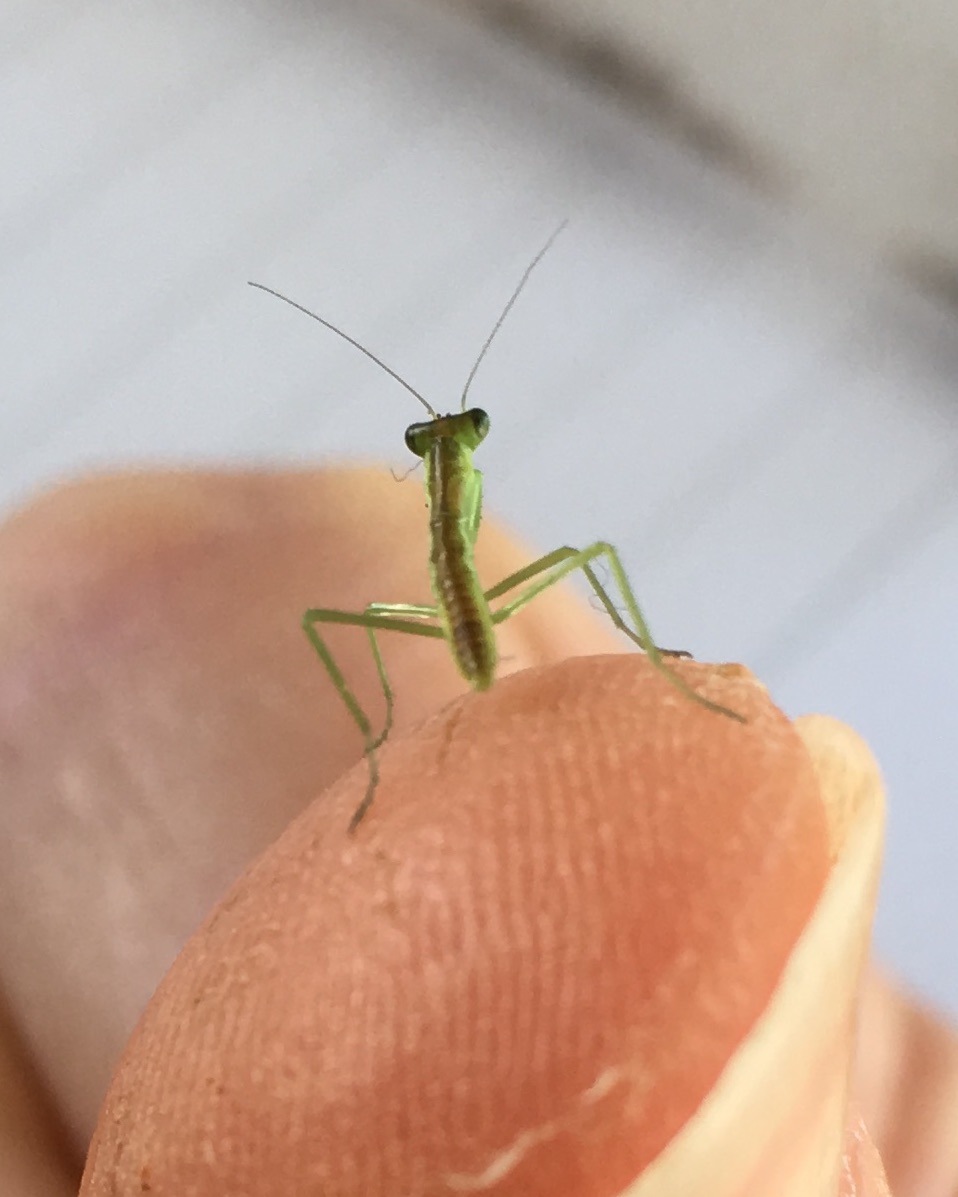
It’s that time of year again! The preying mantis egg case I collected in the autumn is hatching.

Because these mantids were in the warm office for half the winter, they’re early. Mantids in the egg cases outdoors haven’t yet emerged. So they need a little extra care. As the babies emerge, I transfer them to a large tank where they’ll be warm and well-fed for a few weeks while the weather improves. Eventually, I will release most, keeping only a few for use in educational programmes.

I never tire of this annual event. I love watching the newborn mantids stretch their legs and catch their first meal. And I’m always amazed that so many insects can emerge from such a small egg case. The current one, just 15 mm long, has disgorged 35 mantids so far, and only half the case has hatched. The mantids don’t all hatch at once—hatching seems to progress from one end of the egg case to the other over the course of a few days. In the wild, I suspect most of the later hatchlings are eaten by the early ones—it’s a mantid-eat-mantid world out there. It happens in my tanks, too, though I try to minimise cannibalism by spreading them out as much as possible and giving them plenty of hiding spots. I used to raise each individual in its own peanut butter jar, but that gets to be pretty time and space-consuming when there can be 70 mantids in each egg case.

Everyone’s heard the sensational ‘fact’ that female preying mantids eat the males after mating. It does happen, sometimes, in some species, but not as often as you might think. Mantids are creatures of instinct, and one of their most powerful instincts is to capture prey. In fact, this urge is so strong that, even when their digestive system is completely full, and they can’t actually eat anything else, they will continue to capture prey.

So it’s no surprise that a female mantid might snack on her mate, especially since she’s bigger than he is. In species where the females are significantly larger than the males, there’s a higher incidence of cannibalism after mating. Among New Zealand mantids, cannibalism at mating is rare—females are only slightly larger than males, and so the males have a good chance of fighting off the females. I’ve seen this in action in captivity—one of my females had a go at her mate, but he was every bit as feisty as she, and their tussle ended with both alive and unharmed.

My little babies won’t have to worry about mating cannibalism for a while yet, but there are plenty of other dangers out there—other predators, parasites, pathogenic fungi, freezing weather, and careless gardeners all take their toll. Of the maybe 70 mantids that will hatch from my egg case, only one or two are likely to survive to adulthood.

I’ll give my babies the best start I can, and then they’ll be on their own. Watching them now, catching gnats like pros, I think they’re well-equipped.

5 Simple Things You Can Do to Help Conserve Species

It’s Conservation Week here in New Zealand. Fittingly, one of the kōwhai trees we planted years ago has chosen this week to flower for the first time.

Conservation week is a good time to talk about backyard biodiversity. I’ve blogged more than once about biodiversity issues. It’s a topic near to my family’s heart, and something we strive to improve all the time.

Our yard is, unfortunately, home to a wide variety of non-native weeds, but it also sports native plantings (and even a fair number of native ‘weeds’). Here are just a few of the simple things we’ve done to improve the habitat value of our back yard for native organisms. You could do these, too.

  1. Plant natives instead of non-natives. Here in New Zealand this is especially important, but it’s a good rule of thumb wherever you live. Native vegetation will best support native wildlife, because they evolved together. Choose plants that provide food and shelter for local wildlife—shrubs with berries for birds and lizards to eat, dense grasses that provide hiding spots for invertebrates, and flowers that provide food for insects.
  2. Create lizard refuges. A pile of rocks or a stack of broken terracotta pot shards makes a nice refuge for lizards—the rocks and terracotta warm up in the sun, making a convenient basking spot for the lizards, and the little cracks between ensure a quick, safe get-away when predators appear.
  3. Just add water. Birds, insects, and other animals all need water to survive. Provide a bird bath, a small pond, or an attractive water feature, and you’ll find many more animals drawn to your yard.
  4. Kill non-native predators. Less important in some places, but here in New Zealand, protecting native birds and lizards requires controlling invasive predators. Trap out possums, stoats, and rats to give native birds a chance to nest successfully. Put a bell on your cat and keep it indoors around dusk and dawn when the birds are most vulnerable.
  5. Learn what you’ve got. No matter how small, your yard teems with species. Look closely, and you may be surprised at the diversity. Though our yard tends to be quite dry, we’ve discovered half a dozen species of moisture-loving slime moulds on the property. Once you know you an organism is present, you can tweak your planting and maintenance to protect and encourage it.

And that brings me back to the kōwhai tree, finally blooming. It’s not enough, yet, to attract bellbirds or tūī, across the vast stretches of agricultural land between us and the nearest populations, but someday, our kōwhai and flaxes, along with the neighbours’, may very well support a healthy population of native birds. All it takes is for each of us to care for our own backyards, and collectively we can improve the habitat for all our native species.

Sticky Feet! The Eucalyptus Tortoise Beetle

Hanging up the laundry this morning, I found this lovely beetle making its way along the washing line. It’s a eucalyptus tortoise beetle (Paropsis charybdis). I see them occasionally, but with only one eucalyptus tree in the yard, they’re not common.

I’m quite fond of tortoise beetles. This one isn’t much to look at, but many species are sparkling gold, and my first glimpse of them, as a kid, was a truly magical experience that I’ve never forgotten. What tortoise beetles have in common is their domed tortoise-like shape.

Their shape, combined with some pretty awesome feet is what keeps them safe.

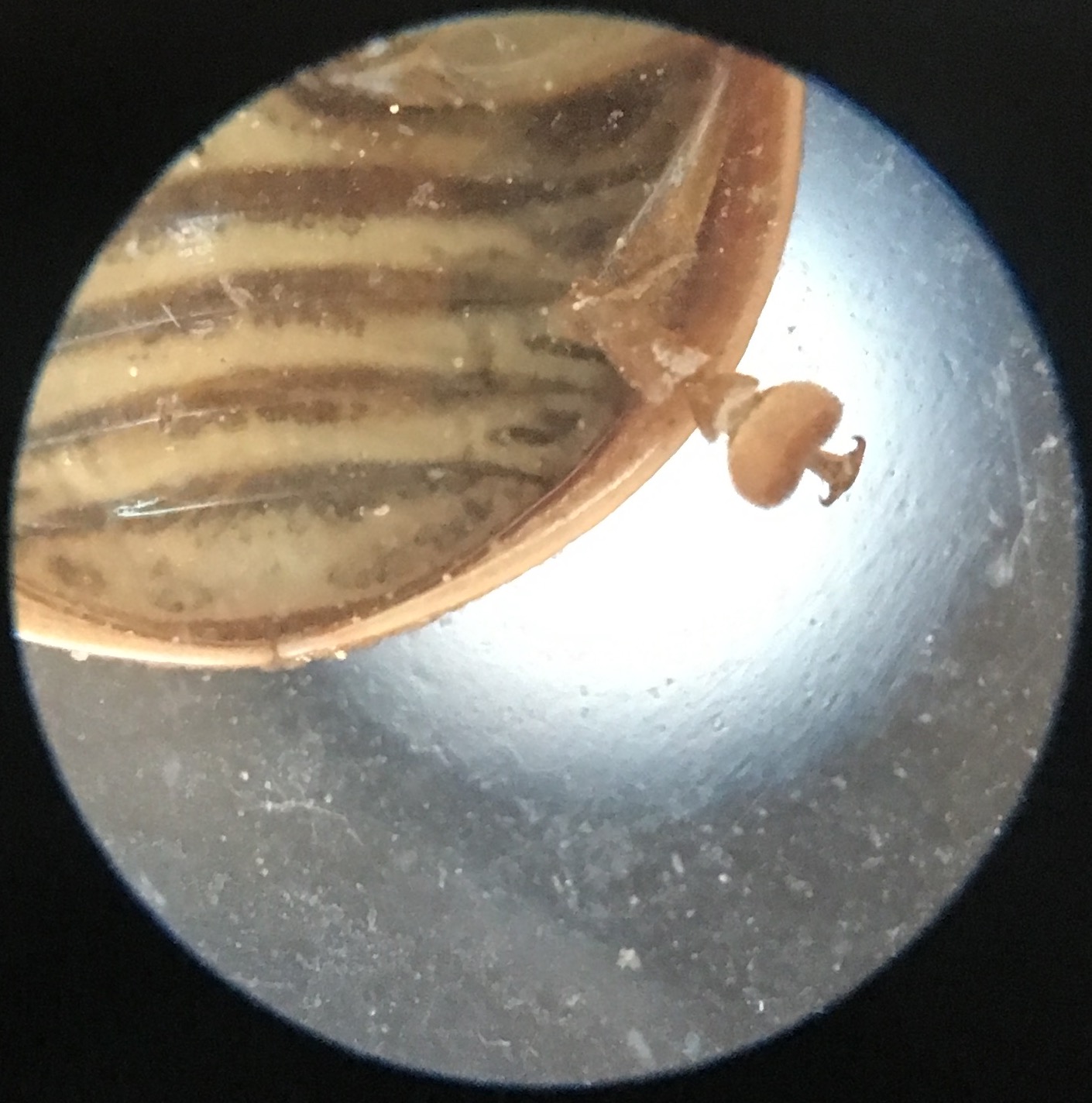
Tortoise beetles have wide pads on their feet (this one obligingly sat on a clear surface and showed its feet under the microscope). The pads are covered densely in short hairs, like the bristles of a toothbrush. Each hair is moistened by oil, which helps it stick to the waxy surfaces of leaves in the same way two wet drinking glasses stick together if they’re nested. The oil bonds to both surfaces and acts as glue. When disturbed, the tortoise beetle presses its feet against the surface, employing as many as 60,000 sticky bristles (about 10 times more than other beetles have) to keep it attached. These sticky feet, combined with the dome-like shape make it difficult for predators to dislodge the beetle.

Entomologist Tom Eisner performed a series of elegant experiments with the palmetto tortoise beetle, attaching weights to the beetles to see how much force they could withstand before being pulled off a leaf. He found they could hold up to 240 times their body mass. Those are some seriously sticky feet!

So if their feet are so sticky, how do they walk? Eisner showed, by looking at palmetto beetle footprints on glass, that when they walk, they don’t let all the bristles on their feet touch the surface. Their full adhesive power is only deployed for defence.

I don’t think anyone has tested eucalyptus tortoise beetle grip strength, but it’s definitely impressive. I popped this one into a narrow jar, and it never hit the bottom—it reached out with one leg, like some movie superhero, and grabbed the smooth wall of the jar, arresting its fall. Then, when I tried to get it out of the jar, it stuck like glue to the side. I had to slide a stiff piece of paper under its feet, prying them up one by one. It was obliging for the photo shoot, but when I tried to let it go, it stuck itself to the paper. It took a few determined nudges, but eventually I got it to the edge of the paper and it dropped off.

The eucalyptus tortoise beetle is not native to New Zealand, and is considered a pest in the forest industry here. Still, I have to admire the beetles’ sheer tenacity, and am willing to share my eucalyptus tree with them for the opportunity to see those sticky feet in action.