Stay Sharp

It’s the time of year when I have too much to do in the garden. It’s a race to get the garden beds prepared before the vegetables are ready to go out into them. It’s a race to keep ahead of the weeds in the perennial beds. It’s a race to get the finished compost out of the bin before I need the space for fresh material.

I hate to waste my garden time. I hate to take breaks, because every minute I’m not out there is a minute for the weeds to get ahead of me.

But I’ve learned that some breaks are not a waste of time. Sharpening the hoe is one of those breaks that pays for itself. When I’m using the hoe a lot, I stop every couple of hours to sharpen it. It takes just a few minutes, and it makes the job much easier and faster.

A nicely sharpened and well-maintained tool can make all the difference between back-breaking drudgery and a job efficiently completed.

It pays to stay sharp.

Nettle Season

It’s stinging nettle season and, as I’ve mentioned before, my garden is host to an irritating quantity of nettle—quite literally.

But though it is a stinging weed, I’ll admit to a certain fascination with nettle. Look at the stinging hairs (trichomes) under the microscope, and you’ll find beautifully wicked structures like fine hypodermic needles. Those syringes are full of an irritating mix of acetylcholine, histamine, serotonin, moroidin, leukotrienes, and formic acid to irritate your skin.

But the triggering mechanism for the trichomes depends upon turgor (water pressure), so once a nettle wilts, it can’t sting.

And once it wilts, nettle is an incredibly useful plant. It is edible and quite nutritious for both humans and livestock. The cooked greens are used in traditional dishes throughout the Northern Hemisphere where it is native.

It can be used to make a vegetarian rennet for cheesemaking, and is used to flavour and decorate some cheeses. I’ve made nettle rennet myself as a substitute for commercial rennet when I’ve run out.

Nettles can be used to make tea, cordial and beer.

The fibrous stems can be used to make linen-like textiles. The roots can be used to make a yellow dye.

Fed to chickens, nettle is an effective egg colourant, which may explain the deep orange colour of my chickens’ egg yolks at this time of year.

All in all, stinging nettles don’t deserve their bad reputation. Like many of our weeds, they’re useful plants that we’ve forgotten how to use.

Making the Most of It

August adventure day at Rakaia Gorge

August is always a month of frustration for me. On the one hand, I’m excited, because spring planting starts, and though the weather might not be the best, there is the promise of spring on its way.

But with the promise of spring on its way is the threat of winter being over. I look at the gardening tasks ahead, feeling overwhelmed and wanting to get cracking on them. But I look back at winter and feel I haven’t accomplished nearly enough while the cold weather lasted. All those sewing projects that I meant to get to, that extra writing I had hoped to do in the long dark evenings, the photographs I meant to print and put into the family photo album…August reminds me that the time for finishing indoor projects is running short.

It’s not that I didn’t do anything over winter. I was busy sewing, knitting, and writing. But there simply aren’t enough winter days for me to accomplish everything on the to-do list. When August comes round, I have to resign myself to not getting things done. I have to prioritise. That photo album? It’s been three years since I’ve put a picture in it. Looks like it’ll have to wait one more year. The jacket I wanted to make for myself will take backseat to the one my son has asked for–he needs it more. The pair of socks I started knitting last winter…well, I still have hope I’ll finish that project.

Half of me is ready for spring. Eager for warm sunny days to whip the garden into shape. The other half of me wants a succession of rainy weekends so I can finish all those winter projects.

The only reasonable thing I can do is make the most of whatever the weather gives me in August. If it rains, I’ll dive into the sewing with gusto. And as soon as the sun comes out, I’ll don gardening gloves and head outside. And if the weather is so fine, it begs for an adventure, I’ll leave everything on the to-do lists for another day.

Planning Season

It’s that time of year again, when I eagerly await the seed catalog. The garlic has been planted, and I’ve made a list of the seeds I have and the seeds I need. I’ll determine what seeds I want once the catalog arrives.

I’ve created the garden map for this coming season, but haven’t yet filled in the spaces. I’ll wait for some cold, nasty evening to do that.

I’ve been eyeing the garden itself, too. There’s still clean-up work to be done out there, and there are big mallow plants to be pulled (the chickens manage many of the weeds, but they can’t deal with mallow). I keep telling myself it won’t be long before I can get out there again. It’s a bit of a lie—it’s still six weeks before I can realistically start preparing the garden for spring. But if I keep myself busy with planning, spring will be here before I know it.

That’s my hope, anyway.

A Messy Life

My not-so-straight edges.

I was working in Halswell today, and I went for a walk at lunchtime. I walked through some of the newer subdivisions, and after a time, I realised I had no idea where I was, though I’ve walked those same streets many times. I wasn’t worried. I wasn’t lost, I just couldn’t remember what street I was on.

Walking on, knowing I would find my location at the next street sign, I pondered why I was so lost in a place I knew reasonably well. I looked around me. It wasn’t a cookie-cutter neighbourhood, with row upon row of identical houses, but there was a sameness to every house, every yard. They were all perfect. The lawns were immaculately clipped, with not a single weed in any of them–more carpet than grass. The paths were edged as though with a ruler. The boxwood hedges were precisely cut and perfectly square–they could have been boxes, cleverly painted to look like plants.

Every house had perfect stonework, perfect paint, a smooth driveway leading to a perfectly hung garage door (operated, no doubt, by an electric opener that ran smoothly and quietly).

The houses, the yards, the streets looked like they had dropped straight from an architectural drawing. Devoid of all character, stripped of any indication real people actually lived there. They were sanitary, and soulless.

It’s no wonder I felt lost.

My home is not like that. My home is full of weeds, sprawling hedges in need of trimming, peeling paint and rotting weather boards. It’s full of paths edged by the grass creeping across their surface. Flowers that aren’t deadheaded, trees that need pruning. My home is alive and growing, taking on surprising forms, springing up in unexpected places.

And my life reflects the weedy lawns that make up my world. It is not a neatly clipped hedge, but a wild hedgerow, full of surprises. Sometimes good surprises like ripe blackberries, sometimes bad surprises like thistles. But it’s alive and exciting.

I think about the people who inhabit those sterile houses on sterile streets. Are their lives as neat and tidy as their yards? Are they as forgettable as the houses that all eventually look the same?

The thought makes me shudder. It’s true, my messy yard and my messy life make me work. I don’t often put my feet up. Some days are a struggle, and every day is long and busy. But my messy yard, my messy life is always growing, even in the midst of drought, or in the aftermath of herbicide overspray. There, in the mess are the seeds of something new, something exciting, something tough and resilient.

I did find my way out of the soulless subdivision. It was a relief to leave it behind, and a joy to come home to my rampant weeds, to a messy life in a messy yard, full of surprises, growth and life.

Ecological Weeding

A parasitised aphid (the bloated brown one), and an unparasitised one (the green)

A parasitised aphid (the bloated brown one), and an unparasitised one (the green)

As much as I enjoy weeding, I can’t possibly keep up with them all. There are always weeds on the property.

In truth, I don’t try to eliminate all the weeds. I take a ‘live and let live’ approach with many of them. I also recognise the utility of many of the weeds on the property–or at least their utility to other organisms.

Except in the vegetable garden where they are, literally, a pain, I allow nettles to reside in the yard. They provide food for our native yellow admiral butterflies and, in a pinch, can be used to make rennet for cheese making. Even in the vegetable garden, I don’t mind seeing them–they hate dry soil, so they’re a good indicator that I’m watering the garden enough for the vegetables.

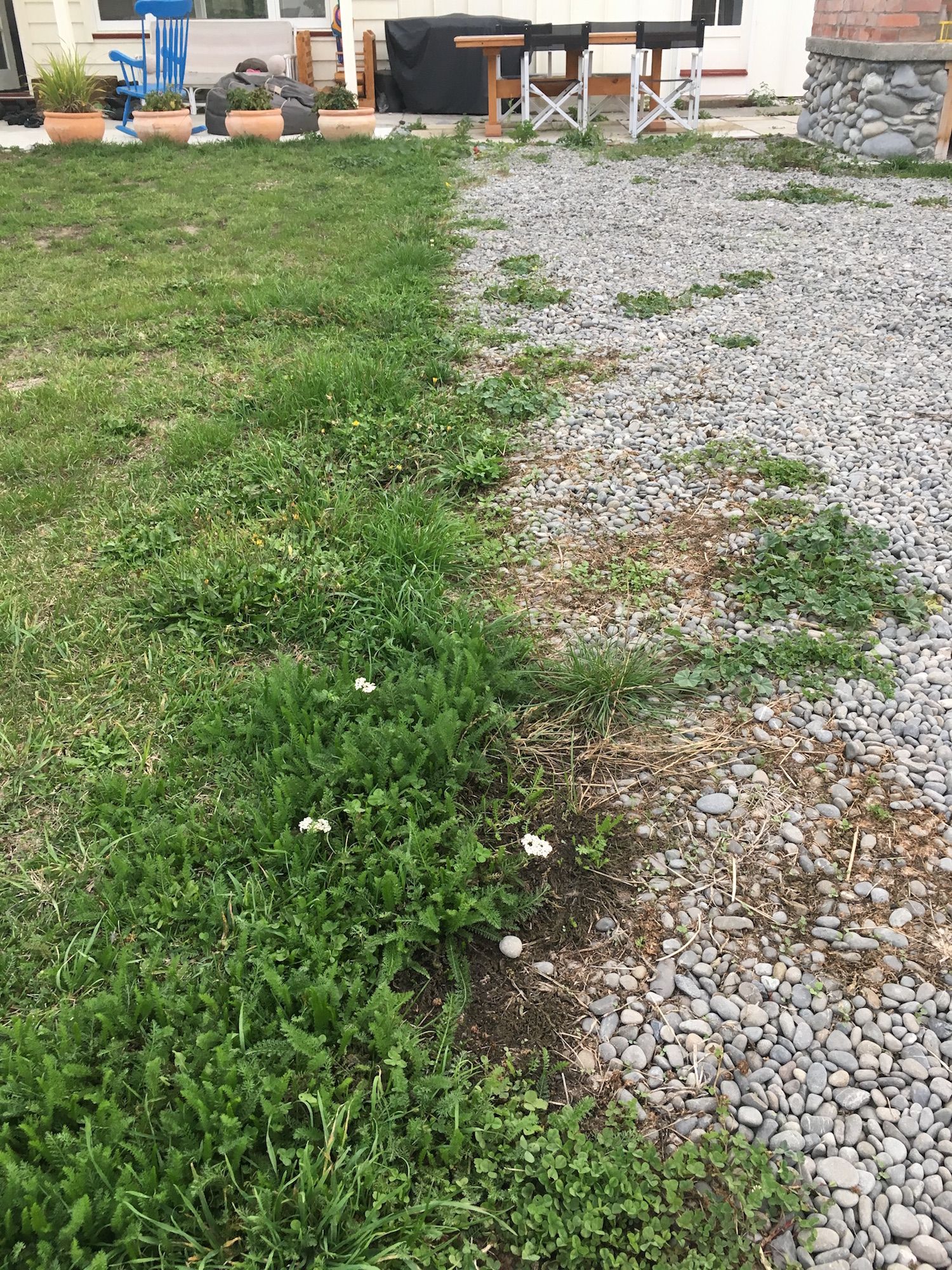
Weeds like yarrow, clover, and dandelions are good food sources for beneficial insects, so they, too, are allowed to grow wherever they’re not in direct competition with crops.

Weeds are also sometimes good ‘trap crops’, attracting pests to plants (themselves) I don’t mind pulling out and destroying to get rid of the pest.

Sometimes, though, the ‘trap crop’ idea backfires on me. Today I noticed that a sow thistle I’d allowed to grow was covered in aphids–it was a great opportunity to destroy thousands of pests. Except that as I bent to pull the weed, I noticed that a large number of the aphids were parasitised by wasps. I depend upon these wasps to deal with my springtime aphid problems. Short of painstakingly picking off every parasitised aphid and caring for them until the wasps hatch, killing the aphids on the weed is going to kill the wasps, too. What to do?

So the weed has gotten a temporary stay of execution. I’ll keep an eye on it. When the wasps have emerged from the parasitised aphids, I’ll pull it and kill the remaining aphids.

Losing Soil, Making Soil

img_3148This time of year is always dusty. The soil is dry. The air is dry. Farmers harvest the summer crops and turn the soil to plant the winter’s grass. It’s not unusual for a wind to kick up, sending newly-turned soil into the air.

I don’t know how much soil farmers in Canterbury lose this way (they’re also getting soil from the farms upwind and loess blown off the mountains), but I do know that where my back yard meets the neighbour’s field, my property is significantly higher. At least some of that soil is being lost.

Interestingly, there seems to be a place on the neighbours’ farms where soil is being made.

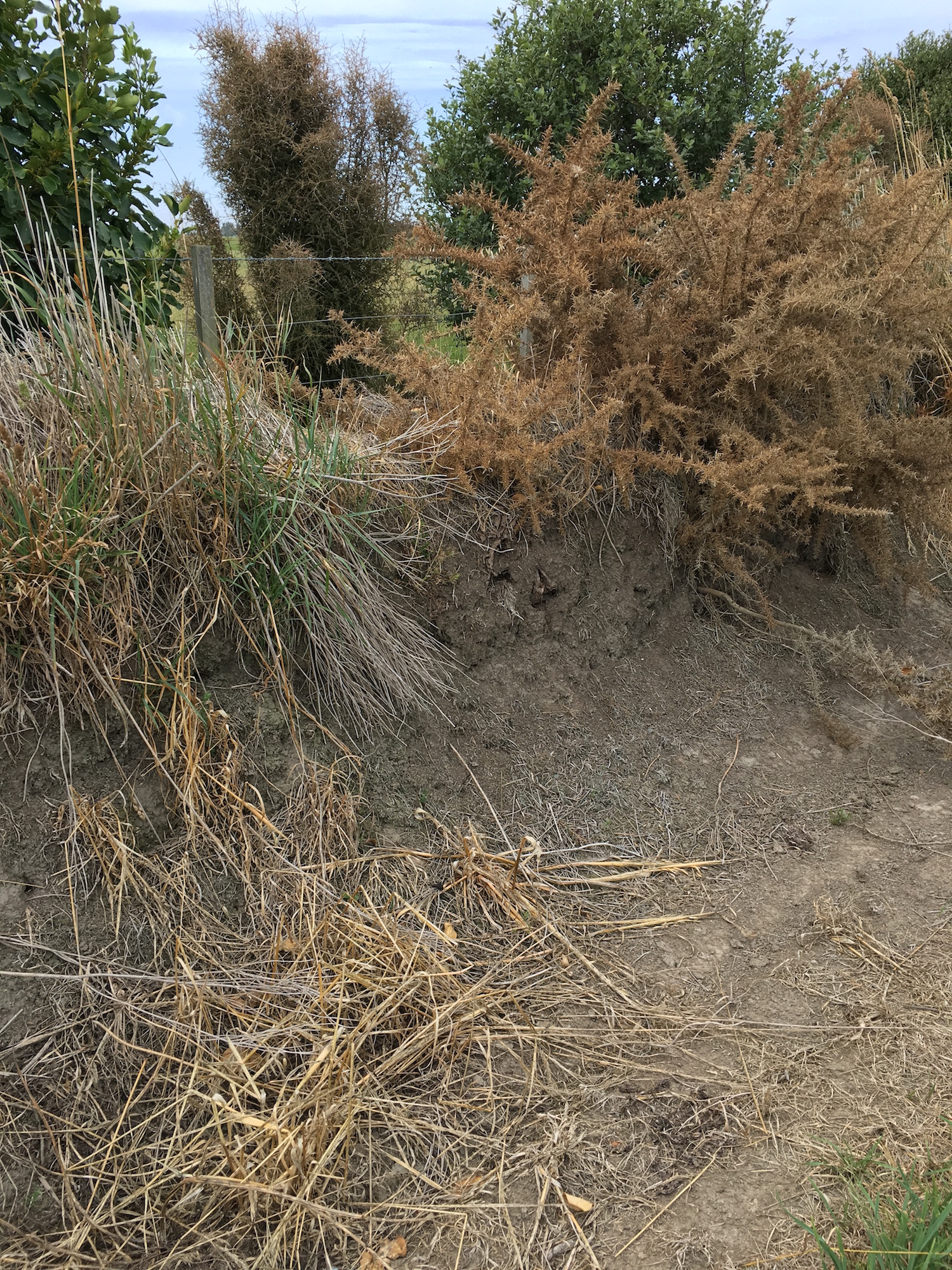
A hundred and fifty years ago, farmers in Canterbury were planting gorse hedges for shelter and fencing. Many of those gorse hedges remain (indeed, they’re hard to get rid of). The original plants are almost certainly long gone, as gorse is a short-lived shrub, but new plants are continuously growing from seeds cast by the mature plants.

It’s quite possible that my neighbour’s gorse hedges have been here since Joseph Price took up the original 5000-acre run number 79 in 1853.

Gorse is dense when pruned into a hedge. New outer growth shades out growth in the middle of the hedge. Thorns and branches fall and form a dense, prickly mass at the base of the plant. Over time, this detritus breaks down and forms soil.

Quite a lot of soil, by the looks of it.

Some gorse hedges were planted on ridges–ditch and dyke, it was called–the farmer dug a ditch to help drain the land, and planted a hedge on the resulting pile of soil scooped out of the ditch. Some hedges were just planted on the level ground. This is how the hedges along my lunchtime walk were planted, but today it looks like they were sown on a tall, narrow wall of soil.

The build-up of soil under the gorse hedges is impressive. In some places, it is as high as my waist. It is most visible where the gorse has been herbicided off to make way for native hedging plants. There you can see how the twisted trunks and branches have caught the detritus and held it in place, even after it has rotted.

How important are these ridges of new soil in a landscape that is losing soil? Probably not terribly important–they cover just a tiny fraction of the landscape–but I find them intriguing, nonetheless. Our agricultural landscapes–as modified, controlled and cultivated as they are–still hold interesting stories.

The View from the Compost

img_2929-smI finished turning the compost today—a back-breaking, exhausting job I don’t particularly enjoy. After I added each layer, I climbed on top of the pile to even it out and water it. From my two-metre high perch, I had a lovely view. I admired the neighbour’s seed radishes—wide stripes of white and pink flowers marking the two varieties he is crossing this year. It looked more like a curtain than an agricultural field.

Then I turned to admire my own garden. Well, actually I just turned. I’ll admit that I was a little surprised I found the view so nice.

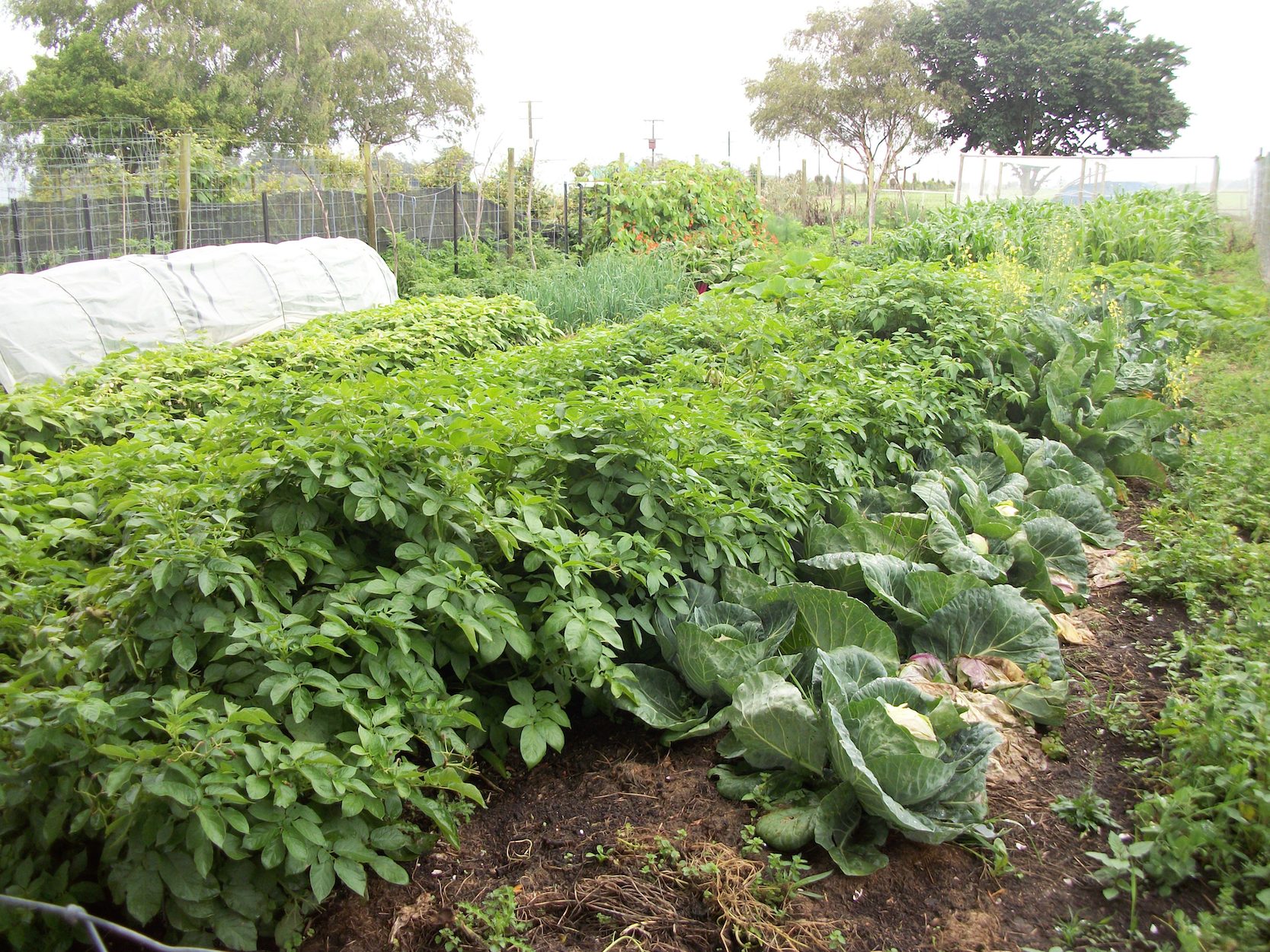
The early January vegetable garden is always gorgeous—everything is at its peak lushness. I expected to find that attractive. But surveying the entire “production” side of the property from my perch, I was pleased to note that the whole place looked surprisingly lush. The berry beds are dense and tidy. The extra vegetables planted in my “overflow beds” (because 300 m2 (3230 ft2) of vegetables naturally wasn’t enough) are growing well, too. The artichokes look a little sad, and the grass paths are brown, but that is to be expected in the heat of summer.

The overall effect was one of lush productivity. I spent a little extra time on top of the compost pile to enjoy the view. It made today’s brutal job a little bit nicer.

New Life for an Old Rug

img_2793

A new garden area with freshly laid rug weed-block. Disguised with wood chips, no one will ever know it’s there.

Nothing lasts forever. Even well-made items eventually come to the end of their useful life.

But that doesn’t mean they’re not useful…in a different way.

Rugs get hard use in our house—there’s an awful lot of traffic in a small space. Add a dose of wool moths and high UV radiation, and it’s no wonder our rugs eventually start falling apart.

But tatty wool rugs don’t need to end up in the landfill. They can serve as excellent weed-blocking mulch in the garden. They last for years and eventually simply rot away. So much nicer than the plastic weed-block that eventually breaks up and stops working, but still needs to be removed and disposed of.

And as an added bonus, out here where there is no rubbish collection, it means we don’t need to haul the old carpet to the tip.

Through Fresh Eyes

100_2137-smAll week I weeded and tidied the yard in preparation for a pizza party on Friday night. I tried to make the sad, tired parts of the yard look less decrepit and free the nicer spots from their mantle of early summer weeds.

It’s a Sisyphean task—by Friday, the spots I had weeded on Monday were already sporting fresh weed growth.

So as the first guests arrived, I fretted over the shabby state of the yard and garden. As I looked around, I saw weeds, flowers that needed deadheading, outdoor furniture that should have been hosed off…

But no one noticed my weeds, aside from those guests studying particular ones (it was a party of ecologists, after all, and they were thrilled to find their research subjects ‘in the wild’).

Instead, they saw the musical instruments, the blooming flowers, the fish in the pond, the cat playing with a grass stalk, the places for playing and relaxing. They saw all the things we love about the yard, and never noticed the twitch sprouting in the paths and the flecks of bird poo on the deck chairs.

“This is awesome!” cried one guest as he beat out a rhythm on the outdoor drum set.

“It all looks so fresh…like it’s all new,” said another.

Throughout the evening kids and adults alike wandered around, feeding goats, playing outdoor instruments, grazing on raspberries, sitting on the benches tucked here and there, climbing trees, playing lawn games, and feasting on produce from the garden, baked in the new bread oven. Everyone smiled. Everyone relaxed.

It was good to see the property through their eyes for the evening. I focus so closely on the work that needs to be done, that sometimes I forget that, even with weeds or grass that needs mowing, the place is a haven. Sometimes I forget to put away the to-do list and just enjoy the place. I struggle to stop and smell the roses without also noticing they need to be pruned.

So thank you to all the guests who joined us Friday night. You gave me a fresh perspective and gave me permission to slack off a little this weekend—to just be here.