Magpie Moths

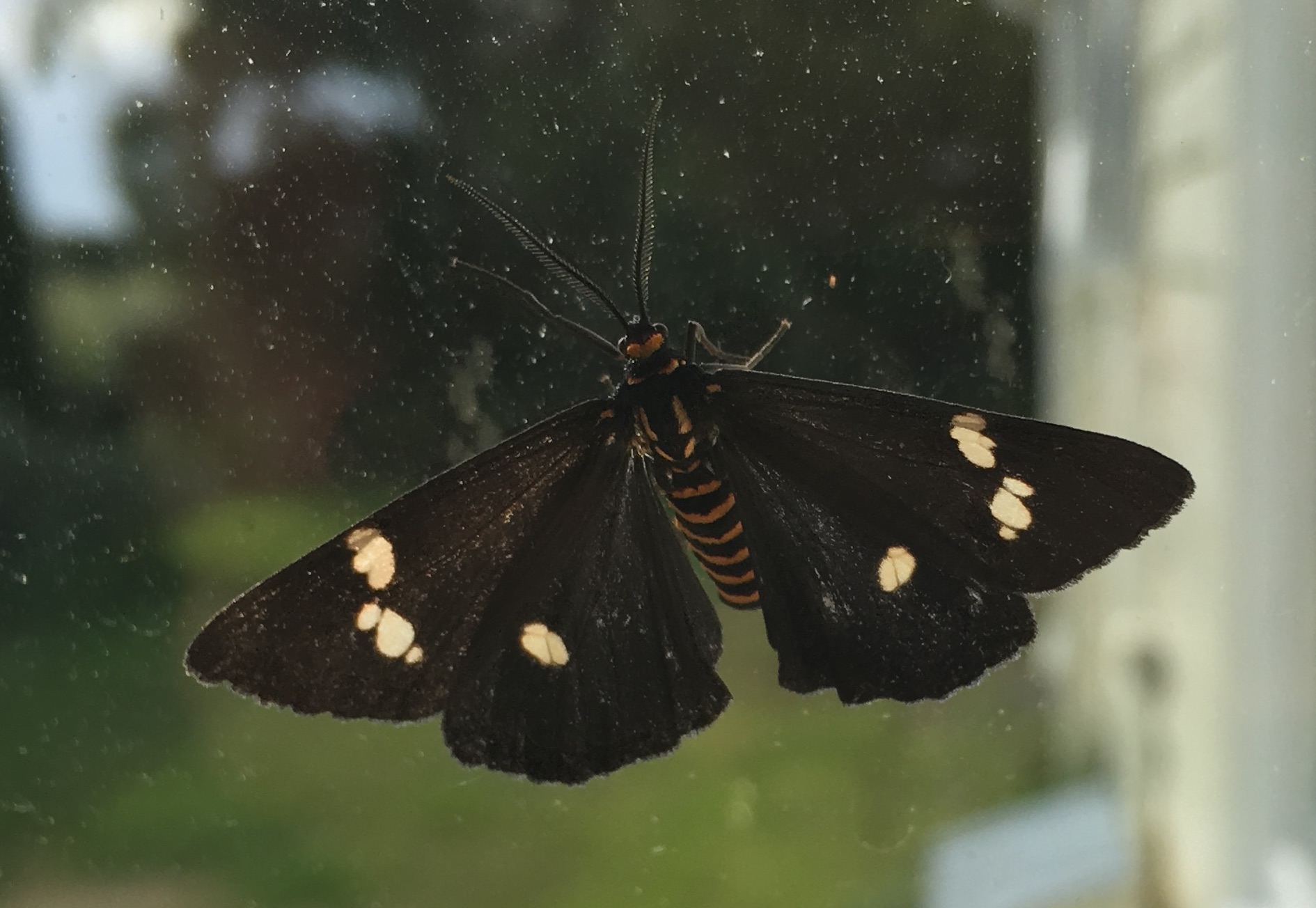
It’s the time of year when one of my favourite moths emerges—the magpie moth (Nyctemera annulata). Magpie moths are in the family Arctiidae—a family including many brightly coloured day-flying moths that threaten to blur the line between moth and butterfly. N. annulata is endemic to New Zealand, though it has a closely related Australian cousin, N. amica, with which it can interbreed.

Magpie moth caterpillars eat plants in the daisy family, especially in the genus Senecio. Common host plants include groundsel (Senecio vulgaris), ragwort (Senecio jacobaea), and cineraria (Jacobaea maritima, formerly Senecio cineraria).

We have large quantities of groundsel, and a few sizeable cineraria on the property, so we always have a healthy population of magpie moths. The caterpillars are black with orange ‘racing’ stripes, and somewhat hairy.

As you can guess from their colouration, magpie moths are poisonous. As caterpillars, they sequester toxins from the plants they eat. These toxins deter most predators. The shining cuckoo, however, is apparently quite fond of magpie moth caterpillars. It avoids the poison by eating only the insides of the caterpillar, leaving the bitter-tasting exoskeleton behind.

In addition to eating weeds like groundsel and ragwort, the magpie moth is a beautiful, colourful addition to the garden. It always makes me smile.

Hawksbeard: a Cheerful Weed

We’ve had recent, much-appreciated rain, and the grass is unusually green for January. But even with the grass growth, summer is weed season in the lawn.

More specifically, summer is weed flowering season.

Some of the weed flowers are uninspiring, and merely annoying—the dull greenish flowers of plantain, for example.

Others bring a splash of colour to what is normally a bleak time in the lawn.

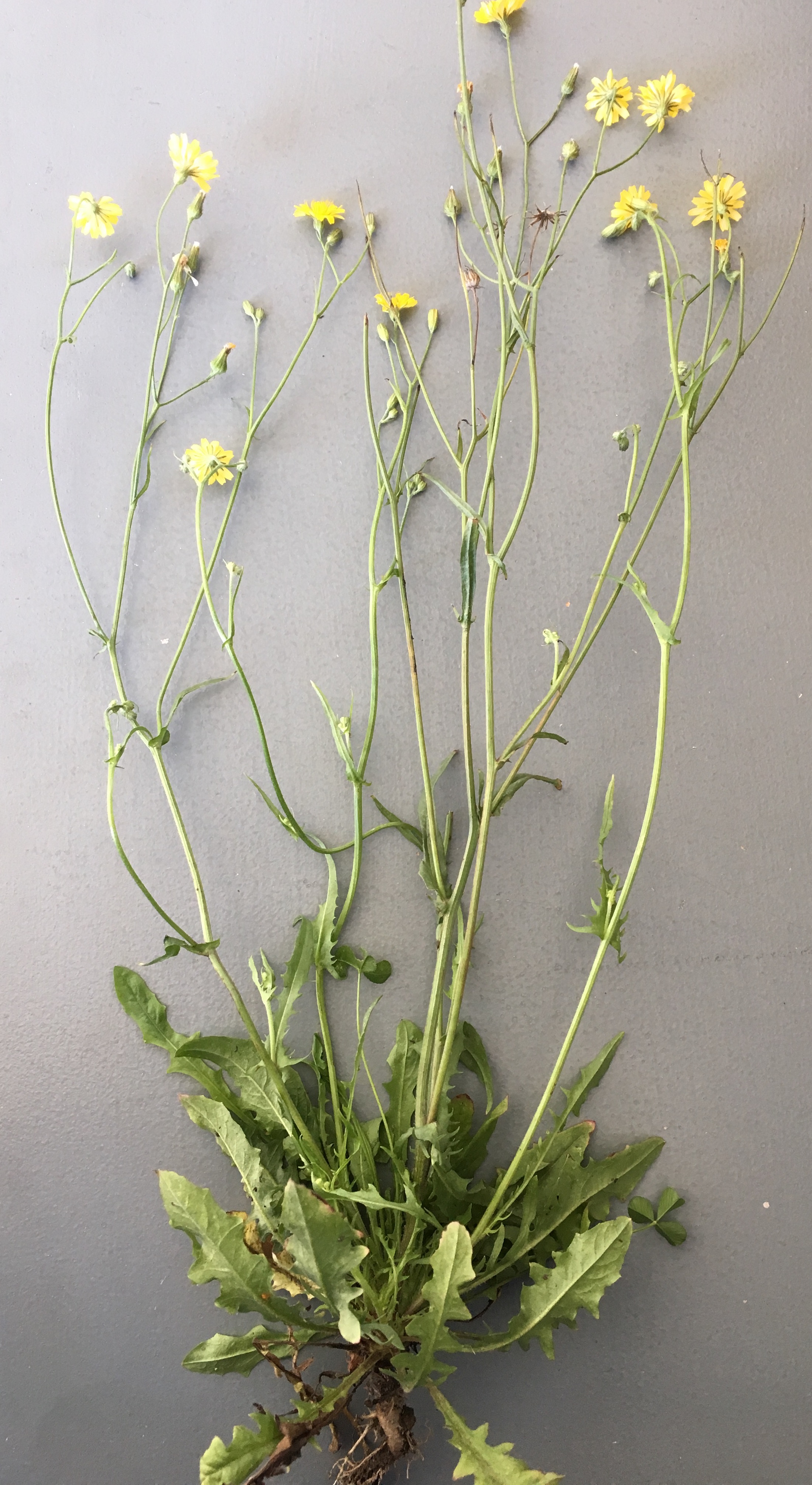
Hawksbeard (Crepis capillaris) is one of the more prolific colourful weeds in the lawn in summer. An annual or biennial member of the dandelion family, this plant bears small, cheery yellow blooms on tall, branched stems.

The NZ Plant Conservation Network shows hawksbeard as being naturalised in 1867 from Europe. Like its cousin dandelion, it was most likely brought to New Zealand on purpose as a food plant—it’s young leaves are edible. Like the dandelion, it is no longer valued as a food, but is considered a weed.

I will admit, the tall flower heads of hawskbeard can be annoying in the lawn. They seem to spring up overnight between mowings, and they slap against your legs as you walk through the yard. But I do appreciate their yellow blooms at a time of year when most other plants give up from the heat and drought. I have been known to use hawksbeard in flower arrangements, and their green rosettes are sometimes the only green to be found around the yard.

Stress Free…sort of

I’m getting better at this. Sort of.

Two weeks to plant out day, and I was able to spend a day at the beach without stressing.

Not that I didn’t stress, actually. I worked hard all day Saturday, and then scrambled to get more done Sunday morning before we left, and then scrambled to finish the rest when we got home Sunday evening.

But from the moment I stepped out the door to the moment I returned, I didn’t think about weeds, plants, animals, cleaning…nothing on the to-do list.

I slipped momentarily, sitting at the edge of a wood-chipped playground…There was a twitch plant growing up through the woodchips. I was sorely tempted to reach out and yank it out, but I stayed strong. That weed is still happily growing, though it was a near thing.

Maybe some day I’ll be able to take an overnight trip without stress. Baby steps.

Subterranean clover

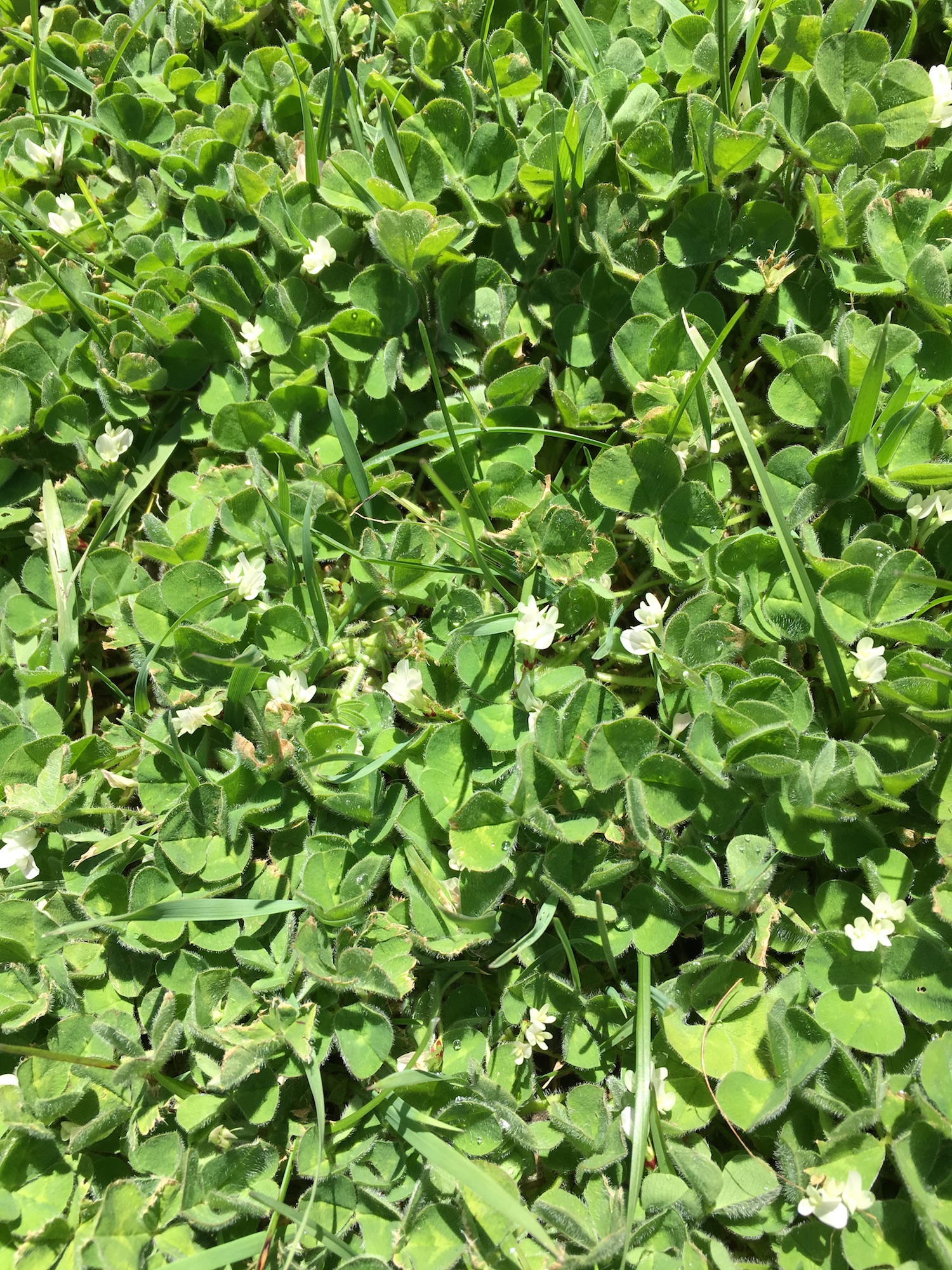
Subterranean clover (Trifolium subterraneum), like other clovers throughout the world, is an important pasture species. And it’s also a weed.

I’ve grown quite fond of ‘sub-clover’ as it’s often called. It’s much smaller than red or white clover, and the flowers form in clusters of only 2-5 in each head (as opposed to the large clusters that make up each ‘flower’ of other clovers). It also has the interesting habit of turning its flower heads downward after germination, so that the seed pods develop underground (hence, its name).

What I like most about subterranean clover is the thick mat of low-growing greenery it can produce, even in the dry rock where the old driveway used to be. Without it, some areas of the lawn would be bare year-round.

I also like the fact clover is a nitrogen-fixing plant. The clover in the old driveway is improving the soil for other plants as it grows and dies. With its help, grass might some day thrive there (though I’m not holding my breath).

Unfortunately, sub-clover dies. Dramatically. Just when we’re desperate for green. It’s a winter annual, meaning it sprouts with the autumn rain, grows through winter and spring, and flowers in early summer. When summer turns hot and dry, the plant dies, its life cycle complete. The lawn outside my office is composed almost entirely of sub-clover, so when it goes, it’s grim.

The only consolation is that the grass dies shortly after the sub-clover. Summer is simply brown here.

So for now I’m enjoying the lush greenery underfoot. It’s wonderful while it lasts.

My First Selfie

So I’ve been doing a lot of weeding lately–clearing beds, dealing with a winter’s worth of growth…

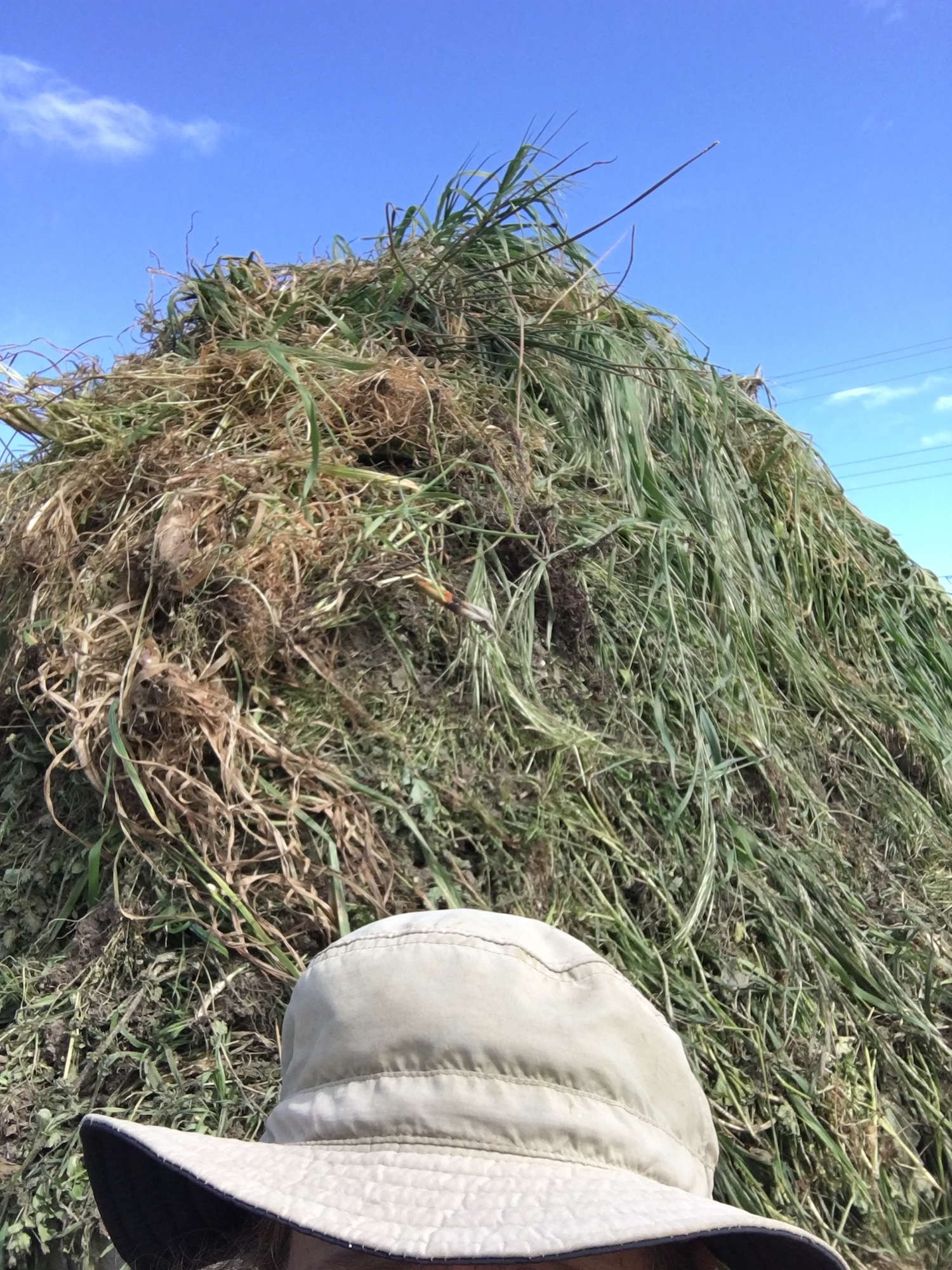
As a rule, I don’t take selfies, but I felt a picture of the compost pile needed a person in it for scale. It was hard to get any shot that included both me and the top of the compost pile, but, here it is–my selfie with Mt. Weedmore.

A New Weed!

I found a new weed in the garden the other day. I don’t know whether to be excited or dismayed.

This one is beaked parsley, also known as bur chervil (Anthriscus caucalis). This weed is native to Eurasia, where it appears it is pretty much ignored. It’s listed by the UK Department for Environment, Food, and Rural Affairs as an indicator species for high value arable margins, but beyond that, it rates little mention in its homeland. It is apparently neither particularly tasty, nor poisonous. It is apparently not used for any medicinal purposes. It’s just a plant that’s neither particularly common, nor particularly rare.

Nor is it mentioned often in the many countries where it is a weed. If it is mentioned at all, it’s usually lumped with its close relative, wild chervil (Anthriscus sylvestris), which appears to be more of a problem. It apparently prefers riparian zones, but is quite happy to live in drier areas, too.

The seeds are covered in curved spines and hairs that cling to fur. The plant almost certainly arrived in New Zealand on the back of an imported sheep.

With so little information about the plant available, I am naturally intrigued. What secrets is this unassuming plant harbouring? Its family–Apiacea–includes such well-known plants as carrot, poison hemlock, fennel, parsley, coriander, dill, caraway, parsnip, celery, anise, lovage, and many others. Many of these plants produce defensive compounds, some of which are incredibly toxic to humans, and some of which are sequestered by caterpillars in the genus Papilio (swallowtail butterflies) for defence.

So I can’t help thinking that bur chervil might harbour some interesting chemistry and ecological connections, if only someone would have a look.


Am I Weird?

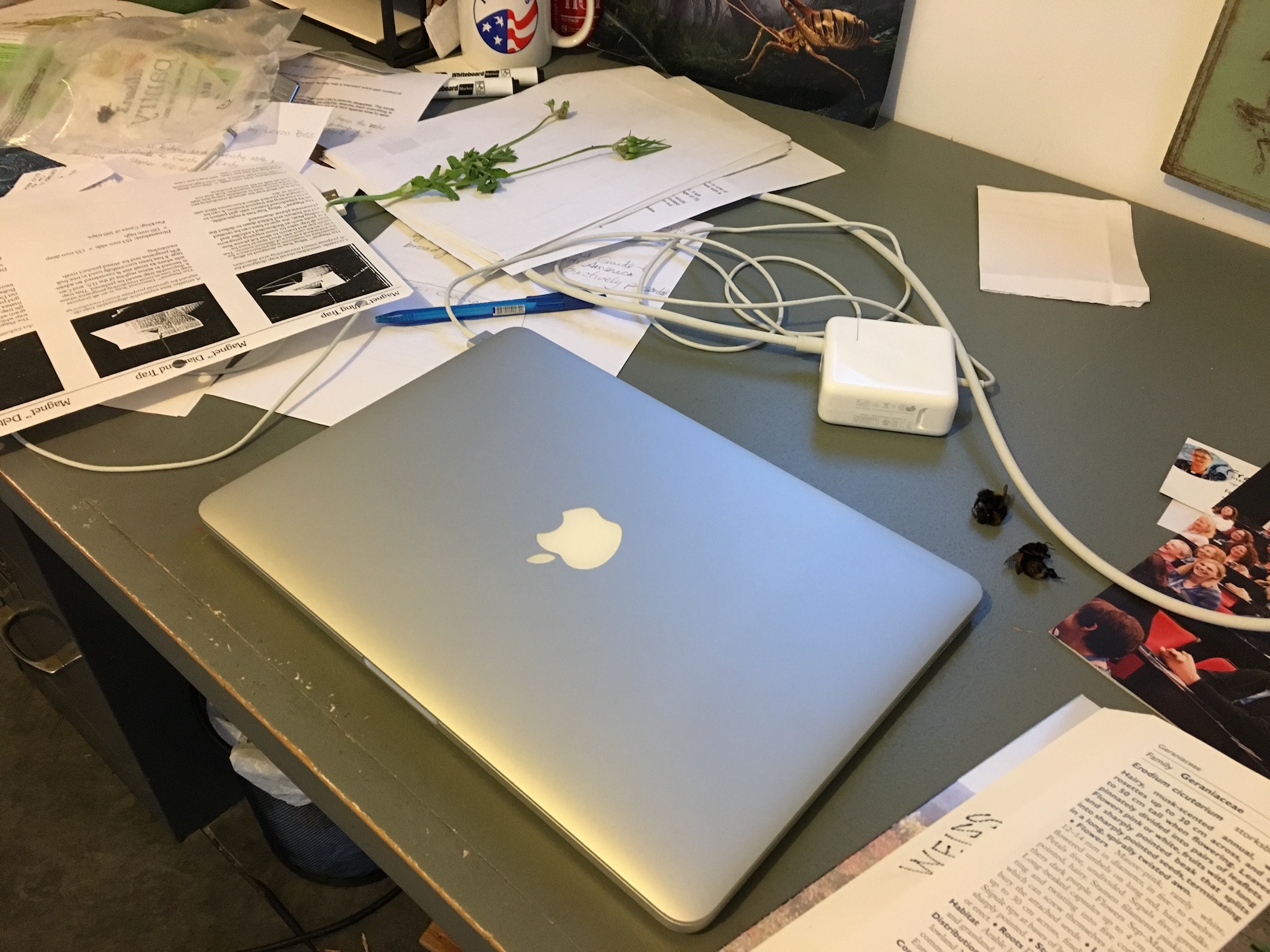
Stepping into my office the other morning, I had a moment of clarity, in which I saw my desk as a stranger might.

It was pretty scary.

The most obvious thing was the computer. Okay, that’s normal. But that’s where normality ended.

Strewn around the computer there were papers. There were notes for a non-fiction book proposal that included calculations for the intrinsic rate of increase of pea aphids, notes about parthenogenic reproduction, and a list of potential titles, many of which included the word ‘alien’. There were also a smattering of papers and notes from the workshop I attended last weekend, a note about my son’s shoe size, and the beginning of a short story set in New Zealand’s not so distant future.

That’s not too weird, though the story is a little bizarre…

Making a lump under the papers were three D&D dice. I use them for my students–they can roll the dice to choose a random writing prompt from the list of 500 prompts I’ve made for them. Honestly, I don’t roll the dice to see if a character lives or dies in a story (though that could be fun). The dice sit on my desk between classes because they’re fun to roll around in my hands while I’m thinking.

Well, that’s not too strange…

Also on the desk was a stem of the storksbill I’d blogged about the day before. It was still there, though I should have thrown it on the compost when I was done with it. It was interesting to look at…

And nearby was the Weeds of New Zealand book that I’d used for reference when blogging about the storksbill. I’d gotten sidetracked after the blog post was written, and spend a good half an hour perusing information about weeds. I left it sitting out because, you know, everyone needs a weed book on their desk.

And here’s where the tableau on the desk got…um…interesting…

Two dead bumblebees nestled together near one corner of the computer. They’d been there for days–ever since I found them on the floor and noticed that one of them had a drop of venom on her stinger. I put it under the microscope at the time for a photo shoot, but then kept the bees on my desk as…as…well, for no good reason really, other than that I enjoyed looking at them, especially as their parasites (mites) started to abandon their dead hosts and crawl all over my desk, questing for a new bee.

That’s not weird, right?

Over on the other side of the computer was a dead German wasp in a plastic bag. She was in the bag because I’d just taken her out of the freezer. Um…yeah. She was clearly a queen looking for a good nesting site (and she was a non-native pest that I’m deathly allergic to), so when I found her in the house, the only sensible thing to do was to kill her. But there was no point in wasting her. I popped her into the bag and into the freezer to kill her without damaging her, thinking I’d pin her later and keep her for teaching.

That’s definitely not weird. Everyone stores bugs in the freezer, right?

And thankfully out of sight inside a folded piece of paper was the dead mosquito I’d brought back from Auckland because it was a species I don’t see much of here, and when I saw it land on my ankle to bite me, I thought it would be a good specimen to keep.

Weird?

*Sigh*

It was definitely time to clean the desk before someone came to visit.
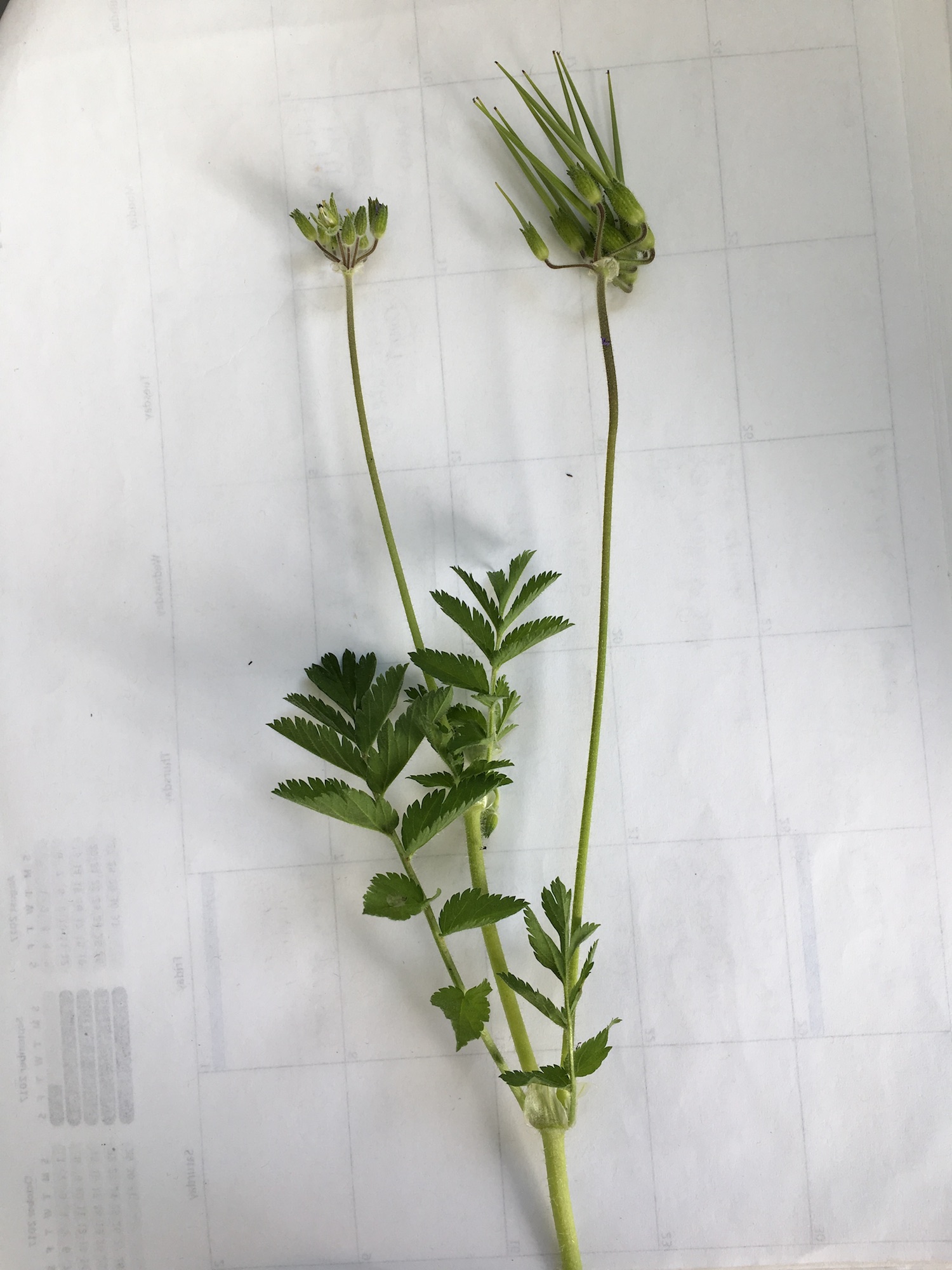
Storksbill

Continuing my springtime obsession with weeds…

Most of my weeds are most weedy in the vegetable garden. That’s where my tolerance is lowest and the weeds’ damage is worst. In fact many of the plants I consider weeds in the vegetable garden are quite welcome in the paddock—yarrow, clover, plantain, and nearly all the grasses. And in the lawn, I don’t worry about weeds at all—as long as it’s green and can be mowed, it works for me as lawn.

But there are a few weeds that are worse in the paddock and lawn than in the garden.

Musky storksbill (Erodium moschatum) is one of them. In the vegetable garden, the weed is aggressive and quick-growing as you would expect from a weed, but it’s pretty easy to pull out. It doesn’t resprout easily from the root, and doesn’t send out underground runners. It seeds prolifically, but the seedlings are easy to deal with along with all the other weeds.

In the paddock, however, it’s a different story. Theoretically, it’s a fine fodder plant when young, but once it sets seed, it can start causing trouble.

The long spiky fruits that give the plant its common name can work their way into animals’ flesh. I have, fortunately, never had to deal with storksbill fruits stuck in any of my goats, but it’s not something I ever want to have to do.

Keeping the storksbill out of the paddock requires constant vigilance. The plants grow quickly, and seem to go from tiny rosette to fully fruited overnight. And because I can never catch them all, for every one plant I pull, two seem to grow in their place.

In the lawn, those spiky seeds form just below mower height (instead of at about 50 cm like they do elsewhere), making barefoot walking in the heavily infested parts of the lawn an excessively exciting experience.

All in all, as weeds go, it’s not the worst. I can’t say I appreciate its charm, because it doesn’t really have any. It doesn’t appear to have any particular use (and I suspect it arrived here accidentally), but the seed heads do have a weird goofiness to their look that I have to admire while I yank them out of the ground.

Spring Weeds–Dock

Springtime is weed season, and there are plenty in my garden–57 species at last count.

I grumble about weeds, but I also find them fascinating. Weeds are the opportunists, the survivors, the tough and persistent plants of the world. Some have been spread accidentally, through virtue of their mobile, sticky, or tough seeds, but many more have been introduced on purpose. They are plants we once considered useful, and it is our changing values that make them weeds today.

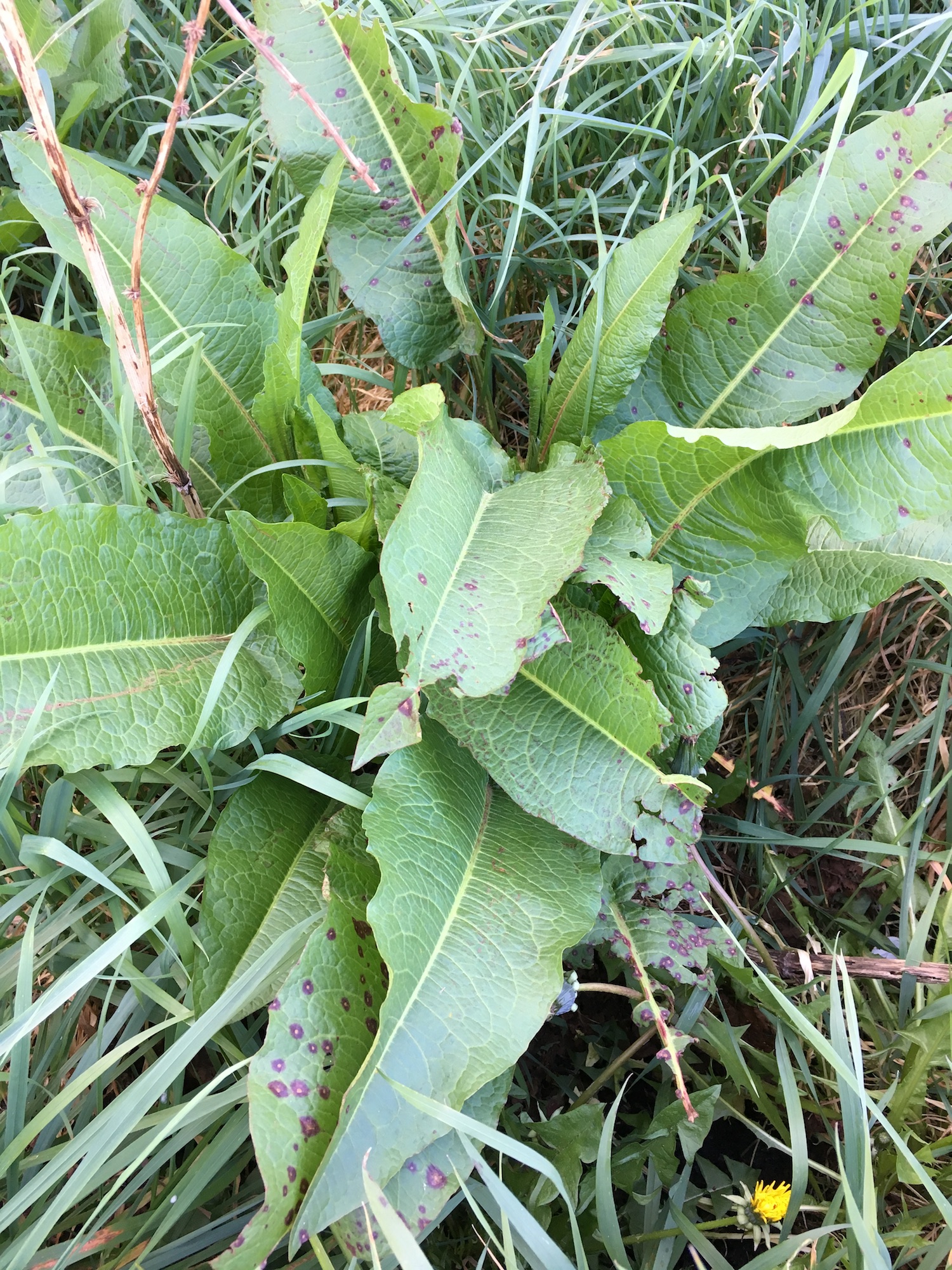
So I’ll be introducing some of my weeds over the next few weeks as they sprout and flower and generally annoy me. We’ll start today with a weed I love to hate–broad-leaved dock (Rumex obtusifolius).

Dock isn’t my worst weed. Not by a long shot. But it is persistent. Deep, branching taproots make it a struggle to pull out, and with each plant able to produce up to 60,000 seeds a year which can remain viable in the soil for up to 50 years, there is an unending supply of new plants. Still, dock struggles to compete with established plants, so it’s mostly a weed of disturbed soil.

The goats absolutely love it, so I can’t complain there. Dock is high in magnesium, phosphate, and potassium, and the tannins in the leaves can help prevent bloat in ruminants. Any dock I pull out of the garden goes directly to the goats.

It is likely dock was brought to New Zealand (from its native Europe) on purpose in the mid-1800s. Though the leaves are high in oxalates, which can irritate the stomach and bind to calcium, potentially leading to calcium deficiency, the plant was regularly eaten like spinach. It was also used to treat a variety of ailments, from coughs to cancer.

Dock often grows side by side with stinging nettle and, like many nettle associates, it can supposedly cure nettle stings. I’ve used dock for this purpose, and can attest that it seems to help, but then so does just about any fresh leaf rubbed on nettle stings.

I wouldn’t want to fight dock on a large scale–it scoffs at most herbicides, easily survives mowing, and can resprout from pieces of root left in the soil after ploughing–but for me, it’s a manageable weed that even has some utility.


Don’t bite the hand

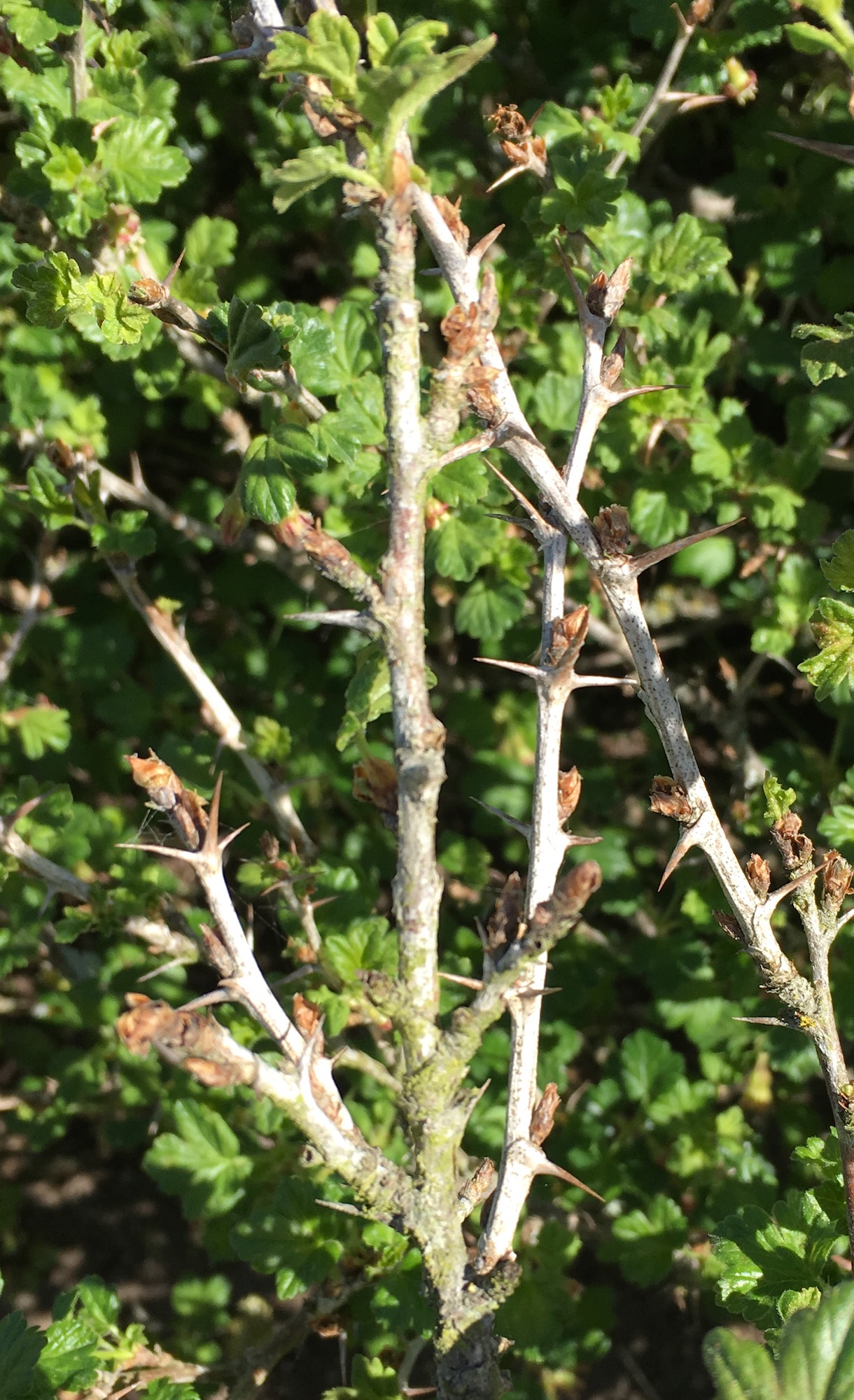
I was working on the bi-annual weeding of the gooseberries today. It’s not that the gooseberries wouldn’t benefit from weeding more than once every six months, but there’s simply a limit to my tolerance.

It’s bad enough that nettles zing me and thistle spines lodge in my gloves as I pull them out. I don’t begrudge them their attempts to stay rooted in the ground and avoid the compost pile.

But the gooseberries have no excuse for aggression. I’m weeding around them, freeing them from competition, making sure they have plenty of space, light and air.

And what do I get for my efforts?

Stab wounds, scratches, spines broken off in my hands…ungrateful plants. Haven’t they heard the saying, Don’t bite the hand that weeds you?