Gazpacho–Cool Food for a Hot Day

Gazpacho depends on good quality tomatoes. Only use the best.

While many of you in North America are shivering in the cold, we’re sweltering in the heat here. Our daily highs are in the mid-30s (the mid-90s F). After dripping sweat all afternoon, the idea of cooking is unappealing.

So we resort to hot-weather foods. Fortunately, the garden makes this easy. One of my favourite cool dinners is gazpacho—a cold vegetable soup. I think there are as many variations on gazpacho as there are cooks, but here’s my version. Serve with crusty bread and butter for a more substantial meal.

5-6 medium tomatoes (about 10 cups, chopped)
2 medium cucumbers
1 small red onion
handful fresh basil
1 clove garlic
1/4 cup red wine vinegar
1 tsp salt
black pepper to taste

Peel and coarsely chop the cucumbers. Process in a food processor until finely chopped (not pureed). Remove to a large bowl.

Core and coarsely chop the tomatoes. Process in a food processor until finely chopped. Remove to the bowl with the cucumbers.

Finely chop the onion and basil (I find this easiest by hand, but it can also be done in the food processor). Add to the bowl.

Crush the garlic and add to the bowl, along with the vinegar, salt, and pepper.

*Optional—add a finely chopped jalapeño or a dash of hot sauce.

Mix all ingredients together and chill 2 hours before serving. If you’ve got no time to chill it, add crushed ice to the soup.
A Passion for Pickles

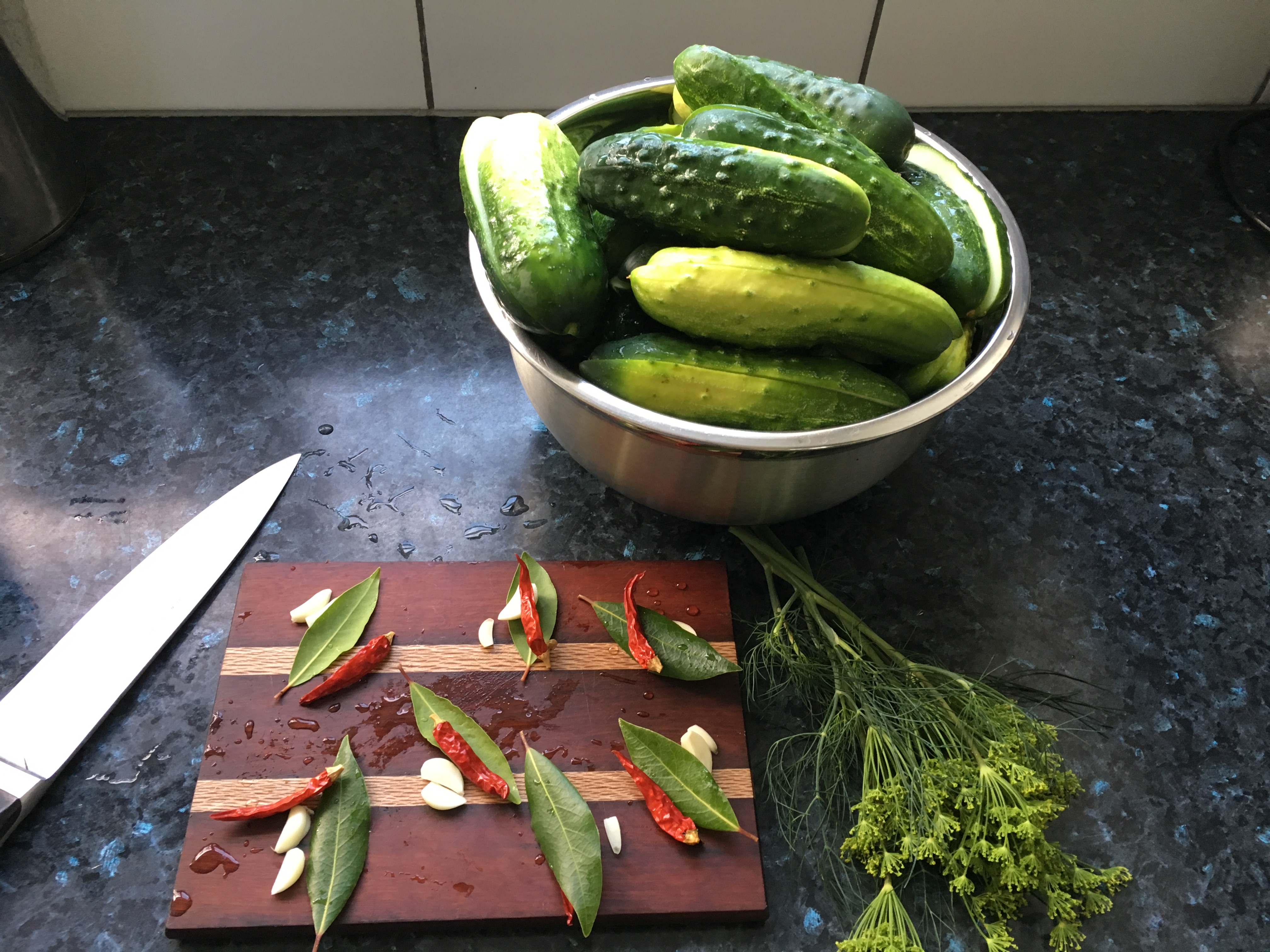
I’ve blogged about pickles before. How could I not? I love pickles. I plant pickling cucumbers only every other year, to prevent me from becoming the Crazy Pickle Lady, but this year is a pickle year.

Our favourites, without question, are dills. I made seven quarts of dills last weekend, and this weekend I put up another nine quarts. Plenty more to come before I’m finished pickling.

I can most of my pickles in a water-bath canner, so they last two years. But the canning process leaves them less crisp than I like, so I also make fresh pickles to eat right now. They’re crisp and sour, and super easy to make.

For a 1-quart jar, you’ll need:
1 kg pickling cucumbers, washed and cut in half lengthwise
1 head fresh dill
1 small red chilli (fresh or dried)
1 clove garlic, cut in half
1 bay leaf
1 cup vinegar (white or cider)
1 cup water
2 Tbsp coarse salt
3 Tbsp sugar
1 Tbsp mixed pickling spices (you can buy commercial, but I make my own mix to have on hand, see below)

Combine vinegar, water, salt, and sugar in a saucepan. Tie the spices into a cloth bag (or use a stainless-steel tea ball) and drop it into the vinegar mixture. Bring to a boil, then lower the heat and simmer, covered, for 15 minutes.

Shortly before the vinegar is ready, fill your jar with hot water (from the tap is fine, but make sure it’s as hot as you can get it). Let it sit for a few minutes, to ensure the jar is hot. This step minimises the risk of heat stress cracking the jar when you pour boiling liquid into it.

When the jar is warm, pour out the water. Drop the dill, chilli, garlic and bay leaf into the jar, and then pack the cucumbers in tightly. Try to arrange them so the cut sides are not pressed against one another—you want the pickling liquid to penetrate the flesh. Remove the spice bag from the simmering pickling liquid and pour it over the cucumbers, covering them completely.

Allow to cool, and then store in the refrigerator for 3-5 days before eating.

If you have leftover pickling liquid, save it in a jar, and just heat it up to make your next batch of pickles.

Pickling spice mix (makes about 1 cup):
6 Tbsp whole mustard seed
3 Tbsp whole allspice
6 tsp whole coriander seed
1 tsp whole cloves
3 tsp ground ginger
3 tsp red pepper flakes
3 bay leaves (crushed)
3 cinnamon sticks (crushed)

A Trifle More Christmas Baking

Okay, so I wrote the Christmas Baking blog post a couple of days ago, and then this happened. We picked another mountain of fruit this morning, and it happened to be a bread day. My original plan was to bake a pie, but my husband agitated for a trifle, but without the custard, which he’s not fond of.

So into the baking rotation went a lemon cake. Once it was cool, I sliced it and layered it with fresh fruit (strawberries, raspberries, black currants and blueberries), raspberry sauce, and a mixture of cream cheese, whipped cream, sugar and vanilla (inspired by this trifle recipe, but I measured nothing, and ignored most of the directions).

Just making it made everyone smile. Eating it … Oh my! I think I have a new favourite Christmas dessert!

Trying New Recipes

Saturday was a bread oven day (see my previous post and video if you don’t know what that entails). As luck would have it, I had just checked out some cookbooks from the local library, and I had a whole bunch of new recipes I wanted to try.

On bread days I usually bake several different things, in order to make use of the ‘free’ oven heat. It can lead to some insanity in the kitchen, as I mix up more than one recipe simultaneously. Usually I stick to things I make regularly, in order to prevent mistakes.

But Saturday I threw caution to the wind and chose three new recipes to make: sticky orange cupcakes, chocolate cardamom cake, and a sort of jam and nut pie bar.

The preparation was frenetic, but I managed to keep all three recipes straight, and the results were pretty good. The orange cupcakes were the perfect consistency—so moist, they’re more nearly pudding than cake, with coarse semolina and ground nuts giving them a wonderful grit. The flavour was good, but simple. I’m already scheming to improve them next time by sweetening with honey instead of sugar, for a more complex flavour.

The chocolate cardamom cake smelled divine. It, unfortunately, went into the freezer without a taste test, but I’m looking forward to eating it and adding another cardamom-flavoured dish to my repertoire. 

The jam and nut pie bars? I had just one bite of them before the rest went into the freezer. I think the jury’s still out on them. They certainly need some work. Both look and taste were marginal, and I suspect it wasn’t a good idea to attempt them on a bread day—a little more care would have gone a long way, at least on look. 

That’s two out of three that I think are keepers—not bad for three new recipes, made up simultaneously. Though, for my own sake, I don’t think I’ll bake three new recipes on a bread day again.

Happy Halloween!

We don’t really do Halloween here, as the celebration makes no sense in springtime, but for all you Northern Hemisphere folks, I pulled together a list of all the pumpkin recipes and food ideas I’ve blogged about in the past. I was surprised at how long the list was. There are some great Halloween party options here. Enjoy!

Pumpkin Pancakes
Pumpkin Pizza
Pumpkin Cupcakes
Pumpkin Ricotta Lasagne
Cinnamon-Pumpkin Bars
Pumpkin Ravioli
Baked Pumpkin Slices
Pumpkin Cranberry Muffins
Pumpkin Galette
Pumpkin, Blue Cheese, and Tofu Burgers

Orange Cupcakes

I’ve developed my own orange cake recipe, which I like a lot, and I’ve made a similar orange cake, based loosely on a recipe in King Arthur Flour’s Whole Grain Baking. Last week I finally made King Arthur Flour’s orange cake, as it’s written, except I baked it as cupcakes.

My orange cake uses barley flour, which gives it a delicate crumb. The recipe I made last week uses wholemeal (whole wheat) flour, leading to a more robust cake, with a lovely nutty flavour.

But the best part of the recipe was the orange glaze on top. The glaze did lovely things for the cupcakes, and made them taste a bit like the dense sticky orange cakes you find in cafes. (but a whole lot less involved to make).

Here’s the recipe for the glaze. Brush it on the warm cakes and let it soak in. Be generous with it!

1/2 cup orange juice
2 tsp orange zest
3/4 cup sugar

Combine all ingredients in a microwave-safe bowl and microwave for 1 minute. Stir until the sugar is completely dissolved.

A Decadent Brioche Breakfast

Sometimes you just have to go a little overboard. My over-the-top fun this weekend was making brioches for Sunday breakfast. Overly decadent and time-consuming to make, brioche is a rare treat for us. My usual Sunday breakfasts (scones, muffins, or whatever) can be made in the morning. Brioche had to be started the evening before.

My son, passing through the kitchen as I kneaded the gooey dough, peeked at the cookbook open on the table. His eyebrows rose.

“Make sure you wake me up for breakfast tomorrow.” This from the teen who usually doesn’t get up until long after breakfast is cleaned up.

The pressure was on. I had to make sure these brioches were worth losing three hours of sleep.

The dough rose overnight in the fridge, and I made up the buns in the morning. When they came out of the oven, I cut the top off each one, scooped out a little hollow inside, and filled each with a dollop of gooseberry jam and then a generous spoonful of whipped cream with lemon curd folded in.

Oh, my. These little butter bombs were delicious!

Red Currant Orange Muffins

I’ve occasionally noted how alike in smell, flavour and texture red currant jam and cranberry sauce are. And since I’ve got a freezer full of last summer’s currants, I decided to use them in a recipe calling for cranberries.

The result was a lovely red currant orange muffin. Even better than the cranberry version, because the fruit came from our own garden.

2 cups all purpose flour
1 c. whole wheat flour
1 Tbs baking powder
3/4 tsp baking soda
1/2 tsp salt
3 eggs
zest of one orange
juice of 1 orange, plus enough yogurt to make 1 1/2 cups
1/2 cup brown sugar
125 g (8 Tbs) melted butter
1 cup fresh or frozen (thawed) red currants

Combine flours, baking powder, baking soda and salt in a large bowl. In another bowl, whisk together the eggs, orange zest, orange juice, yogurt, sugar and butter. Combine wet and dry ingredients, stirring just until evenly moist. Fold in the currants.

Fill well-greased muffin cups—for me, this makes 21 muffins.

Bake 15 minutes at 210ºC (400ºF). Allow to cool in pan 5 minutes before removing.

Salt-preserved Green Beans

I always struggle with what to do with too many green beans. I can (bottle) some, but none of us really like the taste of canned beans, and their mushy texture leaves a lot to be desired. I don’t freeze any, because freezer space is at a premium, and I prefer to fill it with sweet corn and peas instead.

So this past summer, I preserved some green beans in salt. The recipe I used claimed that the flavour and texture of salt-preserved beans is far superior to canned or frozen.

I pulled out the crock of salted beans the other day to test them out.

At first glance, they didn’t win any beauty contests, especially the yellow wax beans, which came out of the salt a sort of dead-flesh colour.

I rinsed them and soaked them for two hours, as directed, and then tossed them into a green bean and potato charcharis.

Cooked into a flavourful Indian dish, the beans most definitely had better flavour and texture than canned beans. Almost as good as fresh, even.

Unfortunately, they were so excessively salty, they made the dish almost inedible. Even my salty-olive-loving family couldn’t choke them down. Most of the dish ended up on the compost pile, and I expect an epidemic of high blood pressure in the local sparrow and mouse population who dine at chez-compost.

There are still some beans left. I’ll try using them again—small quantities in otherwise unsalted stews or soups might work well (sort of like a salty ham hock in bean soup). Maybe.

But I’m thinking I’ll just give away the extra green beans next year.

Pumpkin Pancakes

Now that winter has set in, we’ve turned our culinary sights from eggplant and courgettes to pumpkin, pumpkin, and pumpkin. I blogged about our excellent pumpkin harvest earlier this year. That post was written mid-way through the harvest–ultimately we picked nearly 200 pumpkins and other winter squash.

So w’re eating a lot of pumpkin. That’s not a problem.

Yesterday I made lovely pumpkin pancakes for breakfast. They were moist, dense, and spicy—excellent with maple syrup or redcurrant jam.

To make these delicious pancakes, start with a double batch of my World Famous Pancake Recipe. Add 2 tsp cinnamon and 1/2 tsp cloves to the dry ingredients. Add 1 1/2 cups pureed pumpkin (or other winter squash—I used kabocha squash) to the wet ingredients.

If your pumpkin is dry, you may need to increase the milk to achieve the right batter consistency.

We found these pancakes didn’t store/reheat as well as regular pancakes—they became quite fragile upon reheating (though they were still delicious).