The Ghost of Christmas Trees Past

Growing up, my parents had an artificial Christmas tree. It was hauled out of the attic the weekend after Thanksgiving and assembled and decorated, ushering in the Christmas season.

I remember one year having a real tree—I loved the smell in the closed-up winter house.

When my husband and I married, we spent a few years finding our Christmas tree tradition. For the first two years, we had an eight-inch tall artificial tree in our mud house in Panama. After we returned to the US, we wanted something bigger. So we spent months making a six-foot papier-mache tree, binding on raffia needles and painting bark on the branches. It was a labour of love, and we used it until we had to move across the country, and knew it wouldn’t survive the experience. 

Then babies happened, and for a few years, our Christmas trees were real trees—there was no time or energy for creativity in those early years.
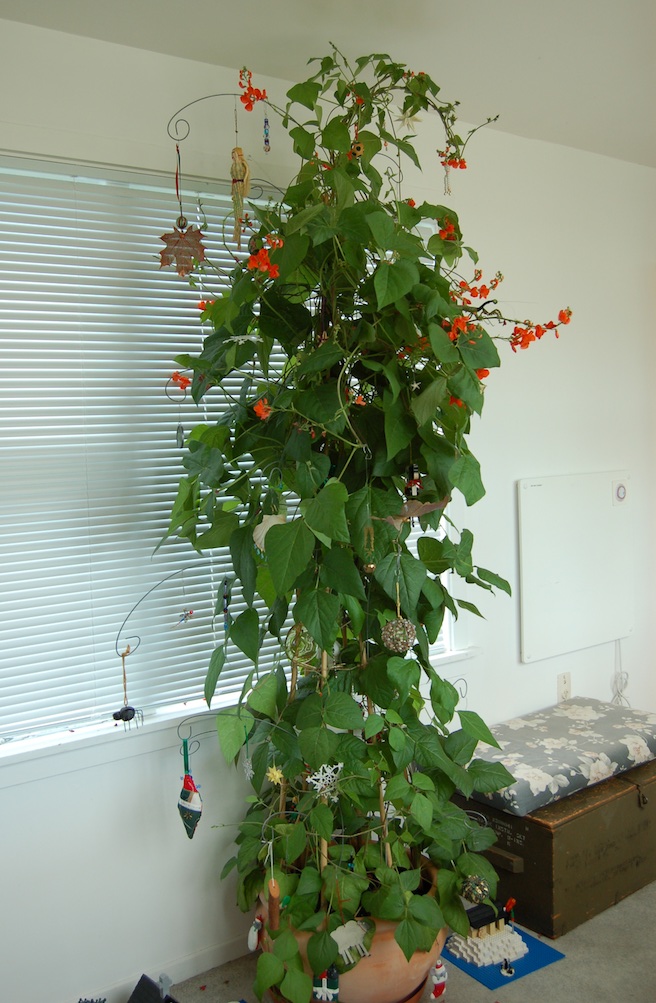
By the time we moved to New Zealand, we were settled into the parent routine enough to be creative again. And summer Christmases invited creativity. We fashioned trees out of driftwood, dead branches pruned off trees in the yard, an old fishing net, fencing wire and flax stalks, copper plumbing, live runner beans—most trees were inspired by what was lying around the property at the time.

Last year, we fashioned a DNA strand as a Christmas tree. Elegant and simple.

This year, we went for crazy, creating an architectural monstrosity from cardboard boxes.

You might wonder what the point is—wouldn’t it be easier and more, well, Christmasy to do a more traditional tree? Yes. But what is a Christmas tree for?

I view a Christmas tree as a focal point—somewhere for family to gather. Our trees have always been decorated with ornaments that have a history—maybe they were made by someone special, or given by a friend, or came from an exotic location. Decorating the tree has always been a time to celebrate the family stories behind the ornaments.

Why shouldn’t that family activity extend to making the tree itself? This year’s tree took a lot of time to make, and we spent several evenings as a whole family working on it—making a tremendous mess of the living room, laughing, and enjoying each other’s company and creativity. That’s exactly what Christmas traditions should do.

So, perhaps our trees don’t meet the traditional definition of a Christmas tree, but I think they embody the spirit of the season.

Summer?

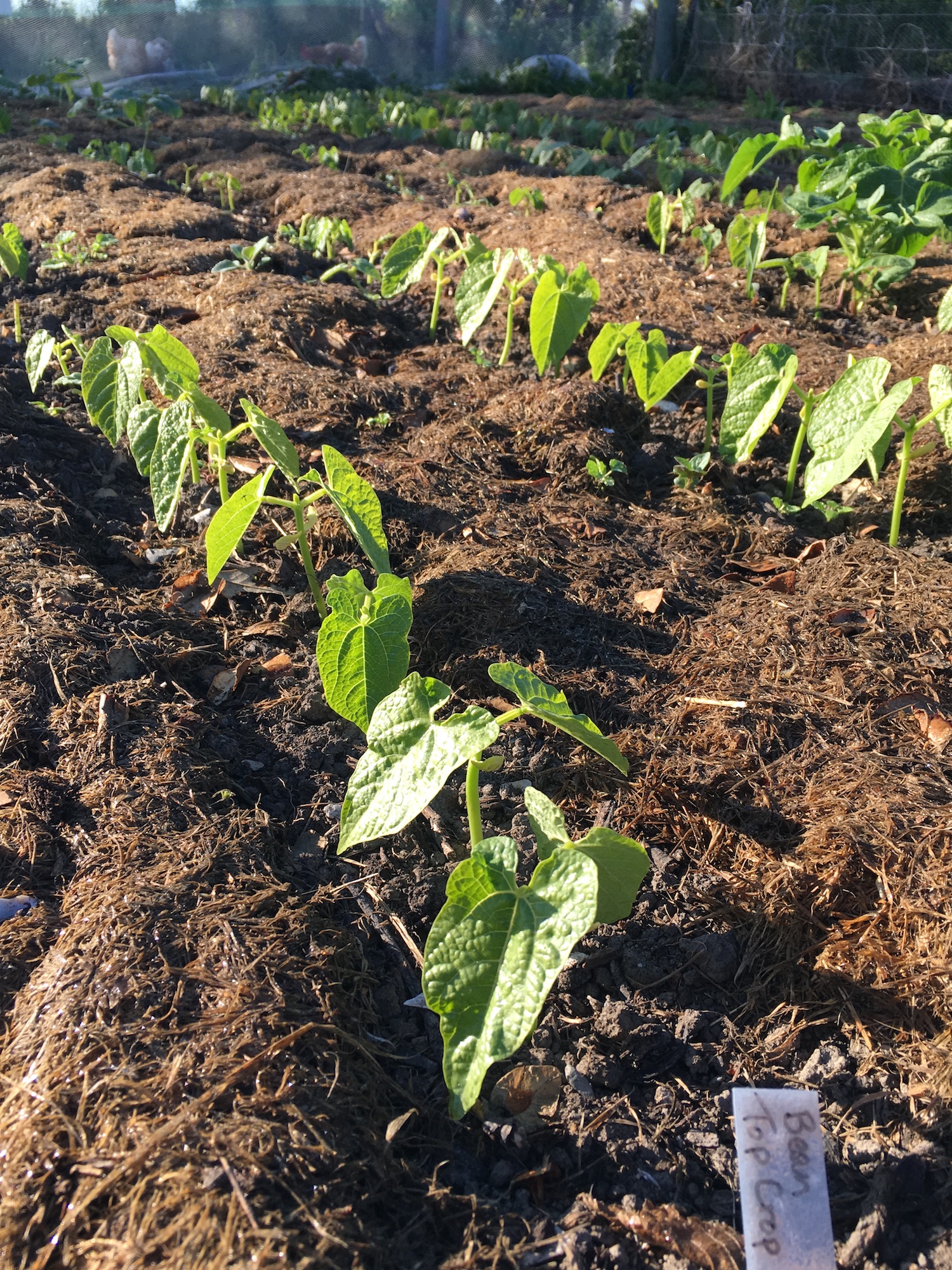
It’s been decidedly un-summer-like recently. We’ve had an exceptionally wet two weeks—there’s a puddle in the yard, Coes Ford is flooded, and weeds and mushrooms are sprouting everywhere.

Fortunately, that hasn’t stopped the strawberries. When my daughter braved the rain to pick, she found a surprising number of slug-bitten but delicious ripe fruits.

Strawberry shortcake for dessert, strawberries on my morning muesli, strawberries every time I walk through the kitchen…it must be summer!

Now, if only we’d see the sun…

Potential Realised and Unrealised

But those apricots may or may not survive the next nor-west wind. The blueberries might be eaten by the birds before they ripen. The tomatoes could be hit by herbicide overspray. The beans might be stripped by hail. A thousand disasters might befall any of these plants and destroy their promise. And sometimes those disasters do happen—hailstorms have shredded the garden, wind has stripped every tree of fruit, birds have plucked out every seedling from the ground, overspray has twisted and stunted vegetables and decimated the grapes. I can be certain of at least one disaster every year.

But every year, something goes right, and potential is realised. Maybe the hail comes with a little extra rain that helps the vegetables recover from the damage. Maybe that wind-blown fruit can be used to make chutney. Maybe the birds ignore the blueberries, and we eat them until we think we’ll turn blue ourselves. Maybe the wind is blowing the other way when the neighbour sprays, and the garden grows unmolested by agrichemicals. A thousand things can go right and lead to abundance in the garden.

I think about this a lot as I prepare my son to leave home in a few months. He’s taking his final high school exams next week and will head to university in February. For him, it’s a time of incredible possibilities, as he launches into adulthood and pursues his passions.

But he has a difficult year ahead of him—on his own for the first time, in a new city providing lots of distractions, and without his support network of friends and family around him. A thousand things could go wrong. He could focus too much on fun and fail his classes. He could focus too much on classes and become over-stressed. He could make no friends. He could make the wrong friends. He could start drinking, smoking, using drugs. 

No doubt, one or more of these disasters will happen next year. 

But I like to think that possibilities for my son are a bit like possibilities in the garden. Regardless of the disasters, some things will go right. He may make good, positive friendships. He may enjoy Friday-night partying without losing sight of his studies. If he does fail a class, it might convince him to redouble his efforts. A thousand things could go right.

In the garden and with my son, I’m preparing for things to go wrong—for potential unrealised. But I’m also preparing for things to go right. There’s an abundant harvest building up, and I can’t wait to see what it is.

Happy New (Garden) Year!

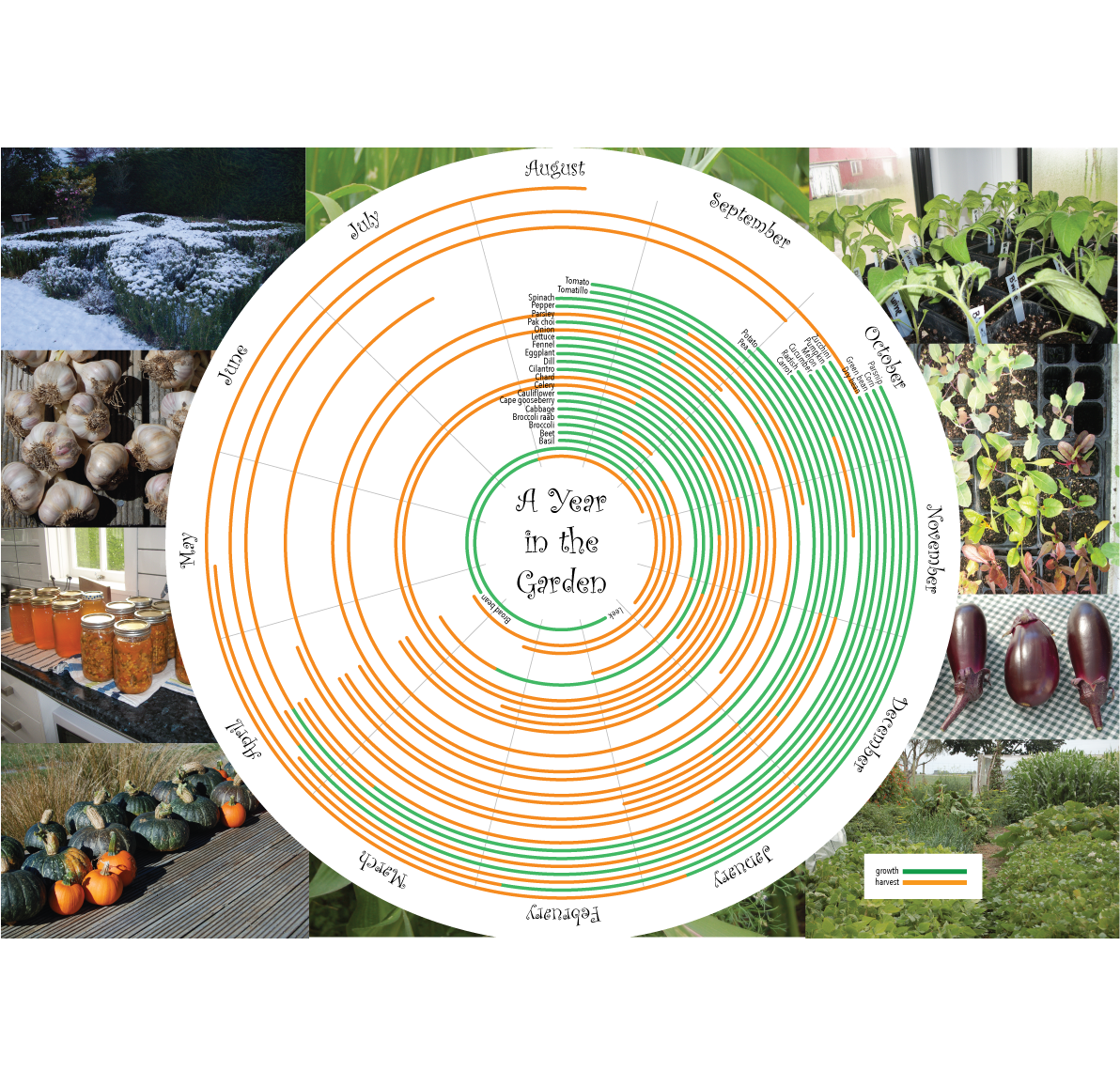
I love the month of July; it’s the beginning of the garden year in my mind, because it’s the month I plan the garden and order my seeds. It’s been a few years since I blogged about my garden year, so I figured it was time to do it again. I unearthed this little graphic my husband helped me create a few years back, showing my annual planting and harvesting schedule. It has changed a little since then, and I notice some crops, like garlic, are missing from it, but it’s still a fairly good indication of my year in the garden.

I struggled the first few years here. Coming from the Northern Hemisphere, I had no idea when I should plant things. And the idea of growing vegetables over winter was foreign to me, too.; gardening in Minnesota and Pennsylvania is sharply seasonal. It’s seasonal here, too, but much less dramatically so.

Instead of growing a ton of spinach over the summer and freezing it for winter, I learned to simply plant small quantities regularly throughout the year, for a perpetual supply of fresh greens. Same with lettuce, chard, broccoli, cabbage, and cauliflower.

Today my garden year ebbs and flows, but there is never a down time in the garden. There is always something to plant, weed or pick. The end of last year overlaps with the beginning of this year, so while I plan my seed order, I’m harvesting the lettuces, broccoli, leeks and other late crops planted in the autumn, and I’m weeding the garlic and broad beans that will be harvested in the coming spring and summer.

Sometimes I miss the complete downtime of gardening in Minnesota—the winter lull when there’s no need to go out and weed in the cold. But only sometimes. The never-ending garden year here has its perks in garden-fresh vegetables year-round.

To the Beach

While all you folks in the Northern Hemisphere are flocking to be beach for a swim and some sun and sand, we are shivering down here in the dark days of winter. But that doesn’t mean we don’t go to the beach.

Research from England has found that people living by the coast have better physical and mental health than those living inland. I can certainly understand that.

Growing up three hours’ drive from the beach, I visited the ocean about once a year. My husband, raised in the midwestern US, doesn’t remember seeing the ocean until age twelve or thirteen.

Today, we live a mere four kilometres from the beach. When the wind is calm, we can hear the surf. When the wind is high, we can smell the sea. Even without research to back us up, we’ve learned to head to the beach when we’re stressed.

Our beach isn’t a white-sand swimming beach—it’s made of cobbles, and the waves pound viciously on the shore. It’s not a place to swim, nor really a place to sit for very long (those rocks get uncomfortable fast). It’s a place to walk. A place to search for wave-polished rocks in glittering colours. A place to watch sea birds, dolphins, and the occasional seal. A place to leave all the stress of daily life behind (I challenge anyone to remain stressed while watching dolphins cavorting in the waves).

Researchers point to the calming blue colour, the hypnotic sound of waves, and the cultural context of the beach to explain its calming effect. But for me its influence is more profound. Our beach is usually free of other people—on a busy day you might see four others. From the beach, it is difficult to see any sign of humans at all—the odd bit of flotsam, but not even much of that. On our beach, the world is reduced to sky, water, and rock, shared only with wildlife. It’s easy to imagine the world is in better shape than it is. It’s easy to believe the vast ocean will endure, in spite of human stupidity. It’s easy to think those rare Hector’s dolphins, which we see nearly every time we visit the beach, are actually common. For the space of time we inhabit the beach, all is right in the world.

It doesn’t last, of course, but it’s good to have that escape so close at hand.

Autumnal Haiku

Yesterday was a gorgeous autumn day. It inspired a few haiku:

Rats tap out poems
On the ceiling at night while
Cats dream of sparrows.

***

Summer slips off to
Warmer climes, leaving autumn
To face winter’s scorn.

***

Summer cashes in,
Trades green for gold to spend on
Ice blocks and snow cones.

Equinox Accounting

Happy Equinox!

It is the autumnal equinox, and fittingly, our weather today has started out pure summer heat, and is predicted to turn to wintery wind and rain later on. I can see the clouds piling up to the south as the front approaches.

There are still plenty of summer crops coming out of the garden, but the equinox is a good time to evaluate what worked and what didn’t this past summer.

It was an extreme summer, so there’s no saying this year’s performance will hold in future years, but new varieties that did well include:

Tomato Indigo Apple—I blogged about this beauty when it first began to ripen. It has proven itself over the season, producing plentiful, delicious and attractive fruits that ripened early and continue to ripen as other varieties are giving up for the year.

Tomato Oxheart—This variety was also new to me this year, and it did well enough to deserve another go. The almost disturbingly heart-shaped (as in ox heart, not love heart) fruits were flavourful and plentiful.

Onion Pearl Drop—Cute and fast-growing. I’ll plant these again.

Watermelon Sweet Red—It might have simply been the weather this summer, but Sweet red matured more quickly and produced more fruit than Rapid Red, which I’ve planted in past years. I’ll be curious to see how it does in a cooler summer.

Varieties that didn’t grow so well:

Eggplant Container Pick—I was excited by this smaller variety of eggplant, as mine always end up pressed against the top of the low tunnel I grow them in, but these seeds didn’t even germinate.

Tomato Russian Red—This isn’t a new variety for me. Usually Russian Red, bred for its ability to withstand and produce well in cool temperatures, is my best producer. This year, the plants spent most of their energy on vegetative production, growing to massive leafy plants without actually producing much fruit. And the fruit they did produce was so hidden in all the greenery that I missed half of it. It won’t stop me from planting Russian Red in the future, but it emphasises to me the need to plant a mix of varieties, as year-to-year differences in weather can make a big difference in production.

Pole Bean Jackson Wonder—The jury is still out on this bean, but poor germination and slow growth mean I still haven’t harvested any of these lima beans. There are plenty of pods on the plants, but whether they will fill out properly before frost kills them is debatable. My guess is that in a normal summer here, they wouldn’t have a chance—they appear to need too long a growing season.

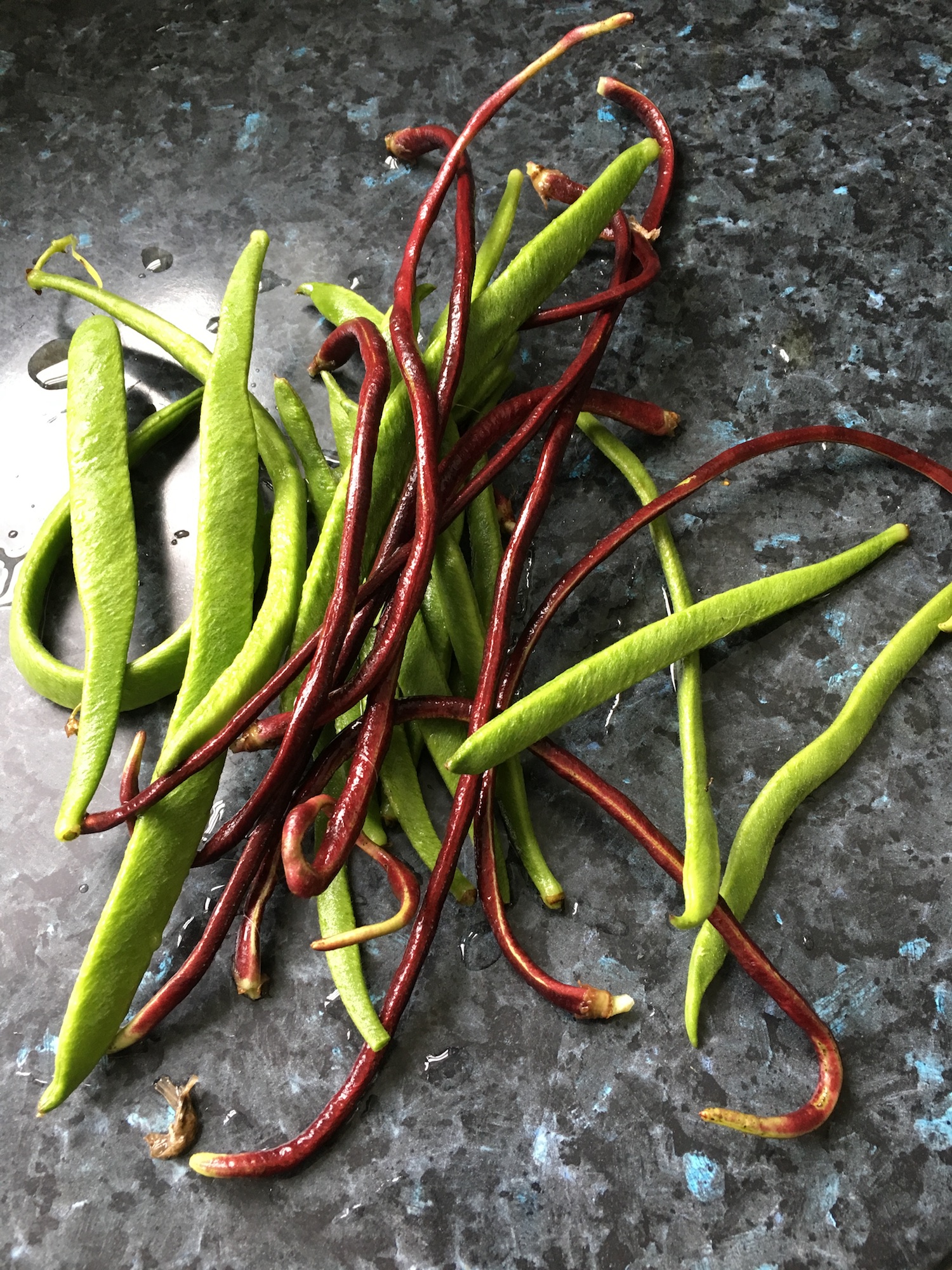
Yard Long Red Noodle

Yard Long Red Noodle alongside scarlet runner beans.

Along with all the other heat-loving plants that did well in this summer’s garden is the bean Yard Long Red Noodle (Vigna unguiculata—the same species as cowpeas). I have never had luck with these beans here in New Zealand—they are particularly sensitive to herbicide overspray, and also prefer it hotter than our summers normally are (ideal temperature for them is 30ºC). But this year, the plants germinated slowly, which spared them the springtime overspray, and the summer was hot and wet. I can’t say they’ve thrived (we grew yard long beans in Panama, and so I know what they’re supposed to grow like), but they have managed to produce a small crop of ridiculous-looking beans. The beans aren’t exactly a yard (90 cm) long, but they’re 30 cm (12 inches) or more, and are the sort of silly crop to make everyone smile.

Their red colour is pretty in the garden, and unlike many other red or purple vegetables, they retain their colour when cooked. Good enough reasons for me to plant them, in spite of their poor performance here—a few go a long way.

Watermelons Rule

Nothing says summer like watermelon—a seasonal fruit that matures during the hottest days of the year, and doesn’t keep.

Watermelon is an unreliable crop here. Twelve years ago, when we first arrived, I was told watermelon doesn’t grow in Canterbury. I’ve planted it every year, regardless, because I can’t imagine a summer without it.

Some years we get nothing. The plants don’t grow at all, or they grow too slowly to produce mature fruit before the first frost, or they’re nailed by herbicide overspray. Some years we get a few smallish fruits that we savour as rare delicacies.

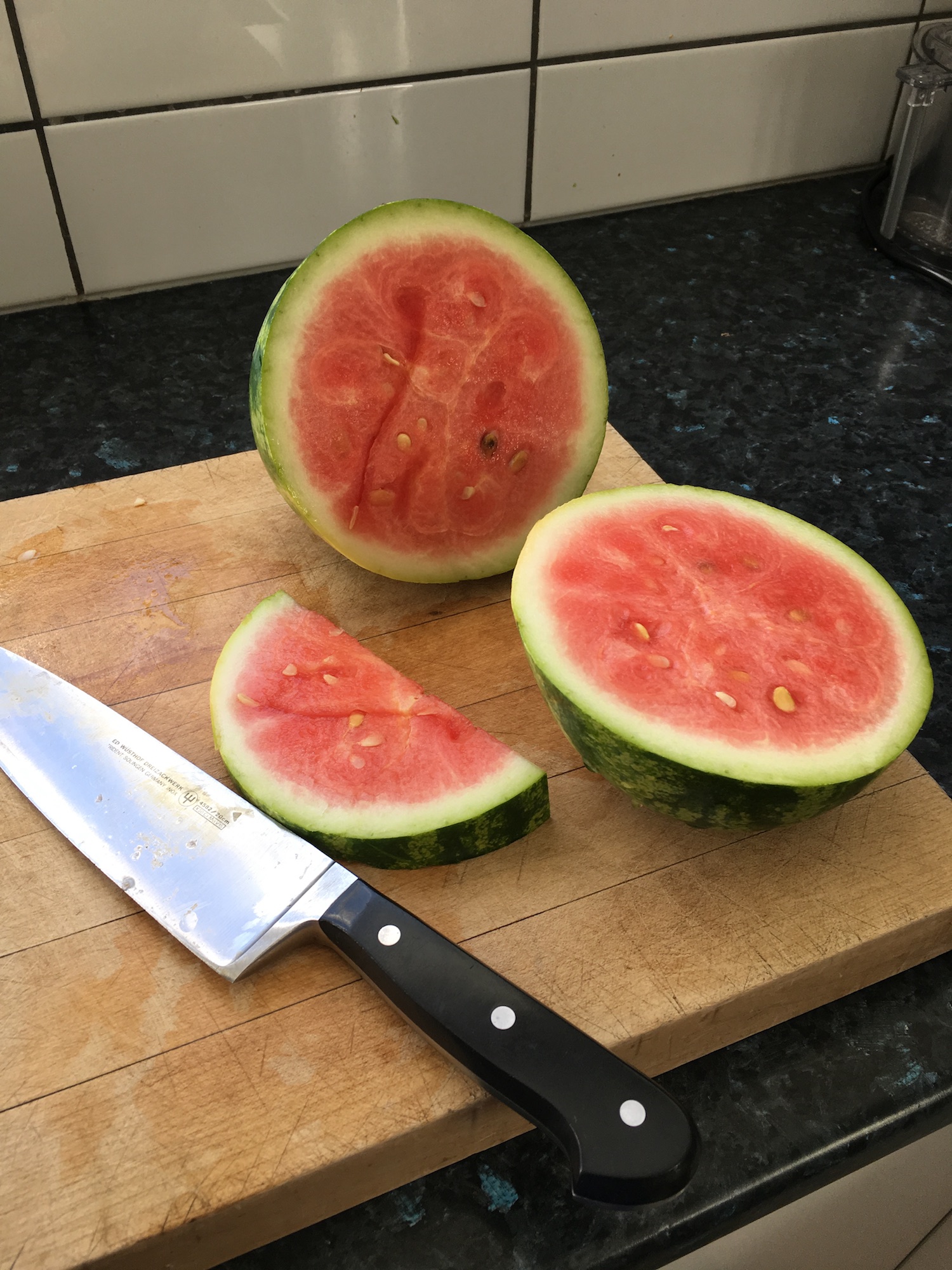
This year we are awash in watermelon. The fruits aren’t big—even the largest hasn’t reached the weight the seed catalogue says this variety should—but they’re the largest watermelons we’ve managed to grow here. And most importantly, they’re sweet, crisp and delicious. And there are lots of them!

As I sit on my office deck spitting seeds, I am reminded of the magical poem by John Tobias—Reflections on a Gift of Watermelon Pickle Received from a Friend Called Felicity.

I wonder if my kids will remember this year of watermelon as Tobias wrote…

“…During that summer—
Which may never have been at all;
But which has become more real
Than the one that was—
Watermelons ruled…”

Green Orb Weaver

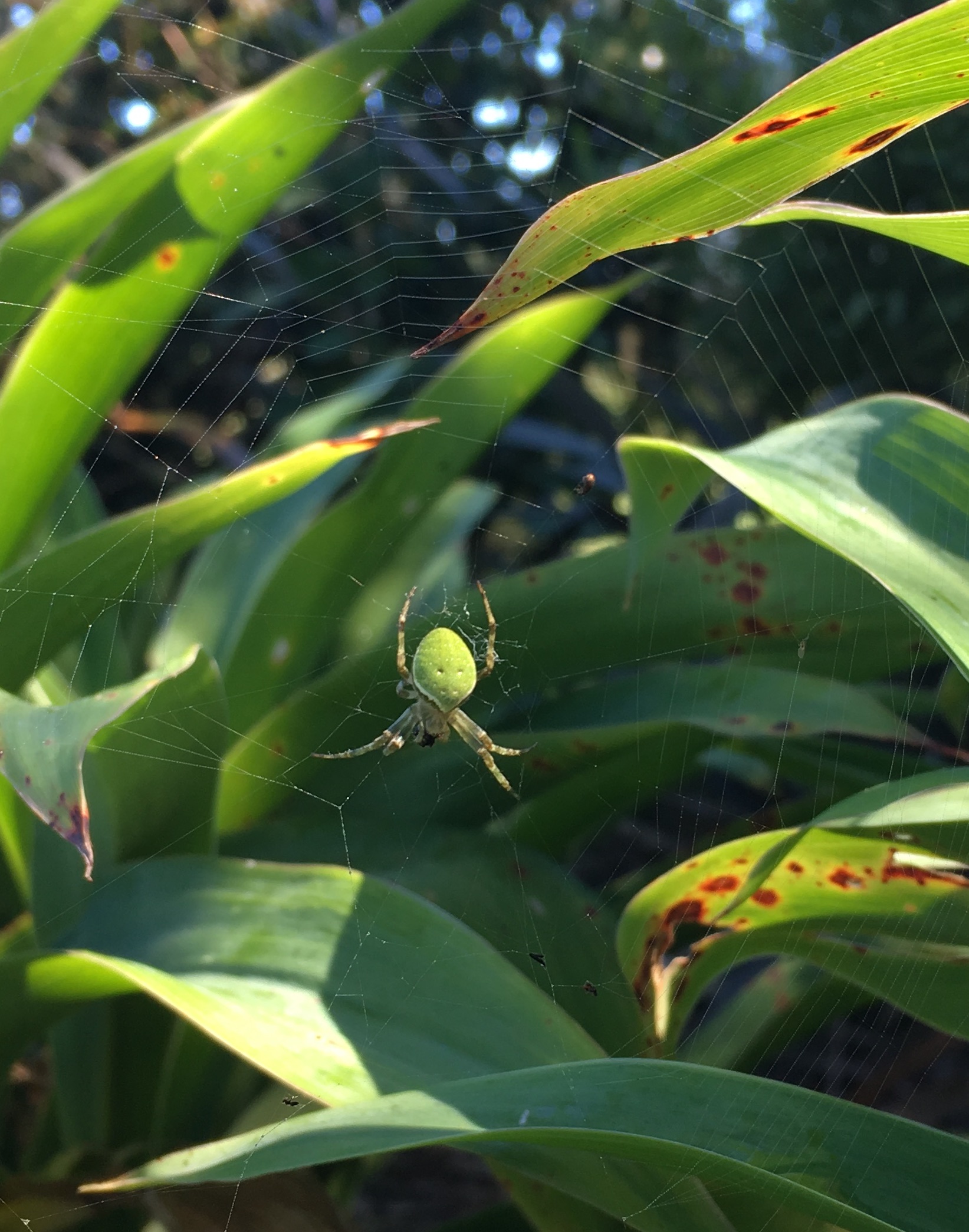
This year has apparently been good for the green orbweb spider (Colaranea viriditas); I usually see them only rarely, but I’ve run across quite a few this summer.

These beauties are pale green with a kelly green leaf-shaped mark covering the abdomen.

As the name implies, these spiders make orb webs—the spiral-shaped webs everyone’s familiar with. Though they’re primarily nocturnal, I’ve regularly seen them hanging out in the middle of their webs during the daytime (often snacking on an insect). These sharp-looking spiders apparently like a tidy web; they rebuild their webs nightly, and the webs are always as attractive as their residents.

The green orb weaver’s main predator is the native potter wasp, which paralyses the spiders with a sting and stuffs them into its nest for its larvae to feed on. However, the green orb weaver appears to be better at hiding from potter wasps than the non-native Australian orb weaver (at least on our property). Earlier this summer, the potter wasps decided that the screw holes in the bottom of the dining room table were perfect nest holes—every one of the dozens of orb weavers they crammed into the table was an Australian orb weaver.

I enjoy finding these little green gems in the garden. They’re as beautiful as they are helpful.