West Coast Weekend

Our daughter wanted to go to the west coast for professional reasons (to photograph mosses for a project she’s doing), so my husband and I happily agreed to accompany her for a weekend getaway.

We left Friday evening, stopping at Lake Pearson (Moana Rua) for a lovely picnic dinner, and then carrying on over the mountains to camp at Goldsborough Campsite near Kumara. We pulled into the campsite around eight o’clock and set up camp. With the light already fading, we decided to wander up one of the tracks that followed old gold mining tracks through the bush. 

Old mining water race tunnelling through the hillside

We started up German Gully Track, thinking we’d just go up a little ways, then return. The track passed an old mining water race that looked like a cathedral-shaped tunnel as it snaked steadily up the hill. Soon we were close enough to the end of the track that, of course, we had to finish. 

We popped out onto a broad, modern gold mining road. The sign at the road indicated that we could either return to the track the way we came (30 minutes, according to the sign), or return via Goff’s Track (65 minutes). It was 8.55 pm. To take Goff’s Track would, theoretically, have us arriving back at the campsite at 10 pm. After ascertaining we all had our head torches with us, we powered up the road towards Goff’s Track.

German Gully track–an old mining road

The west coast was unusually dry, for which I was glad as we picked our way down Goff’s Track in the gloom—while most of the track was easy going, the steeper sections would have been slick and no fun in low light.

Knowing we were racing the light, we kept the pace up, and didn’t even need to use our torches, arriving back at the campsite around 9.30. A nice little evening hike!

The following day, we got an early start and hiked up Mount French, near Lake Brunner. None of the track descriptions have much to say, except that the hike is a steady climb of over 1000 vertical metres. Telling, however, are the listed track length and times: 7 km return, 8 hours return. That’s a walking speed of only 875 metres per hour. 

View from the top of Mount French towards the Tasman Sea

We did slightly better, making the 3.5 kilometre trip to the summit in 3 hours forty-five minutes, for a walking speed of 933 metres per hour. Most of the hike up is through dense west coast rainforest, so other than the forest itself, there’s not much to see. When we hit the alpine vegetation near the top, the views opened up and it was spectacular. At first we were a little worried we’d struggle to find our way across the multiple false peaks to the actual summit, because clouds obscured the tops. In hindsight, I’m glad the cloud was there, because when it did clear and we finally got a view of the summit, I was disappointed at how far away it still was. LOL! Though the elevational change from the bottom to the top is officially a bit over 1000 metres, there are several significant dips along the ridge, so I suspect the actual amount of climbing you do to reach the summit is more like 1200 metres.

Looking back down the ridge from the summit of Mount French

But we made it, and by the time we were on the summit the clouds had cleared entirely. We had stunning views to the Tasman Sea on one side, and to the mountains on the other. Lake Brunner glittered in the sun far below us. 

We had lunch on the peak and spent a good bit of time enjoying the view and exploring the plants and insects at the top before tackling the descent.

Lake Brunner seen from the summit of Mount French

Going down was faster than going up, and we reached the car shortly after 3 pm, hot and sweaty and ready for a swim. After a quick dip in Lake Brunner, and a change of clothes, we headed to Hokitika for dinner and a short stroll on the beach.

All of us were in bed and asleep early Saturday night.

Sunday, we packed up camp and headed to Lake Kaniere to hike the Lake Kaniere walkway. We’ve done part of this walk several times. It’s a mostly flat, well maintained track that follows the entire western edge of the lake. There are multiple stony beaches to stop at along the way, and amazing lowland rainforest vegetation. 

A reflective early morning Lake Kaniere

On Sunday, it was also really hot (28 degrees by early afternoon). And even on the flat, we were sweating. My husband turned back about a third of the way into the hike, in order to drive the car to the end of the one-way track. My daughter and I continued on, stopping for a quick skinny dip at Lawyer’s Delight beach, before meeting my husband walking back towards us from the far end, about a kilometre from the end of the track.

Carové’s giant dragonfly at Dorothy Falls

We had lunch, a stop a Dorothy Falls, and another swim in Lake Kaniere, then headed home.

The entire weekend on the west coast was hot and sunny, so it was a bit of a shock to hit Porter’s Pass and drive into drizzle and 12 degrees. It was a chilly 15 at home under overcast skies. Poor Canterbury—this summer has been anything but summery here. It’s no wonder the west coast was absolutely packed with vacationing families.

And now I have one week left before returning to the day job. My summer to-do list is getting shorter, but I will definitely not accomplish everything on it. But it’s been a good summer for getting out and hiking, so I can’t complain. Now I just need to knuckle down and get some writing in while I can.

Sorrel Salad

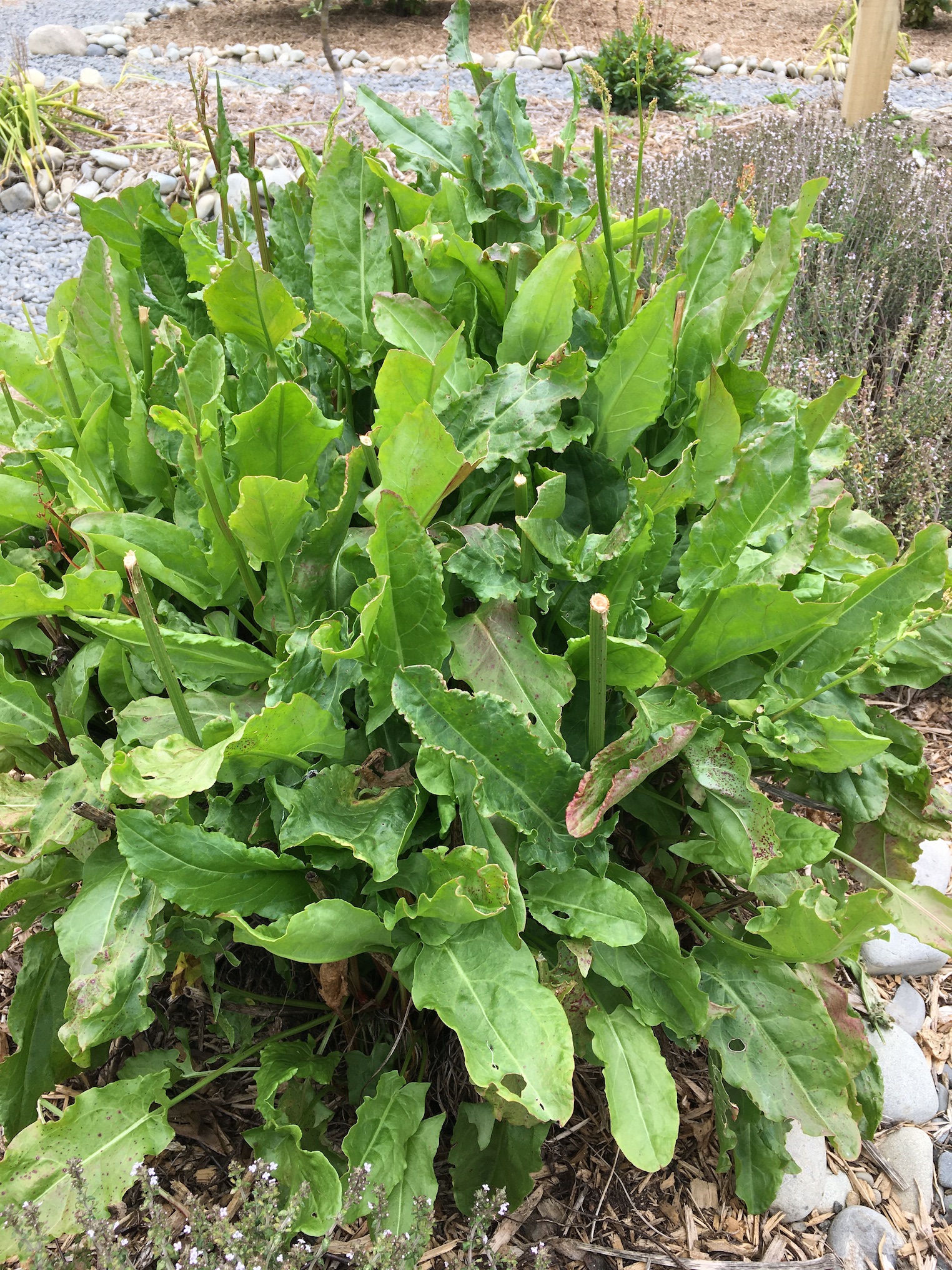
I love sorrel, with its succulent texture and bright sour flavour, but I don’t often think to use it. I occasionally use it to fill out early spring salads, when the lettuces aren’t quite big enough to make a full salad, and that’s generally about it. 

But last night I wanted a salad to go with quiche. The spring lettuces are long since bolted, and the fall lettuces are still baby seedlings, so I turned to sorrel, this time to make the bulk of the salad.

I got inspiration from a few different sorrel salad recipes, but then simply used what I had on hand. The result was a spectacular salad—one I will definitely make again.

Here’s my ‘recipe’, for what it’s worth:

1 handful sorrel leaves, chopped into thin strips (maybe 2 cups, chopped)
1/4 cup walnut pieces, toasted in a 190C oven until aromatic and beginning to darken
6 small olives, chopped (I used my own olives, and they are quite small. If you’re using big commercial ones, you probably don’t need more than 2 or 3)
6 cherry tomatoes, cut in quarters (I would have used a lot more tomatoes, but this was all I had)
1 Tbs olive oil
1 Tbs balsamic vinegar
1 small clove of garlic, crushed
dash of salt

Whisk together the oil, vinegar, crushed garlic and salt in a small bowl.

Place all the other ingredients in a bowl, and toss with the dressing. If you want a little less knock-your-socks-off fresh garlic flavour, strain the garlic out of the dressing first.

Why Garden?

“Gardens are fashioned for many purposes with many different tools, but all are collaborations with natural forces. Rarely do their makers claim to be restoring or rebuilding anything from the past; and they are never in full control of the results. Instead, using the best tools they have and all the knowledge that they can gather, they work to create future environments.
If there is a lesson it is that to think like the original inhabitants of these lands we should not set our sights on rebuilding an environment from the past but concentrate on shaping a world to live in for the future.”

–Charles C. Mann (1491: New Revelations of the Americas before Columbus)

Many years ago, I wrote this quote into a sticky note on my laptop. I look at it regularly, and it resonates with me every time. It expresses a mindset my husband and I employ on our little plot of land.

As I sit here on the porch on a warm summer afternoon, I can’t help but think back to what this section was like when we bought it—a bare paddock so devoid of nutrients that even the weeds were sparse. Sitting here today, I am surrounded by a mix of food crops, beautiful flowers and native plants. Five years ago, this plot of land could barely sustain the scraggliest of grass. Today it feeds us, provides food and shelter for native insects and birds, and is a welcome escape from all the ills of modern life. In time, as plants grow, it will hopefully become more sheltered, more resilient to temperature and rainfall extremes. In time, it will hopefully take less effort to maintain. In time, perhaps we will see native bellbirds and tūī as often as we see non-native blackbirds and starlings in the garden.

This is what we aim for. But, as Mann said, we’re not in full control. 

Native skinks seem to have disappeared from the garden, despite the abundant food and shelter we’ve provided. Perhaps the influx of domestic cats is at fault. Or maybe some other factor outside of our control. Unwanted weeds continue to invade from neighbouring properties. Plant diseases take advantage of favourable conditions to decimate crops from time to time. Hail, floods, droughts, and wind all take their toll. 

So the resulting garden is a compromise. What can we reasonably grow this year? What needs to be abandoned, either temporarily or permanently? What new opportunities are presented by quirks of nature or chance?

Guiding every decision is the question, what do we want the place to look like next year? In five years? Because, as Mann said, we’re shaping a world to live in for the future.

Incidentally …

If you haven’t read 1491, do it. It will shatter all those Eurocentric views of the world you’ve been steeped in since birth and change your whole attitude towards the history of the Americas.

A Writer’s Christmas

This year’s tree is NZ Flax stalks.

It’s Christmas Eve, and I suppose I should be in holiday mode, preparing for our upcoming tramping trip, baking or cooking something, doing last-minute gift wrapping …

But we had our family Christmas celebration on Sunday, because our daughter is already on her way to Southland for two weeks of climbing, and our son leaves tomorrow. So, with the gifts and fancy meals out of the way, I am ready to get back to work.

Not the day job—I still need a break from that—but writing work is calling me. Which means it’s not really ‘work’, I suppose. 

I treat writing as a job that I go to two days a week. I put in long hours on my writing days, and there are certainly days on which it’s hard to keep myself at the desk, plugging away. But the fact I was at the computer typing away at 6.30 am on Christmas Eve tells me writing is more than a job. 

As it should be. If I was writing to make a living, I’d be sorely disappointed. Turns out, I can’t not write. The past week, filled with family, celebrations and outings has been fun, but I’ve keenly felt the missed writing days. I’ve been snatching moments here and there (hence the 6.30 am writing session on Christmas Eve), but haven’t had a chance to spend long stretches in the writing zone.

Instead, I’ve been gathering experiences, watching people, squirrelling away ideas. When the holiday madness settles, I’ll be primed and ready to write. 

In the meantime, I’ve got a new outdoor poetry chalkboard, made for me by my daughter, to fuel some quick writing exercises. I’m wondering how long I could sustain a poem a day, like I did during lockdown. Or maybe I should limit myself to one a week, in the interests of getting other stuff done, too. So many writing possibilities! 

I hope you all have a lovely holiday season doing things that inspire you!

Holiday Traditions

At this time of year, I love chatting with others about their holiday traditions. Every family’s traditions are unique—a combination of family history, ancestry, and geography all mashed together with individual preferences.

Trifle has mostly replaced cookies as my Christmas baking of choice.

And they evolve over time. The Christmas traditions I grew up with are not the ones I practise today. They took a dramatic shift twenty years ago when we moved to New Zealand from Minnesota—northern hemisphere traditions make no seasonal sense here, where Christmas and the summer school holidays coincide.

So my husband and I adapted. Like most Kiwis, our holidays involve travel—we have a tradition of a family backpacking trip the week before Christmas. I always carry a little stuffed reindeer, strapped to the top of my pack, as our holiday hike mascot. We pack Christmas cookies, and usually include one ‘fancy’ camp meal (especially if the tramp extends over Christmas Day).

Our Christmas tree isn’t a pine tree—a cut tree would last about three minutes in the summer heat and wind. Instead, we make our ‘tree’ each year out of whatever materials we have on hand. Making, then decorating the tree is usually a whole-family event.

The LEGO tree of 2019 was one of my favourites, with a motor powering moving parts.

Our big Christmas meal (if we’re not on the trail) is on Christmas Eve—calzones full of vegetables from the garden. We make extras, and enjoy the leftovers for lunch on Christmas Day.

The big day is meant to be a day of relaxation for everyone, so Christmas breakfast sticky buns are made the night before, and rise in the fridge overnight, to be popped into the oven in the morning. After a lunch of leftover calzones, dinner is a big salad accompanied by cheese and bread. Simple as. No slaving in the kitchen on a beautiful summer day.

Boxing Day is beach day for us—along with most of the population of New Zealand—a day to relax with the family and celebrate summertime.

It’s a long way from the hot cocoa, turkey dinners, and carolling of Christmases in my youth, but our traditions do what all good holiday traditions do—they provide opportunities to spend time with family while enjoying seasonal delights.

So happy holidays to you all, and may you enjoy your own traditions, whatever they are! Add a comment with your own traditions!

Thankfulness

Today is Thanksgiving in the United States. Since we’ve been in Aotearoa New Zealand, we don’t celebrate the holiday—who has a harvest festival in springtime? Add to the seasonal disconnect the dumpster fire that is world politics at the moment, and you could be forgiven for not feeling terribly thankful this Thanksgiving.

But it’s good to set aside all the frustrations in life (like the frost that has hit the vegetable seedlings every single night since our ‘frost free’ date), and reflect on the good things.

This Thanksgiving, I am thankful for a multitude of things …

  • My coworkers at my day job—teachers, teaching assistants, and support staff—who are all absolute legends, working under stressful conditions for lousy pay, usually without any recognition of the amazing work they do.
  • The fellow authors in various author communities I’m a part of, who are supportive of all writers and work together to support, encourage, and promote authors, books, and reading. You are rock stars!
  • The members of my local garden group, who share freely of their gardens, knowledge, and experience. You are inspiring!
  • My garden. Maybe it is weird to be thankful for it, because it doesn’t just happen—my husband and I have worked hard to turn this sad paddock into an oasis of food and flowers. But I am thankful for all the plants and soil organisms that have worked with us to make our efforts pay off.
  • My husband, who is my best friend, greatest fan, and partner in all things.
  • My kids, whose passion for the people and the world around them remind me that all is not lost yet.

Do you notice the pattern? It’s all about communities—of people, of living things. 

I don’t know what’s going to happen in the world over the next few years. Much of it will be pretty bad, I’m guessing. But there are communities around us working for good. There are people who want all our tamariki to be able to read, to have healthy food to eat, clean water to drink, health care and mental health support. There are people around us who don’t think in terms of ‘us’ and ‘them’, but embrace humanity as a whole, in all its diversity. There are people everywhere who care about the people and the world around them.

I am so thankful that these people exist. I am thankful to be part of some of the communities who put this caring into practice in their daily lives. 

So, while the world burns around us, I give thanks for the small communities that work tirelessly to put out the fires.

Sharing Gardens

It’s easy to feel like the world is going to hell in a hand basket these days. You can readily believe that there is no kindness left in the world. That no one cares about the earth or community. That values such as integrity and selflessness are dead. That people’s only motivation is money.

Of course that’s not the case, and I’m reminded of that regularly.

I am blessed to be part of a community of vegetable gardeners—people who can restore my faith in humanity. I’ve written about gardeners in the past, but it bears saying again. These are people who have a deep sense of community. They pay attention to the effects their actions have on the land. They give of their time and are generous with food, seeds and plants, sharing what they have with others.

They organise local food pantries and community gardens. They raise funds for charities. They give away produce to those in need. They share their knowledge and skills freely with others. One gardener I know even hands out jars of jam to strangers.

And when those gardeners get together, they can make a difference in communities. Here in New Zealand, it is common for houses in towns to be surrounded by high wooden fences. But in the nearby town of Akaroa, fence heights are restricted, so that people share their gardens with the street. What a difference it makes to the entire feel of the community! It actually feels like a community, and not a collection of houses. I love walking the streets and enjoying everyone’s beautiful gardens.

In the past couple of weeks, I’ve turned to my own garden to escape the drumbeat of depressing news from around the world. The flowers and vegetables transcend politics, war, economics and societal dysfunction. They centre me and give me a respite from the troubles of the outside world.

And as a gardener, I feel compelled to share that respite with others. 

So I invite you to come on a brief tour of some of my garden. Stop and smell the roses. Enjoy the scent of the herbs as you brush past them. Munch on some early produce from the vegetable garden. Say hello to the chickens. Bask in the warmth of the greenhouses. Take a moment to unwind and relax.

And most of all, stay safe, stay hopeful, and look after one another.

The Importance of Microclimate

I’m part of a local group of keen vegetable gardeners who meet fortnightly throughout the growing  season. Each meetup involves a tour around someone’s garden, and then a cup of tea, while we discuss our gardens and gardening, complain about the weather, and generally catch up with each other.

Our most recent gathering was at a garden just 200 metres down the road from our house. Bev’s been gardening there for over 20 years, and the property is beautifully sheltered by large hedges and mature plantings.

And even though we live only a three minute walk away from one another, our gardens grow remarkably differently.

Bev’s is almost always a week or two ahead of mine. And not just because she plants earlier than I do—her tree and berry crops leaf out, bloom and fruit before mine do. She plants out her tomatoes before I do, her carrots germinate more rapidly and grow more quickly, her peas outstrip mine within weeks of germination, her green beans produce pods a week ahead of mine. The differences are remarkable. 

We are so close to one another, the temperature and rainfall on our two gardens is all but identical. But Bev has created an amazing microclimate for her plants with rich soil and excellent shelter.

Other women in the group have done similar wonders on their properties, creating striking pockets of abundance by carefully manipulating the microclimate in their gardens. In fact, my garden is sometimes behind other group members’ gardens in colder locations.

It’s something to aspire to. Having started with a bare paddock with no topsoil four and a half years ago, we’ve come a long way on our property, but we also have a long way to go. We are incredibly fortunate to have amazing gardeners nearby to inspire us to keep working towards our own pocket of abundance.

Enjoy the Garden

It’s always exciting when we cross over onto the light side of the equinox. The whole garden responds to the rapidly lengthening days. Daffodils and tulips run riot. Pale fingers of asparagus poke up through the mulch. Artichokes spring up from winter-lush plants. Perennial herbs suddenly flush green with new growth. Fruit trees turn snowy with blossoms. Vegetable seedlings seem to double in size overnight.

The weeds, too, spring up overnight. And the rats and devouring sparrows multiply. Aphid populations explode. Spring isn’t all fun and games.

Fortunately, the gardener responds, too. I wake with the magpies warbling as the sky begins to shade from black to grey. I spend more of my weekend hours in the garden. I snatch a few minutes to water or weed before and after work. On my writing days, my lunchtime walk is replaced by lunchtime gardening. Daily life begins to mould around the sun and the plants that respond to it.

It is exciting, and it can be daunting to look forward to all the work that the new growing season entails—the planting, weeding, watering, harvesting, processing …

But it’s important to simply sit and enjoy. Our garden is four years old this year, and this spring I feel as if it is coming into its own. My husband recently built trellises for espaliered apple trees, and with the planting of those trees, the gardens in the front are finally ‘finished’. Not that there isn’t lots of work to do out there, but all the pieces of the plan for that space are in place. 

In the vegetable garden, too, the final piece—the garden shed—is enjoying its first spring of use (and what a joy to work in there, potting up tomatoes or planting seeds!). After the application of, literally, tonnes of manure and compost over the last four years, the garden soil promises reasonable productivity, and we can count on plenty of fruit and vegetables in the coming months.

I find myself spending more time enjoying the garden this spring than I remember doing anytime recently. What better excuse for a cup of tea on the porch than that the daffodils are spectacular, or the bees are humming in the rosemary blossoms?

So here’s a bit of my spring garden for you. Hope you enjoy it as much as I do!

Canterbury Springtime

We’re two days away from the official start of spring here in Aotearoa New Zealand, and the atmosphere is definitely vernal.

The daffodils are up, and I expect them to be in full bloom within a week. The tulips are following close behind them.

Artichoke buds are beginning to form, nestled among winter’s leafy growth, ready to shoot up and deliver gourmet meals for the coming three months, and the fruit trees and berry bushes are flowering and leafing out, despite the fact there are frosts to come.

In the tunnel house and cold frame, vegetable seedlings bask in the sun. The first ones will be ready for planting out this weekend. In the warmth of the living room indoors, seeds germinate by a sunny window. They, too, will end up in the tunnel house and cold frame before long.

The bumble bees and honey bees are blundering around in dandelion blossoms, the ladybugs are out and about, and I’m keeping an eye on a preying mantis egg case which should hatch before too long.

The sounds have become spring-like as well—frogs trilling at night, magpies warbling before dawn, and white-faced herons croaking in the treetops. 

Along with the bucolic scenes of flowers and bumble bees, spring in Canterbury brings howling wind. The wind whips up clouds of pine and wattle tree pollen, which settles like gritty mustard powder on every surface. The windows are hazy with it, and I find myself swiping my computer screen clear several times a day. 

The wind makes springtime a challenging season—blossoms blown off the trees; fresh growth flattened to the ground; trees (and the occasional camper van or centre pivot irrigator) tipped over; trampolines, greenhouse panels and rubbish bins flying free … A lot of people struggle with springtime wind here. And of course, there will be more frost. There may even be snow yet to come. Plants out in the cold frame will have to be hauled back into the house and out again several times, tender plants will have to be covered with frost cloth. Invariably it will be too hot and dry for the early crops one week, then too cold and wet for the late crops the following week. There will be multiple disasters in the garden due to weather, pests, irrigation malfunction, or any number of other factors. I’ll struggle and I’ll stress …

Moody springtime sky, with rain obscuring the mountains.

But there will be moments when the wind stills, the sun is warm, and I can sit among the spring blossoms drinking a cup of tea and watching the bees and dreaming of summer.