Losing Soil, Making Soil

img_3148This time of year is always dusty. The soil is dry. The air is dry. Farmers harvest the summer crops and turn the soil to plant the winter’s grass. It’s not unusual for a wind to kick up, sending newly-turned soil into the air.

I don’t know how much soil farmers in Canterbury lose this way (they’re also getting soil from the farms upwind and loess blown off the mountains), but I do know that where my back yard meets the neighbour’s field, my property is significantly higher. At least some of that soil is being lost.

Interestingly, there seems to be a place on the neighbours’ farms where soil is being made.

A hundred and fifty years ago, farmers in Canterbury were planting gorse hedges for shelter and fencing. Many of those gorse hedges remain (indeed, they’re hard to get rid of). The original plants are almost certainly long gone, as gorse is a short-lived shrub, but new plants are continuously growing from seeds cast by the mature plants.

It’s quite possible that my neighbour’s gorse hedges have been here since Joseph Price took up the original 5000-acre run number 79 in 1853.

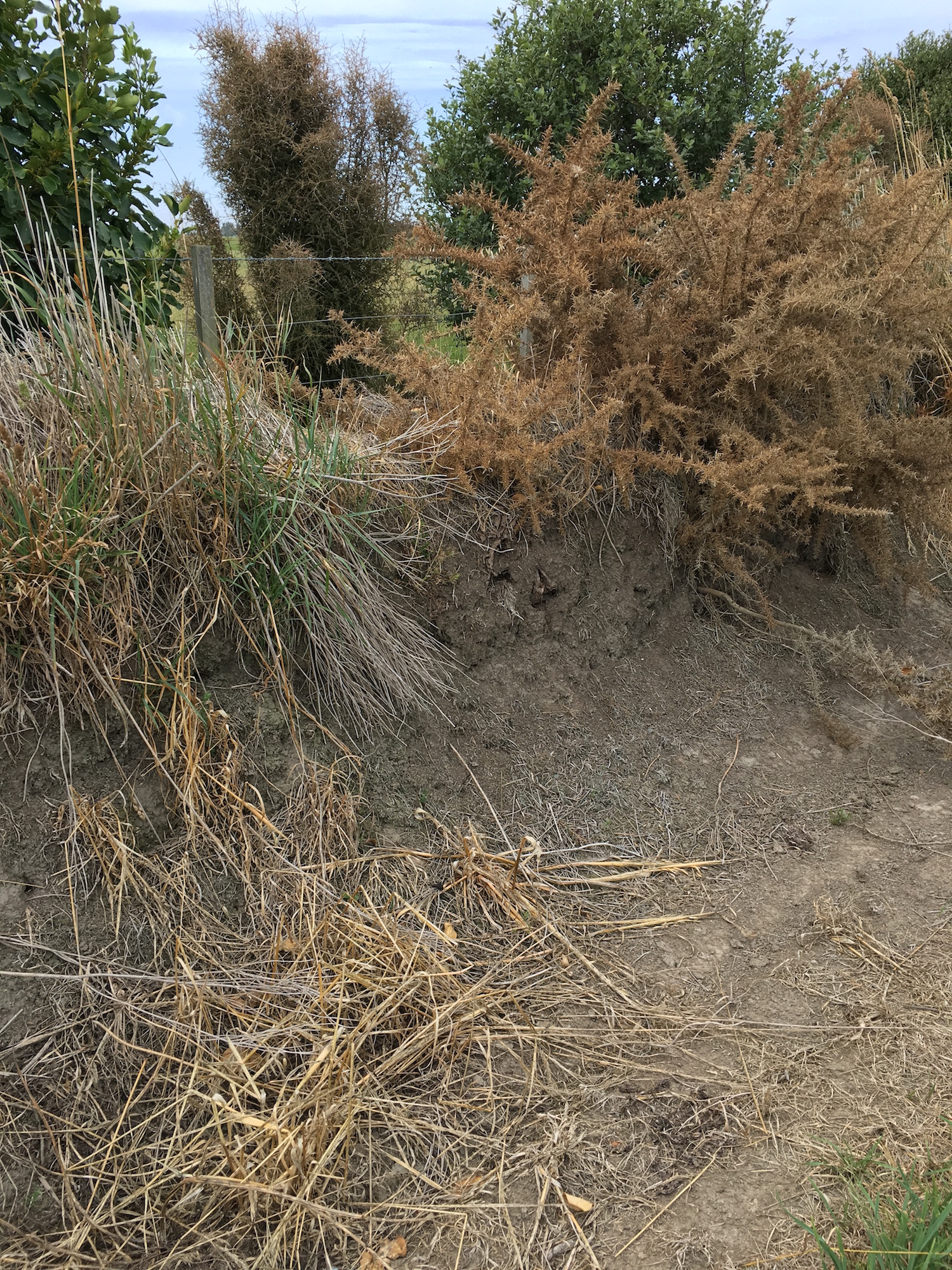
Gorse is dense when pruned into a hedge. New outer growth shades out growth in the middle of the hedge. Thorns and branches fall and form a dense, prickly mass at the base of the plant. Over time, this detritus breaks down and forms soil.

Quite a lot of soil, by the looks of it.

Some gorse hedges were planted on ridges–ditch and dyke, it was called–the farmer dug a ditch to help drain the land, and planted a hedge on the resulting pile of soil scooped out of the ditch. Some hedges were just planted on the level ground. This is how the hedges along my lunchtime walk were planted, but today it looks like they were sown on a tall, narrow wall of soil.

The build-up of soil under the gorse hedges is impressive. In some places, it is as high as my waist. It is most visible where the gorse has been herbicided off to make way for native hedging plants. There you can see how the twisted trunks and branches have caught the detritus and held it in place, even after it has rotted.

How important are these ridges of new soil in a landscape that is losing soil? Probably not terribly important–they cover just a tiny fraction of the landscape–but I find them intriguing, nonetheless. Our agricultural landscapes–as modified, controlled and cultivated as they are–still hold interesting stories.


She Just Wants To Be Useful

Artemis in her younger years.

Artemis in her younger years.

Seven months ago, I blogged about my 12-year-old dairy goat who had been diagnosed with heart trouble. The vet clearly was trying to tell me she ought to be put down at the time. I heard the message, but couldn’t bear the thought, provided she wasn’t uncomfortable.

I got a prescription of diuretics for her to try to clear the fluid from her lungs. It seemed to help a little…until she got wise to the medicine and began to refuse it. By then it was springtime, and I thought she might just be okay without the medicine. I stopped giving it to her, and she was fine. With the spring grass growth, she put on condition, and toward the beginning of summer, her udder started to fill out.

Artemis has always been a strong milk producer. In years when she’s kidded, her udder gets so full, it drags in the grass, and her kids have trouble finding the teats. I haven’t actually gotten her in kid for two years, and she still gives milk every year.

This year, she was supposed to be officially ‘retired’. I replaced all my other dairy goats with fibre goats so I wouldn’t have to be tied to daily milking.

Artemis had other ideas. In spite of her dicky heart, in spite of her age, her body decided to produce milk.

At first, I ignored it. If there was no demand for the milk, she’d stop producing. At least, that’s what the textbooks say. It’s never worked for Artemis in the past (drying her off in winter has always been challenging)–I don’t know why I expected it to work this time.

Eventually, I had to milk her. And once it milked her one time, her body responded by producing more milk. It was a vicious cycle–the more I milked, the more she made.

I’m now milking her twice a week. Not much, really, compared to the usual daily milking. I have to say I appreciate the milk, but more importantly, Artemis appreciates the milking.

She knows the signs I’m coming to milk her. When she realises that’s what’s happening, she saunters over to the gate, full of self-importance, nipping haughtily at the fibre goats. She slips out the gate when I open it and trots to the milking stand. She talks to me a little bit as I milk her, as if to bring to my attention what lovely milk she’s made for me.

When I release her from the stand, she leaps off and scampers like a kid back to the paddock, kicking her heels in the air. When I let her back into the paddock, she skips around the other goats, as if to say, “See, I’m useful, unlike some around here.”

It clearly gives her so much pleasure, I feel bad that I hesitated to start milking her.

Maybe producing milk will be the last straw for her heart–just too much to ask of her body–but I believe it makes her happy.

And so, I will milk her. For as long as she wants. After all, isn’t that what we all want? To be useful? To be needed?

Bittersweet Sweet Corn

2017-01-24-15-16-41-smYou wait for it all summer. You watch it grow taller and taller. You marvel when it overtops your head. You cheer when it starts to flower, and you impatiently poke the ears as they grow and fatten.

Then one day–finally–the first ears of sweet corn are ready to pick. Always eaten as corn-on-the-cob, the first ears are celebrated and savoured. They cry out Summer!

They are the beginning of the end, of course.

Once the sweet corn is coming on, the green beans will start to slow down. The peas, already on their last hurrah, will give up. February’s heat and dry will begin to take its toll on all the plants.

There is still plenty of time to enjoy summer’s bounty–the deluge of vegetables won’t be over until mid-April. There is still ketchup to make, and summer soup to bottle. And lots and lots of corn-on-the-cob to eat.

But once the corn is ripe, the clock is ticking. From here on out, the garden will look a little worse each day. I’ll start pulling plants out, clearing beds, harvesting storage crops.

And in a shady corner of the yard are two trays of seedlings, sheltering from the heat and harsh sun. Waiting for the end of the sweet corn. Winter crops.

Because every season’s end is another’s beginning.

Summer Farewell

2017-01-29-06-18-08-smSunrise over
Quiet water.
Waves roll in.

— • —

Anemones and
Starfish rule.
Snail goes slow.

— • —

Cliffs enclose
Sandy bays in
Rocky embrace.

— • —

Footprints
Tell
Stories.

— • —

Paddle slowly.
Quiet now.
Fish are sleeping.

— • —

Beach beckons
Sun is high
School threatens.

Celebrate January

2017-01-24-15-13-32-smThe golden month is nearly over. January is the sweet spot of the year.

The Christmas frenzy is over. The kids are o vacation. much of the rest of the population goes on holiday too.

Even I get a break. By January, the plants in the garden are large enough to suppress weeds, so there’s little weeding to be done. Te early crops are winding down and the summer crops are ramping up. Full-scale bottling (canning) and dehydrating will come later. January is mostly a time to enjoy the garden’s summer bounty.

There is work to do, of course. Peas, pickling cucumbers, and green beans all peak in January, and they need to be processed. But they are relatively quick and easy crops to preserve.

Along with the garden respite usually comes sunny summer weather. We can go camping and backpacking, and take trips to the beach. January is a month of sand, sun and effortless meals.

February will come, with school, work, and a mountain of vegetables to process. The nationwide party mindset will end, and we’ll all settle in for another year at the grindstone.

But there’s still a week left. Enough time for a bit more fun…

The Christmas Calzone

2016-12-24-19-21-34-smGrowing up, Christmas eating was strictly traditional stuff—lots of cookies, turkey, mashed potatoes, cranberry sauce, a token vegetable, and lots of gravy. I remember Christmas day as being a frenzy of cooking, starting with my mother putting the turkey in the oven in the wee hours of the morning, so that by 10 am the whole house smelled like turkey. It truly was glorious from a kid’s perspective.

At Crazy Corner Farm, Christmas eating is about as far from traditional as it gets. Except that it has become our Christmas tradition, and as such, it is traditional.

Our big holiday meal is on Christmas eve. With all the wonderful vegetables from the garden, we make calzones. We enjoy them with a fresh salad, or fruit from the garden.

In the evening, my husband makes up sticky buns and puts them in the refrigerator to rise overnight. I pop them into the oven in the morning before I go out to feed the animals, and they’re ready for breakfast by the time everyone else is awake.

We feast on sticky buns throughout the morning, then have leftover calzones for lunch. We hardly need an evening meal Christmas day, so our tradition is a big salad, broad beans, and the first of the season’s new potatoes.

All very low-key and relaxing, yet wonderfully decadent.

Christmas eve eve…

img_2742Surprisingly, a day of calm. It was overcast and rainy. The garden is reasonably well weeded. The berries and peas were picked yesterday.

Tomorrow I will clean the house (because Santa doesn’t visit dirty houses—I’m sure my mother taught me that one), and the peas and berries will need to be picked again, but today there was remarkably little on the to-do list. I’m not sure what happened, because usually the lead up to Christmas is a frenzy, just so I can feel free to take the whole of Christmas day off.

So, I gave myself an early gift—a day of sewing. I managed two new desperately needed t-shirts for myself, and did the finishing by hand while listening to a recording of my far-away family reading A Christmas Carol. Then I picked roses, and played a game with my daughter.

Such a lovely, relaxing day, I hardly need Christmas at all…

You have got to be kidding me…

2016-12-16-15-35-55It frosted Saturday morning. Yeah. It was 30C Friday afternoon, and by Saturday morning it was 2C. It was back up to 30 degrees by Saturday afternoon, and today we went to the pool.

I didn’t even think to check the garden Saturday morning. It never frosts this late in the year. That’s the seasonal equivalent of frost on June 16th, for those of you in the Northern Hemisphere. Even in St. Paul, Minnesota, it never frosted that late. It was a rude surprise when I went out to the garden in the afternoon to pick some vegetables and found the pumpkins and beans blackened.

The plants will survive—it was a light frost and the growing tips of the plants weren’t hit—but it will knock the pumpkins back significantly. They were already behind, because the first planting didn’t germinate, and these plants were my second try at them this year. A frost this late might be the difference between mature pumpkins when the first autumn frost hits or pumpkins that still need a few weeks of growth to reach the right stage for storage.

Unfortunately, the only thing to do at this point is shrug and be thankful the other frost-tender crops weren’t damaged…after the obligatory grumpy farmer complaints are through.

Christmas-lite

2016-11-30-17-31-25-smIt’s beginning to look a lot like Christmas…

Strawberries, gooseberries, black currants, red currants, cherries, and peas—ah! The signs of Christmas! They’re red and green, just like those in the Northern Hemisphere, but the greens are brighter than pine tree green, and the reds more succulent than holly berries.

They are just as festive as the colours up north, though in a different way. While you look inward, gathering around the hearth on long dark evenings, we look outward, sitting with friends on the beach on long summer days. You dream of white snow, we dream of white sand. You have visions of sugar plums dancing in your heads, we have visions of fresh strawberries dancing in ours. While you sing ‘let it snow’, we sing ‘let us go’ (to the beach).

Now and again I miss the cosy dark of Christmas in the north. And every year, I wish summer gardening, Christmas, and the end of the school year didn’t happen simultaneously. But I’ve grown to appreciate the summer Christmas. I appreciate not having to plan Christmas dinner, but letting it spring from whatever is abundant in the garden. I appreciate being able to sit outside on the porch in the sun after gifts have been opened. I appreciate the barefoot, short-sleeved, nature of Christmas here.

It’s like Christmas-lite.