I’ve Got This Bug

Pseudocoremia leucelaea

Pseudocoremia leucelaea

“So, I’ve got this bug?”

I grimaced into the phone. It was going to be one of those calls.

One of those calls where the caller expects me to identify an insect over the phone. An insect they didn’t really look at terribly closely and didn’t bother to collect.

“It’s sort of brown, with long feelers. What is it?”

I try to help. I try to tell people where and how they can get their bug identified, but sometimes I think I’m just talking into the wind. Most of the time I’m sure they hang up thinking, “Well, she didn’t know much, did she?”

Here’s the thing.

Even in New Zealand, which has a very limited number of insects, compared with other places in the world, there are 10,000 species of insect to choose from.

Some are iconic, to be sure. Some are easily recognisable.

Many are not. Many look different as an adult than they do when young. Sometimes males and females look very different. Colours and markings can vary from individual to individual. Some features are only visible under a microscope. And verbal descriptions are less than useless.

So when a person says an insect is brown, I wonder whether it is a dark chocolate sort of brown, a reddish brown, a light brown…because “brown” could be anything.

When they say it’s “about a centimetre long” I wonder whether it is closer to 9 millimetres or 11 millimetres, because it might matter.

When they say, “It looks sort of like a huhu grub” I wonder what features make them say that. Is it legless? Is it a creamy white colour? Or is it just that they’ve seen pictures of huhu grubs and it’s the only thing they can think to compare it to?

When they say it’s got long feelers, I wonder whether those antennae are filiform, moniliform, pectinate, capitate, or serrate.

When they say it has clear wings, I wonder whether it has two or four. And whether those wings are fully clear, tinted, or partly covered in scales.

I wonder how many tarsal segments its legs have.

I wonder whether it has setae on its tibia. And if so, how many, and what size they are, and how, exactly, they are arranged.

I wonder what the shape of the marginal cell on the front wing is. Or whether the wing venation is reduced, or whether the wing is fringed at all.

Sometimes, someone can describe an insect in detail to me over the phone, and I am baffled. Then they bring me the insect, and I can immediately identify it, and it looks nothing like I imagined from the description they gave.

I’m always happy to try to answer people’s entomological questions, but sometimes I feel like one of the three blind men trying to identify an elephant by feeling just a small part of it’s body.
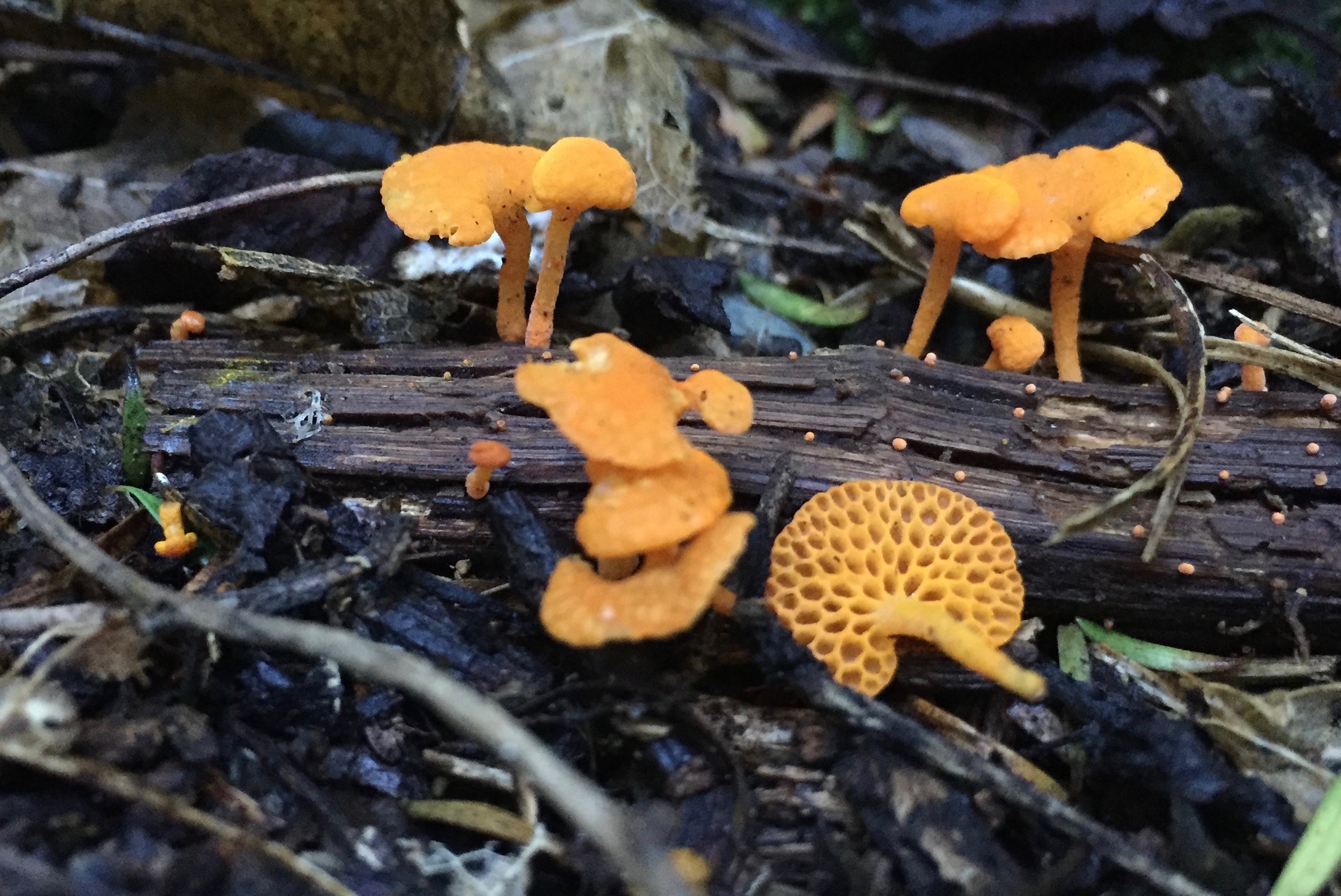


Orange Pore Fungus—a storybook mushroom

IMG_5266As my husband and I were hiking on Sunday, we came across a beautiful little fungus along the trail. Pebbly orange caps with a honeycomb underside. I was enchanted—they were storybook mushrooms that would have nestled neatly into any fairy tale.

But when my husband posted the sighting to NatureWatch NZ, the dirty truth came out.

These storybook fungi are Favolaschia calocera, the orange pore fungus, an invasive weed, and our sighting was the first in Hinewai Reserve.

The orange pore fungus is a curious organism. It appears to be native to Madagascar, though there is some speculation that it might also be native in parts of Asia.

It was first recorded in New Zealand in 1969, and has since spread throughout the North Island and much of the South Island. It has also recently been found in Australia, Thailand, China, Kenya, Reunion Island, and Norfolk Island. Its success probably shouldn’t be surprising—it’s a generalist, invading just about any dead wood available, unlike many other species that have specific tastes. It is also able to produce spores without mating, so it’s very quick to reproduce. It is so successful in New Zealand that mycologists are concerned that it could be displacing native fungi.

But it hasn’t stopped in New Zealand. In 1999, the orange pore fungus was first noted in Italy near the busy port of Genoa. Genetic studies of the Italian fungus indicate that it probably came from New Zealand on imported timber.

This storybook fungus is straight out of a fairy tale, all right—but the tale was written by the brothers Grimm.

Happy International Women’s Day!

Girls can have adventures, too.

Girls can have adventures, too.

It’s only fitting that today I celebrate two women who influenced my view of the world and a woman’s place in it—Dian Fossey and Jane Goodall.

These two women were my heroes growing up. They defied everything society taught me a woman should be. They were bold, courageous, and smart. They spent their days scrambling through the rainforest wearing khakis, with their hair pulled back into a no-nonsense ponytail. They believed passionately in their work, and Fossey even died for it.

I devoured every article about them in National Geographic and International Wildlife magazines. I watched every documentary on their work. I wanted to grow up just like them.

They taught me the value of patience. They taught me to sit still and observe. Watching how they studied apes, I learned to leave the butterfly net and jam jars at home—I could learn more by joining my subjects in their world than by bringing them into mine.

And when, as a teen-ager on a job shadow day, I was told by a burly wildlife manager, “We don’t like girls,” Fossey and Goodall were standing behind me. “Ha! I’d like to see him try to stop you! Hold your ground, girl!”

I know I am not alone. I am not the only girl who has taken strength from the women who have gone before them. I am not the only girl who might have caved in to dismissive career counsellors and teachers, to the stereotypes they saw on TV every day, to the expectation that even a ‘tomboy’ would eventually grow up into a ‘real’ girl. A generation of girls watched Fossey and Goodall and took notes.

I never did study big mammals like I wanted to, but not because of my gender—I found my skills and interests ultimately led me elsewhere. But Fossey and Goodall are still my heroes.

Thank you, ladies. For your groundbreaking research, and for being you. You have made a difference in more lives than you know.

Outside In

2016-01-01 16.46.05Window screens are uncommon in New Zealand.

It’s not that there is no need for them. This time of year I struggle to keep the outside out of the house.

Flies, bees, wasps, mosquitoes, and moths all find their way in, to buzz, bite, and generally be a nuisance. Leaves and seeds blow in on the ever-present wind. And the occasional escaped chicken or feral cat wanders in, too.

So why no screens?

It makes sense if we look at why window screens are found elsewhere in the world.

In the United States, window screens were uncommon until the early 1900s, when they were suddenly mandated by local governments all over the country. An important advance of science was the reason for the new laws.

Today, with think of malaria, yellow fever, dengue, and a host of mosquito-borne diseases as tropical. But these “tropical” diseases, especially malaria, used to range all through Europe and North America. The ancient Romans invading Scotland, lost half their soldiers to Scotland’s local strain of malaria. Yellow fever and malaria were common in Boston and London. Philadelphia was decimated in 1793 by a yellow fever epidemic.

The connection between mosquitoes and malaria was discovered by entomologist Ronald Ross in 1897, and by 1900, mosquito control efforts were underway all over the world. Within a few years, window screens were being mandated by law in disease-hit areas. Most of those laws are still in place, as there is nothing preventing those mosquito-borne diseases from returning.

Here in New Zealand, we are remarkably free of mosquito borne diseases. Malaria, and yellow fever have never gained a foothold, though they almost certainly have shown up now and again in the form of sick travellers.

With no mosquito borne disease, the biters that slip in through my windows every night are just a nuisance, so screens haven’t been written into the building code.

But they would be nice to have…

That Gunk on Your Car

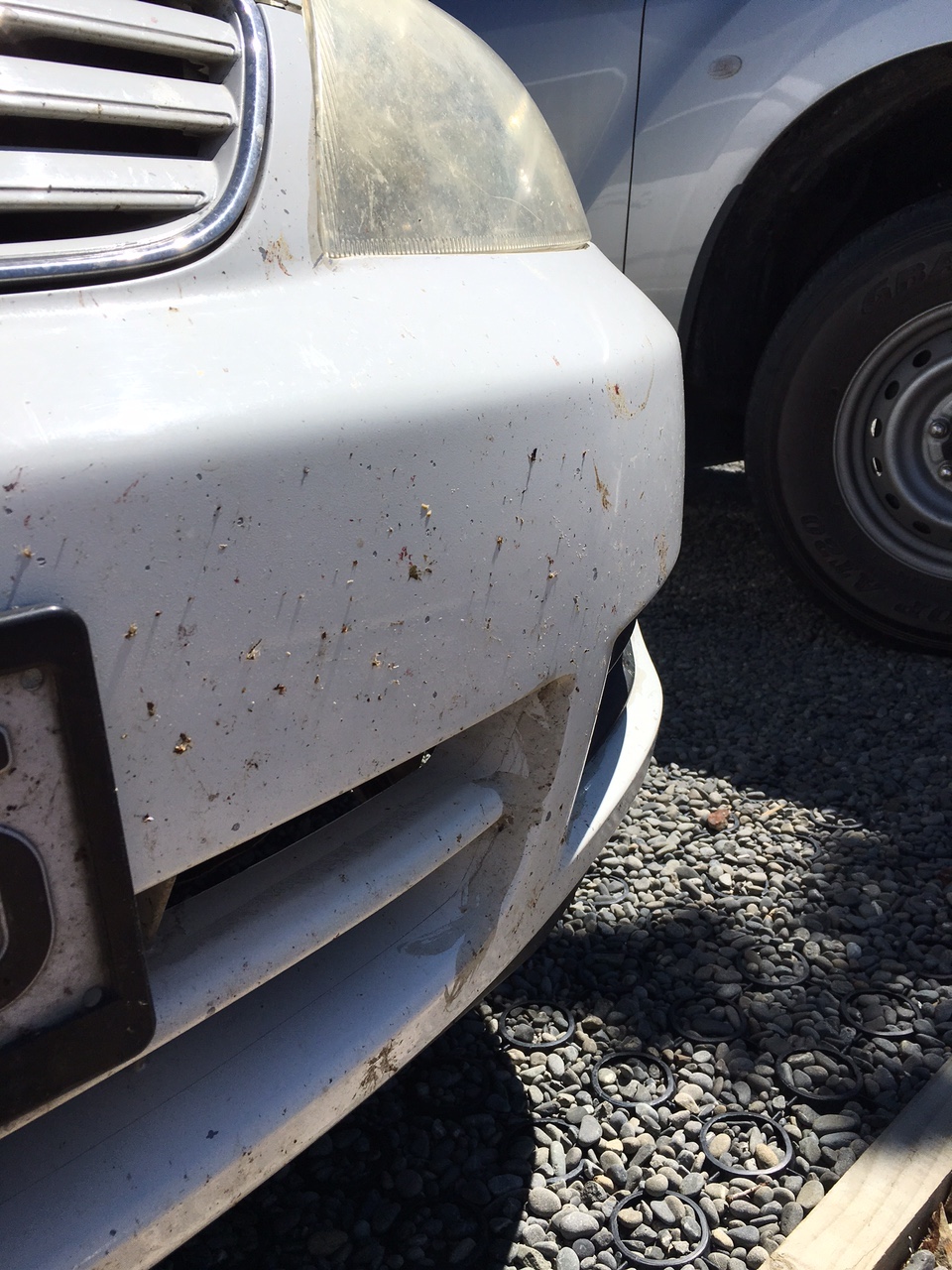
IMG_0514Back in 1997, entomologist Mark Hostetler published the book That Gunk on Your Car, a serious and funny identification guide to the flattened bodies you might find on your front bumper in the southeastern U.S.

I think there needs to be a companion book to Mark’s—The Ecology of That Gunk on Your Car.

Why?

This morning, I sat and watched sparrows descend upon cars in a carpark, picking off splatted insects. How these birds discovered that cars are a great source of protein, I don’t know, but they were certainly enthusiastic. They flitted into crevices to pick out tasty bits—a gooey abdomen here, a crunchy thorax there.

It made me wonder how important car-splat insects were in their diet. Birds inhabiting an urban environment are likely to have difficulty finding insects to eat—the bodies carried in by cars could be incredibly important to them. What other species make use of car-splats? How much nutrient flow is there between rural and urban areas, just on the front ends of cars? Do these nutrients affect the populations of urban pests like sparrows? How does a good mass-transit system affect the flow of nutrients into the urban environment?

So many questions, so few answers! How little we really know about the world around us!

Damselflies

2016-01-31 13.44.27 cropTwo years ago, my husband did what he’d been threatening to do for years—he dug a pond. At some point, I’ll write a blog post on the pond itself, but today I want to talk about the damselflies that live there.

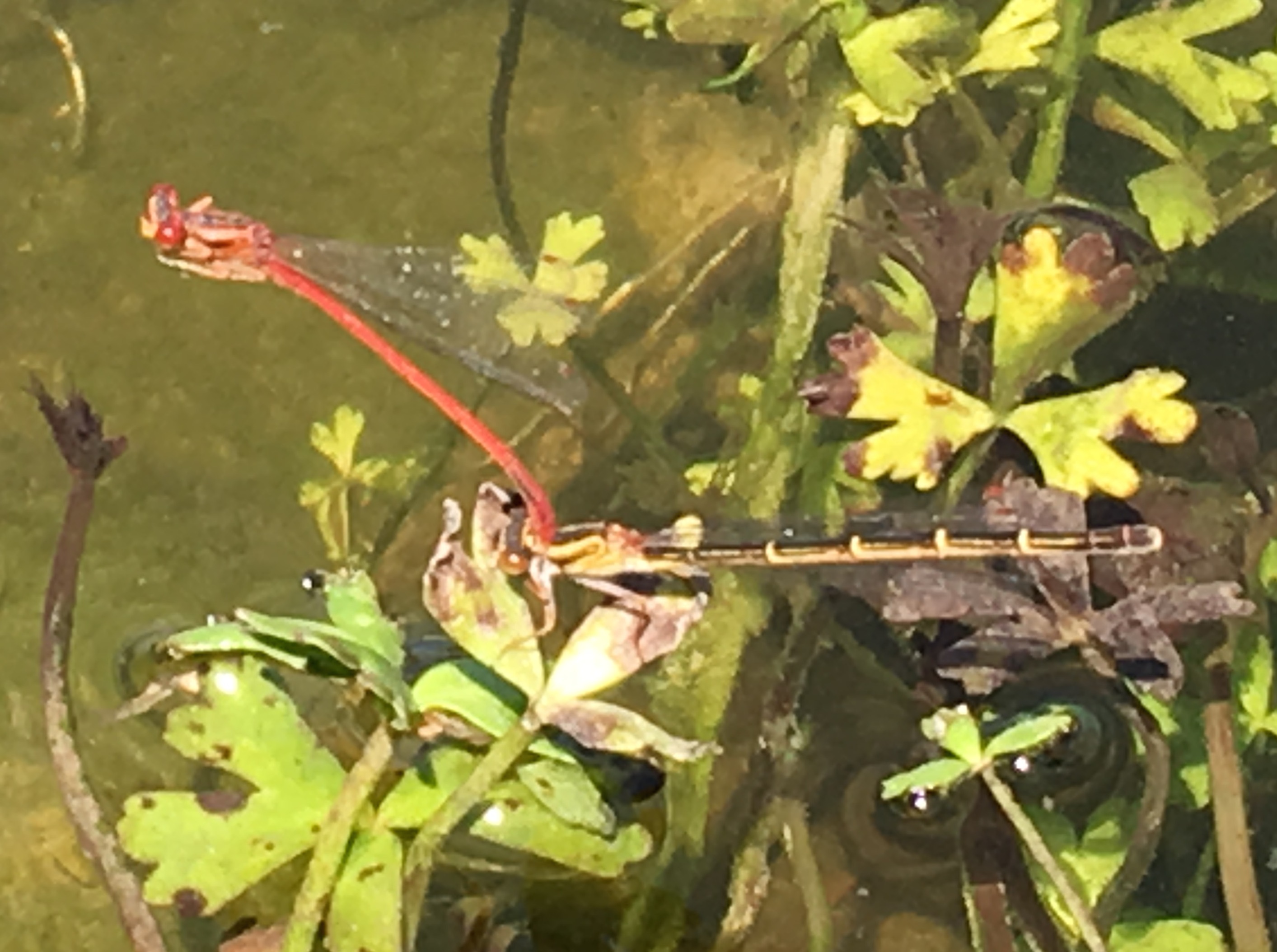
I took a break from my work this morning and spent a few minutes sitting beside the pond. It was swarming with red damselflies (Xanthocnemis zealandica). They were mostly males jockeying for the best territories—chasing and dive bombing each other, all short jabs of snapping wings.

2016-01-31 13.44.40 cropThe females were there, too. Every one I saw was being guarded by a male as she flitted from plant to plant, dipping her abdomen into the water to lay her eggs in the plant’s submerged stem. Damselfly mate guarding is awkward at best—the male grasps the female behind the head with claspers on the end of his abdomen and discourages other males from mating with “his” female. Both insects must beat their wings to keep the pair aloft, and as I watched them, it wasn’t at all clear to me who chooses the spots to stop and lay eggs.

When a pair stops, the male often supports himself entirely with his claspers, tucking in wings and legs and forming a bizarre appendage to the female as she gets down to business. She appears completely oblivious of her escort, resting after laying each egg, as if to say, “If you want to cling there in that ridiculous pose, that’s fine by me, but you’re not going to rush me.”

The eggs these girls lay will hatch in a week or two, and the nymphs will spend nearly a year living in the pond, eating other aquatic invertebrates with a hinged, extrusible mouth that is the stuff of horror movies, before emerging from the water as adults.

I sat and watched the spectacle for a while, and just as I was about to leave, I was treated to the sight of the other damselfly resident in this part of New Zealand—the blue damselfly (Austrolestes colensonis)—a large neon-blue insect that makes the red damselfly look dull.

Unfortunately, he didn’t stick around for a photograph, but I’ll be looking for his nymphs in the water later in the year.

Science education at its best

Physarum cinereum

Physarum cinereum

About eight months ago, my daughter did a school project on slime moulds. Along with internet research on slime moulds, she searched for live slime moulds in various habitats, and even tried keeping one as a pet. Unfortunately, the weather was particularly dry and warm, so slime moulds were scarce, and her pet died. We considered the project somewhat of a failure.

Except that she has been tuned in to slime moulds ever since, so when she noticed a funny grey substance covering blades of grass in the yard a few days ago, she was primed for it. She brought it inside to look at under the microscope, and correctly identified it as Physarum cinereum, a type of slime mould.

She posted a photo and her identification on Nature Watch NZ, and had her identification verified by several scientists.

Today, she found a similar slime mould, but this one was a mustard yellow colour. In form it was very like Physarum cinereum, but altogether the wrong colour.

She pulled out her iPad to search for it online. No luck…

But…

While she was searching, the sample under the microscope changed colour, from yellow to grey. Based on her knowledge of slime mould biology, she reckoned the grey colour must be spores. She has posted her new photo and identification to Nature Watch NZ, and is waiting to see what the experts think.

Could I ever have devised a better science lesson? Not in a million years. She made an observation, used her research skills and prior knowledge to make sense of what she saw, and got corroboration from an expert.

The resources available to kids (and bigger kids, too) these days are amazing—the opportunities to engage directly with the scientific community, find current information about things (no more 20 year-old World Book Encyclopaedias), and record their observations are so far beyond what I had as a child, it still feels a bit like magic to me.

But of course none of that is possible if we don’t nurture our children’s curiosity and teach them how to use the tools available to them. None of it is possible if we don’t give our kids time to watch the world go by, time to get bored and lie down in the grass. Tom Eisner (famous entomologist, for those who don’t know him) wrote in his book For Love of Insects, “How is it, I am often asked, that I make discoveries? I always feel a bit awkward about answering the question, because I do not have a particular method. The truth is that I spend a fair amount of time looking around.”

So go on. Get out there. Look around. Who knows what you might discover.

Daddy long-legs

daddylonglegs1cropsmThe name Daddy long-legs conjures images of swift, leggy creatures, but depending on where you live, the image you see in your mind may not be the creature pictured here. The name can refer to a particularly common house spider, a crane fly, or this delightful animal—a harvestman.

Harvestmen are arachnids, and are often confused with spiders—eight legs, roundish body, move quickly—but they are in a separate order from the spiders, and have important differences.

The most obvious distinction is the body shape. Spider bodies are divided into two sections, but harvestman bodies are just one section.

Most people are familiar with the European harvestman (pictured), but most harvestmen are much more fierce-looking than the European ones. They sport vicious-looking spines, oversized pincers, and bizarre body shapes and colours. Perhaps this is where they get their reputation as “the most poisonous spider on the planet”. The truth is that, unlike spiders, none of the harvestmen have poison glands.

Harvestmen are primarily scavengers—eating dead insects, and the occasional tiny, slow-moving live insect (the European ones are said to like aphids). They have no need for poison except in defence, and here they are well-endowed. Most harvestmen have small pores on their backs that exude a smelly substance that repels most predators.

So the worst a harvestman can do is smell bad.

Of course, every kid who’s ever tried to catch a harvestman knows they have another defence mechanism—legs that break off easily. A harvestman’s legs act as a quick get-away mechanism if it is snatched by a predator—the leg snaps off easily in the predator’s mouth, allowing the harvestman to escape. Harvestmen seem to get along quite well with seven, six, even as few as four legs (look closely and you’ll notice the one I photographed has only seven legs).

These shy, gangly creatures are some of my favourites in the garden and in the forest, where hundreds of species abound, many of which are still undescribed by science.

Cut the Cake

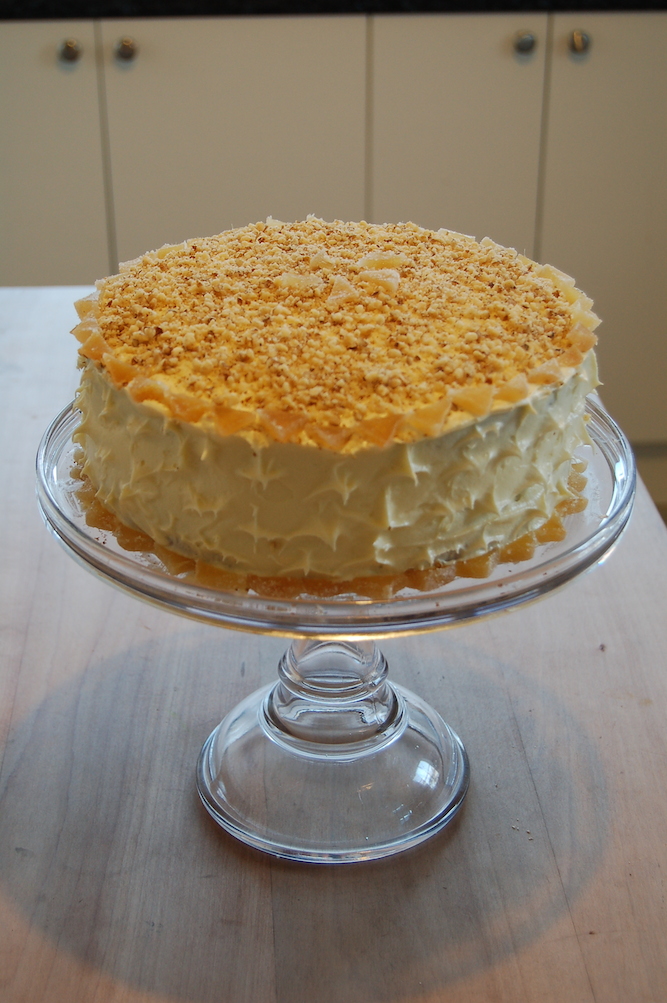
DSC_0008 copyThere are many ways to cut a cake, depending on the shape and size of the cake and the occasion. There is a protocol for wedding cakes, and techniques for large sheet cakes (the first time I saw someone pull out dental floss to cut a birthday cake, I was very impressed). There is the all-important first piece for the birthday kid—usually determined by where the most interesting bit of decoration is.

But, for the most part, your average person doesn’t think much about how a cake is cut. We just cut it the way we’ve always done.

But that’s not good enough for some people.

I’ve recently run across two intriguing videos about cake cutting that take the art to a whole different level.

First, there’s the guy who wanted to be able to cut more interesting shapes, without wasting cake, so he designed and built a hexagonal cake cutter.

Then there’s the cake-cutting technique that was actually published in the scientific journal Nature in 1906, that prevents the half-eaten cake from drying out.

Clearly, these men didn’t have enough other household chores to do!

Pastry for Science

Photo: Simon Pierre Barrette

Photo: Simon Pierre Barrette

Yes! The next time anyone questions my predilection for pastry, all I have to do is say I’m making it for science!

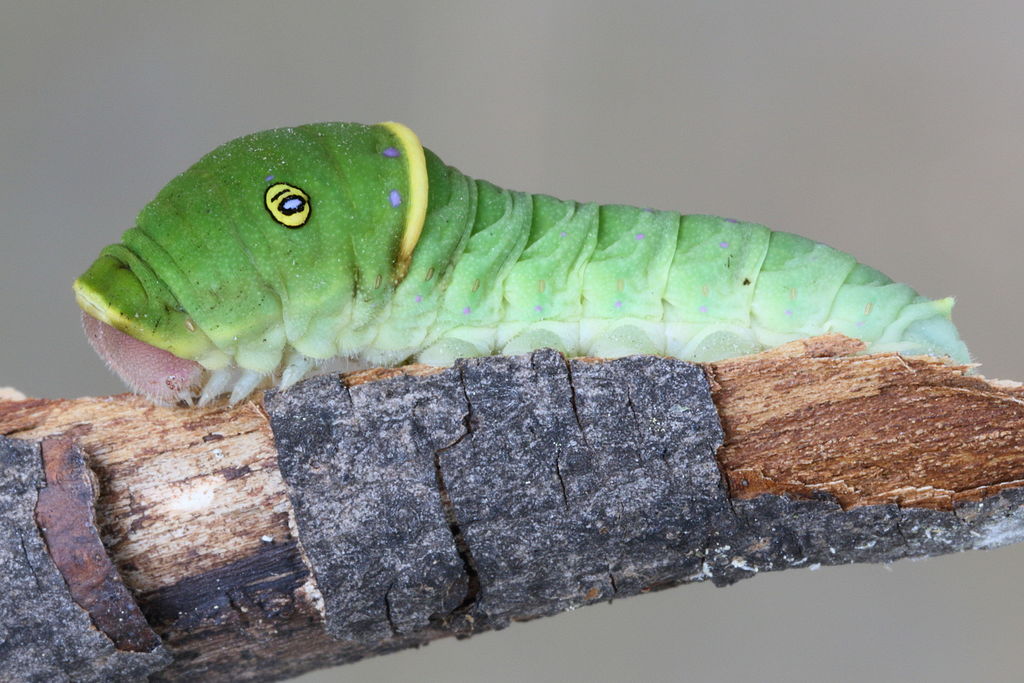
Researchers at Carleton University in Ontario made fake caterpillars from pastry in order to test the importance of the visual components of the tiger swallowtail caterpillar’s defence strategy (which is to look like a snake). The pastries were popular with birds, until they painted snake eyes on them. But young birds could learn that pastry with snake eyes was tasty, too, and then would only avoid pastry with eyes and the shape of a snake.

The researchers conclude that the combination of features the swallowtail caterpillar uses is a result of the selective pressure of smart birds, who aren’t fooled by imperfect disguises.

I might conclude that birds like pastry just as much as I do!