Magpies in the dark

Photo: Eric Weiss

As though they know
What I need
When winter returns
On the eve of bud burst,
Magpies warble
On fence posts
In the dark.

Spring comes!
Spring comes!

Ten years ago I posted a blog titled, It Ain’t Over ’Til the Magpie Sings. The post was prompted by the first morning that a magpie warbled for an hour before dawn. At the old house, where the windows weren’t double glazed, the magpies were my alarm clock in spring and summer, warbling an hour or so before sunrise, urging me up to do the milking and make the most of the day. It’s harder to hear them in our new house, where the double glazed windows deaden outdoor sounds, but I’ve been tuning into the magpies for years.

And I’ve discovered that the magpies are remarkably predictable. Ten years ago, I heard the first pre-dawn magpie song on August 8th. Today (the 8th of August) I heard the first pre-dawn magpie song of the year.

And just like that day a decade ago, the first magpie song was followed by a winter lashing reminding us that, while spring was on its way, winter was still in charge. Today’s weather forecast shows the temperature dropping from a 4 am high (a balmy 12.3℃) all day, to 3℃. We can expect rain and icy wind for the next couple of days.

But in the dark, the magpies will keep singing.

Garden Tally

Years ago, struggling with the feeling that I wasn’t pulling my weight in my family because I wasn’t earning much money with my business, I did a few back of the envelope calculations of what my gardening and milking/cheesemaking activities ‘earned’. At the time, I worked out that I was producing about $50,000 worth of food every year. The domestic accounting blew me away and put my mind at ease.

Plenty of food in the winter garden.

I’m no longer concerned about the monetary value of the gardening I do, but I’m still curious, and I love data and numbers. So I’ve decided to do some garden accounting this year.

Beginning at the winter solstice, I started keeping a log of all the food that comes out of the garden. Although the garden year never really ends here, I figured the solstice was as good a place as any to start. I’ve dedicated a notebook to the task and I’m recording as much information as I can about what I harvest—weight, number, variety, etc. I’ll periodically enter the data into a spreadsheet, so I can play around with the numbers.

Okay, yes, I’m a total nerd. But I love playing with data. And we always come to late summer (as we heave yet another laden basket onto the kitchen bench) wondering just how many kilos of courgettes we’ve harvested. But by then it’s too late to go back and weigh them. 

Peppers hanging on in the greenhouse.

Besides, there’s always the fascinating harvests, like the 500 grams of hot peppers I harvested yesterday. (in July?! For those in the northern hemisphere, July is the seasonal equivalent of January.) In addition, the exercise might tell me a bit about which varieties are more or less worth growing. Not that it would stop me from growing a crop I love, even if it doesn’t produce a lot, but it never hurts to have the data.

My intent is not to place a dollar value on what we harvest (Who can put a value on a warm, heirloom tomato fresh from the garden?), but to use the exercise to capture the quantity and diversity of food we enjoy. 

Pleasing Spaces, Pleasing Spouses

I’ve been gardening with my husband for almost 33 years now. Over the years, we’ve created many different garden spaces together. And even after all these years, we have different ideas about what our garden should look like. Each garden we’ve created has been a push and pull of our ideas, a creative collaboration, better for the different ideas we bring to the task.

I tend towards tidy, functional. My husband tends towards whimsical, aesthetic. I think about how I’m going to get a wheelbarrow into a space, how I’m going to weed it. He thinks about seating and art, lines of sight, and how we will enjoy the space. We joke that he builds gardens and I weed them.

The end result is beautiful gardens that are relatively easy to maintain. The end result is a garden that feeds us, but is also a place we regularly stroll with a glass of wine in hand, just to enjoy the beauty of it. The end result is beautiful spots to eat lunch, read a book, or write a blog post. The end result is a space that meets our physical, emotional and spiritual needs. 

And I can’t help but suspect that the collaborative act of gardening is one of the reasons we’ll be celebrating our 33rd anniversary next month. A lifetime of what are essentially team building activities can’t be bad for a relationship.

In fact, I see the same in many of the couples in our local garden group—spouses acting as teams, collaborating with one another to create spaces to nurture each other. I love to see the beautiful, supportive relationships between spouses in that group, and I have to believe that gardening together is a strengthening factor in those relationships.

One more reason (if you needed one) to get out there and garden—but do it with your partner.

Winter Gardening

It’s not quite winter here yet. There are a few more days until it officially starts. And the weather has been unusually warm. 

It’s a far cry from gardening in Minnesota, where I used to hack my parsnips out of the frozen ground in November and December, and the garden spent much of the winter under a blanket of snow.

Here, the garden is reduced and slow growing in winter, but there’s plenty happening.

We’re still picking tomatoes, peppers and eggplants from the greenhouses, though many of the plants are looking pretty sad. They will almost certainly give up in the next month.

The winter broccoli, cauliflower and cabbage are doing nicely. We’ve been enjoying plenty of these cool-weather crops over the past few weeks, and they will continue to give through winter. The leeks are gorgeous and ready to pick. They’ll provide onion flavour in dinners after the stored onions are gone, and before the first spring onions are ready in October. 

Leafy greens like Beet Erbette and Silverbeet (Swiss Chard) are in their prime through winter—they’ve been largely ignored through summer while so many other crops were available, but now they offer fresh greens to add to the frozen and bottled vegetables in winter dinners.

Weeds are slow growing in winter, and the vegetables require little work. Much of the vegetable garden is tucked up under mulch or green manures all winter.

But there’s a fair bit of maintenance to be done over winter. Perennial crops like berries and fruit trees need pruning, and winter is a good time to tackle the really pernicious weeds like twitch (couch grass), because the soil is soft and wet. Winter is also a great time to top up mulch and add compost to the soil, to mend fences and bird nets, to shift plants.

The beauty of winter gardening is that the urgency of the spring and summer gardening seasons is gone—there isn’t so much to do that you can’t enjoy a rainy day indoors, but you have a perfect excuse to be outdoors on those glorious sunny winter days.

And speaking of glorious sunny days … I think it’s time to get out of the office and into the garden.

Happy Autumnal Equinox!

Some years still feel summery at the equinox, but this year, the weather is decidedly autumnal. Monday, we hit our highest temperature of the summer—a blustery nor’westerly day that had my students wilting by 10 in the morning. It was 31 degrees at 5 pm when we left work. Dinner was a summer feast of sweet corn, soybeans and zucchini.

We slept with the windows open, covers kicked aside on Monday night.

Tuesday morning, I went out in the dark to water the plants at about 5.30. It was still 23 degrees. As I watered, the wind shifted.

By the time I left for work an hour and a half later, the temperature had dropped to 16, and rain spattered the windshield in fits and starts.

By ten o’clock, the skies had opened up. Wind drove the rain in sheets, and the temperature continued its slide downward.

Driving home from work, the temperature registered 11 degrees. Traffic moved slowly through the downpour, wind rocking the car and thrashing trees alongside the road. When I got home, I stripped off my rain soaked cotton clothes and replaced them with cosy wool. We had potato soup for dinner.

We woke on Wednesday morning to full autumn. Summer had been scoured away by over 40 mm of rain, and stripped bare by gale force winds.

A dramatic entrance for the season. But the truth is, autumn was already well underway. Our first frost came weeks ago, on 6 March. I picked the pumpkins last weekend. And the zucchini, tomatoes and other summer-loving plants were all showing signs of being nearly done for the season.

And, of course, squirrelly me has been in autumn mode for weeks, preserving everything I can in preparation for the dark days ahead.

Today we step into the dark side of the year. Although I very much enjoyed our last couple days of hot summer sun (and today promises some beautiful sunshine), I’m looking forward to all that the dark side has to offer. 

Autumnal Harvest

The weather has turned decidedly autumnal, so while the sun is still summer-hot, the air has gotten chillier, and the weather more unsettled.

And it means I’ve gone into my annual squirrel mode—harvesting and preserving summer’s bounty so we can enjoy it all winter.

Last Saturday was summer soup day. Long time readers of my blog will know this is a key part of my gardening year. When the children were young, it was a whole-family event, with everyone pitching in to pick and chop vegetables. It’s become a more solitary activity for me in recent years, but no less important in my annual calendar. 

With just my husband and me at home now, I always think I’ll make less soup. And this year, I was a little worried I wouldn’t have enough vegetables for a big batch, because January and February were so cold and wet, the heat-loving vegetables sulked.

I should have known better.

I needed both my 20-litre and 18-litre pots to cook the soup, plus the 12 litre pot for making vegetable stock from the vegetable off-cuts. In the end, I made 23 quarts of soup and 13 pints of stock. That’s Monday dinners for almost six months, plus stock to flavour 13 more meals. Not bad for 13 hours of work.

The day after summer soup day, I tackled the sweet corn. I usually sow three plantings of sweet corn, two weeks apart, in the spring. The first two plantings were desperate to be picked, so I harvested 63 ears of corn. Blanched and cut off the cob, it yielded 5.3 kilograms of corn, which went into the freezer. That’s a year’s supply of sweet corn for us, to be used in casseroles, stews, and side dishes. 

I had hoped to also freeze some soy on Sunday, but I’d waited too long to harvest, and about half the beans were too mature. So we’ll save the majority of this year’s soy as dry beans instead.

And speaking of dry beans, in the last fortnight, I’ve harvested my Borlotti and Black Turtle beans, and have started harvesting the climbing beans: Blue Shackamaxon, Bicolour Peans, Bird’s Egg, and Cherokee Cornfield. The harvest of the climbers will go on for the next month as the plants continue to grow and put out new pods while the older ones mature. Not quite as neat and tidy as the bush beans, which all mature at the same time, but in the end, I’ll get more beans from the same amount of garden space off the climbers than the bush beans.

I’ve also now harvested most of the potatoes, which did beautifully this year, with the cool rain. The spuds are tucked away in a dark corner of the laundry room, and should last through much of the winter.

There are still more vegetables to squirrel away in the next few weeks: pumpkins, hopefully more tomatoes, more basil (in the form of pesto), and the rest of the beans and potatoes. As I do every year, I mourn the end of summer’s bounty, but I look forward to the ease of winter meals that come from the freezer or pantry instead of directly from the garden. There is something delightful about knowing that the hard work has been done, and the food is tucked away, ready to be eaten.

Oven Fried Zucchini Sticks

Many years ago, I posted a blog titled 50 Ways to Eat Zucchini. Since then, I’ve gotten much better about my zucchini planting—I plant half as many as I used to. Of course, that still means we have too many. We’re currently giving away 5 to 10 kg of zucchini a week, eating it in every dinner and baking it into desserts.

I don’t mind having too much zucchini. It’s a versatile vegetable that can be grated into all kinds of dishes (chilli, pasta sauce, enchiladas, burgers …) or featured in beautiful slabs or rounds (zucchini and tomato tart, grilled zucchini, frittata …).

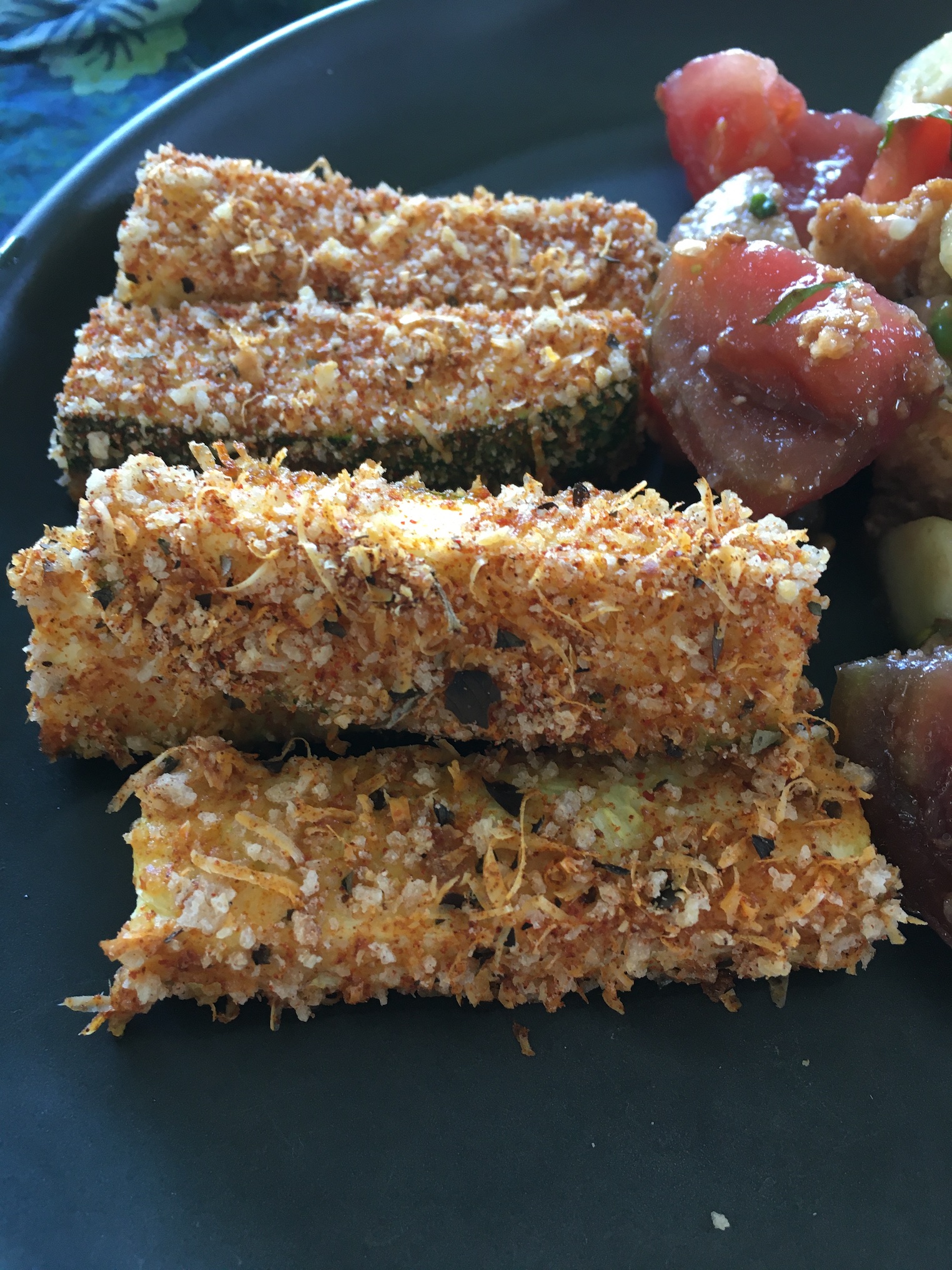
One of my favourite ways to eat zucchini is as breaded, oven fried sticks. These tasty ‘fries’ take a little work, but are well worth the effort. I fill a large jelly roll pan with them, and they vanish, even when it’s just my husband and me for dinner.

I don’t have a set recipe, but here’s an approximation of what I do:

2 small to medium sized zucchini
1 egg
1 cup bread crumbs
3/4 tsp salt
1/2 cup grated Parmesan cheese
2 tsp paprika
1/4 tsp chipotle
1/2 tsp smoked paprika
1 tsp dry oregano
small handful of fresh parsley or basil, finely chopped

Cut the zucchini into thick sticks, about the length and thickness of a finger. Whisk the egg in a small bowl. Combine all other ingredients in a separate bowl. Generously oil a large baking sheet.

Dredge each zucchini stick in the egg, then the breadcrumb mixture and set on the pan.

Bake for about 20 minutes at 200℃, until browned and cooked through.

Serve hot, with your favourite dip, if desired. We love chipotle mayonnaise with them, but they really need no further embellishment—they’re delicious as is.

In Praise of the Sauerkraut Crock

There are certain pieces of kitchen equipment that don’t get used often—the milk frother, the crinkle cut knife, the herb scissors … Most of these items are really unnecessary, and some don’t work very well, so they’re only pulled out on rare occasions when you feel like faffing around with something.

Other equipment is absolutely essential, but serves a specific purpose.

The sauerkraut crock is one of those.

This heavy, straight-sided 3-gallon stoneware crock is the perfect vessel for fermenting cabbage. It holds a large amount of cabbage, and is easy to pack and empty. With straight sides, weighting the cabbage while it ferments is easy to do, and we’ve made a custom ‘chaser’ for this very purpose.

For six weeks of the year, the sauerkraut crock is full of bubbling cabbage.

For the remaining forty-six weeks, it sits in the corner of the living room—a dubious decoration in an otherwise unused corner. It’s pretty much useless for anything else in the kitchen—it’s heavy, bulky, and an inconvenient shape. The custom chaser, too, is of limited use—it gets tucked into the unreachable cabinets above the refrigerator. 

By the time I pull the crock out again, it’s full of dust and dead insects.

You might think it’s not worth keeping around. And for many items I use maybe once a year, I’d agree.

The milk frother, crinkle cut knife and herb scissors … when they break, I won’t replace them. The sauerkraut crock, I will.

Because I can’t imagine not making sauerkraut, and the crock is the only tool that will do for the job.

January in the Garden

It is the last day of January here, my favourite month in the garden.

This January has been more difficult than many, with cold wet weather rather than the usual dry summer warmth. But the garden has still been a January garden.

December is a month of weeding, because my vegetables aren’t yet large enough to compete against most weeds. The weeding effort spans the entire month, and I always aim to have a weed-free garden on Christmas Day. 

All that effort pays off in January, when, as if by magic, the vegetables are suddenly huge, crowding out the weeds and basically looking after themselves. I pull the occasional weed that manages to pop its head above the vegetables, and I keep the paths relatively clear, just so I can move easily through the garden. I water as needed. Otherwise, there’s little to do to as far as maintenance goes.

In January, the gardening effort switches from establishment and maintenance to harvesting, reaping the benefits of my hard work. It’s not that we don’t eat from the garden all year long, but the stretch from January to March is a magical one, where production vastly outstrips our ability to eat. In January, the freezer and the cupboards begin filling up with fruit and vegetables preserved for winter enjoyment. The squirrel in me chitters smugly as I stash away the fruits of my labour, already savouring the meals, snacks, and desserts to come.

It’s as much work as the establishment and maintenance phase of the year, but the reward is immediate and tangible. By mid-March, I’ll be exhausted by the harvest, tired of making sauces, jams, and preserves. Tired of having to deal with overflowing baskets of vegetables every day. But here in January, the novelty hasn’t worn off. The excitement of each new crop coming on is palpable. The thrill of lining up jars of preserved food on the shelves banishes any fatigue.

So I say farewell to January with reluctance and look forward to several months more of deliciously exhausting harvest. And I’ll take you on a tour of my January garden. Enjoy!

Sorrel Salad

I love sorrel, with its succulent texture and bright sour flavour, but I don’t often think to use it. I occasionally use it to fill out early spring salads, when the lettuces aren’t quite big enough to make a full salad, and that’s generally about it. 

But last night I wanted a salad to go with quiche. The spring lettuces are long since bolted, and the fall lettuces are still baby seedlings, so I turned to sorrel, this time to make the bulk of the salad.

I got inspiration from a few different sorrel salad recipes, but then simply used what I had on hand. The result was a spectacular salad—one I will definitely make again.

Here’s my ‘recipe’, for what it’s worth:

1 handful sorrel leaves, chopped into thin strips (maybe 2 cups, chopped)
1/4 cup walnut pieces, toasted in a 190C oven until aromatic and beginning to darken
6 small olives, chopped (I used my own olives, and they are quite small. If you’re using big commercial ones, you probably don’t need more than 2 or 3)
6 cherry tomatoes, cut in quarters (I would have used a lot more tomatoes, but this was all I had)
1 Tbs olive oil
1 Tbs balsamic vinegar
1 small clove of garlic, crushed
dash of salt

Whisk together the oil, vinegar, crushed garlic and salt in a small bowl.

Place all the other ingredients in a bowl, and toss with the dressing. If you want a little less knock-your-socks-off fresh garlic flavour, strain the garlic out of the dressing first.