Respite on the Rakaia

The temperature is squatting at 37 degrees C. Body temperature. I’ve experienced hotter, but when it hits 37, it’s just hot, no way to argue it’s not.

So we headed down to the Rakaia River, just a short drive from our place.

The walk in from the settlement of Rakaia Huts is green and humid. The track is maintained only by the feet that tread it and winds through a magical scrubby forest. Non-natives brush leaves with natives, feral fruit trees share space with hydrangeas. The worst of Canterbury’s weeds coexist with a remarkable array of native shrubs and ferns—it’s the Peaceable Kingdom of the plant world.

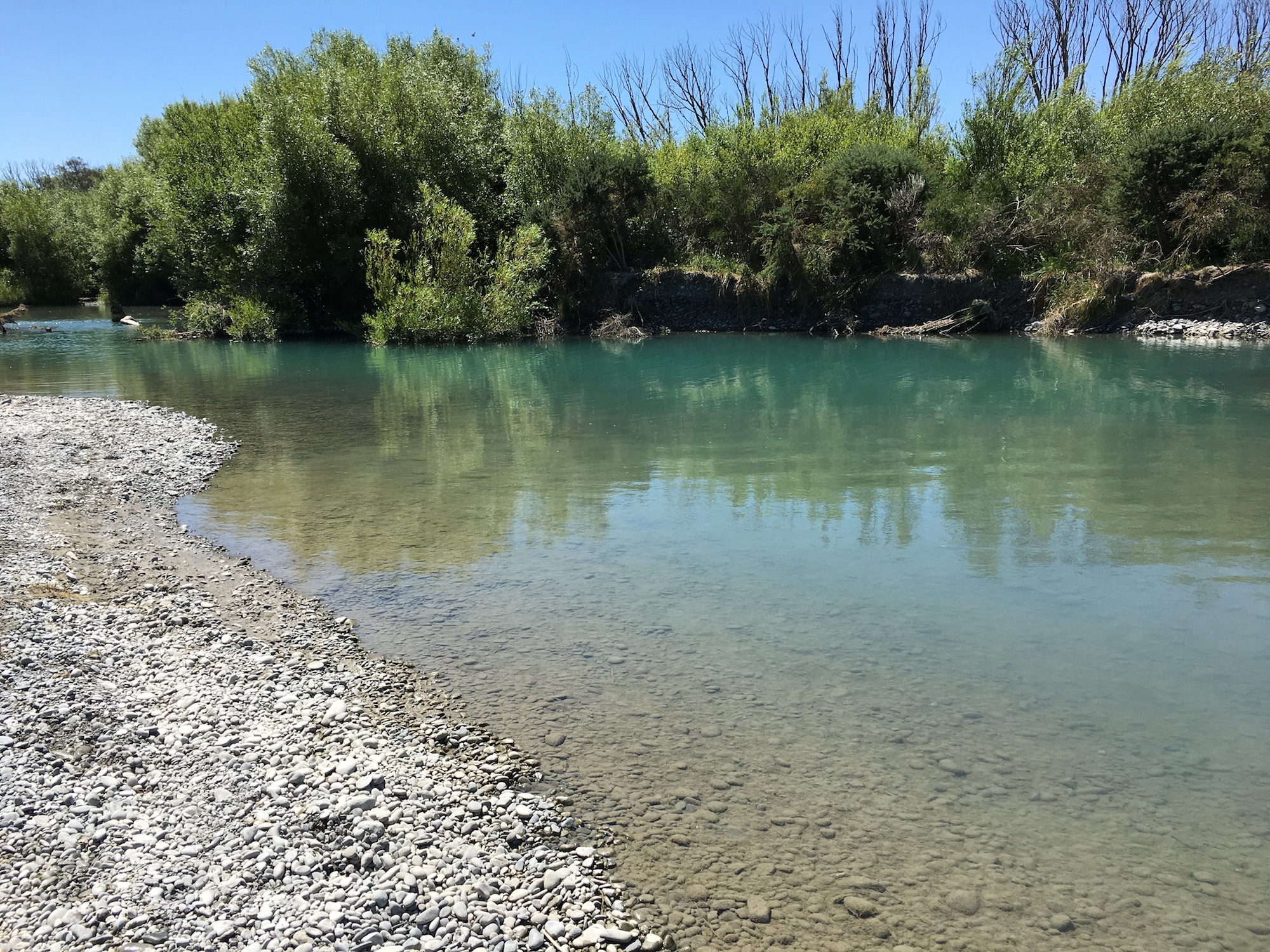
Twenty minutes of walking through this green glade brings you to the river. The Rakaia is a braided river, so you cross and re-cross channels to reach one suitable for swimming. Down near the mouth, there are many swimming holes—deep and turquoise with suspended loess (wind-blown rock dust)—separated by sparkling riffles. We followed the river to the sea, testing each pool to find the best one.

They were all delightful, all ours for the taking, because there was no one else there.

Back home, we stayed in our wet togs until they dried, bringing the cool river with us.

In the time it’s taken me to write this blog, the temperature has risen further. The river water has long since evaporated. Now we have just the memory to keep us cool.

A Trifle More Christmas Baking

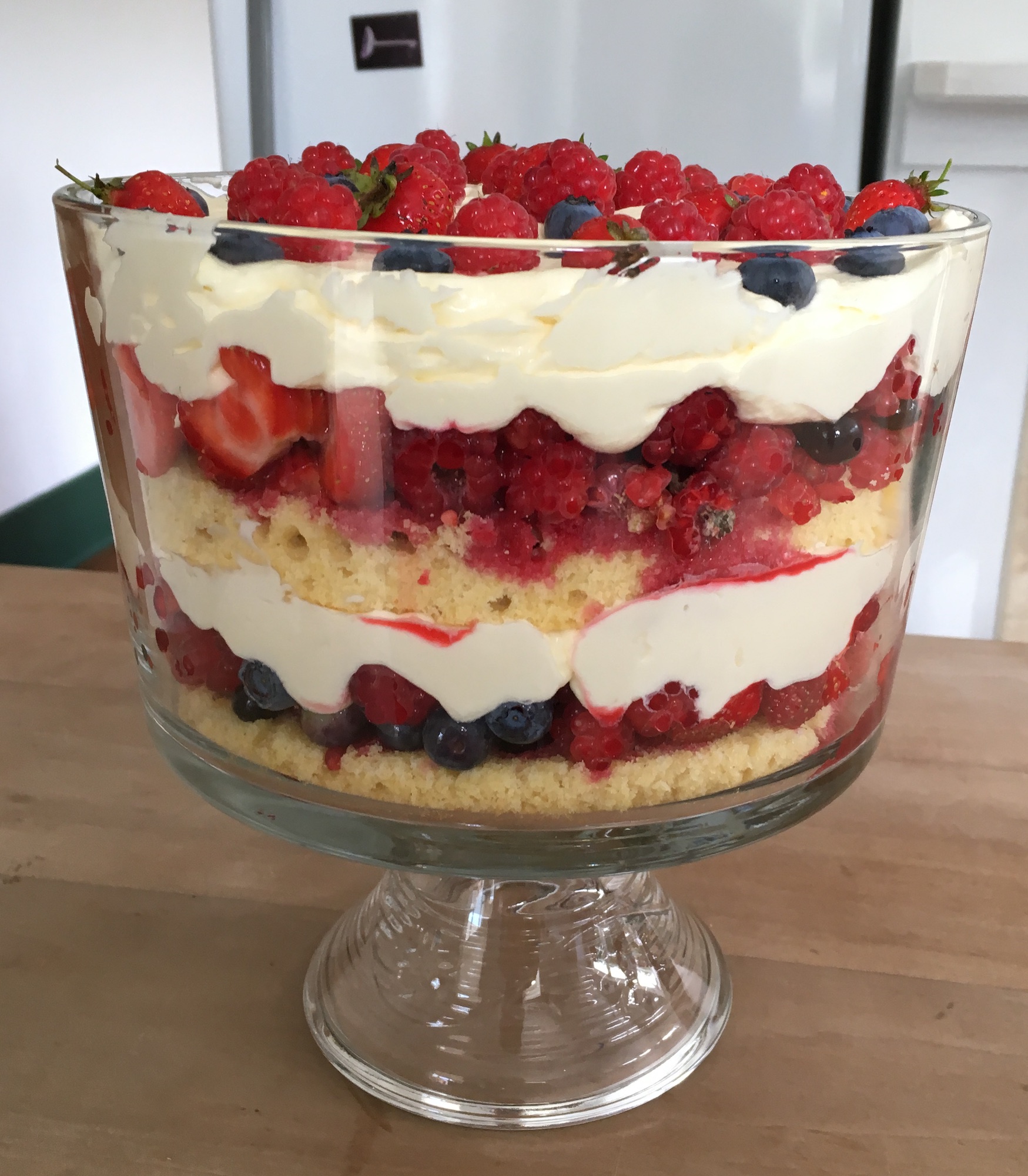
Okay, so I wrote the Christmas Baking blog post a couple of days ago, and then this happened. We picked another mountain of fruit this morning, and it happened to be a bread day. My original plan was to bake a pie, but my husband agitated for a trifle, but without the custard, which he’s not fond of.

So into the baking rotation went a lemon cake. Once it was cool, I sliced it and layered it with fresh fruit (strawberries, raspberries, black currants and blueberries), raspberry sauce, and a mixture of cream cheese, whipped cream, sugar and vanilla (inspired by this trifle recipe, but I measured nothing, and ignored most of the directions).

Just making it made everyone smile. Eating it … Oh my! I think I have a new favourite Christmas dessert!

Christmas Baking

When I was a kid, my mother would start her Christmas baking just after Thanksgiving. She’d bake dozens of kinds of cookies and freeze them. For weeks before the big day, there would be a big platter of cookies—a few of each of the types she’d made—out for eating. It was a child’s dream. I don’t remember her making anything but cookies for holiday desserts. We certainly didn’t need anything else, with all those cookies available.

Before moving to New Zealand, my holiday baking was similar (though with only one child eating cookies, I didn’t make quite so many as my mother did—she had three young cookie eaters). But it’s changed a lot since then.

Cookies are made with ingredients that store well—flour, butter, sugar, nuts—that’s great for winter baking, when fresh ingredients are hard to come by. But Christmas falls at the height of the summer fruit season here—it’s no wonder the traditional Christmas dessert here is pavlova—a meringue ring filled with fresh fruit (Unfortunately, I’m really not fond of meringue).

At the moment on our property, we are harvesting black currants, red currants, gooseberries, raspberries, strawberries, cherries, and blueberries. With as much as 10 kilograms of fruit coming in every two days, much of that harvest goes into jam, sauces, chutney, or simply gets frozen for later use. But it would be a shame not to bake with that fruit, in favour of cookies, which I can make any time of the year.

So we’ve been enjoying strawberry shortcake, currant pie, and gooseberry crisp. For breakfast, we’ve been eating waffles smothered in fruit, and muffins studded with fruit. For snacks, and with every meal, we’ve been eating fresh fruit—whatever hasn’t gone into baking or the freezer.

Oh, there are cookies, too (why not?). But it’s the fruit I snitch while walking through the kitchen, and it’s the pie I crave for dessert.

Some day I’ll dispense with the cookies entirely … Maybe I’ll even learn to like pavlova.

The Ghost of Christmas Trees Past

Growing up, my parents had an artificial Christmas tree. It was hauled out of the attic the weekend after Thanksgiving and assembled and decorated, ushering in the Christmas season.

I remember one year having a real tree—I loved the smell in the closed-up winter house.

When my husband and I married, we spent a few years finding our Christmas tree tradition. For the first two years, we had an eight-inch tall artificial tree in our mud house in Panama. After we returned to the US, we wanted something bigger. So we spent months making a six-foot papier-mache tree, binding on raffia needles and painting bark on the branches. It was a labour of love, and we used it until we had to move across the country, and knew it wouldn’t survive the experience. 

Then babies happened, and for a few years, our Christmas trees were real trees—there was no time or energy for creativity in those early years.

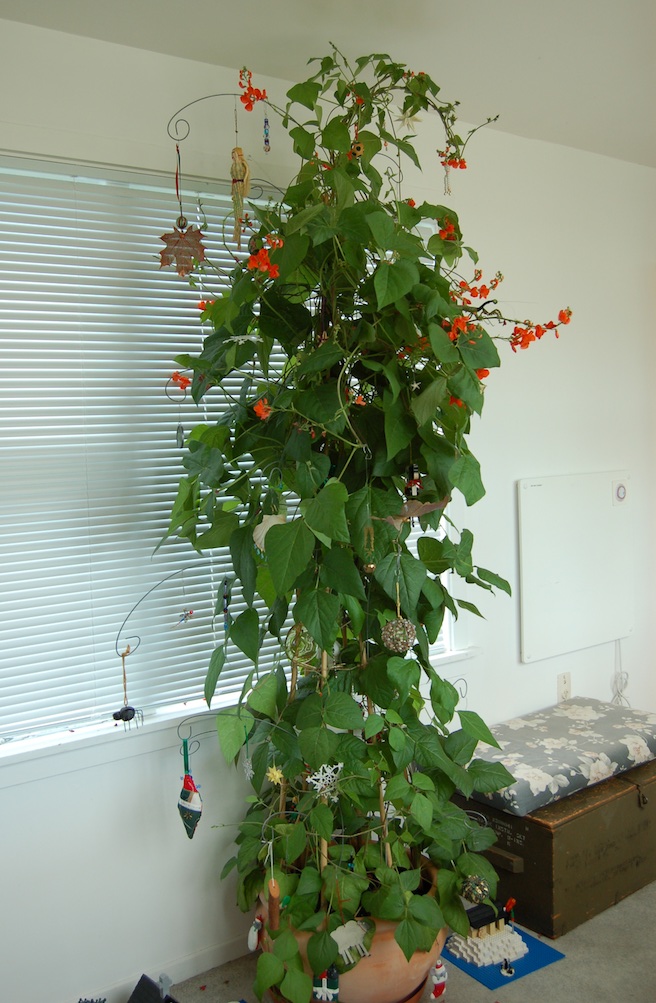
By the time we moved to New Zealand, we were settled into the parent routine enough to be creative again. And summer Christmases invited creativity. We fashioned trees out of driftwood, dead branches pruned off trees in the yard, an old fishing net, fencing wire and flax stalks, copper plumbing, live runner beans—most trees were inspired by what was lying around the property at the time.

Last year, we fashioned a DNA strand as a Christmas tree. Elegant and simple.

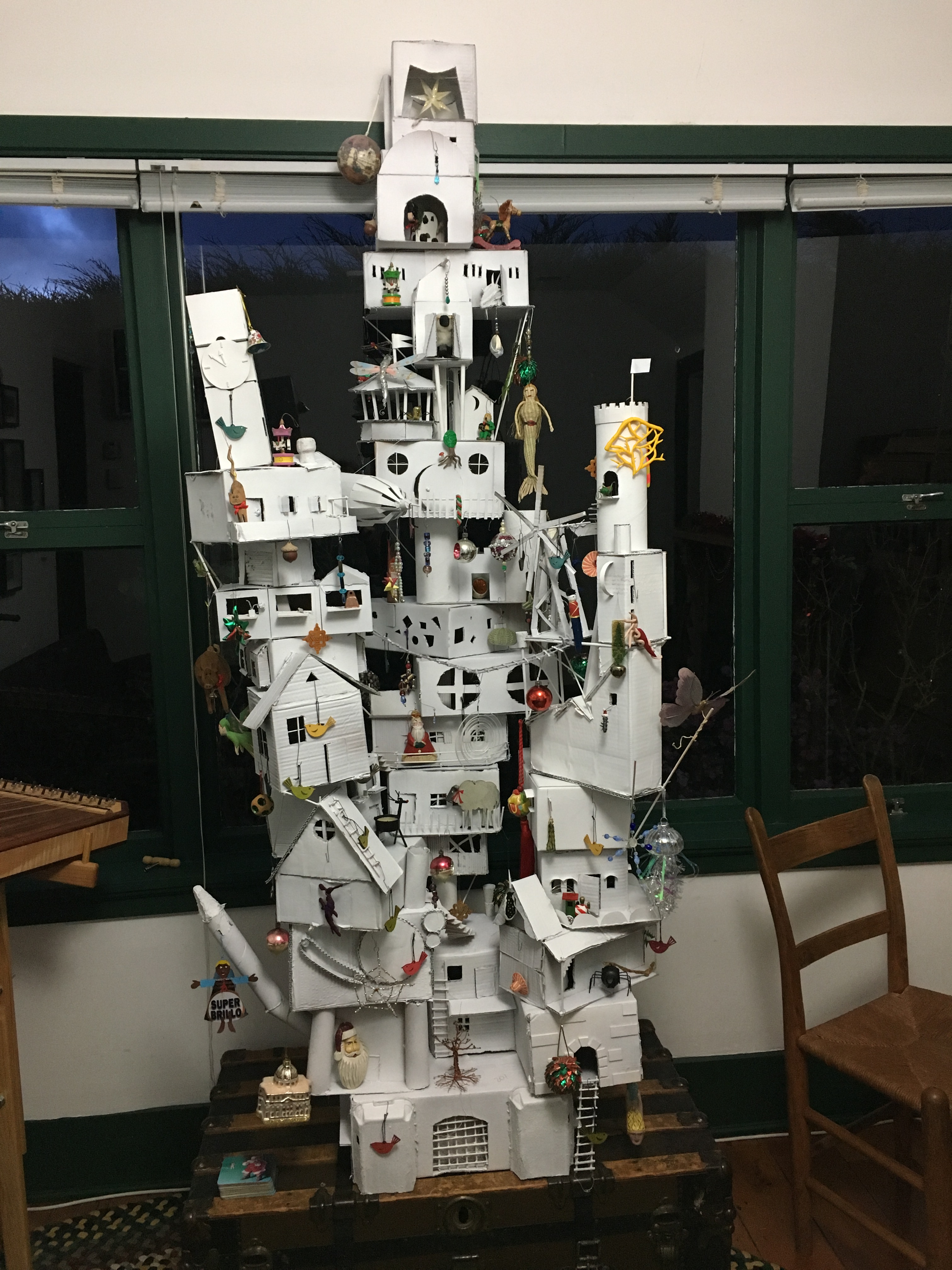
This year, we went for crazy, creating an architectural monstrosity from cardboard boxes.

You might wonder what the point is—wouldn’t it be easier and more, well, Christmasy to do a more traditional tree? Yes. But what is a Christmas tree for?

I view a Christmas tree as a focal point—somewhere for family to gather. Our trees have always been decorated with ornaments that have a history—maybe they were made by someone special, or given by a friend, or came from an exotic location. Decorating the tree has always been a time to celebrate the family stories behind the ornaments.

Why shouldn’t that family activity extend to making the tree itself? This year’s tree took a lot of time to make, and we spent several evenings as a whole family working on it—making a tremendous mess of the living room, laughing, and enjoying each other’s company and creativity. That’s exactly what Christmas traditions should do.

So, perhaps our trees don’t meet the traditional definition of a Christmas tree, but I think they embody the spirit of the season.

Summer?

It’s been decidedly un-summer-like recently. We’ve had an exceptionally wet two weeks—there’s a puddle in the yard, Coes Ford is flooded, and weeds and mushrooms are sprouting everywhere.

Fortunately, that hasn’t stopped the strawberries. When my daughter braved the rain to pick, she found a surprising number of slug-bitten but delicious ripe fruits.

Strawberry shortcake for dessert, strawberries on my morning muesli, strawberries every time I walk through the kitchen…it must be summer!

Now, if only we’d see the sun…

Potential Realised and Unrealised

But those apricots may or may not survive the next nor-west wind. The blueberries might be eaten by the birds before they ripen. The tomatoes could be hit by herbicide overspray. The beans might be stripped by hail. A thousand disasters might befall any of these plants and destroy their promise. And sometimes those disasters do happen—hailstorms have shredded the garden, wind has stripped every tree of fruit, birds have plucked out every seedling from the ground, overspray has twisted and stunted vegetables and decimated the grapes. I can be certain of at least one disaster every year.

But every year, something goes right, and potential is realised. Maybe the hail comes with a little extra rain that helps the vegetables recover from the damage. Maybe that wind-blown fruit can be used to make chutney. Maybe the birds ignore the blueberries, and we eat them until we think we’ll turn blue ourselves. Maybe the wind is blowing the other way when the neighbour sprays, and the garden grows unmolested by agrichemicals. A thousand things can go right and lead to abundance in the garden.

I think about this a lot as I prepare my son to leave home in a few months. He’s taking his final high school exams next week and will head to university in February. For him, it’s a time of incredible possibilities, as he launches into adulthood and pursues his passions.

But he has a difficult year ahead of him—on his own for the first time, in a new city providing lots of distractions, and without his support network of friends and family around him. A thousand things could go wrong. He could focus too much on fun and fail his classes. He could focus too much on classes and become over-stressed. He could make no friends. He could make the wrong friends. He could start drinking, smoking, using drugs. 

No doubt, one or more of these disasters will happen next year. 

But I like to think that possibilities for my son are a bit like possibilities in the garden. Regardless of the disasters, some things will go right. He may make good, positive friendships. He may enjoy Friday-night partying without losing sight of his studies. If he does fail a class, it might convince him to redouble his efforts. A thousand things could go right.

In the garden and with my son, I’m preparing for things to go wrong—for potential unrealised. But I’m also preparing for things to go right. There’s an abundant harvest building up, and I can’t wait to see what it is.

Breaking up the Work

Edits and notes … tackling one at a time

I’ve neglected my blog lately. Between springtime and the end of the school year, I’ve felt like my time at the computer has been limited, and I’ve felt the need to focus on editing.

I know, most people would take any excuse to avoid editing, and I admit it can be daunting to wade through a 70,000-word first draft of a story, knowing it needs lots of work.

It’s a bit like tackling the garden in springtime. If I look at the entire garden—all 300 square metres of it (about 3200 square feet)—when it’s waist-high with weeds in September, I freak out. It’s too much to do. I think I can’t possibly clear all that area, turn all that soil, haul compost to it, and then plant it. It’s more than one person can do.

But I do it every year.

I divide the garden into 26 beds, and I make myself a weekly plan from September through November. Each week, I have certain tasks, certain beds to prepare, and I don’t let myself look at or think about everything else that needs to be done. Each piece seems doable, and since I think I can do it, I dive right in without freaking out. Bed by bed, the entire garden is cleared, turned, composted and planted. When I arrive at late November, I can look at a beautifully prepared and planted garden and think, “Wow! I did that!”

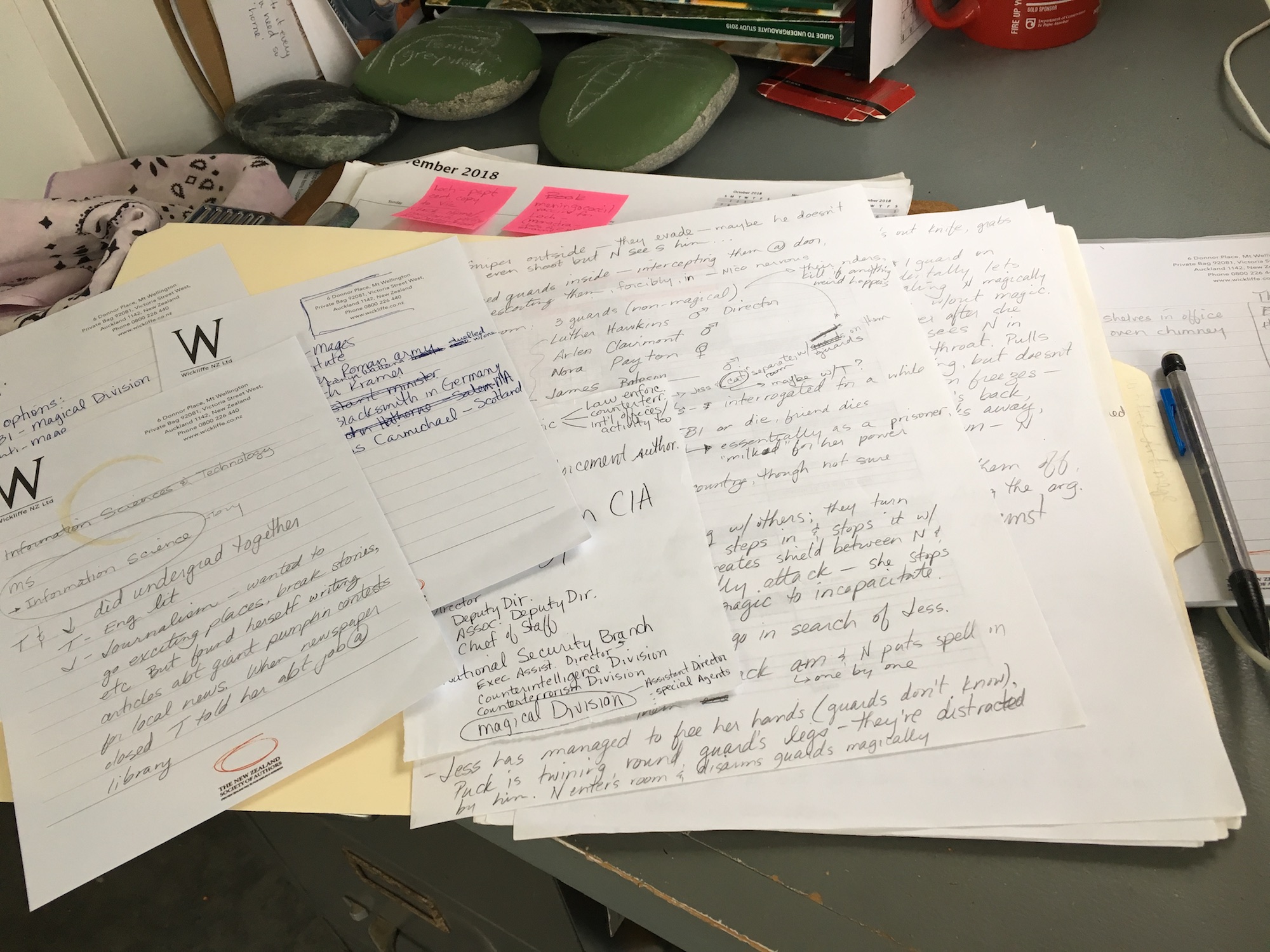
It’s the same with editing. A first draft of a novel is a horribly weedy garden—there are inconsistencies, plot holes, leaps of time that make no sense (sometimes unintended time travel, too), typos, spelling errors, grammatical errors, scenes that don’t advance the plot, scenes in the wrong places … the list of problems with a first draft could scare anyone away from editing.

So I break it into chunks, just like the garden.

I read through my novel over and over, and each time I focus on one or two problems. I start with the big ones—continuity, inconsistency, plot holes, pacing. Then I move on to smaller problems—characterisation, dialogue, action within each scene. Then I move on to even smaller problems—grammar, spelling, and regional language issues. With each reading, I focus on a subset of things, ignoring everything else.

And suddenly, editing isn’t overwhelming. It’s manageable and even enjoyable, because I can see the improvement at each step of the way, without fretting about all the work still to come.

Hence the neglected blog—when I’m having fun editing, sometimes I forget to stop and do other things.

A Bird in the Hand

I’ve had two funny encounters with birds recently. Two birds in-the-hand, so to speak.

A few weeks ago I was in town, doing some writing in Hagley Park, because it was a beautiful spring day. I sat down on the grass with my lunch and my laptop.

A few minutes later, I noticed a male European blackbird eyeing me up. He hopped closer, stopping when I met his gaze, but then, deciding I was no threat, sidling even closer. My lunchbox sat open between us, and I knew he was sizing it up.

Well, I don’t feed wildlife in general, and I certainly wasn’t going to feed a non-native invasive bird. Besides, I wanted to eat that lunch myself. I finished off my sandwich and started in on my apple.

The bird watched my every move. When I set the apple into the lunchbox to type, he rushed in. I clapped my hand over the box, and he backed off.

The bird was undeterred. When I brought the apple to my mouth again, he lunged for it. He flew up and took a bite out of it while I was biting the other side. His wingtips brushed my cheeks, he was so close.

Well, how could I refuse after that? I gave him the rest of the apple (which wasn’t much more than core at that point, anyway). 

But I made him work for it.

I put it back in the lunchbox, and set the box next to my leg. And that cheeky bird perched on the lunchbox and ate the rest of the apple. Other birds came to see what he had, but none were brave enough to come close, so he had it all to himself. He was terribly smug about it—quite pleased with himself, I’m sure.

My second recent bird encounter happened last weekend. My husband was mowing the lawn, and there was a fledgling magpie in the way. The magpie wouldn’t move out of the mower’s path, so I tried to shoo it away. It still wouldn’t budge, just cheeped at me, as if to say, “Yeah. What do you want?”

So I gently picked it up to pop it over the fence, out of the way. It gave one alarmed squawk, and suddenly its parents were arrowing straight for me from where they had been feeding in the neighbouring paddock. They swooped and screeched as I walked away, and I had to wave my arms over my head to avoid being pecked. The fledgeling, meanwhile, hopped away as though nothing had happened. I could almost hear him chuckling.

So, yeah, I’ve been had by two birds recently. A human in the beak is worth two in the bush, apparently.

A Weakness for Weevils

I was excited to find a new weevil on our property the other day. At least until I identified it.

Meet Otiorhynchus sulcatus—the black vine beetle—pest on a wide range of garden plants, including grapes, black currants and strawberries (all common in my garden).

I admit, I have a weakness for weevils—no matter how much of a pest they are, I think they’re cute. And this one is no exception. She’s lovely, in spite of her diet. And I’m certain she’s a ‘she’, because no males of this species have ever been found. The black vine beetle reproduces parthenogenetically, producing viable eggs without the need for fertilisation by males. 

This ability is the result of a bacterial symbiont in the genus Wolbachia. When researchers in California eliminated Wolbachia in black vine beetles (by giving the beetles antibiotics), the beetles’ unfertilised eggs were no longer viable. It’s a clever little ploy by the bacterium to ensure its own reproduction—only infected insects can reproduce, and they can do so without the trouble of finding a mate (I wrote more about this fascinating relationship in Putting the Science in Fiction and on Dan Koboldt’s Science in Fiction blog).

Another cool feature of the black vine beetle is that it is flightless. It’s not uncommon to find flightless insects and birds here in New Zealand, but it’s a little unusual to see it in invasive pests like the black vine beetle. Native to Europe, the black vine beetle is now distributed all around the world. Pretty impressive travelling for a 6 mm-long flightless insect.

Apparently black vine beetles can cause significant damage to plants. The larvae eat roots in the soil and do the most damage, particularly in potted plants, where root growth is limited. I’ve decided not to worry about them at the moment. I’ve got more damaging pests to worry about, and to be honest, I wouldn’t mind seeing them again. They are awfully cute.

Pity the One Percent

I enjoy springtime for its warmer temperatures, flowers and the opportunity to get outdoors more frequently. But it’s the bump in our standard of living that I enjoy most.

Garden excess comes early, in the form of artichokes and asparagus. Add in some home grown oyster mushrooms, spinach, leeks and herbs, and I begin to feel like we have unlimited wealth. Like we’re in the ‘one percent’.

Except, I doubt the one percent gets vegetables as fresh as ours.

And I expect they don’t have the pleasure of strolling among head-high artichoke plants, breathing in their earthy scent and picking twice as many as they need, because, well, why not?

And I know they don’t enjoy passing their excess vegetables on to the neighbours, spreading and sharing riches that cannot be saved, banked, or invested.

So I feel sorry for them, in springtime; they are so poor, and I am a queen.