Welcome 2018

The new year is here, and I feel I should declare some resolution to go with it.

But the truth is, I don’t wait for the new year to make resolutions. If I feel a need to work harder, change my life, eat less chocolate (heaven forbid!), or whatever in order to be a better person, I just do it, as soon as I realise I need to. New year or old, it doesn’t matter. Why wait to improve your life or yourself?

And so I come to the new year with a list of to-dos that has little to do with it being 2018 instead of 2017. Oh, there are some big-ticket items there that might be construed as ‘resolutions’, but they’re really just the next step in a progression, and their appearance on my list has nothing to do with the change of year.

So, whether you’ve made resolutions or not, may your new year be full of growth and personal improvement. May you strive to spread love and happiness wherever you go and in whatever you do. If we all do that, think what a fabulous year it will be!

A-Z of Thankfulness–#3

Here’s the final instalment, posted on Christmas day, I hope you all find much to be thankful for today and every day.

Sunshine—The counterpoint to rain, and just as necessary for the garden. It’s also critical for my mental health, and I try to make the most of our sunny days.

Teeth—Where would we be without them? I wish I had appreciated them earlier in life and taken better care of them when I was a teen.

Ukuleles—Who can resist smiling while listening to ukulele music?

Vision—Not just my eyesight, though I appreciate that a great deal, but also the ability to look ahead at what could be. I’ve relied on vision the past twelve years, building a business, and then closing it to become a writer. Many days, that vision has been the only thing getting me out of bed in the morning.

Water—I have not truly experienced a lack of water—not as many people in the world have—but after losing our well in the 2010 earthquake, and experiencing a few years of drought, I have an appreciation for the ease with which I obtain water. I am thankful to have access to clean, safe water.

Xenophilia—The love of the unknown. I love the fact we humans don’t understand everything. I love the fact that in my backyard, there may be insects that have yet to be described by science. I love the fact there are discoveries to be made every day. I love that our world is populated by weird and wonderful life.

Yellow admirals—These butterflies, and all the native insects and spiders in my yard are a source of great pleasure to me. They help me tolerate the weeds, because they rely upon many of them for food and shelter.

Zucchini—How many ways can you eat zucchini? I don’t know, but I love them all. I always plant too many zucchini, and I end up wondering what on earth I’m going to do with them, but they are a wonderful summer staple in our kitchen.

A-Z of Thankfulness–#2

Jumper cables—They bring out the best in everyone. How many times have I stood by my car, cables in hand, and had strangers happy to help? How many times have I had the pleasure of pulling out my cables to help someone else? Wonderful things, those jumper cables.

Knitting needles—My nemesis. I hate them, and I have conquered them. How rewarding is that?

L2—The collective term I use for my children, both of whom have names beginning with L. They have grown into fine young people who I am proud to own up to. I take no responsibility for that—they’ve always been the best kids ever.

Mountains—They make New Zealand what it is. Every time I look west to see their changing faces, I smile.

Nettles—Okay, I’m weird, but nettles growing lush in the garden over winter tell me my soil is rich and fertile. They harbour the caterpillars of beautiful butterflies, and they remind me that things can be useful and irritating at the same time.

Ocean—A critical part of the Earth’s life support system, a source of food, moderator of our weather, a wild and mysterious frontier…and a wonderful place to play on a hot summer day.

Peas, Pumpkins, and Potatoes—Of all the vegetables I grow, these are perhaps the most important. Productive, tasty, and easy to store, they are year-round ingredients in our dinners.

Quiet—There is beauty in silence. I appreciate that every morning when I head out to tend to the animals at 5.30. It’s such a peaceful silent time of day, that even when I don’t really have to get up that early, I’m eager to do so.

Rain—We never get enough of it here, and I’m always thankful when it arrives to water my thirsty garden.

A-Z of Thankfulness–#1

I saw another blogger doing this a few weeks ago and liked the idea. I thought it would be a good set of posts for the holiday season.

Here’s the first instalment—A to I.

Apples—It seems a silly thing to be thankful for, but I eat at least one apple a day. They are my go-to snack. Having lived in the tropics for two years, where apples don’t grow, I am thankful to live in a place where excellent apples are produced and available year-round.

Bees—I’d have no garden if it weren’t for the bees pollinating all my fruit and vegetables. I try to show my thanks by planting flowers they like and managing the garden to maximise nectar throughout the year.

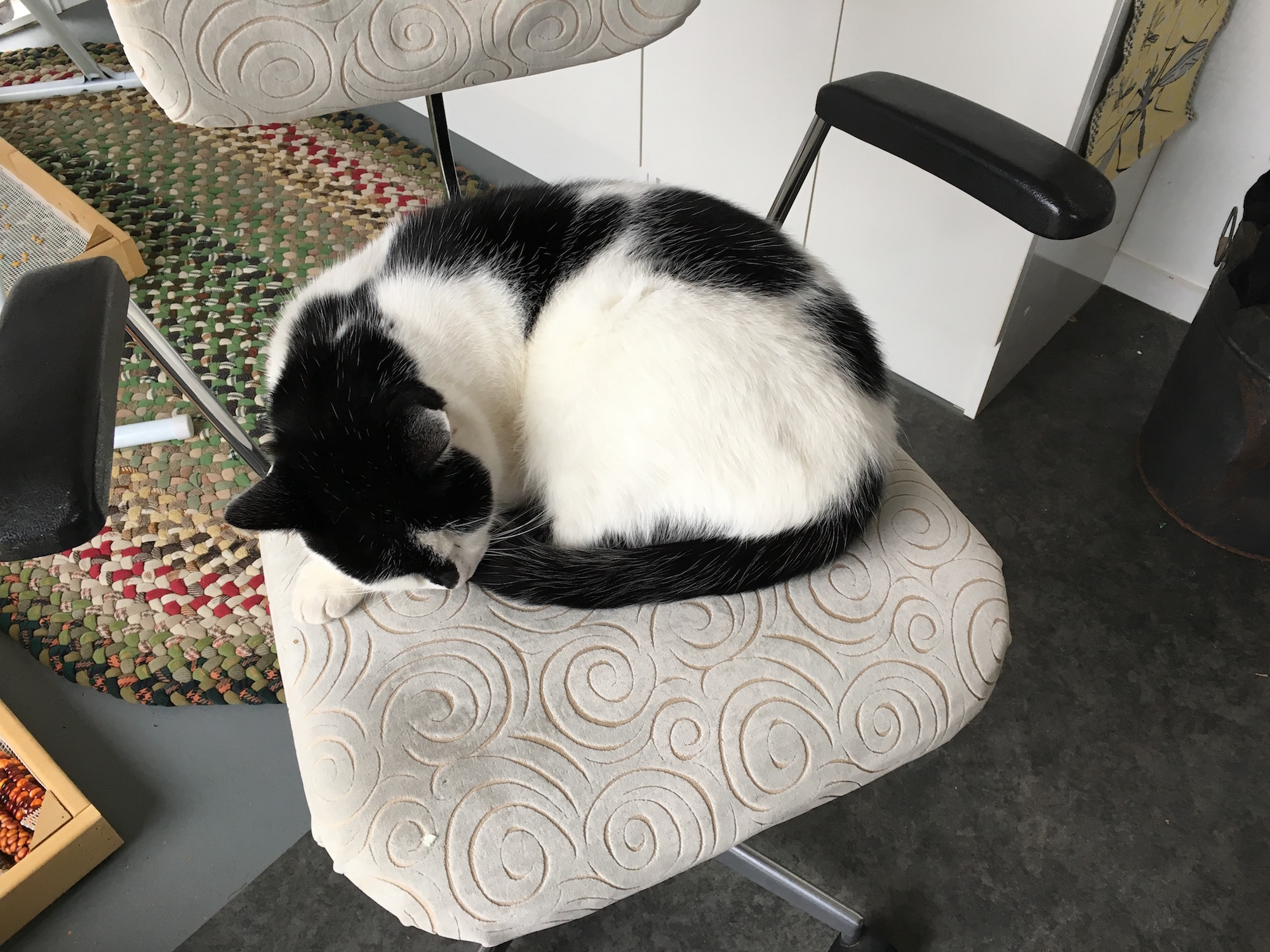
Cat—He’s a real pain in the rear a lot of the time, waking me at four in the morning, getting fur on everything, using furniture as scratching posts. But I appreciate his hunting abilities. This spring was looking bad for rabbits—they seemed to be everywhere, and I was worried they’d cause havoc in the garden and paddocks—but the cat seems to have a particular fondness for rabbit. He seems to have dealt handily with the rabbit problem, saving me a great deal of trouble.

Desk—A space of my own to work. I appreciate this most when I have to spend a few days working in the library, elbow to elbow with strangers, and without my reference books, my porch, and my view.

Earthquakes—I know, it’s a weird thing to be thankful for, but the devastating 2010/2011 earthquakes set into motion a series of events that led to my kids being enrolled in an incredibly supportive school, and to a friendship I value a great deal.

Friends and Family are the obvious answers here, and for the obvious reasons.

Gardening—I am thankful to be able to produce most of our food for the year. I get great pleasure out of gardening, watching the plants grow, and eating the excellent produce I’m able to grow.

Home—Not just a house, but a home. A community in which I feel comfortable. A place I feel I belong. I am blessed to have been welcomed so warmly into this country and this community.

Ian—My best friend, who has stuck by me for over 25 years and is father to my children. If I had nothing but him, it would be enough.

Giving Thanks

Special thanks to plate tectonics for this…

Thanksgiving Day in the U.S.

We don’t even try to celebrate it here anymore, for obvious seasonal reasons.

Still, today, and every day, I am thankful for many things:

  • An incredible, supportive partner who has stuck with me for over 25 years.
  • Two really cool kids, and all the amazing teachers that have helped them grow
  • A home that feeds my soul and my family
  • The health to physically manage half an acre of food-producing garden
  • Lovely friends
  • Forty-seven years of rich experiences to give me ballast
  • A world of wonders to explore
  • My adopted country, where I have been so warmly welcomed
  • Sunshine
  • Rain
  • The opportunities life has presented me
  • The difficulties life has presented me
  • All the little things that make me smile–fresh basil, strawberries, hedgehogs, skinks, jumping spiders, lavender…

I could go on and on. Mostly, I am thankful to have the opportunity to take this ride on rollercoaster Earth.

Enjoy your day, enjoy your ride.

The Christmas Season

Twelve years ago, I was facing my first Christmas in the Southern Hemisphere. Everything felt wrong. I tried to carry on the traditions my husband and I had established in the States; I made truffles and cookies, I decorated with fresh greenery, we strung Christmas lights, we planned a big Christmas dinner, we played Christmas music.

The truffles melted, the greenery turned brown, the Christmas lights were invisible in the long summer evenings, the heavy dinner sat like lead on a hot summer day.

I longed for snow, and all the indoor family time of the northern holiday. I wanted long nights, candles and a roaring fire. I wanted hygge. But it was summer—time to be outdoors, on the beach, enjoying the sun.

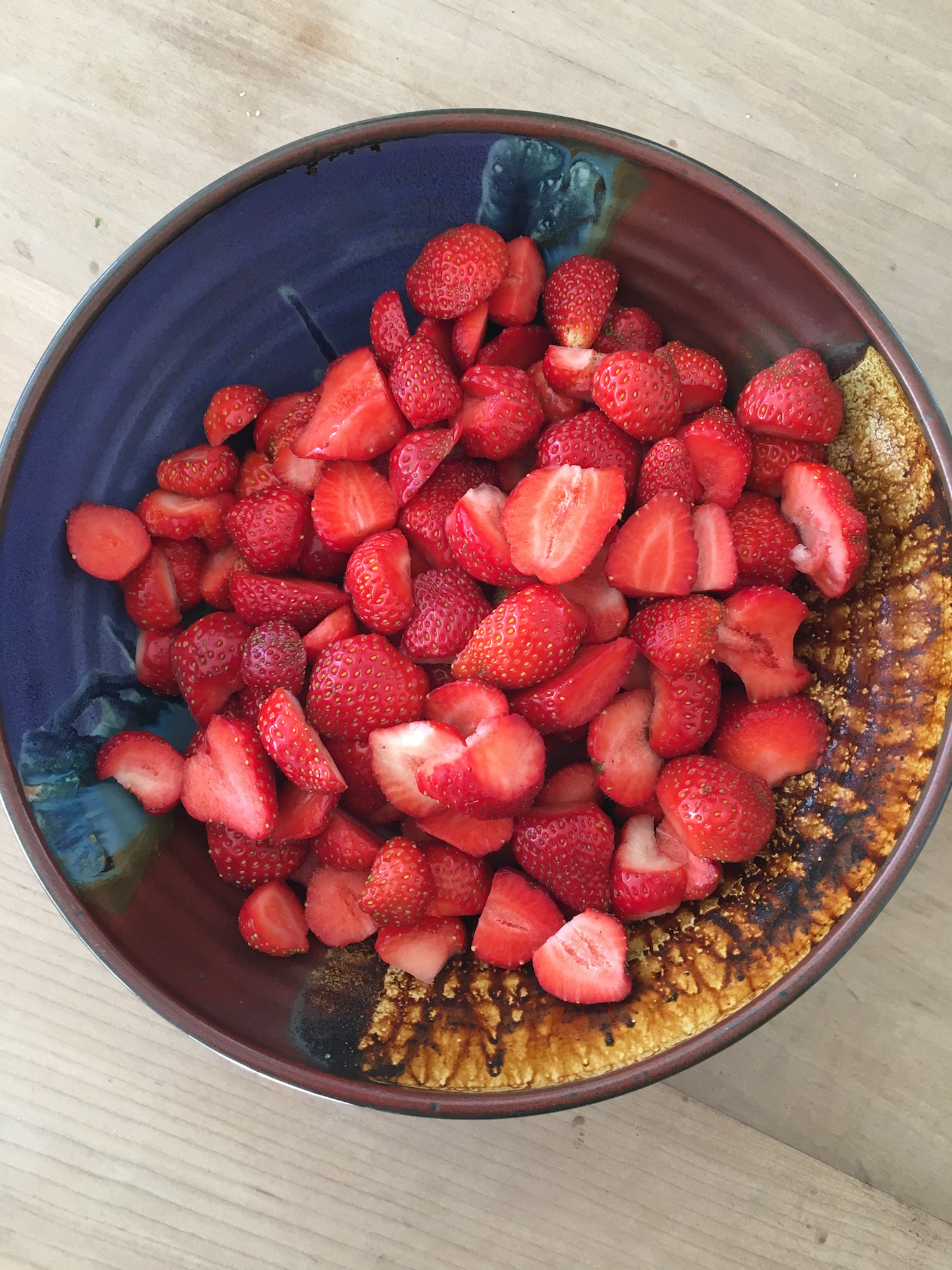
Slowly our traditions have adapted to this southern holiday. I realised how far I’d come on Sunday morning. Slicing strawberries for breakfast, the smell of berries made it feel so Christmassy, I started humming carols. Then I laughed at the idea that strawberries equal Christmas.

I thought about all the things my kids have grown up associating with Christmas—long days at the beach, gardening, strawberries, cherries, making jam, making sauerkraut (which usually happens about Christmas eve every year), the ‘traditional’ Christmas salad, the first new potatoes, broad beans, backpacking.

We rarely play Christmas carols anymore (who wants to be indoors?). We bake fruit pies, and not many cookies. We use red carnations from the garden for Christmas decorations. Rather than being a time for focusing inward, Christmas is a time for adventuring—traveling, hiking, exploring.

And so, as we start into this Christmas season, I am looking forward to our travel plans. I’m looking forward to many days at the beach. I’m looking forward to the summer bounty from the garden. I’m looking forward to ice cream, roadside stands selling Otago cherries, outdoor dinners, and warm sun.

And that, I think, is the key of the season—to celebrate what is good about the here and now. To celebrate the bounty we’ve been given, whatever form it comes in—love, friendship, snow or strawberries. To be mindful. To be present in the moment.

Am I Weird?

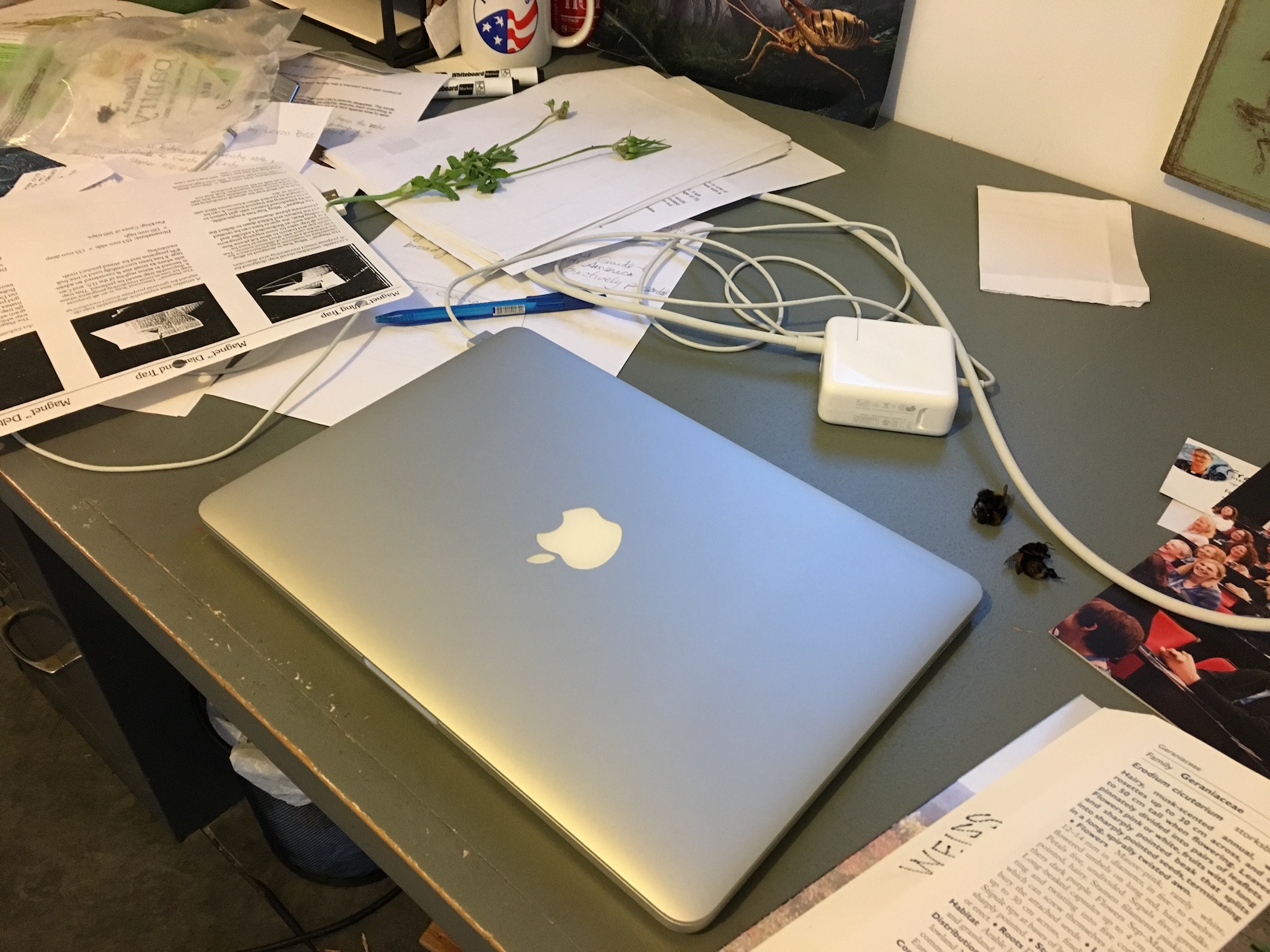
Stepping into my office the other morning, I had a moment of clarity, in which I saw my desk as a stranger might.

It was pretty scary.

The most obvious thing was the computer. Okay, that’s normal. But that’s where normality ended.

Strewn around the computer there were papers. There were notes for a non-fiction book proposal that included calculations for the intrinsic rate of increase of pea aphids, notes about parthenogenic reproduction, and a list of potential titles, many of which included the word ‘alien’. There were also a smattering of papers and notes from the workshop I attended last weekend, a note about my son’s shoe size, and the beginning of a short story set in New Zealand’s not so distant future.

That’s not too weird, though the story is a little bizarre…

Making a lump under the papers were three D&D dice. I use them for my students–they can roll the dice to choose a random writing prompt from the list of 500 prompts I’ve made for them. Honestly, I don’t roll the dice to see if a character lives or dies in a story (though that could be fun). The dice sit on my desk between classes because they’re fun to roll around in my hands while I’m thinking.

Well, that’s not too strange…

Also on the desk was a stem of the storksbill I’d blogged about the day before. It was still there, though I should have thrown it on the compost when I was done with it. It was interesting to look at…

And nearby was the Weeds of New Zealand book that I’d used for reference when blogging about the storksbill. I’d gotten sidetracked after the blog post was written, and spend a good half an hour perusing information about weeds. I left it sitting out because, you know, everyone needs a weed book on their desk.

And here’s where the tableau on the desk got…um…interesting…

Two dead bumblebees nestled together near one corner of the computer. They’d been there for days–ever since I found them on the floor and noticed that one of them had a drop of venom on her stinger. I put it under the microscope at the time for a photo shoot, but then kept the bees on my desk as…as…well, for no good reason really, other than that I enjoyed looking at them, especially as their parasites (mites) started to abandon their dead hosts and crawl all over my desk, questing for a new bee.

That’s not weird, right?

Over on the other side of the computer was a dead German wasp in a plastic bag. She was in the bag because I’d just taken her out of the freezer. Um…yeah. She was clearly a queen looking for a good nesting site (and she was a non-native pest that I’m deathly allergic to), so when I found her in the house, the only sensible thing to do was to kill her. But there was no point in wasting her. I popped her into the bag and into the freezer to kill her without damaging her, thinking I’d pin her later and keep her for teaching.

That’s definitely not weird. Everyone stores bugs in the freezer, right?

And thankfully out of sight inside a folded piece of paper was the dead mosquito I’d brought back from Auckland because it was a species I don’t see much of here, and when I saw it land on my ankle to bite me, I thought it would be a good specimen to keep.

Weird?

*Sigh*

It was definitely time to clean the desk before someone came to visit.

Danger! Keep out!

I was driving to town with the kids this afternoon, and we got to talking about dreams. After concluding that dreams were seriously weird, and even more so considering they come from inside our heads, I said, “Yeah. A brain isn’t a place you want to go walking around alone in after dark.”

To which my daughter’s response was, “I don’t think I’d want to go wandering around there at any time.”

And it struck me that there lies the crux of being an introvert. We go walking alone in our brains, in spite of the fact it’s not a nice neighbourhood.

We go walking alone there, where anything could jump out at us, and probably will. We walk through alleys smelling of rats and urine, where all the stupid things we’ve ever said slouch in shadowy doorways drinking out of bottles in brown paper bags.

We walk through busy thoroughfares where our own doppelgangers repeat every public embarrassment we’ve ever committed over and over and over without pause.

We walk into brightly lit rooms where we are handcuffed and a poised and confident extrovert asks probing questions about why, exactly, we decided to wear our “Nerd is the new Sexy” t-shirt to the bar on Saturday night.

We step out onto the street, thinking the way is clear, and the bus carrying every one of our personal inconsistencies and incompetencies runs us down.

We pass a parked car with tinted windows, and the door opens. Out steps our younger self. She looks us up and down and sighs. “I thought by now you’d have done something with your life.” She rolls her eyes and stalks off.

We walk past a tall chain link fence topped with razor wire. On the other side is the hitchhiker we didn’t pick up last August, the crying child we didn’t comfort two years ago, the Salvation Army bell ringer we didn’t empty our pockets for on December 23, 1989.

The mind is the seedy place we introverts are drawn to in the dead of night, when the happy extroverts are tucked safely in bed or walking brightly lit streets with a crowd of friends. It’s a bad neighbourhood, but it’s our own, and maybe we think we can fix it up if only we visit it frequently enough.


Slowing it Down

When I tell people I enjoy quilting, they assume I mean I enjoy choosing fabrics and colours, and piecing quilt blocks. They’re usually surprised to find that it’s actually the quilting that I enjoy, and that I do it by hand.

People are also often surprised to know how much hand sewing goes into the clothing I make. Buttonholes, zips, linings…even my t-shirts often have hand-stitched hems or neckbands.

Partly, I do a lot of hand stitching because I prefer the way it looks, or it’s the only way to handle something my machine can’t do.

But mostly, it’s a way to take my time and focus on both product and process. A machine stitches quickly, but if I sew something by hand, I can place each stitch exactly where it want it. I can shape an edge or an awkward corner. I can make hand stitches invisible or use them to add subtle embellishment. By sewing slowly, by hand, I have greater control over the stitches themselves.

Sewing by hand also forces me to take more time with each project. I rarely make anything purely for fun–when I sew a pair of jeans, it’s because I need a new pair of jeans–but I also enjoy sewing. It is tempting, sometimes, to whip out a project quickly, just to get it done and have the final product to wear. By sewing parts of a project by hand, I am able to slow down and enjoy the process, not just the product.

While I am sewing by hand, I have time to think–about the project, about the person it’s for (if it’s a gift), about the ways in which it might be used, about how the process is going (and whether I need to rip a hastily done seam and do it over, or add a feature I hadn’t planned on). There is something meditative about hand sewing that sewing by machine doesn’t provide. And I think it has to do with speed.

It’s like walking versus driving. You might not get there as quickly walking, but you will experience more along the way.


Building Castles

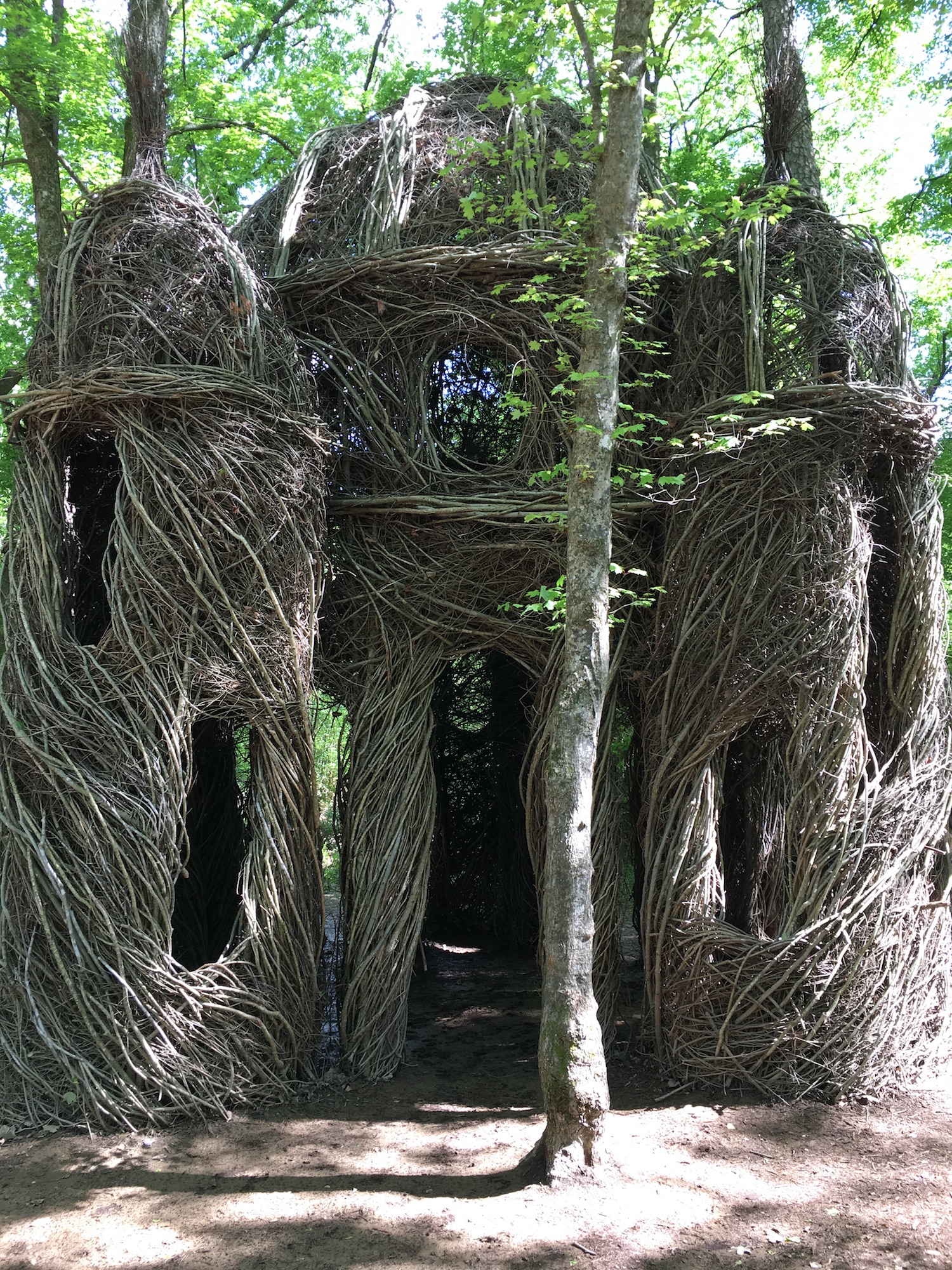
Patrick Dougherty is a North Carolina artist who builds amazing structures from tree saplings and sticks. His works are remarkably detailed. They evoke movement with their swirling lines and often skewed shapes. They provoke thought and reflection. Most of them invite you in, to experience them inside and out. And, by nature, they are ephemeral.

I can’t help but think we’re all building stick castles. We take the materials around us–the stuff life has dealt us–and build a structure we call ‘me’. Every ‘me’ is different and detailed, and many are wonky. Every ‘me’ is in motion–ever changing as we add new materials to our structure. Hopefully our ‘me’ invites people in for a more personal experience. And, ultimately, our structures are ephemeral.

Dougherty began building his stick structures with material that happened to be available in North Carolina. When he first started building structures in other places, he brought his materials with him. Over the years, he’s discovered that suitable materials can be found nearly everywhere, and he now finds what he needs close to where he’s working.

Likewise, we start off building our ‘me’ structures with the materials around us, and as we grow, hopefully we learn what we need to create strong selves. Hopefully we learn how to find those things, no matter where life takes us. The older we get, the more refined our technique, the more efficient and skilled we are at finding materials and building ‘me’. It doesn’t mean we aren’t wonky anymore–it means the wonkiness is perhaps more deliberate, planned, and stronger than it was before.

Dougherty builds about one structure a month, and he accepts that his artworks will only last two to four years. But though the artwork itself doesn’t last, its impact lingers in the hearts and minds of those who have experienced it. May our own ‘me’ castles do the same.