Throwback Thursday: At the Centre of the Universe

d1scans001 copy“This bit needs to be yellow. It’s part of the United States.”

“No it’s not. It can’t be! There is the United States. This bit, way over here can’t be part of it.”

I was working with a group of students in Membrillo, Panama. We were painting a map of the world on the wall of the school, and we were arguing about Alaska.

We argued about more than one country placement, including Panama.

It wasn’t really a surprise that these children, most of whom had never gone further from home than they could walk in a few hours, didn’t know where on the planet they lived.

But talking to them, I realised they didn’t even know where in Panama they lived. Many of them had parents working in Panama City, and most of them would one day work there themselves, but they had no idea where the city was in relation to their own village.

So when we finished the world map, I spent a week enlarging a map of Panama to transfer to the other blank wall at the school. Before these kids were going to make sense of Panama’s place in the world, they needed to be able to see their place in Panama. We outlined the provinces, and labelled the cities and towns. When we finished, Membrillo was the largest name on the map—the centre of the universe, with their nation and their world arrayed around them.
Throwback Thursday: Panama Nights

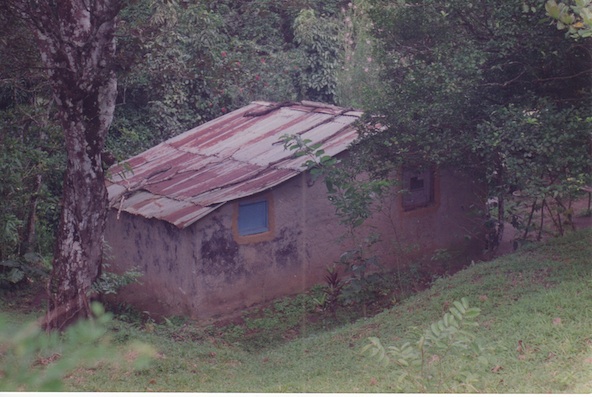
HousePmasmI recently ran across a series of haiku I wrote by lamplight, sitting on the porch of our house in Panama many years ago. I still think they capture those evenings, full of water, wildlife, and the sounds of the village around us.

I.
Rats’ tin nights.
Dancing rooftop rodents
Steal my sleep.

II.
Muggy night
Love in stagnant puddle
Mud. Eep! Mud.

III.
Rosary
Evening chant for the dead.
Do they hear?

IV.
Lightning strike
Shatters bones and makes the
Cat lie low.

V.
Frogs clatter
Loving neck deep in
Calm wet nights.

VI.
Keep a calm
Ear listening. You may
Hear trees sing.


Throwback Thursday—visiting friends, Panama style

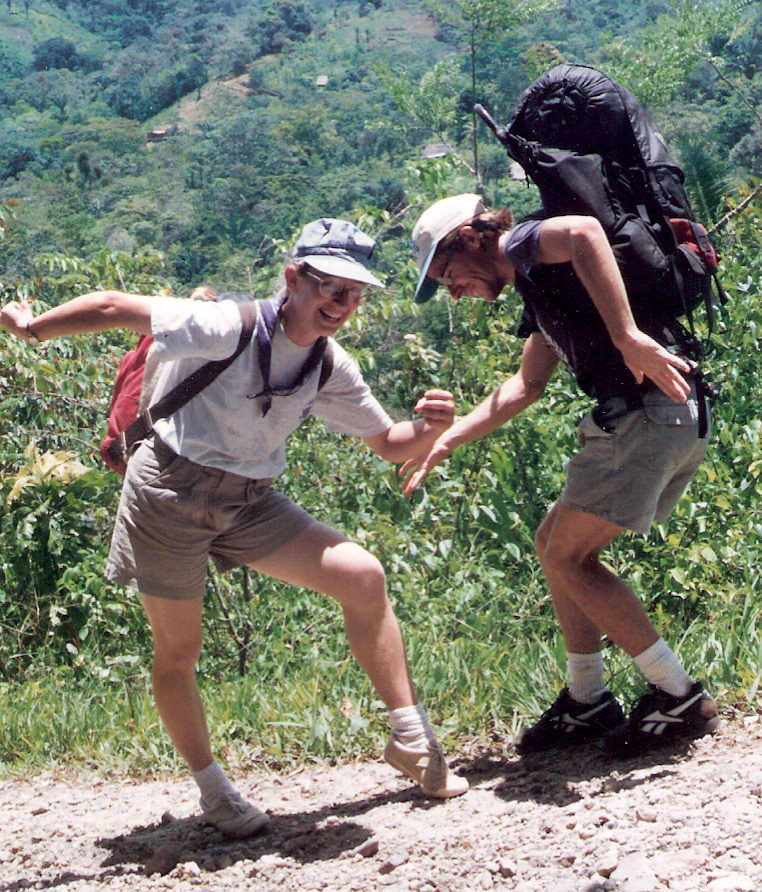
Paul and me, hamming it up for the camera on our trek.

Paul and me, hamming it up for the camera on our trek.

In Peace Corps in Panama, we lived in a village that was on the edge of what was accessible by vehicle. The lower part of our village was reliably accessible, but the upper part, where we lived, was only accessible in the dry season, and even then it was rough.

Walking was the main mode of travel there.

We walked everywhere. To all the farmers we worked with, to all the forestry groups we worked with. To the tienda, to the bus stop. Up and down (because there was no flat land in our village, or anywhere nearby, for that matter). We grew what we called “campo calves”—massive calf muscles that would have made an Elizabethan swoon.

Walking was such a natural mode of transport, that when we decided to visit a friend, Gareth, who lived on the other side of the mountains (hills, really, the continental divide is very low in Panama), we decided to walk.

First stop was our friend, Paul’s house, an hour up the mountain from our place. Paul went with us. Paul, Gareth, my husband, and I regularly met up for late-night Dungeons and Dragons sessions—a modified version that used only the two ordinary dice we had with us. This was to be an epic journey to play D&D.

After picking up Paul, we climbed further, to El Valle, where we spent the night with one of Paul’s friends there. We found ourselves without breakfast in the morning, so we shouldered our packs and set off with nothing but a cup of coffee in our stomachs.

Not to worry, we soon came across a campesino willing to sell us some bananas, and we ate as we walked.

We had only a vague notion of how to get where we were going, but all paths lead somewhere in the Panamanian countryside, and with regular stops along the way to ask directions, we managed a good pace.

Along the way we talked and laughed, we met campesinos, we enjoyed beautiful views. When we finally trudged into Gareth’s yard late in the afternoon, we felt we’d seen the world.

I have visited many friends since then, but that trip stands out as the best journey ever.

Pilando

PilandocoffeeJulian smThrowback Thursday was so fun last week, I thought I’d do another one this week.

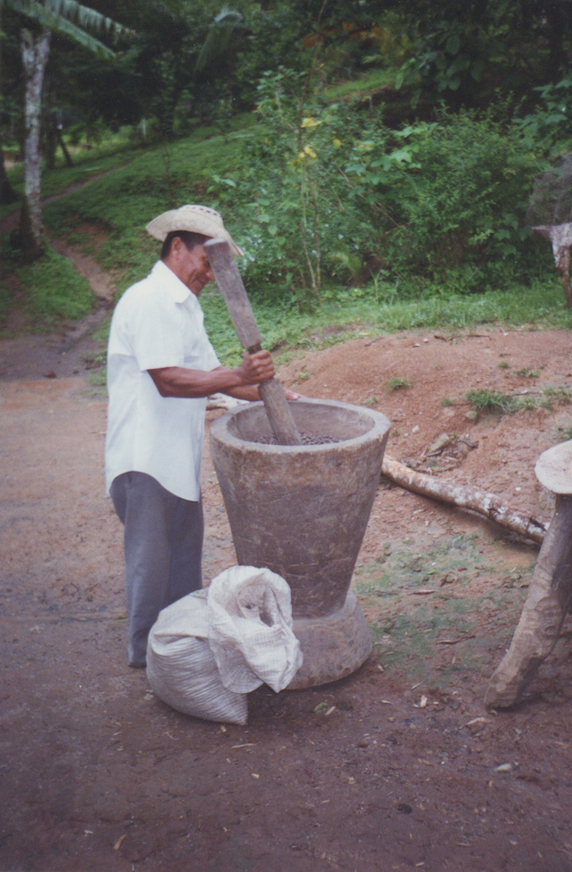
This week I dredged up a photograph of Julián, our landlord and next door neighbour in Panama. He was tickled to pose for this photo—he always enjoyed sharing cultural differences.

In this photo, Julián was grinding coffee in a massive mortar and pestle called a pilón. These tools get near-constant use—grinding coffee, pounding rice to remove the hulls, grinding corn—and I loved to hear the deep, rhythmic thud, thud, thud of the neighbours at work.

And I was always grateful to buy my coffee already ground…

A pilón is carved from the trunk of a tree, and when it’s not in use as a grinder, often serves, tipped on its side, as a bench in the kitchen. Every family we knew had one, but they must last forever, because I never saw a new one. They were all beaten and dinged, and I imagine they must be able to tell some great stories.

Throwback Thursday—Amas de Casa

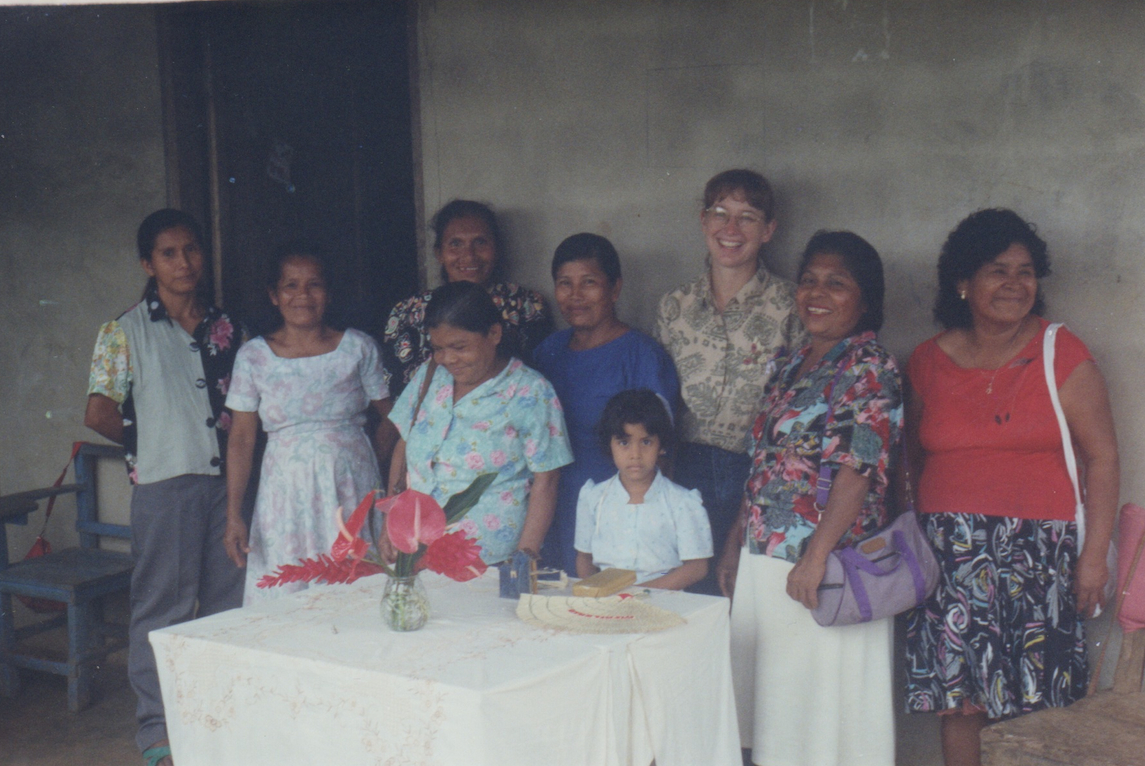
AmasdeCasasmI thought I’d take a trip down memory lane today and share this photo of some of the women I worked with as a Peace Corps Volunteer in Panama.

I regularly joke that this is my favourite photo ever, because it’s the only one in which I look tall (at 5-foot 2, I towered over most everyone in my village). But that isn’t really why I love this photo. I love it because of who is in it.

These women were all part of the Membrillo Amas de Casa (housewives) group. These women welcomed me into their group, and taught me so much. Together we created a tree and medicinal plant nursery. We created a demonstration garden using soil conservation techniques. We made bollo for Carnival. We laughed, we drank coffee, we shared our lives.

Two of the women were particularly special to me.

Onofre Gonzalez, the woman to my right, taught me that when it comes to using a machete, it’s attitude that matters, not size. Onofre could take down a tree in seconds with her little, wickedly sharp blade. She once snicked a palm viper’s head off right in front of me with her machete before I even saw the snake. She carried loads on her head, feeling the path with her bare feet like a cat.

To my left is Francisca Chirú. She and her husband, Cándido, adopted me and my husband into their family, though we did not live with them. They embraced us as though we were long lost friends, and we became a regular fixture at their house. They taught us to weed, included us in their family celebrations, and shared their lives with us.

All these women were incredibly strong, creative, and loving. Even 22 years later, I am still honoured and humbled by their acceptance of the tall white stranger among them.


The Shower

Shower cropFlicking through old photos from our Peace Corps Service in Panama today, I found this…

We called it the shower, but it was nothing but a few sticks holding up a motley assortment of old sheets and plastic bags. We scrounged a quartet of decorative cement blocks for a floor, so our feet wouldn’t get muddy. We’d haul a bucket of cold water out there every day and do our best to wash off the grime and sweat.

After the neighbourhood boys started coming by to peek in at me, I began showering after dark. It wasn’t bad, with the stars overhead.

But one night, I had company in the shower. As I stood there naked, bracing for the cold water I was about to pour over my head, something cool and damp thudded onto my hip, and stuck there. I could feel the little suction feet, and had a pretty good idea of what it was, but I fumbled around for my flashlight anyway.

When I flicked it on, there sat a little green tree frog, blinking in the light. It perched jauntily on my hip like I was just another tree branch. It cocked its head and considered me for a minute, then leapt onto the wall of the shower.

I chuckled and carried on with my shower. I heard the frog leap twice more on the shower walls, and then it was gone.

These Are a Few of My Favourite Things: Preying Mantids

DSC_0025 sm

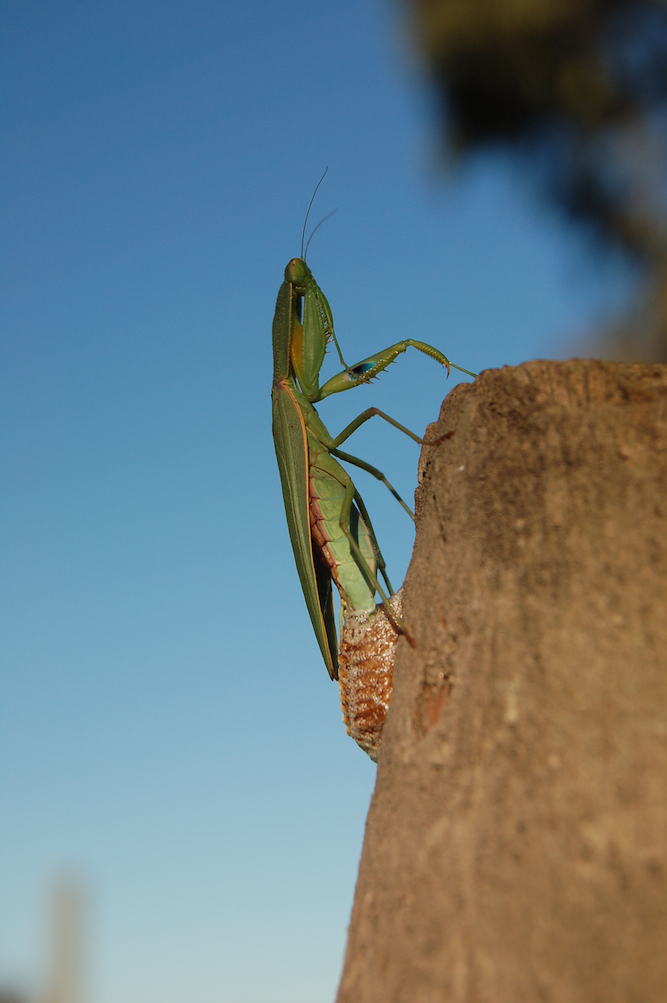
NZ mantis laying eggs

There’s no question why I’ve been known as The Bug Lady most of my life. I have a weakness for anything with more than four legs.

Preying mantids are some of my favourites. Not just because they eat pests in the garden, but because they are simply fun to watch.

How often can you watch a cheetah bring down an antelope in real life? Um…never. But it’s easy to watch a mantis snatch a fly—all the drama of the Discovery Channel, right in your back yard.

Sometimes the drama is a little too close for comfort.

When we lived in Panama, a beautiful 10 cm long green mantid with bright pink hind wings often came to our light at night. It would sit on our table and snatch moths attracted to the oil lamp. It was a cheeky insect, and had no compunctions about perching on our faces or arms to get a better vantage point for its nightly hunting. We laughed that it would follow us to bed some night.

We weren’t quite right, but one morning I slipped on my jeans, only to feel something enormous crawling up my thigh. With a yelp of surprise (and visions of scorpions, which were common in our house) I tore the jeans back off and peered down the leg to find our cheeky mantid scrambling out. It looked distinctly ruffled by the experience, but that didn’t stop it from returning to our light.

But from then on, we trapped it in a jar every night before we went to bed.

We are blessed with a healthy population of New Zealand mantids here at Crazy Corner Farm. Like most mantids, they enjoy hanging out on flowering plants, particularly herbs which attract huge numbers of flies and bees. Sometimes, I sit in the middle of the herb garden with my morning coffee, just to watch the mantids. I’m always surprised and impressed by the size of prey they can take down. I’ve even seen them snatch more than one fly at a time—one in each “hand”. Indeed, they will keep snatching prey as long as it keeps coming—even once they are fully sated and can’t possibly eat any more—their predatory instinct is so strong, they can’t stop themselves.

Of course, everyone has heard that female preying mantids eat their mates, and in species in which the female is much larger than the male, I’m sure it happens. But male preying mantids are just as fierce as the females, and they don’t go without a fight. The female New Zealand mantid is only slightly larger than the male, and I have kept males and females together in captivity. Only once did I see a female try to eat her mate. It was an epic struggle, worthy of the best wildlife documentary. It went on for at least fifteen minutes, and in the end, the male got away.

So turn off the TV. Get outside and watch the drama unfold!

Cilantro and Culantro

100_4228 smCilantro is an acquired taste. This strong herb is used in Asian and Central American cooking, and is one of those things you either love or hate.

When I first tasted fresh cilantro (Coriandrum sativum), I will admit I didn’t like it.

It wasn’t until I had culantro—Eryngium foetidum, also known as Mexican coriander—that I really learned to like the flavour (Never mind that the scientific name means ‘foul-smelling thistle’).

In Panama, both are eaten, and though they are only distantly related plants, they serve the same culinary purposes, with similar flavours. Panamanians consider Eryngium foetidum the ‘real’ cilantro, and call it simply culantro. Coriandrum sativum is called culantro Chino (Chinese cilantro).

Culantro grew wild in our lawn in Panama, and we weren’t long in the country before we were eagerly searching it out to flavour our dinners. It was a disappointment to return to the U.S. and find we could only get culantro Chino—positively bland in comparison to the foul-smelling thistle we grew to love.

But we’ve since grown fond of Chinese cilantro, too. It grows year round here. In fact, it’s as much a weed here as culantro was in Panama, and I find it cropping up all over the place. It does a lovely job of providing a year round crop without any work on my part at all. I just need to be open-minded about leaving the ‘weeds’ where they sprout.

Favourite Garden Tool–Machete

100_4045 smI learned to use a machete in Panama, where it became an extension of my arm. I learned my macheteing technique from greats such as Julián Valdéz and Onofre Gonzales. Not having been born with a machete in my hand as they were, I could never match their skill, but by the end of my two years, I could at least keep pace with a crew clearing brush for a new crop. Of course I could only do this because I’m ambidextrous, and when my left arm gave out, I could switch to the right. But, hey, that meant I was at least half as good as the farmers around me!

In rural Panama, a machete may be the only tool a farmer owns. It’s used for everything from taking down trees three feet in diameter to paring one’s toenails. Machetes are kept razor sharp, and if a farmer isn’t using her machete, she’s probably sharpening it. All that use wears them down. As a machete grows smaller and smaller, its use changes—from land clearing, to weeding tool, to kitchen knife. The smallest ones are given to little children, who proudly toddle around with machete in hand—able to help around the farm now they have a tool.

When I left Peace Corps, I sadly had to leave my “Collins”* behind—it was Peace Corps issued, and went to the next volunteer in my village. But I couldn’t live long without a machete, and soon had another upon my return to the United States. Actually, we had three…size is critical, and you have to get just the right one, so my husband has a long one, and I have a shorter one, and we have an even shorter one that fits neither of us well, but is useful for edge-destroying activities.

Those machetes came to New Zealand with us when we moved, and they are as useful here as they were every other place we’ve lived, though they get odd looks from the neighbours.

Here in the developed world, the machete is an anachronism of sorts. Its jobs are done by petrol-powered weed whips, chainsaws, saws and secateurs.

But there is something satisfying about a tool that can do just about anything. A tool that never breaks down, doesn’t need fuel, and requires only simple maintenance—sharpening—easily done with a file or even a chunk of concrete.

And of course, as the forerunner of the sword, a machete comes in handy if you happen to come across a dragon in the garden…

*Collins is a favoured brand of machete in Panama.

Klim Diplomacy

Kitchensm

All the kitchen you need for making ricotta!

I ran across this lovely article about unofficial Peace Corps cookbooks, and it brought a smile to my face.

There was no Panama Peace Corps cookbook when my husband and I were there, but there were plenty of recipes shared in the Peace Corps newsletter. I still have a few of them—ragged pieces of paper torn from the newsletter, smelling ever so faintly of mould.

The best Peace Corps recipe ever was for ricotta cheese made with powdered milk.

Fresh milk was impossible to come by in our village, as there was no electricity, and hence no refrigeration. Dairy of any sort just wasn’t part of the diet. But you could buy cans of powdered milk (marketed by Borden as Klim…the most uncreative name ever).

Today, with my goat milk, I am quite precise with temperature when I make ricotta, but the Peace Corps recipe was written for the Volunteer cooking over a three-rock fire with nothing more than a pot and a spoon.

The recipe went something like this:

Mix up two litres of milk from powder.

Heat to just below a boil.

Add ¼ cup of vinegar.

Skim off the cheese curds as they form.

This little recipe made surprisingly good ricotta, even from powdered milk. With it, we managed lasagne, pizza, and all manner of other cheesy treats over our little fire. It was a delightful break from unending days of rice and yuca.

Excited by our ability to make foods from home, we shared our pizza with the neighbours.

They thought it was disgusting.

But we all laughed and enjoyed the chance to talk about and compare our different cultures and cuisines.

One of the goals of Peace Corps is to foster understanding and exchange between cultures. Food is an important part of that exchange for all Peace Corps Volunteers. Even when the various parties can’t agree on what tastes good, food opens dialogue, it makes people smile, it is a common language.

Perhaps the world would be a more peaceful place if we all tried a little Klim diplomacy.