Everyday Beautiful

I don’t need an excuse to make cake, but today’s icy southerly gales were an excellent excuse, regardless.

I chose to make a devil’s food cake. I generally don’t ice ‘everyday’ cakes–too much work, and none of us needs the extra sugar. This intensely dark cake, though, cried out for something to show off it’s colour.

I filled it with gooseberry jam, and then made up a simple powdered sugar/lemon juice icing to drizzle over the top. The icing was purely for decoration.

Because every day deserves something beautiful.

Colours of Autumn

Growing up in eastern North America, autumn meant colourful leaves, fading to brown, bare branches. Green fields gave way to gold, then brown.

So it was a lovely surprise to find when we first moved here that in Canterbury, the opposite is true. Summer has its green bits, but because there is little summer rainfall, the summer landscape is predominantly brown.

But with autumn come cooler temperatures and more rain. Grass begins to grow again. Plants that were dormant through summer sprout new leaves. Autumn is a time of lush green—a time of life, not death.

For certain, the days are shortening, and the growth won’t last. Soon there won’t be enough sunlight hours to fuel plant growth. But winters are mild, and the green will remain all the way through until spring.

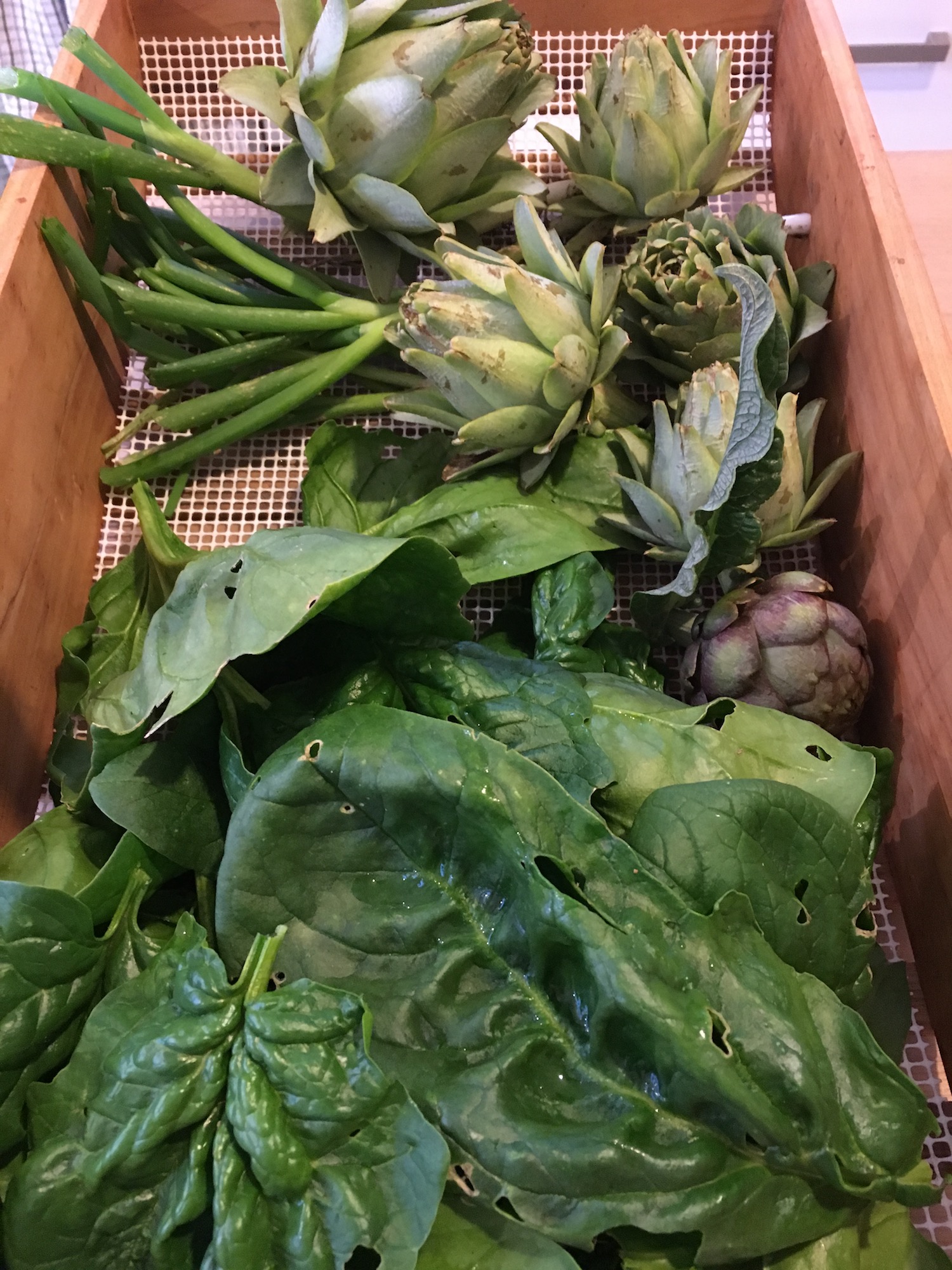
Today I picked a basket of autumn crops for dinner—all in shades of green.

Happy Mother’s Day

Trig M, where every table has a panoramic view.

Advertising media has been exhorting us to do all sorts of things for our mothers today—buy her flowers, make her breakfast, take her out to a fancy restaurant, buy her diamonds…

We have a rather different take on Mother’s Day at our house.

After the usual Sunday morning routine where I get up before everyone else, light the fire, feed the animals, and bake something lovely for breakfast, we headed to the hills.

It was two hours of uphill slogging to our lunch spot. One of the best restaurants around, Trig M has spectacular views. No need for a reservation, even on Mother’s Day (we were the only ones there). The ambiance was great, if a little chilly today. The thirteen year-old chef made us an excellent lunch of cheese sandwiches and apples, with chocolate bars for dessert.

A lovely Mother’s Day. I hope yours was / is as nice as mine.

Darkness, My Old Friend

I was off today. Scatterbrained, uncentred. I couldn’t focus on a task long enough to complete it. I forgot to hang up the wet washing before leaving the house for the day. I left things at home that I needed to take with me. I grumbled through the day. Everything irritated me.

So when I finally remembered the washing late this evening, I was seriously annoyed with myself–a beautiful clothes-drying day wasted. I snatched up the basket of wet clothes and stomped out the door headed for the shed where the clothes dryer is…

And stopped dead.

The chill night air.

The gibbous moon illuminating a mackerel sky.

Silence.

Darkness.

I took a deep breath. Centred. Collected.

And walked slowly to the shed, letting the cool night and glittering stars bring back my good humour.


Happy World Naked Gardening Day

Well, you learn something new every day. Apparently, the first Saturday in May is World Naked Gardening Day.

Thankfully, I only learned that fact after I was through with the day’s weeding and mulching.

I suspect that whoever came up with the idea of World Naked Gardening Day didn’t have a garden like mine. I spent my day pulling nettles and thistles—just the idea of doing that wearing less than long pants, long sleeves, and gloves makes me shudder. I also did some pruning. Yikes! Wielding secateurs in the nude? Then there’s the cold. It was one degree Celsius this morning. I was wearing a merino top, a jersey, and a wool hat when I started the day’s garden work, and even so, my toes were numb by morning tea time. Had I been nude, it would have been full-blown hypothermia.

I’ve got no problem with the idea of hanging out in the nude, or playing nude volleyball, or whatever, but gardening? I’ll pass on that one, thanks.

But, you know, if you’re keen, today’s the day. Happy World Naked Gardening Day!

Garden Rescue Mission

A southerly storm blew through yesterday, and the clouds cleared around midday today. The sun was warm this afternoon, but the wind remained chilly. This evening was clear and still. Perfect conditions for a frost.

There are few summer vegetables left at this point. The tomatoes outside the greenhouse are all dead. The peppers and eggplants are ripening their final fruits, the zucchinis and cucumbers are maturing at a tiny size. The corn has all been eaten, and the runner beans are giving just a handful every few days.

A frost will kill everything left in the summer garden, so I went on a rescue mission this evening. I gathered in everything that was still decent, whether it was fully ripe yet or not, assuming that anything left in the garden will be dead by morning.

It felt oddly good.

It’s not that I won’t miss the fresh tomatoes and eggplants of summer, but I also look forward to the pumpkins, potatoes, and beans of winter. As they say, variety is the spice of life. I would say that seasonality is the spice of life. Food marks the course of the year, and each crop has its own time. It gives the year variety and interest. It gives us things to look forward to with each season.

So, while I mount my summer vegetable rescue mission, I don’t worry about the loss of those summer crops. There are other delights to come.

Red-spotted Newt

I was pleased to see today one of my favourite North American animals, the red-spotted newt (Notophthalmus viridescens). These colourful little salamanders have a complex life cycle that includes an aquatic larval stage, a terrestrial juvenile (eft) stage, and an aquatic adult. The terrestrial efts, like this one, are brightly coloured.

Like most bright colours in animals, the red skin and spots of the red-spotted newt are a warning. The red-spotted newt has toxic skin secretions that protect it from predators. This toxic defence gives red-spotted newts the ability to live in permanent bodies of water with fish in them, unlike many other salamanders which fall prey to fish, and rely on temporary pools.


A Tale of Two Walnuts

We have two walnut trees, both of them young. The older of the two gave us a few walnuts last year and one the year before. This year it gave us several good handfuls of nuts.

That’s not anywhere close to satisfying our annual walnut consumption. We put walnuts in granola, baked goods, burgers, tofu meatballs, and rice pilaf, among other things. We eat them as snacks, too, and I buy them in kilo-sized bags.

But walnuts here are all the mild English walnut (Juglans regia). They’re a good staple, but somewhat tame. Not something to feature in a dish.

Not like American walnuts (Juglans nigra). To me, these are the true walnuts–piney-flavoured and bitter, difficult to shell, with thick green husks that leave your fingers black. There aren’t many foods from the US that I miss anymore, but American walnuts are one of them.

When I was a kid, every Christmas my mother made walnut crescents–moon-shaped shortbread cookies packed with American walnuts and rolled in confectioner’s sugar. They melted on the tongue, and burst with nutty flavour. I made the mistake of making these with English walnuts once. They were vapid little sugar bombs. Not at all like real walnut crescents.

I have looked high and low for American walnuts here in New Zealand, with no luck. One time I saw a label in the grocery story saying “American walnuts”, and I was thrilled. Then I looked at what they were selling. The nuts weren’t American walnuts, they were English walnuts grown in America.

So I buy the cultured, mild-mannered English variety and dream of the wild, brash variety of my homeland.

Completing the Cycle

Back in early December last year, I posted an update on the preying mantids on my rosemary bushes that I’ve been following since mid-winter, when they were eggs.

Well, I haven’t forgotten them, and I’m pleased to report that they are all grown up now, and laying eggs of their own.

On the one hand, I’m thrilled (as I am every year) to watch the entire life cycle play out in the garden.

On the other hand, I’m getting a little worried.

Last winter, I didn’t prune the rosemary bushes because the bees depend on their flowers in late winter. Then in the spring I couldn’t prune them because the preying mantids hatched out. All summer I waited and watched the mantids grow. The rosemary plants grew, too, engulfing a bench on one side, and the path on the other.

And now the mantids are laying their eggs on the very branches I need to prune off…

We may soon see just how big rosemary can grow here.

To Burn or Not To Burn

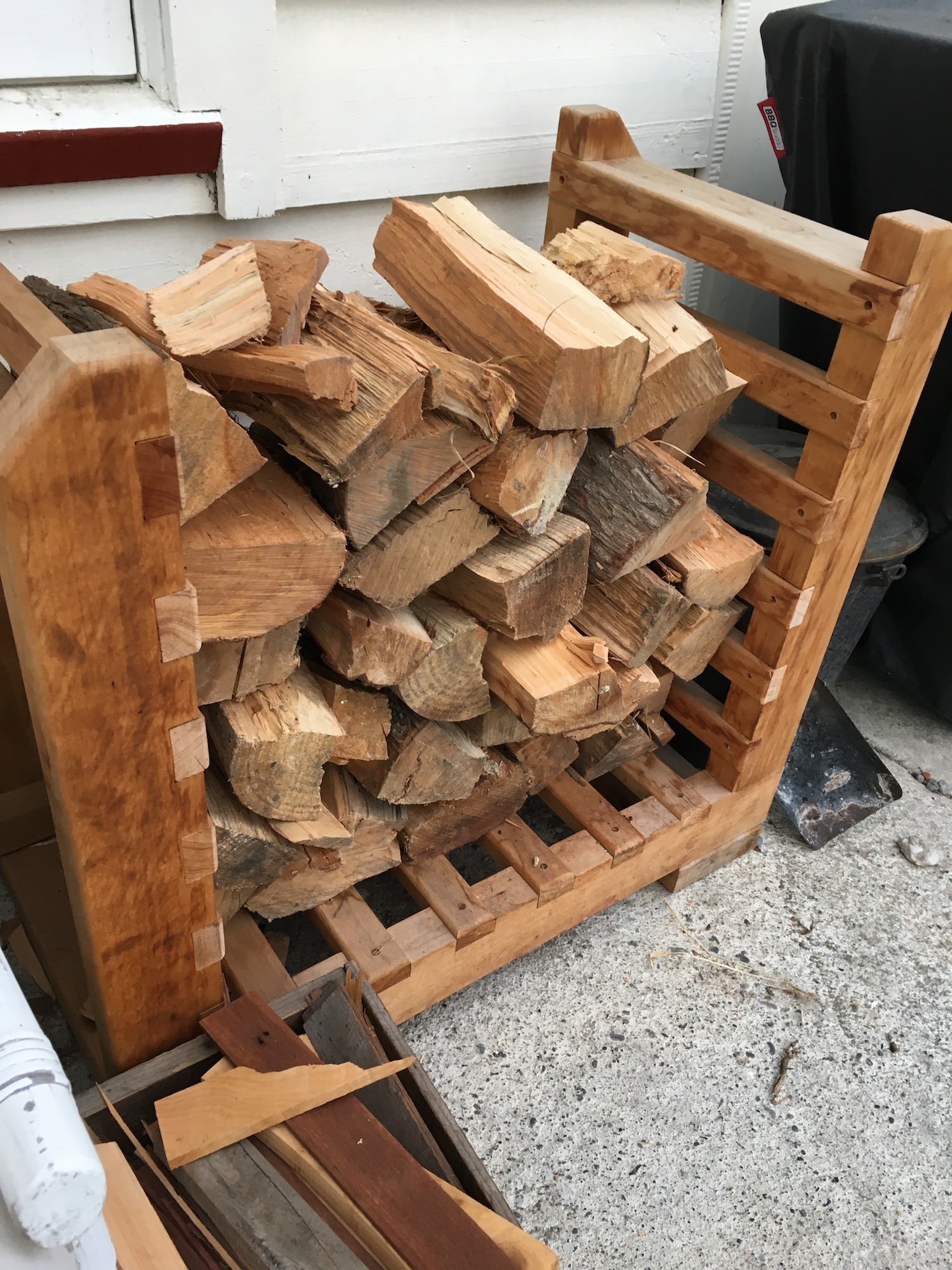
The firewood stands ready to go.

That is the question, on a night like tonight. If we light the fire, it will be the first fire of the season–always a bit momentous, because it’s an admission that summer is over.

Technically, we don’t need a fire tonight. It’s cool, but not terribly cold. We’ve had colder nights already this autumn, and never even considered lighting a fire.

But it’s been raining most of the day. The temperature has been inching downward since morning, and the wind has been picking up. It’s thoroughly unpleasant outdoors this evening.

It’s emotionally cold.

It’s not that I’m not thankful for the rain–we really need it. It’s not that I don’t enjoy hearing it on the roof and against the windows.

But it would sound even better accompanied by the sound of a crackling fire.

It’s not so much a need for warmth, but a need for hygge. A need for comfort.

And so, as a fresh gust of wind rattles the window, I think I’ll close this blog post, put on a pot for tea, and build a fire.