Walking Wellington

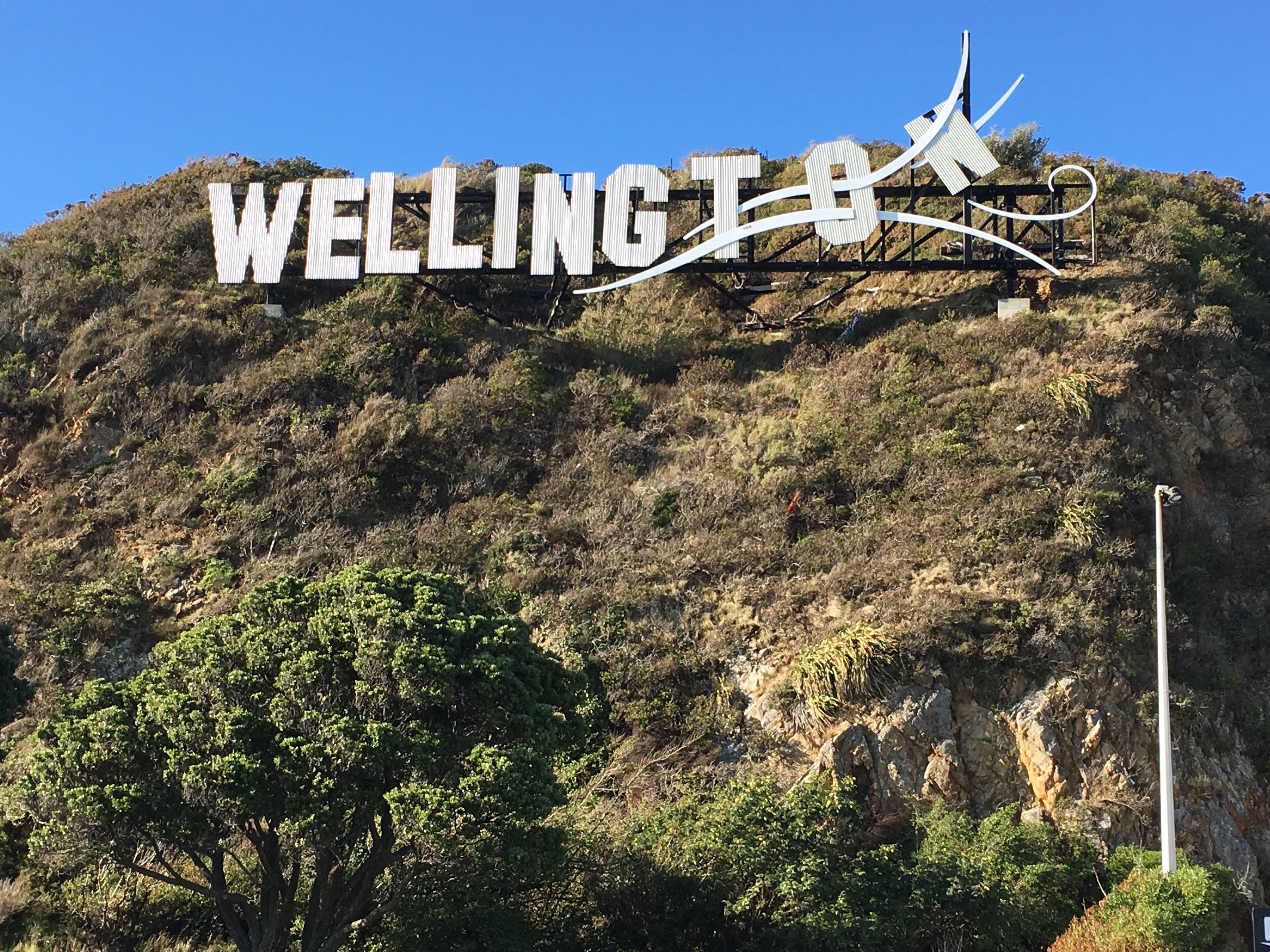
2016-06-03 10.22.20I spent the weekend in Wellington at a convention, but I have to admit that the best part of the weekend was walking around the city.

I could never live in Wellington—I’m just not a city gal, and it would kill me—but I love to visit. Yes, I enjoy Te Papa, and the Carter Observatory, the World of Wearable Arts show, and all the other indoor attractions. But mostly I like going there to walk.

And I have to think I’m not the only one who enjoys walking in Wellington. The streets are full of people walking—to and from work, during lunch breaks, to shops, to the bus stop…

You can walk along the waterfront, or through the residential neighbourhoods with their many finial posts, through the parks or the botanic garden, or along bustling Cuba Street. You can even walk to the airport, if you’ve got time and inclination—the city is compact enough that nearly everything is within a reasonable walk.

Well, reasonable by my standards.

Of course, when Wellington’s weather turns, it’s not a place you want to walk. I’ve been drenched by wind whipped waves on the waterfront, even when it’s not raining. But on a good day walking Wellington is a delight.

This past weekend’s weather was crisp and clear, with almost no wind. Perfect. I did about 10 hours of walking from Friday to Sunday, and would have happily done twice that much, had my schedule allowed.

So, if you’re planning a trip to windy Wellington, be sure to pack your walking shoes.

A Fondness for Finials

2016-06-05 10.31.13 smWellington is a city rich in finial posts.

And…um…what’s a finial post?

Finial posts are the ornamentation found on the gable ends of roofs. Roof finials have been used for millennia all over the world. They originally served the purpose of capping the point of a roof, where the tiles come together (think of the fancy post on top of a Japanese pagoda). You need something to cover the unavoidable hole where all the tiles meet. Many roof finials still serve this purpose, but they are also ornamental.

2016-06-05 10.29.42 smGable finial posts were popular in the New Zealand villas built between about 1880 and the beginning of World War I. They were just one of the many ornamentations (inspired by the new steam-powered woodworking tools of the time) used in these houses. The style (including the finial posts) was also popular during this time in America and England. Folklore in the eastern U.S. suggests that finial posts were not just attractive, but also prevented witches from landing their broomsticks on the roof.

At this point most of you are wondering why on earth I even notice finial posts. My appreciation of finial posts started when we did a major repair on our own house—a tiny villa built around 1880. The front gable was rotting and in need of replacement. It had been repaired in the past, and in one of the repairs the finial post had been sawn off at the roofline. This is a common fate of finial posts on old villas—re-roofing is much easier without finial posts in the way.

When we repaired our house, my husband insisted on restoring the house’s finial post, and this started a whole-family appreciation of finial posts. Now we can’t go anywhere without noticing good finial posts, or noticing when they’ve been removed.

And so, while in Wellington this weekend, I took several long walks, simply to admire the finial posts.

Of course, the question I have is, with so many finial posts in Wellington, do witches need to land at the airport instead?

Sunrise, Sunset

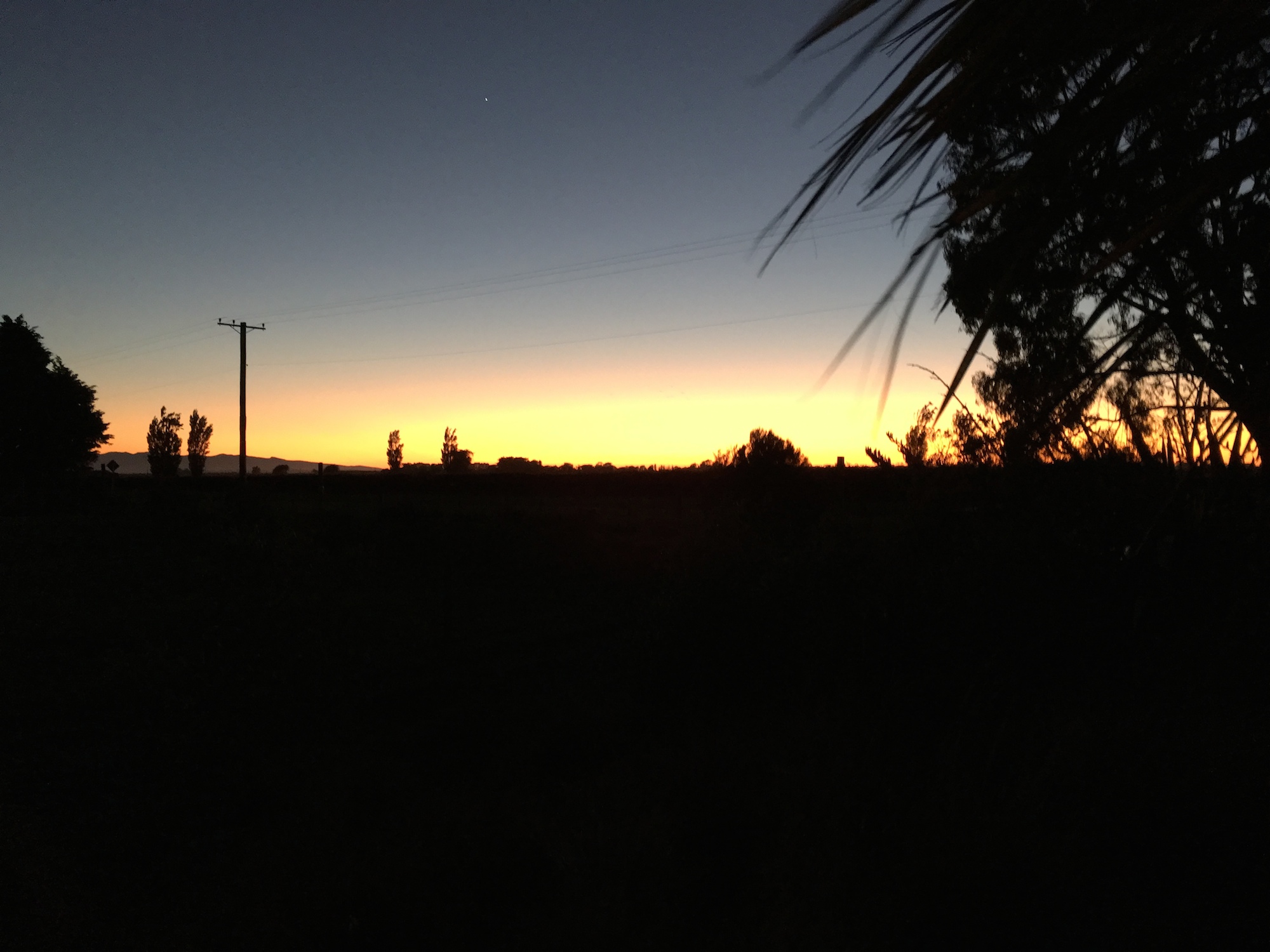
2016-02-04 05.55.27 smOne of the best things about living in the temperate zone is the long sunrises and sunsets we get much of the year.

When we lived in Panama, the sun would leap into the sky in the morning, and dive out of it in the evening, with little in the way of lingering twilight. It was like flicking on and off a light.

The more gradual appearance and disappearance of the sun in the temperate zone is far more picturesque, and there are few places on earth more picturesque than New Zealand when it comes to sunrise and sunset. Between mountains and wild weather, you can’t beat it.


Homeland

Lovely, but doesn't make me feel at home.

Lovely, but doesn’t make me feel at home.

When Europeans settled new lands, they had a habit of bringing all their favourite plants and animals with them. The result has been a plague of invasive exotic species all over the world. It’s easy to dismiss these settlers to as misguided imperialists, and I’ve done so myself.

But being a stranger in a strange land more than once in my life, I have to admit that I understand the desire to bring a little of the homeland to a new land.

Autumn is when I feel it most.

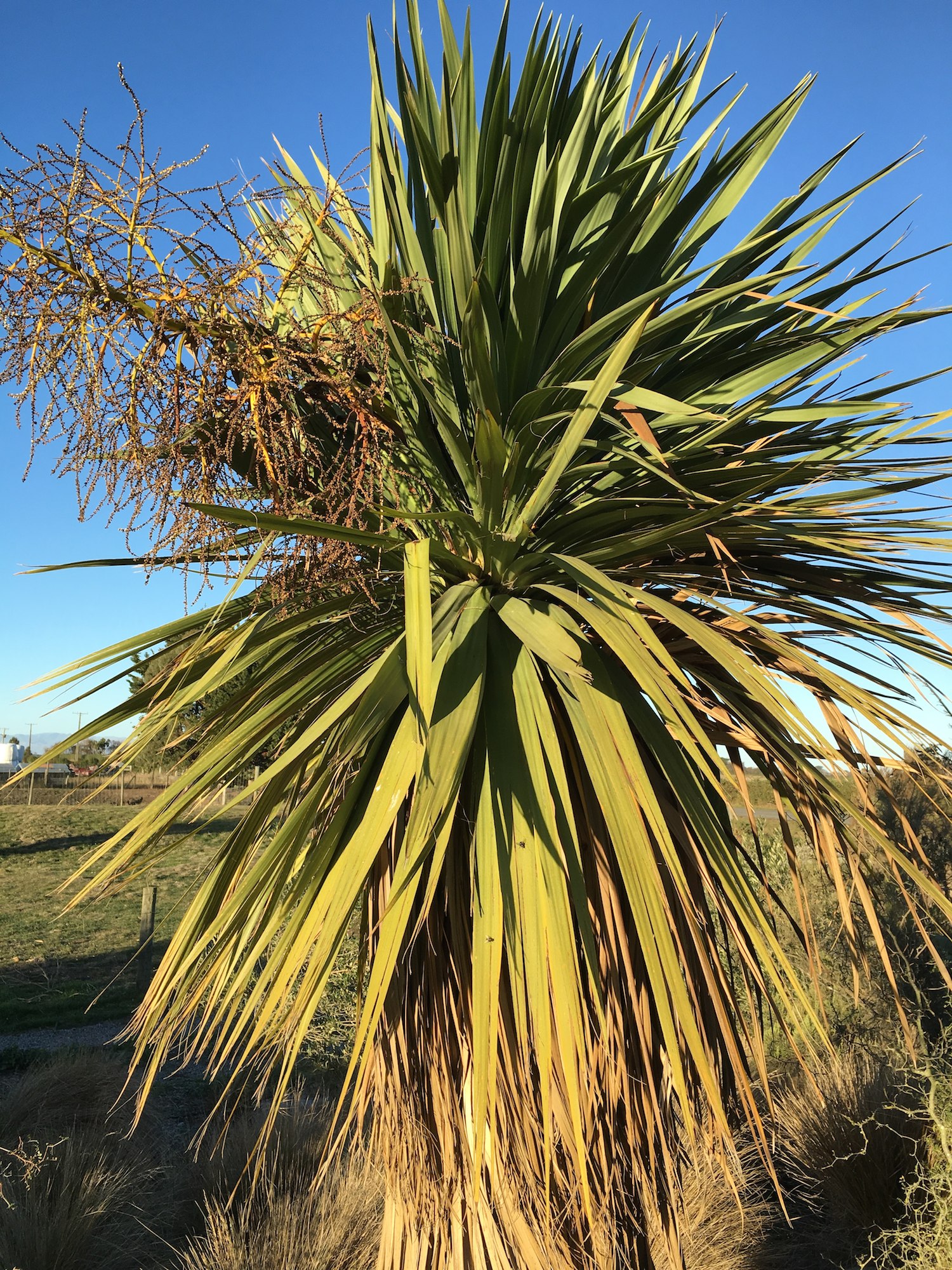
Most native New Zealand trees are evergreen. There are no native autumn colours, no piles of native leaves to be raked and jumped in. No smell of wet leaves carpeting the ground on crisp autumn mornings.

Last year my daughter and I found a lovely little path along a stream on one of our city walks. Dropping down to the stream edge from the street, I was first struck by the fact that all the trees were non-native oaks and maples. Then I was struck by the smell, and the rustle of fallen leaves on the path, and the glow of yellow that suffused everything. The familiarity of that little stretch of path lifted a weight I didn’t know I carried—the weight of being away from home. For the three minutes it took us to stroll through that little patch of Northern Hemisphere trees, I was in my element. The illusion came to an end all too quickly as we stepped back out onto the street.

So, while I still advocate native plantings, and whittle away at the non-natives on our own property as our young native trees grow, I don’t pass judgement on those early Europeans. They carried a weight in their hearts greater than mine—once they were here, there was no going back for most of them. Never to return to their homeland, they needed to bring a piece of it here. I can sympathise.

Any day now…

DSC_0060smOkay, it’s allowed to rain now.

Any day would be fine.

Just a little?

And maybe something a bit cooler than t-shirt and shorts weather to go with it?

Please?

Six years ago, the beginning of May looked like the picture above—we called it the black days of May. That was a bit too much rain, but normally we’ve had some good rain by the beginning of May.

Not so, this year. This year, it’ll be the brown days of May. We had plans to do a lot of landscaping this fall, but the soil is still bone dry—new plants wouldn’t stand a chance, even if we could water them. Almost every bit of promised rain has failed to materialise. The little that has fallen has evaporated within a day under summer-like heat.

2016-05-03 10.26.14It feels like summer will never end.

I’m still watering the garden, though the summer crops have mostly given up out of drought and exhaustion. The winter crops are likely to bolt in this weather, even with watering.

And who knows how long I’ll be able to water. It hardly rained last winter, and last summer was particularly dry, too. Canterbury water is over-allocated. The water table is dropping, and some people have already had to deepen their wells. How long before we run out?

Water is still being managed for short-term profit here—to ensure maximum output of dairy and crops. Environmental concerns and future supply are given lip service. That will come back to bite us. Climate change models predict less rain for Canterbury. If we keep on like this, at some point, we will run out.

Do we have the will to change before that happens? Experience in other parts of the world says no.

I do my best to conserve water here—using greywater to water plants, watering sparingly, mulching heavily, planting shrubs that can handle the dry—but I’m a tiny player, surrounded by farms hundreds of times the size of my property. The water I conserve is just a drop in the bucket.

A drop in the bucket would be nice about now. But the meteorologists are predicting no rain at all for the month of May in Canterbury.


Mosquitoes, Disease, and Environmental Change

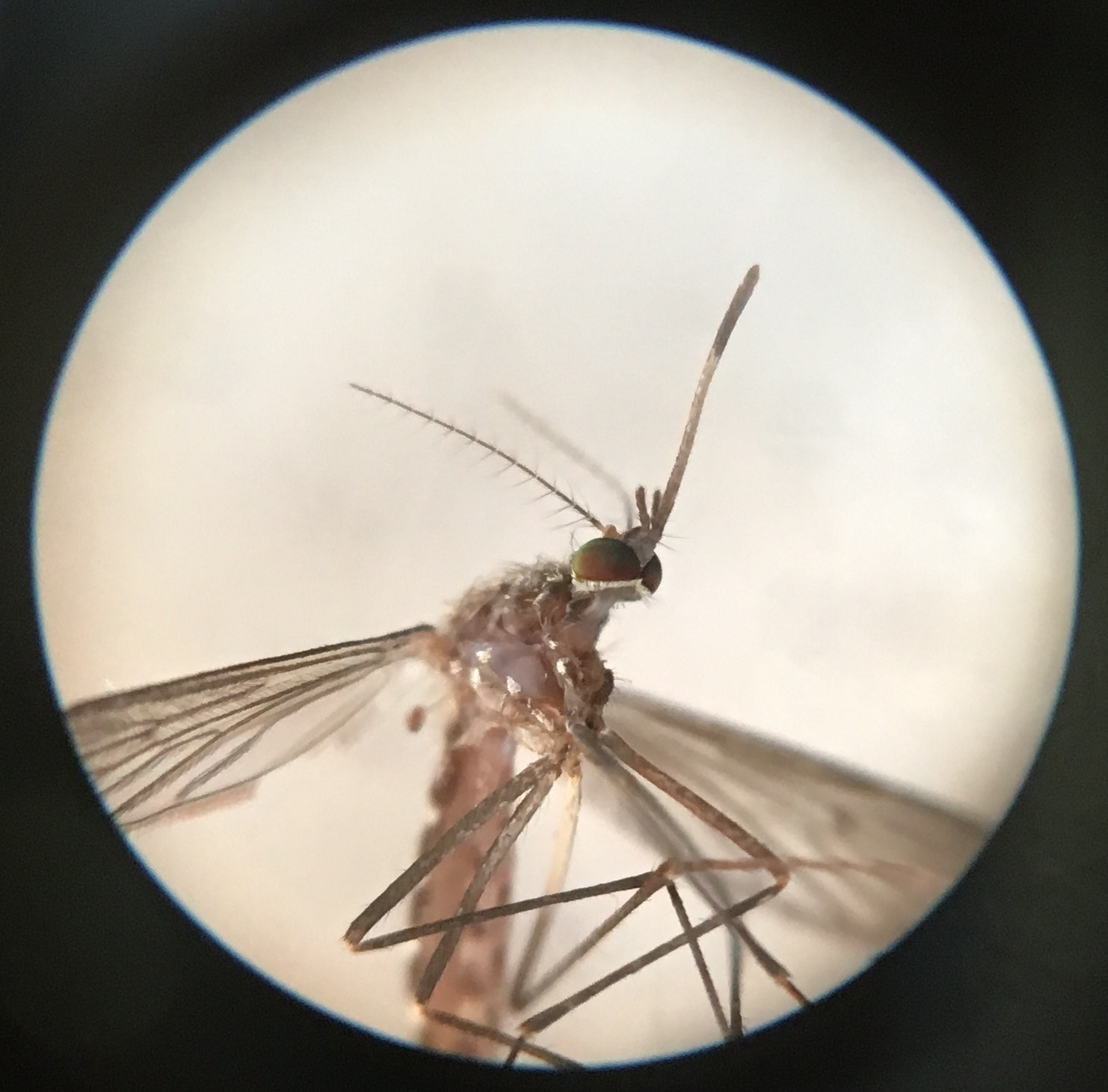
2016-05-02 07.38.34With Te Waihora/Lake Ellesmere just a few kilometres away, we’ve always had mosquitoes at our house. But since we installed a small pond, the mosquito population of our property has gone up (in spite of the fish, which do eat a lot of them).

Though mosquito identification is not my forte, most of the mosquitoes appear to be Culex pervigilans, the common house mosquito, or vigilant mosquito. Like most of our mosquitoes, this species is endemic to New Zealand.

Because of the isolated nature of New Zealand, few of the world’s nasty mosquito-borne diseases have ever arrived here, and no human diseases have managed to arrive and spread. But that doesn’t mean they couldn’t, if given the opportunity.

Whataroa virus is an Australian bird virus, which may also produce flu-like symptoms in people. In New Zealand, it has been found only in the area around the small West Coast community of Whataroa. It was first detected in 1962, and recent surveys show it has not increased in prevalence since then. In New Zealand, it is vectored by Culex pervigilans, which is common throughout the country.

So why hasn’t it spread?

Well, we don’t know for certain, but to get a clue, it’s worth looking at why other mosquito-borne viruses spread. Most emerging diseases come on the heels of environmental change—when the habitat changes, mosquito populations may increase (many mosquitoes do well in disturbed habitats), or the virus’ other hosts may increase or move around, spreading the virus. Environmental changes can be natural, like seasonal flooding; or human-induced, like cutting native forest (or digging a pond…).

Which brings us back to Whataroa, which hasn’t changed much at all over the past 50 years. There’s been no great increase in mosquito habitat, and little development that would favour the non-native blackbirds and thrushes that appear to be the reservoir for the virus. So the Whataroa virus has simply languished in place.

If the Whataroa virus had arrived at another location, it might have already spread far and wide (as avian malaria has done over the past 40 years). If a developer had come into Whataroa and built golf courses or fancy subdivisions, it might have spread. When the next big Alpine Fault quake happens, the resulting destruction will likely create new disturbed habitat for mosquitoes, blackbirds, and thrushes, and Whataroa virus might spread with them.

All sorts of variables determine whether and when a mosquito-borne disease becomes a problem. Some of these are known, and under our control, but many are either not understood or are out of our control. Sometimes, the only thing we can do is to react when trouble strikes.

Which is, of course, my excuse for swatting this mosquito when it landed on my arm this morning.

Rocket Spider

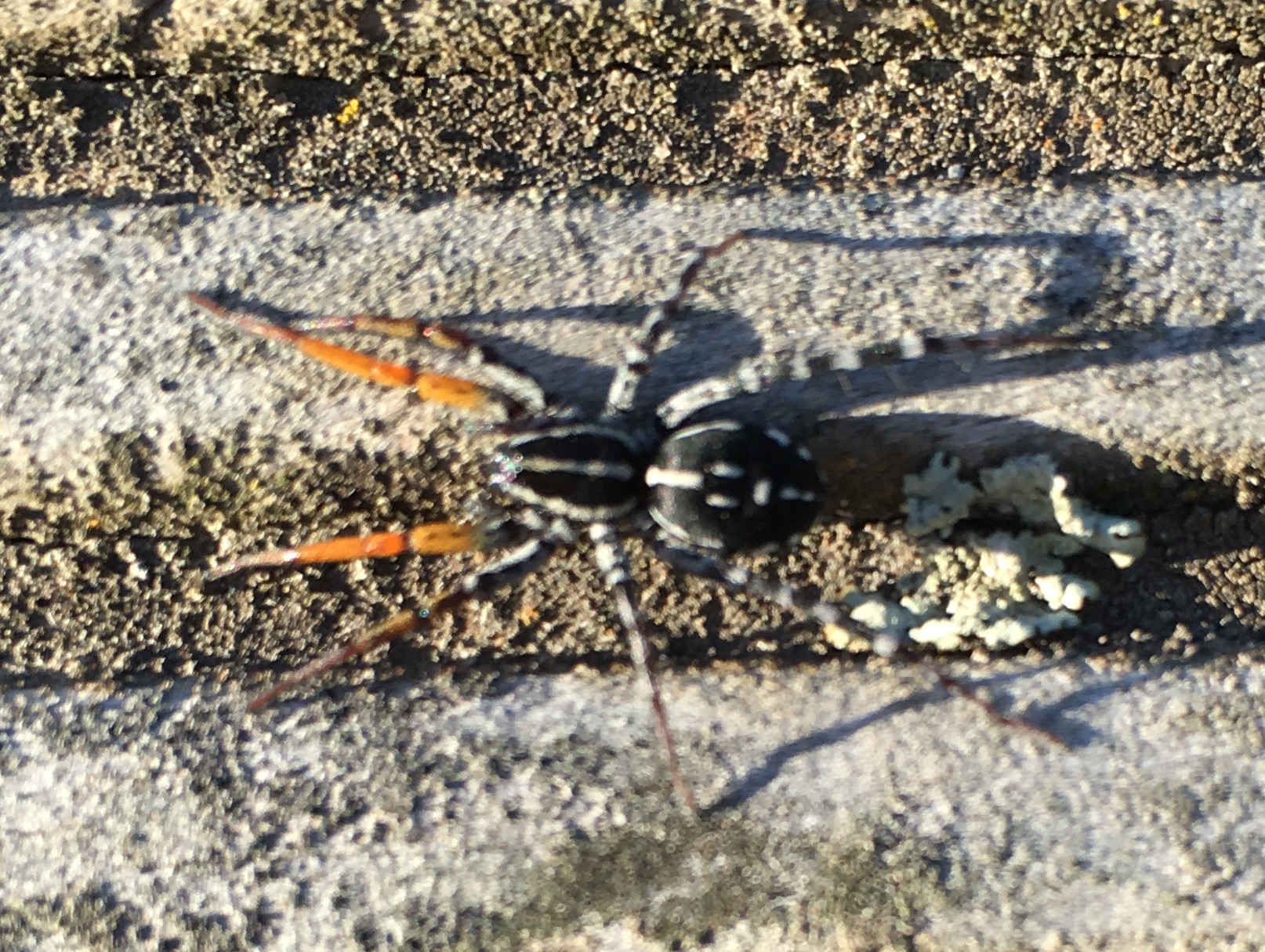
2016-05-01 15.49.10One of my favourite spiders here is an Australian invader. Officially known as the Australian ground spider Nyssus coloripes (formerly Supunna picta), but at Crazy Corner Farm, we invented a more colourful name, the rocket spider.

Rocket spiders have colourful orange front legs and white spots down their sides, making them stand out wherever they are.

They are in a group of spiders known as the fleet-footed spiders, and they are most definitely that. They are active daytime hunters, and race around as though they are rocket-propelled.

There is a female rocket spider who lives in my office. She’s been there for the better part of a year now, and zips over my bookshelves, desk, and walls as I work. She’s not shy—I sometimes have to shoo her off the keyboard, and once she skittered across my face.

I’m sure the rocket spider finds plenty of flies to eat in my office, but these spiders have unusual tastes. Though rocket spiders don’t build webs to catch food, I’ve seen them in the webs of Australian orb weavers—eating the orb weaver.

It’s a spider eat spider world, after all.

Saturday Stories–The Summer Job, part 3

DSC_0182 smContinued from last week

“You gotta see this,” slurred Grabloc, showing Matt a photo on his phone—Grabloc standing side by side with a grinning man.

“Is that really…”

“Yep! It’s him! Fame didn’t go to his head. He always had time for us orcs, though he can’t hold his liquor.”

Thigspit laughed, snorting orc-whisky out his nose. This naturally set Grabloc and Matt laughing. When they finally stopped, Thigspit explained.

“He got the hiccups every time he drank, And then he’d get really crazy! Take a look at this!”

Grabloc pulled up an other picture, slightly out of focus and taken at an odd angle.

“What’s he doing? Dancing naked on the table?”

Grabloc nodded, laughing.

“I had no idea he was so…”

“Well-hung?” The three burst out laughing.

More whisky and more stories followed. Outside, the storm blew itself out, and calm descended, but none of the inhabitants of the bivvy noticed. By the end of the second bottle, the three were singing songs together and getting teary-eyed reminiscing over the death of Theoden.

#

Matt woke around noon with a screaming headache. He almost wished one of the orcs had buried an axe in his head—it might have felt better. He opened his eyes to find himself alone in the bivvy. All the orcs’ gear was gone. He stumbled to his feet and out the door, grimacing at the bright sunshine as he made his way to the loo. By the time he returned, his eyes had adjusted, but his head still throbbed. He sat down on a rock and looked around. There was no sign of the orcs. Two trampers were making their way up the ridge toward him. Still far away, though.

Matt went back into the bivvy and packed up the rest of his gear. As he opened his pack to shove in his sleeping bag, a piece of paper fluttered out. Crude writing was scrawled across it.

Safe travels, Matt! We enjoyed meeting you yesterday. Thanks for the chocolate and the sword! Give your boss our regards, and tell him to fuck off.

Matt rummaged around in his pack. The sword was gone. The Tim-Tams were still there.

Ten minutes later, he was on top of a nearby ridge, cell phone and Tim-Tams in hand. He hurled the package of Tim-Tams into the steep valley below, then sent a text to his boss.

Encountered orcs yesterday. Pls include single-malt scotch in next food drop.

Then he dropped down off the ridge, following the unmistakable tracks of a pair of gumboots beside a pair of Merrells. He hoped he’d be able to catch up.

THE END

Orange Pore Fungus—a storybook mushroom

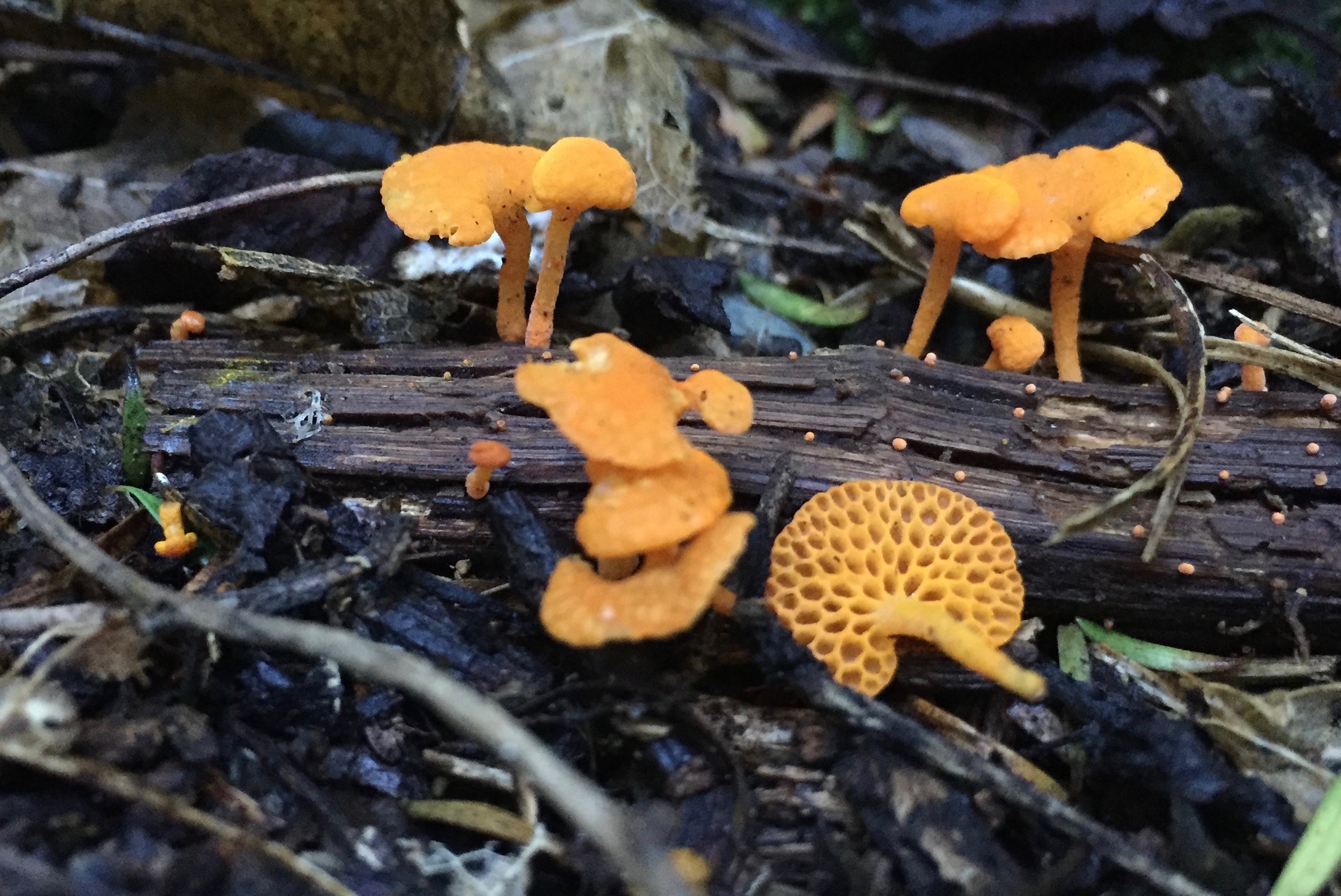
IMG_5266As my husband and I were hiking on Sunday, we came across a beautiful little fungus along the trail. Pebbly orange caps with a honeycomb underside. I was enchanted—they were storybook mushrooms that would have nestled neatly into any fairy tale.

But when my husband posted the sighting to NatureWatch NZ, the dirty truth came out.

These storybook fungi are Favolaschia calocera, the orange pore fungus, an invasive weed, and our sighting was the first in Hinewai Reserve.

The orange pore fungus is a curious organism. It appears to be native to Madagascar, though there is some speculation that it might also be native in parts of Asia.

It was first recorded in New Zealand in 1969, and has since spread throughout the North Island and much of the South Island. It has also recently been found in Australia, Thailand, China, Kenya, Reunion Island, and Norfolk Island. Its success probably shouldn’t be surprising—it’s a generalist, invading just about any dead wood available, unlike many other species that have specific tastes. It is also able to produce spores without mating, so it’s very quick to reproduce. It is so successful in New Zealand that mycologists are concerned that it could be displacing native fungi.

But it hasn’t stopped in New Zealand. In 1999, the orange pore fungus was first noted in Italy near the busy port of Genoa. Genetic studies of the Italian fungus indicate that it probably came from New Zealand on imported timber.

This storybook fungus is straight out of a fairy tale, all right—but the tale was written by the brothers Grimm.

Saturday Stories–The Summer Job, Part 2

DSC_0145 smSorry this is a little late. Not Saturday, but here’s the Saturday Story…continued from last week.

“Hey, uh…what’s-yer-name,” called Thigspit.

“Matt. My name’s Matt.”

“Sorry, we’ve forgotten to introduce ourselves. I’m Thigspit, and the ugly one here is…”

“Grabloc. Yeah, I’d figured that out.”

“Look! He is a smart one! Told ya! Anyway, I was gonna tell ya to pull out the bread and butter—d’ya mind buttering a few slices for us so they’re ready for the sausages?”

“No worries.” Matt found a partly squashed loaf of white bread and a greasy chunk of butter in the chilly bin. “Tomato sauce, too?” he asked as he noticed the bottle.

“Oh, yeah! Thanks!”

As Matt buttered bread, the orcs argued over how long to cook the sausages. At least, that’s what they appeared to be arguing about—they’d slipped back into Orcish while they bickered. Matt didn’t blame them—it seemed to him that the language was specially designed for arguments.

Matt let his eyes wander over the orcs’ gear as he worked. Axes, bows, knives—their packs bristled with weaponry. One of the bags was a scuffed, dun-colored military pack from the 1960s, but the other…Matt was impressed. The other was a snazzy new Exped Expedition pack—eighty liter capacity, fully waterproof—a great pack if you could afford it. Matt had looked at that pack himself, until he knew the price. He ended up settling on a used MacPac Cascade he bought on Trade Me.

Matt didn’t want to think about where the orcs had gotten that pack. He tried to remember if any trampers had recently gone missing nearby.

“Ya got that bread ready, Matt?” asked Grabloc. “Bring it on over.”

Matt carried a stack of buttered slices to where the orcs crouched over the stove. He handed the bread a slice at a time to Grabloc who laid a sausage in the middle of each. Thigspit squeezed an artistic squiggly line of tomato sauce on each sausage and stacked them on a plate.

“Ah! That looks good enough to eat!” growled Grabloc.

The three sat down on the floor with the plate between them. Grabloc poured a generous measure of scotch into their mugs. Thigspit raised his drink for a toast.

“To the great outdoors!”

“To single malt!” added Grabloc.

Matt smiled and raised his mug, clinking it ceremoniously with Thigspit’s Sierra cup and Grabloc’s insulated travel mug.

They ate in silence for a minute, Matt trying hard not to watch the orcs eat, lest he lose his appetite.

“So,” began Grabloc through a mouthful of sausage. “What brings you to our lovely corner of paradise? And don’t tell me yer one of them DOC rangers. Pesky things! Seem ta think we’re not allowed here!” Grabloc’s voice took on a threatening tone.

Matt’s sausage stuck in his throat, and he was incredibly thankful his DOC-issued polar fleece was currently wadded up in his pack.

“Ah, no…I…um…I’m just tramping, you know…on vacation.” Matt smiled and laughed weakly. “And what about you?”

“You might say we’re on vacation, too,” said Thigspit with a laugh. In answer to Matt’s questioning look, he added, “We just quit our job last week.”

“Another movie?” asked Matt.

Grabloc grunted. “I wish. Nah, we was workin’ for the old man.”

“Old man?”

“Saruman—or Sorry-man as we like to call him ’cause he’s such a sorry excuse for a man.”

“Wait. You were working for Saruman? Where?”

“Over in Long Sound. He’s building himself another Orthanc. Thinks he’s gonna breed himself up a new batch of Uruk-hai and take over New Zealand.”

“What?”

“That’s what I say—who’d want New Zealand? ‘Course, I know for a fact Saruman’s very fond of sheep, if you know what I mean.” At this Grabloc burst out laughing, spraying bits of sausage all over Matt.

“But, isn’t he an actor?”

“Yeah, he was,” said Thigspit. “But he vanished right after the filming of that scene where the ents destroy Isengard. Collected his paycheck and just disappeared.”

“Is that why they never showed the scene where he sweet-talks Theoden and Gandalf and everyone from the tower, and Gandalf breaks his staff? That was such a great scene in the book, I thought it a shame they left it out of the movie.”

“Exactly! So Saruman just up and vanished, and then showed up in the middle of the night at filming sites, promising us orcs jobs, fame, fortune, women…everything, if we’d come with him. We figured, what the hell!”

“But he never paid us shit. And there were no women, and precious little else to eat. So we slaved away in the rain and sandflies for bloody nothing, while old Saruman lived in a sweet flat in Auckland and issued orders by cell phone.”

“But cell phone reception in Fiordland is terrible!”

“Yep. Three times a day we had to run to the top of Cone Peak to report in and get instructions. When we complained, the bastard said that we’d have fine reception in the tower as soon as we finished it. We told him he could build his own fucking tower, then shove it up his ass.”

“So, did all the orcs quit?” asked Matt.

“Nah, couple of dozen quit last week with us. The others? I dunno. Either they’re stupid or they think the old bastard is gonna come through on his promises. Ha! Yeah, right.”

“So, what are you going to do now?”

“Dunno,” said Thigspit. “Grabloc here wants to go home.” He rolled his eyes.

“Bloody wasteland here. Not a bar within miles, and no one to fight, except this sorry bastard, who’s only interested in nature,” complained Grabloc.

“So, where exactly is home?”

“Philly.”

“Philadelphia? You mean Philadelphia, Pennsylvania?”

“That’s the place. You been there?”

“No, but I’ve heard stories…Isn’t it, like, murder capital of America?”

Grabloc laughed. “Yeah, that’s home!”

Thigspit rolled his eyes again. “He just doesn’t see the possibilities here. We’re free of all that city shit! We got a whole country to explore! Awesome mountains, fabulous beaches…I want to learn to surf…and the gear! I mean, look at this!” He tugged at his shirt. “Wool! Merino! I’ve never worn wool this light or soft! It doesn’t itch, it’s warm when wet, dries almost instantly…sure as hell beats that armor shit they made us wear in Lord of the Rings!” Grabloc grunted his agreement, and Thigspit continued. “And these boots!” Matt noted he sported a pair of Merrells. “Completely waterproof! Light and cool—feet don’t sweat in them.” He frowned. “Course, I never know whether it’s better to go with the synthetic or leather, you know, environmentally speaking.”

Now it was Grabloc’s turn to roll his eyes. “Don’t let him get started on all that environmental shit! You’ll never hear the end of it!”

“Just because you have the environmental sensitivity of George Bush doesn’t mean the rest of us don’t care how our actions affect the planet,” retorted Thigspit. “Look at you, in your cotton t-shirt. Do you know how many chemicals go into growing cotton? And it’s not even warm when wet!”

“I’m an orc, not a fucking pansy,” growled Grabloc. “I don’t give a shit what I wear! I don’t get cold.”

It was clear he spoke the truth. Grabloc was wearing a black singlet, shorts, and gumboots. If you could overlook the warty skin and distinctly non-human body shape, he looked just like a Kiwi farmer.

“Well, I enjoy being comfortable, and this modern gear is brilliant!” Thigspit pulled out his cell phone. “Look at this!” he said eagerly, pulling up a web page on the screen. “This is what I want—tramping tent, weighs less than a kilo. Shelter anywhere I want it! I could hike anywhere with this!” Then his face fell. “But the price…I’ll probably never be able to afford it.”

“Maybe you could do product testing for MacPac or someone. They supply the gear, you use it, then write a review of it. It’d be great advertising—tested by orcs in tough New Zealand conditions!” suggested Matt.

“Do they do that?” Thigspit’s eyes lit up.

“Well, they used to. It’d be worth ringing them to ask. Especially with you being so well-known from the movies.” Matt wasn’t sure this was entirely accurate, but Thigspit was identifiable, and it couldn’t hurt.

Grabloc spit on the floor. “Don’t encourage him. He’s insufferable as it is. Anybody gonna eat that?” He pointed to the last sausage. Thigspit and Matt didn’t want it. They passed the bottle around again.

Matt felt mildly guilty, sitting around eating the orcs’ food and drinking their scotch. He was near the end of a two-week cycle though, and his food stores were low.

“I’ll get dessert,” he said, rising a little unsteadily. How much scotch had he had? He staggered to his pack and opened it.

There was his last package of poisoned Tim-Tams.

It would be so easy–they might not even notice if he didn’t eat any.

His hand rested for a moment on the package.

Then he shoved it aside and reached further in to grab his emergency chocolate bar.

“Ooo! Cadbury Fruit and Nut! That’s good stuff! You know, they use Fair Trade chocolate?”

Matt didn’t know. He hadn’t actually ever paid any attention to that. He sat back down and opened the bar, offering a piece to each of the orcs and taking one for himself. It didn’t really go well with the scotch, but the orcs didn’t seem to care.

Thigspit sighed as he bit into the chocolate. “Now, aren’t you glad we came to the bivvy instead of squatting under a bush in the rain, Grabloc?”

Grabloc grunted. “Woulda been fine in the rain. We don’t melt.”

“Oh, stop being such a grump! Here, have some more scotch.” Thigspit refilled everyone’s cup, then looked sadly at the bottle. “Almost empty.”

“That’s okay. I brought backup,” said Grabloc, reaching over to his pack and pulling out another bottle. “Might be a bit rougher than the last.” He chuckled and set the bottle down heavily beside the rest of the chocolate bar. “That’s proper orc-whisky. It’ll curl your toes!”

“So, what was it like filming Lord of the Rings.” The filming had caused such a buzz in New Zealand, especially once the first film made millions. And the movie industry was big—everyone wanted to use New Zealand’s beautiful landscape as their backdrop. Matt was curious.

Thigspit and Grabloc were eager to tell their story. And there was plenty to tell. Matt was beginning to think that orcs weren’t far removed from university freshmen—heavy drinking, lots of selfies.

To be continued…