Gate Sales

I picked up a kilo of honey and a lovely variegated sage plant while I waited for my son at piano lessons today. And I didn’t step into a grocery store or a nursery.

One of my favourite aspects of New Zealand life is the practice of ‘gate sales’–selling your produce at the farm gate. Gate sale setups can be elaborate, like the beautiful flower cart one of the local daffodil farms uses, or they can be simply a table or box by the side of the road. They operate on an honour system–there’s no one there to make sure you pay–you simply drop your money into a box. Theft does happen–I know from my own experience–but most people are honest.

I’ve seen all sorts of things for sale on the roadside–all manner of vegetables, eggs, walnuts, plants, honey, in-season fruits, flowers–whatever the grower has in abundance. And it’s not just commercial growers–did your lemon tree produce a spectacular crop? Sell the excess at the gate. Zucchinis out of control? Sell the them at the gate. I used to pay my entire year’s garden expenses from gate sales of whatever was extra. I’ve gotten better at planning in recent years and have two teenagers in the house now, so I don’t have the same problem with excess produce anymore.

While I don’t sell much anymore, I take full advantage of those who do. I’ll even go out of my way to buy something (like honey) directly from the farm, rather than picking it up at the grocery store. Other times, the farm is much closer than the store. If we’ve run out of potatoes or eggs, all I have to do is walk to the neighbour’s place to get more. I like the idea that my money is going to the producer, and not to all the middlemen. I like fact that whatever I’ve bought has been locally produced. I like the feel of the trust inherent in the transaction. It feels good, neighbourly, and personal.

As we move into spring and summer, gate sales will be increasing. I’ll be ready, with my ’emergency’ stash of loose change in the car so I can stop and pick up whatever is fresh and at the gate today.

Beech Forest Hiking

I’m particularly fond of hiking in early spring. It’s not for the spring weather, which is often raw and windy, or for spring flowers, which aren’t particularly abundant in the bush. No, it’s for the lack of German wasps.

Much of the forest we hike through is dominated by beech (not the northern beech, but several species of Nothofagus). Beech is host to a fascinating ecosystem which has been invaded by non-native wasps.

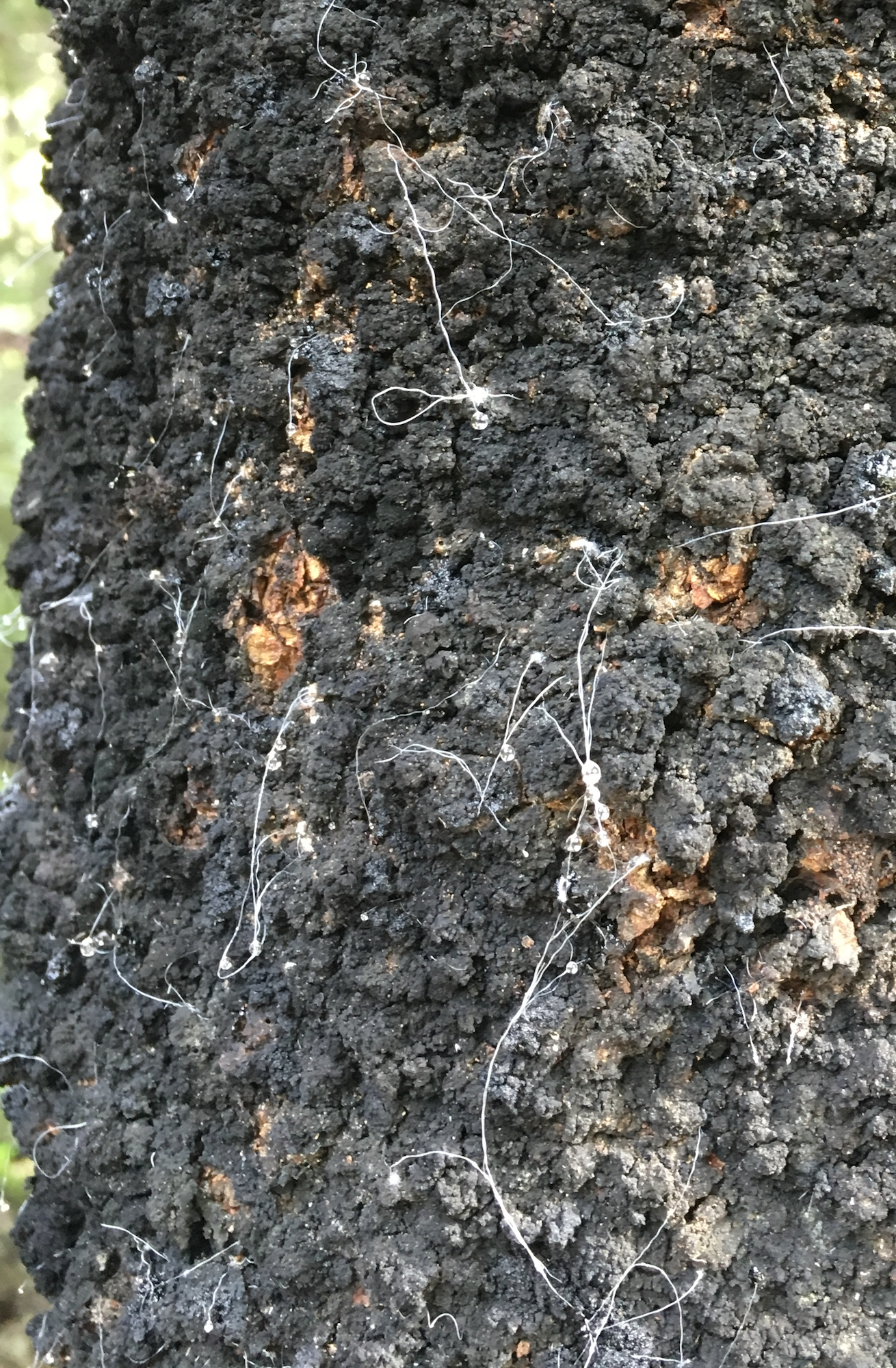
Throughout much of its range, beech is infested by scale insects. The scales live in the bark of the trees, feeding on sap. Because sap is low in nutrients and high in sugar, the insects need to excrete the extra sugar. Each insect has a long anal tube through which it ‘pees’ concentrated sugar water called honeydew.

Drops of honeydew form on the tips of the anal tubes and fall to the ground, tree, trunk, and branches around the insects. The entire area ends up coated in sticky sugar.

Sooty mould grows on the sugar coated surfaces, turning trees and forest floor black, and giving the beech forest a distinctive smell. The sooty mould is eaten by a variety of insects, including moths and beetles.

But not all of the honeydew simply drops to the ground. Native birds and insects (and hikers) drink the drops of water on the tips of the scales’ anal tubes. For wildlife, honeydew is an important winter food, when flower nectar is scarce.

German wasps enjoy honeydew, too, but only in the summer.

By mid-summer, the beech forest hums with the sound of millions of wasps collecting honeydew. For me—allergic to wasp stings—it means a hike requires constant vigilance lest I grab a tree trunk for balance and end up in anaphylactic shock. But in springtime, the wasps aren’t yet out and about, and I can enjoy the sticky smell of the beech ecosystem without worry.

Springtime Adventure–Mt. Oxford

I’ve been AWOL from the blog for a couple of days. I have a good excuse, though. Friday I raced from 5.30 am to 7 pm to do two days worth of work in one day. I managed to plant out all the peas, lettuce, and spinach, cleaned the house, baked cookies, did a bunch of writing and editing…

It was all in preparation for taking the entire day off yesterday to go for a hike.

We had a lovely day hiking to the top of Mt. Oxford. It was a long day, too, by any measure—7 1/2 hours of hiking, 31,700 steps (according to the phone’s health app), 20 km, and over 1 km elevation from carpark to peak.

Starting from a honey bee farm, the track climbs through beech forest and into subalpine tussock. Yesterday the hike had everything—snow, mud, sun and rain, wind. The lichens were especially exuberant, as was one particular rifleman (a tiny bird, for those of you unfamiliar with NZ fauna) who shot through the trees with such abandon, it smacked me in the face. It was the perfect springtime adventure.

Te Wiki o te Reo Māori

Aotearoa–land of the long white cloud

Tēnā koutou!

It’s Te Wiki o te Reo Māori—Māori Language Week.

My grasp of te reo is poor. I know a few phrases, a smattering of words, a couple of waiata (songs). But I’m always eager to pick up new vocabulary and phrases. I love languages. They speak to a culture’s values, and reveal some of its history.

I also enjoy finding the similarities between languages—phrases and sayings that reveal truths that transcend culture and geography.

For example, check out these Maori proverbs:

E mua kaikai, e muri kai huare.
Early arrivals have the pick, but late comers may only get spittle.
Doesn’t that remind you of ‘The early bird gets the worm’?

Waiho ma te tangata e mihi, kia tau ai.
It would be better to let others praise.
Sounds like ‘Don’t blow your own horn’ to me.

Mauri mahi, mauri ora; mauri noho, mauri mate.
Industry begets prosperity (security); idleness begets poverty (insecurity).
Bears a striking resemblance to ‘Early to bed, early to rise makes a man healthy, wealthy and wise’.

He manako te koura i kore ai.
Crayfish are scarce when they are expected.
To me, that says ‘Don’t count your chickens before they hatch’.

Have a great week everyone!

Haere rā!

Living With Earth

Coes Ford–open…just.

Nature is bigger than we are.

That’s been clear from world events the past few weeks—flooding in Indonesia, earthquake in Mexico, multiple hurricanes in the Atlantic.

We can pretend the natural world doesn’t affect us. We can do our best to engineer human structures and our daily lives so that, most of the time, we forget we are an integral part of Earth. But I think this is a terrible mistake.

On my way to and from town every day, I cross the Selwyn River. Normally, I do this at a spot called Coes Ford.

The Selwyn River floods. It’s simply part of the hydrology and ecology of the river. The low bridge over the Selwyn at Coes Ford acknowledges flooding. The bridge was never meant to allow passage over the river during a flood. It was meant to survive floods intact, and provide passage during low water.

The ford has been closed for several weeks, but reopened yesterday. The bridge itself is still underwater, but it’s passable.

To me, there is something right and good about an infrastructure that acknowledges the forces of nature and doesn’t try to control them. It is good for us to accept that, while we have great influence, we are not masters of the planet. At Coes Ford, we will be inconvenienced by floods. This is part of the natural order. It is part of what it means to live here. And if we are inconvenienced by floods, we will notice when the pattern of flooding changes. We will feel that something is amiss. Hopefully, we will do something about it. It’s not a coincidence that when the Selwyn stopped flooding and dried up last summer, the focus of the worry was at Coes Ford—that’s where the locals understand the river’s pulse the best.

If we are separated from the rhythms of the planet, we won’t notice when something is wrong, locally or globally. When we are separated from the rhythms of the planet, we may not notice problems with our life-support system until it is too late. Separated from, and ignorant of the rhythms of the planet, it’s easy to deny that there are any problems.

And so, I embrace the inconvenience of Coes Ford. I thank the engineers who chose to accept the Selwyn River for what it is. I hope that, as human technology advances, we continue to remember our interdependence on the natural systems of Earth. We must live with the earth, not on it.

Spur-winged Plovers

Almost every year, a pair of spur-winged plovers (Vanellus miles, known as the masked lapwing in Australia) establishes a territory in the goat paddock. A few days ago, I was taking food to the goats, and noted where the plovers were making a ruckus at the other end of the paddock.

This afternoon, I took a walk out there. The plovers were nowhere to be seen, and I was worried–they’re not always successful nesters here. There are simply too many predators around our property.

I nearly turned around, but I decided to take a look anyway.

I was rewarded with the perfect plover nest. Two eggs, a little dried grass, and some rocks.

The spur-winged plover self-introduced from Australia in 1932. Since then, its population has grown dramatically. No surprise when you consider it likes open habitat, and is quite happy to set up house in paddocks, parks, and road verges (we once had a pair nesting in the middle of an intersection nearby).

It has done so well since it arrived in New Zealand that its protections as a native bird were removed in 2010 due largely to the problems it was causing for aircraft (airports are lovely habitat for it). It is one of only two native birds to not be protected under the Wildlife Act (the other is the black backed gull).

I enjoy the plovers. I love their harsh night-time cry, and their indignant posturing while defending territory and nest. I love the fact they cheekily nest wherever they want and expect everyone else to stay out of their way.

I’ll be watching these eggs closely. Fluffy plover chicks are even more fun to see than plover eggs.

It’s Show Time!

We got the annual schedule for the Ellesmere A&P Show the other day. For those of you not familiar with the term, A&P means Agricultural and Pastoral–Farm Shows they’re called in the US.

I grew up enjoying the local Farm Shows, entering bad art projects into the competition, and admiring the rows of cattle on display. As an adult, I was lucky enough to live for several years mere blocks from the Minnesota State Fair–the Farm Show to end all Farm Shows. I even entered a quilt there–won second prize in a category in which I was the only entrant. A feat worthy of mention in the News from Lake Wobegon, if you ask me.

Farm Shows/A&P Shows are a defining cultural experience, but the truth is, you don’t even need to go to the show to have a cultural experience. Reading the show schedule is almost as good.

For example, in the little old Ellesmere show, there are 95 different sheep classes in which one could enter one’s woolly livestock. That doesn’t include the children’s pet classes or the wool classes. And then, of course, there are the shearing and sheep dog competitions. Sheep farming may be on the decline in New Zealand, but it’s still king in Ellesmere.

Dairy has boomed in recent years, and there are quite a large number of dairy classes in which aspiring farmers can enter their bovines. The lucky winners of many of the dairy classes will receive semen as their prize. Doesn’t that just make you want to enter?

Semen certainly beats the poor dairy goat farmers, who pay $5 to enter a goat, and can only hope for, at best, $5 for first prize.

If you’ve got a dairy animal, it might just win Best Udder (Judged both full and empty–I expect no saggy udders need apply). Now there’s something to aspire to.

One of my favourites is the calf fancy dress class. Nothing like a bunch of calves in tutus and tuxes to make you smile.

And I noticed a new category I never knew existed–Donkey Challenge, judged on ‘willingness, style and accuracy over four challenges’. Now, that’s a competition I may have to make sure I see this year.

But of course, like any rural event, the real excitement is simply the hustle and bustle on the day. The hot chips and mini-donuts, the carnival rides, running into neighbours and people you haven’t seen for months, and celebrating the importance of agriculture in our lives and culture.

Hedge Fortifications

Our usual route to town has been closed for the past couple of weeks, with the flooding of the Selwyn River. Instead of crossing at Coes Ford, we have to drive upstream and cross at the bridge on Leeston Road. It adds about five minutes to the daily commute, but it gives me an excuse to drive past one of my favourite hedges.

Hedges are important out here on the Canterbury Plains. Winds regularly hit 100 kph (62 mph). If the wind isn’t howling from the northwest bringing hot dry weather, it’s probably gusting from the south, carrying rain.

When we first moved into our house, I wasn’t happy about the tall hedge, no more than five metres from the south western wall, that blocks the view and the evening sun. Luckily, we moved in during winter, or we might have cut down the hedge before we fully understood why it was there. After the first screaming southerly storm, I knew that the only reason the house was habitable in winter was because of the hedge.

Hedges protect buildings, crops, and livestock, and most of them are meticulously maintained. The larger hedges are like fortifications, a dozen metres tall and two metres thick. They’re trimmed with strange-looking machines with huge, terrifying spinning blades.

One of my favourite hedges (the one I get to drive past when Coes Ford is closed) is the one in this picture. It is enormous, both in height and length, but I have never seen this hedge looking shaggy, as mine does when it’s in need of a trim. It is always trimmed like chiselled stone. And the marks of the great rotary trimmer blade leave a swirling pattern in the hedge that I find mesmerising. It is almost a work of art.

There are certainly more artistically trimmed hedges–I’ve seen a few clipped into undulating waves, or including graceful archways–but there’s something about this hedge that evokes stone castles. It is artistic in its clean lines and sheer bulk. It’s a hedge to aspire to.