Wool Sower Gall

Visiting America is always a rewarding experience from a naturalist’s point of view. Though New Zealand has some spectacular wildlife, it simply doesn’t have the sort of diversity one finds in North America.

This visit’s best find so far has been the wool sower gall.

This spectacular fuzzy ball, found on the twigs of white oak trees, is caused by the tiny wasp, Callirhytis seminator. The structure of the gall is reminiscent of a fluffy seed head of a plant. Small ‘seeds’ inside the fluffy exterior house wasp larvae.

Galls are fascinating structures. They are made by the plant in response to chemicals produced by an insect or mite. Galls are incredibly diverse in structure and location on the plant, but all provide food and protection to the insects or mites as they grow and develop. Essentially, the insect has hijacked the plant’s biology to create a perfect home with a built-in food source.

Gall-making evolved several times in different groups of insects and mites; it’s clearly a successful survival strategy.

But the plants aren’t entirely defenceless. In response to the gall insects, many plants produce chemicals that attract predators to eat the damaging insects.

In turn, some gall-inducing insects can turn off these chemical defences in their host plants. Host and insect are constantly evolving, each trying to get the better of the other. The galls are a spectacular result of their arms race.

Completing the Cycle

Back in early December last year, I posted an update on the preying mantids on my rosemary bushes that I’ve been following since mid-winter, when they were eggs.

Well, I haven’t forgotten them, and I’m pleased to report that they are all grown up now, and laying eggs of their own.

On the one hand, I’m thrilled (as I am every year) to watch the entire life cycle play out in the garden.

On the other hand, I’m getting a little worried.

Last winter, I didn’t prune the rosemary bushes because the bees depend on their flowers in late winter. Then in the spring I couldn’t prune them because the preying mantids hatched out. All summer I waited and watched the mantids grow. The rosemary plants grew, too, engulfing a bench on one side, and the path on the other.

And now the mantids are laying their eggs on the very branches I need to prune off…

We may soon see just how big rosemary can grow here.

Mushroom Season

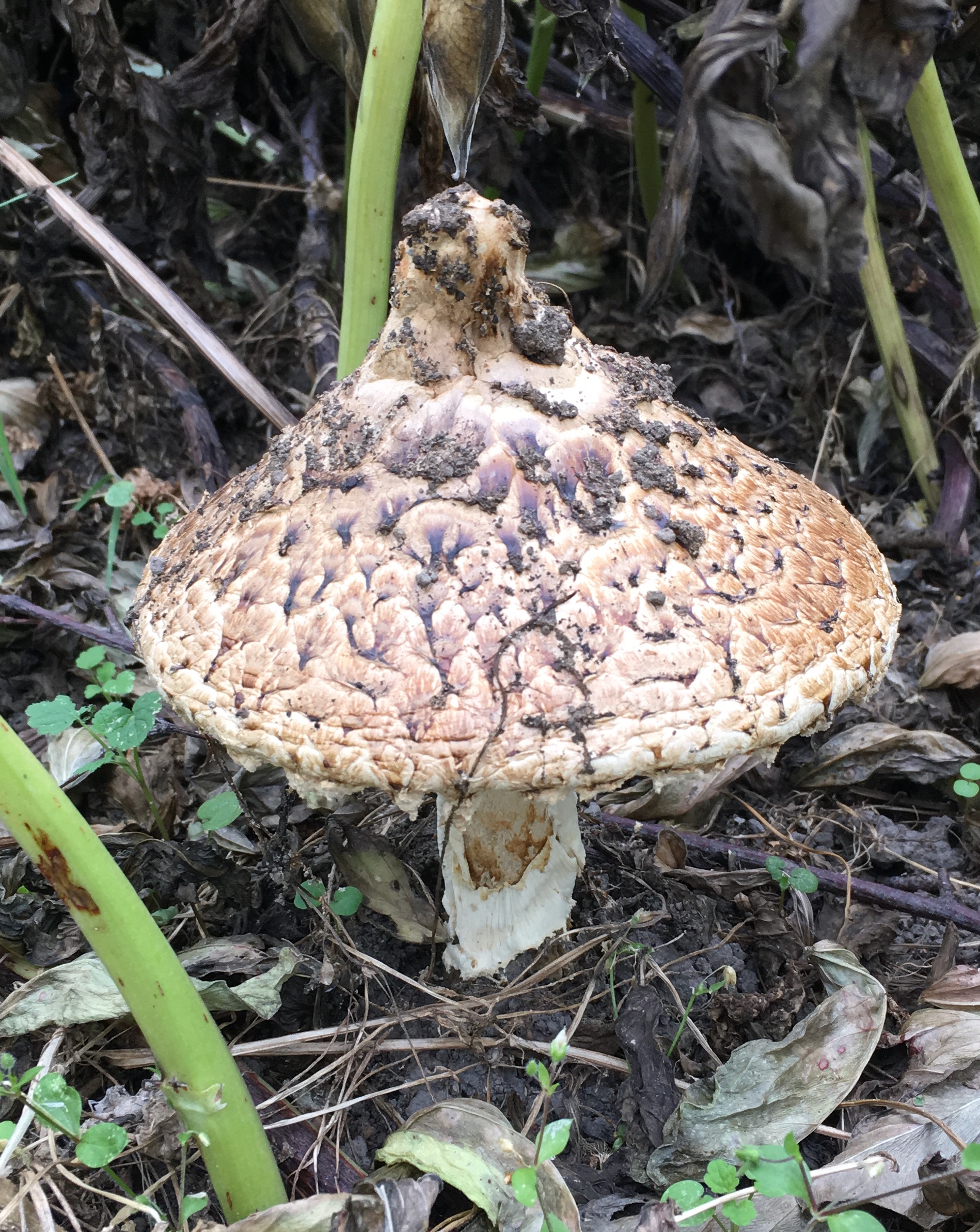
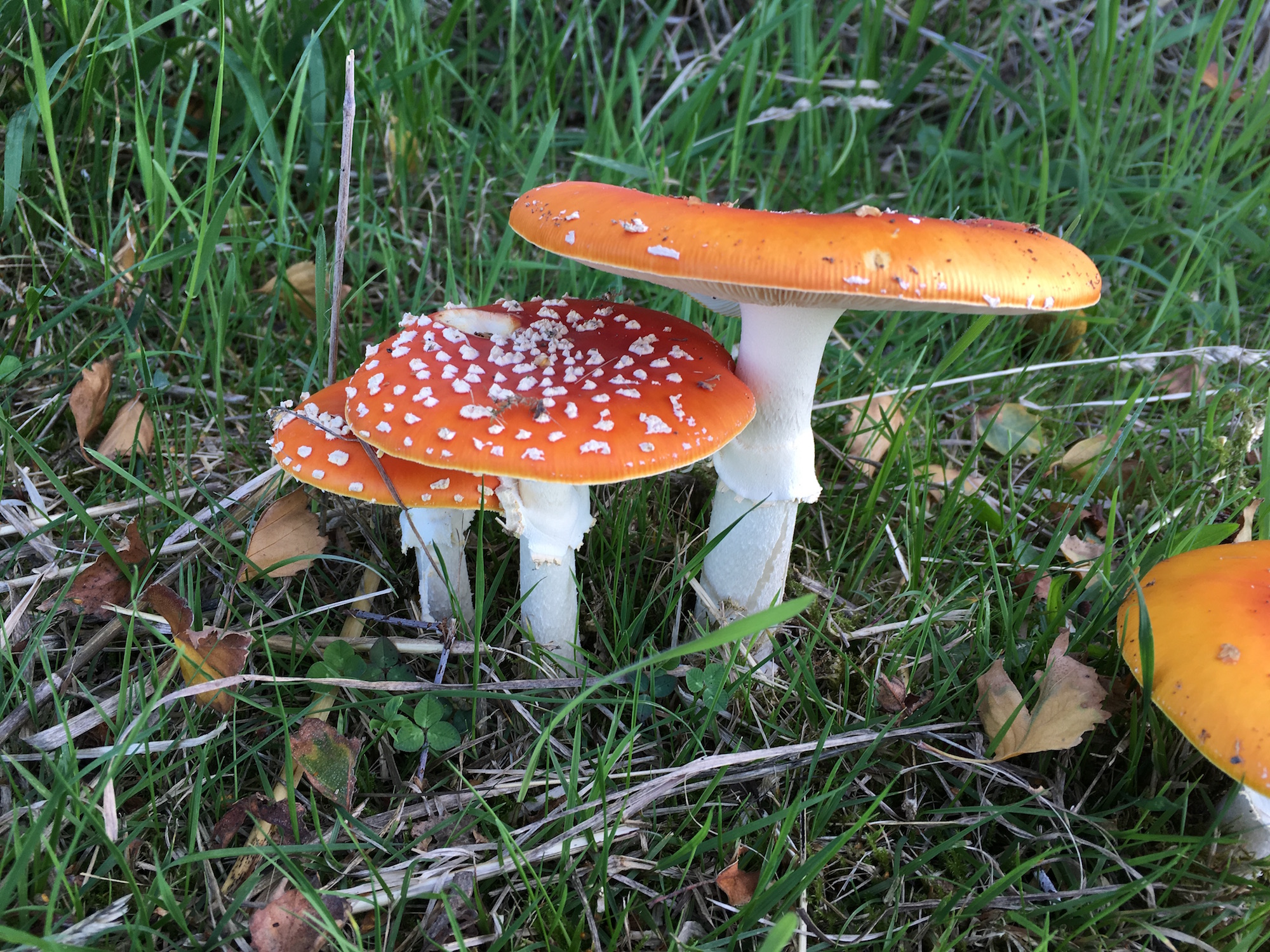
With the arrival of rain and cooler temperatures, the mushrooms have come out. Many fungi fruit in autumn, but this year seems particularly spectacular on our property. I can only guess that, after three years of drought, the fungi are taking advantage of weather that’s finally moist.

The most visually striking ones are naturally the Amanita muscaria–their bright red caps have reached epic sizes this year, and they’ve sprung up in profusion under the birch trees. They’re accompanied this year by three other species of mushroom with large brown caps (Paxillus involutus, Leccinum scabrum and a Russula).

Puffballs dot the lawn, and an assortment of smaller mushrooms have joined them.

The best find so far has been the presence of seven Noddy’s flycaps in the vegetable garden. I blogged about this mysterious fungus several months ago when the first sporocarp popped up. To find this many all at once is quite unusual.

There is another full week of rain in the forecast, and I’m looking forward to what new gems might spring up. There is also the exciting possibility of slime moulds in this weather.

So forgive me if I walk around with my eyes on the ground this week. I’d hate to miss the show.

Mysteries of the Pomegranate

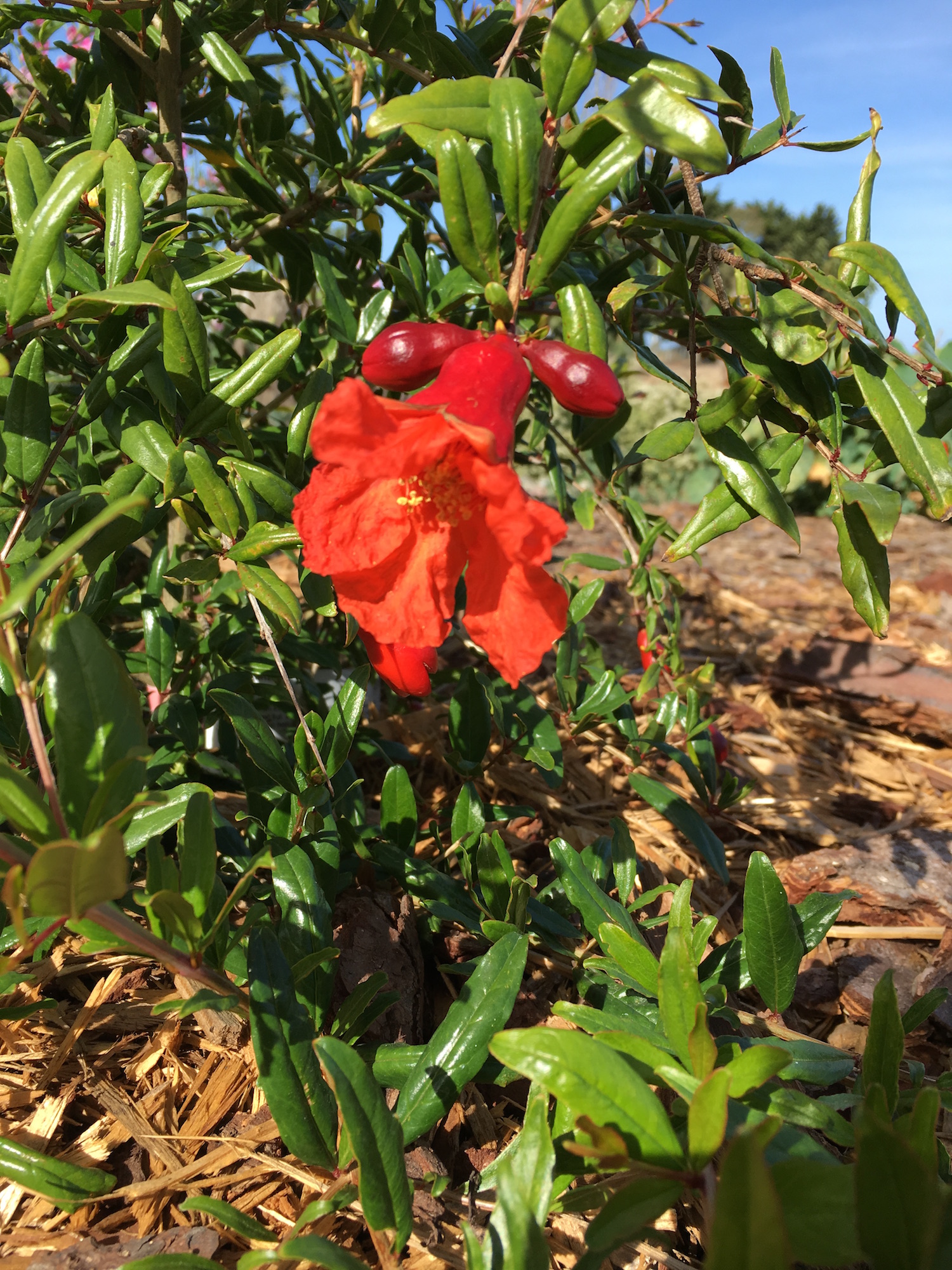
img_3242I know nothing about pomegranates. Sometimes my husband gives me one for Christmas, and I like them, especially in fruit salad. Beyond that, I’m completely ignorant.

So last year, when I saw a pomegranate tree for sale in a local nursery, I naturally bought it.

To be fair, I did do a little research first, just to make sure we had any chance of actually getting it to grow on our property. By the time I brought it home, I knew it had no less of a chance of surviving here than any other fruit tree (all of which prefer more water and less wind than they get here).

So we planted a pomegranate, and a couple of months later it lost all its leaves.

Are pomegranates deciduous, or is it dead? We didn’t even know this much. Turns out, yes, they are. Ours dutifully leafed out again in spring.

Once we knew it was alive, we promptly ignored it again, until a few weeks ago when we noticed little red bulbs on it.

Hey! Fruit! Though we had seen no flowers, we could easily have missed them. For all we knew, pomegranates had small, plain flowers.

Then today, one of those little red bulbs burst, unfurling this stunning big red bloom.

Wow! We had no idea. I’d grow this tree for the flowers alone. They have all the tropical exuberance of a hibiscus (but on a more cold-hardy plant).

I still have no idea when or if those flowers might become fruit (it seems the wrong time of year for any tree to be flowering) but, hey, we know a lot more about pomegranates than we did a year ago. Reason enough to grow something new.

Ecological Weeding

A parasitised aphid (the bloated brown one), and an unparasitised one (the green)

A parasitised aphid (the bloated brown one), and an unparasitised one (the green)

As much as I enjoy weeding, I can’t possibly keep up with them all. There are always weeds on the property.

In truth, I don’t try to eliminate all the weeds. I take a ‘live and let live’ approach with many of them. I also recognise the utility of many of the weeds on the property–or at least their utility to other organisms.

Except in the vegetable garden where they are, literally, a pain, I allow nettles to reside in the yard. They provide food for our native yellow admiral butterflies and, in a pinch, can be used to make rennet for cheese making. Even in the vegetable garden, I don’t mind seeing them–they hate dry soil, so they’re a good indicator that I’m watering the garden enough for the vegetables.

Weeds like yarrow, clover, and dandelions are good food sources for beneficial insects, so they, too, are allowed to grow wherever they’re not in direct competition with crops.

Weeds are also sometimes good ‘trap crops’, attracting pests to plants (themselves) I don’t mind pulling out and destroying to get rid of the pest.

Sometimes, though, the ‘trap crop’ idea backfires on me. Today I noticed that a sow thistle I’d allowed to grow was covered in aphids–it was a great opportunity to destroy thousands of pests. Except that as I bent to pull the weed, I noticed that a large number of the aphids were parasitised by wasps. I depend upon these wasps to deal with my springtime aphid problems. Short of painstakingly picking off every parasitised aphid and caring for them until the wasps hatch, killing the aphids on the weed is going to kill the wasps, too. What to do?

So the weed has gotten a temporary stay of execution. I’ll keep an eye on it. When the wasps have emerged from the parasitised aphids, I’ll pull it and kill the remaining aphids.

Thirsty Bees

img_3051When my husband created a pond in the yard, I expected the damselflies, mayflies, midges, diving beetles, and other aquatic insects to show up. I even expected the heron who occasionally drops by to sample the goldfish.

I didn’t necessarily expect the honey bees.

I wasn’t surprised when they showed up, though. What surprised me was the sheer numbers that have shown up this summer. The edge of the pond has been humming for weeks as hundreds of bees jostle for space on the best perches.

Honey bees, like all animals, need water–at least a litre a day per hive. The bees don’t just drink the water; they also use it to dissolve honey that has crystallised, dilute honey for larval food, and to cool the hive on hot days.

When scout bees find a good water source, they mark it with pheromones that tell the other bees it’s a good spot. I reckon by now, the edge of our pond is sticky with pheromones (or at least stinky with them), because there’s always a crowd there.

And after yesterday’s 31°C (88°F) temperatures and 130 kph (81 mph) wind, the pond was extra crowded today.

I’m happy to oblige the bees. I need them to pollinate my vegetables, and they’re not aggressive when they’re foraging away from the hive, in spite of the potentially frightening crowds. The arrangement is a win-win situation for all of us.

Nīkau Palm Gully

img_3044-smWe spent the weekend on the Banks Peninsula. Saturday we kayaked around Akaroa Harbour all day, and today we hiked out to Nīkau Palm Gully.

The track out to NÄ«kau Palm Gully is easy walking, as it follows a farm track. It’s pleasant, but not exactly wilderness. The views out over Akaroa Harbour, however, are spectacular. And at the end of the track is the steep drop down into NÄ«kau Palm Gully.

The gully is a tiny V of land, hemmed in by cliffs, and sporting one of the few remaining remnants of original Banks Peninsula forest.

Most notable among the trees are the palms which give the valley its name. The nÄ«kau palm is the southernmost palm in the world, and New Zealand’s only native palm. It is found in coastal lowland areas, and the Banks Peninsula is as far south as it ranges on this coast. There are nÄ«kau scattered around the Peninsula, but the population of them in NÄ«kau Palm Gully is impressive.

Nīkau palms are slow-growing. They begin as clusters of leaves growing on the forest floor. It may take forty to fifty years before they begin to form a trunk, and up to two hundred years to reach their maximum height of 10-15 metres. There are individuals of all sizes in Nīkau Palm Gully.

People have been visiting the gully for many years. One tree still bears the mark of a visitor who carved the year–1907–onto its trunk. A pair of amusing (to a reader over 100 years later) letters in the Akaroa Mail in 1909 indicate that the gully was, even then, considered a special place. In the first article, a member of the Beautifying Association writes a scathing indictment of the Akaroa Boating Club for having cut down several palms in the gully to use as decoration for an event. In a subsequent issue of the Akaroa Mail, a member of the Boating Club explains that they only removed a few leaves, not whole trees. The letter writer then goes on to accuse the Beautifying Association of removing entire plants (seedlings) from the gully for their gardens.

Thankfully, the landowners whose farm once encompassed the gully understood its significance, and gifted it to the Department of Conservation (in exchange for one 10-cent stamp presented to them on behalf of Her Majesty the Queen). It is now protected as a scenic reserve, and has been linked to other patches of native vegetation through a number of land covenants on adjacent properties.


Noddy’s Flycap

img_2955-cropI was working in the garden this morning, and came across this stunning mushroom in the middle of the broad beans.

My first reaction was, “Oh, my! Fairies must have visited the garden.” I wondered if nature was trying to tell me I needed a little whimsy among the vegetables. I began to consider the possibilities. A few fanciful carvings on my trellises? Gargoyles atop the fence posts?

My next reaction was, “I’ve got to show this to my husband.” (He researches mycorrhizal fungi, and this looked to me a bit like an Amanita, which are usually mycorrhizal). He saw it, and said, “Oh!…Oh!…that’s a…no, wait…I won’t say anything until I’m sure…this could be important.”

He did some research and confirmed the mushroom as Noddy’s flycap–Amanita sp. 2–an unusual fungus recorded only from New Zealand, but thought to be introduced, as it is generally found among non-native vegetation. It has never been recorded this far south, and we’ve never seen it on our property before.

Geoff Ridley has written a nice blog post about this fungus and its odd distribution and mysterious origin.

And so, perhaps nature was, instead, telling me to keep my eyes open for scientific wonders, even in my own back yard.

And then, I learned that Noddy’s flycap is named for the Enid Blyton character, Noddy (and his pointy hat).

And at this point, the symbolism of this strange fungus in my garden got really weird. A whimsical-looking fungus of unknown origin, and not known to be present here, named after a character in a middle grade novel?

The message was loud and clear–this fungus has to show up in my next book. Excuse me while I go scribble down some ideas…

Insects in the Classroom

insectsintheclassroomcoverI’m pleased to announce the release of Insects in the Classroom!

This collection of insect information and activities is the only one of its kind written specifically for the New Zealand classroom. Special features include:

  • Background information about insects and their relatives
  • Instructions on how to care for live insects in the classroom
  • A dozen buggy classroom activities
  • Student-friendly identification guides designed for the New Zealand school yard
  • Insect-themed colouring sheets and worksheets

The book is released in conjunction with a new outreach programme for schools–Bugs and Books–that uses science as the inspiration for writing.


Get Outside—See Cool Stuff

The swarm--apologies for the image quality; I'm allergic to bee stings.

The swarm–apologies for the image quality; I’m allergic to bee stings.

I’m trying to make myself go out for a walk at lunchtime every day. I’ll admit that I can be a bit of a slave driver when I’m working, and I don’t always manage it. I have a tendency to simply work through lunch, and then suddenly discover it’s late afternoon.

In truth, the walks available to me from my front door aren’t necessarily all that inspiring—endless agricultural fields in every direction.

But you can’t experience anything if you don’t first go out. Yesterday, I took the most boring of the boring walks from my house—the one that doesn’t offer so much as a mailbox for the first kilometre. Don’t ask why I chose that way—maybe I wanted to clear my mind, as I’d been doing intense editing all morning.

On this most boring of walks, I happened to see something awesome—a honey bee swarm.

We are blessed with many nearby apiaries, and I always have a plentiful supply of bees to pollinate my garden vegetables, but even so, it’s unusual to spot a swarm. This one was hanging in a drooping mass off the neighbour’s fence.

Bees swarm to create a new colony. It’s usually the old queen who leaves her hive with a large portion of the workers. A new queen will hatch in her absence and take over the old hive.

The swarming bees leave the hive and gather nearby while scout bees search for a new hive location. This is what I saw—the resting swarm. It likely flew away to a new home within a few hours. Where those bees are now, I don’t know, but I hope they found a nice place nearby from which to visit my garden.

So, my most boring walk was amazing. That reminds me, I still haven’t gotten out for a walk today. Time to step away from the desk and get outside. Who knows what I might see?