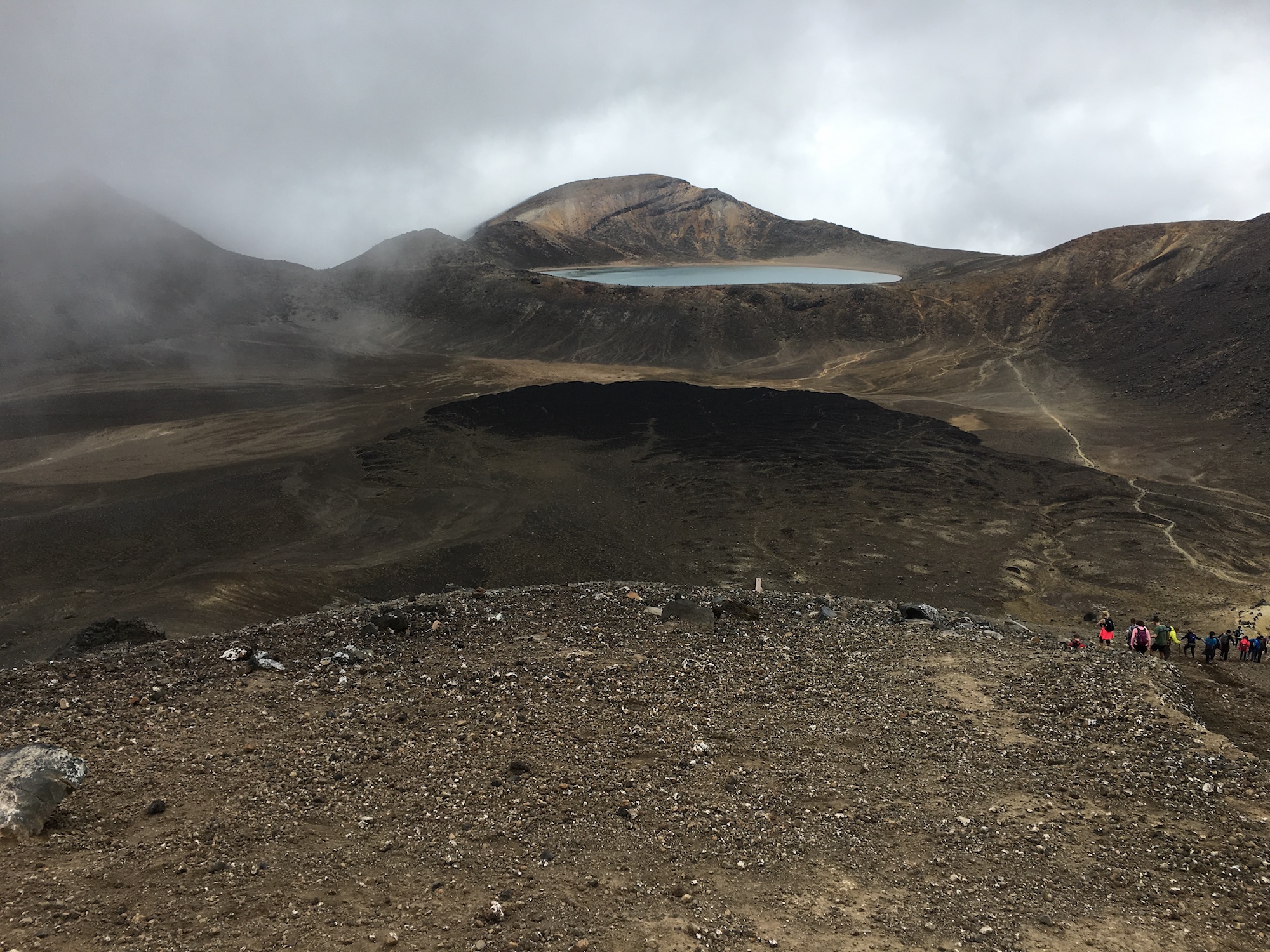
Volcanoes in the Mist

Our pre-Christmas family adventure this year took the form of a week on the North Island. One of the many things we did was to hike the Tongariro Crossing. The track climbs the slopes of Mt. Tongariro passes between Tongariro and Mt. Ngauruhoe. The volcanoes are active–the last eruption was in 1975, and they have a history of erupting about every nine years before that–so the landscape near the top is stark and raw, with sulphurous steam rising from fissures and craters, tumbled rock, and dark lava flows.

The area is tapu, sacred, to the local Māori, and it’s no surprise. Power and violence are written on the landscape, the lush lower slopes of the mountain only accentuating the devastation near the top. The awesome forces that shape the face of the planet are on display there. It is a place for gods to live.

Unfortunately, it has also become an incredibly popular tourist destination. The day we hiked it, there was a constant stream of shuttle buses arriving at the start of the track. We spent the day hiking on others’ heels, with hikers on our own heels. When we stopped for lunch, we counted sixty-eight people pass us in just 15 minutes. A quick back-of-the-envelope calculation, and we estimated that there were 1600 people on the track at the time.

It seemed to me that most of the people were treating the excursion as nothing but a physical challenge–a race to be completed or 19.4 km to tick off their to-do list. A large group of twenty-somethings all but pushed us off the track in their effort to pass us as they chatted loudly to one another, oblivious to the beauty around them. A group of teens playing loud music sauntered past. A man sat beside a crater lake doing a business deal on his cell phone.

I wanted to stop, to soak in the alien landscape, to feel the immense power of lava beneath my feet, to examine the crusted sulphur on the rocks and the tenacious plant life that colonised the harsh landscape. But like sheep being herded onto a truck, we were pushed along the narrow track by the people behind us. Fifteen seconds, thirty seconds was all we could snatch at a time to appreciate the landscape.

Like our favourite beach, the Tongariro Crossing has been diminished by its popularity. The gods are still there, in the steam and the lava, the raw craters blasted in the earth, but no one is paying attention.
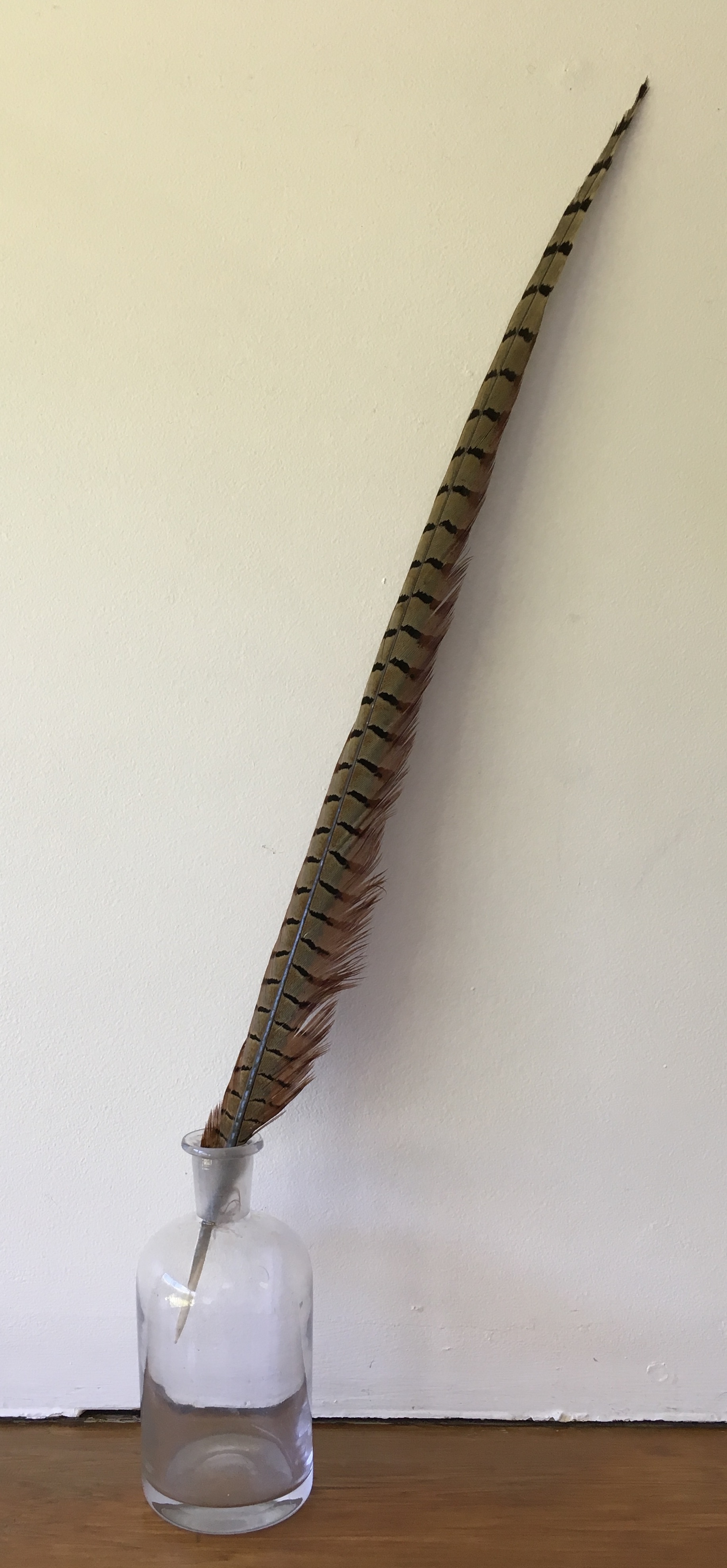
Pheasants: Honorary Natives

We’ve had a lot of pheasants around the house this spring. The common pheasant (Phasianus colchicus), also known as the ring-necked pheasant. Is a curious bird…or rather, our relationship to it is curious.

The common pheasant is native to Asia, but has a long history in Europe. It was probably introduced by the Romans, and the first printed mention of the bird in Britain was in 1059.

Who knows what ecological impacts the pheasant had in Britain? I doubt anyone paid attention at the time. By the time people began to worry about conservation, in the early 1800s, it was the pheasant they worried about, as its numbers declined with land-use changes and the introduction of firearms for hunting.

The pheasant was first introduced to North America in the 1770s, and has naturalised in many areas. As in Europe, it has become a popular game animal and is the focus of conservation efforts, in spite of its non-native status.

Many years ago, I applied for a job with a ‘conservation’ organisation in Minnesota. Though I was ultimately offered the job, I turned it down, because its sole focus was on the maintenance of pheasant populations for sport hunting. I struggled to view that as conservation in a place where pheasant habitat was incompatible with habitat for threatened native animals, and where maintaining a pheasant population required captive breeding, because winters are simply too harsh for it to survive, even with appropriate habitat.

Even in Hawaii and New Zealand, where introduced species are almost universally considered pests, the pheasant is fussed over and cared for as a native—bred in captivity and released to keep its numbers up for the benefit of sport hunting.

A search for information on the ecological impact of pheasants is curious. Many sources presuming to address the ecology of pheasants deal only with the threats to pheasants themselves, not pheasants’ impact on the native ecology around them. It is as if even researchers have turned a blind eye to the fact pheasants are non-native over most of their current range. In truth, their impact is undoubtably small compared with non-native predators like stoats, cats, and rats. They tend to prefer disturbed, agricultural habitats (though they have been recorded as competing with native prairie birds in North America) and feed primarily on cultivated foods, weeds, and insects.

Yes, they feed primarily on crops. They’re crop pests. They particularly like grains and small fruit crops, and can cause significant losses in grape vineyards and in small holdings.

So, why do we embrace the pheasant so unreservedly? Let’s face it, most of us don’t eat pheasant, so we get no benefit from the bird. But it seems its long historical association with people and the agricultural landscape have made it almost a domesticated species. And, as we put up with the chickens occasionally wreaking havoc in the garden, so we put up with the pheasants, too.

Summer Rock Concert

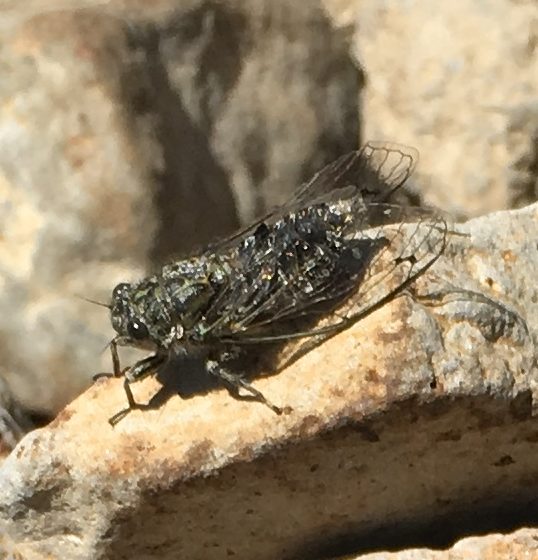
It’s a cicada; it must be summer.

The main cicada season doesn’t really start until the chorus cicadas (Amphisalta zealandica) come out after Christmas, but two weeks ago, we found a few chirping cicadas (Amphisalta strepitans) on the rocks around Okains Bay.

Cicadas are largish, as insects go, but they’re well camouflaged. Usually, you find them by sound. As with most insects, it’s the males that do the singing. The main part of a cicada’s song is made by flexing plates (tymbals) on top of the body. Built-in amplifiers (opercula) pump up the volume to an astonishing level. Cicadas are noisy. I don’t know if any of the New Zealand species have been tested, but the calls of some North American cicadas are over 105 decibels at a distance of 50 cm. That’s nearly as loud as a rock concert (115 decibels). When the chorus cicadas here in New Zealand come out in large numbers, they can be so loud in some places that it’s impossible to carry on a conversation.

Some New Zealand cicadas add an extra feature to their song—a bit of drumming called clapping. The cicada snaps the leading edge of its wings against a branch to make a sharp click. Females also clap, and I’ve read (though I’ve never tried it) that you can call the males to you by snapping your fingers.

There are about 2500 species of cicada worldwide. Because of their size and volume, they seem to be culturally important wherever they live. They are eaten as food in many areas, and sometimes used as fish bait. Growing up, my siblings and I used to collect the shed exoskeletons of cicadas and attach them to our clothing like jewellery. When I lived in Panama, the children would catch cicadas and tie strings to their feet, then carry them like helium balloons, flying on the end of the string.

Wherever they live, they mark the seasons. Here in New Zealand, and in America where I grew up, summer hasn’t really started until the cicadas sing.

Loud singing? Drumming? Must be a summer rock concert!

Subterranean clover

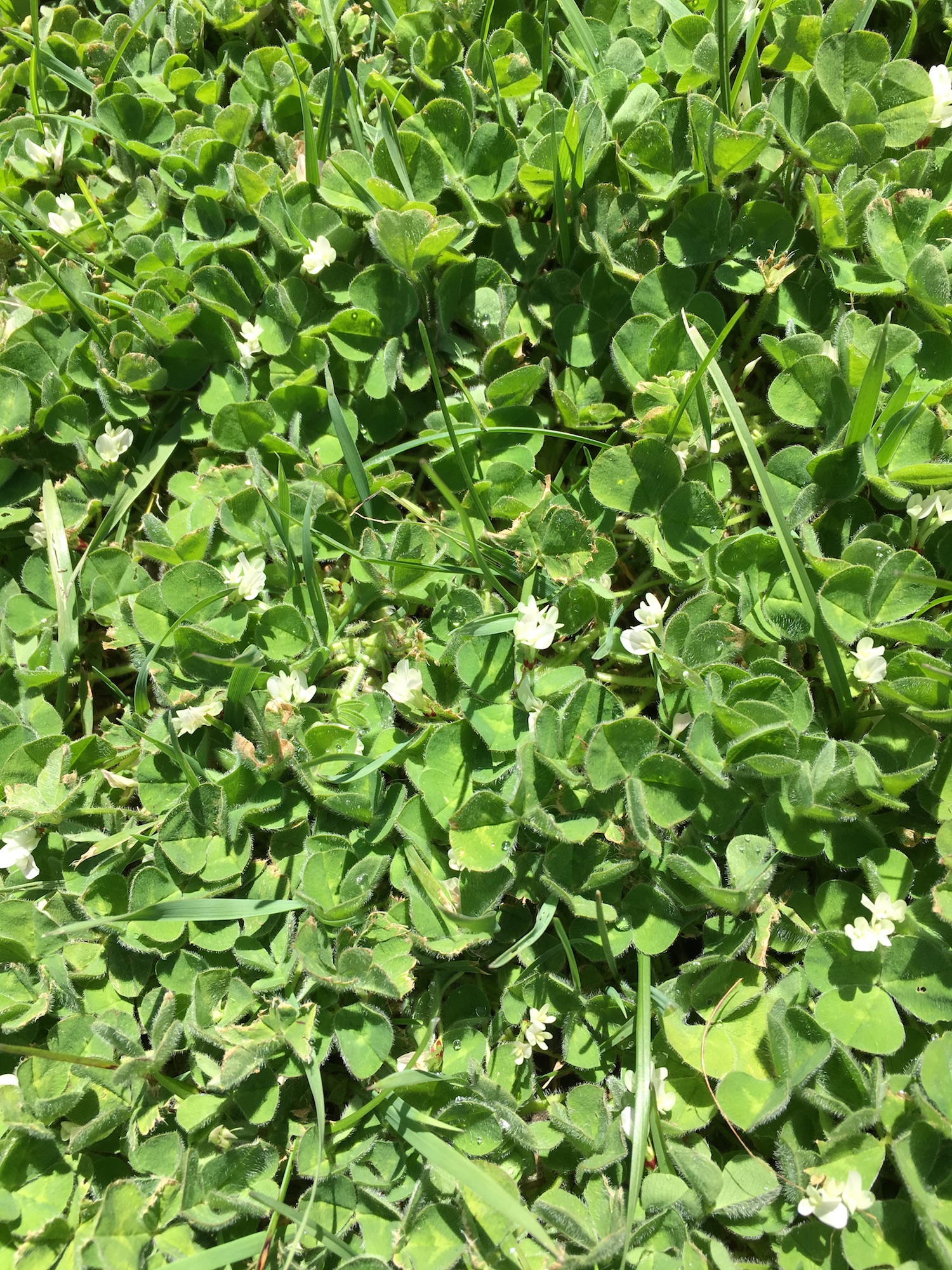
Subterranean clover (Trifolium subterraneum), like other clovers throughout the world, is an important pasture species. And it’s also a weed.

I’ve grown quite fond of ‘sub-clover’ as it’s often called. It’s much smaller than red or white clover, and the flowers form in clusters of only 2-5 in each head (as opposed to the large clusters that make up each ‘flower’ of other clovers). It also has the interesting habit of turning its flower heads downward after germination, so that the seed pods develop underground (hence, its name).

What I like most about subterranean clover is the thick mat of low-growing greenery it can produce, even in the dry rock where the old driveway used to be. Without it, some areas of the lawn would be bare year-round.

I also like the fact clover is a nitrogen-fixing plant. The clover in the old driveway is improving the soil for other plants as it grows and dies. With its help, grass might some day thrive there (though I’m not holding my breath).

Unfortunately, sub-clover dies. Dramatically. Just when we’re desperate for green. It’s a winter annual, meaning it sprouts with the autumn rain, grows through winter and spring, and flowers in early summer. When summer turns hot and dry, the plant dies, its life cycle complete. The lawn outside my office is composed almost entirely of sub-clover, so when it goes, it’s grim.

The only consolation is that the grass dies shortly after the sub-clover. Summer is simply brown here.

So for now I’m enjoying the lush greenery underfoot. It’s wonderful while it lasts.

Wasp 1: Cleaning 0

I try to keep a clean and tidy house, but sometimes it’s just not possible.

I was going to dust this weekend, but the first spot I ‘dusted’ was the dining room windowsill. It’s a big window and, for some reason, most of the insects that get into the house seem to end up there when they die.

Next thing I knew, I had a handful of dead insects in a petri dish and was looking at them through the microscope. Most were insects I was familiar with—old friends I was catching up with—but this lovely lady was new. A tiny parasitic wasp, but I couldn’t quite place her family. Several hours, a couple of taxonomic keys, and a stack of entomology books later, I still wasn’t certain, but I tentatively put her in the family Pteromalidae.

Oh, and the cleaning was entirely forgotten.

Spittlebugs

Spring is spittlebug season. Just about the time I want to start picking and dehydrating the perennial herbs, the spittlebugs descend upon them. In bad years, it makes harvesting herbs a slimy task.

Spittlebugs are also known as frog hoppers. As adults, they are cute, squat, dun coloured insects with spectacular leaping abilities. They really do resemble frogs (with a little imagination).

It’s the nymphs that have the disgusting habit of spitting. Well, it’s actually not spit at all. The foamy slimy ‘spittle’ is a combination of fluid from the insect’s anus, and slimy gunk from glands on the insect’s abdomen. The insect sits head downward on the stem of a plant and exudes the ‘spittle’, letting it pour over its body and cover it completely. The resulting mass keeps the young insect protected from enemies and from drying wind and sun. Gross, but effective.

Like humans, who usually stop blowing bubbles in their milk as adults, spittlebugs leave off spittle production when they grow up. As adults, they use their hopping ability to avoid predators.

Some species of spittlebug can become significant agricultural pests, stunting the growth of herbaceous plants and some forestry trees, but in the home garden, they’re usually not much more than a minor nuisance.

A New Weed!

I found a new weed in the garden the other day. I don’t know whether to be excited or dismayed.

This one is beaked parsley, also known as bur chervil (Anthriscus caucalis). This weed is native to Eurasia, where it appears it is pretty much ignored. It’s listed by the UK Department for Environment, Food, and Rural Affairs as an indicator species for high value arable margins, but beyond that, it rates little mention in its homeland. It is apparently neither particularly tasty, nor poisonous. It is apparently not used for any medicinal purposes. It’s just a plant that’s neither particularly common, nor particularly rare.

Nor is it mentioned often in the many countries where it is a weed. If it is mentioned at all, it’s usually lumped with its close relative, wild chervil (Anthriscus sylvestris), which appears to be more of a problem. It apparently prefers riparian zones, but is quite happy to live in drier areas, too.

The seeds are covered in curved spines and hairs that cling to fur. The plant almost certainly arrived in New Zealand on the back of an imported sheep.

With so little information about the plant available, I am naturally intrigued. What secrets is this unassuming plant harbouring? Its family–Apiacea–includes such well-known plants as carrot, poison hemlock, fennel, parsley, coriander, dill, caraway, parsnip, celery, anise, lovage, and many others. Many of these plants produce defensive compounds, some of which are incredibly toxic to humans, and some of which are sequestered by caterpillars in the genus Papilio (swallowtail butterflies) for defence.

So I can’t help thinking that bur chervil might harbour some interesting chemistry and ecological connections, if only someone would have a look.


Spring Weeds–Dock

Springtime is weed season, and there are plenty in my garden–57 species at last count.

I grumble about weeds, but I also find them fascinating. Weeds are the opportunists, the survivors, the tough and persistent plants of the world. Some have been spread accidentally, through virtue of their mobile, sticky, or tough seeds, but many more have been introduced on purpose. They are plants we once considered useful, and it is our changing values that make them weeds today.

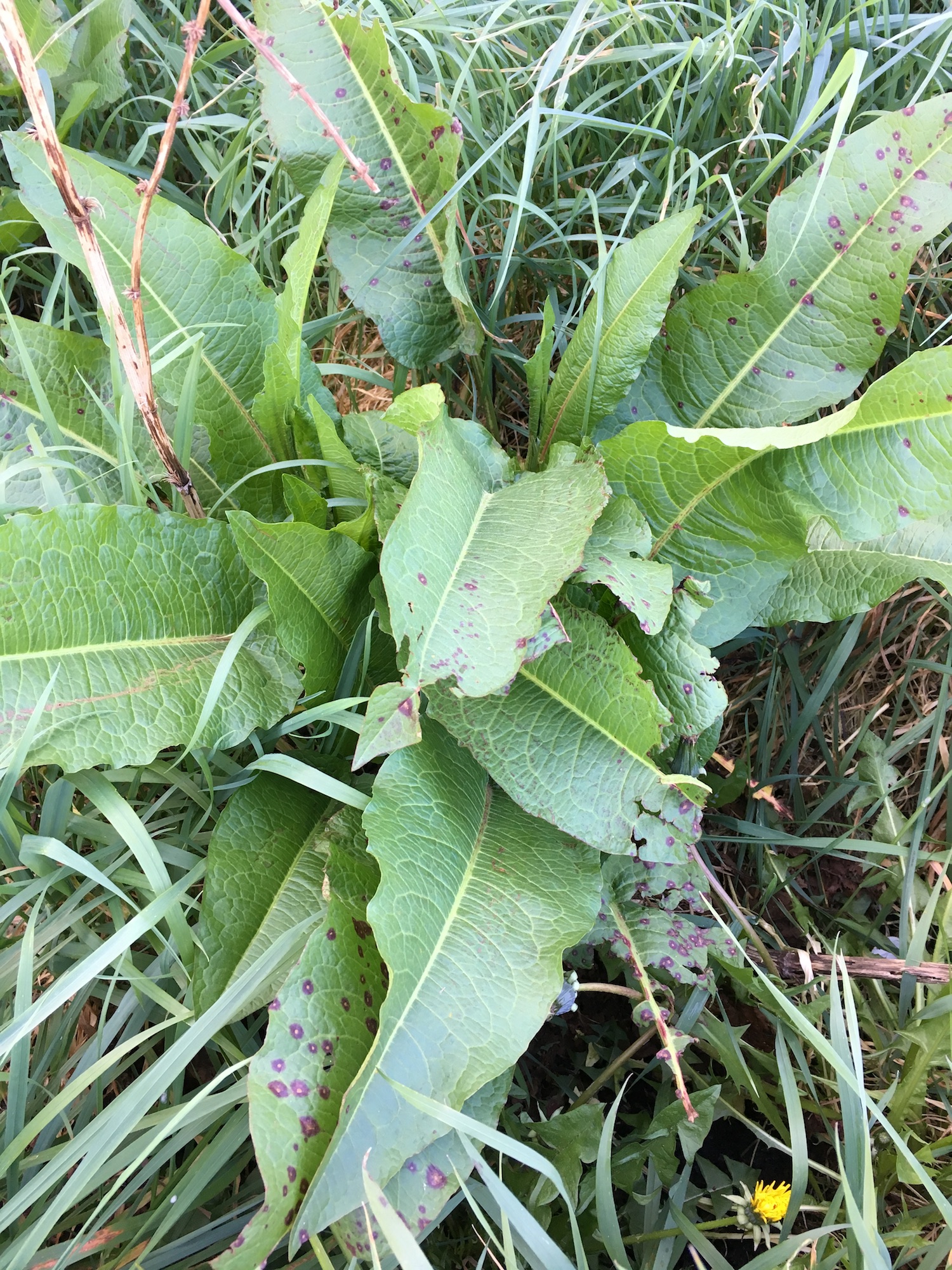
So I’ll be introducing some of my weeds over the next few weeks as they sprout and flower and generally annoy me. We’ll start today with a weed I love to hate–broad-leaved dock (Rumex obtusifolius).

Dock isn’t my worst weed. Not by a long shot. But it is persistent. Deep, branching taproots make it a struggle to pull out, and with each plant able to produce up to 60,000 seeds a year which can remain viable in the soil for up to 50 years, there is an unending supply of new plants. Still, dock struggles to compete with established plants, so it’s mostly a weed of disturbed soil.

The goats absolutely love it, so I can’t complain there. Dock is high in magnesium, phosphate, and potassium, and the tannins in the leaves can help prevent bloat in ruminants. Any dock I pull out of the garden goes directly to the goats.

It is likely dock was brought to New Zealand (from its native Europe) on purpose in the mid-1800s. Though the leaves are high in oxalates, which can irritate the stomach and bind to calcium, potentially leading to calcium deficiency, the plant was regularly eaten like spinach. It was also used to treat a variety of ailments, from coughs to cancer.

Dock often grows side by side with stinging nettle and, like many nettle associates, it can supposedly cure nettle stings. I’ve used dock for this purpose, and can attest that it seems to help, but then so does just about any fresh leaf rubbed on nettle stings.

I wouldn’t want to fight dock on a large scale–it scoffs at most herbicides, easily survives mowing, and can resprout from pieces of root left in the soil after ploughing–but for me, it’s a manageable weed that even has some utility.


Skink-scaping

Our property sits in the middle of an agricultural landscape. Not the quaint, woodsy sort of agricultural landscape favoured by jigsaw puzzle makers, but the scorched-earth type of agricultural landscape, where every square metre of land is ploughed, planted, sprayed, and sucked for all it’s worth. Not the sort of landscape that welcomes wildlife, particularly not native wildlife.

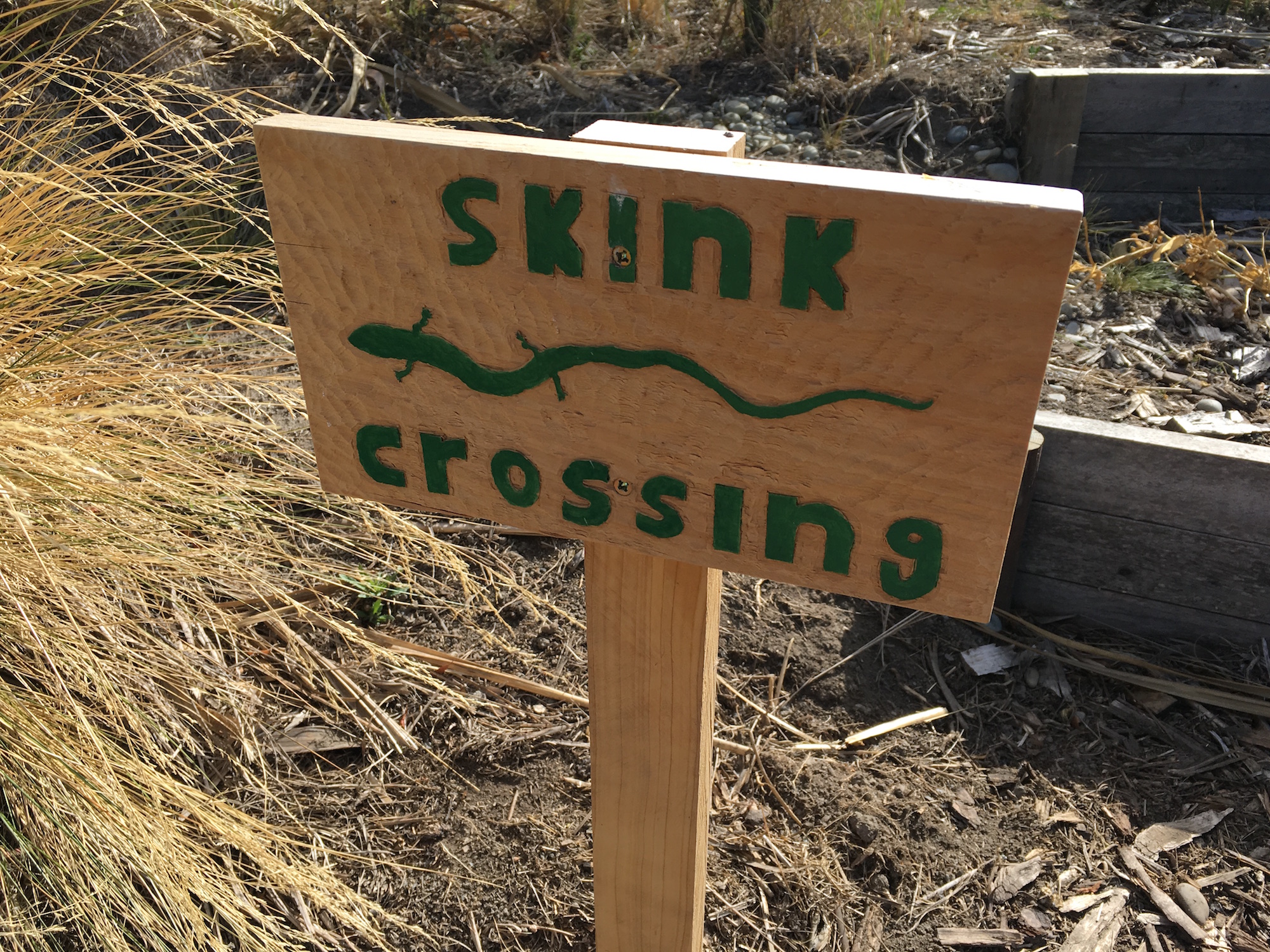
In spite of that, our property is home to native skinks (the common skink, Oligosoma nigriplantare). They stalk the vegetable garden and sun themselves on rocks in the flower garden. They rustle among the native grasses and slip into garden hoses left lying on the ground. I don’t know why we have so many skinks, but I aim to keep them here.

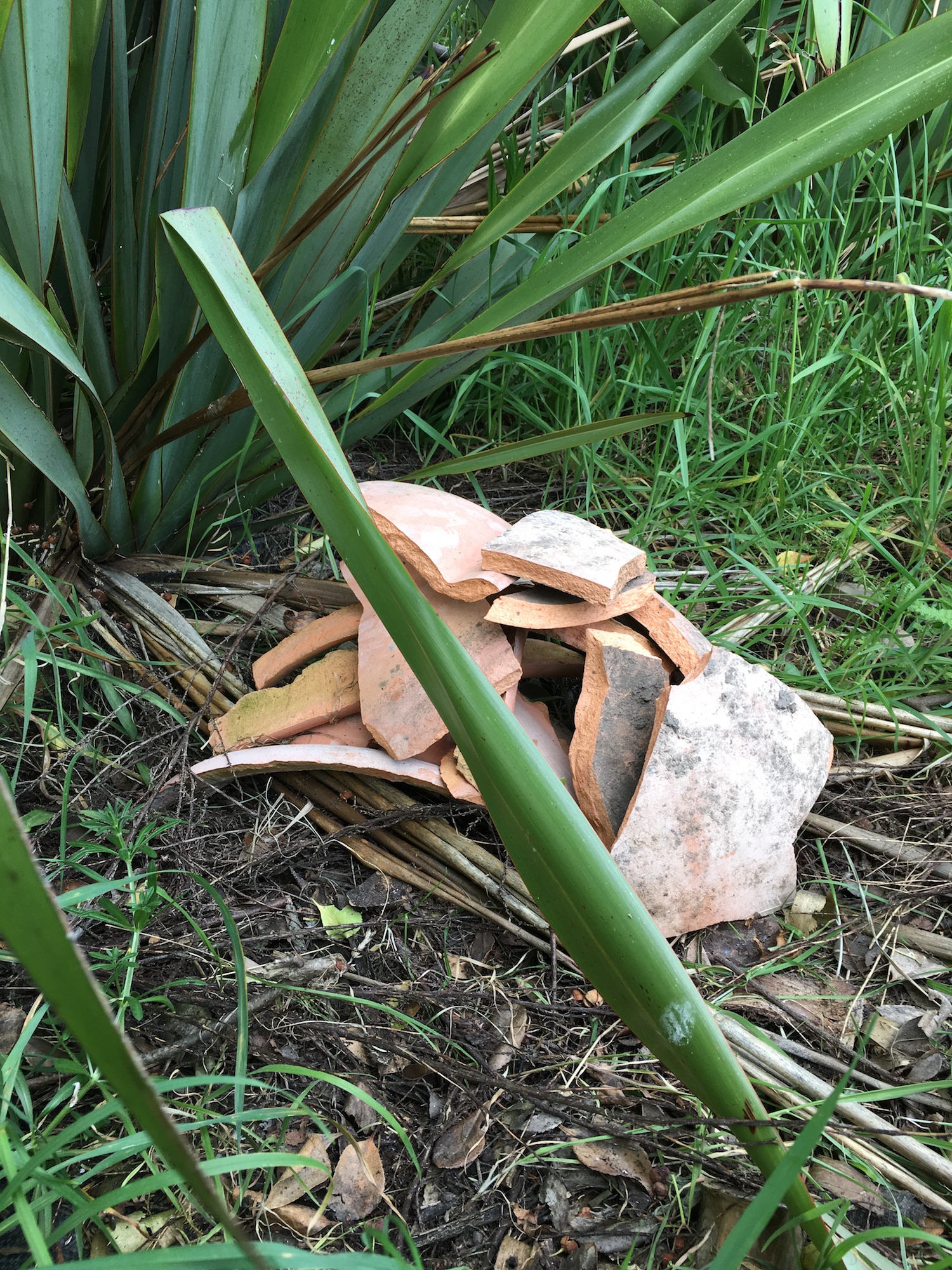
Habitat loss and predators are the main threats to skinks in New Zealand (though the common skink is not threatened, as many of our other lizards are). Skinks are preyed upon by cats, rats and stoats, all of which are plentiful around our place. We can’t eliminate all the predators, but we can provide plenty of hiding spots for the skinks. Dense native grasses, rocks, and even broken flower pots all provide shelter for skinks. The rocks and flower pots also make nice sunning spots.

Skinks eat mostly insects and spiders, along with the occasional fruit or seed snack. Our live-and-let-live attitude toward insect pests means there are plenty of arthropods for our skinks to eat. We’ve also planted a range of native plants to ensure there are berries available much of the year. (I also suspect the skinks of snapping up the currants that drop to the ground and taking the odd bite of my strawberries, but I’m happy to share.)

The end result is a healthy population of skinks on the property—welcome wildlife that makes me smile every time I see one basking outside my office window or rustling through the lettuces.