You say Iris, I say Orris

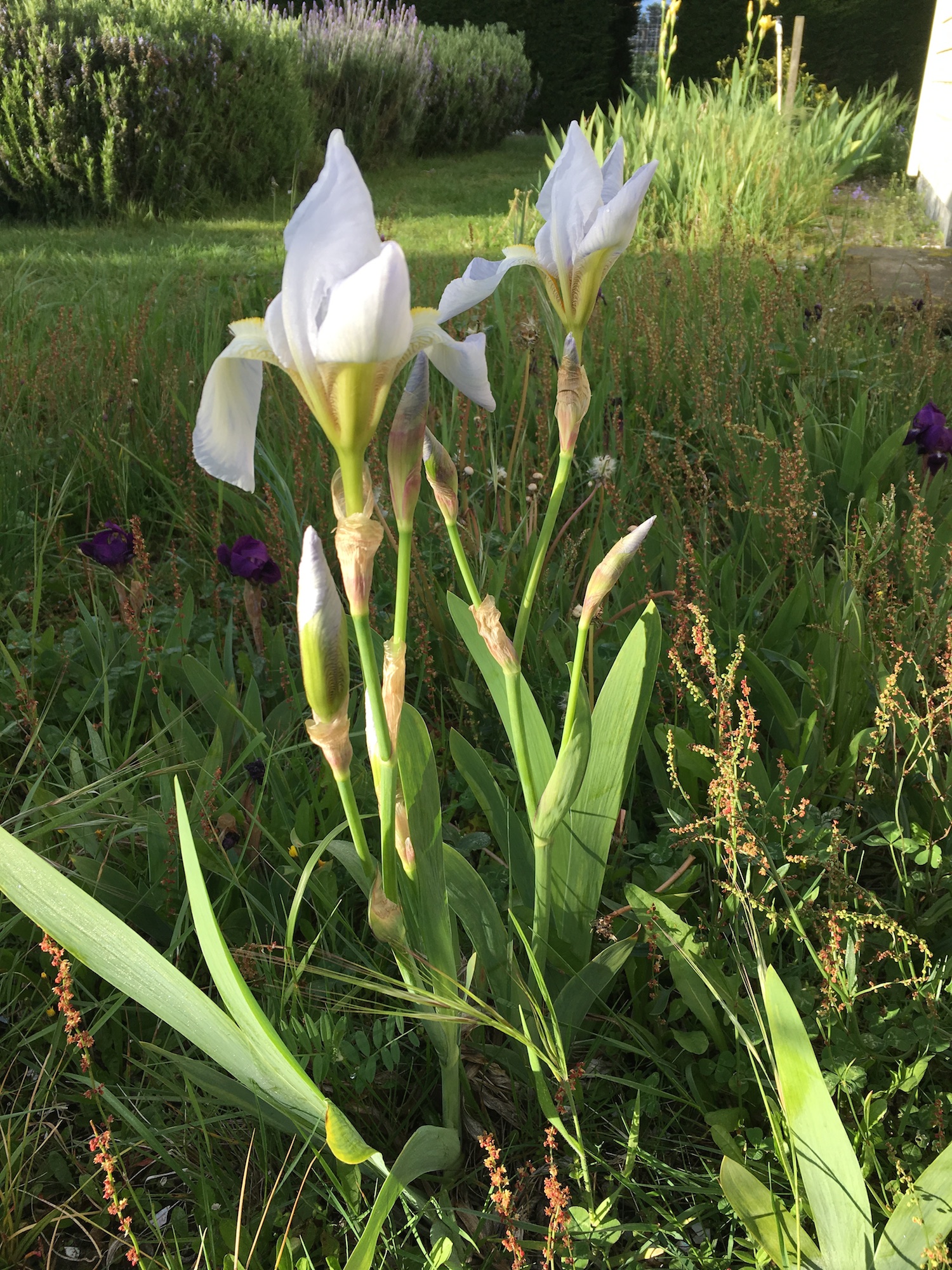
2016-10-28-07-33-39-smWhen we first planted our herb garden, nearly ten years ago, we planted a ‘knot’ of rosemary and lavender. In all the spaces inside the knot, we planted other herbs—a wide range of thymes, oregano, salad burnet, chives, etc. This iris was one of them (though we’ve since rescued it from being smothered in the knot). It is not a herb we ever intended to use—we just thought it was interesting. It is Iris pallida—the iris that is the source of orris root.

Orris root used to be used medicinally, but today its main attraction is its smell. It is used in perfume and potpourri, and in a Moroccan spice mix called Ras el harout.

I love the word orris, because it’s so clearly a case of dialect confusion. Say ‘iris’ with your teeth clenched, and you’ll get ‘orris’.

I can just imagine how it happened…the doctor calls on a patient in a remote village. He examines the man, and asks the family, “What have you done for him so far?”

“We’ve given ‘im a bit of iris root.”

“What? Orris root?”

“Yep, iris.”

“What is orris? I’ve never heard of it.”

“It’s this plant, blue flower, grows down by the creek. I’m sure ye’ve seen it before.”

“Hm.” The doctor scribbles orris root into his notebook, and forever after iris root is known as orris root.


Midnight Flowers

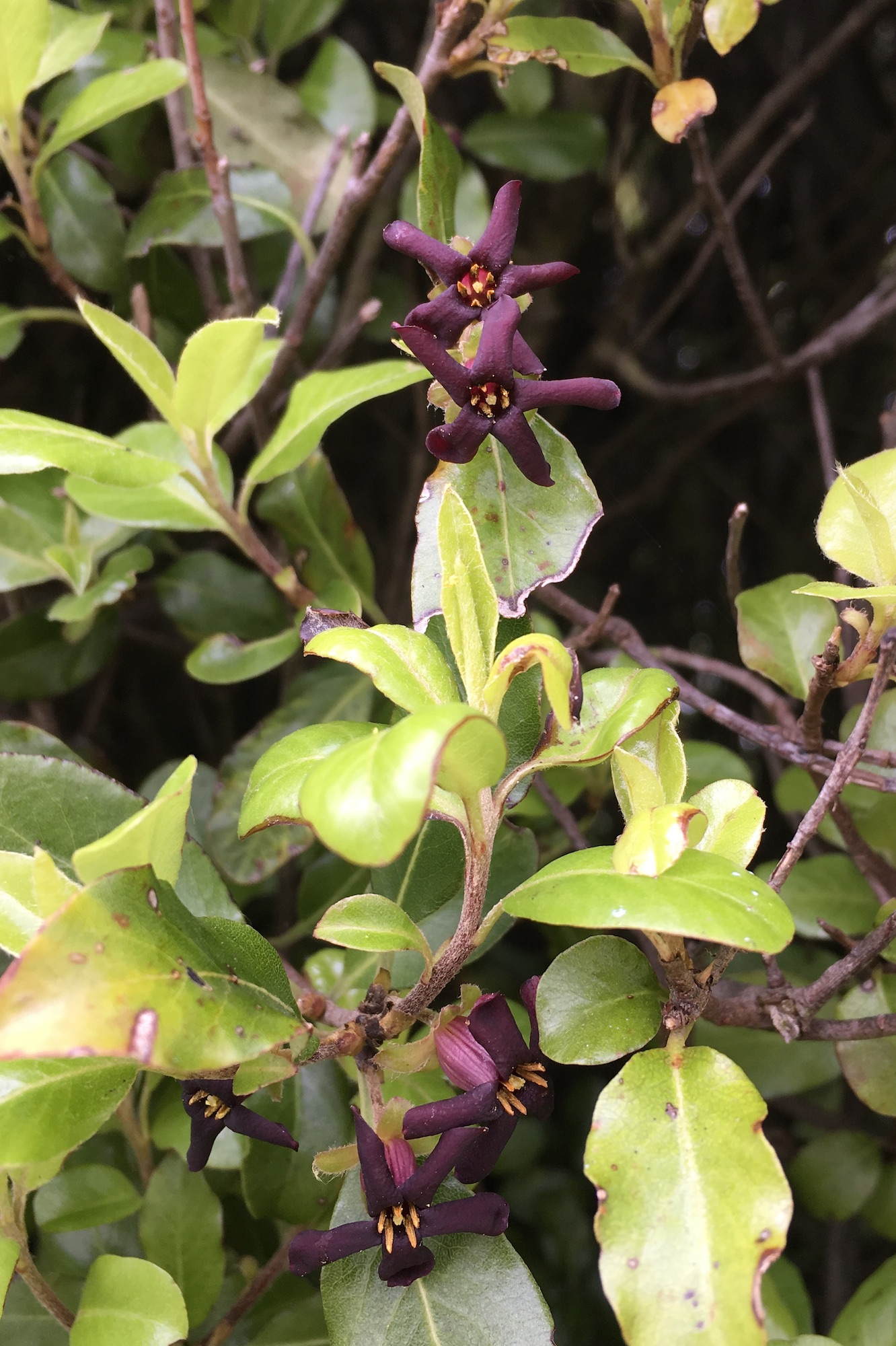
2016-10-26-15-51-31We have several pittosporums around the house, mostly Pittosporum tenuifolium, also known as kohuhu. Kohuhu are nice hedging plants, and form lovely dense shrubs when pruned. They’re a great background plant—like mood music—a lot of nice greenery, but little character.

Until they bloom, that is.

And only at night.

Pittosporum flowers are the kind of blooms that you can walk past a hundred times a day and never see. They’re about the same colour as the branches, and sit nestled among the greenery. They attract no bees or butterflies.

But walk past the same bush in the dark, and you’re practically knocked over by the smell. Heavy and clinging, the smell must attract all the night-flying moths and beetles for miles around.

I’m generally not a fan of smelly flowers, but there’s something marvellously incongruous about pittosporum flowers—so inconspicuous during the day, so in-your-face at night. The smell has become as sign of spring for me, and I always make sure my early-morning chores take me close to one of the bushes at this time of year.


At the Penguin Spa

2016-10-11-14-40-35-cropIt was a week of endangered species for me. After being bitten by a kea on Monday, I was lucky enough on Tuesday to have a chance to see a Fiordland crested penguin / tawaki at Haast School, where I’d spent the morning teaching.

After lunch that day, a trio of Department of Conservation rangers arrived with a juvenile female tawaki that had been rescued off a nearby beach where she had been found emaciated. She was being nursed back to health in preparation for re-release, and the rangers took the opportunity to share her with the local school.

Tawaki are not quite as rare as kea, but they’re shy and tend not to frequent tourist areas like the kea do. This was the first one I had ever seen. There are about 2500 to 3000 breeding pairs remaining, and they’re one of only three penguin species that nest on mainland New Zealand.

Like many of our native birds, they are threatened by stoats, which eat eggs and chicks, and dogs, which can wipe out entire breeding colonies.

The children at Haast School named this particular penguin Ellen, and they had great fun watching Ellen take a warm saltwater bath. The water needed to be warm because Ellen wasn’t preening and waterproofing her feathers properly (because she was too weak to do so). Without waterproof feathers, she got waterlogged in the bath, rather than staying nice and dry as penguins usually do underwater. After her bath, the DOC ranger wrapped her in a fluffy pink towel to dry off, and put a hot water bottle underneath her.

A full spa experience, I would say.

It wasn’t quite the same as seeing a tawaki in the wild would have been, but it was closer than I’m ever likely to get to one of these birds in the wild.

Ellen will spend about four weeks eating and taking spa baths before she’s ready to fend for herself again. I wish her luck.

Going bananas

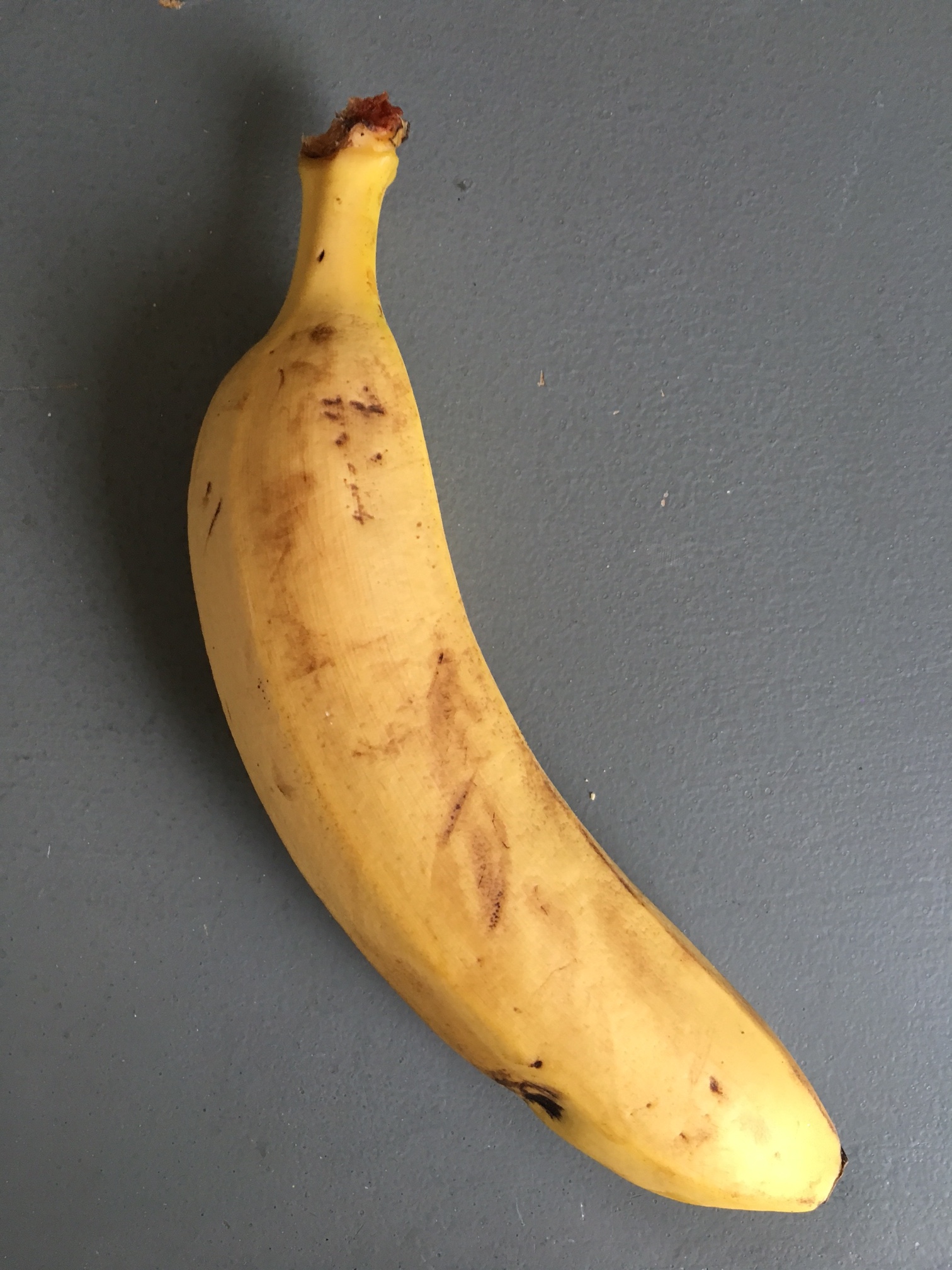
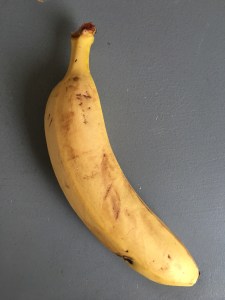
bananaOver 100 billion bananas are eaten globally every year, making bananas the fourth most important food crop in the world. Most bananas are consumed locally—only 15% are exported. Almost all the bananas grown for export are a variety known as Cavendish. New Zealand is said to have the highest per-capita consumption of Cavendish bananas in the world, at 18 kg per person per year.

The Cavendish was named for the Duke and Duchess of Devonshire—whose family name was Cavendish. Their head gardener imported a plant from Mauritius in 1830 and grew it in the family’s hothouse. The banana flourished and provided the duke’s guests with fresh bananas to eat. The Cavendish banana grew so well, the duke was able to supply two cases of plants to a missionary in Samoa. Those bananas were the start of the banana industry in Samoa.

Missionaries spread the Cavendish throughout the Pacific, but it wasn’t until the 1950s that the variety became popular commercially.

Until the 1950s, the most important banana for export was the Gros Michel, but in that decade, it was almost wiped out by a fungus known as Panama disease.

The Cavendish—smaller and not as flavourful as the Gros Michel—was immune, so growers switched largely to the Cavendish.

Almost all commercially grown bananas today are Cavendishes—clones of the plant grown by the Duke and Duchess of Devonshire.

Panama disease didn’t sit idly, though. By 1992, a strain evolved in Southeast Asia that was able to attack the Cavendish. And since the plants are all genetically identical, they are all susceptible to the new strain of the disease. At least 10,000 hectares of Cavendish bananas have been destroyed, and more will certainly fall as the fungus spreads.

For many of the nations that export bananas, it will be an economic disaster. For those of us who enjoy bananas…who knows?

There will likely be a time in which bananas become more expensive, even hard to find in our grocery stores.

But having lived in Panama, I know there are many banana varieties (about 1000, worldwide). And every single one I’ve eaten is better than the Cavendish. The Cavendish’s main selling point is its ability to survive transport, not its flavour.

In our village in Panama, everyone grew bananas. They came in many sizes, shapes, and colours. Some were more starchy, some were sweeter. Some tasted so much like banana, they seemed almost fake. Others tasted like a fruit salad, with tangy citrus overtones to the banana flavour.

I have to believe that as growers develop a replacement for the Cavendish, they will naturally end up with something more flavourful than the bland Cavendish. If we’re really lucky, they’ll develop more than one variety, providing greater insurance against the future evolution of Panama disease and more variety in our supermarkets. That has to be a good thing in the long run.

Want to know more? Visit the Panama Disease website.
Cicada Killers

IMG_1470How can you not love an insect called a cicada killer?

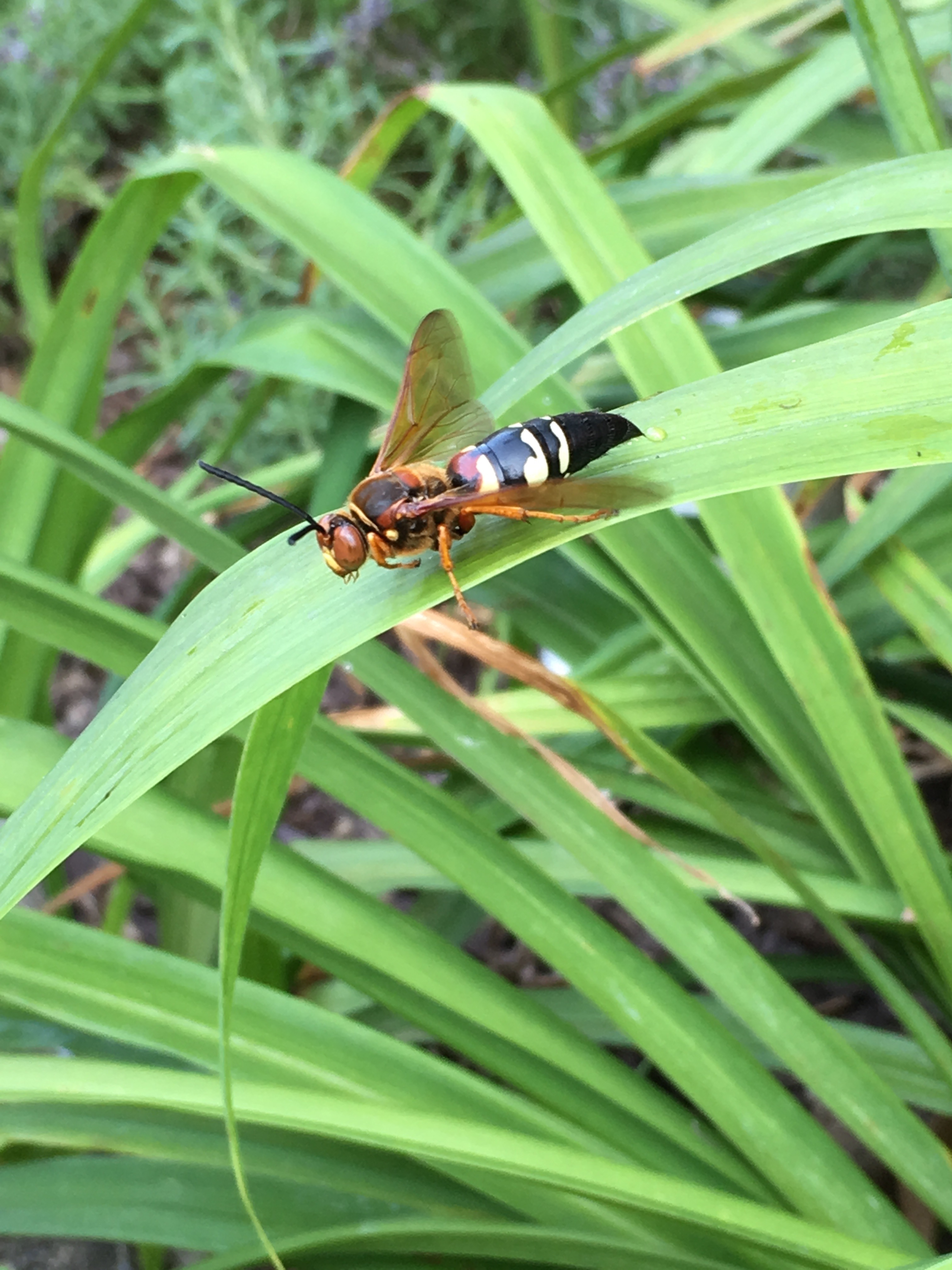
The eastern cicada killer (Sphecius speciosus) is a solitary burrowing wasp. One of the largest wasps in eastern North America, the females top out at about 5 cm (2 inches) in length. These beautiful, large wasps are harmless to humans, but deadly to cicadas.

The female catches and stings adult cicadas. The sting paralyses, but doesn’t kill the cicada. The wasp then takes her immobilized prey to her underground burrow where she lays eggs on them. Male eggs get one cicada each, and female eggs get two or three cicadas (because females are bigger and need more food to reach adulthood). The eggs hatch out, and the wasp larvae eat the cicadas.

Cicada killers, looking a lot like giant hornets, strike fear into most people’s hearts. Their behaviour can be frightening, too. Males defend territories from other males, and can be seen fighting one another, grappling in midair. But males have no stinger, so they’re completely harmless to humans. Female cicada killers can theoretically sting, but unlike the social wasps, they don’t sting to defend their nests. You’re only likely to be stung by a cicada killer if you pick it up and squeeze it.

The cicada killer in this photo is a male. His territory is in my mother’s garden, and he is reliably found on a particular plant in the morning sun, sallying forth to challenge other males who get too close.

Like Those Lichens

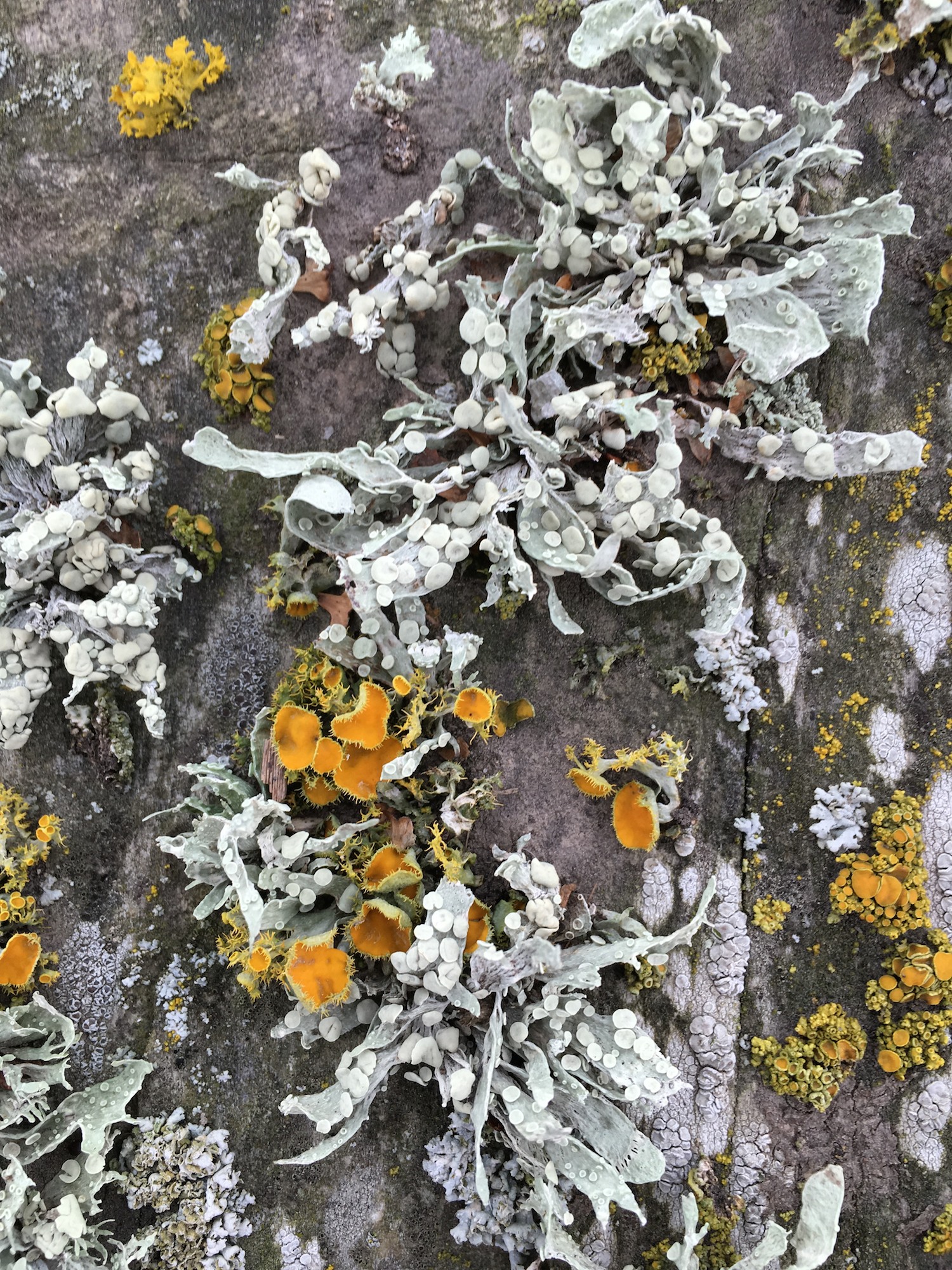
2016-07-04 10.32.44 smLichens are one of those groups of organisms that defies categorisation. A lichen is a symbiosis between a fungus and either a green alga or cyanobacteria. As such, they are neither strictly fungus, nor plant, nor bacteria.

Nor are all lichens the same. The relationships between fungi and their photosynthesising partners did not all evolve from a common ancestor, so each relationship is unique. In all cases, the fungus has the upper hand—capturing and enveloping its algal partner, and drawing carbohydrates from it. In some relationships, the fungus is only mildly parasitic, and in others it better resembles a disease on the alga.

The algae, however, do reap some benefit from the relationship. The fungal hyphae protect the alga from excess sunlight and keep it moist, allowing it to thrive in places it would otherwise be unable to survive.

Then there are the lichens that are parasitic on other lichens, stealing their algae, and those that begin as a lichen, but then become independently living fungi—there seems no upper limit on the complexity of lichen relationships.

Separate a lichen into its component organisms, and each will take on a form quite different from their joint lichen form–the lichen is more than the sum of its parts.

Together, lichens can colonise some of the most inhospitable places on the planet—bare rock, polar regions, mountain peaks, intertidal zones, and even the backs of living insects.

They certainly like to colonise my yard—benches, tree trunks, my office deck, even the roofs of house and shed are home to lichens. Many of the lichens in our yard are leaflike or shrubby in form, which is a good indication that our air quality is high. Shrubby and leaflike lichens don’t like air pollution, and tend to vanish in more industrial areas.

Biology and ecology aside, lichens are simply beautiful, with their intricate shapes and sometimes vivid colours. There’s a lot to like about lichens.

Be a Plantain

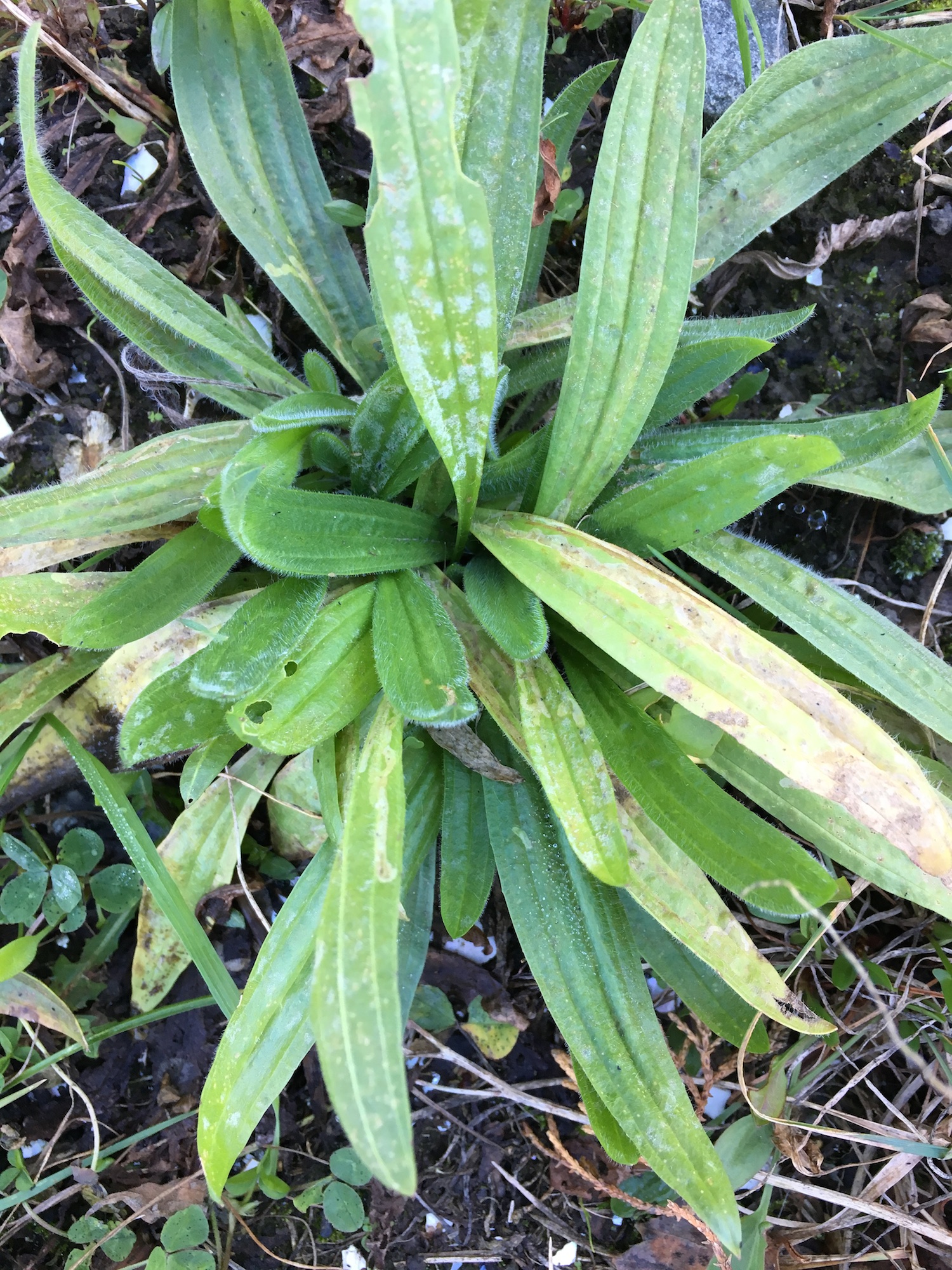
2016-06-29 14.01.15 smWeeds are survivors—that’s part of what makes them weeds—and none more so than the lowly plantain. This plant, carried throughout the world by European colonists for its medicinal uses, thrives in even the most inhospitable places.

It is common along roadsides and paths, in lawns, and even in the tiniest of cracks in pavement. It withstands trampling and mowing, and can resprout from pieces of root left in the soil.

It was known by the Anglo-Saxons as waybread or waybroad, for its habit of colonising roadsides, and it was revered for its tenacity.

And thou, Waybroad,
Mother of Worts,
Open from eastward,
Mighty within;
Over thee carts creaked,
Over thee Queens rode,
Over thee brides bridalled,
Over thee bulls breathed,
All these thou withstoodest
Venom and vile things
And all the loathly ones,
That through the land rove.

Anglo-Saxon poem about plantain, as reproduced in A City Herbal, by Maida Silverman.

As a gardener, I should despise plantain’s tenacity, it’s ability to invade and overtake my garden. Instead, I side with the Anglo-Saxons—I admire it. I might even say I aspire to be as tenacious myself.

Be tough. Be strong. Thrive in spite of the tramplings of life (or the bridalling of brides). Be a plantain.

My Love/Hate Relationship with Yarrow

2016-06-24 13.33.30Growing up, yarrow was a flower to be dried for arrangements. An innocuous plant that grew along the roadsides. I liked the flowers, and I loved the insects and spiders it attracted.

It wasn’t until I moved to New Zealand, where yarrow is a pernicious weed in my garden, that I began to consider yarrow more closely and learn more about it.

Yarrow is native to Europe and parts of Asia, but has been spread widely, because of its many uses.

It is referenced in Homer’s Iliad as being used for stanching wounds, and has been used all over the world for many other medicinal purposes—from reducing fevers and soothing earaches, to curing urinary problems and head colds.

Yarrow was probably originally brought to New Zealand as a medicinal plant, but it has other uses that are more valid than the medicinal ones.

Today yarrow is a common pasture plant. Its deep rhizomes make it drought resistant, and it is higher in certain key nutrients than either ryegrass or white clover. I discovered this when I began to worry about the goat paddock. After two dry summers, the yarrow was taking over a big swath of the paddock. I worried, knowing that to remove that much yarrow would be a Sisyphean task—dig it out and any bits of rhizome left in the soil will simply resprout. Even herbicides are largely ineffective against yarrow.

So I was thrilled to learn that its virtues went beyond pretty dried flowers, and that I could ignore it in the paddock.

Of course, it grows everywhere, and isn’t bothered by mowing. But that has benefits, too. This past summer, when all the grass of the lawn was brown and dead, the yarrow remained some of the only spots of green.

And then there are the insects it attracts, which I naturally love.

And so, I love yarrow…and I hate yarrow. Either way, I have to live with it.

Light in the Night

2016-02-24 20.57.32Last night was the longest night of the year. It’s fitting that we all overslept this morning. Everyone left for work and school in the dark, and will come home in the dark. To add to the dark of this winter solstice, the day is overcast.

But all is not black and bleak.

Yesterday, we saw the first of this year’s lambs bouncing around in the neighbour’s paddock.

The young blackbirds and magpies are already singing and vying for territories.

The breeze is from the north today, soft and gentle.

And from here, the days will only get longer.

At the bottom of the well, there is only one way to go.

So we’ll enjoy the sun while it lasts, light the table with candles this evening, and look forward to our slow climb toward spring.

A happy solstice to you, whichever one you are enjoying today.

Throwback Thursday: Jujuná

d1scans011 smLiving in Panama was sometimes like living in a never-ending episode of David Attenborough’s Life on Earth.

The invertebrates alone were enough there to keep me intrigued for a lifetime—tarantulas, whip scorpions, solifugids, scorpions, grasshoppers, mantids, butterflies, bioluminescent click beetles…every day was an entomological adventure.

And the snakes! Coral snakes, fer-de-lances, palm vipers, vine snakes, boa constrictors…never a dull moment.

And don’t even get me going on the frogs, birds, and lizards—I could spend a week waxing lyrical about the hummingbirds alone.

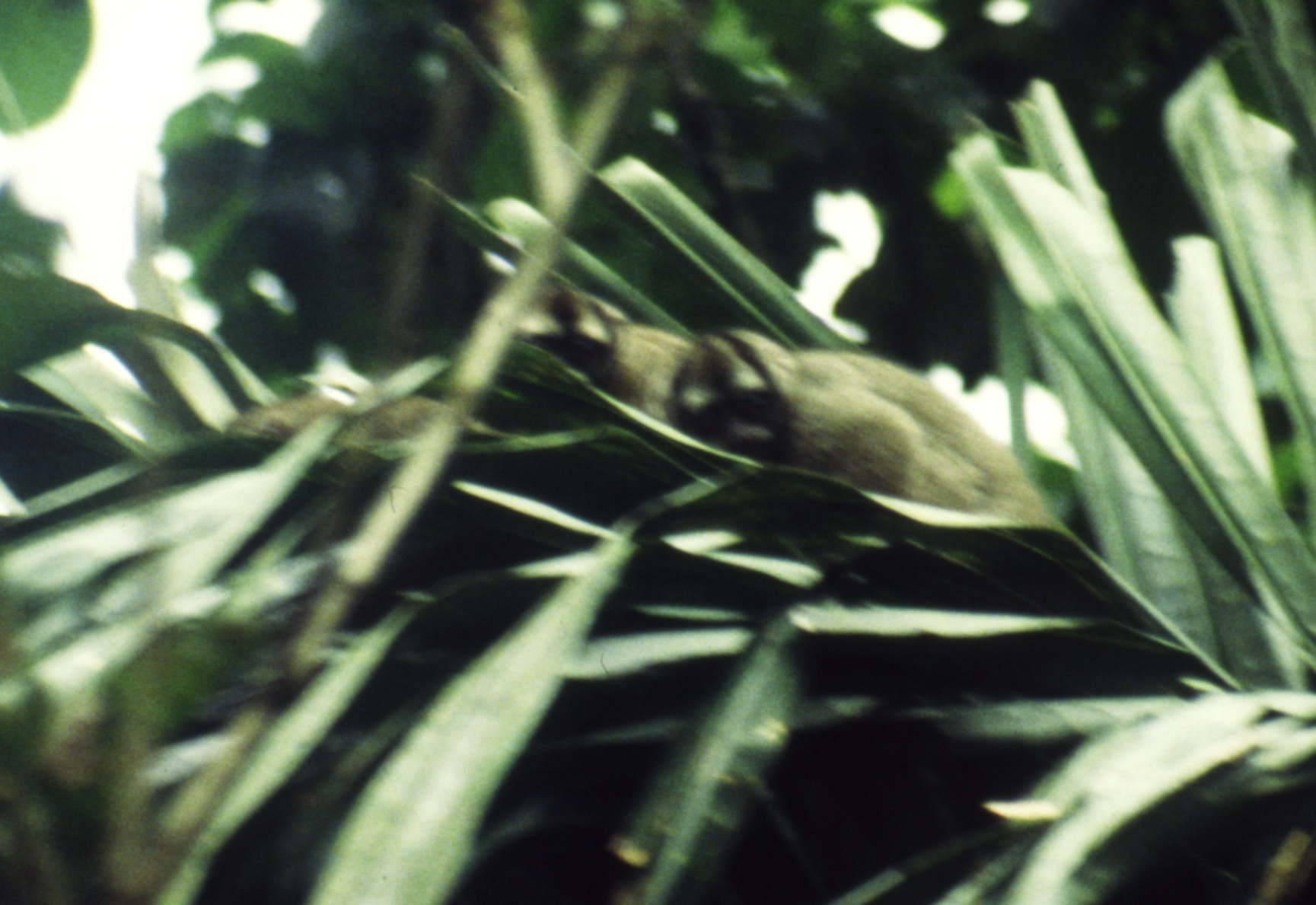
In the rainforest, we could see howler monkeys, spider monkeys, cotton-top tamarins, agouti, and jaguarundi, among other mammals. And even in our far-from-pristine village, where all the forested land was managed by the local farmers, we had mammals—sloths, squirrels, rats the size of small dogs, and one of my favourites—the jujuná or night monkey. We didn’t see them often. As their name implies, they’re nocturnal. The only nocturnal monkey, as it turns out. Its secretive habits are probably why it manages to live where other monkeys don’t.

Night monkeys are interesting, not just because of their unusual nighttime habits, but also because they are one of the few primates other than humans who contract malaria, making them important in medical research on the disease.

Night monkeys live in small family groups. The individuals in this photo are probably a mated pair and their young (the little one is on the left—you can just see its back). Though we seldom saw them, it was fun to know they were there.