Light in the Night

2016-02-24 20.57.32Last night was the longest night of the year. It’s fitting that we all overslept this morning. Everyone left for work and school in the dark, and will come home in the dark. To add to the dark of this winter solstice, the day is overcast.

But all is not black and bleak.

Yesterday, we saw the first of this year’s lambs bouncing around in the neighbour’s paddock.

The young blackbirds and magpies are already singing and vying for territories.

The breeze is from the north today, soft and gentle.

And from here, the days will only get longer.

At the bottom of the well, there is only one way to go.

So we’ll enjoy the sun while it lasts, light the table with candles this evening, and look forward to our slow climb toward spring.

A happy solstice to you, whichever one you are enjoying today.

Throwback Thursday: Jujuná

d1scans011 smLiving in Panama was sometimes like living in a never-ending episode of David Attenborough’s Life on Earth.

The invertebrates alone were enough there to keep me intrigued for a lifetime—tarantulas, whip scorpions, solifugids, scorpions, grasshoppers, mantids, butterflies, bioluminescent click beetles…every day was an entomological adventure.

And the snakes! Coral snakes, fer-de-lances, palm vipers, vine snakes, boa constrictors…never a dull moment.

And don’t even get me going on the frogs, birds, and lizards—I could spend a week waxing lyrical about the hummingbirds alone.

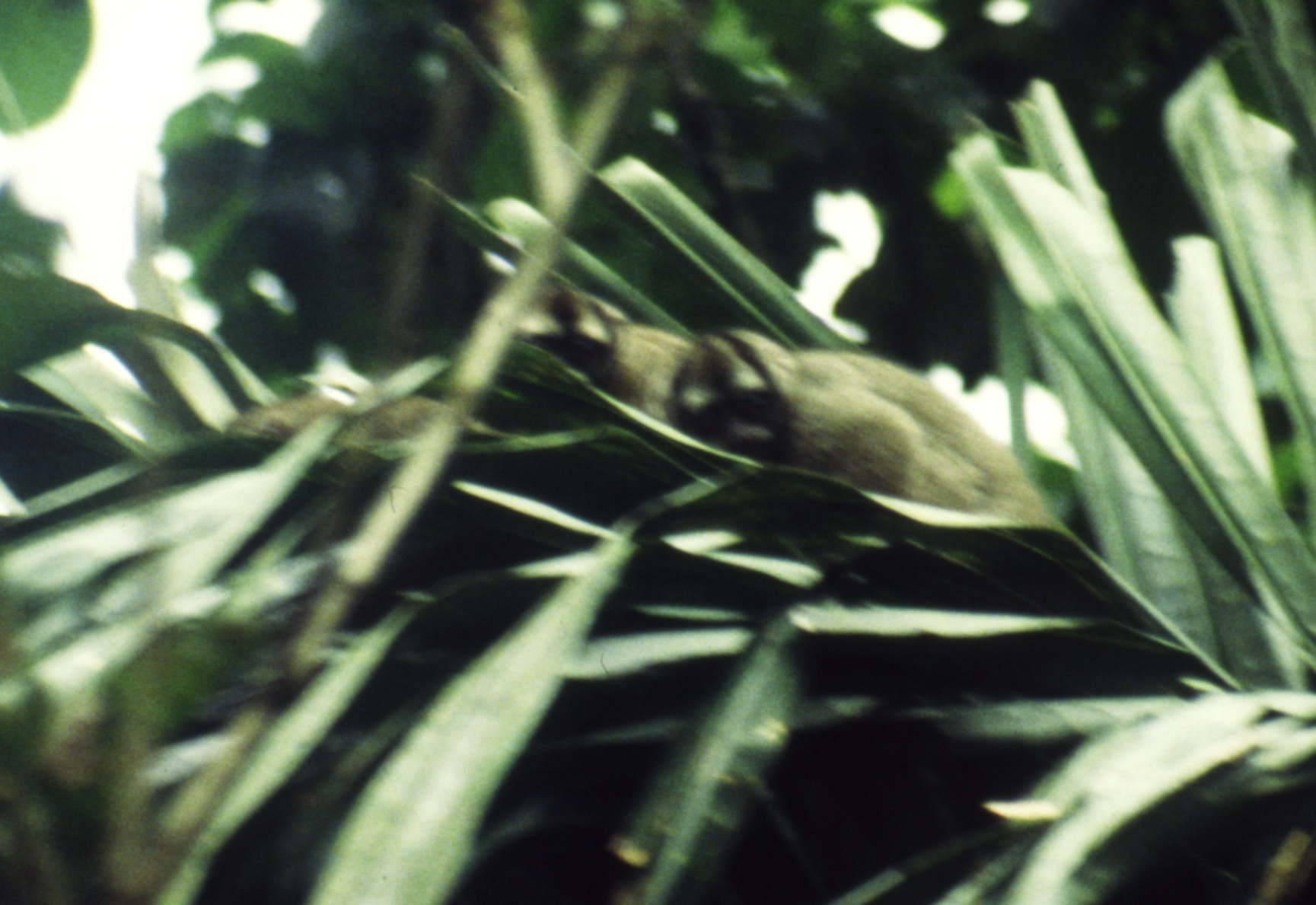
In the rainforest, we could see howler monkeys, spider monkeys, cotton-top tamarins, agouti, and jaguarundi, among other mammals. And even in our far-from-pristine village, where all the forested land was managed by the local farmers, we had mammals—sloths, squirrels, rats the size of small dogs, and one of my favourites—the jujuná or night monkey. We didn’t see them often. As their name implies, they’re nocturnal. The only nocturnal monkey, as it turns out. Its secretive habits are probably why it manages to live where other monkeys don’t.

Night monkeys are interesting, not just because of their unusual nighttime habits, but also because they are one of the few primates other than humans who contract malaria, making them important in medical research on the disease.

Night monkeys live in small family groups. The individuals in this photo are probably a mated pair and their young (the little one is on the left—you can just see its back). Though we seldom saw them, it was fun to know they were there.

Promise of Spring

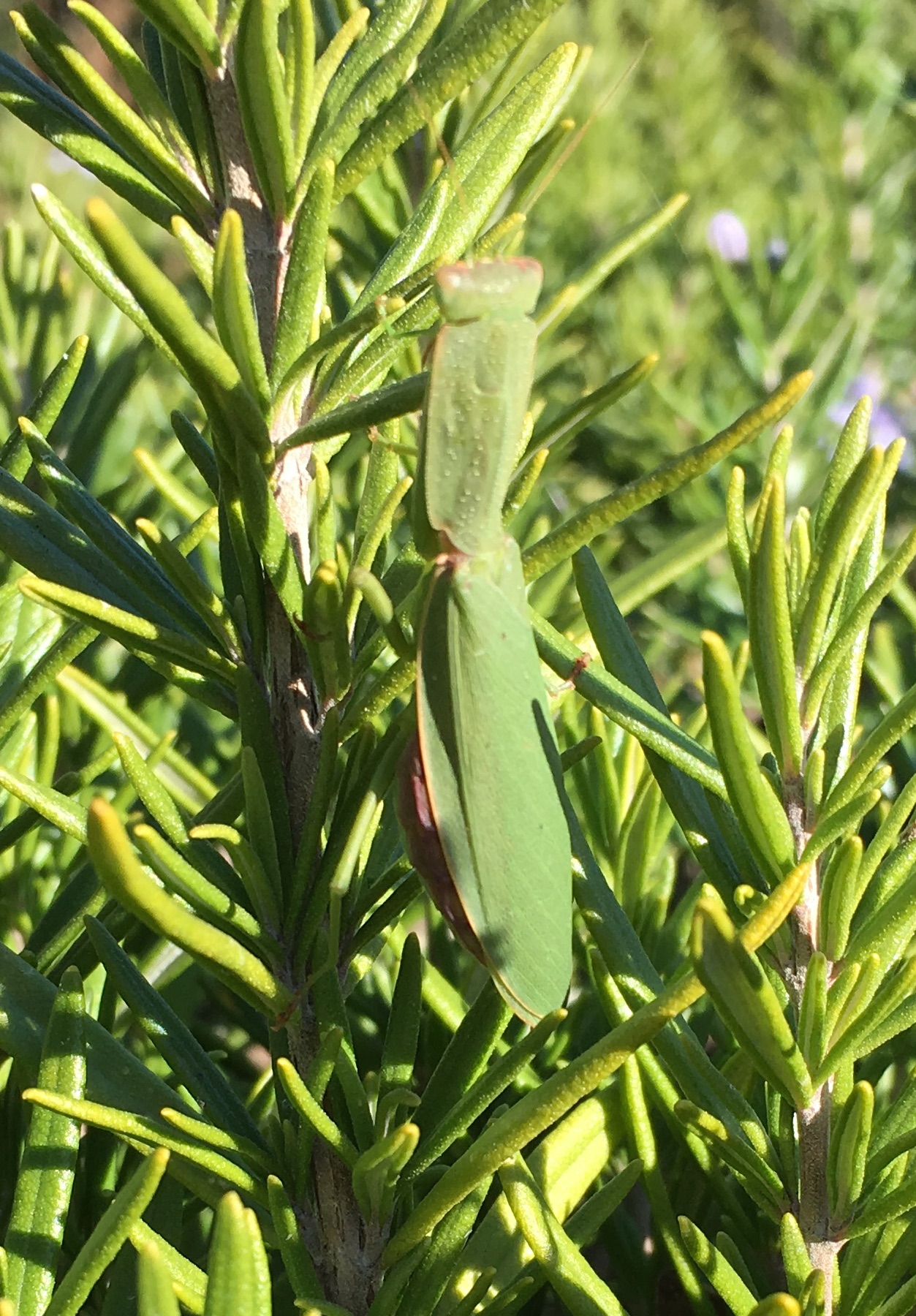
2016-05-27 12.53.09Tomorrow’s forecast is rather wintery, but I’ve been fortified today. The preying mantises must know their time is short—that one of these storms is going to do them in for good—because over the past couple of days, they’ve been laying eggs all over the place.

There are new clusters on the fence posts, on the rosemary, and even on my office deck.

Though the adults will succumb to the weather, their eggs will rest snug all winter in their cosy egg capsules—a promise of the spring to come.


Stalking the Wild Tardigrade

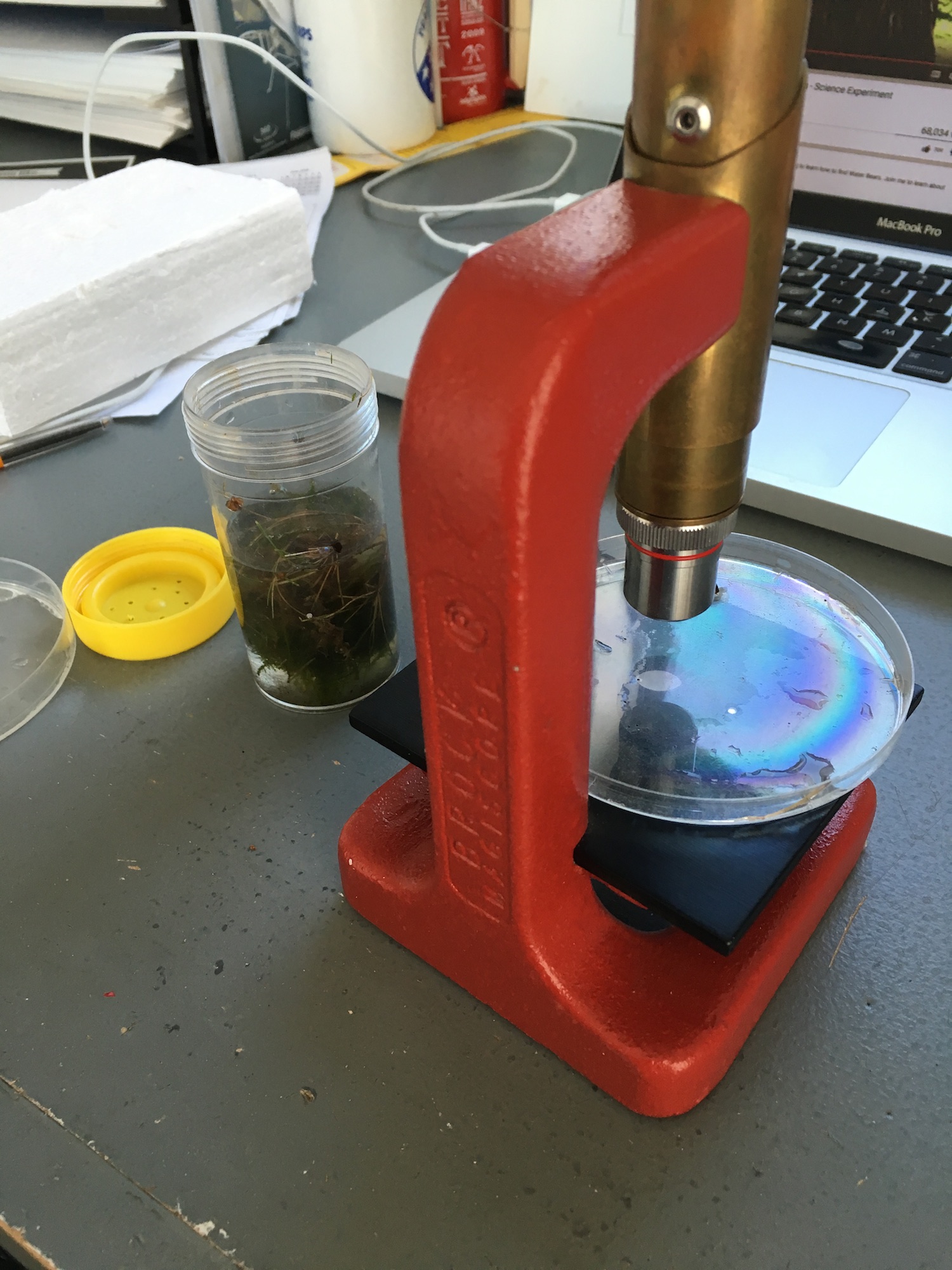
2016-05-25 14.50.00The recent rain has got me thinking about tardigrades. Tardigrades are, of course, one of the most awesome creatures of the animal kingdom–able to survive freezing, desiccation, radiation, intense pressure, and the vacuum of outer space, just to name a few. I mentioned them in a sci-fi short story I wrote over the summer, and have been meaning to go looking for them ever since.

Well, the moss is nice and wet now, so I figured it would be a good time to find some. I collected some moss, soaked it, squeezed out the water and, voila!

I found springtails,

And mites,

And paramecia,

And nematodes,

And some things that looked and acted like microscopic leeches…

But no tardigrades.

I peered down the microscope until my eyes crossed. I squeezed out more water from my moss.

No joy.

No tardigrades.

Of course, that just makes them all the more exciting. Now I have a challenge—stalking the wild tardigrade.

Stay tuned…

Predictability

She's occupied the same plant for weeks. Her neighbour, on the next plant over, is equally predictable.

She’s occupied the same plant for weeks. Her neighbour, on the next plant over, is equally predictable.

There isn’t a huge body of research on why people don’t like insects and spiders, but the studies that have been done have concluded that one of the main problems people have with creepy crawlies is their unpredictability. They could jump, bite, sting, run, fly…and most people can’t predict what an insect will do next.

But I’ve come to realise that insects and spiders are, in fact, highly predictable.

For three years (its entire adult life) there was a metallic green ground beetle underneath the goats’ water barrel. It was there every time I looked, and I came to depend upon it to be there for Bugmobile programmes (along with two or three others whose ‘addresses’ I knew).

Until age and winter claimed her, I had an Australian orb weaver who I would pluck from her hiding place in the morning, take to a bug program, and return to her home in the afternoon—day after day, week after week.

A bee or wasp will always be the first insect to fly out of a sweep net, so you can quickly let them go before seeing who else you’ve caught.

If you put two adult male crickets together in a cage, they will always chirp.

A ladybug will always climb up an object, and fly away when it gets to the top.

A bee will not sting unless it feels threatened.

Most spiders will quickly rappel to the floor when frightened.

In fact, because insects and spiders behave largely out of instinct, they are incredibly predictable.

But, of course, you have to spend time with them to know that. You have to pay attention to them, instead of just stomping on them when you see them. You have to learn their ways. You have to behave predictably around them, in order to note that they are predictable themselves.

Somewhere, there is an insect research project going on to try to figure out why insects are so frightened of people. I suspect the bugs will find it’s because we’re so unpredictable.


Feeling Bad? Consider the Barnacle

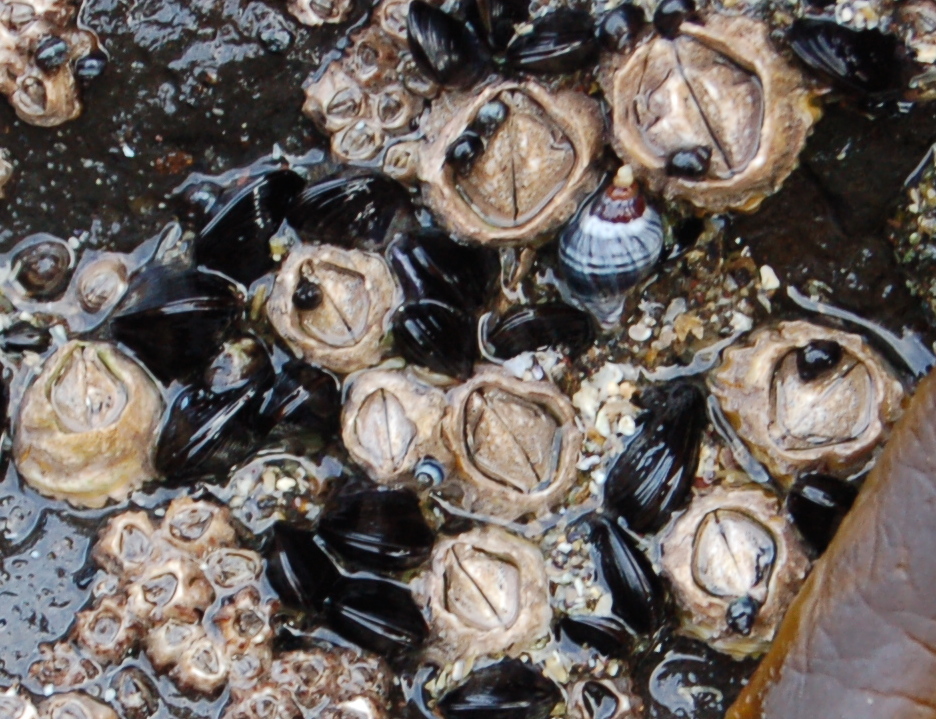
DSC_0027 cropThe lowly barnacle is well-known. Most people can point to one and say, “that’s a barnacle.”

Well done, but how many people know exactly what a barnacle is?

“It’s this…thing…that lives on rocks at the beach.”

“Don’t they grow on whales?”

“Ships get covered in them.”

As an entomologist, I know a bit about barnacles, because they are Arthropods, just like insects, spiders, millipedes, crabs, and lots of other creepy crawlies. In fact, they are crustaceans, closely related to crabs and crayfish.

Wait, you say. Don’t Arthropods have ‘jointed legs’—that’s what the word means, after all—but barnacles don’t have legs.

Or do they?

Barnacles are perhaps the strangest of the Arthropods. The free-living larva is a weird, tiny, spiky creature with one eye. It goes through a metamorphosis, like insects do, in which it changes shape dramatically. In its last larval stage, it finds a nice place to spend the rest of its life, presses its forehead against it, and secretes a calcium-rich cement from near the base of its antennae that permanently affixes its head to the spot.

In its adult form, a barnacle grows a protective shell, complete with a clever two-part ‘door’ that it can snap shut to conserve water at low tide, or to protect itself from predators. Its legs grow long and feathery, and act as tentacles to waft particles of food to its mouth.

As you can imagine, adult barnacles don’t have much of a social life. Most species are hermaphroditic, meaning individuals are both male and female. Surprisingly, though, self-fertilisation is rare. Like other arthropods, most barnacles have what’s euphemistically known as ‘internal fertilisation’—that is, the male has a penis, and he deposits his sperm inside the female. How does an animal glued by its head to a rock get together with another to mate? The answer is a very long penis.

So the next time you feel like your life is rough, be thankful you’re not a barnacle.

I’ve Got This Bug

Pseudocoremia leucelaea

Pseudocoremia leucelaea

“So, I’ve got this bug?”

I grimaced into the phone. It was going to be one of those calls.

One of those calls where the caller expects me to identify an insect over the phone. An insect they didn’t really look at terribly closely and didn’t bother to collect.

“It’s sort of brown, with long feelers. What is it?”

I try to help. I try to tell people where and how they can get their bug identified, but sometimes I think I’m just talking into the wind. Most of the time I’m sure they hang up thinking, “Well, she didn’t know much, did she?”

Here’s the thing.

Even in New Zealand, which has a very limited number of insects, compared with other places in the world, there are 10,000 species of insect to choose from.

Some are iconic, to be sure. Some are easily recognisable.

Many are not. Many look different as an adult than they do when young. Sometimes males and females look very different. Colours and markings can vary from individual to individual. Some features are only visible under a microscope. And verbal descriptions are less than useless.

So when a person says an insect is brown, I wonder whether it is a dark chocolate sort of brown, a reddish brown, a light brown…because “brown” could be anything.

When they say it’s “about a centimetre long” I wonder whether it is closer to 9 millimetres or 11 millimetres, because it might matter.

When they say, “It looks sort of like a huhu grub” I wonder what features make them say that. Is it legless? Is it a creamy white colour? Or is it just that they’ve seen pictures of huhu grubs and it’s the only thing they can think to compare it to?

When they say it’s got long feelers, I wonder whether those antennae are filiform, moniliform, pectinate, capitate, or serrate.

When they say it has clear wings, I wonder whether it has two or four. And whether those wings are fully clear, tinted, or partly covered in scales.

I wonder how many tarsal segments its legs have.

I wonder whether it has setae on its tibia. And if so, how many, and what size they are, and how, exactly, they are arranged.

I wonder what the shape of the marginal cell on the front wing is. Or whether the wing venation is reduced, or whether the wing is fringed at all.

Sometimes, someone can describe an insect in detail to me over the phone, and I am baffled. Then they bring me the insect, and I can immediately identify it, and it looks nothing like I imagined from the description they gave.

I’m always happy to try to answer people’s entomological questions, but sometimes I feel like one of the three blind men trying to identify an elephant by feeling just a small part of it’s body.


Mosquitoes, Disease, and Environmental Change

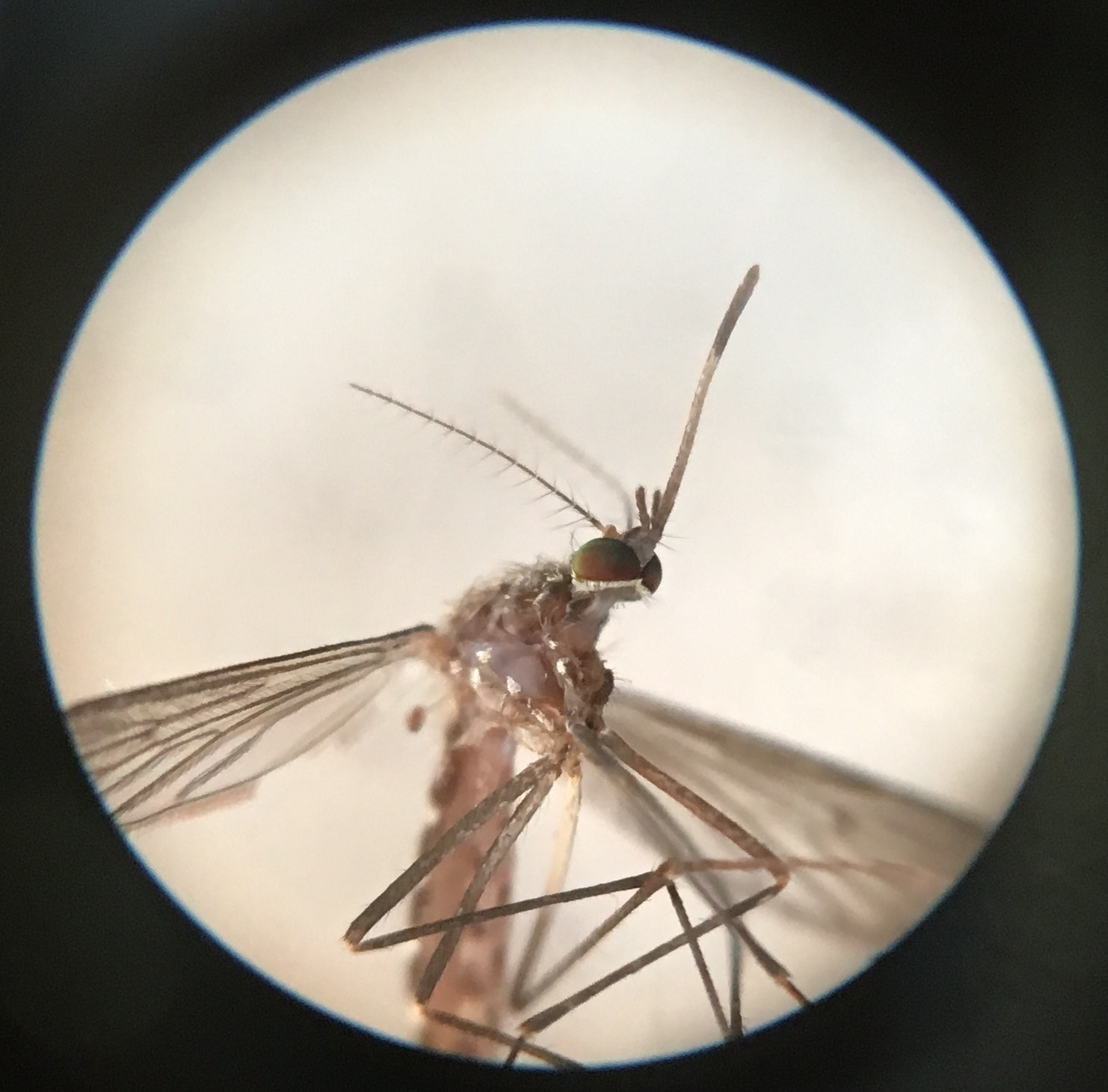
2016-05-02 07.38.34With Te Waihora/Lake Ellesmere just a few kilometres away, we’ve always had mosquitoes at our house. But since we installed a small pond, the mosquito population of our property has gone up (in spite of the fish, which do eat a lot of them).

Though mosquito identification is not my forte, most of the mosquitoes appear to be Culex pervigilans, the common house mosquito, or vigilant mosquito. Like most of our mosquitoes, this species is endemic to New Zealand.

Because of the isolated nature of New Zealand, few of the world’s nasty mosquito-borne diseases have ever arrived here, and no human diseases have managed to arrive and spread. But that doesn’t mean they couldn’t, if given the opportunity.

Whataroa virus is an Australian bird virus, which may also produce flu-like symptoms in people. In New Zealand, it has been found only in the area around the small West Coast community of Whataroa. It was first detected in 1962, and recent surveys show it has not increased in prevalence since then. In New Zealand, it is vectored by Culex pervigilans, which is common throughout the country.

So why hasn’t it spread?

Well, we don’t know for certain, but to get a clue, it’s worth looking at why other mosquito-borne viruses spread. Most emerging diseases come on the heels of environmental change—when the habitat changes, mosquito populations may increase (many mosquitoes do well in disturbed habitats), or the virus’ other hosts may increase or move around, spreading the virus. Environmental changes can be natural, like seasonal flooding; or human-induced, like cutting native forest (or digging a pond…).

Which brings us back to Whataroa, which hasn’t changed much at all over the past 50 years. There’s been no great increase in mosquito habitat, and little development that would favour the non-native blackbirds and thrushes that appear to be the reservoir for the virus. So the Whataroa virus has simply languished in place.

If the Whataroa virus had arrived at another location, it might have already spread far and wide (as avian malaria has done over the past 40 years). If a developer had come into Whataroa and built golf courses or fancy subdivisions, it might have spread. When the next big Alpine Fault quake happens, the resulting destruction will likely create new disturbed habitat for mosquitoes, blackbirds, and thrushes, and Whataroa virus might spread with them.

All sorts of variables determine whether and when a mosquito-borne disease becomes a problem. Some of these are known, and under our control, but many are either not understood or are out of our control. Sometimes, the only thing we can do is to react when trouble strikes.

Which is, of course, my excuse for swatting this mosquito when it landed on my arm this morning.

Rocket Spider

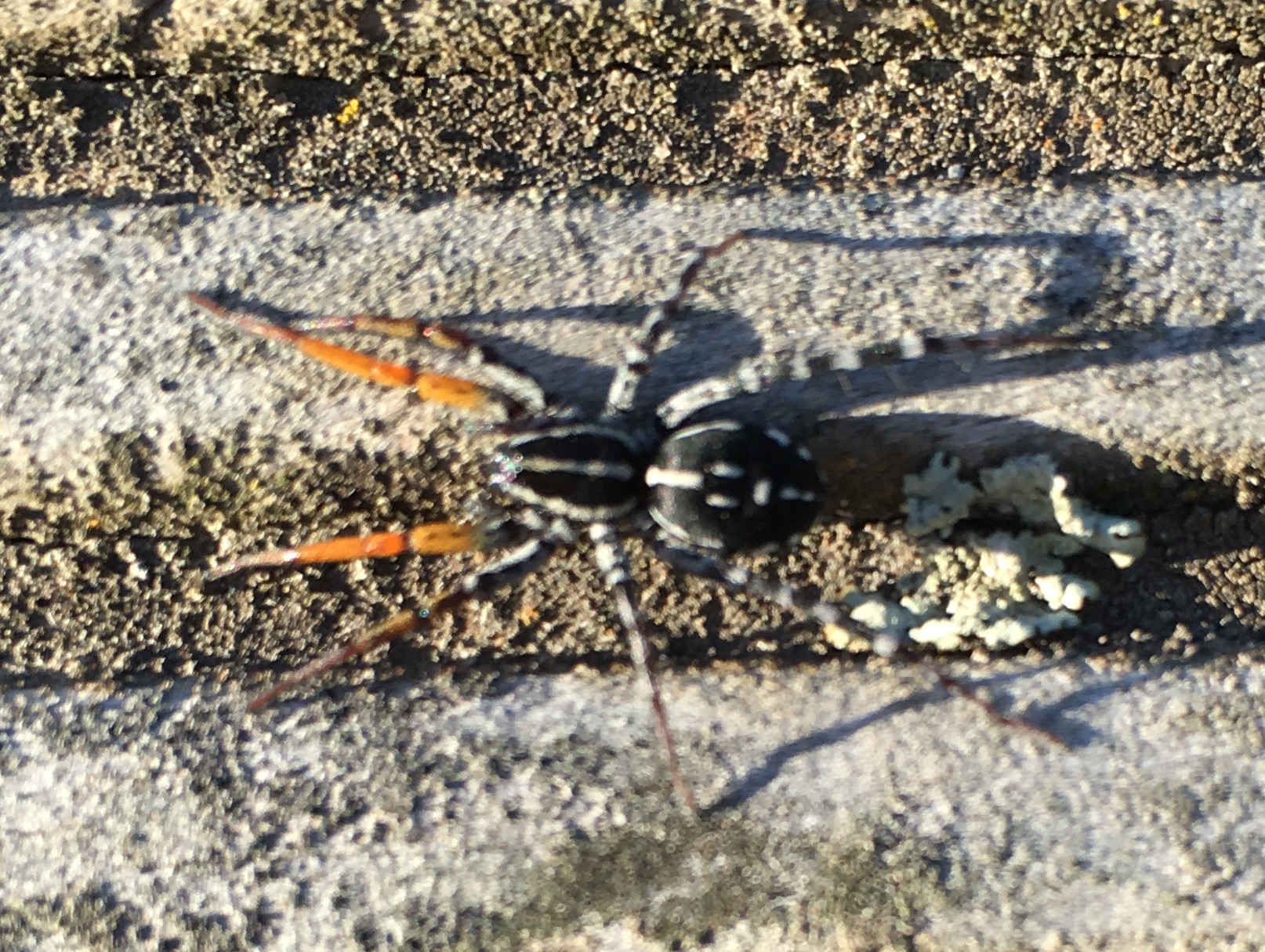
2016-05-01 15.49.10One of my favourite spiders here is an Australian invader. Officially known as the Australian ground spider Nyssus coloripes (formerly Supunna picta), but at Crazy Corner Farm, we invented a more colourful name, the rocket spider.

Rocket spiders have colourful orange front legs and white spots down their sides, making them stand out wherever they are.

They are in a group of spiders known as the fleet-footed spiders, and they are most definitely that. They are active daytime hunters, and race around as though they are rocket-propelled.

There is a female rocket spider who lives in my office. She’s been there for the better part of a year now, and zips over my bookshelves, desk, and walls as I work. She’s not shy—I sometimes have to shoo her off the keyboard, and once she skittered across my face.

I’m sure the rocket spider finds plenty of flies to eat in my office, but these spiders have unusual tastes. Though rocket spiders don’t build webs to catch food, I’ve seen them in the webs of Australian orb weavers—eating the orb weaver.

It’s a spider eat spider world, after all.

An Unusual Moth

2016-04-22 15.36.36One day last week I was folding the laundry, which had been hanging out on the line all day. As I shook a t-shirt to fold it, up flew a tiny moth. When it landed again, I noticed that it looked odd. It sat with wings wrapped around it, a bit like a grass moth. But it held its spiky back legs high in the air, unlike any moth I’d seen. I took a couple of photos, none of which came out great—the iPhone just wasn’t made for macrophotography.

Still, even with a grainy photo, I was able to identify the moth to the genus Stathmopoda.

That’s where it started to get weird.

Everyone knows that butterflies and moths start off their lives as caterpillars, and that caterpillars eat plants, right?

Not so, in the genus Stathmopoda. Instead of munching leaves, the caterpillars of Stathmopoda eat other insects.

Yes, they’re carnivorous caterpillars.

They prey primarily on scale insects, so some species are actually used as biological control agents to help control these pests.

They are not the only carnivorous caterpillars. Though carnivory is rare among butterflies and moths, it has evolved separately several times in at least eight different lineages. Most carnivorous caterpillars eat small, slow-moving or sedentary insects, as you might expect from an animal that is neither speedy nor particularly formidable itself. As far as we know, there is only one moth that is carnivorous as an adult—the ‘vampire moth,’ Calyptra eustrigata, which feeds on the blood of ungulates.

I’m quite happy that this little Stathmopoda is carnivorous. Our currants suffered a bad case of scale insects this summer, so I hope there are lots more Stathmopoda out there. Here’s wishing it great reproductive success in the garden!