Gate Sales

I picked up a kilo of honey and a lovely variegated sage plant while I waited for my son at piano lessons today. And I didn’t step into a grocery store or a nursery.

One of my favourite aspects of New Zealand life is the practice of ‘gate sales’–selling your produce at the farm gate. Gate sale setups can be elaborate, like the beautiful flower cart one of the local daffodil farms uses, or they can be simply a table or box by the side of the road. They operate on an honour system–there’s no one there to make sure you pay–you simply drop your money into a box. Theft does happen–I know from my own experience–but most people are honest.

I’ve seen all sorts of things for sale on the roadside–all manner of vegetables, eggs, walnuts, plants, honey, in-season fruits, flowers–whatever the grower has in abundance. And it’s not just commercial growers–did your lemon tree produce a spectacular crop? Sell the excess at the gate. Zucchinis out of control? Sell the them at the gate. I used to pay my entire year’s garden expenses from gate sales of whatever was extra. I’ve gotten better at planning in recent years and have two teenagers in the house now, so I don’t have the same problem with excess produce anymore.

While I don’t sell much anymore, I take full advantage of those who do. I’ll even go out of my way to buy something (like honey) directly from the farm, rather than picking it up at the grocery store. Other times, the farm is much closer than the store. If we’ve run out of potatoes or eggs, all I have to do is walk to the neighbour’s place to get more. I like the idea that my money is going to the producer, and not to all the middlemen. I like fact that whatever I’ve bought has been locally produced. I like the feel of the trust inherent in the transaction. It feels good, neighbourly, and personal.

As we move into spring and summer, gate sales will be increasing. I’ll be ready, with my ’emergency’ stash of loose change in the car so I can stop and pick up whatever is fresh and at the gate today.

Te Wiki o te Reo Māori

Aotearoa–land of the long white cloud

Tēnā koutou!

It’s Te Wiki o te Reo Māori—Māori Language Week.

My grasp of te reo is poor. I know a few phrases, a smattering of words, a couple of waiata (songs). But I’m always eager to pick up new vocabulary and phrases. I love languages. They speak to a culture’s values, and reveal some of its history.

I also enjoy finding the similarities between languages—phrases and sayings that reveal truths that transcend culture and geography.

For example, check out these Maori proverbs:

E mua kaikai, e muri kai huare.
Early arrivals have the pick, but late comers may only get spittle.
Doesn’t that remind you of ‘The early bird gets the worm’?

Waiho ma te tangata e mihi, kia tau ai.
It would be better to let others praise.
Sounds like ‘Don’t blow your own horn’ to me.

Mauri mahi, mauri ora; mauri noho, mauri mate.
Industry begets prosperity (security); idleness begets poverty (insecurity).
Bears a striking resemblance to ‘Early to bed, early to rise makes a man healthy, wealthy and wise’.

He manako te koura i kore ai.
Crayfish are scarce when they are expected.
To me, that says ‘Don’t count your chickens before they hatch’.

Have a great week everyone!

Haere rā!

Living With Earth

Coes Ford–open…just.

Nature is bigger than we are.

That’s been clear from world events the past few weeks—flooding in Indonesia, earthquake in Mexico, multiple hurricanes in the Atlantic.

We can pretend the natural world doesn’t affect us. We can do our best to engineer human structures and our daily lives so that, most of the time, we forget we are an integral part of Earth. But I think this is a terrible mistake.

On my way to and from town every day, I cross the Selwyn River. Normally, I do this at a spot called Coes Ford.

The Selwyn River floods. It’s simply part of the hydrology and ecology of the river. The low bridge over the Selwyn at Coes Ford acknowledges flooding. The bridge was never meant to allow passage over the river during a flood. It was meant to survive floods intact, and provide passage during low water.

The ford has been closed for several weeks, but reopened yesterday. The bridge itself is still underwater, but it’s passable.

To me, there is something right and good about an infrastructure that acknowledges the forces of nature and doesn’t try to control them. It is good for us to accept that, while we have great influence, we are not masters of the planet. At Coes Ford, we will be inconvenienced by floods. This is part of the natural order. It is part of what it means to live here. And if we are inconvenienced by floods, we will notice when the pattern of flooding changes. We will feel that something is amiss. Hopefully, we will do something about it. It’s not a coincidence that when the Selwyn stopped flooding and dried up last summer, the focus of the worry was at Coes Ford—that’s where the locals understand the river’s pulse the best.

If we are separated from the rhythms of the planet, we won’t notice when something is wrong, locally or globally. When we are separated from the rhythms of the planet, we may not notice problems with our life-support system until it is too late. Separated from, and ignorant of the rhythms of the planet, it’s easy to deny that there are any problems.

And so, I embrace the inconvenience of Coes Ford. I thank the engineers who chose to accept the Selwyn River for what it is. I hope that, as human technology advances, we continue to remember our interdependence on the natural systems of Earth. We must live with the earth, not on it.

Nettle Season

It’s stinging nettle season and, as I’ve mentioned before, my garden is host to an irritating quantity of nettle—quite literally.

But though it is a stinging weed, I’ll admit to a certain fascination with nettle. Look at the stinging hairs (trichomes) under the microscope, and you’ll find beautifully wicked structures like fine hypodermic needles. Those syringes are full of an irritating mix of acetylcholine, histamine, serotonin, moroidin, leukotrienes, and formic acid to irritate your skin.

But the triggering mechanism for the trichomes depends upon turgor (water pressure), so once a nettle wilts, it can’t sting.

And once it wilts, nettle is an incredibly useful plant. It is edible and quite nutritious for both humans and livestock. The cooked greens are used in traditional dishes throughout the Northern Hemisphere where it is native.

It can be used to make a vegetarian rennet for cheesemaking, and is used to flavour and decorate some cheeses. I’ve made nettle rennet myself as a substitute for commercial rennet when I’ve run out.

Nettles can be used to make tea, cordial and beer.

The fibrous stems can be used to make linen-like textiles. The roots can be used to make a yellow dye.

Fed to chickens, nettle is an effective egg colourant, which may explain the deep orange colour of my chickens’ egg yolks at this time of year.

All in all, stinging nettles don’t deserve their bad reputation. Like many of our weeds, they’re useful plants that we’ve forgotten how to use.

It’s Show Time!

We got the annual schedule for the Ellesmere A&P Show the other day. For those of you not familiar with the term, A&P means Agricultural and Pastoral–Farm Shows they’re called in the US.

I grew up enjoying the local Farm Shows, entering bad art projects into the competition, and admiring the rows of cattle on display. As an adult, I was lucky enough to live for several years mere blocks from the Minnesota State Fair–the Farm Show to end all Farm Shows. I even entered a quilt there–won second prize in a category in which I was the only entrant. A feat worthy of mention in the News from Lake Wobegon, if you ask me.

Farm Shows/A&P Shows are a defining cultural experience, but the truth is, you don’t even need to go to the show to have a cultural experience. Reading the show schedule is almost as good.

For example, in the little old Ellesmere show, there are 95 different sheep classes in which one could enter one’s woolly livestock. That doesn’t include the children’s pet classes or the wool classes. And then, of course, there are the shearing and sheep dog competitions. Sheep farming may be on the decline in New Zealand, but it’s still king in Ellesmere.

Dairy has boomed in recent years, and there are quite a large number of dairy classes in which aspiring farmers can enter their bovines. The lucky winners of many of the dairy classes will receive semen as their prize. Doesn’t that just make you want to enter?

Semen certainly beats the poor dairy goat farmers, who pay $5 to enter a goat, and can only hope for, at best, $5 for first prize.

If you’ve got a dairy animal, it might just win Best Udder (Judged both full and empty–I expect no saggy udders need apply). Now there’s something to aspire to.

One of my favourites is the calf fancy dress class. Nothing like a bunch of calves in tutus and tuxes to make you smile.

And I noticed a new category I never knew existed–Donkey Challenge, judged on ‘willingness, style and accuracy over four challenges’. Now, that’s a competition I may have to make sure I see this year.

But of course, like any rural event, the real excitement is simply the hustle and bustle on the day. The hot chips and mini-donuts, the carnival rides, running into neighbours and people you haven’t seen for months, and celebrating the importance of agriculture in our lives and culture.

Enrique’s Violin

Music
Wrung from a life of want.

Wrought of
Cedro amargo,
But not bitter.

Wrought of
Machete
And Imagination,
Of sheer desire for beauty.

Your maker a poet,
A dreamer,
Inventor.

You made the people dance
And forget
The crops washed away,
The sick child,
The dead baby.
If only for an hour.

Sing and dance
With the discarded
Rubbish of life.

Sing and dance
With me.

Nostalgic Cookie Stars

Remember those Barnum’s animal crackers that came in the little box printed like a circus wagon and with a string handle?

When I was a kid, those were my favourites. Mum used to let us kids get a box when she did the weekly grocery shopping (no doubt a ploy to keep us quiet), and I can still remember trailing her through the store carrying my little box of cookies.

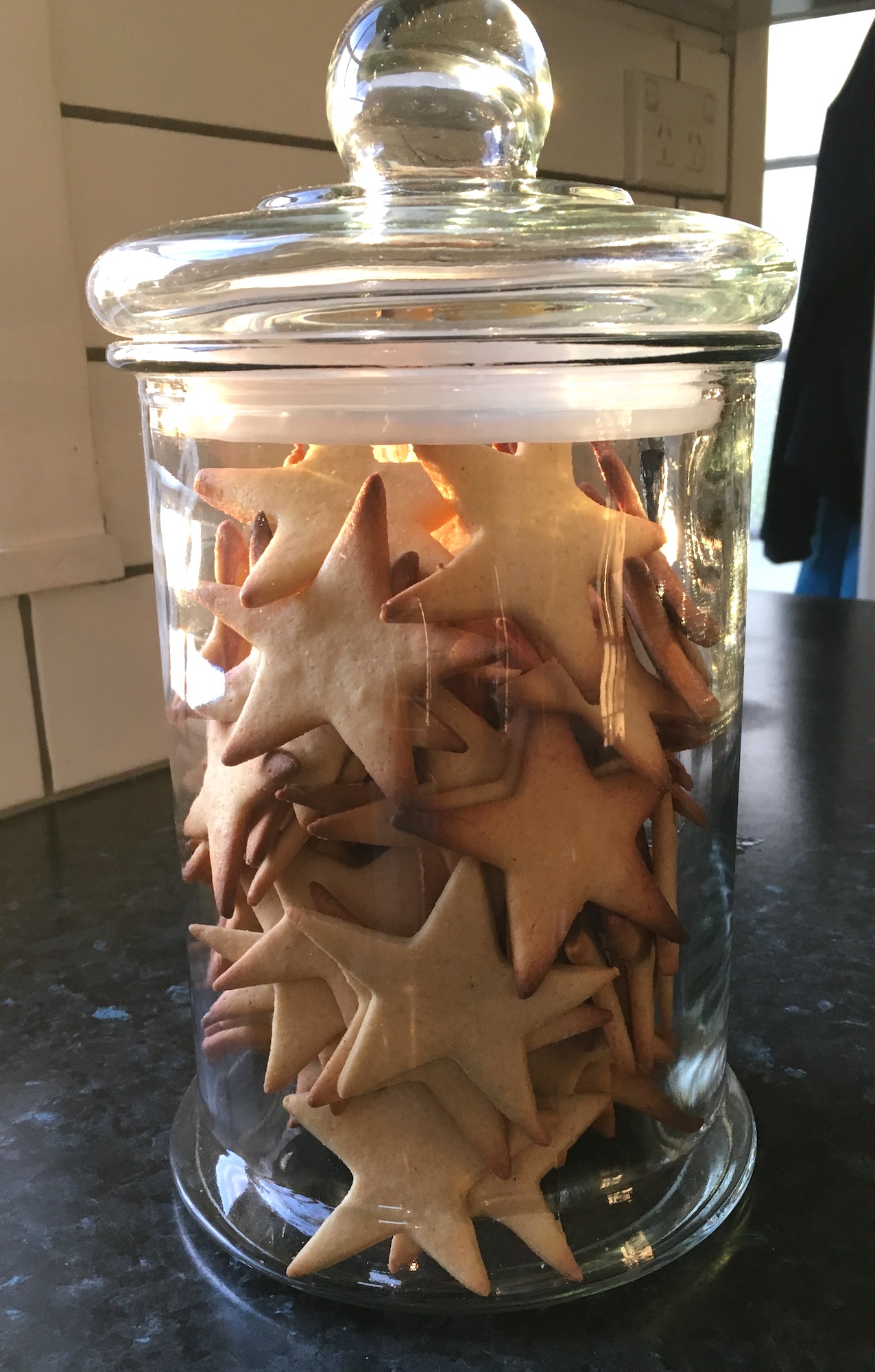
This week, I found a cookie recipe that evokes those animal crackers. From the most beautifully designed cookbook I’ve ever seen–The Gourmet Cookie Book–these Moravian White Christmas Cookies are stars.

The recipe makes a huge number of cookies, and the dough is not the easiest to work with. Make sure it is well chilled before rolling, roll it in small batches on a well-floured board, and give yourself plenty of time.

1 cup butter
2 cups sugar
4 eggs
4 cups flour
1/2 tsp salt
1/2 tsp cinnamon
1/4 tsp nutmeg
2 Tbsp sherry (I used brandy)

Cream butter. Add sugar gradually and beat until light. Add eggs and continue to beat. Combine dry ingredients, and add them alternately with the sherry. Chill several hours.

Roll dough to 1/16 inch (seriously–the thinner the better) and cut with cookie cutters. Bake on a greased baking sheet at 450°F for 7 minutes (I found that the cookies burned at this temp/time combination–keep a close eye on them and pull them out when they begin to brown).


Going Overboard

I know people for whom to spend half an hour preparing dinner is an unthinkable chore.

I don’t understand those people.

Don’t get me wrong, I totally understand the got-home-late-from-some-after-school-activity sort of feeling. The days when we know we’ll be coming in late and hungry, I pull something out of the freezer that needs only a few minutes in the microwave.

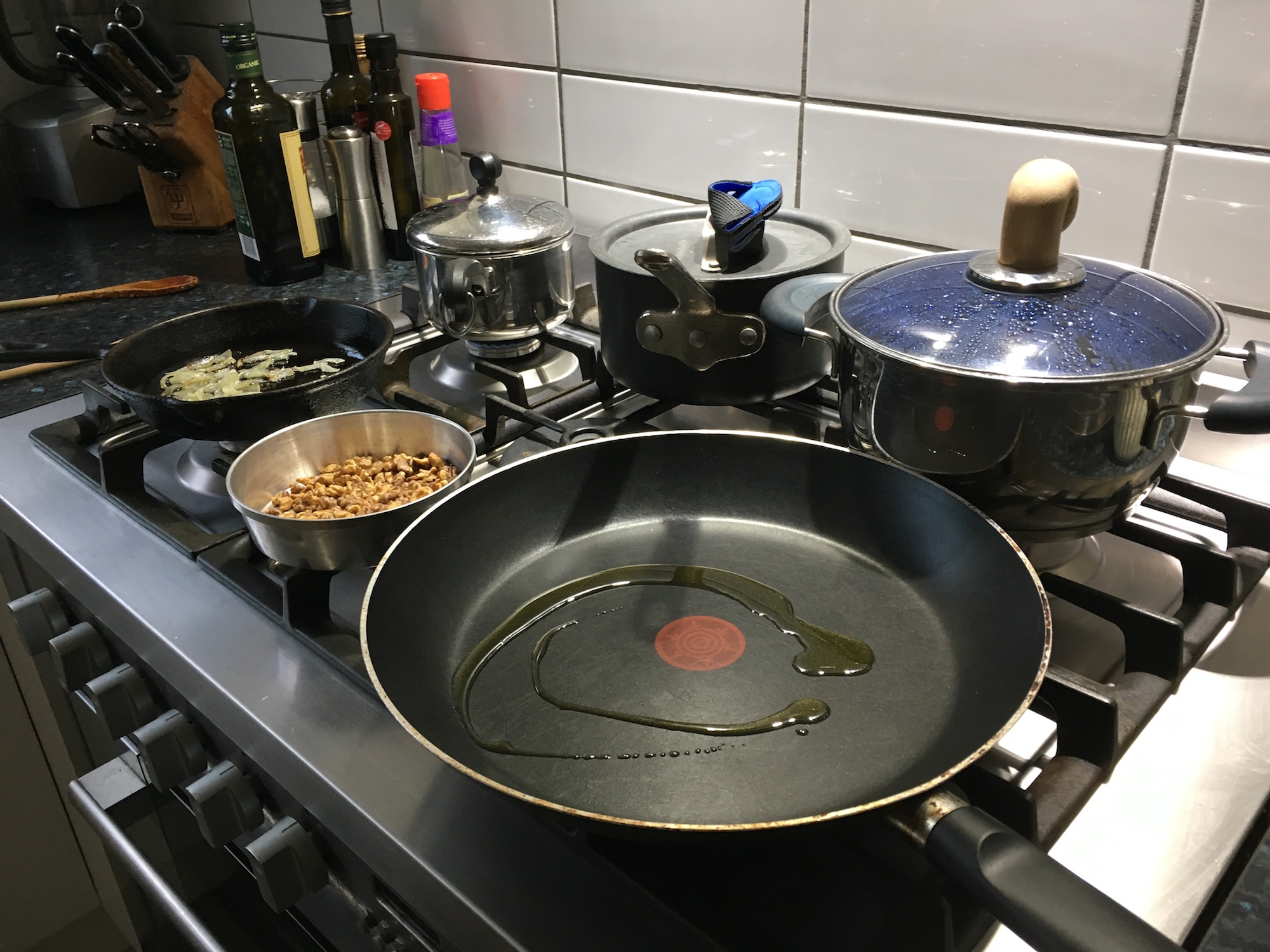
But on ‘normal’ days, making dinner is a way to make every day special. If it takes an hour to do that, who cares? An hour spent nurturing my family is an hour well-spent, in my mind. And if, some days, that hour expands to two or three…well, I at least make sure on those days I’m making enough to put a meal or two in the freezer for when I need an instant meal.

I also don’t mind going overboard now and again on dinner, because our family has a culture of food appreciation. From an early age, the kids learned to appreciate new flavours, interesting textures, and the culinary effort it takes to create a meal. If I spend two hours making dinner, I know the people who eat it will appreciate the extra effort. I know they will recognise it as one of the ways I show my love for them–a culinary hug. As teenagers, they resist real hugs, but they love a good culinary hug. It’s not just conditioning that they thank the cook at each meal–they actually mean it.

So if I go a bit overboard sometimes…well, you can never have too many culinary hugs.

Traditional Easter Jack-o-lantern

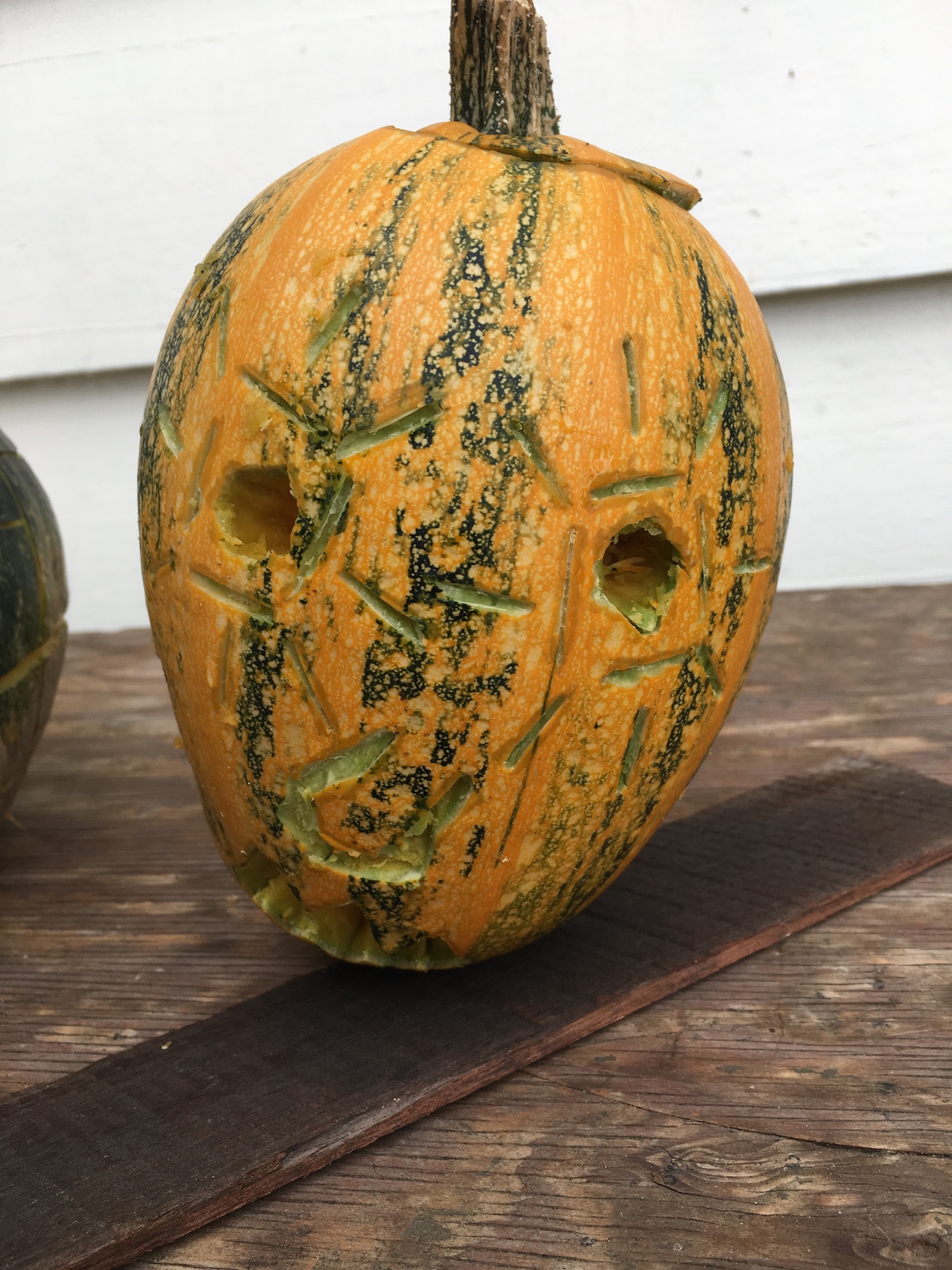
The traditional Northern Hemisphere holidays make absolutely no sense here. Easter falls at the Northern Hemisphere seasonal equivalent of mid-October. So a celebration of spring flowers, new-season’s growth, resurrection, etc. just doesn’t work.

We’ve just brought in the last of the harvest–pumpkins, apples, popcorn. The only summer crops left are those in the greenhouse, and they won’t be around much longer, either. Trees are losing their leaves. We’ve brought out the candles, and dream of sitting by a crackling fire in the coming months. Clearly, painted eggs, bunnies, and spring flowers are inappropriate.

So I introduce the traditional Easter Jack-o-lantern. Carved while snacking on roasted pumpkin seeds.

Great fun for the kids, and better for them than chocolate bunnies!

A Tale of Two Walnuts

We have two walnut trees, both of them young. The older of the two gave us a few walnuts last year and one the year before. This year it gave us several good handfuls of nuts.

That’s not anywhere close to satisfying our annual walnut consumption. We put walnuts in granola, baked goods, burgers, tofu meatballs, and rice pilaf, among other things. We eat them as snacks, too, and I buy them in kilo-sized bags.

But walnuts here are all the mild English walnut (Juglans regia). They’re a good staple, but somewhat tame. Not something to feature in a dish.

Not like American walnuts (Juglans nigra). To me, these are the true walnuts–piney-flavoured and bitter, difficult to shell, with thick green husks that leave your fingers black. There aren’t many foods from the US that I miss anymore, but American walnuts are one of them.

When I was a kid, every Christmas my mother made walnut crescents–moon-shaped shortbread cookies packed with American walnuts and rolled in confectioner’s sugar. They melted on the tongue, and burst with nutty flavour. I made the mistake of making these with English walnuts once. They were vapid little sugar bombs. Not at all like real walnut crescents.

I have looked high and low for American walnuts here in New Zealand, with no luck. One time I saw a label in the grocery story saying “American walnuts”, and I was thrilled. Then I looked at what they were selling. The nuts weren’t American walnuts, they were English walnuts grown in America.

So I buy the cultured, mild-mannered English variety and dream of the wild, brash variety of my homeland.