Traditional Easter Jack-o-lantern

The traditional Northern Hemisphere holidays make absolutely no sense here. Easter falls at the Northern Hemisphere seasonal equivalent of mid-October. So a celebration of spring flowers, new-season’s growth, resurrection, etc. just doesn’t work.

We’ve just brought in the last of the harvest–pumpkins, apples, popcorn. The only summer crops left are those in the greenhouse, and they won’t be around much longer, either. Trees are losing their leaves. We’ve brought out the candles, and dream of sitting by a crackling fire in the coming months. Clearly, painted eggs, bunnies, and spring flowers are inappropriate.

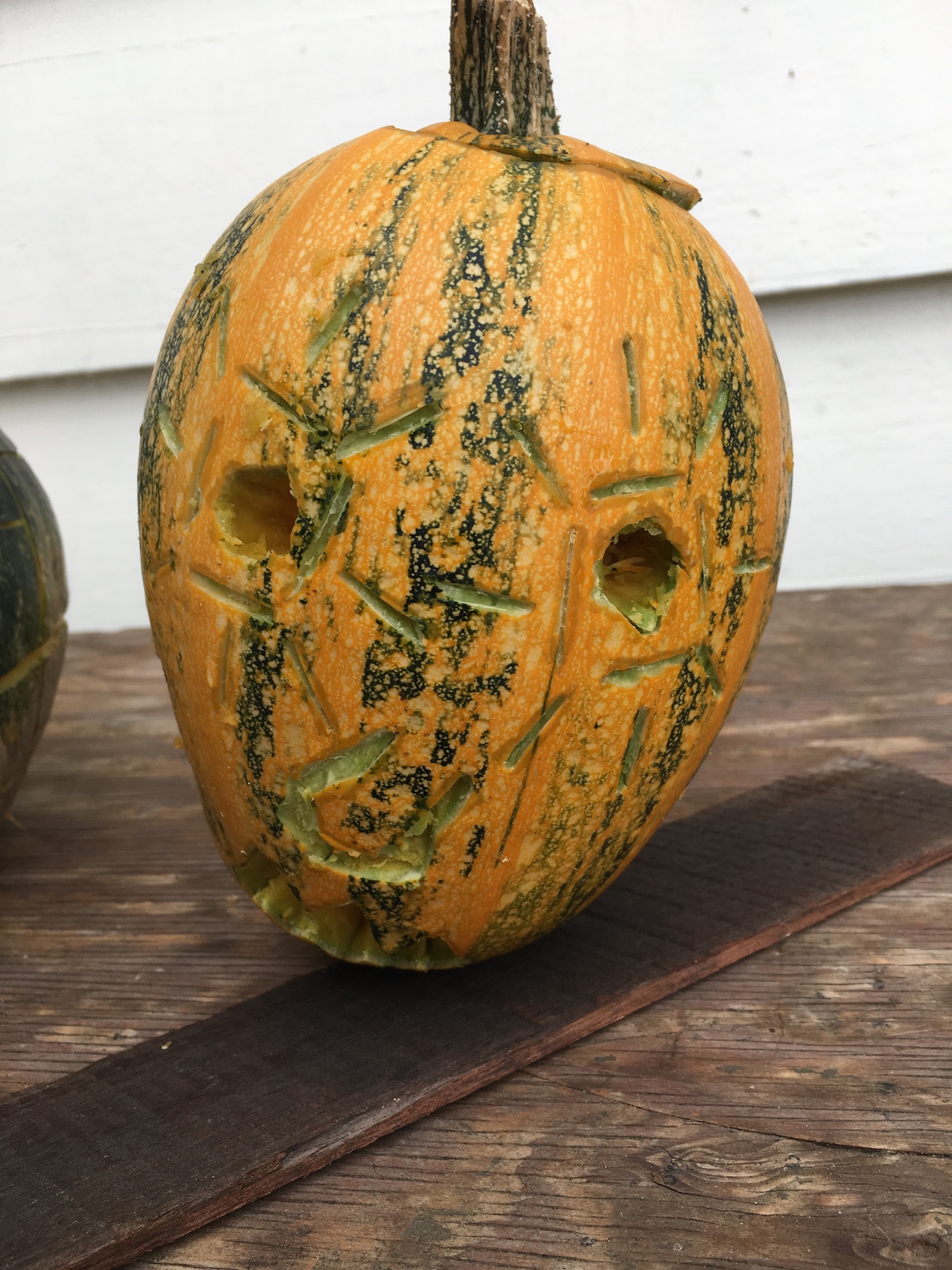
So I introduce the traditional Easter Jack-o-lantern. Carved while snacking on roasted pumpkin seeds.

Great fun for the kids, and better for them than chocolate bunnies!

A Tale of Two Walnuts

We have two walnut trees, both of them young. The older of the two gave us a few walnuts last year and one the year before. This year it gave us several good handfuls of nuts.

That’s not anywhere close to satisfying our annual walnut consumption. We put walnuts in granola, baked goods, burgers, tofu meatballs, and rice pilaf, among other things. We eat them as snacks, too, and I buy them in kilo-sized bags.

But walnuts here are all the mild English walnut (Juglans regia). They’re a good staple, but somewhat tame. Not something to feature in a dish.

Not like American walnuts (Juglans nigra). To me, these are the true walnuts–piney-flavoured and bitter, difficult to shell, with thick green husks that leave your fingers black. There aren’t many foods from the US that I miss anymore, but American walnuts are one of them.

When I was a kid, every Christmas my mother made walnut crescents–moon-shaped shortbread cookies packed with American walnuts and rolled in confectioner’s sugar. They melted on the tongue, and burst with nutty flavour. I made the mistake of making these with English walnuts once. They were vapid little sugar bombs. Not at all like real walnut crescents.

I have looked high and low for American walnuts here in New Zealand, with no luck. One time I saw a label in the grocery story saying “American walnuts”, and I was thrilled. Then I looked at what they were selling. The nuts weren’t American walnuts, they were English walnuts grown in America.

So I buy the cultured, mild-mannered English variety and dream of the wild, brash variety of my homeland.

Rich in Mushrooms

I come to the computer under the delightful glow of my third meal of wild mushrooms in the past two days. As I mentioned a few days ago, the recent deluge has brought all the fungi out to play.

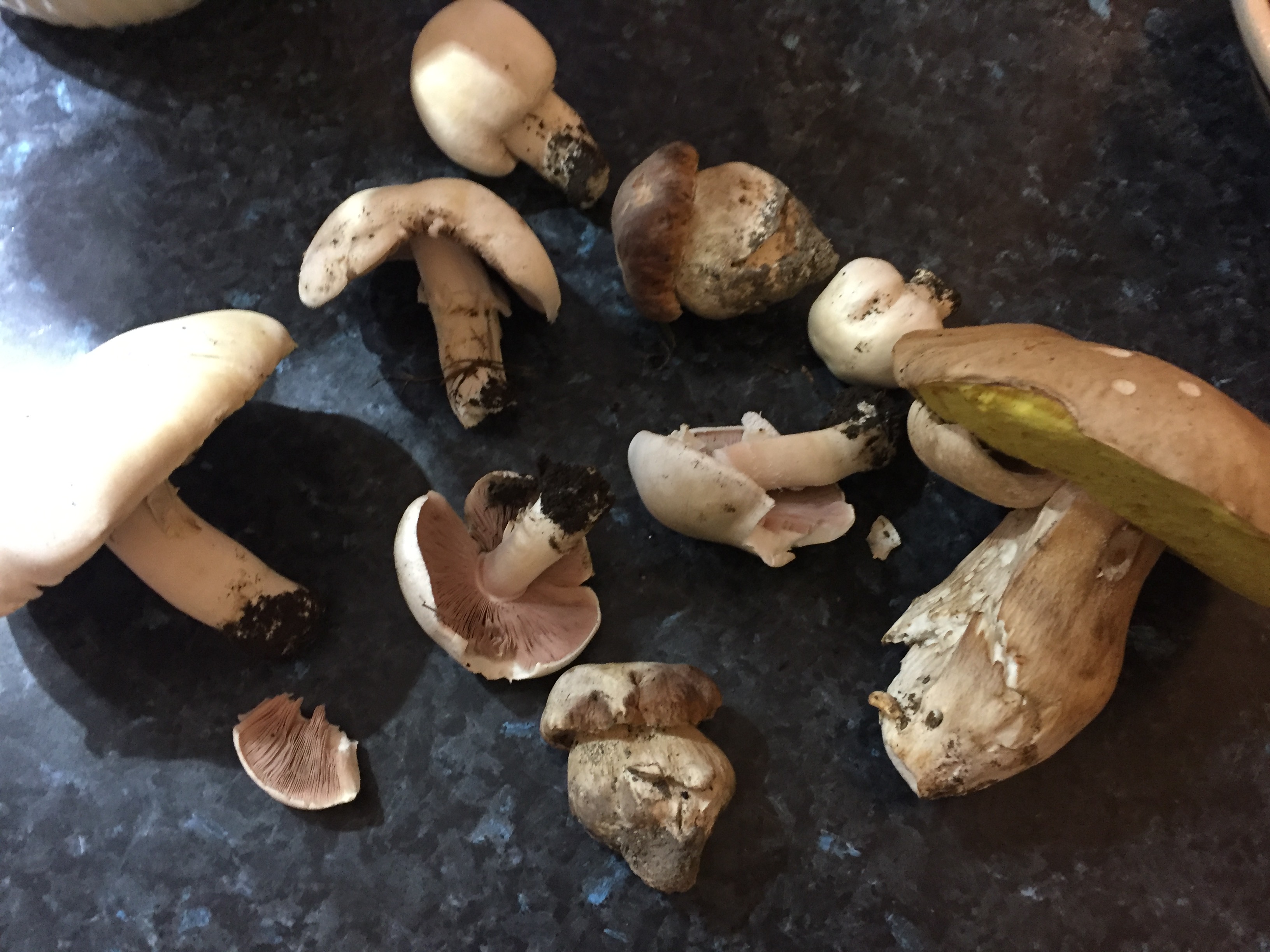
Agaricus arvensis and Boletus edulis are this week’s two wild additions to our meals. Their rich, earthy flavours have topped burgers and adorned home made pasta (because how can you possibly serve such wonderful mushrooms on store-bought pasta?)

There’s no doubt I love these wild mushrooms for their flavours, but I also appreciate them for their provenance. There’s something satisfying and primal about foraging for dinner. And it becomes even more satisfying when you consider these mushrooms can retail for $40/lb ($88/kg) in the US, if you can get them at all.

I smile to think that the dinner we’ve just eaten might have easily cost $30 to $40 a plate in a restaurant. But with wild-picked mushrooms, vegetables from the garden, and home made pasta (made with eggs from our own chickens), we spent well under $1 per person (and we all had seconds, and there are leftovers for tomorrow’s lunch). It’s no wonder we feel far wealthier than we actually are.

Indeed, you’d be hard-pressed to buy such a meal at any price, with vegetables just minutes out of the garden, eggs laid today, and obscene quantities of gourmet mushrooms. I almost feel sorry for rich people. All they have is money.


Apple Ring Pancakes

My husband mentioned he’d seen apple ring pancakes on the internet the other day, so I had to try them. I’m sorry I can’t attribute this idea to someone in particular, because I never actually saw the page. It’s a great idea, though.

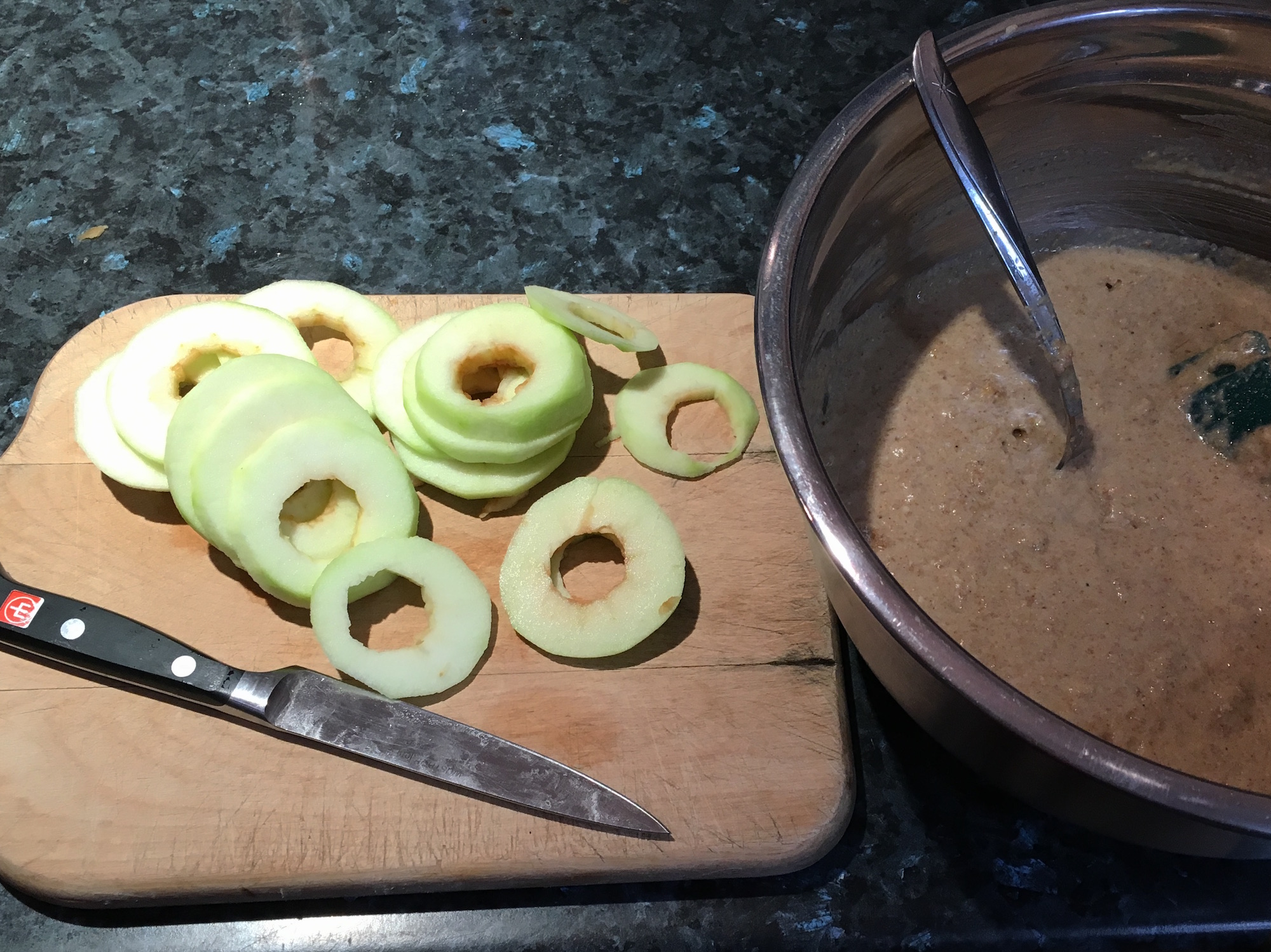
To make mine, I started with a double batch of my usual World Famous Pancake Recipe, and added a teaspoon of cinnamon and half a teaspoon of cloves to the batter. You want a thick batter, to cling to the apples.

I peeled, cored, and sliced into rings four apples.

To make the pancakes, I dipped each apple ring into the batter and laid it on the hot skillet. My skillet was too hot at first, and I was having trouble getting them cooked through without burning on the outside–they’re thicker than normal pancakes. But even the dark ones were delicious.

Fun to make and fun to eat. I’ll definitely be making these again.

Flying Saucers in the Garden!

I’ve mentioned these wee beauties before, but they deserve their own post. This is my third year planting extraterrestrials in the garden. Flying Saucers is an unusually shaped variety of scallopini (aka patty pan squash), developed in 2000. Its exaggerated ribbing gives it a spiky appearance. I’m not sure it’s particularly UFO-shaped, but it is bizarre-looking.

Like all scallopini, Flying Saucers has a lovely, nutty flavour and a firm texture. It does well in stir-fries, soups, pasta–anywhere you would use zucchini.

The ribs are most dramatic on young fruits, so pick them small (5cm/2in diameter), for maximum visual effect. If you pick them small enough, you can cut them in ’rounds’ that look like stars. I’ve also seen them used to great visual effect cut in half, hollowed out, and stuffed, creating beautiful star-like stuffed squash.

The seed catalogues say they are more green, less yellow when nighttime temperatures are high. Our nights are always chilly, so I don’t know if that’s true–mine have just a touch of green on the ends.

Flying Saucers is my scallopini of choice, since I discovered it. How could I resist such a brilliant squash?

Painted Mountain Corn

Last year, I tried planting a coloured corn, but the rats ate it all. This year, with some protection for my seedlings, I managed a crop of Painted Mountain. Though it’s popular for autumn decoration in the US, I’d never grown it myself.

I wasn’t certain it would produce well. The plants are shorter and faster-maturing than sweet corn, and they looked stunted. They were beautiful in the garden, though–deep burgundy-coloured stems and light green leaves. Dark red silk peeking out of the husks.

The beauty didn’t stop in the garden. My daughter and I sat on the porch yesterday evening and husked the harvest, exclaiming as each new cob was revealed. It was like Christmas, never knowing what surprise would be in the next package. The variety of colours and arrangements of colours was amazing. I’d seen all this before, in the “Indian corn” my mother decorated with each fall, but there was something magical about seeing the diversity emerge from one small crop I’d grown myself.

I have no intention of using this corn for decoration. It is beautiful, and I will enjoy it as it dries, but it is destined for more interesting uses. Painted mountain is a starch corn. Once it’s dry, I’ll grind it into cornmeal.

I have visions of beautiful, coloured corn chips, red cornbread, rosy polenta…mmm…can’t wait until it’s dry.

Summer Soups and Stews

One of the nicest things about the end of summer are those autumnal days that make me crave hearty soups and stews–dishes I haven’t particularly wanted to eat in the heat of summer.

To have a chill in the air, but still have a garden bursting with summer vegetables means we can make wonderful warming dishes with the very best of summer flavours.

We’re into our third day of rain, with temperatures hovering around 11°C (52°F), and enjoying the possibilities the weather has offered.

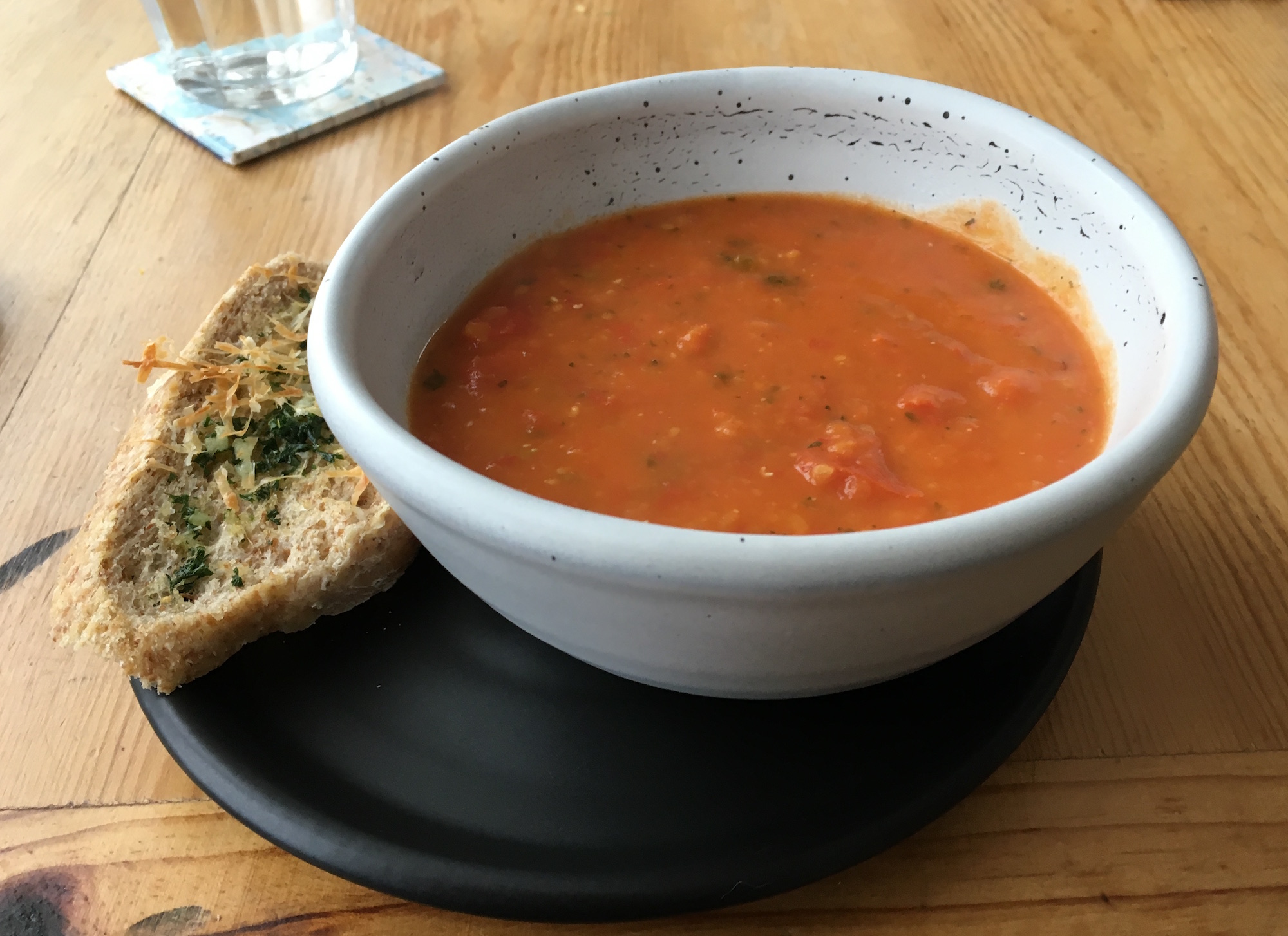
First up was a beautiful tomato soup, made with a king’s ransom of fresh, garden-ripened tomatoes, and handfuls of fresh herbs. It was amazing for dinner and made a wonderful warming lunch the following day, too.

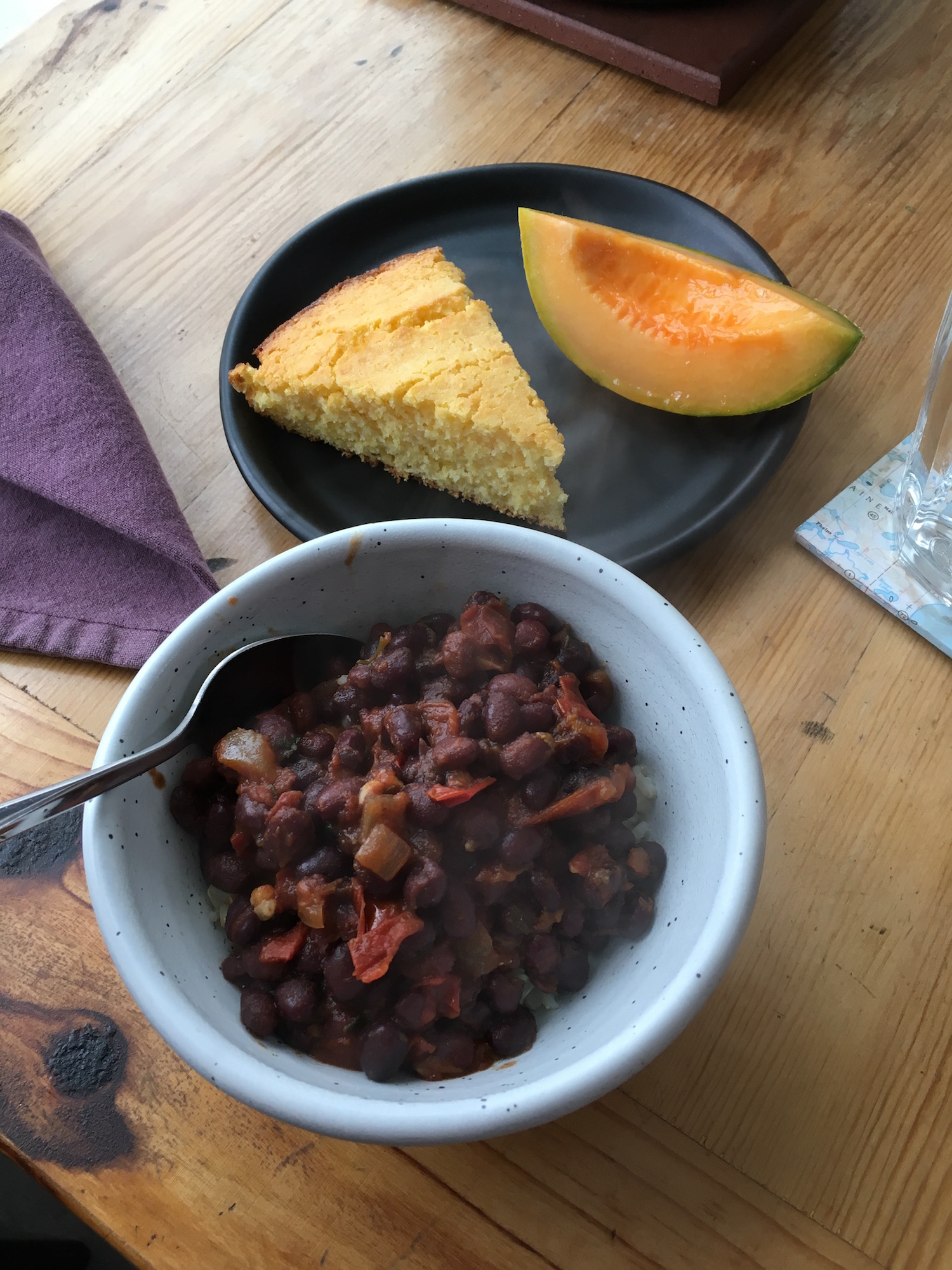
Tonight it was black beans from this year’s harvest, cooked with more fresh tomatoes and herbs, accompanied by corn bread and our own melons.

It makes me look forward to more rainy days to come!


Zucchini Tomato Tart

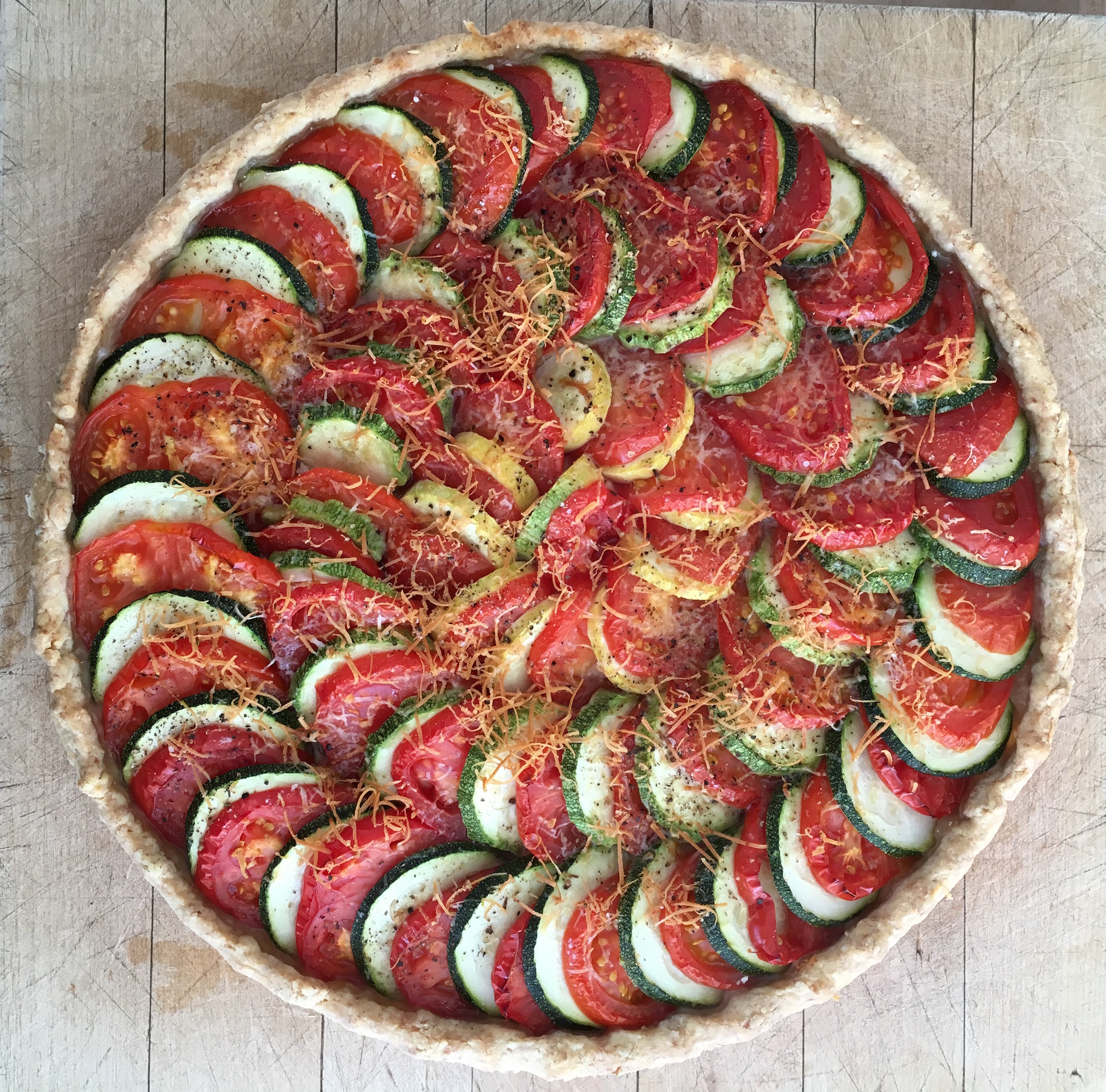
img_3173I knew what I wanted for dinner this evening. I remembered seeing the photo of it in one of our cookbooks. I remembered making it once, ages ago–a tomato zucchini tart. I couldn’t find the recipe, though, so I punted. The resulting tart was spectacularly good.

Here’s the completely untested recipe I made up on the fly.

Make your favourite pie crust. Line a large tart pan with it and chill it in the fridge while you prepare the rest of the tart.

Slice zucchinis and tomatoes into 3 mm (1/8 inch) slices. How many? I don’t know…enough. You can always slice more as you go.

Spread a generous layer of chevre (a soft goat cheese) on the bottom of the crust.

Layer slices of zucchini alternated with slices of tomato, starting at the outside edge of the pan and working toward the centre in rings. (Because I could, I used a different variety of zucchini for each ring, moving from dark green to light green to yellow…but I’m weird like that)

Sprinkle freshly grated parmesan cheese over the top, along with a generous grinding of black pepper and salt.

Bake at 210°C (400°F) for about 40 minutes.

I served this with corn on the cob and a cucumber and onion salad for a mid-week meal that felt more like a weekend feast.

The price of the beach

img_3170We spent yesterday at the beach–sun, sand, and surf!

It was glorious.

Today I paid for it.

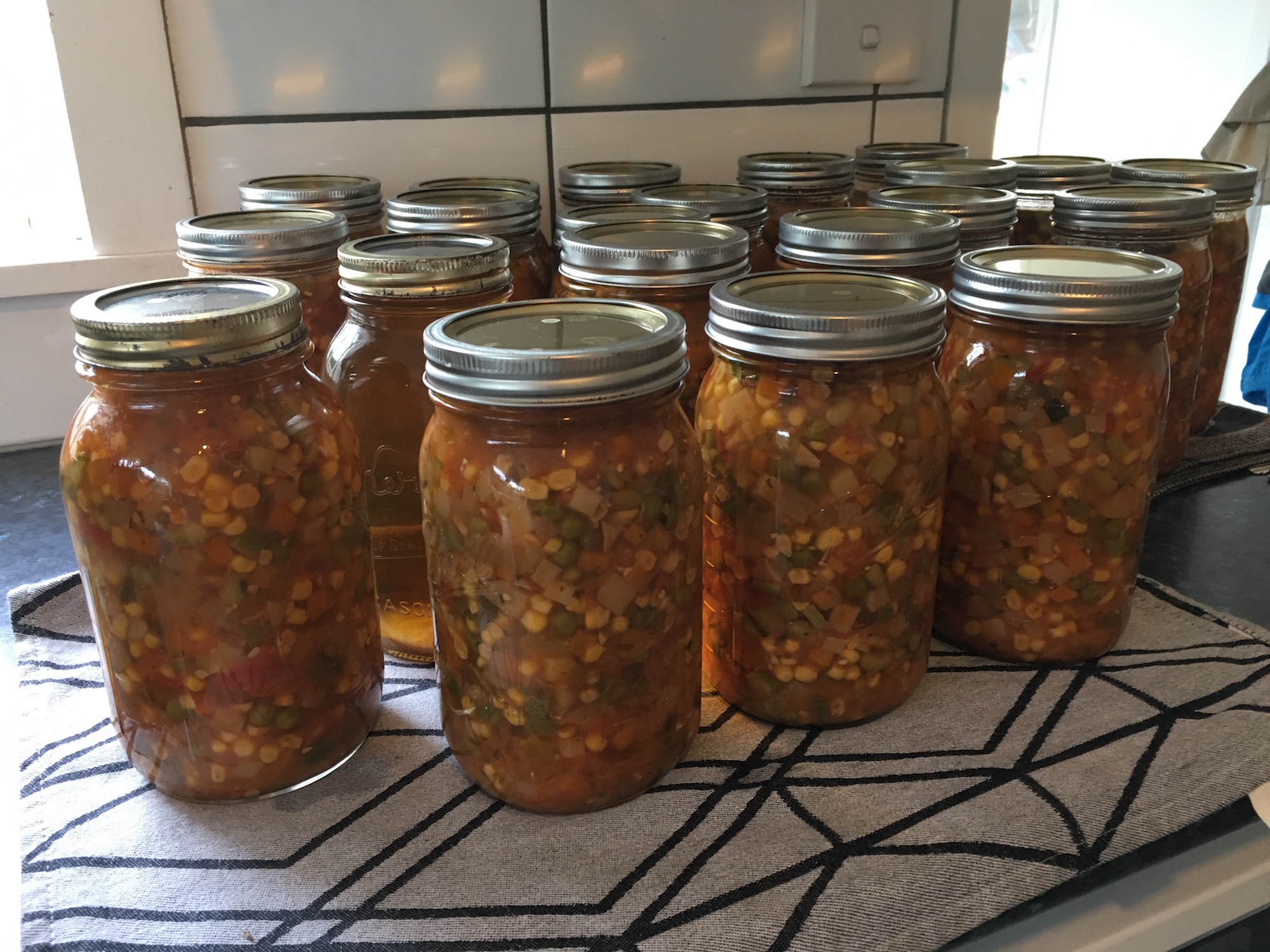
Not in sunburn or sand in my shorts, but in work. It was time to make our annual vat of summer soup, I was milking for the neighbour this weekend, and I had a weekend of cleaning and animal care to do–all in one day.

While I milked the neighbour’s goats, the rest of the family started picking and chopping vegetables. When I got home with a pot of milk, I made cheese around the vegetable prepping, then I joined in.

As the pot of soup came together, we started calculating how many jars we needed to hold it all. It was several more than we had empty.

So I made apple crisp, freeing up two jars (which still held last year’s apples). I baked that while the first load of jars was in the canner.

I had also planned on baking lunchbox desserts this weekend, so after putting the second load of jars in the canner, I made cookies.

I also took down and folded the laundry (and patched a hole in my daughter’s shirt), and washed a ton of dishes.

While the third load of jars was in the canner, I cleaned the house (mostly), and milked my own goat. Before that batch of jars was finished, it was dinnertime. I sat down for the first time since breakfast.

Whew!

The final tally for the day was 23 quarts of soup, 6 quarts of vegetable stock, 6 dozen cookies, one beautiful apple crisp, and a batch of chevre (and a clean house and laundry).

Unfortunately, the chicken house hasn’t gotten cleaned yet, nor has the bathroom. I could probably manage them yet today.

Or I could pour myself a glass of wine and worry about them tomorrow…
Uplifted Polenta Lasagne

2017-02-11-18-05-05-smLet me start by saying I had nothing to do with this meal, aside from growing the raw ingredients and making the feta and parmesan cheese. I was off doing other things while my husband cooked this. I didn’t even do the dishes afterwards–the kids washed.

Do I have the best family, or what?

This incredible dish is actually quite simple. My husband started by making firm polenta (flavoured with parmesan cheese, rosemary, salt and pepper) and allowing it to cool in an oiled jelly roll pan. When the polenta was firm, he cut it into squares, and layered the squares at an angle in an oiled lasagne pan with slabs of raw zucchini, slices of tomato, salt and pepper, and a mix of feta and grated edam cheese. He sprinkled fresh basil, chopped garlic, and diced tomato on top, and baked it at 220°C (on fan bake) for about 20 minutes. The result was rich, juicy and flavourful.

My contribution to the dinner was a simple salad of thinly sliced cucumbers tossed with salt, red wine vinegar, olive oil, and chopped fresh fennel leaves–a perfect accompaniment.

Summer cooking just doesn’t get better than this.