Market Month!

The Christmas season is heating up, and with it my market schedule. This month, I’ve got a stand at three markets, the first coming up this Sunday in Hokitika. My husband and I are taking the market as an excuse to spend the long weekend enjoying the West Coast, so my office floor is currently piled with books and market swag to be loaded in the car tomorrow morning. I’m very excited to be selling my latest book (set largely on the West Coast) in Hokitika!

Come on out to a market this month and say hello!

Astrobiology Fun

Not long ago, I attended a workshop on Astrobiology for teachers. I’m not sure which of my two jobs it was more useful for—teaching or writing.

Cool swag from NASA and Blue Marble Space!

My day job, though ever changing, often involves teaching science across years 3-8. One of the strands of the New Zealand science curriculum is Planet Earth and Beyond, so I regularly teach about our solar system and various features within our galaxy. Last year, I did a fun unit with the year 7 and 8 students in which students had to design spacecraft, habitat modules, and promotional campaigns for a colonising trip to Mars. 

I’ve rarely touched much on astrobiology, and the questions about life elsewhere in the universe, but the workshop made me think about all the ways that questions about life on other planets reflects on life on Earth. How these questions reflect on our actions as human beings—our treatment of other humans, our treatment of the planet and other living things on it. The presenters made a great case for using astrobiology as a way to dive into big philosophical questions about what it means to be alive on Earth today. 

What are our responsibilities to planet Earth and the life on it? What if we are alone in the universe? What if we’re not? Does it change our perspective on our own actions as humans? 

Sanjoy Son, from Blue Marble Science, spoke eloquently about how the teaching of astrobiology can give students valuable perspective on life, and how they can approach questions of personal differences, values, and civic responsibility. The take home message I got from his talk was that we are either the caretakers of the only life in the universe, or we are part of a vast, interstellar network of life. Either way, we are all ambassadors of planet Earth. What a great message for kids. What a great way for them to think about their roles as human beings.

As an author of fantasy and science fiction, of course I soaked up the cool facts about the gazillions of planets there are just in our galaxy, the weird ways life might have to adapt to wildly different conditions on other planets, the surprises that even our own solar system has produced in terms of planets and moons on which life could potentially survive, the physics of travel and communication through space. So many story ideas!

You’ll definitely be seeing more astrobiology creeping into my writing and teaching in the future!

Preorder Draconic Search and Rescue

I’m thrilled to announce that the Draconic Search and Rescue ebook is now available for preorder on many online retailers!

Nathan McMannis is bored. His friends have gone on to new adventures, while he’s stuck at the Alexandra Institute doing correspondence school. All he wants is more excitement, less maths homework.

But you know what they say: Be careful what you wish for.

A huge earthquake strikes, and emergency services are overwhelmed, unable to rescue the thousands of people in danger. To make matters worse, the weather turns deadly. 

Against his father’s orders, Nathan flies away with his draconic partners, Foggy Bottom and Rata, to rally the dragons. The Draconic Search and Rescue Team descends upon isolated and endangered towns to ferry people to safety. But the task might be too big, even for the dragons.

If they fail, thousands will die. 

Will the fragile peace between people and dragons hold in the face of disaster? How far are the dragons willing to push themselves to save the humans who persecuted them for centuries?

Another wild, dragon-filled adventure set in modern day New Zealand! This standalone adventure can also be read as Book 5 of the Dragon Defence League series.

Market Season

Next weekend I’ll be selling books at my stall at the Ōtautahi Crafter’s Market. It’s the first market of what I consider my Christmas market season. I know, I know, Christmas is AGES away, and I won’t start thinking about my own Christmas shopping until at least late November. But thankfully, lots of people start turning their thoughts to gift buying as early as September. Especially, the aunties and grandmas who buy books for their nieces, nephews and grandkids.

So I’ve booked in for a number of markets over the next few months, and I’ve come to realise that, in spite of being a socially awkward introvert who hates crowds and noise, I love selling at markets.

It’s EXHAUSTING, for sure. And it can be really depressing when you have a bad day and don’t even sell enough to cover the cost of your stall. But there’s so much to love about selling at markets.

  1. I love to meet my readers, or the parents/grandparents/aunties of my readers. Anyone who is browsing books at a market where they could instead spend their money on ice cream, hot chips, or cute garden gnomes is serious about books. They’re my kind of people. (Not that I don’t like ice cream, hot chips and garden gnomes, of course). I enjoy hearing what they like to read, who their favourite authors are, and why reading is important to them.
  2. Despite the crowds and noise, I appreciate the festival atmosphere of a market. Aside from the occasional spouse or young child who’s being dragged along against their will, people are there to have a good time. They’re happy. Shopping at a market isn’t like shopping for your groceries, that has to be done whether you want to or not. Market goers are willing victims—er, I mean—customers. And because they’re having fun, it’s easy for me to have fun.
  3. I love the excuse to browse other people’s stalls. I mostly frequent craft markets, and as an avid crafter myself, I love to see what other folks are creating. It’s a great way for me to get my Christmas shopping done, too.
  4. I enjoy the community of market goers. Go to enough markets, and you start to see the same vendors over and over. You say hello, ask how their day is going, whether they’ll be at the next market. For the vendors on either side of your stall, you practically become staff by the end of the day—looking after their stalls while they’re at the loo (and of course they do the same for you), and coming up with clever ways to hawk your own items and theirs together (Look! You can read my great books by the light of those beautiful handmade candles.)
  5. There’s nothing more satisfying than personally sending a copy of one of your books out into the world. Digital sales are fine, but there’s not the same feeling of success as when you actually hand your book to a reader yourself.
  6. I enjoy the creativity involved in creating my stall. Like many authors, I dabble in lots of other creative pursuits. A market stall gives me an opportunity to make use of my sewing, paper crafts, and other creative output to titivate my stall.

In spite of these positive things, I can’t deny that selling at markets can be exhausting and overwhelming. I’ve developed a few techniques to manage the stress that a day among so many people can induce.

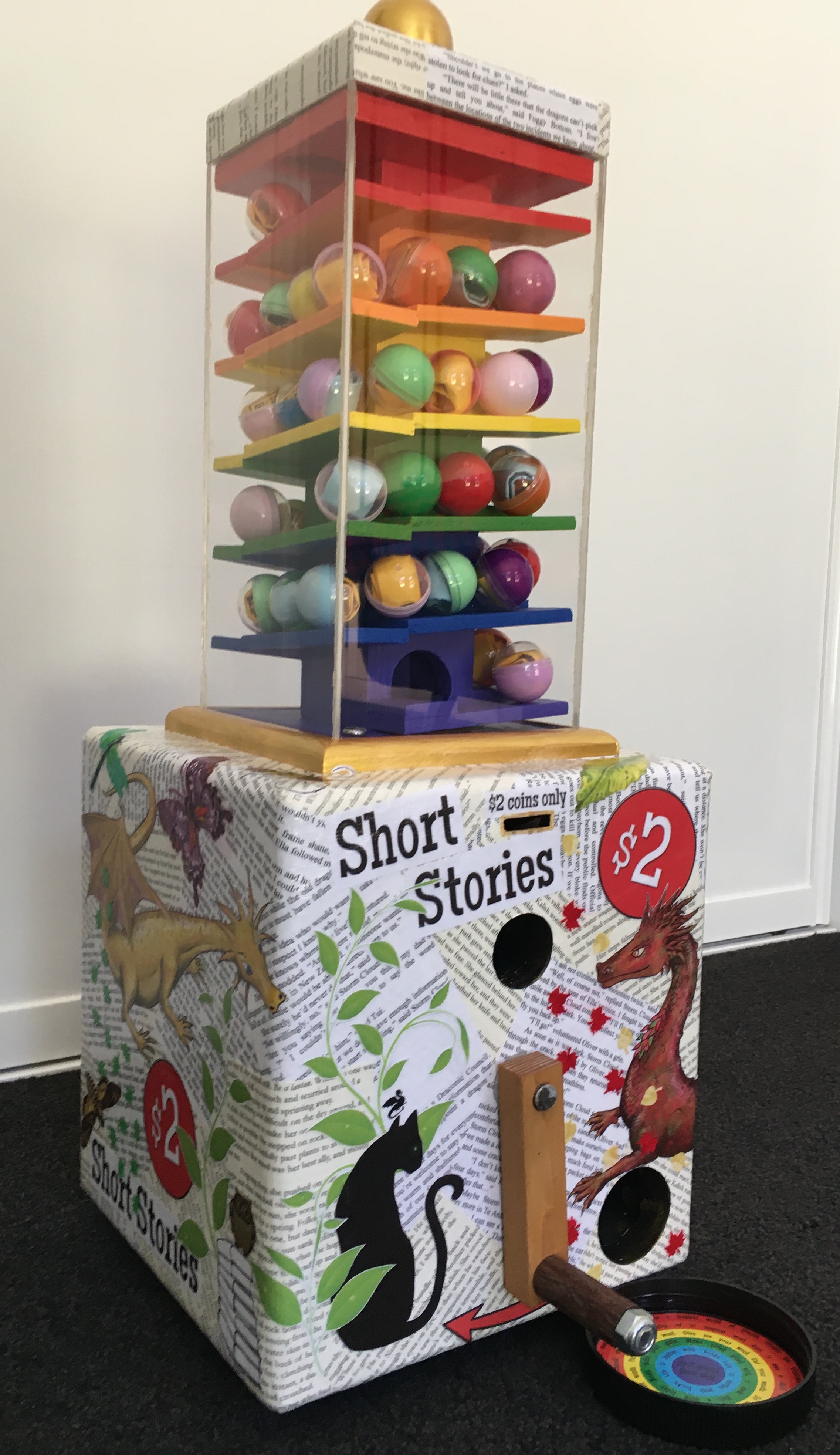
The story ball vending machine adds to my market day fun.
  1. Bring a healthy lunch. It’s so easy to think, “Oh, I’ll treat myself to something from a vendor for lunch.” But sugary, salty, greasy food leads to feeling depleted and icky by the end of the day. I take carrot sticks, fruit, and a sandwich—all prepared in bite-sized pieces so I can snatch a bite between customers throughout the day.
  2. Get there early, but not too early. I know how long it takes me to set up. To avoid being stressed about not being ready, and to avoid awkward standing around before the market starts, I time my arrival with just enough time to set up and use the toilet.
  3. Rehearse my spiel. I know what I want to say about each of my books, making it short and snappy. By thinking in advance, I don’t flounder awkwardly for the right words with a customer.
  4. Remember, books don’t sell themselves. I use this truth to my advantage when I need a social break. When I’m overwhelmed and don’t want to engage with anyone, I simply take a step back and stop talking to people. I smile politely, but if I don’t attempt to engage, most people won’t engage with me, and I get to take a break. 

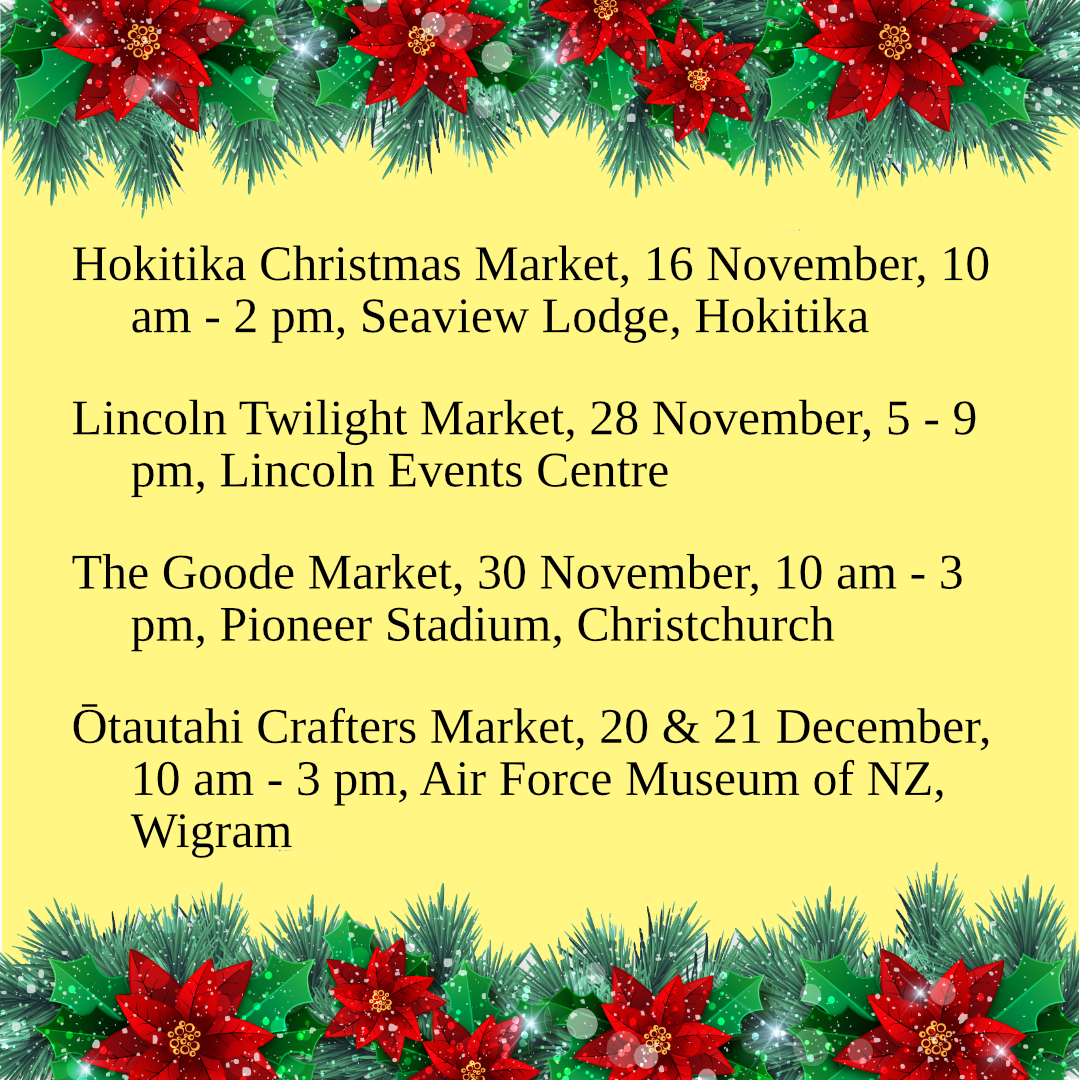
I’m looking forward to the coming months, hawking my books to readers. Come visit me at these upcoming markets!

Ōtautahi Crafters Market—20 September, 10am – 5pm at South City Mall

Hokitika Christmas Market—16 November, 10am – 2pm at Seaview Lodge

Lincoln Twilight Market—28 November, 5 – 9pm at Lincoln Event Centre

The Goode Christmas Market—30 November, 10am – 3-pm at Pioneer Stadium, Christchurch 

Ōtautahi Crafters Market—20 December, 10am – 4pm at the Air Force Museum of NZ, Wigram

Writing Jitters

Yesterday marked 15 years since the M7.3 earthquake here in Canterbury. I doubt there’s been a single day since then that I haven’t, at some point in the day, thought about earthquakes. I even sleep under a quilt inspired by the 2010 quake.

Working on the quake quilt. Wow! Look how little grey hair I had back then!

Earlier this year, I took a friend, who was visiting from overseas, to Quake City, the museum dedicated to our earthquakes in 2010-2011, which devastated Christchurch. I thought I would be okay visiting the museum, since the quakes were so long ago. But facing that exhibition, everything about those days, weeks, and months came rushing back. At one point, my friend turned to me and said, “You talk like this happened yesterday.”

It felt like it had happened yesterday.

The quakes changed me, changed everyone who was here at the time.

The quakes made me a New Zealander. In the aftermath, when communities were rallying together to help everyone, I realised that this was the place I wanted to be. When the world came crashing down, I wanted to be in a place where university students mobilised a massive volunteer force to dig liquefaction from people’s houses, where farmers airlifted food into the city, where ordinary people organised the collection and distribution of blankets and other homewares for people who had lost everything, where spaces left empty in the city by demolished buildings were turned into temporary parks and places of joy.

The Famous Grouse in Lincoln, post quake.

This week I got the beta reader comments back from my next book, Draconic Search and Rescue,  in which the Alpine Fault ruptures, so earthquakes have been on my mind a lot. None of my beta readers experienced the Canterbury quakes—most of them hadn’t even been born yet. Writing the book, I worried that I would frighten my readers (8-13 year-olds are my target market) with a book about the Alpine Fault rupture. When it happens (and it will), the consequences for the whole country will be huge, and some towns are likely to be entirely destroyed. Researching for this book kept me awake at night, inspired me to be even more particular about my own earthquake preparedness, and reminded me that I’m not entirely crazy to ensure that, wherever I go, I’m prepared to walk home (hi vis vest and water bottle in the car, check, comfortable shoes, check, jersey, check).

But my beta readers wanted more danger, more fear. For them, it isn’t real. The rumble of a large truck doesn’t have them pausing to listen, make sure it’s just a truck. They don’t look for the emergency exits every time they enter a room. They don’t mentally assess the construction date of every building and consider whether it will collapse in the next quake.

So this week, I’m ratcheting up the danger in my book. Shoving my characters closer the destruction, maybe breaking a limb or two. And if I’m a bit jumpy for the next week or so, you’ll know why.

Setting Goals, Celebrating Achievements

We all love it when we get that sense of accomplishment—the feel-good sensation when we can step back and say ‘I did that.’

But sometimes that feeling is hard to come by. When we have lofty goals or a big job ahead, it can feel daunting. The grinding slog to your goal might never end—or at least it feels that way.

I know a lot of people who have started on some project or creative pursuit, but have given up partway, because they felt they’d never reach their goals.

I’ve certainly felt the same from time to time.

But I’ve come to realise that there’s a difference between goals and dreams, and by defining the difference, we can keep ourselves motivated to continue those massive projects.

Dreams are the big-picture goals. For example, one of my dreams is to be able to support myself with my writing. Another is to be able to produce all the food my family consumes.

It’s possible (okay, probable) I’ll never reach those dreams, for lots of reasons. I should probably give up on both of them. But then I’d never reach them, for certain.

Here’s where goals come in. Goals are achievable steps towards those dreams. Businesses and organisations use goals all the time to measure their progress. A charity might have the dream (or mission, in organisational speak) of eliminating child poverty. Are they likely to actually accomplish that? No. So they turn to smaller, achievable goals to measure their progress—number of meals handed out, number of families housed, etc.

I do the same thing in both writing and gardening.

This week, I am working on my quarterly plan for July – September. This is my road map. My 3-month to-do list. Modified from a report form I was required to file as a Peace Corps Volunteer 30 years ago, I’ve been using these quarterly plans for decades now. 

Each quarterly plan includes goals for that quarter. Goals are actions I can take. Things within my control. For example, I never include a goal like, ‘publish four short stories in literary magazines’, because I have no control over whether a literary magazine accepts my story. Instead, my goal might be to ‘submit short stories to ten literary magazines.’ This is something I can accomplish. And if I keep doing it, eventually I’ll end up with those four short stories published in literary magazines. But as the rejections pile up, I won’t feel as though I failed to meet my goal, provided I did actually submit to ten literary magazines. Likewise, sales goals might include attending a certain number of markets during the quarter, but wouldn’t include goals as to number of books sold at those markets. Because I can’t control how many people show up to the market, or whether the people at the market are interested in buying books on that day. Of course, over time, I’ll learn which markets are worth attending, and how many books I can reasonably expect to sell at a particular market. But my goals will always centre on attendance at those markets, because that is the only thing I can realistically control.

And every time I accomplish one of those goals (and mark that satisfying tick in the DONE column of my plan), I get to celebrate. At the end of each quarter, I can look back at my plan and say, ‘look at all the things I’ve accomplished.’ Have I reached my dream? Yeah, nah. Have I taken concrete, useful steps towards it? Absolutely.

I do the same when I’m gardening, although it’s a more seasonal activity. When I survey the garden and consider all there is to do in order to grow enough to feed us, it’s easy to get overwhelmed. So late each winter, I make a plan that includes achievable goals for each week. All of those goals add up to plants in the ground—an excellent accomplishment. Of course, there’s nothing I can do about the weather—if there’s a drought, or weeks of rain, or excessive heat … I still might not reach my dream. But I have still accomplished my goals and given myself the best chance I can of reaching that dream.

And, honestly, that’s all we can ask of ourselves. Everything we want to achieve—those big dreams we have—include aspects that are out of our control. Luck, the decisions or actions of others, the weather, the economy, pandemics, earthquakes … you can’t pin your sense of accomplishment on the outcome of events like that.

So set yourself some achievable goals, then celebrate your accomplishments. You’ll find the journey to your dreams much more rewarding.
Market Fun!

Just one more sleep until the Goode Market (Saturday 29 March, 10-3 at Pioneer Stadium), and then a week until Christchurch Armageddon (Saturday and Sunday, 5-6 April at Te Pae)!

To say I’m excited and nervous about these events is an understatement. 

Not that I haven’t had stalls at these events before—I know the drill. 

But this year, I have something new. Something I’ve been having fun with for the past couple of months.

For some reason (I’ll never understand the strange workings of my brain) I decided I wanted to have a coin-operated story vending machine. After investigating the commercially available gumball machines, I decided I’d have to make what I wanted.

I roped my husband into the project, and he sorted out the inner workings and the fiendish physics of funnelling balls into a hole (Who would have thought it was so complex?).

Then I spent some fun and sometimes frustrating hours decoupaging and painting (my first-ever decoupage project … I probably should have practiced a bit more before launching into it).

Once we were confident the machine functioned, I got to work writing 500-word stories—the perfect length to print on a quarter-sheet of paper and fold up inside a small vending machine capsule.

As someone who normally thinks in novel-length stories, I had a HARD time writing 500-word stories. I wrote quite a few 1500 and 2000-word stories before I nailed the 500-word length. But it was so much fun! I got to explore different genres, different voices, different story structures—there’s a bit of everything among the vending machine stories. I’ve learned heaps while creating these stories.

Tomorrow’s market is the first time I’ll have the story vending machine. It’s loaded with a mix of twelve different stories for ages 8 and up, each one a bite-sized morsel of adventure. What better way to liven your day?

I’m nervous, because I’m so excited about the story vending machine, and I want my readers to be just as enthusiastic. I’m also nervous because there are still some technical glitches with the machine (those crazy physics of rolling balls again …), and I just hope it works smoothly when it’s put to the test.

Want to try out the story vending machine? Visit my stand at The Goode Market or Christchurch Armageddon! See you there!

World Poetry Day 2025

March 21 is World Poetry Day. Take a moment to enjoy your favourite poem or poems. Write a few of your own. I was inspired to write a poem about poetry today by one of my favourite poems—How to Eat a Poem, by Eve Merriam. This is just one of many favourite poems in the book, Reflections on a Gift of Watermelon Pickle…, (Scholastic, 1966).

What is a Poem?

It is
The hanging moment
before the roller coaster plunges.
The intake of breath
as you drop a dozen free range eggs.
The band around your heart
at a friend’s funeral.
The comfort
of rain on a roof that does not leak.
The burn in your thighs
as you reach the mountain peak.
The roar
of fans at the football game
The wind in your hair
on a Sunday drive to the beach.
The silence
of a starry night sky.
The rest
at the end of a long day.

Release Day is Coming!

Book 2 in the Rifton Chronicles is almost here! 

Meet Katie Cochrane, budding restauranteur. She has no idea what she’s in for when her crazy Aunt Rachael gifts her the burnt out Rifton Pub for her birthday. Before long, it’s clear that renovations are the least of her worries. She always knew running a restaurant would be challenging, but she never expected it to involve witchcraft.

This cosy urban fantasy can be read as a standalone, but, Rifton being a small town, it includes many of the characters from book 1 of the series. I was excited to have a chance to spend more time with the quirky ladies of the Rifton garden group and Rifton’s demonic felines.

So pull out your gardening gloves and secateurs, and pop on down to the Rifton pub for some supernatural fun!

Preorder today, and be the first to read Demonic Summoning for the Modern Gardener!

Release date is 31 January, so you won’t have to wait long!

View the trailer

A Writer’s Christmas

This year’s tree is NZ Flax stalks.

It’s Christmas Eve, and I suppose I should be in holiday mode, preparing for our upcoming tramping trip, baking or cooking something, doing last-minute gift wrapping …

But we had our family Christmas celebration on Sunday, because our daughter is already on her way to Southland for two weeks of climbing, and our son leaves tomorrow. So, with the gifts and fancy meals out of the way, I am ready to get back to work.

Not the day job—I still need a break from that—but writing work is calling me. Which means it’s not really ‘work’, I suppose. 

I treat writing as a job that I go to two days a week. I put in long hours on my writing days, and there are certainly days on which it’s hard to keep myself at the desk, plugging away. But the fact I was at the computer typing away at 6.30 am on Christmas Eve tells me writing is more than a job. 

As it should be. If I was writing to make a living, I’d be sorely disappointed. Turns out, I can’t not write. The past week, filled with family, celebrations and outings has been fun, but I’ve keenly felt the missed writing days. I’ve been snatching moments here and there (hence the 6.30 am writing session on Christmas Eve), but haven’t had a chance to spend long stretches in the writing zone.

Instead, I’ve been gathering experiences, watching people, squirrelling away ideas. When the holiday madness settles, I’ll be primed and ready to write. 

In the meantime, I’ve got a new outdoor poetry chalkboard, made for me by my daughter, to fuel some quick writing exercises. I’m wondering how long I could sustain a poem a day, like I did during lockdown. Or maybe I should limit myself to one a week, in the interests of getting other stuff done, too. So many writing possibilities! 

I hope you all have a lovely holiday season doing things that inspire you!