Many years ago, I posted a blog titled 50 Ways to Eat Zucchini. Since then, I’ve gotten much better about my zucchini planting—I plant half as many as I used to. Of course, that still means we have too many. We’re currently giving away 5 to 10 kg of zucchini a week, eating it in every dinner and baking it into desserts.
I don’t mind having too much zucchini. It’s a versatile vegetable that can be grated into all kinds of dishes (chilli, pasta sauce, enchiladas, burgers …) or featured in beautiful slabs or rounds (zucchini and tomato tart, grilled zucchini, frittata …).
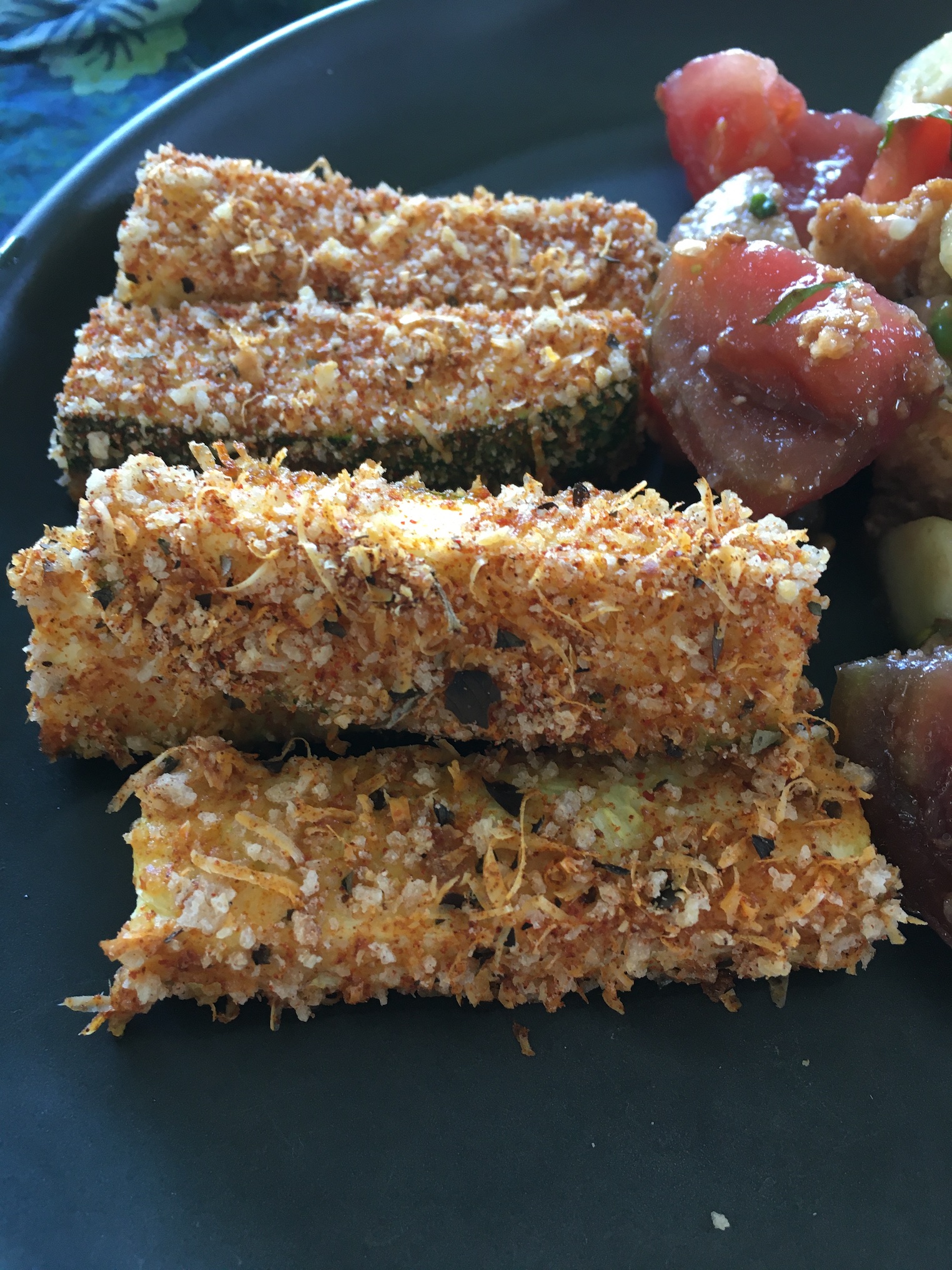
One of my favourite ways to eat zucchini is as breaded, oven fried sticks. These tasty ‘fries’ take a little work, but are well worth the effort. I fill a large jelly roll pan with them, and they vanish, even when it’s just my husband and me for dinner.
I don’t have a set recipe, but here’s an approximation of what I do:
2 small to medium sized zucchini 1 egg 1 cup bread crumbs 3/4 tsp salt 1/2 cup grated Parmesan cheese 2 tsp paprika 1/4 tsp chipotle 1/2 tsp smoked paprika 1 tsp dry oregano small handful of fresh parsley or basil, finely chopped
Cut the zucchini into thick sticks, about the length and thickness of a finger. Whisk the egg in a small bowl. Combine all other ingredients in a separate bowl. Generously oil a large baking sheet.
Dredge each zucchini stick in the egg, then the breadcrumb mixture and set on the pan.
Bake for about 20 minutes at 200℃, until browned and cooked through.
Serve hot, with your favourite dip, if desired. We love chipotle mayonnaise with them, but they really need no further embellishment—they’re delicious as is.
There are certain pieces of kitchen equipment that don’t get used often—the milk frother, the crinkle cut knife, the herb scissors … Most of these items are really unnecessary, and some don’t work very well, so they’re only pulled out on rare occasions when you feel like faffing around with something.
Other equipment is absolutely essential, but serves a specific purpose.
The sauerkraut crock is one of those.
This heavy, straight-sided 3-gallon stoneware crock is the perfect vessel for fermenting cabbage. It holds a large amount of cabbage, and is easy to pack and empty. With straight sides, weighting the cabbage while it ferments is easy to do, and we’ve made a custom ‘chaser’ for this very purpose.
For six weeks of the year, the sauerkraut crock is full of bubbling cabbage.
For the remaining forty-six weeks, it sits in the corner of the living room—a dubious decoration in an otherwise unused corner. It’s pretty much useless for anything else in the kitchen—it’s heavy, bulky, and an inconvenient shape. The custom chaser, too, is of limited use—it gets tucked into the unreachable cabinets above the refrigerator.
By the time I pull the crock out again, it’s full of dust and dead insects.
You might think it’s not worth keeping around. And for many items I use maybe once a year, I’d agree.
The milk frother, crinkle cut knife and herb scissors … when they break, I won’t replace them. The sauerkraut crock, I will.
Because I can’t imagine not making sauerkraut, and the crock is the only tool that will do for the job.
It is the last day of January here, my favourite month in the garden.
This January has been more difficult than many, with cold wet weather rather than the usual dry summer warmth. But the garden has still been a January garden.
December is a month of weeding, because my vegetables aren’t yet large enough to compete against most weeds. The weeding effort spans the entire month, and I always aim to have a weed-free garden on Christmas Day.
All that effort pays off in January, when, as if by magic, the vegetables are suddenly huge, crowding out the weeds and basically looking after themselves. I pull the occasional weed that manages to pop its head above the vegetables, and I keep the paths relatively clear, just so I can move easily through the garden. I water as needed. Otherwise, there’s little to do to as far as maintenance goes.
In January, the gardening effort switches from establishment and maintenance to harvesting, reaping the benefits of my hard work. It’s not that we don’t eat from the garden all year long, but the stretch from January to March is a magical one, where production vastly outstrips our ability to eat. In January, the freezer and the cupboards begin filling up with fruit and vegetables preserved for winter enjoyment. The squirrel in me chitters smugly as I stash away the fruits of my labour, already savouring the meals, snacks, and desserts to come.
It’s as much work as the establishment and maintenance phase of the year, but the reward is immediate and tangible. By mid-March, I’ll be exhausted by the harvest, tired of making sauces, jams, and preserves. Tired of having to deal with overflowing baskets of vegetables every day. But here in January, the novelty hasn’t worn off. The excitement of each new crop coming on is palpable. The thrill of lining up jars of preserved food on the shelves banishes any fatigue.
So I say farewell to January with reluctance and look forward to several months more of deliciously exhausting harvest. And I’ll take you on a tour of my January garden. Enjoy!
“Gardens are fashioned for many purposes with many different tools, but all are collaborations with natural forces. Rarely do their makers claim to be restoring or rebuilding anything from the past; and they are never in full control of the results. Instead, using the best tools they have and all the knowledge that they can gather, they work to create future environments. If there is a lesson it is that to think like the original inhabitants of these lands we should not set our sights on rebuilding an environment from the past but concentrate on shaping a world to live in for the future.”
–Charles C. Mann (1491: New Revelations of the Americas before Columbus)
Many years ago, I wrote this quote into a sticky note on my laptop. I look at it regularly, and it resonates with me every time. It expresses a mindset my husband and I employ on our little plot of land.
As I sit here on the porch on a warm summer afternoon, I can’t help but think back to what this section was like when we bought it—a bare paddock so devoid of nutrients that even the weeds were sparse. Sitting here today, I am surrounded by a mix of food crops, beautiful flowers and native plants. Five years ago, this plot of land could barely sustain the scraggliest of grass. Today it feeds us, provides food and shelter for native insects and birds, and is a welcome escape from all the ills of modern life. In time, as plants grow, it will hopefully become more sheltered, more resilient to temperature and rainfall extremes. In time, it will hopefully take less effort to maintain. In time, perhaps we will see native bellbirds and tūī as often as we see non-native blackbirds and starlings in the garden.
This is what we aim for. But, as Mann said, we’re not in full control.
Native skinks seem to have disappeared from the garden, despite the abundant food and shelter we’ve provided. Perhaps the influx of domestic cats is at fault. Or maybe some other factor outside of our control. Unwanted weeds continue to invade from neighbouring properties. Plant diseases take advantage of favourable conditions to decimate crops from time to time. Hail, floods, droughts, and wind all take their toll.
So the resulting garden is a compromise. What can we reasonably grow this year? What needs to be abandoned, either temporarily or permanently? What new opportunities are presented by quirks of nature or chance?
Guiding every decision is the question, what do we want the place to look like next year? In five years? Because, as Mann said, we’re shaping a world to live in for the future.
Incidentally …
If you haven’t read 1491, do it. It will shatter all those Eurocentric views of the world you’ve been steeped in since birth and change your whole attitude towards the history of the Americas.
At this time of year, I love chatting with others about their holiday traditions. Every family’s traditions are unique—a combination of family history, ancestry, and geography all mashed together with individual preferences.
Trifle has mostly replaced cookies as my Christmas baking of choice.
And they evolve over time. The Christmas traditions I grew up with are not the ones I practise today. They took a dramatic shift twenty years ago when we moved to New Zealand from Minnesota—northern hemisphere traditions make no seasonal sense here, where Christmas and the summer school holidays coincide.
So my husband and I adapted. Like most Kiwis, our holidays involve travel—we have a tradition of a family backpacking trip the week before Christmas. I always carry a little stuffed reindeer, strapped to the top of my pack, as our holiday hike mascot. We pack Christmas cookies, and usually include one ‘fancy’ camp meal (especially if the tramp extends over Christmas Day).
Our Christmas tree isn’t a pine tree—a cut tree would last about three minutes in the summer heat and wind. Instead, we make our ‘tree’ each year out of whatever materials we have on hand. Making, then decorating the tree is usually a whole-family event.
The LEGO tree of 2019 was one of my favourites, with a motor powering moving parts.
Our big Christmas meal (if we’re not on the trail) is on Christmas Eve—calzones full of vegetables from the garden. We make extras, and enjoy the leftovers for lunch on Christmas Day.
The big day is meant to be a day of relaxation for everyone, so Christmas breakfast sticky buns are made the night before, and rise in the fridge overnight, to be popped into the oven in the morning. After a lunch of leftover calzones, dinner is a big salad accompanied by cheese and bread. Simple as. No slaving in the kitchen on a beautiful summer day.
Boxing Day is beach day for us—along with most of the population of New Zealand—a day to relax with the family and celebrate summertime.
It’s a long way from the hot cocoa, turkey dinners, and carolling of Christmases in my youth, but our traditions do what all good holiday traditions do—they provide opportunities to spend time with family while enjoying seasonal delights.
So happy holidays to you all, and may you enjoy your own traditions, whatever they are! Add a comment with your own traditions!
Today is Thanksgiving in the United States. Since we’ve been in Aotearoa New Zealand, we don’t celebrate the holiday—who has a harvest festival in springtime? Add to the seasonal disconnect the dumpster fire that is world politics at the moment, and you could be forgiven for not feeling terribly thankful this Thanksgiving.
But it’s good to set aside all the frustrations in life (like the frost that has hit the vegetable seedlings every single night since our ‘frost free’ date), and reflect on the good things.
This Thanksgiving, I am thankful for a multitude of things …
My coworkers at my day job—teachers, teaching assistants, and support staff—who are all absolute legends, working under stressful conditions for lousy pay, usually without any recognition of the amazing work they do.
The fellow authors in various author communities I’m a part of, who are supportive of all writers and work together to support, encourage, and promote authors, books, and reading. You are rock stars!
The members of my local garden group, who share freely of their gardens, knowledge, and experience. You are inspiring!
My garden. Maybe it is weird to be thankful for it, because it doesn’t just happen—my husband and I have worked hard to turn this sad paddock into an oasis of food and flowers. But I am thankful for all the plants and soil organisms that have worked with us to make our efforts pay off.
My husband, who is my best friend, greatest fan, and partner in all things.
My kids, whose passion for the people and the world around them remind me that all is not lost yet.
Do you notice the pattern? It’s all about communities—of people, of living things.
I don’t know what’s going to happen in the world over the next few years. Much of it will be pretty bad, I’m guessing. But there are communities around us working for good. There are people who want all our tamariki to be able to read, to have healthy food to eat, clean water to drink, health care and mental health support. There are people around us who don’t think in terms of ‘us’ and ‘them’, but embrace humanity as a whole, in all its diversity. There are people everywhere who care about the people and the world around them.
I am so thankful that these people exist. I am thankful to be part of some of the communities who put this caring into practice in their daily lives.
So, while the world burns around us, I give thanks for the small communities that work tirelessly to put out the fires.
I’m part of a local group of keen vegetable gardeners who meet fortnightly throughout the growing season. Each meetup involves a tour around someone’s garden, and then a cup of tea, while we discuss our gardens and gardening, complain about the weather, and generally catch up with each other.
Our most recent gathering was at a garden just 200 metres down the road from our house. Bev’s been gardening there for over 20 years, and the property is beautifully sheltered by large hedges and mature plantings.
And even though we live only a three minute walk away from one another, our gardens grow remarkably differently.
Bev’s is almost always a week or two ahead of mine. And not just because she plants earlier than I do—her tree and berry crops leaf out, bloom and fruit before mine do. She plants out her tomatoes before I do, her carrots germinate more rapidly and grow more quickly, her peas outstrip mine within weeks of germination, her green beans produce pods a week ahead of mine. The differences are remarkable.
We are so close to one another, the temperature and rainfall on our two gardens is all but identical. But Bev has created an amazing microclimate for her plants with rich soil and excellent shelter.
Other women in the group have done similar wonders on their properties, creating striking pockets of abundance by carefully manipulating the microclimate in their gardens. In fact, my garden is sometimes behind other group members’ gardens in colder locations.
It’s something to aspire to. Having started with a bare paddock with no topsoil four and a half years ago, we’ve come a long way on our property, but we also have a long way to go. We are incredibly fortunate to have amazing gardeners nearby to inspire us to keep working towards our own pocket of abundance.
The natural microclimate of our property is apparently perfect for dandelions, because they are abundant and healthy everywhere.We haven’t managed a good microclimate for citrus yet, except in the greenhouse.We do manage to grow great broad beans!
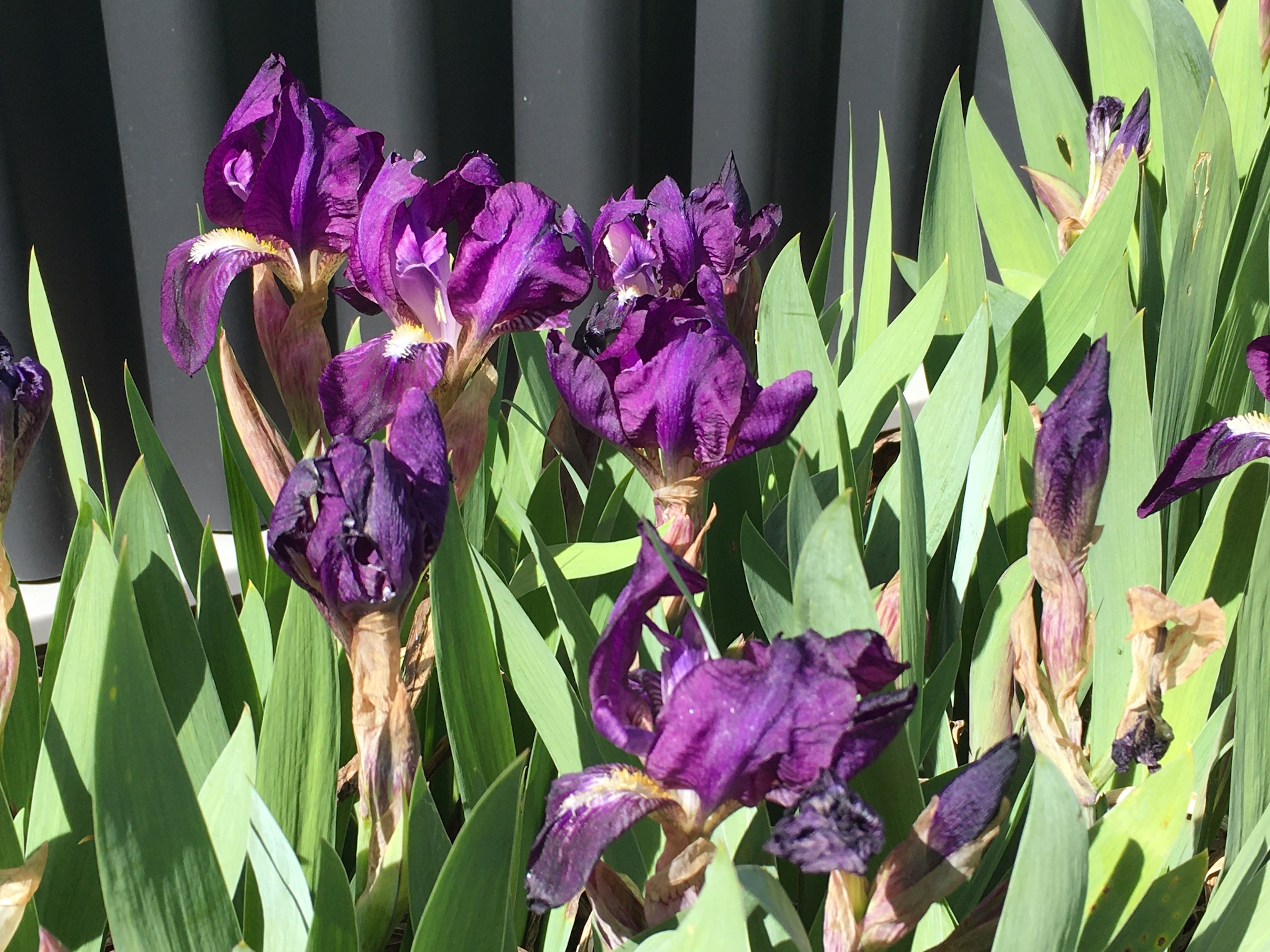
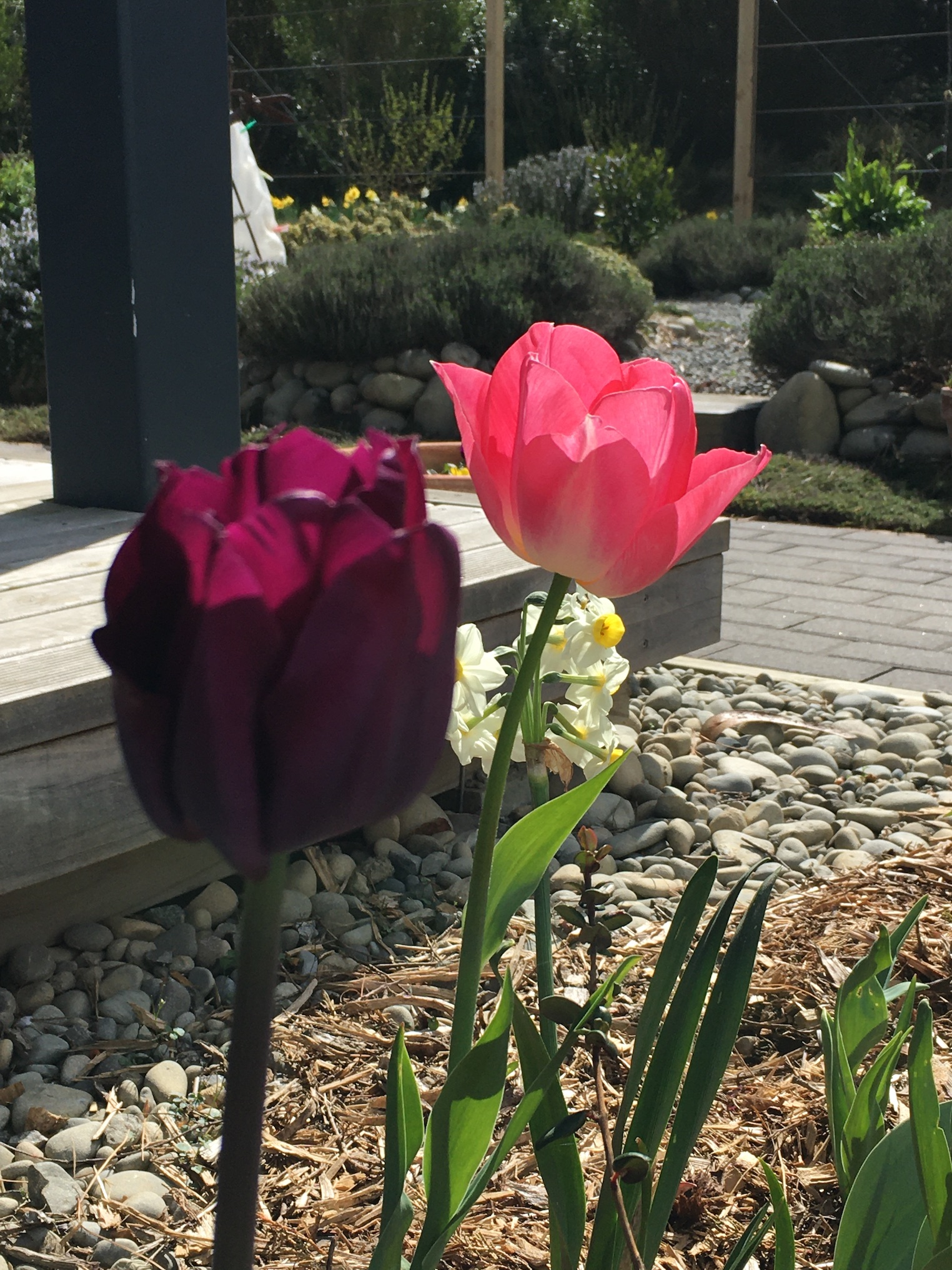
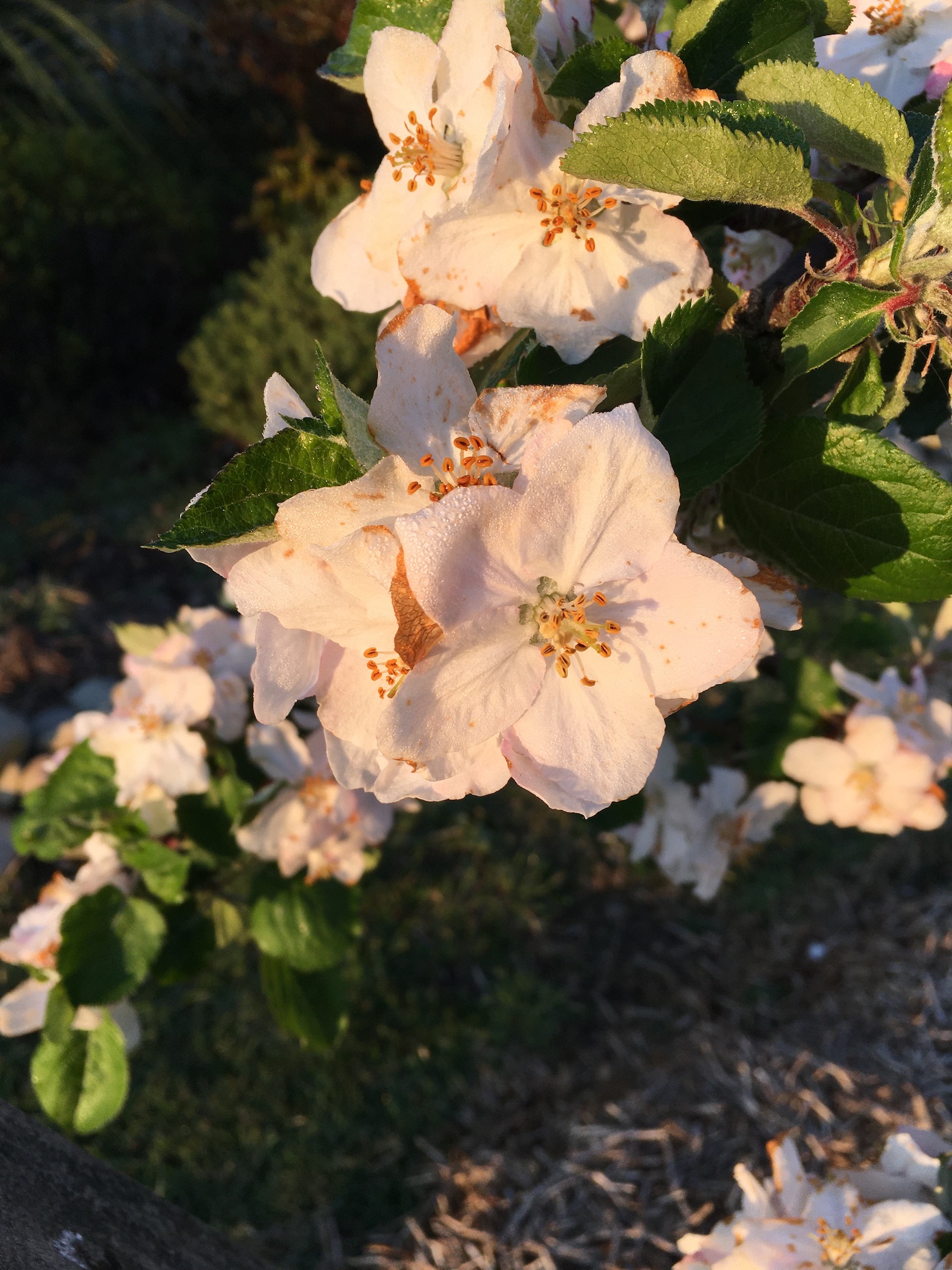
It’s always exciting when we cross over onto the light side of the equinox. The whole garden responds to the rapidly lengthening days. Daffodils and tulips run riot. Pale fingers of asparagus poke up through the mulch. Artichokes spring up from winter-lush plants. Perennial herbs suddenly flush green with new growth. Fruit trees turn snowy with blossoms. Vegetable seedlings seem to double in size overnight.
The weeds, too, spring up overnight. And the rats and devouring sparrows multiply. Aphid populations explode. Spring isn’t all fun and games.
Fortunately, the gardener responds, too. I wake with the magpies warbling as the sky begins to shade from black to grey. I spend more of my weekend hours in the garden. I snatch a few minutes to water or weed before and after work. On my writing days, my lunchtime walk is replaced by lunchtime gardening. Daily life begins to mould around the sun and the plants that respond to it.
It is exciting, and it can be daunting to look forward to all the work that the new growing season entails—the planting, weeding, watering, harvesting, processing …
But it’s important to simply sit and enjoy. Our garden is four years old this year, and this spring I feel as if it is coming into its own. My husband recently built trellises for espaliered apple trees, and with the planting of those trees, the gardens in the front are finally ‘finished’. Not that there isn’t lots of work to do out there, but all the pieces of the plan for that space are in place.
In the vegetable garden, too, the final piece—the garden shed—is enjoying its first spring of use (and what a joy to work in there, potting up tomatoes or planting seeds!). After the application of, literally, tonnes of manure and compost over the last four years, the garden soil promises reasonable productivity, and we can count on plenty of fruit and vegetables in the coming months.
I find myself spending more time enjoying the garden this spring than I remember doing anytime recently. What better excuse for a cup of tea on the porch than that the daffodils are spectacular, or the bees are humming in the rosemary blossoms?
So here’s a bit of my spring garden for you. Hope you enjoy it as much as I do!
We’re two days away from the official start of spring here in Aotearoa New Zealand, and the atmosphere is definitely vernal.
The daffodils are up, and I expect them to be in full bloom within a week. The tulips are following close behind them.
Artichoke buds are beginning to form, nestled among winter’s leafy growth, ready to shoot up and deliver gourmet meals for the coming three months, and the fruit trees and berry bushes are flowering and leafing out, despite the fact there are frosts to come.
In the tunnel house and cold frame, vegetable seedlings bask in the sun. The first ones will be ready for planting out this weekend. In the warmth of the living room indoors, seeds germinate by a sunny window. They, too, will end up in the tunnel house and cold frame before long.
The bumble bees and honey bees are blundering around in dandelion blossoms, the ladybugs are out and about, and I’m keeping an eye on a preying mantis egg case which should hatch before too long.
The sounds have become spring-like as well—frogs trilling at night, magpies warbling before dawn, and white-faced herons croaking in the treetops.
Along with the bucolic scenes of flowers and bumble bees, spring in Canterbury brings howling wind. The wind whips up clouds of pine and wattle tree pollen, which settles like gritty mustard powder on every surface. The windows are hazy with it, and I find myself swiping my computer screen clear several times a day.
The wind makes springtime a challenging season—blossoms blown off the trees; fresh growth flattened to the ground; trees (and the occasional camper van or centre pivot irrigator) tipped over; trampolines, greenhouse panels and rubbish bins flying free … A lot of people struggle with springtime wind here. And of course, there will be more frost. There may even be snow yet to come. Plants out in the cold frame will have to be hauled back into the house and out again several times, tender plants will have to be covered with frost cloth. Invariably it will be too hot and dry for the early crops one week, then too cold and wet for the late crops the following week. There will be multiple disasters in the garden due to weather, pests, irrigation malfunction, or any number of other factors. I’ll struggle and I’ll stress …
Moody springtime sky, with rain obscuring the mountains.
But there will be moments when the wind stills, the sun is warm, and I can sit among the spring blossoms drinking a cup of tea and watching the bees and dreaming of summer.
Last weekend was quite warm—temperatures in the mid to upper teens—with sunshine to make me think of spring. It was a gift I didn’t want to waste.
A tidy herb garden. The wooden step had been nearly overgrown by the thymes on either side.
Most years, we have a window of beautiful weather in the depths of winter. It’s a great time to get out and do some tidying in the garden.
So last weekend, I deadheaded and trimmed the herbs and flowers. I had mostly kept up with the deadheading through the autumn, but I trimmed sparingly then, trying to coax a few more blooms out of bedraggled plants. Last weekend, I was ruthless. With fresh new growth just beginning to show, I cut away all of last year’s rangy branches, even if they managed to make it through most of winter with a few leaves intact.
The thyme, finally mostly done blooming, got a major haircut. I reclaimed paths from great swathes of creeping thyme and from bushy thymes muscling out over the edges of their beds. I cut the mint and oregano to the ground to encourage nice lush cushions of leaves in spring. I cut off dense clumps of dead flower spikes from the winter savoury, and hacked a rangy sage back to try to improve its look. I hauled four wheelbarrow loads of dead leaves and flowers and trimmed herbs out of the front gardens.
I actually rescued this path two weeks ago. The wet area shows where the creeping thyme was cut away. Other paths were equally invaded.
Then I turned my sights to the basket willow. It never fully loses its leaves here, but at some point in the winter, it needs to be cut to the ground. I harvested four hefty bundles of long sticks from it. I’ll use those sticks in the garden over the coming year to support plants, frost cloth and bird netting. Once the trees were levelled, it was time to tackle the thick layer of leaves they’d strewn over the path and the stones of the Zen garden. I raked them up and tucked them underneath other plants as mulch.
After the plant tidy-up, there was the garden shed to tackle. In two weeks, I’ll start using the shed weekly for starting seeds and potting up seedlings. It needs to be clean and tidy for that. So I sorted through all the stuff that had carelessly been tossed in there over the past couple of months—sacks of bird netting and potting mix, plant trays, irrigation hoses … everything that came out of the garden at the end of summer and had never been properly put away.
My husband finished a beautiful rack on the back of the shed on Sunday, so the tidying expanded to include going through the pile of wood sitting in the orchard, and organising everything worth saving onto the new rack. Some of the things weren’t worth ‘saving’, but were worth using right away, leading to a new bench in the fern garden that I’m looking forward to sitting on with a cup of tea some day soon.
And of course, while I was at it, it was time to tidy the pile of fencing, hoops and stakes I use in the vegetable garden every summer. These items sit atop a wooden platform beside the compost pile. I hauled everything off the platform and realised the rats had shoved compost under it, nearly filling the space.
So, the platform had to be lifted, and I hauled almost two full wheelbarrow loads of beautiful compost out from underneath and spread it on the garden.
By Sunday afternoon, a walk through the yard was a delight, with everything neat and tidy. I had lunch on the porch, gazing out into an immaculate herb garden. I hadn’t considered it messy before, but the difference was stunning. The Zen garden, visible now that the willows are down, is a little gift every time I step outside. And I can’t wait to start seeds in the tidy garden shed.
Unfortunately, there will be no sitting outside to enjoy the garden this week. The clouds rolled in Monday morning, and by the time we got home from work, the rain had begun. It promises to be a proper winter storm, with wind, rain and temperatures in the single digits. (The snow won’t reach us here, but the mountains should be spectacular when the clouds clear.) I’ll have to enjoy the garden from indoors this week.