Old Farmers

My winter goat feed was delivered yesterday afternoon by the same father/son pair who delivers it every year. “Dad” isn’t a day under 90, and his son is in his late 60s. I always leap to help when they arrive. They would happily unload all the hay and stack it in the shed for me, but I can’t watch these two elderly gentlemen hauling hay bales while I do nothing.

Truth is, many of the neighbouring farmers could trade their tractors in for walkers. They work until their bodies give out, or until an accident or death claims them.

You might wonder why. Most of these guys are sitting on a fortune of land. They could sell out and retire in style instead of working themselves to death.
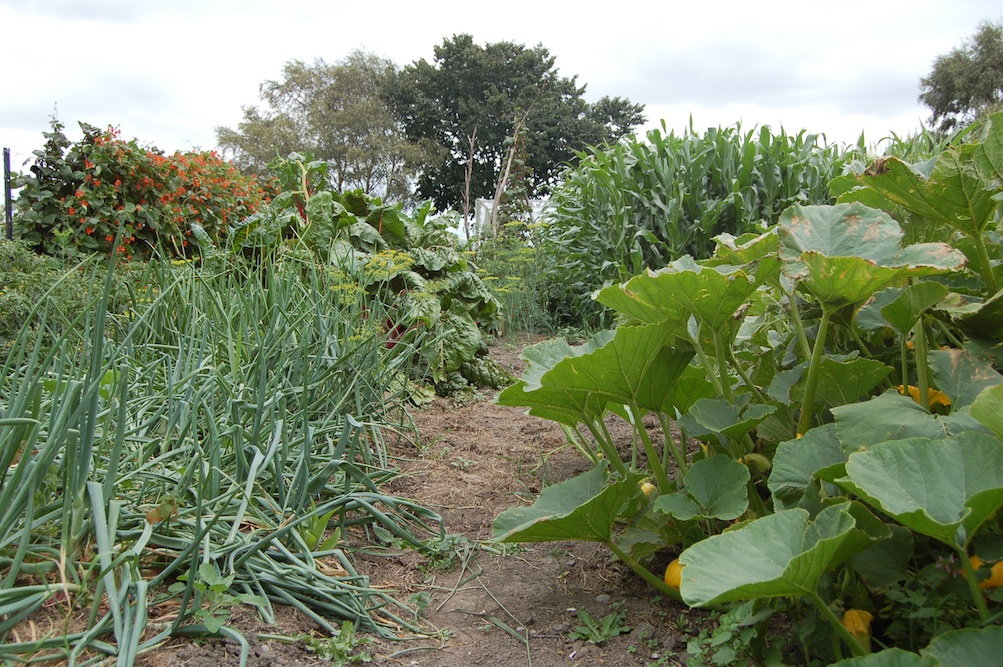
Paths wide enough for a walker?

Paths wide enough for a walker?

I understand, though. Will I give up gardening as long as I can drag myself to the garden? No. It’s who I am. Even injury can’t keep me away—I’ve been known to do my gardening on hands and knees when a back injury prevented me from standing. Farmers are the same. Farming isn’t a job; it’s an identity. To retire is to lose oneself. The 90 year-old who delivers my hay every year is cheerful and spry for his age. He will always be a farmer. One day he’ll stop working, but not until he stops breathing.
Salt

SaltsmIt preserves and flavours almost all our food. It’s been traded commercially for over 2600 years. It features in the language of nearly all cultures—you are “worth your salt”, you are “the salt of the earth”, you take things “with a grain of salt”, you “rub salt in a wound”.

Central as it is, it is one of those ingredients we don’t produce ourselves. During summer, our meals often consist entirely of products we’ve produced…except for the salt.

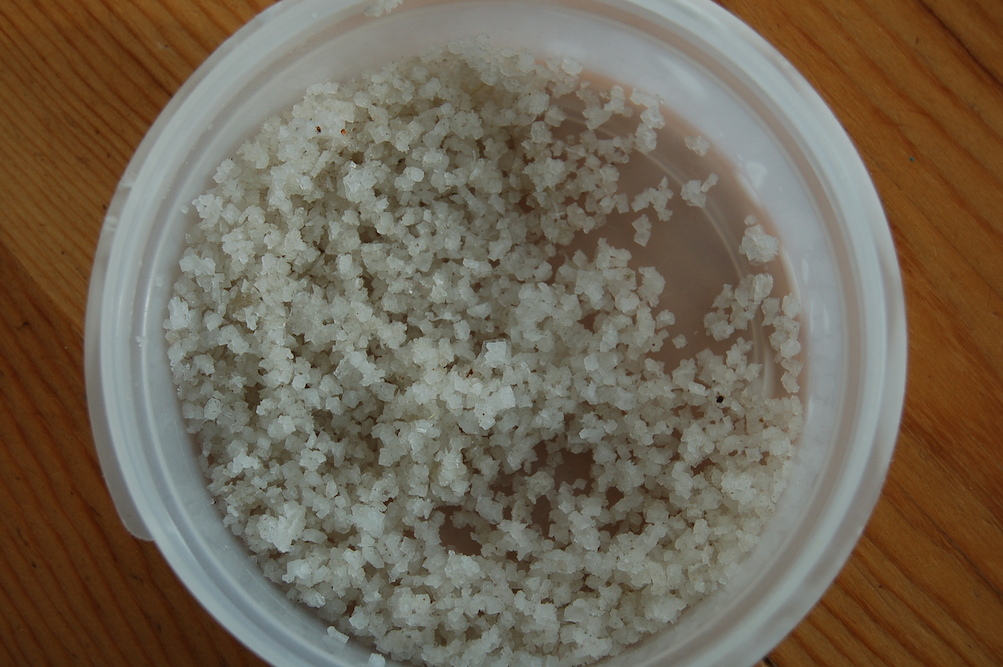
My daughter was determined to rectify that. Last week, she declared she was going to make salt. We popped out to the beach and snatched a bucket of sea water from a large and violent surf. She poured the water into a pan and set it on the porch. Within two days, she had a pan of salt…and, due to a dust storm, dirt. She tried again, this time protecting the pan from dust with a sheet of Perspex, propped up to allow air circulation.

The result was delightful, and surprising to us all. From a jelly roll pan full of seawater, she harvested about half a cup of salt. Even with the cover, some was too dirty to use, but the rest is beautiful. We enjoyed it on our corn on the cob last night, and it was everything a gourmet salt should be—a full-bodied taste of the sea. And so easy to harvest!

Half of New Zealand’s salt is produced just a few hours north of Christchurch at Lake Grassmere. The industrial scale process of harvesting 70,000 tonnes of sea salt each year is little different from our tiny experiment in a baking pan. Like we did, the process at Lake Grassmere relies on summer sun and strong, drying nor’west winds. We buy a lot of salt from Lake Grassmere, for cheese making, preserving, and cooking. But we might be buying less from now on. There’s something wonderful about harvesting this most basic of ingredients, this gift from the sea.

Water

waterglasssmI was most of the way through a pond life lesson and leading 30 kids back to the nature centre when I had my first real lesson in dehydration. My world went black. I fainted. When I came to, I retched until long after my stomach was empty. Years later I watched a fellow Peace Corps Volunteer do the same after a long hot day in the field.

For a while, a small skink lived in our house in Panama. We named him Smaug. One day we found him listless and dull. It was the dry season, and we wondered if he might be thirsty. We offered a jar lid of water. He instantly pounced on it and began to drink. He was pert and perky the next day.

Last week, our son was complaining about helping with a garden task. He was dragging his feet and grumbling. “Have you had anything to drink today?” asked Ian. No. A glass of water, and he was a different boy—energetic and helpful.

Water.

Taken for granted when it’s there, terribly missed when it’s not.

I’ve been thinking a lot about water lately—naturally so, since it’s in such short supply here at the moment. I am ever grateful for the new well, and its ability to keep the vegetable garden green and our water glasses full.

We lost the old well in the September 2010 earthquake. When the power came back on, after four days of near-constant shaking, the pump poured out a slurry of sand instead of water. We spent five months trying to salvage the old well. They were five months of not knowing whether we’d have water or not each day; of carefully filling every vessel we could on the “wet” days, so we were sure to have water on the “dry” ones; of daily conversations with the technicians at Allied Water, who began to feel like family, they were here so often. More than once, I washed the laundry with rainwater in a 5-gallon bucket, just as I used to do in Panama. The garden went without, so we and the animals could drink.

It was a relief when the new well was dug, and we could again count on water for drinking, cooking, washing and irrigating. The careful habits stuck, though, and I try to make every drop count. And just in case, a week’s worth of drinking water sits in the shed, and a barrel of rainwater stands ready for watering and washing.

The Food Year

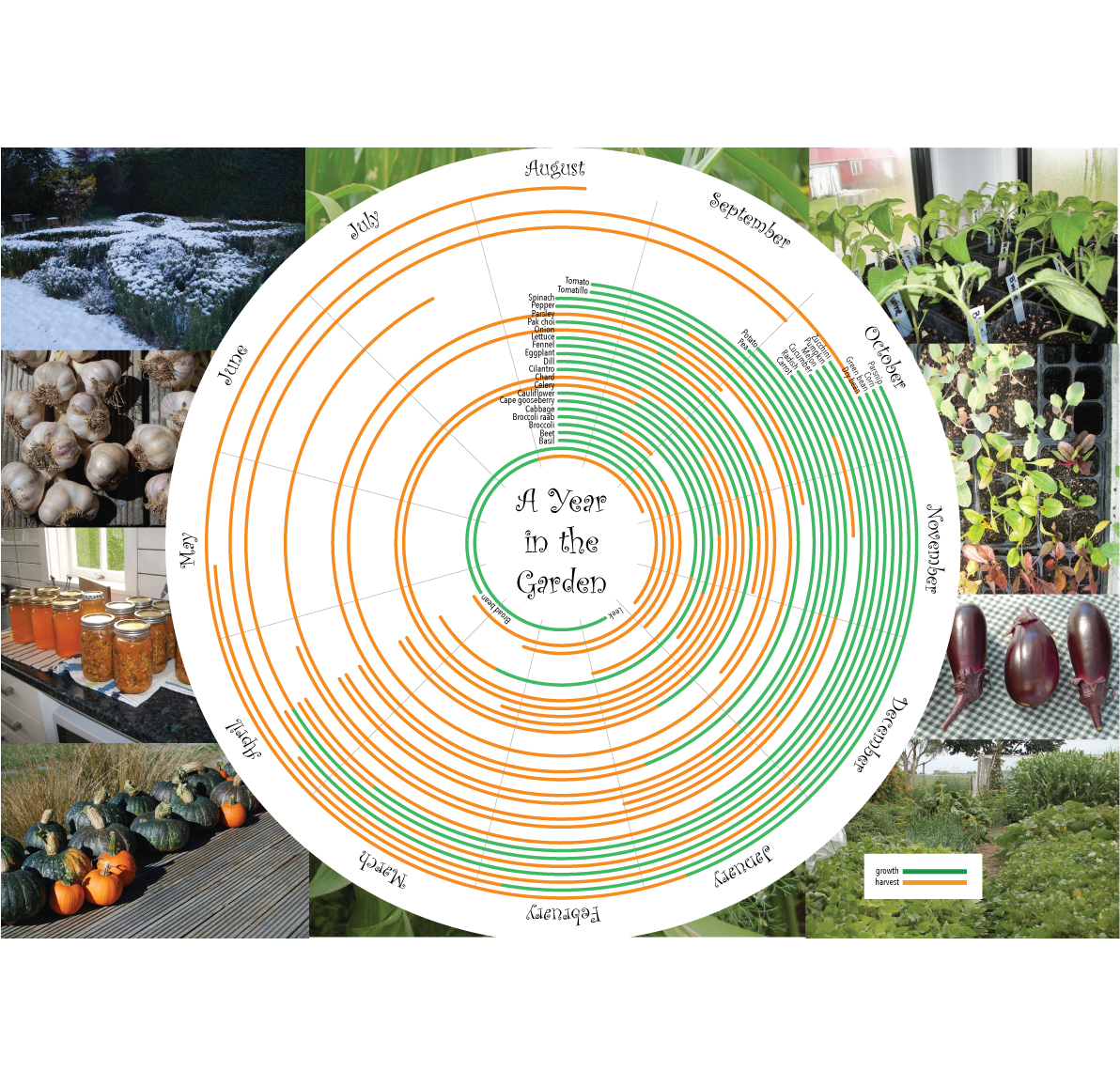
GardenYearThe modern food system, with international trade and refrigerated transport, ensures that fresh tomatoes, cucumbers and other summer crops are always available, even in Maine in February. Want eggplant parmesan for New Year’s dinner? A special cucumber salad for Valentine’s day? Even in Maine, it’s no problem—you’ll find the ingredients in the supermarket.

A gardener’s food year is more seasonal. Some might say having year round supplies of summer fruits and vegetables is a great thing, and I don’t deny its appeal. But there is something to be said for seasonality. Nothing tastes sweeter than the first strawberry of the year, when you’ve been dreaming of strawberries for months. Nothing is more poignant than the last tomato, knowing it heralds winter, and eight months wait for the next juicy bite. Absence makes the heart grow fonder. Vegetables herald, define, celebrate, and farewell seasons and annual events.

It’s difficult to capture the essence of seasonality in the garden. There is the early spring scrounge for anything still alive and edible, while you madly plan and plant for the future. There is the overwhelming abundance of summer, when the question shifts from “what is there to eat?” to “what needs to be eaten?” There is the frantic preserving of late summer, when you realise it all has to end. There is the calm of autumn, when the larder is full, and you know you can curl up like a chipmunk in your well-provisioned nest when the winter winds blow.

I tried to capture some of the garden year’s seasonality in this little graphic. It includes most of the annual crops we grow, though some are lumped together and others left out to minimise clutter. None of the perennial crops are included. But I hope it gives you an idea of what’s in and coming out of the garden at different times of year.

Special thanks to Ian for writing the R code to create this nifty little graphic.

There’s only two things that money can’t buy…

DSC_0033 smTrue love and home grown tomatoes—the only two things that money can’t buy, according to singer Guy Clark. I could add a few other foods to that list, but he’s definitely right about the tomatoes.

Home grown tomatoes are the only ones we’ll eat any more. Life’s too short to eat the store bought ones. I plant 6 or 7 varieties every year—a couple of new ones, and a bunch of old favourites. Each variety has different uses.

Brandywine is without a doubt, the best tasting tomato on the planet. So good that I plant it every year, even though the summers are really too short and cool for it here. For raw eating, nothing beats a Brandywine.

Delicious is almost as good as Brandywine. It’s my insurance policy; it grows better in cool weather than Brandywine does. I’m sure to get some Delicious, even if the Brandywines don’t give well, or they all get eaten by the birds (they think Brandywines are best, too, and even eat them green).

Amish Paste is robust and prolific. Unlike many other paste tomatoes, it manages well with erratic watering. Fleshy and dry, it makes great sauces.

Russian Red is my prolific, hardy workhorse tomato. It has small fruits with a fine, but not stellar flavour. Its value lies in its ability to flourish in cold weather, ripening fruits long after other varieties have succumbed to frost.

Suncherry is a lovely red cherry tomato that not only fills lunchboxes with juicy goodness, but also dehydrates well, providing us with lovely sweet/tart dried tomatoes all through winter.

Of course, the best way to enjoy a tomato is standing up in the garden, but here’s one of my favourite tomato dishes. This is straight out of Vegetarian Cooking for Everyone, by Deborah Madison. Make it with the best tomatoes you have, and don’t use an iron skillet or the tomatoes will taste tinny.

Tomatoes Glazed with Balsamic Vinegar

1 ½ pounds tomatoes

2 tablespoons butter

3 tablespoons balsamic vinegar

1 plump shallot, finely diced

salt and pepper to taste

Cut tomatoes into wedges about 1 ½ inches across at the widest point. In a skillet large enough to hold the tomatoes in a single layer, heat the butter until it foams. Add the tomatoes and sauté over high heat, turning them over several times, until their colour begins to dull, about 3 minutes. Add the vinegar and shallot and shake the pan back and forth until the vinegar has reduced, leaving a dark, thick sauce. Season with salt and plenty of pepper.

Landscape Shaped by Food

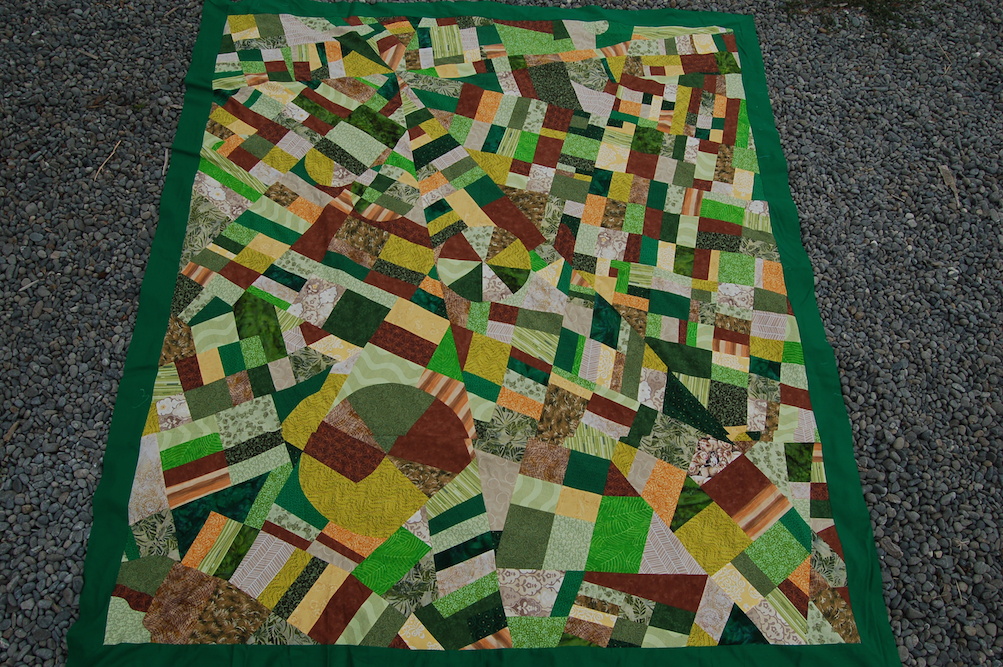
DSC_0007 smI’ve thought a lot about the Canterbury landscape over the past year. I’ve been piecing a quilt of the plains inspired by the September 4 2010 earthquake. The huge jog the quake created in the otherwise dead-straight Telegraph Road made me think about its effect on the aerial view of the entire area—all those straight fence lines and hedges shifted. It took a few years for the ideas to come together enough to execute, but last year I began to work on it. I took a satellite image of the area I wanted, projected it onto my living room wall, and traced the landscape onto a quilt-sized piece of paper. Every field was numbered and mapped on a reference sheet—six hundred and two pieces, each one different. Along the Greendale Fault, I cut and shifted the quilt, exaggerating the real break a bit, and creating a subtle disruption in the patterns.

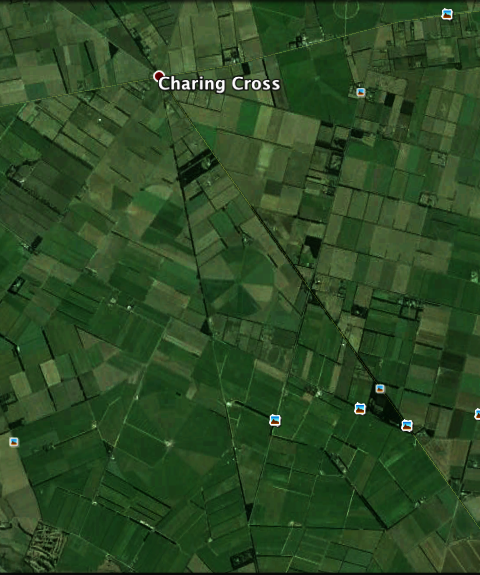
Though the quilt began with a focus on the quake, as I worked on it, I thought more and more about the agricultural landscape itself. For over 100 years, sheep and grain have been the staples of the region. They have left their impression on the landscape. The wedges formed by intersecting roads at Charing Cross were sliced by straight fences and hedges, forming paddocks and fields for sheep, oats, and barley. Today, dairy cows and the centre pivot irrigators that keep the cows’ paddocks lush have overlaid circles on the straight lines of the past. You can see places where the centre pivot has obliterated the geometry of the past, and others where the straight lines limit or slash through the centre pivot. The push and pull of the past and the present.

Satellite photo of the real thing.

Satellite photo of the real thing.

This landscape has fed people for over 600 years. When the first Maori arrived, the native forest provided food like moa and pigeons. As the forests were felled, the region’s rivers and wetlands continued to provide abundant fish and waterfowl. When Europeans arrived in the 1870s, they brought livestock and crops, which thrived on the plains. Though the landscape has changed dramatically, the use we make of it remains. Today, this landscape of food feeds not only locals, but also people in far-flung places like China, Europe, and the Americas. No doubt the landscape will change in the future. New lines will erase the old. But chances are good the new lines will be shaped by food.

Drought

DSC_0011 smIn Christchurch, the City Council and the media are only just now recognising what we gardeners and farmers have known for two months. It’s dry. And hot.

It’s the fate of those who grow plants and raise livestock to grow grimmer and grimmer as everyone else trips off to the beach for yet another perfect summer day.

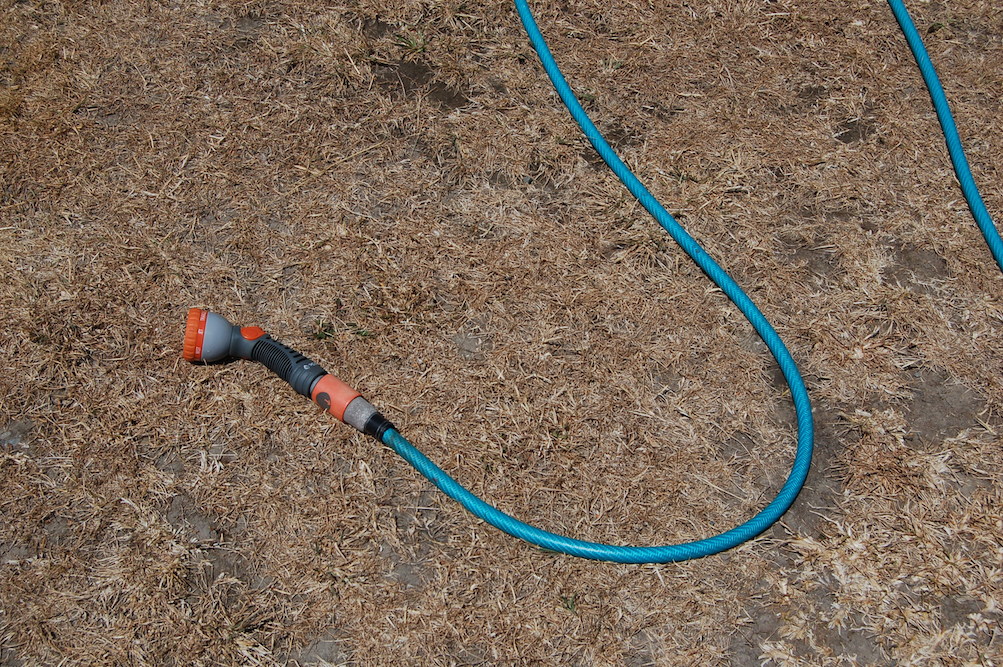
The grass has been dead for at least a month, new plantings have succumbed despite our efforts to water them, and even well established shrubs are showing stress. The poplars—large trees that have been here for forever—are shedding leaves.

Every day begins and ends with watering—food crops are the first priority, then new plantings, then (maybe) established plants. We are thankful for every drop of water that spills over from the neighbour’s irrigator.

Still, not everything will make it, even if it starts raining tomorrow (which it won’t). The ground is hot dust, so dry the water pools on the surface rather than soaking in. So we choose what to water and what not to water, what will live and what will die. We haul extra food to the livestock, because they have little to eat in the paddock. We watch the sky for clouds and sniff the air for smoke (header fires aren’t uncommon out here, and they can spread rapidly). We rescue what we can…then shrug and head to the beach with everyone else.

Worst Hostess of the Year

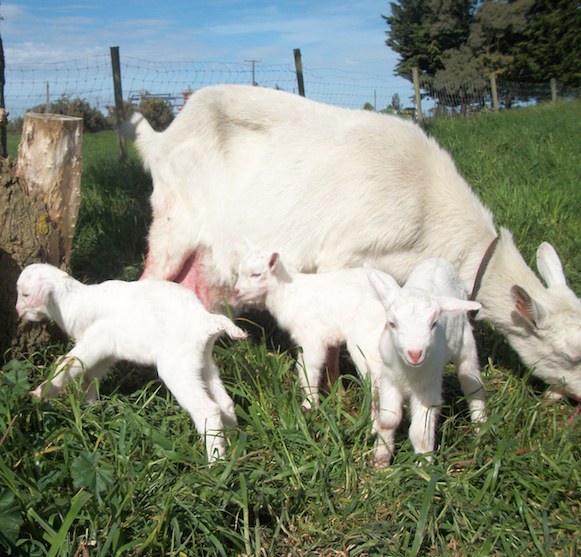
Just on their feet, the triplets Ariana, Albus and Ableforth.

Just on their feet, the triplets Ariana, Albus and Ableforth.

Our visitors were scheduled to arrive for lunch at 12:30—a colleague of Ian’s visiting from overseas and some members of her family. Lunch was in various stages of preparation at 12:15 when I got the call from my vigilant children that my goat Artemis was in labor. Leaving the production of meal entirely to Ian (with quick instructions as to what to do with the muffins when the oven timer went off), I dashed outside, pulling my boots on as I went.

It wasn’t long before our guests pulled in the driveway. I greeted them in my blood stained coveralls (from Ish’s kidding last week), leaving the paddock only long enough to explain my predicament and hand them over to Ian.

Back in the paddock, Artemis was looking decidedly uncomfortable. She leaned into my leg as I scratched her back. How Ian was getting on with lunch and guests, I didn’t know. After a while, her contractions seemed to slow, and I was starving, so I took a break for some food. Everyone was relaxing on the porch, food and drinks in hand. I raced to fill a plate and a glass, and sat down, apart from the group, where I had a view of the paddock.

Less than a minute later, I was up again, shrugging on my coveralls, lunch left mostly uneaten on my seat. The first kid was coming, but Artemis was lying down, and the big boy she was trying to deliver needed either gravity or me to do some pulling. Artemis refused to stand, so I pulled her first kid out and proceeded to wipe the mucous off him while she ponderously got to her feet to check him out. I called out his gender to my children, nervously waiting in the yard.

Number two (a girl) was already visible, but she was breach—coming out back feet first. She, too, needed some help. While Artemis licked one, I towelled the other. I called out the gender of the second kid to the children, and they cheered and raced to tell Ian (we’d been hoping for a girl from Artemis this year).

Artemis still looked awfully round, and I was pretty sure I could feel at least one more set of legs in her belly. Labor had stopped, though, so I ventured back to the house, covered in fresh blood and all manner of birthing fluids, to see if I could finish my lunch during the lull.

I had just enough time to finish my dried out bread and cheese and my wilted salad before kid number three made his appearance. He was out by the time I got to the paddock.

It took another hour or so before all three kids were on their feet and nursing well. I waved to our guests as they drove out.

When I finally stripped off my coveralls and washed up for the last time, I asked Ian, “So…who were those people?”