Winter Gardening

It’s not quite winter here yet. There are a few more days until it officially starts. And the weather has been unusually warm. 

It’s a far cry from gardening in Minnesota, where I used to hack my parsnips out of the frozen ground in November and December, and the garden spent much of the winter under a blanket of snow.

Here, the garden is reduced and slow growing in winter, but there’s plenty happening.

We’re still picking tomatoes, peppers and eggplants from the greenhouses, though many of the plants are looking pretty sad. They will almost certainly give up in the next month.

The winter broccoli, cauliflower and cabbage are doing nicely. We’ve been enjoying plenty of these cool-weather crops over the past few weeks, and they will continue to give through winter. The leeks are gorgeous and ready to pick. They’ll provide onion flavour in dinners after the stored onions are gone, and before the first spring onions are ready in October. 

Leafy greens like Beet Erbette and Silverbeet (Swiss Chard) are in their prime through winter—they’ve been largely ignored through summer while so many other crops were available, but now they offer fresh greens to add to the frozen and bottled vegetables in winter dinners.

Weeds are slow growing in winter, and the vegetables require little work. Much of the vegetable garden is tucked up under mulch or green manures all winter.

But there’s a fair bit of maintenance to be done over winter. Perennial crops like berries and fruit trees need pruning, and winter is a good time to tackle the really pernicious weeds like twitch (couch grass), because the soil is soft and wet. Winter is also a great time to top up mulch and add compost to the soil, to mend fences and bird nets, to shift plants.

The beauty of winter gardening is that the urgency of the spring and summer gardening seasons is gone—there isn’t so much to do that you can’t enjoy a rainy day indoors, but you have a perfect excuse to be outdoors on those glorious sunny winter days.

And speaking of glorious sunny days … I think it’s time to get out of the office and into the garden.

Compost–a really rotten subject

Talk to a serious gardener for more than a few minutes, and you’ll probably hear about compost. We all have our own composting methods, and we’re all passionate about how well our methods work.

If you go on line and search how to make compost, you’ll find a range of suggestions, most of which involve building your pile with ‘green’ and ‘brown’ layers. There are lots of suggestions about what to, and not to, put in your compost, and how often to turn it. I find many of these suggestions take a lot more time and effort than I’m willing to put into my compost, and they don’t necessarily take into account the effects of climate on compost making.

I’ve made compost in Pennsylvania, Minnesota, Michigan, Ohio, Panama, and New Zealand. Every place I’ve done it, it needs to be done differently. Few of my compost piles have followed the ‘rules’, yet I’ve almost always gotten fine compost out of them.

In Panama, the compost pile needed to be protected from too much rain, or it would get waterlogged and go smelly and anaerobic.

At our first place in New Zealand, the compost pile needed to be watered regularly and covered with a tarp or it would dry out and not rot at all.

Our current location is a sweet spot for compost making—not too wet and not too dry. It’s almost impossible to avoid making compost, because plant material rots beautifully. But making a ‘proper’ compost pile speeds up the process.

I have two compost bins measuring 2 m by 2 m. One serves as a holding bin for plant waste while I use the finished compost from the other. When one bin is empty, I turn the material from the holding bin into the empty bin.

As I turn the compost out of the holding bin, I layer it with manure and give it a good watering to ensure that there aren’t dry pockets in the pile. I don’t follow the ‘green’ and ‘brown’ layer guidelines, but I do try to make sure that woody debris is well mixed with leafy green stuff, and that there’s a good amount of manure in the mix, too. I find the key is not so much the exact nature of each layer, but that I don’t end up with a thick mat of one hard-to-compost thing. The manure and the watering both give the pile a good kick to speed up decomposition, and in the days after the pile is turned, the smell of rotting vegetation can be strong, and the pile reduces in size rapidly.

As for the rules about what goes into a compost pile, I ignore them all. Cheese and other oily things go right in, as do non-recyclable paper products like butter wrappers, paper towels, greasy paper bags, and used baking paper. They all break down just fine, particularly because they form such a small component of the total pile. Do those things attract rats, as the composting guides suggest they will? Yeah, probably, but rats are also drawn to my vegetable garden, where they eat raw potatoes underground, pumpkins on the vine, and peas and beans off the plants. ANY vegetable material in the compost is going to attract vermin—I’m not sure a greasy butter wrapper is going to increase the number of rats attracted to the compost. I keep a trap next to the compost pile to snap up rats and hedgehogs as they arrive to feast. Any animals my trap catches go right into the compost pile, to give back whatever nutrients they’ve consumed from it. The neighbourhood cats also help keep the rodents in check. These rodent-control measures are necessary, but they’re no more than I’d already be doing, as rats and hedgehogs are a problem everywhere here.

I do try to make sure that plant material is chopped into short pieces before I put it on the compost. This not only helps it break down faster, it makes turning the pile much easier.

And there are a few things I won’t put in my compost pile. Thick branches take far too long to rot, so they get chopped into short pieces and spread under the trees in the native garden. And twitch (couch grass) gets put into black rubbish bags for about 18 months before going on the compost—otherwise it will sprout and grow through the compost, then plant itself all over the garden when I spread compost. Twitch is an aggressive weed that’s almost impossible to eradicate once established, so it’s worth keeping it out of the vegetable garden at all costs. I’ve learned this lesson the hard way over the years. My rule of thumb is that until the twitch has rotted enough that I can’t identify it, it could still grow. A year and a half tied up tightly in a rubbish bag seems to be what it takes to reach this stage.

Although the centre of my compost pile can get quite hot, not all of the pile reaches the high temperature needed to kill weed seeds, so I do have weeds in the compost. But I don’t particularly worry about weed seeds. All the weeds in the compost came from the garden in the first place, so I’m not introducing new ones, and aside from twitch, the weeds are manageable. I have considered sterilising small quantities of compost in the microwave for use in seed raising mix, where I don’t want any weeds, but have never tried it.

Overall, I think too much emphasis is placed on making compost the ‘right’ way, and it can scare some people off even trying. But decomposition is a natural process that happens whether we “compost” or not. By setting up even a small compost bin, and making sure the compost stays moist but not waterlogged, so bacteria, fungi and invertebrates to do their work, gardeners can reclaim nutrients from their plants and return them to the soil. It may take a little trial and error to find out what works best for your climate and your level of enthusiasm for compost management, but it’s well worth the effort.

Happy Autumnal Equinox!

Some years still feel summery at the equinox, but this year, the weather is decidedly autumnal. Monday, we hit our highest temperature of the summer—a blustery nor’westerly day that had my students wilting by 10 in the morning. It was 31 degrees at 5 pm when we left work. Dinner was a summer feast of sweet corn, soybeans and zucchini.

We slept with the windows open, covers kicked aside on Monday night.

Tuesday morning, I went out in the dark to water the plants at about 5.30. It was still 23 degrees. As I watered, the wind shifted.

By the time I left for work an hour and a half later, the temperature had dropped to 16, and rain spattered the windshield in fits and starts.

By ten o’clock, the skies had opened up. Wind drove the rain in sheets, and the temperature continued its slide downward.

Driving home from work, the temperature registered 11 degrees. Traffic moved slowly through the downpour, wind rocking the car and thrashing trees alongside the road. When I got home, I stripped off my rain soaked cotton clothes and replaced them with cosy wool. We had potato soup for dinner.

We woke on Wednesday morning to full autumn. Summer had been scoured away by over 40 mm of rain, and stripped bare by gale force winds.

A dramatic entrance for the season. But the truth is, autumn was already well underway. Our first frost came weeks ago, on 6 March. I picked the pumpkins last weekend. And the zucchini, tomatoes and other summer-loving plants were all showing signs of being nearly done for the season.

And, of course, squirrelly me has been in autumn mode for weeks, preserving everything I can in preparation for the dark days ahead.

Today we step into the dark side of the year. Although I very much enjoyed our last couple days of hot summer sun (and today promises some beautiful sunshine), I’m looking forward to all that the dark side has to offer. 

Autumnal Harvest

The weather has turned decidedly autumnal, so while the sun is still summer-hot, the air has gotten chillier, and the weather more unsettled.

And it means I’ve gone into my annual squirrel mode—harvesting and preserving summer’s bounty so we can enjoy it all winter.

Last Saturday was summer soup day. Long time readers of my blog will know this is a key part of my gardening year. When the children were young, it was a whole-family event, with everyone pitching in to pick and chop vegetables. It’s become a more solitary activity for me in recent years, but no less important in my annual calendar. 

With just my husband and me at home now, I always think I’ll make less soup. And this year, I was a little worried I wouldn’t have enough vegetables for a big batch, because January and February were so cold and wet, the heat-loving vegetables sulked.

I should have known better.

I needed both my 20-litre and 18-litre pots to cook the soup, plus the 12 litre pot for making vegetable stock from the vegetable off-cuts. In the end, I made 23 quarts of soup and 13 pints of stock. That’s Monday dinners for almost six months, plus stock to flavour 13 more meals. Not bad for 13 hours of work.

The day after summer soup day, I tackled the sweet corn. I usually sow three plantings of sweet corn, two weeks apart, in the spring. The first two plantings were desperate to be picked, so I harvested 63 ears of corn. Blanched and cut off the cob, it yielded 5.3 kilograms of corn, which went into the freezer. That’s a year’s supply of sweet corn for us, to be used in casseroles, stews, and side dishes. 

I had hoped to also freeze some soy on Sunday, but I’d waited too long to harvest, and about half the beans were too mature. So we’ll save the majority of this year’s soy as dry beans instead.

And speaking of dry beans, in the last fortnight, I’ve harvested my Borlotti and Black Turtle beans, and have started harvesting the climbing beans: Blue Shackamaxon, Bicolour Peans, Bird’s Egg, and Cherokee Cornfield. The harvest of the climbers will go on for the next month as the plants continue to grow and put out new pods while the older ones mature. Not quite as neat and tidy as the bush beans, which all mature at the same time, but in the end, I’ll get more beans from the same amount of garden space off the climbers than the bush beans.

I’ve also now harvested most of the potatoes, which did beautifully this year, with the cool rain. The spuds are tucked away in a dark corner of the laundry room, and should last through much of the winter.

There are still more vegetables to squirrel away in the next few weeks: pumpkins, hopefully more tomatoes, more basil (in the form of pesto), and the rest of the beans and potatoes. As I do every year, I mourn the end of summer’s bounty, but I look forward to the ease of winter meals that come from the freezer or pantry instead of directly from the garden. There is something delightful about knowing that the hard work has been done, and the food is tucked away, ready to be eaten.

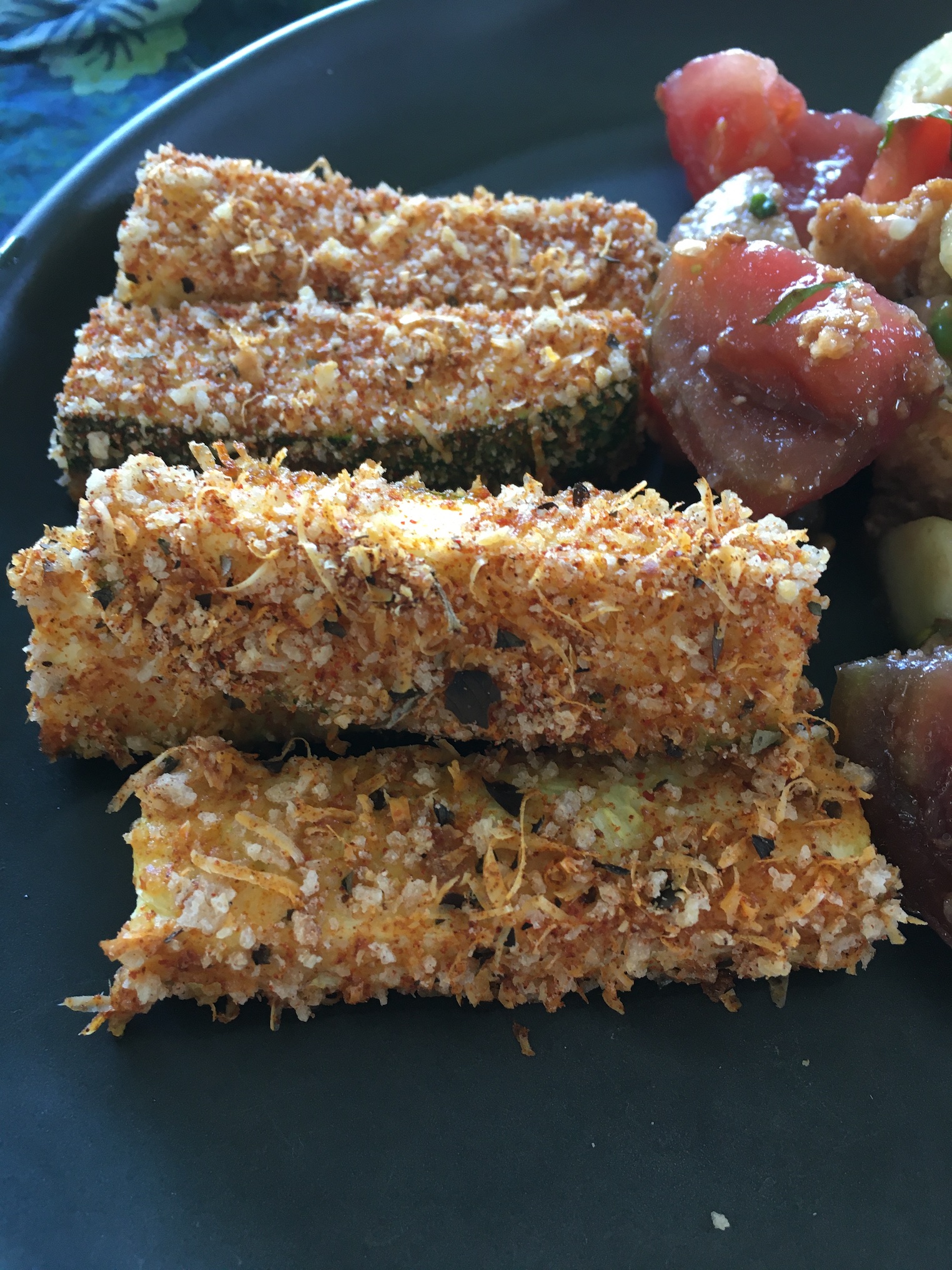
Oven Fried Zucchini Sticks

Many years ago, I posted a blog titled 50 Ways to Eat Zucchini. Since then, I’ve gotten much better about my zucchini planting—I plant half as many as I used to. Of course, that still means we have too many. We’re currently giving away 5 to 10 kg of zucchini a week, eating it in every dinner and baking it into desserts.

I don’t mind having too much zucchini. It’s a versatile vegetable that can be grated into all kinds of dishes (chilli, pasta sauce, enchiladas, burgers …) or featured in beautiful slabs or rounds (zucchini and tomato tart, grilled zucchini, frittata …).

One of my favourite ways to eat zucchini is as breaded, oven fried sticks. These tasty ‘fries’ take a little work, but are well worth the effort. I fill a large jelly roll pan with them, and they vanish, even when it’s just my husband and me for dinner.

I don’t have a set recipe, but here’s an approximation of what I do:

2 small to medium sized zucchini
1 egg
1 cup bread crumbs
3/4 tsp salt
1/2 cup grated Parmesan cheese
2 tsp paprika
1/4 tsp chipotle
1/2 tsp smoked paprika
1 tsp dry oregano
small handful of fresh parsley or basil, finely chopped

Cut the zucchini into thick sticks, about the length and thickness of a finger. Whisk the egg in a small bowl. Combine all other ingredients in a separate bowl. Generously oil a large baking sheet.

Dredge each zucchini stick in the egg, then the breadcrumb mixture and set on the pan.

Bake for about 20 minutes at 200℃, until browned and cooked through.

Serve hot, with your favourite dip, if desired. We love chipotle mayonnaise with them, but they really need no further embellishment—they’re delicious as is.

January in the Garden

It is the last day of January here, my favourite month in the garden.

This January has been more difficult than many, with cold wet weather rather than the usual dry summer warmth. But the garden has still been a January garden.

December is a month of weeding, because my vegetables aren’t yet large enough to compete against most weeds. The weeding effort spans the entire month, and I always aim to have a weed-free garden on Christmas Day. 

All that effort pays off in January, when, as if by magic, the vegetables are suddenly huge, crowding out the weeds and basically looking after themselves. I pull the occasional weed that manages to pop its head above the vegetables, and I keep the paths relatively clear, just so I can move easily through the garden. I water as needed. Otherwise, there’s little to do to as far as maintenance goes.

In January, the gardening effort switches from establishment and maintenance to harvesting, reaping the benefits of my hard work. It’s not that we don’t eat from the garden all year long, but the stretch from January to March is a magical one, where production vastly outstrips our ability to eat. In January, the freezer and the cupboards begin filling up with fruit and vegetables preserved for winter enjoyment. The squirrel in me chitters smugly as I stash away the fruits of my labour, already savouring the meals, snacks, and desserts to come.

It’s as much work as the establishment and maintenance phase of the year, but the reward is immediate and tangible. By mid-March, I’ll be exhausted by the harvest, tired of making sauces, jams, and preserves. Tired of having to deal with overflowing baskets of vegetables every day. But here in January, the novelty hasn’t worn off. The excitement of each new crop coming on is palpable. The thrill of lining up jars of preserved food on the shelves banishes any fatigue.

So I say farewell to January with reluctance and look forward to several months more of deliciously exhausting harvest. And I’ll take you on a tour of my January garden. Enjoy!

Why Garden?

“Gardens are fashioned for many purposes with many different tools, but all are collaborations with natural forces. Rarely do their makers claim to be restoring or rebuilding anything from the past; and they are never in full control of the results. Instead, using the best tools they have and all the knowledge that they can gather, they work to create future environments.
If there is a lesson it is that to think like the original inhabitants of these lands we should not set our sights on rebuilding an environment from the past but concentrate on shaping a world to live in for the future.”

–Charles C. Mann (1491: New Revelations of the Americas before Columbus)

Many years ago, I wrote this quote into a sticky note on my laptop. I look at it regularly, and it resonates with me every time. It expresses a mindset my husband and I employ on our little plot of land.

As I sit here on the porch on a warm summer afternoon, I can’t help but think back to what this section was like when we bought it—a bare paddock so devoid of nutrients that even the weeds were sparse. Sitting here today, I am surrounded by a mix of food crops, beautiful flowers and native plants. Five years ago, this plot of land could barely sustain the scraggliest of grass. Today it feeds us, provides food and shelter for native insects and birds, and is a welcome escape from all the ills of modern life. In time, as plants grow, it will hopefully become more sheltered, more resilient to temperature and rainfall extremes. In time, it will hopefully take less effort to maintain. In time, perhaps we will see native bellbirds and tūī as often as we see non-native blackbirds and starlings in the garden.

This is what we aim for. But, as Mann said, we’re not in full control. 

Native skinks seem to have disappeared from the garden, despite the abundant food and shelter we’ve provided. Perhaps the influx of domestic cats is at fault. Or maybe some other factor outside of our control. Unwanted weeds continue to invade from neighbouring properties. Plant diseases take advantage of favourable conditions to decimate crops from time to time. Hail, floods, droughts, and wind all take their toll. 

So the resulting garden is a compromise. What can we reasonably grow this year? What needs to be abandoned, either temporarily or permanently? What new opportunities are presented by quirks of nature or chance?

Guiding every decision is the question, what do we want the place to look like next year? In five years? Because, as Mann said, we’re shaping a world to live in for the future.

Incidentally …

If you haven’t read 1491, do it. It will shatter all those Eurocentric views of the world you’ve been steeped in since birth and change your whole attitude towards the history of the Americas.

Sharing Gardens

It’s easy to feel like the world is going to hell in a hand basket these days. You can readily believe that there is no kindness left in the world. That no one cares about the earth or community. That values such as integrity and selflessness are dead. That people’s only motivation is money.

Of course that’s not the case, and I’m reminded of that regularly.

I am blessed to be part of a community of vegetable gardeners—people who can restore my faith in humanity. I’ve written about gardeners in the past, but it bears saying again. These are people who have a deep sense of community. They pay attention to the effects their actions have on the land. They give of their time and are generous with food, seeds and plants, sharing what they have with others.

They organise local food pantries and community gardens. They raise funds for charities. They give away produce to those in need. They share their knowledge and skills freely with others. One gardener I know even hands out jars of jam to strangers.

And when those gardeners get together, they can make a difference in communities. Here in New Zealand, it is common for houses in towns to be surrounded by high wooden fences. But in the nearby town of Akaroa, fence heights are restricted, so that people share their gardens with the street. What a difference it makes to the entire feel of the community! It actually feels like a community, and not a collection of houses. I love walking the streets and enjoying everyone’s beautiful gardens.

In the past couple of weeks, I’ve turned to my own garden to escape the drumbeat of depressing news from around the world. The flowers and vegetables transcend politics, war, economics and societal dysfunction. They centre me and give me a respite from the troubles of the outside world.

And as a gardener, I feel compelled to share that respite with others. 

So I invite you to come on a brief tour of some of my garden. Stop and smell the roses. Enjoy the scent of the herbs as you brush past them. Munch on some early produce from the vegetable garden. Say hello to the chickens. Bask in the warmth of the greenhouses. Take a moment to unwind and relax.

And most of all, stay safe, stay hopeful, and look after one another.

The Importance of Microclimate

I’m part of a local group of keen vegetable gardeners who meet fortnightly throughout the growing  season. Each meetup involves a tour around someone’s garden, and then a cup of tea, while we discuss our gardens and gardening, complain about the weather, and generally catch up with each other.

Our most recent gathering was at a garden just 200 metres down the road from our house. Bev’s been gardening there for over 20 years, and the property is beautifully sheltered by large hedges and mature plantings.

And even though we live only a three minute walk away from one another, our gardens grow remarkably differently.

Bev’s is almost always a week or two ahead of mine. And not just because she plants earlier than I do—her tree and berry crops leaf out, bloom and fruit before mine do. She plants out her tomatoes before I do, her carrots germinate more rapidly and grow more quickly, her peas outstrip mine within weeks of germination, her green beans produce pods a week ahead of mine. The differences are remarkable. 

We are so close to one another, the temperature and rainfall on our two gardens is all but identical. But Bev has created an amazing microclimate for her plants with rich soil and excellent shelter.

Other women in the group have done similar wonders on their properties, creating striking pockets of abundance by carefully manipulating the microclimate in their gardens. In fact, my garden is sometimes behind other group members’ gardens in colder locations.

It’s something to aspire to. Having started with a bare paddock with no topsoil four and a half years ago, we’ve come a long way on our property, but we also have a long way to go. We are incredibly fortunate to have amazing gardeners nearby to inspire us to keep working towards our own pocket of abundance.

Enjoy the Garden

It’s always exciting when we cross over onto the light side of the equinox. The whole garden responds to the rapidly lengthening days. Daffodils and tulips run riot. Pale fingers of asparagus poke up through the mulch. Artichokes spring up from winter-lush plants. Perennial herbs suddenly flush green with new growth. Fruit trees turn snowy with blossoms. Vegetable seedlings seem to double in size overnight.

The weeds, too, spring up overnight. And the rats and devouring sparrows multiply. Aphid populations explode. Spring isn’t all fun and games.

Fortunately, the gardener responds, too. I wake with the magpies warbling as the sky begins to shade from black to grey. I spend more of my weekend hours in the garden. I snatch a few minutes to water or weed before and after work. On my writing days, my lunchtime walk is replaced by lunchtime gardening. Daily life begins to mould around the sun and the plants that respond to it.

It is exciting, and it can be daunting to look forward to all the work that the new growing season entails—the planting, weeding, watering, harvesting, processing …

But it’s important to simply sit and enjoy. Our garden is four years old this year, and this spring I feel as if it is coming into its own. My husband recently built trellises for espaliered apple trees, and with the planting of those trees, the gardens in the front are finally ‘finished’. Not that there isn’t lots of work to do out there, but all the pieces of the plan for that space are in place. 

In the vegetable garden, too, the final piece—the garden shed—is enjoying its first spring of use (and what a joy to work in there, potting up tomatoes or planting seeds!). After the application of, literally, tonnes of manure and compost over the last four years, the garden soil promises reasonable productivity, and we can count on plenty of fruit and vegetables in the coming months.

I find myself spending more time enjoying the garden this spring than I remember doing anytime recently. What better excuse for a cup of tea on the porch than that the daffodils are spectacular, or the bees are humming in the rosemary blossoms?

So here’s a bit of my spring garden for you. Hope you enjoy it as much as I do!