March 21 is World Poetry Day. Take a moment to enjoy your favourite poem or poems. Write a few of your own. I was inspired to write a poem about poetry today by one of my favourite poems—How to Eat a Poem, by Eve Merriam. This is just one of many favourite poems in the book, Reflections on a Gift of Watermelon Pickle…, (Scholastic, 1966).
What is a Poem?
It is
     The hanging moment
          before the roller coaster plunges.
     The intake of breath
          as you drop a dozen free range eggs.
     The band around your heart
          at a friend’s funeral.
     The comfort
          of rain on a roof that does not leak.
     The burn in your thighs
          as you reach the mountain peak.
     The roar
          of fans at the football game
     The wind in your hair
          on a Sunday drive to the beach.
     The silence
          of a starry night sky.
     The rest
          at the end of a long day.
Some years still feel summery at the equinox, but this year, the weather is decidedly autumnal. Monday, we hit our highest temperature of the summer—a blustery nor’westerly day that had my students wilting by 10 in the morning. It was 31 degrees at 5 pm when we left work. Dinner was a summer feast of sweet corn, soybeans and zucchini.
We slept with the windows open, covers kicked aside on Monday night.
Tuesday morning, I went out in the dark to water the plants at about 5.30. It was still 23 degrees. As I watered, the wind shifted.
By the time I left for work an hour and a half later, the temperature had dropped to 16, and rain spattered the windshield in fits and starts.
By ten o’clock, the skies had opened up. Wind drove the rain in sheets, and the temperature continued its slide downward.
Driving home from work, the temperature registered 11 degrees. Traffic moved slowly through the downpour, wind rocking the car and thrashing trees alongside the road. When I got home, I stripped off my rain soaked cotton clothes and replaced them with cosy wool. We had potato soup for dinner.
We woke on Wednesday morning to full autumn. Summer had been scoured away by over 40 mm of rain, and stripped bare by gale force winds.
A dramatic entrance for the season. But the truth is, autumn was already well underway. Our first frost came weeks ago, on 6 March. I picked the pumpkins last weekend. And the zucchini, tomatoes and other summer-loving plants were all showing signs of being nearly done for the season.
And, of course, squirrelly me has been in autumn mode for weeks, preserving everything I can in preparation for the dark days ahead.
Today we step into the dark side of the year. Although I very much enjoyed our last couple days of hot summer sun (and today promises some beautiful sunshine), I’m looking forward to all that the dark side has to offer.
The weather has turned decidedly autumnal, so while the sun is still summer-hot, the air has gotten chillier, and the weather more unsettled.
And it means I’ve gone into my annual squirrel mode—harvesting and preserving summer’s bounty so we can enjoy it all winter.
Last Saturday was summer soup day. Long time readers of my blog will know this is a key part of my gardening year. When the children were young, it was a whole-family event, with everyone pitching in to pick and chop vegetables. It’s become a more solitary activity for me in recent years, but no less important in my annual calendar.
With just my husband and me at home now, I always think I’ll make less soup. And this year, I was a little worried I wouldn’t have enough vegetables for a big batch, because January and February were so cold and wet, the heat-loving vegetables sulked.
I should have known better.
I needed both my 20-litre and 18-litre pots to cook the soup, plus the 12 litre pot for making vegetable stock from the vegetable off-cuts. In the end, I made 23 quarts of soup and 13 pints of stock. That’s Monday dinners for almost six months, plus stock to flavour 13 more meals. Not bad for 13 hours of work.
The day after summer soup day, I tackled the sweet corn. I usually sow three plantings of sweet corn, two weeks apart, in the spring. The first two plantings were desperate to be picked, so I harvested 63 ears of corn. Blanched and cut off the cob, it yielded 5.3 kilograms of corn, which went into the freezer. That’s a year’s supply of sweet corn for us, to be used in casseroles, stews, and side dishes.
I had hoped to also freeze some soy on Sunday, but I’d waited too long to harvest, and about half the beans were too mature. So we’ll save the majority of this year’s soy as dry beans instead.
And speaking of dry beans, in the last fortnight, I’ve harvested my Borlotti and Black Turtle beans, and have started harvesting the climbing beans: Blue Shackamaxon, Bicolour Peans, Bird’s Egg, and Cherokee Cornfield. The harvest of the climbers will go on for the next month as the plants continue to grow and put out new pods while the older ones mature. Not quite as neat and tidy as the bush beans, which all mature at the same time, but in the end, I’ll get more beans from the same amount of garden space off the climbers than the bush beans.
I’ve also now harvested most of the potatoes, which did beautifully this year, with the cool rain. The spuds are tucked away in a dark corner of the laundry room, and should last through much of the winter.
There are still more vegetables to squirrel away in the next few weeks: pumpkins, hopefully more tomatoes, more basil (in the form of pesto), and the rest of the beans and potatoes. As I do every year, I mourn the end of summer’s bounty, but I look forward to the ease of winter meals that come from the freezer or pantry instead of directly from the garden. There is something delightful about knowing that the hard work has been done, and the food is tucked away, ready to be eaten.
Many years ago, I posted a blog titled 50 Ways to Eat Zucchini. Since then, I’ve gotten much better about my zucchini planting—I plant half as many as I used to. Of course, that still means we have too many. We’re currently giving away 5 to 10 kg of zucchini a week, eating it in every dinner and baking it into desserts.
I don’t mind having too much zucchini. It’s a versatile vegetable that can be grated into all kinds of dishes (chilli, pasta sauce, enchiladas, burgers …) or featured in beautiful slabs or rounds (zucchini and tomato tart, grilled zucchini, frittata …).
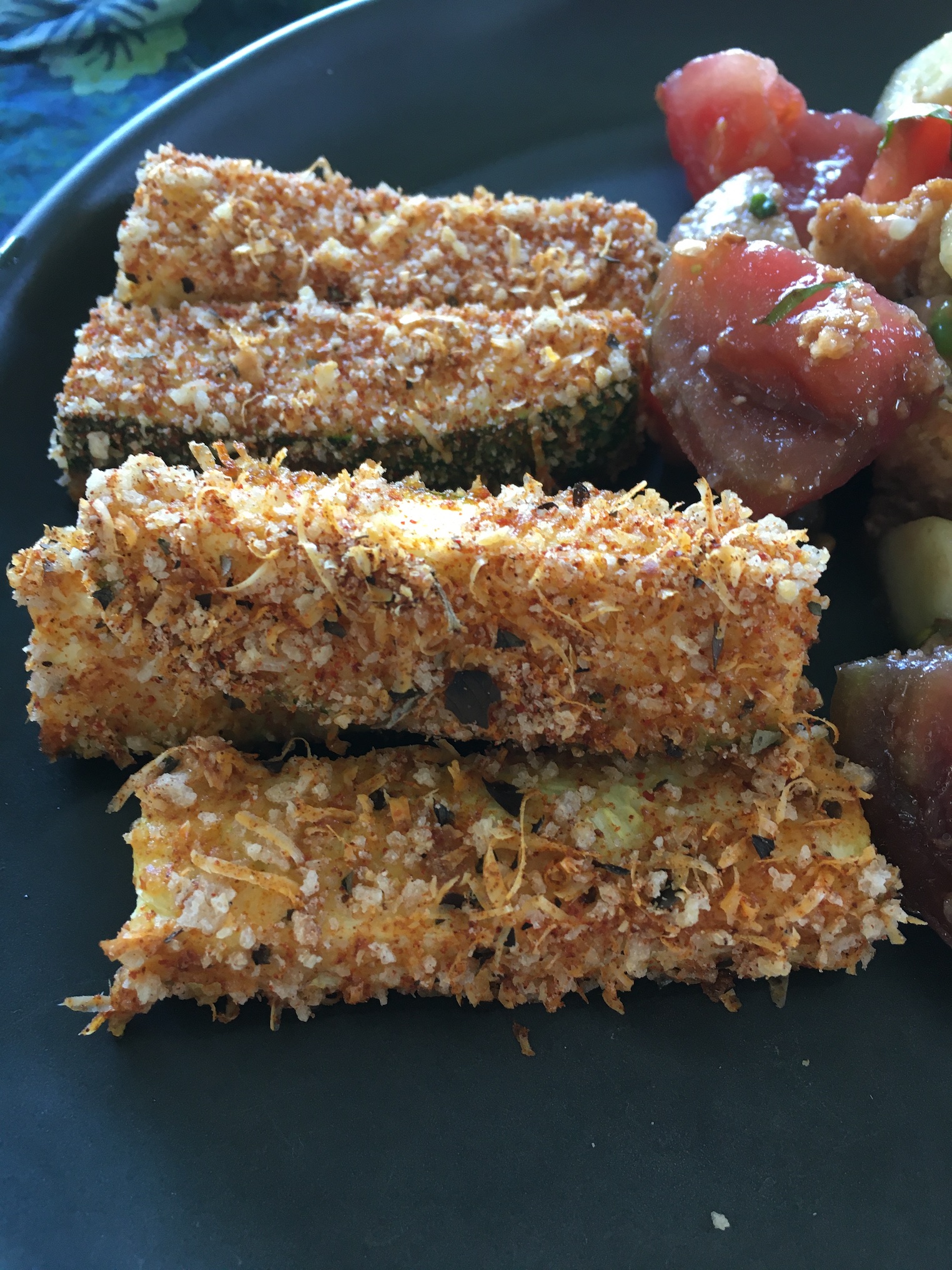
One of my favourite ways to eat zucchini is as breaded, oven fried sticks. These tasty ‘fries’ take a little work, but are well worth the effort. I fill a large jelly roll pan with them, and they vanish, even when it’s just my husband and me for dinner.
I don’t have a set recipe, but here’s an approximation of what I do:
2 small to medium sized zucchini 1 egg 1 cup bread crumbs 3/4 tsp salt 1/2 cup grated Parmesan cheese 2 tsp paprika 1/4 tsp chipotle 1/2 tsp smoked paprika 1 tsp dry oregano small handful of fresh parsley or basil, finely chopped
Cut the zucchini into thick sticks, about the length and thickness of a finger. Whisk the egg in a small bowl. Combine all other ingredients in a separate bowl. Generously oil a large baking sheet.
Dredge each zucchini stick in the egg, then the breadcrumb mixture and set on the pan.
Bake for about 20 minutes at 200℃, until browned and cooked through.
Serve hot, with your favourite dip, if desired. We love chipotle mayonnaise with them, but they really need no further embellishment—they’re delicious as is.
Those of you who have followed my blog for years will know that the first three months of the year are birthday months in my family. For years, I called it crazy cake season, because I would obsess over birthday cakes all month, and spend literally weeks designing and making crazy birthday cakes.
Like the octopus:
The geode:
The peripatus:
An alpine botanical scene:
And many others.
But now that the kids are adults, the crazy cake season is far less crazy. It still involves cake, of course, but the cakes are more subdued and geared toward adult tastes.
This year, my daughter said ‘surprise me’ when I asked about her cake preferences.
So, faced with a kitchen full of beautiful ripe peaches from our trees, I made her a three-tiered peach upside down cake using my favourite upside down cake recipe, from King Arthur Flour’s Whole Grain Baking book.
The cake recipe is meant for nectarines, but I’ve also made variations of it with pears, lemons, peaches, and plums, and it’s fabulous.
I recommend reducing the sugar in the batter, because it can be overly sweet, with the gooey fruity sugar that soaks in from the topping. I also adjust the spicing to suit the fruit and my own tastes. And I always use more fruit than the recipe suggests. 🙂
Here’s the original recipe:
Topping: 3 Tbs butter (43 g), melted 1/2 cup brown sugar 1/4 tsp nutmeg 1/4 tsp cinnamon 2 large nectarines 2 tsp lemon juice
Batter: 1 3/4 cups whole wheat flour 1 3/4 tsp baking powder 1/4 tsp salt 4 Tbs (57 g) butter, softened 3/4 cup brown sugar (I use 1/2 cup) 2 large eggs 1 tsp vanilla or almond extract 1/2 cup milk
To make the topping: Place the melted butter in an ungreased 8-in (20 cm) square baking pan, tilting to coat the bottom evenly. Mix together the brown sugar and spices, and sprinkle evenly over the butter. Slice the fruit (either peeled or unpeeled is fine) 1/4-inch (half a centimetre) thick and arrange the slices in the pan on top of the sugar and butter. Sprinkle with lemon juice. Set aside.
To make the batter: Whisk together the flour, baking powder and salt in a small bowl. Cream together the butter and sugar in a large bowl until light in colour and fluffy. Beat in the eggs, one at a time, and the vanilla. Stir in half the flour mixture, then the milk. Add the remaining flour mixture, stirring until the batter is evenly moistened. Gently pour the batter over the fruit in the pan.
Bake at 375℉ (190℃) for 45 minutes or until the cake begins to pull away from the sides of the pan and a cake tester inserted into the centre comes out clean. Allow to cool 5 minutes in the pan. Then invert the pan onto a serving platter and let sit for 1 minute before removing the pan. Serve warm, with whipped cream or ice cream, if desired.
We enjoyed our peach upside down cake with homemade peach ice cream, made by my husband.
There are certain pieces of kitchen equipment that don’t get used often—the milk frother, the crinkle cut knife, the herb scissors … Most of these items are really unnecessary, and some don’t work very well, so they’re only pulled out on rare occasions when you feel like faffing around with something.
Other equipment is absolutely essential, but serves a specific purpose.
The sauerkraut crock is one of those.
This heavy, straight-sided 3-gallon stoneware crock is the perfect vessel for fermenting cabbage. It holds a large amount of cabbage, and is easy to pack and empty. With straight sides, weighting the cabbage while it ferments is easy to do, and we’ve made a custom ‘chaser’ for this very purpose.
For six weeks of the year, the sauerkraut crock is full of bubbling cabbage.
For the remaining forty-six weeks, it sits in the corner of the living room—a dubious decoration in an otherwise unused corner. It’s pretty much useless for anything else in the kitchen—it’s heavy, bulky, and an inconvenient shape. The custom chaser, too, is of limited use—it gets tucked into the unreachable cabinets above the refrigerator.
By the time I pull the crock out again, it’s full of dust and dead insects.
You might think it’s not worth keeping around. And for many items I use maybe once a year, I’d agree.
The milk frother, crinkle cut knife and herb scissors … when they break, I won’t replace them. The sauerkraut crock, I will.
Because I can’t imagine not making sauerkraut, and the crock is the only tool that will do for the job.
It is the last day of January here, my favourite month in the garden.
This January has been more difficult than many, with cold wet weather rather than the usual dry summer warmth. But the garden has still been a January garden.
December is a month of weeding, because my vegetables aren’t yet large enough to compete against most weeds. The weeding effort spans the entire month, and I always aim to have a weed-free garden on Christmas Day.
All that effort pays off in January, when, as if by magic, the vegetables are suddenly huge, crowding out the weeds and basically looking after themselves. I pull the occasional weed that manages to pop its head above the vegetables, and I keep the paths relatively clear, just so I can move easily through the garden. I water as needed. Otherwise, there’s little to do to as far as maintenance goes.
In January, the gardening effort switches from establishment and maintenance to harvesting, reaping the benefits of my hard work. It’s not that we don’t eat from the garden all year long, but the stretch from January to March is a magical one, where production vastly outstrips our ability to eat. In January, the freezer and the cupboards begin filling up with fruit and vegetables preserved for winter enjoyment. The squirrel in me chitters smugly as I stash away the fruits of my labour, already savouring the meals, snacks, and desserts to come.
It’s as much work as the establishment and maintenance phase of the year, but the reward is immediate and tangible. By mid-March, I’ll be exhausted by the harvest, tired of making sauces, jams, and preserves. Tired of having to deal with overflowing baskets of vegetables every day. But here in January, the novelty hasn’t worn off. The excitement of each new crop coming on is palpable. The thrill of lining up jars of preserved food on the shelves banishes any fatigue.
So I say farewell to January with reluctance and look forward to several months more of deliciously exhausting harvest. And I’ll take you on a tour of my January garden. Enjoy!
Meet Katie Cochrane, budding restauranteur. She has no idea what she’s in for when her crazy Aunt Rachael gifts her the burnt out Rifton Pub for her birthday. Before long, it’s clear that renovations are the least of her worries. She always knew running a restaurant would be challenging, but she never expected it to involve witchcraft.
This cosy urban fantasy can be read as a standalone, but, Rifton being a small town, it includes many of the characters from book 1 of the series. I was excited to have a chance to spend more time with the quirky ladies of the Rifton garden group and Rifton’s demonic felines.
So pull out your gardening gloves and secateurs, and pop on down to the Rifton pub for some supernatural fun!
Preorder today, and be the first to read Demonic Summoning for the Modern Gardener!
Release date is 31 January, so you won’t have to wait long!
Our daughter wanted to go to the west coast for professional reasons (to photograph mosses for a project she’s doing), so my husband and I happily agreed to accompany her for a weekend getaway.
We left Friday evening, stopping at Lake Pearson (Moana Rua) for a lovely picnic dinner, and then carrying on over the mountains to camp at Goldsborough Campsite near Kumara. We pulled into the campsite around eight o’clock and set up camp. With the light already fading, we decided to wander up one of the tracks that followed old gold mining tracks through the bush.
Old mining water race tunnelling through the hillside
We started up German Gully Track, thinking we’d just go up a little ways, then return. The track passed an old mining water race that looked like a cathedral-shaped tunnel as it snaked steadily up the hill. Soon we were close enough to the end of the track that, of course, we had to finish.
We popped out onto a broad, modern gold mining road. The sign at the road indicated that we could either return to the track the way we came (30 minutes, according to the sign), or return via Goff’s Track (65 minutes). It was 8.55 pm. To take Goff’s Track would, theoretically, have us arriving back at the campsite at 10 pm. After ascertaining we all had our head torches with us, we powered up the road towards Goff’s Track.
German Gully track–an old mining road
The west coast was unusually dry, for which I was glad as we picked our way down Goff’s Track in the gloom—while most of the track was easy going, the steeper sections would have been slick and no fun in low light.
Knowing we were racing the light, we kept the pace up, and didn’t even need to use our torches, arriving back at the campsite around 9.30. A nice little evening hike!
The following day, we got an early start and hiked up Mount French, near Lake Brunner. None of the track descriptions have much to say, except that the hike is a steady climb of over 1000 vertical metres. Telling, however, are the listed track length and times: 7 km return, 8 hours return. That’s a walking speed of only 875 metres per hour.
View from the top of Mount French towards the Tasman Sea
We did slightly better, making the 3.5 kilometre trip to the summit in 3 hours forty-five minutes, for a walking speed of 933 metres per hour. Most of the hike up is through dense west coast rainforest, so other than the forest itself, there’s not much to see. When we hit the alpine vegetation near the top, the views opened up and it was spectacular. At first we were a little worried we’d struggle to find our way across the multiple false peaks to the actual summit, because clouds obscured the tops. In hindsight, I’m glad the cloud was there, because when it did clear and we finally got a view of the summit, I was disappointed at how far away it still was. LOL! Though the elevational change from the bottom to the top is officially a bit over 1000 metres, there are several significant dips along the ridge, so I suspect the actual amount of climbing you do to reach the summit is more like 1200 metres.
Looking back down the ridge from the summit of Mount French
But we made it, and by the time we were on the summit the clouds had cleared entirely. We had stunning views to the Tasman Sea on one side, and to the mountains on the other. Lake Brunner glittered in the sun far below us.
We had lunch on the peak and spent a good bit of time enjoying the view and exploring the plants and insects at the top before tackling the descent.
Lake Brunner seen from the summit of Mount French
Going down was faster than going up, and we reached the car shortly after 3 pm, hot and sweaty and ready for a swim. After a quick dip in Lake Brunner, and a change of clothes, we headed to Hokitika for dinner and a short stroll on the beach.
All of us were in bed and asleep early Saturday night.
Sunday, we packed up camp and headed to Lake Kaniere to hike the Lake Kaniere walkway. We’ve done part of this walk several times. It’s a mostly flat, well maintained track that follows the entire western edge of the lake. There are multiple stony beaches to stop at along the way, and amazing lowland rainforest vegetation.
A reflective early morning Lake Kaniere
On Sunday, it was also really hot (28 degrees by early afternoon). And even on the flat, we were sweating. My husband turned back about a third of the way into the hike, in order to drive the car to the end of the one-way track. My daughter and I continued on, stopping for a quick skinny dip at Lawyer’s Delight beach, before meeting my husband walking back towards us from the far end, about a kilometre from the end of the track.
Carové’s giant dragonfly at Dorothy Falls
We had lunch, a stop a Dorothy Falls, and another swim in Lake Kaniere, then headed home.
The entire weekend on the west coast was hot and sunny, so it was a bit of a shock to hit Porter’s Pass and drive into drizzle and 12 degrees. It was a chilly 15 at home under overcast skies. Poor Canterbury—this summer has been anything but summery here. It’s no wonder the west coast was absolutely packed with vacationing families.
And now I have one week left before returning to the day job. My summer to-do list is getting shorter, but I will definitely not accomplish everything on it. But it’s been a good summer for getting out and hiking, so I can’t complain. Now I just need to knuckle down and get some writing in while I can.
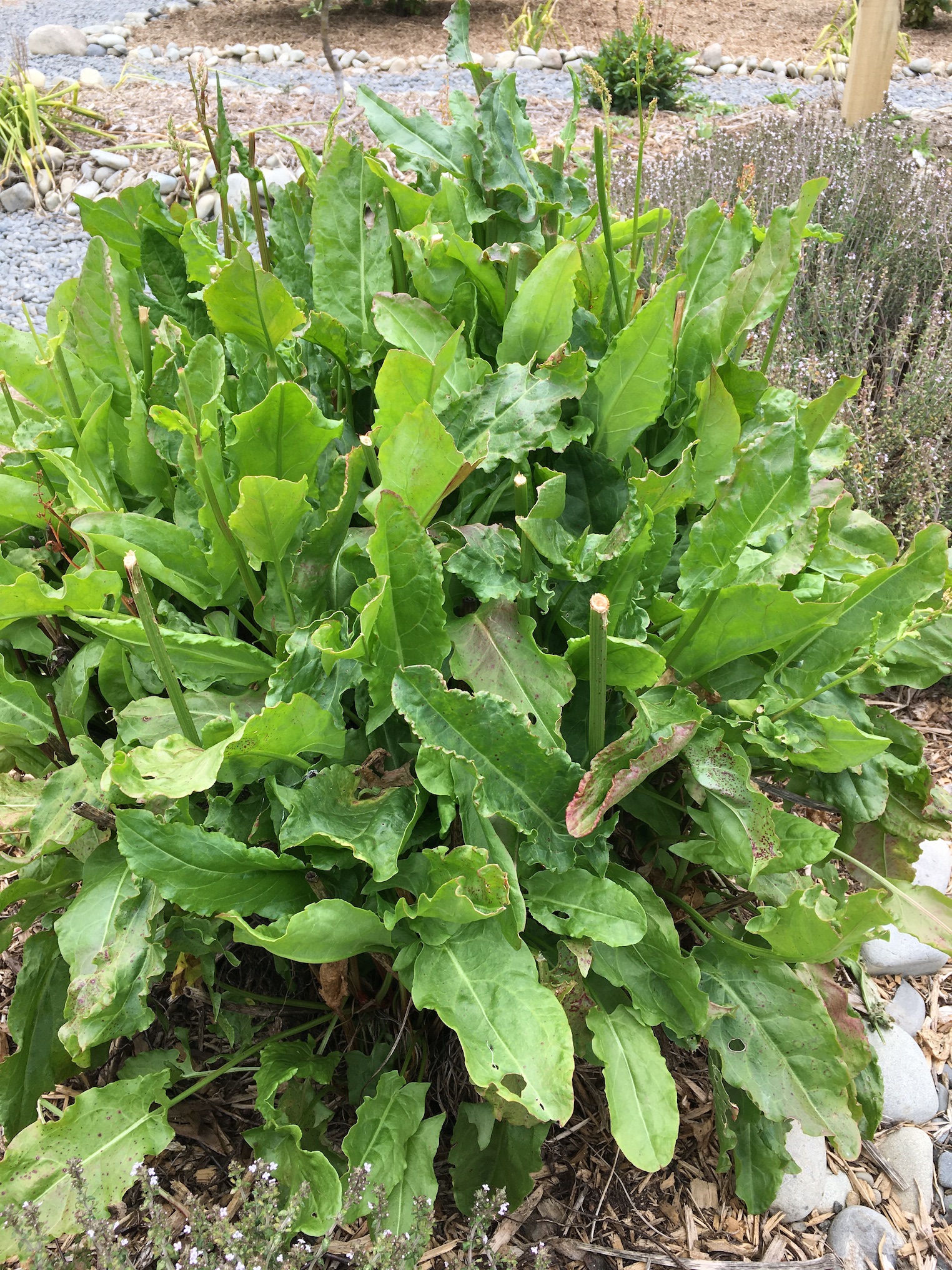
I love sorrel, with its succulent texture and bright sour flavour, but I don’t often think to use it. I occasionally use it to fill out early spring salads, when the lettuces aren’t quite big enough to make a full salad, and that’s generally about it.
But last night I wanted a salad to go with quiche. The spring lettuces are long since bolted, and the fall lettuces are still baby seedlings, so I turned to sorrel, this time to make the bulk of the salad.
I got inspiration from a few different sorrel salad recipes, but then simply used what I had on hand. The result was a spectacular salad—one I will definitely make again.
Here’s my ‘recipe’, for what it’s worth:
1 handful sorrel leaves, chopped into thin strips (maybe 2 cups, chopped) 1/4 cup walnut pieces, toasted in a 190C oven until aromatic and beginning to darken 6 small olives, chopped (I used my own olives, and they are quite small. If you’re using big commercial ones, you probably don’t need more than 2 or 3) 6 cherry tomatoes, cut in quarters (I would have used a lot more tomatoes, but this was all I had) 1 Tbs olive oil 1 Tbs balsamic vinegar 1 small clove of garlic, crushed dash of salt
Whisk together the oil, vinegar, crushed garlic and salt in a small bowl.
Place all the other ingredients in a bowl, and toss with the dressing. If you want a little less knock-your-socks-off fresh garlic flavour, strain the garlic out of the dressing first.




 Robinne Weiss