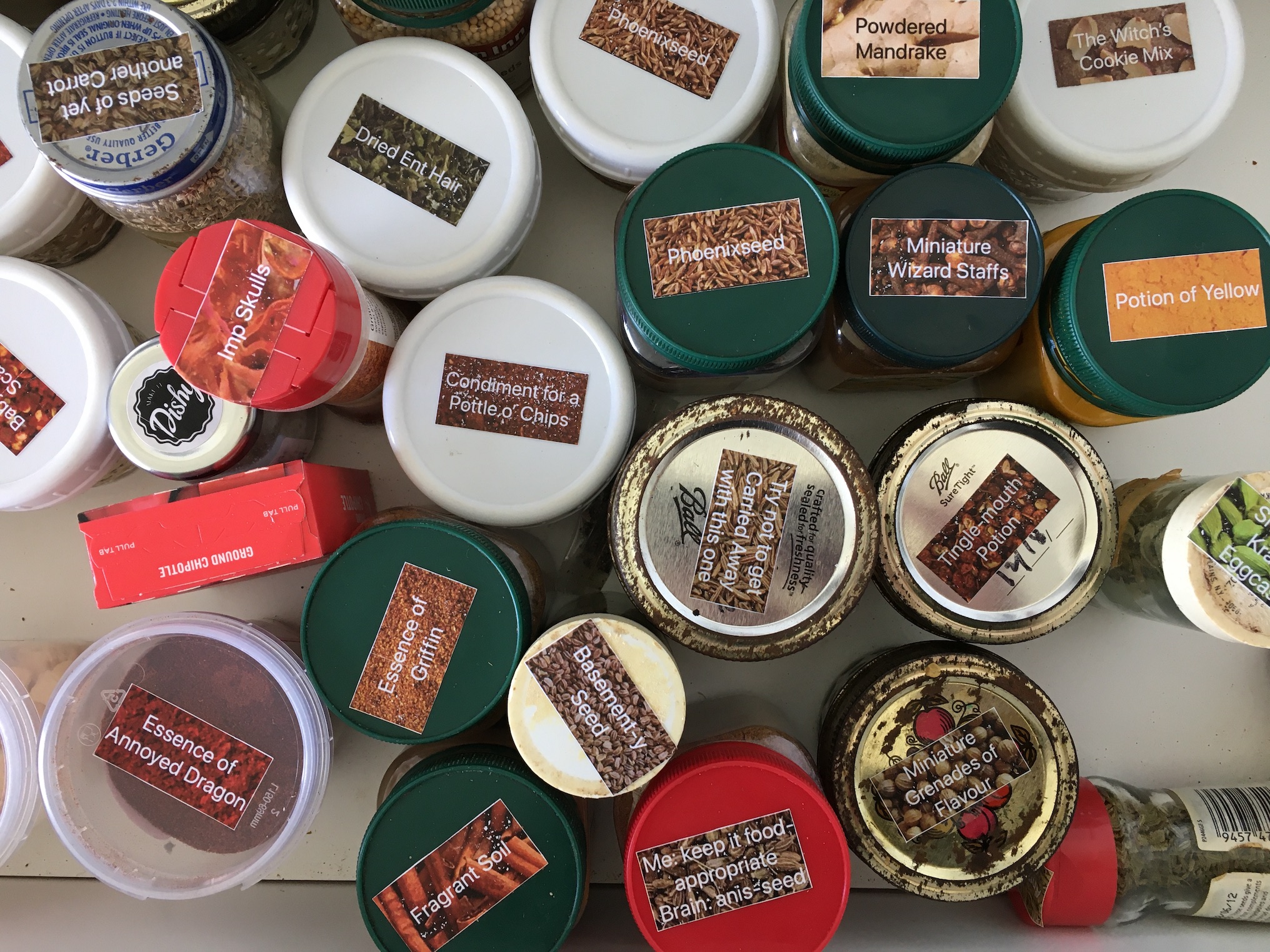
One of my Christmas gifts from my daughter this year was a set of creative spice jar labels. She spent an hour or so on Christmas Day affixing the labels to all our spice jars.
I love the creativity of the names: imp skulls, essence of griffin, condiment for a pottle o’ chips, miniature grenades of flavour …
Today I was looking for cinnamon and allspice. It took ages to find the ‘fragrant soil’, and ‘cannonballs of spice’. LOL!
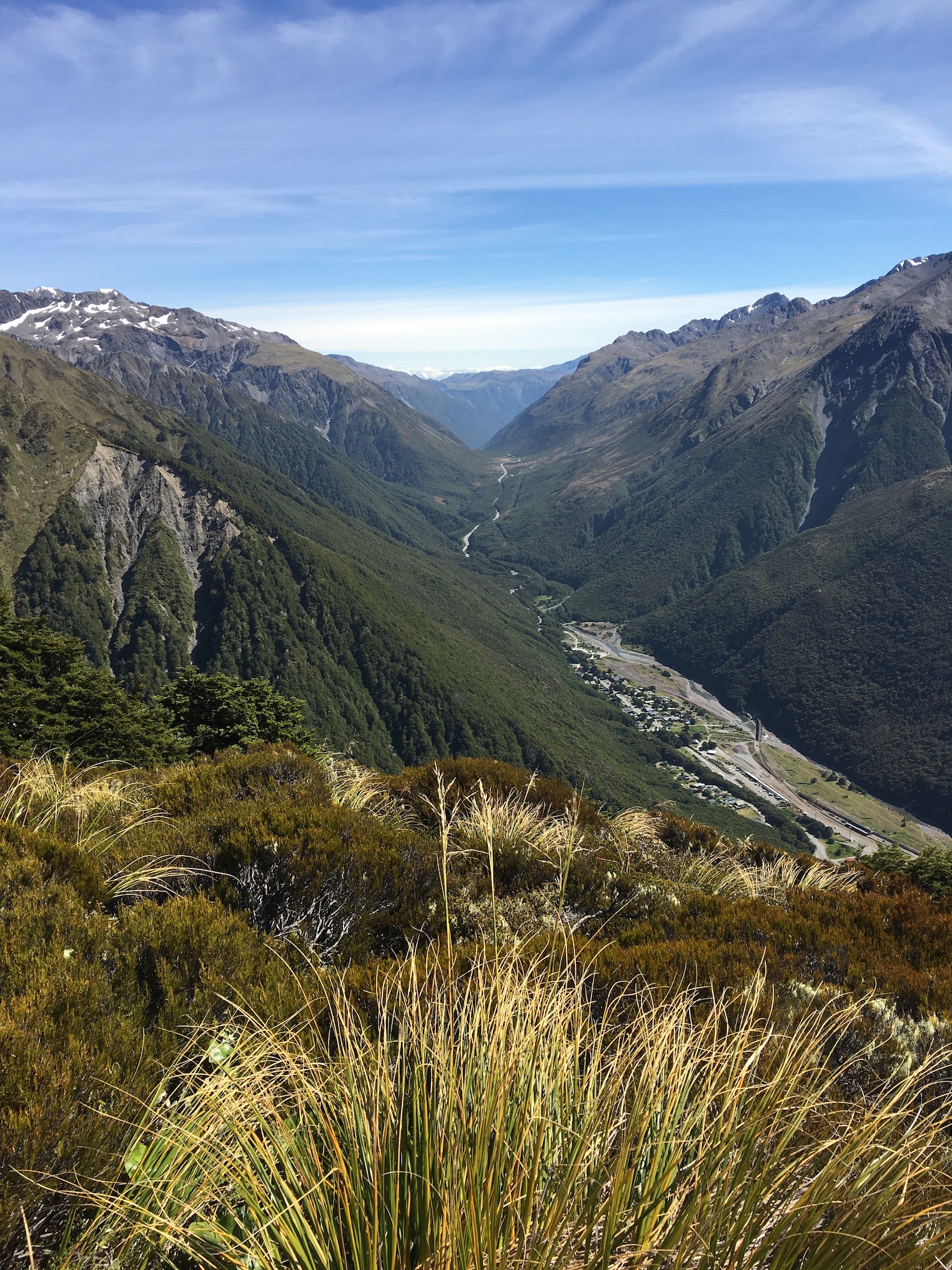
This year’s pre-Christmas tramp took us to the Lewis Pass area for four days of forests, mountains, and lots of water.
Day 1 was up the Nina Valley Track through beautiful beech forest. We bypassed Nina Hut, planning to camp below Devil’s Den Bivvy. Unfortunately, recent rain had rendered the area below Devil’s Den Biv into a swamp. There was no place to pitch a tent, so we carried on to the biv. Then we had to figure out how to bunk four people in a two-person hut. With three in the biv and one in a tent blocking access to the loo, we managed. It was … cosy.
Day 2, we left the biv in dense fog, hiking down to the Doubtful River on a track that has clearly seen no maintenance for a decade. At times it felt like bush bashing, and there was lots of windfall to clamber over, under and around.
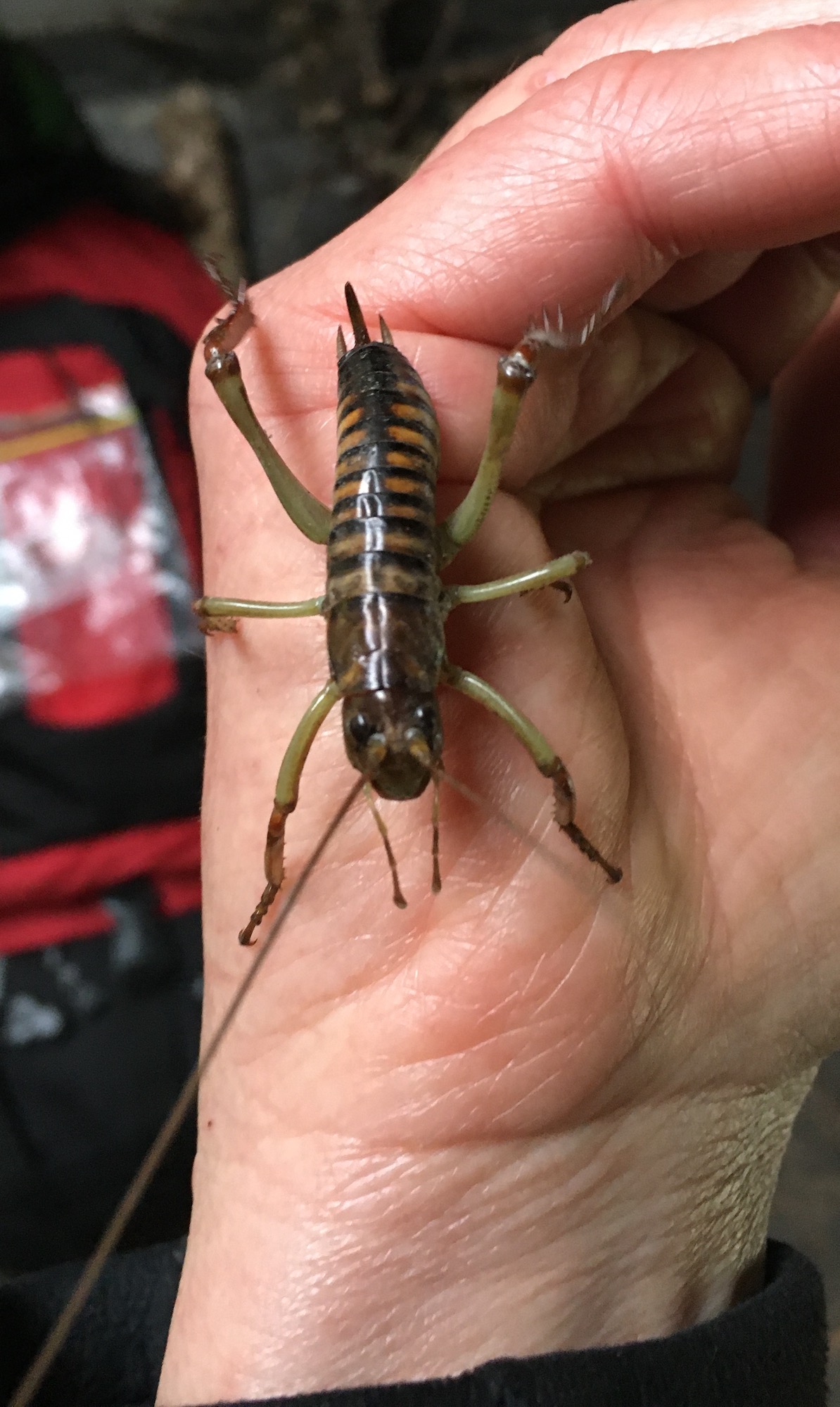
Once at the Doubtful River, a cruisy 40-minute hike took us up to the confluence with the Doubtless River, and shortly thereafter, to the Doubtless Hut, where we had a spacious six bunks to ourselves. Well, almost to ourselves. As we were packing up to leave, we found a beautiful young female Wellington tree wētā in the hut.
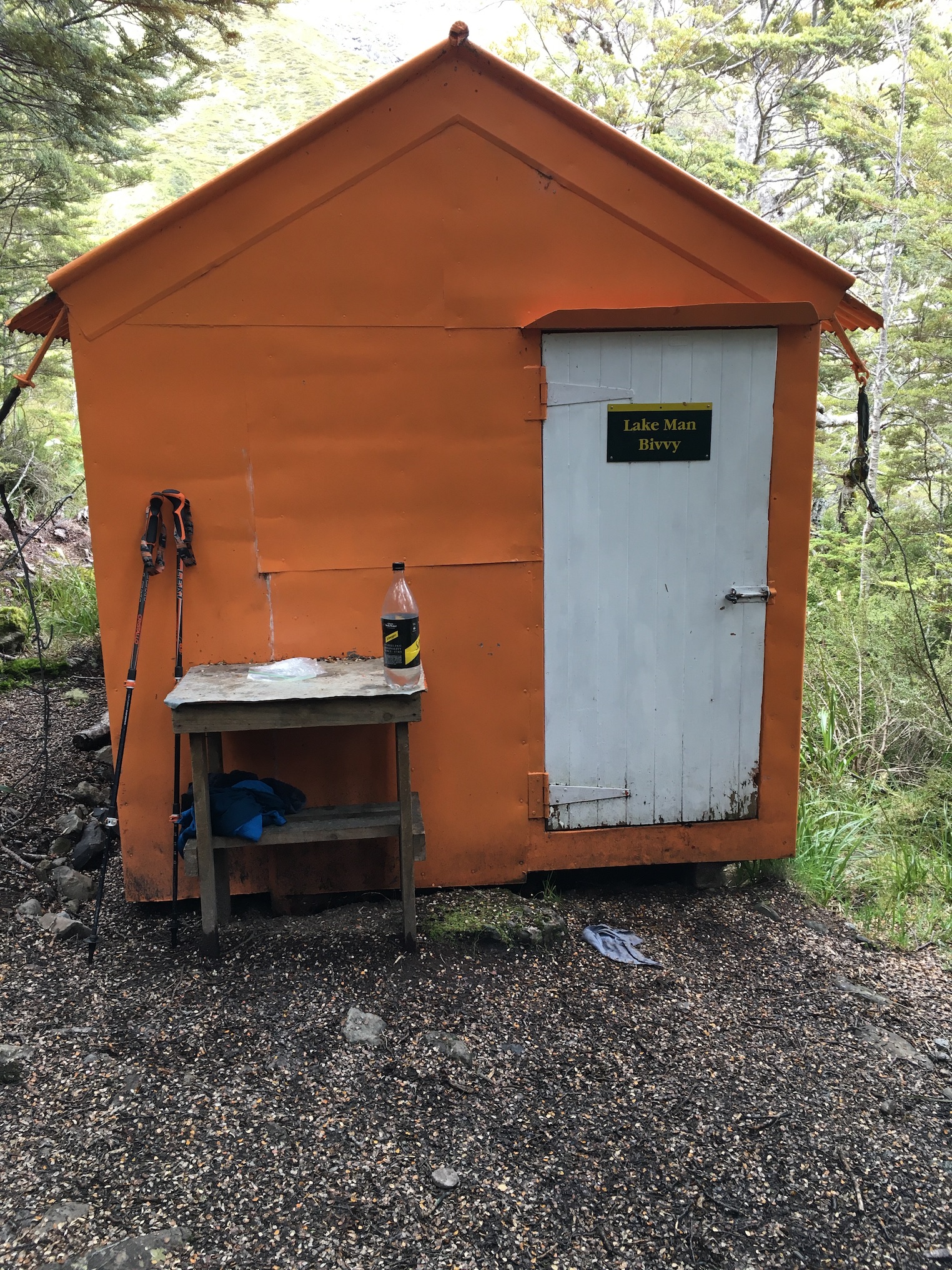
On day 3 we climbed up to Lake Man Biv—another 2-person hut, thankfully with a little more camping space nearby. Lake Man Biv is hobbit-sized. The door is about three-quarters height, and the bunks were so short, even 160-centimetre (5-foot, two-inch) me couldn’t stretch out on them. But in spite of its size, the biv is perfectly appointed, with a small table for cooking (complete with a drawer full of cooking and cleaning supplies) a set of tiny shelves, a fold-down bench, and an empty ammo box for additional seating and mouse-proof storage. Cords along the ceiling provide clothes drying space, and there are even clothes pegs fashioned from beech tree branches. The overall effect is a tidy, fully-functional space, in spite of its size.
After dropping our gear at Lake Man Biv, we hiked up to Lake Man, an alpine lake where we found our summer solstice snow and had a lovely lunch in the sun, surrounded by awesome alpine vegetation and some cool bugs.
After a cosy night in Lake Man Biv, we hiked out via the Doubtful River. The hike ended with a couple of crossings of the thigh-deep Boyle River and a long river-valley slog—easy hiking, but not terribly exciting.
The trip wasn’t our most strenuous ever, but after having spent the better part of the last six weeks sick, first with Covid, then with a nasty, lingering not-Covid, I was seriously out of shape and thankful for the relatively easy hike.
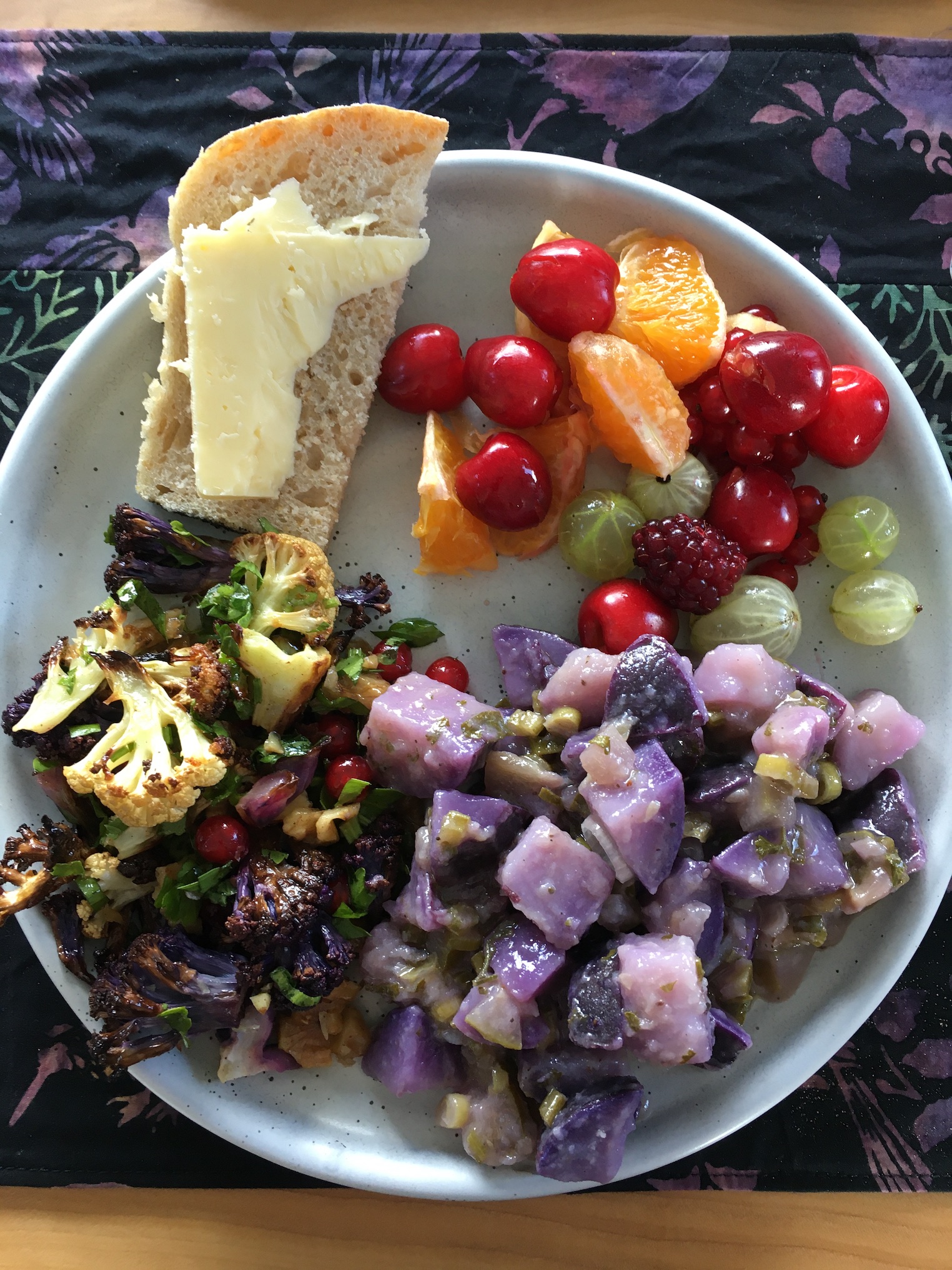
It’s been too long since my last post. I have illness to thank again. And simple early summer busyness. The strawberries, gooseberries, raspberries, black currants and red currants are all coming in now, and I’m wondering how on Earth I’m going to pick and process them all!
The big garden excitement here at the moment is the new greenhouse that my husband and I gave to each other for Christmas. Yes, we know it was a rather early Christmas gift, but by the time we get the thing set up and ready to go, it’ll be Christmas Day. I’m looking forward to having more garden space under cover for some tender perennial crops and better winter growing.
I’m off to pick berries now and consider what different jams I’m going to be making this weekend! I’ll leave you with a little bit of Christmas doggerel (because I can’t help myself–bad holiday poetry just spills out of my brain at this time of year).
Down here where kiwi birds roam Santa trades snowy rooftops for foam Of the incoming tide As the reindeer all ride A Sea-Doo till it’s time to go home.
Down here while the barbies heat up Santa sips pinos gris from a cup. With sand in his shorts He’ll play summertime sports Till the elves tell him it’s time to sup.
Down here where pavlova is king Santa enjoys his annual fling Wiggling tired bare feet In the summertime heat While we wait for the gifts that he’ll bring.
The base of the new greenhouse. Raised beds to lift plants above winter flooding and provide decent soil for growing. Hopefully we’ll get the top put together this weekend.
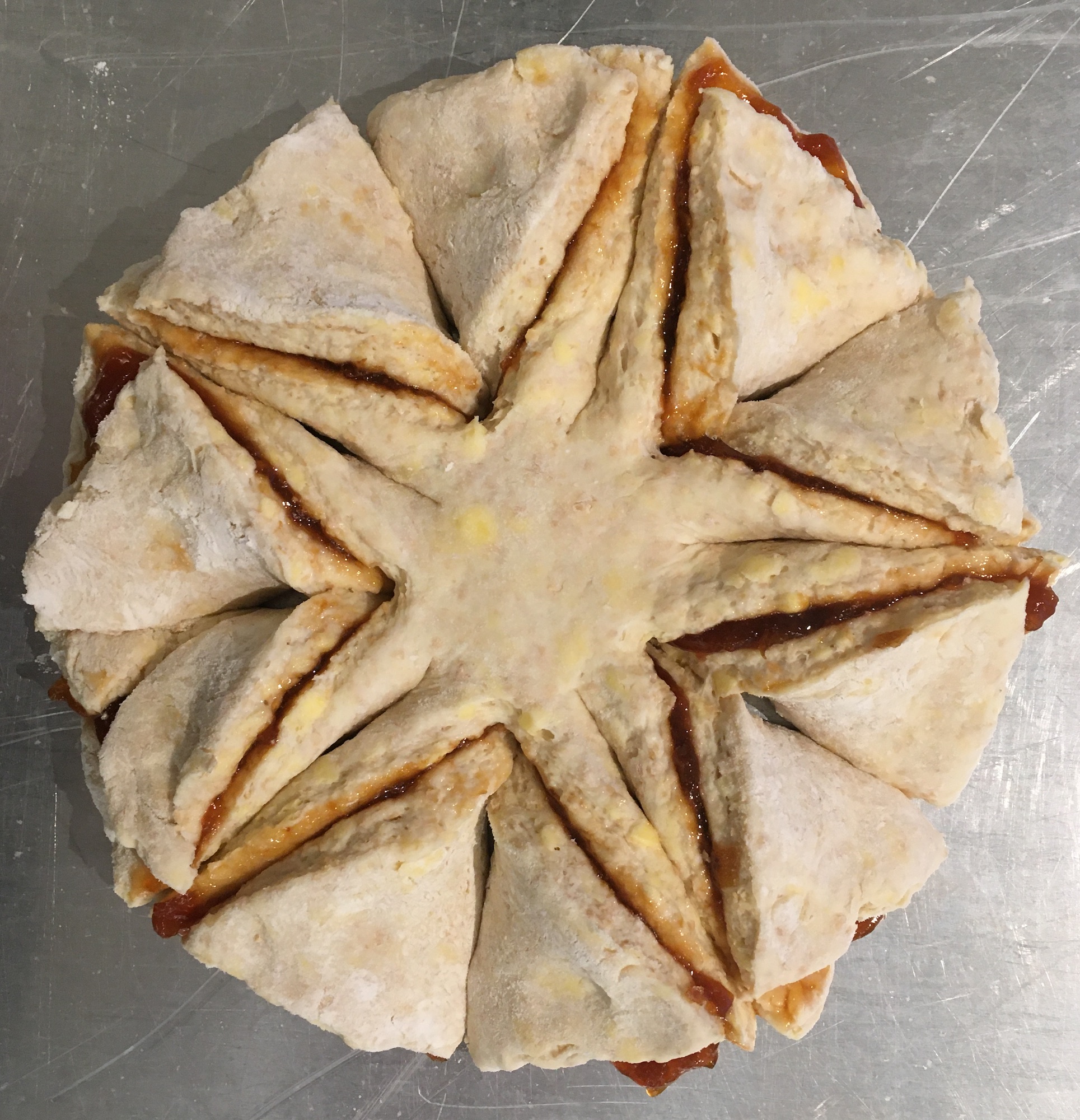
It’s been a long time since I blogged about biscuit stars (or Starry Scones, as I call them here in NZ, since ‘biscuits’ are cookies here). It’s been a while since I made them, too.
I was feeling whimsical on Sunday morning, though, and whipped one up for breakfast. As usual, it turned out beautifully and took minimal effort. It struck me as the perfect ‘fancy’ breakfast for the coming busy holiday season.
Try making one of these yourself—everyone will ooh and aah over your amazing culinary skills, and you never have to let on that it’s dead easy (I won’t tell …).
They say that necessity is the mother of invention, but I contend that actually it’s crisis that’s the real mother of invention.
Lately I feel like I’ve hit one crisis after another—getting Covid during the busiest season in the garden, having book sales completely tank in the lead-up to Christmas, having a critical component of a week-long science lesson be unavailable anywhere last week …
In the garden, I cut corners, laying compost on top of the soil rather than incorporating it as I usually do, in order to save time and limited physical energy. It’s something I hoped to be able to start doing, but figured I still had years of breaking up clay before it would work. Surprisingly, while the soil is a little harder than I’d like it to be for planting, it’s not terrible. If the plants do okay, I may have just changed my garden routine for good, saving me lots of work.
For my books, I’ve taken a step back from the ‘usual’ marketing techniques that have been costing me more than they’ve been bringing in. I’ve analysed what I’m good at, what I enjoy doing, and how I can incorporate those things into my marketing strategy, rather than banging my head against marketing strategies I’m no good at and hate doing. It will take a while to implement my new plan, and even longer to know if it works, but I’m having a great time working on marketing at the moment, rather than dreading every second of it as I usually do.
In the classroom, with less than 24 hours until my science lesson, I launched into preparations for plan B—activities I hadn’t run in 30 years. I felt completely unprepared, and kept realising things I’d forgotten to prepare or forgotten to do—each time I looked around at the resources to hand and got creative. The result was a set of fabulous lessons that didn’t look at all like I’d planned, but which worked well and were fun for everyone.
I really hope next week isn’t as full of crisis as the past several have been, but if they are, I’m pretty sure that as long as I keep moving forward, creativity will blossom and I’ll end up in better shape than before.
I actually set out to whip out something simple and quick—a Covid cake—because I had little energy for baking last week as I recovered from the virus.
So I chose a tried and true recipe. My favourite lemon cake is a recipe I came up with years ago when my daughter asked for a lemon birthday cake. It draws on components of a good lemon scone recipe, an orange cake recipe, and a coconut cake recipe.
It’s a recipe I’ve honed over the years, and one I could probably make in my sleep.
And this iteration of it was one of the best cakes I’ve ever made.
The butter was at the perfect temperature to whip up light and fluffy. And maybe I gave it a little extra time with the mixer, because I was bored of Covid isolation. And because I wasn’t up for much work, I added a little extra liquid to the batter to make the egg whites easier to fold in.
The recipe always makes a cake with good texture, but this one was a step up from the usual. Whether it was perfectly whipped butter or a wetter batter, something worked in my favour, and the finished cake’s texture was positively sublime—soft and fluffy, but with body like a good butter cake should have.
When it came time for a topping, I took the lazy way out. I topped and filled the cake with black currant puree I happened to have in the fridge. No measuring, and no additions to it—I simply spread it between the layers and poured it over the top. The puree spread out thickly, dripping down the sides and drying to a shiny, soft, fruity layer. Not only did it look great (and appropriately bloody-looking for Halloween), but the tart, unsugared black currant was the perfect foil for the sweet cake underneath.
It was a cake I could have served to anyone.
Unfortunately, because we were in isolation, only my husband and I got to enjoy this perfect cake, but I’ll definitely be trying to replicate it in the future.
It’s been a while since my last blog post. I wish I could say it’s because I’ve been so busy in the garden I haven’t had a chance to sit down.
Reality is I’ve finally been hit by Covid, so I haven’t been in the garden at all for days.
The weeds are growing, the pests multiplying, and time is ticking away in the spring planting season while I’m indoors sneezing, coughing and blowing my nose.
It’s not the end of the world, of course, but it is frustrating.
However, there have been positives of an enforced rest.
I’ve never enjoyed the flowers outside my windows more. Right now, the pansies are a riot of purples and yellows throughout the flowerbeds, the snow-in-summer is a frosty carpet of blooms, the geum is flowering with the richest red, columbines are opening their blooms, and best of all, the irises right outside my office window have started to bloom. These plants were rescued from the school I work at when their location was due to be paved over. I had no idea what colour they were, and it turns out they’re a gorgeous purple—my favourite iris colour.
I’m appreciating anew the security of having plenty of preserved fruit and vegetables from last year and spring vegetables in the garden. No matter that we’re not allowed to leave home for a week—everything we need is here.
I’m appreciating the care of other gardeners who have offered help and dropped off fresh lemons for us.
I’ve gotten some sewing done, which is unusual at this time of year, when I’m usually occupied by the garden.
I’ve read several books—always a bonus.
Now that I’m feeling a bit better, I’ve been able to get some writing done. I was disappointed Covid took me away from editing my next book, because I felt like I was on a roll. But a few days away from the computer gave me time to more deeply consider the changes I needed to make, and the edits I’m now making are going to lead to a better book. That’s a win!
Most importantly, I’m in isolation with my husband (who is also sick), and the extra time together is a gift.
So in spite of the fact there is a mountain of work awaiting me in the garden, getting Covid hasn’t been a complete disaster. Eventually I’ll be well enough to get back to the vegetables and the weeds, and they’ll still be there for me when I do.
Young carrots, fresh from the garden–nothing is better!
I used up the last of the fresh carrots yesterday—the last of the carrots that I planted a year ago at this time.
There are still about 2 kilograms of frozen carrots left that should last almost until the first of this season’s carrots are ready to pick.
I can’t tell you how pleased I am about that. It’s the first time ever I’ve grown (nearly) enough carrots for the year. Usually I end up buying commercial carrots by mid-June.
We eat a lot of carrots. I have raw carrots for lunch every day, and at least half our dinners have carrots in them. We also discovered the joy of Mexican pickled carrots this year, and probably ate five kilos of them in the past two months. So a year’s supply is a whole heap of carrots!
And if you wonder why I go to all the effort of attempting to grow a year’s supply of carrots, you have clearly never grown your own carrots. Home grown carrots put the tasteless, watery supermarket carrots to shame. Yes, they’re not as uniform in size and shape—I harvest some pretty ugly, twisted roots from my rocky garden—but their flavour (and colours) are far superior to commercially grown carrots.
I plant a wide variety of carrots. Last year I planted Paris Market, Scarlet Nantes, Touchon, Kuroda Improved, Tendersweet, and Purple Dragon. Touchon has been my workhorse carrot for years—flavourful, reliable and nicely shaped. When we moved to the rocky soil of the new property, I first tried Paris Market—a stubby round carrot I figured would be less bothered by the rocks. I wasn’t terribly excited about it at first—little carrots can be a pain to process in the kitchen, when you want a whole lot of carrot for dinner. What I didn’t know was that Paris Market carrot also has fantastic flavour for eating raw, and roasts beautifully as whole little carrot nuggets. It can also grow to a whopping size if you let it. And because of its shape, it’s easy to pick in my heavy clay soil. It’s beginning to nudge Touchon out of the top spot on my favourite carrots list.
Now that I’ve successfully grown enough carrots, my goal this year is to spread my carrot planting over a longer period, so I get just as many carrots off half the garden space, and so I don’t have 40 kilos of carrots in the fridge at any one time.
And there’s one of the many reasons I love gardening—there’s always something new to learn, new to try. There are always tweaks and improvements to be made. A gardener can always aspire to a more productive, less weedy, less labour-intensive garden for the coming season.
I’m pleased to announce the release of The Dragon Slayer’s Son Novel Study Unit today!
I’m even more pleased to report that the students who tested the Dragon Slayer’s Son Novel Study experience loved it.
So if you’re looking for a new novel for your novel studies, it’s a snap to pick up this novel study guide and run with it–the work’s already done for you!
The 57-page guide includes:
vocabulary lists
vocabulary activities
discussion questions
reading response activities
printable worksheets
digital worksheets
before- and after-the-book activities
Vocabulary and activities are organised into six sections. Activities are indexed with reading strategies, story elements, and difficulty level so you can pick and choose based on your students’ needs. You also get a digital version included which provides all student materials in fillable Google Slides.
So ditch the tired, dated novels you’ve been teaching, and pick up The Dragon Slayer’s Son. Set in modern day New Zealand, with dragons to spice up the adventure, there’s plenty to unpack. Themes include wildlife conservation, friendship, values, and leadership.
October is nearly upon us. For me here in Aotearoa New Zealand, that means springtime planting, flowers, and lots of weeding! But for many of my readers, it means colourful autumn leaves, pumpkins, and the spooky season of Halloween. And for writers of fantasy, like me, it means story inspiration too (even if my witches aren’t always who you might expect …).
When I was a child in the United States, Halloween was one of my favourite holidays. Yes, the candy was a draw (I’ve always had a weakness for candy corn), but what I liked most was the chance to make a costume and then walk around after dark wearing it.
Halloween imagery is all about darkness and things that go bump in the night. It’s meant to be scary, but I quite enjoy the night and all the creatures that inhabit it.
As an interpretive naturalist in America, I led a lot of night hikes. ‘Spooky’ owls and bats are old friends I’ve had the privilege to not only observe in the wild, but teach with in classrooms and nature centres in a variety of places.
Spooky enough for Halloween?
And those nocturnal animals can be helpful. When I lived in Panama, there was a sizeable gap between the top of the walls of my mud house and the roof. At night, little bats would swoop into the house through the gap, zipping around snapping up mosquitoes. I used to lie awake at night waiting for their arrival before falling asleep, knowing they were keeping guard against the little blood suckers that wanted to disturb my rest.
New Zealand is blessed with a fabulous array of nocturnal animals. If Halloween had originated here, the icons of the season might be a bit different …
Kiwi—Imagine this beach-ball-sized bundle of fluff with a deadly beak spearing hapless hikers in the dark. Maybe there would be vampire kiwi.
Kakapō—What could be scarier than a nearly invisible nocturnal parrot with a booming voice that echoes through the night?
Wētā—Okay, lots of people already find these giant crickets spooky. And some of them bite. They’d be a perfect candidate for Halloween horror.
Owls … maybe not—The morepork and the little owl might need to up their game to be Halloween mascots. Their cute factor is pretty high, and their calls are far from scary. I’d even go so far to say that the morepork’s call is soothing.
Bats—Unfortunately, New Zealand’s bats are all endangered, so you’re not likely to encounter them frequently. However, they have some interesting habits that would play out well on the spooky scale. Short-tailed bats don’t hunt from the air like many other bats. Instead they scramble around on the forest floor, using their wings as legs. What’s that rustle in the undergrowth?
Moa—Yes, these giant birds are extinct and were probably only partly nocturnal, but maybe their ghosts or skeletons could haunt a New Zealand Halloween. Their diet was mostly plants, but I still wouldn’t want to meet up with a 3.5-metre-tall bird in the dark.
Of course, a Southern Hemisphere Halloween would have to fall in April or May, during the autumn here. We could all dress up as kiwi or moa and eat pavlova …