Oh, what a taste!

Beer, anyone?

Beer, anyone?

You would think that, taste being such a fundamental part of human culture and survival, we would know all about it.

Not so!

When I was a child, we were taught that there were four tastes: sweet, salt, bitter, and sour. Later, scientists discovered the taste, umami—the taste of glutamates, inosinate and guanylate–found in many foods, including meat, vegetables and dairy products, and often added to Asian foods in the form of MSG.

Now, scientists have discovered a sixth taste—oleogustus, or fat. Like bitter, fat is a flavour that, by itself, is disgusting. It is only in mixing with other flavours that fat becomes palatable (think chocolate—by itself, it is almost inedibly bitter, but add sugar and it’s delicious).

This sixth taste makes sense to me. The best foods combine all the flavours, and I’ve always maintained that a little fat goes a long way to making food taste good. Vegetable soup made by simply boiling the vegetables is flat. But sauté the onions first, adding a little fat, and suddenly the soup tastes rich.

The best foods include all the tastes. Think about the worldwide popularity of tomato sauces. Tomatoes are themselves an incredible mixture of sweet, sour and umami. Add to them some sautéed onions for a little fat, a handful of bitter herbs like oregano and rosemary, and a little salt, and you’ve got a sauce that excites all the senses. Serve it with a grating of Parmesan cheese (with fat, salt, and umami), and it doesn’t get much better.

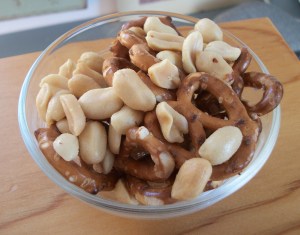
And, of course, it explains why a beer begs for peanuts and pretzels alongside it—the sour and bitter of the beer need the fat, salt, sweet and umami in the peanuts and pretzels to join them!
Dad’s Decadent Submarine Sandwich

subsandwichsmI will admit, I give little consideration to lunch. I’m usually quite ready to eat by midday, but am loathe to stop whatever it is I’m doing. During the week, I usually eat at my desk. On the weekend, of course, there are others to consider—the whole family sits down to lunch together. I still try to hurry things along; I’ll pull out bread and cheese, pickles, and carrot sticks, and call it lunch.

My husband is more relaxed about lunch, and often more willing to invest time in its preparation. One of his signature lunches is Dad’s Decadent Submarine Sandwich.

The ingredients of one of these sandwiches varies, depending upon what’s in the refrigerator at the time. Yesterday’s included cheese, sauerkraut, dill pickles, tofu luncheon, jalapeño rings, mustard, and black olives.

He generously piles all these ingredients into one of his wonderful baguettes and pops it under the broiler for a few minutes to melt the cheese.

Delicious!

Word Famous Pancake Recipe

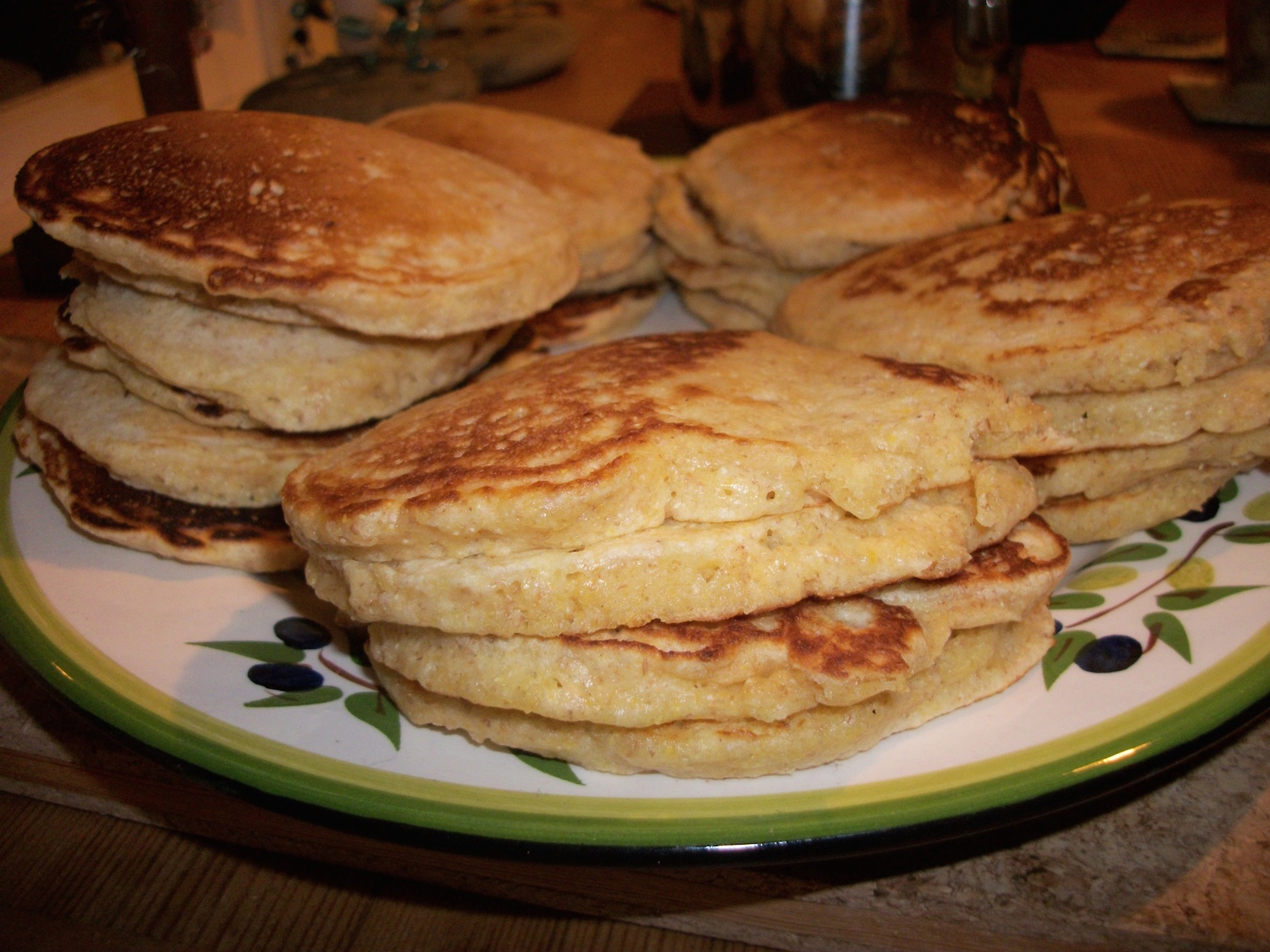
100_3505 copyFew of my recipes are made beyond my own kitchen, but one has gained a certain amount of recognition. Okay, maybe it’s not world famous, but thousands of people have eaten “my” pancakes over the past 17 years.

I used to work at Shaver’s Creek Environmental Center, and one year I was put in charge of pancake production for the annual Maple Harvest Festival. I figured we could save some money and have better tasting pancakes if we made them from scratch instead of from a boxed mix as they’d always done before.

I used my own recipe (multiplied 10 times for each batch!), and spent the day flipping pancakes for hundreds of visitors to the festival. Within an hour or two, I had scribbled the recipe on scraps of paper for several people. For the second day of the festival, I printed up a stack of recipes to hand out.

We certainly ate better tasting pancakes, but whether we saved money, I’m not sure—the pancakes were so good, the average visitor ate almost twice as many as they had in previous years!

That was around 1998, and my recipe has been used for Maple Harvest Festival ever since. The festival has grown, and now attracts more than 2,000 people annually. That’s a lot of pancakes!

Here’s the recipe. I double this for breakfast for four.

1/2 cup all-purpose flour

1/2 cup whole wheat flour

1/2 cup cornmeal

1 tsp salt

3 Tbsp sugar

1 ¾ tsp baking powder

2 eggs

3 Tbsp melted butter

1- 1 ¼ cups milk

Mix dry ingredients in a medium bowl. Whisk eggs, butter and milk together in a large bowl. Combine wet and dry ingredients with a few swift strokes. Bake on a hot griddle, lightly greased with butter, flipping to brown on both sides.

Rosemary

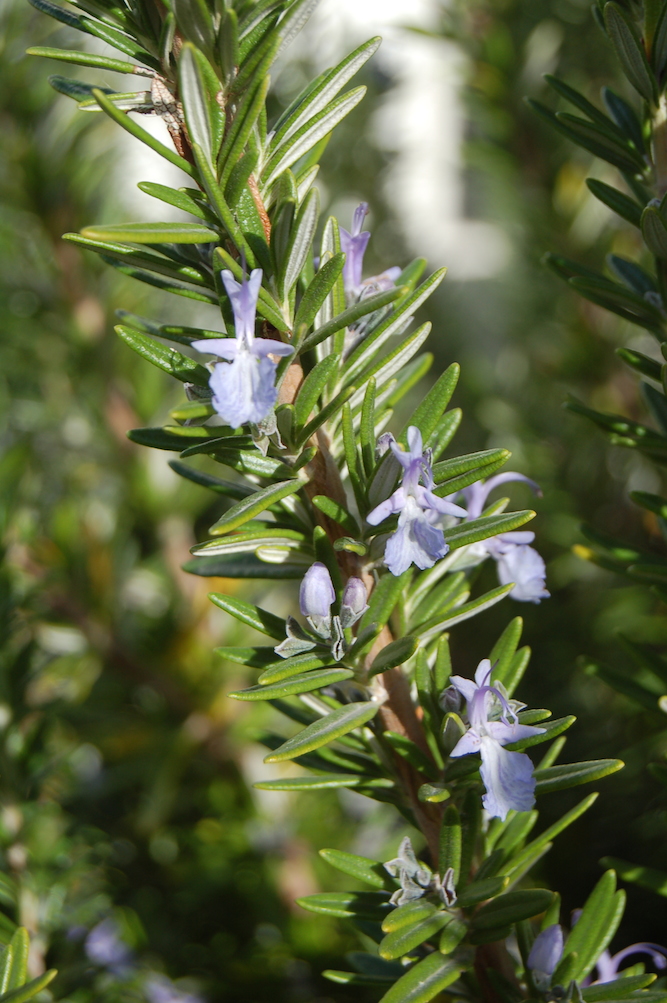
Rosemary1 smIn Minnesota, I grew rosemary in pots and brought it indoors for the winter, lest it be killed by the cold. Here in New Zealand, I grow my rosemary in the garden, and have to hack it back twice a year to keep it from growing taller than I am.

Rosemary is one of my favourite herbs, whether in dinner, in the garden, or in a flower arrangement. It is decorative as well as delicious.

Rosemary was named by Pliny in the first century. Ros (foam) mare (sea)—meaning that it grew so close to the sea that the foam sprayed on it. The Greek gods supposedly valued a rosemary wreath more highly than one made of gold (think how much I could make selling my biennial rosemary trimmings to Zeus!).

Rosemary was first used medicinally and culturally. It entered the kitchen in the Middle ages as a way to disguise the saltiness of salt-preserved meat. I’m told it goes well with lamb, pork, and game. As a vegetarian, I like rosemary with potatoes, pumpkin, and in Italian tomato sauces. And I love to brush the bushes with my hands as I walk past, so I can bring that lovely smell with me wherever I go!

Promise

DSC_0046 smThere comes a day every year. A day when winter loses its grip.

A day when the wind vane lazily turns around and the breeze no longer cuts sharply into our cheeks, but gently caresses our faces and tucks the hair behind our ears.

It is a day when the lanolin of four hundred Romney lambs next door warms and mixes with the smell of freshly turned earth and the exhalations of the grass.

It is a day when we throw open the windows, though it is only fourteen degrees outside.

daffodils2 smIt is a day when we don’t worry that the firewood is scarce, when we can imagine a day that doesn’t start and end with a fire in the grate.

It is not spring. That day will come, but not yet. There are still weeks of kindling to split, and ice to break off the water troughs.

But it is the promise of spring.

And it is enough.

Ants!

NewBugmobileclipsmFor nine years, I was owner/operator of The Bugmobile, taking live arthropods into classrooms all over Canterbury in a vehicle festooned with giant pictures of insects. I was known everywhere as The Bug Lady.

Last summer, when I closed my business, I didn’t expect to continue to think of my car as The Bugmobile. But fate, or rather a colony of ants, has interceded. My car is infested with ants.

I wouldn’t notice the ants if they weren’t so fond of Mentos…or if I weren’t so fond of Mentos.

I started keeping a roll of Mentos in the car when I was running The Bugmobile—if I had a sore throat, or needed a pick-me-up between programmes, a mint kept me going.

Apparently, they keep the ants going, too. I collected a few and identified them as the Black House Ant, Ochetellus glaber, an Australian ant that originally hitched a ride to New Zealand tucked in people’s belongings and in plant material. Ordinarily, these ants nest under stones and in tree cavities, but this particular nest is tucked neatly into a hollow in one of my mud flaps.

I should probably evict them…but they’re cute little creatures. Just 2mm long, and shiny black. I rather like them tootling around the car, cleaning up the crumbs the kids leave when they finish off their lunches on the way home from school. Maybe I’ll just find an ant-proof container for my mints.

Once The Bug Lady, always The Bug Lady…

Friends don’t let friends plant horseradish

You can pull it out, but it will never die.

You can pull it out, but it will never die.

When we first moved in, ten years ago, we had big plans for the landscaping around the property. The first priority, however, was the vegetable garden. Even before we moved in, we had the garden tilled.

So it was natural that, when we had the odd plant that was supposed to go in some perennial bed not yet existent, we tucked it into the vegetable garden until its ultimate home was ready.

In my foolishness, I did this with horseradish.

I have spent the last ten years regretting it.

The horseradish never did establish well where we wanted it, but it thrives in the vegetable garden. I have dug it out down to 30 cm. I have planted large, smothering crops over it. I weed it out as soon as it pokes its leaves above ground. And still, the patch expands every year.

I like horseradish, and we eat the larger roots I pull, but never again will I plant it where I don’t want it.

Lentils

100_3491 smEver since our stint in the Peace Corps, we’ve eaten lentils at least once a week, often several times. Lentils and rice was a staple meal in Panama, and it has since become a comfort food. And since lentils feature in many cuisines, they find their way to our table in many guises.

As a gardener, I found lentils intriguing. They show up in none of the seed catalogues, yet they can be grown in a wide range of conditions and locations. The two biggest lentil producing countries are Canada and India. If they grow in these disparate climates, surely I could grow them here!

With this in mind, a couple of years ago, I took a handful of lentils purchased at the grocery store and tested their germination—100%. Hooray! I was in business! I planted two types of lentils—brown and French green—at the same time I planted my beans. They sprouted well and grew vigorously. Their feathery leaves were a beautiful and intriguing addition to the garden. Patiently I watched them grow, flower, and set seed.

When the plants died back and the seed pods dried, I harvested whole plants, laden with pods.

Then I discovered why home gardeners don’t grow lentils.

Each pod contained only one or two seeds. If the plants were sufficiently dry, many of the seeds could be extracted from the pod by rubbing the plant between my hands. But even dry, a lot of seeds had to be picked individually out of the pod. And rubbing the dry plant left a lot of chaff mixed into the lentils. The chaff and the lentils were about the same weight, so blowing the chaff off also blew off many of the lentils.

After hours of painstaking work, I had enough lentils for, maybe, two meals. From the same garden space, and for a lot less work, I could have produced a year’s worth of dry beans.

I don’t regret growing lentils, and I’m pleased to know I can grow them. I’m also quite content to let someone else grow them (and harvest them mechanically) for me.

Strawberry Muffins

100_3478 smI froze strawberries for the first time last summer, and I’ve been trying to find ways to use them. The problem is that I think the frozen strawberries taste disgusting unless they are further processed after thawing. That’s not a problem with the sliced and sugared ones—throw them into a saucepan and simmer them down for a while, and they make an excellent strawberry syrup for pancakes. I can use up a lot of frozen strawberries on pancakes!

It’s the ones I froze whole that are causing me trouble. But yesterday I found a very nice way to use them—Strawberry yogurt muffins! This is a variation on Sour Cream Muffins in King Arthur Flour’s Whole Grain Baking.


2 cups whole wheat flour

½ cup all –purpose flour

1 ½ tsp baking powder

½ tsp baking soda

½ tsp salt

4 Tbsp (60 g) butter, softened

½ cup sugar

2 large eggs

1 tsp vanilla

1 cup plain yogurt

2 cups frozen strawberries

Mix flours, baking powder, baking soda and salt in a medium bowl. In a large bowl, cream the butter and sugar together until light and fluffy. Beat in the eggs, one at a time. Add the vanilla and yogurt. Add the dry ingredients and mix just until smooth. Slightly thaw, then roughly chop the strawberries. Fold them into the batter, and refrigerate at least an hour (for breakfast muffins, make the batter the night before, and refrigerate overnight). The strawberries will release juice, so you’ll need to give the batter another stir just before scooping it into a greased muffin tin.

Bake at 400°F (210°C) for about 25 minutes. Makes 12 – 15 muffins depending on how big you like them.

Wedding Bowls

100_3483 smTwenty-three years ago, when Ian and I got married, a whole lot of people gave us gifts. Most of those gifts were kitchen items. In addition to pots, pans, and knives, we acquired 23 bowls that day–ceramic mixing bowls, stainless steel mixing bowls, hand-blown glass serving bowls, artistic pottery bowls, wooden bowls… You name it, we got it.

We could have broken one a year for every year of our marriage so far. But most of those bowls are still with us, 23 years later. All are well-used, and remind us even now of the people who gave them to us all those years ago.

So, thanks everyone! Our wedding bowls ring daily!